
2026 Eichler Homes Market Analysis – Santa Clara & San Mateo Counties
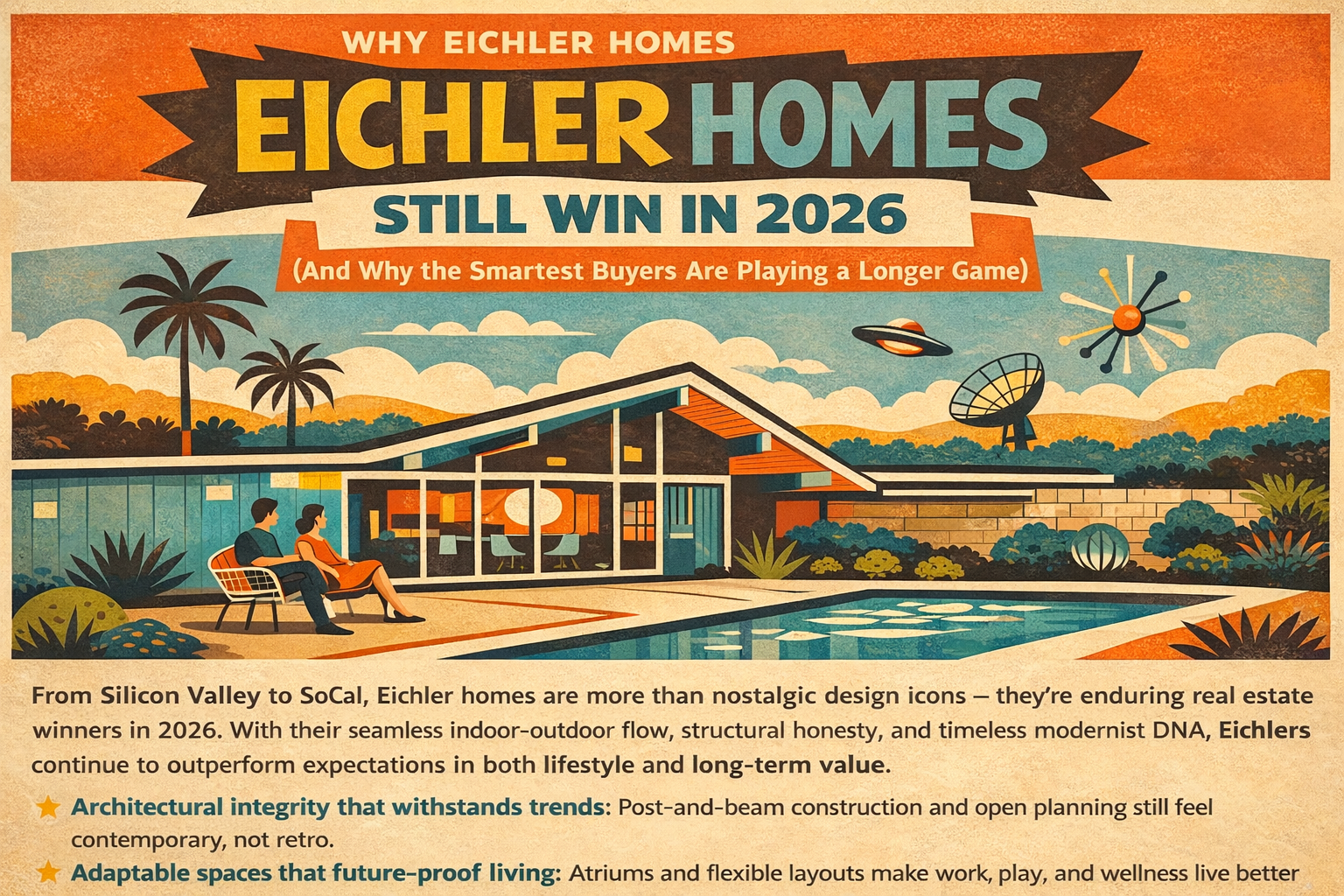
This report provides a comprehensive real estate market analysis of Eichler homes in Santa Clara and San Mateo Counties, with a focus on city-level trends, pricing, architectural factors, and buyer behavior as of early 2026. Eichler homes – the iconic mid-century modern houses built by Joseph Eichler – have become a niche asset class commanding unique premiums. Below, we break down key insights by city, compare Eichler pricing to conventional homes, examine how architectural subtypes affect value, review recent sales (with condition and days-on-market), discuss renovations that preserve or erode value, profile today’s Eichler buyers, and analyze inventory turnover and market resilience.
1. City-by-City Eichler Market Overview (Santa Clara & San Mateo Counties)
Palo Alto (Santa Clara County) – “The Valuation Apex.” Palo Alto remains the zenith of Eichler pricing in Silicon Valley, thanks to its prestigious location and schools (Palo Alto Unified) and an affluent, design-savvy buyer pool. Median Eichler sale prices here are the highest among typical Eichler markets (roughly in the low-to-mid $3 millions as of 2025). In 2025, the entry-level price for a livable Eichler in Palo Alto solidified above $3.1M, with even “fixers” no longer available under ~$2.5M. Turnkey Eichlers (often ~1,600–1,900 sq ft) in Midtown and Greenmeadow traded in the $3.2M–$3.7M range, and fully updated larger models reached into the high-$3 millions. Notably, historic Eichler tracts like Greenmeadow (94306) traditionally commanded a premium, but 2025 saw a convergence between 94306 and 94303 (Midtown) values – scarcity in prime tracts pushed buyers to pay top dollar even in “entry” neighborhoods. Palo Alto Eichlers often sold within days of listing, frequently at or above asking: e.g. a 1,667 sq ft Eichler on David Court closed at $3.60M (5 DOM, $2,160/ft²) in Nov 2025, essentially at list price – a sign that sellers’ pricing met the market’s lofty expectations. Another Eichler on Greer Road fetched $3.76M (August 2025) for ~1,905 sq ft, underlining Palo Alto’s role in setting valuation benchmarks for standard Eichler floor plans.
Los Altos (Santa Clara County) – “Estate-Tier Eichlers.” Los Altos Eichler homes occupy a special high-end niche. With larger lots (often 0.25–0.4 acres) in a city known for luxury home values, Eichlers here trade as estate properties rather than tract homes. In 2025, record-shattering sales redefined this market: for example, 721 Raymundo Ave (Miramonte area) sold for $5.50M (overbid by $600K) – an unprecedented price that exceeded neighboring valuations and signaled that buyers will preserve rather than tear down these architectural gems. Another turnkey Eichler at 663 Camellia Way closed at $4.92M (the highest $/ft² at ~$2,407) after a $425K bidding war, indicating liquidity-rich buyers in this $4M+ segment remained unfazed by interest rates. Even late in the year, demand held: a renovated Eichler on El Monte Ct sold in Dec 2025 for $4.40M (10% over asking), reinforcing a valuation floor around $4.4M for updated homes on standard ~9,000 sq ft lots. Summary: Los Altos Eichlers consistently achieved $4–5M+ in 2025, decoupled from other Eichler markets – they’re valued akin to Los Altos land value and compete with new builds, yet command a premium for mid-century style. Lot size and privacy are major drivers: the $5.5M Raymundo sale (on 0.39 ac) proved that when Eichler architecture is combined with estate-like land, buyers will pay top-of-market prices without intent to demolish.
Mountain View (Santa Clara County) – “The Hybrid Market.” Mountain View’s Eichler market bridges the ultra-high-end of Palo Alto/Los Altos and the more volume-driven Sunnyvale. Prices here firmly settled in the mid-$3M range in 2025, effectively pushing out entry-level buyers. The new normal for a standard 4BR Eichler was roughly $3.4M–$3.8M. For instance, 1249 Marilyn Ct (Cul-de-sac location) sold at $3.75M, and 1231 Eichler Ct for $3.41M, confirming this band. One standout was 969 Eichler Dr, an exceptionally large Eichler (2,595 sq ft) that fetched $3.535M. The market “rewarded” this rare super-sized model (~2× the typical Eichler size) with a premium price, as buyers preferred paying for original square footage over undertaking costly expansions. Mountain View Eichlers tend to be efficiently priced with fewer anomalies than other areas – by 2025, both small older Eichlers (e.g. in Monta Loma) and larger atrium models in tracts like Bell Meadows saw rising tides. The presence of some ~1,200 sq ft Eichlers (which still sell around $1.9M–$2.2M) keeps the median lower, but fully upgraded atrium models have topped $3M. Overall, Mountain View’s Eichler segment is highly liquid and balanced: appraisers and agents have ample comps to peg value, so outlier overbids are less common. In 2025, virtually every Eichler listing in MV commanded multiple offers in the first 1–2 weeks, given the squeeze of $3M+ pricing in nearby Sunnyvale and Cupertino (many buyers shifted their focus to Mountain View’s mix of strong schools and central location).
Sunnyvale (Santa Clara County) – “The Volume Engine.” Sunnyvale boasts some of the largest Eichler enclaves (Fairbrae, Rancho San Miguel, etc.), making it the highest volume Eichler market in the region. In 2025, demand was frenzied and inventory turned over at extreme velocity. Prime Sunnyvale Eichlers (94087 ZIP, southern Sunnyvale) established a floor around $2.6M for a livable 3–4BR, with many sales pushing into the $2.7M–$3.0M range – effectively catching up to Mountain View’s entry tier. For example, 836 Peach Ave (Fairbrae) sold for $2.67M in June 2025 and was flipped back on the market by November with a $2.88M list, aiming to gross ~8% appreciation in just five months. This rapid “micro-flip” attempt illustrates Sunnyvale’s surging values – the market absorbed the price increase, indicating 8%+ jump in mid-2025 in that tract. Meanwhile, in northern Sunnyvale (94089, north of 101), Eichlers remained the last affordable frontier: e.g. 1269 Manzano Way sold at $1.70M (Dec 2025) for a petite 1,108 sq ft home – about $900K less than a comparable south Sunnyvale Eichler. This ~$1.7M price (still ~$1,534/ft²) underscores that even “entry-level Eichlers” are costly, but 94089’s relative discount has spurred a drive-to-qualify effect: buyers priced out of 94087 are increasingly bidding up the north Sunnyvale homes. Days on market in Sunnyvale were the lowest anywhere – Eichlers often sold in under 10 days (median ~8 days), thanks to a deep pool of dual-income tech families (Apple, Google, LinkedIn, etc.) who see Sunnyvale as offering the best commute-to-suburb balance. In short, Sunnyvale’s Eichler market in 2025 was characterized by rapid turnover, strong overbids, and even speculative flips – a clear sign of hot market momentum.
Cupertino (Santa Clara County) – “The ‘Walk-to-Apple’ Premium.” Cupertino Eichlers (primarily in the Fairgrove and Fairmeadow tracts) benefit from top-ranked schools (Fremont Union HS District) and proximity to Apple’s campus. This location-driven demand translated into valuation parity with Palo Alto on a $/ft² basis for some sales. In 2025, $3M became the effective entry price for a turnkey Eichler in Cupertino. For instance, 10211 E Estates Dr (Fairgrove) was deliberately underpriced at ~$2.999M, igniting a bidding war that closed at $3.55M (18% over ask) – at $2,136/ft², rivaling Palo Alto prices. Even a small 1,392 sq ft Eichler on Lindsay Ave hit $3.066M (with $177K over list), proving that $3M is now the floor for Cupertino Eichlers in good condition. By late 2025, the trend persisted: a 1,595 sq ft Eichler on Pineville Ave sold in December for $3.25M (>$360K over asking) – reinforcing $2,000+/ft² as the norm. The only exceptions were homes with major location or condition issues: e.g. 939 S. Tantau Ave (on a busier street) which sold at $2.412M (significantly below others). That $1+ million gap from the peak ($3.55M) highlights how severely the market penalizes busy streets or fixer condition in Cupertino. Still, even this “cheap” sale was ~$1.68K/ft², reflecting lot value and upside potential. Overall, Cupertino Eichlers enjoyed an “Apple effect”: homes within walking distance of Apple Park consistently command premiums and proved resilient even if broader market factors cooled. Inventory remained scant, and virtually all Cupertino Eichlers sold immediately (often 1 week or less on market) if priced near comps. Buyers in this sub-market are extremely school- and location-conscious, hence willing to pay Palo Alto-like prices for smaller mid-century homes that let them live in Cupertino.
San Jose – Willow Glen (Santa Clara County) – “Value Pockets and Renovation Plays.” San Jose has a few Eichler tracts, notably in Willow Glen (Fairglen and adjacent streets) and a smaller tract in Cambrian Park. These represent the most accessible price point for Eichler ownership in Santa Clara County. In 2025, top-tier Willow Glen Eichlers broke into the mid-$2Ms: e.g. 1634 Andalusia Way sold for $2.55M in May, the highest seen in that neighborhood. At ~$1,540/ft², this sale showed that well-renovated Eichlers in SJ can rival Sunnyvale’s prices – indeed, buyers at this price chose Willow Glen’s Eichler community and charm over a Sunnyvale address. Meanwhile, original or rough-condition Eichlers still traded under $2M here: 2326 Fairglen Dr (needing extensive work) sold for $1.90M, which was ~$650K less than the Andalusia sale despite a similar size, illustrating a huge renovation discount in this market. Many San Jose Eichler buyers are value-seeking “Eichler enthusiasts” – they’ll take on a project to get an Eichler under $2M, given that’s virtually impossible elsewhere in Silicon Valley. The spread between ~$1.9M fixers and ~$2.5M turnkeys in Willow Glen offers a “profit corridor” for investors and owner-renovators. Notably, two sales on Fairorchard Ave in 2025 (one in April, one in Nov) both around $2.30–$2.325M showed remarkable price stability through the year – evidence that even as interest rates ticked up, demand at ~$2.3M remained steady with plenty of buyers waiting in the wings. Days on market in Willow Glen Eichler tracts averaged a bit longer than in Palo Alto (often around 2–3 weeks if a home needed work), but turnkey offerings still sold quickly with multiple offers. Overall, San Jose’s Eichler enclaves demonstrated resilience and “value-buy” appeal: they consistently attracted buyers priced out of $3M markets, helping these homes hold value even when broader SJ suburbs cooled slightly.
Menlo Park & Redwood City (San Mateo County) – “Small Eichler Clusters with Divergent Markets.” These two cities have smaller concentrations of Eichler homes, yet they highlight interesting extremes. Menlo Park has only about 50 Eichlers scattered in clusters (e.g. the Oakdell Park tract in west Menlo and a few in the Willows/Flood Park area). Despite low inventory, Menlo Park Eichlers span a wide price range. The Oakdell Park Eichlers, on large ~¼-acre lots in prime Menlo Park, are among the largest Eichler models (some ~2,800 sq ft) – these command top-tier prices. For example, an Oakdell Eichler on Evergreen St. (4 bed, ~2,200 sq ft) was listed around $3.7M in 2025, and similar properties often sell in the mid-$3M’s or higher (approaching ~$1,700/ft²). By contrast, Menlo’s few smaller Eichlers (early 1950s 3-bedroom models ~1,100 sq ft) trade closer to $1.3–$1.5M when available, primarily due to size and location (some are tucked in less central neighborhoods). Many Menlo Park buyers are not even aware of these hidden Eichlers, but those who are tend to be architectural aficionados eager to preserve them. The tiny sample size makes median price oscillate, but generally Menlo Park Eichlers sell for prices on par with the city’s overall high-end market, meaning $1,000–$1,500/ft² depending on condition.
In Redwood City, Eichler homes are found in four small 1950s tracts (Atherwood, Fairwood, Sequoia Meadow, and a row on Lyons St) within the 94061 and 94062 ZIP codes. These Eichlers are modest compared to Menlo’s: typically 3 bed/2 bath and 1,100–1,400 sq ft. In 2025, Redwood City Eichlers generally sold in the $1.7M–$2.1M range – a premium above the city’s ~$1.9M median for all homes, reflecting their architectural appeal. For example, several Eichlers in the Redwood Oaks area sold in mid/late 2025 around $1.8M–$2.05M for ~1,400–1,500 sq ft (often $1,300–$1,400/ft²) – notably higher $/ft² than nearby ranch-style homes, which average closer to $1,000/ft². Buyer demand in Redwood City is strong for these rarities: their open floor plans and glass walls stand out amid otherwise traditional housing stock, so they often attract multiple offers from mid-century modern fans. However, being smaller and older, some require substantial upgrades (original models had 3/1 layouts or lacked atriums). Turnkey remodeled Eichlers in Redwood City (with modernized systems) can push slightly above $2M, while original-condition ones tend to hover in the high-$1M’s. Despite Redwood City’s Eichler count being low, their “iconic design” and scarcity ensure premium pricing and relatively swift sales. In July 2025, for instance, active inventory in 94062 increased a bit, but Eichler pricing wasn’t diluted because buyer focus concentrated on the few architecturally significant listings.
Chart – Median Eichler Prices by City: Eichler home values vary by city, generally mirroring the broader Silicon Valley housing hierarchy (Palo Alto and Los Altos highest, San Jose lowest), but with notable premiums in each area. The chart below compares approximate median Eichler sale prices by city as of 2024 (before the 2025 surge). Palo Alto led around $3.0M, with Sunnyvale close behind (~$2.85M) reflecting tech demand. Cupertino medians were around $2.6M, Mountain View ~ $2.3M, and San Jose (Willow Glen/Cambrian) ~ $2.1M. Not shown, Los Altos Eichlers likely exceeded $4M median by 2025 (unique market). These medians all rose further through 2025, but they illustrate how Eichlers consistently command higher prices than local averages – e.g. Sunnyvale’s overall SFH median was only ~$1.7M in 2024, yet Eichlers were ~$2.8–2.9M.
Median Eichler sale price by city (2024 data, Santa Clara Co.). Palo Alto remains the priciest Eichler market (~$3M median), followed by Sunnyvale and Cupertino. Even in San Jose, Eichler medians topped $2M, outpacing ordinary tract homes.
2. Eichler vs. Conventional Homes – Pricing and Market Metrics
Eichler Premiums in $/Sq Ft and Sale-to-List: Across all these cities, Eichler homes fetch higher prices per square foot and often higher sale-to-list ratios than conventional post-war homes. For example, in Sunnyvale, the median Eichler sale (~$2.8–$2.9M) was well above the city’s ~$1.7M median for all homes. Eichlers’ combination of architectural cachet and typically smaller footprint means buyers pay more per square foot for them. It’s common to see Eichlers selling at $1,500–$2,300/ft² (depending on city and condition), whereas larger generic homes nearby might be $1,000–$1,200/ft². In Palo Alto, one Eichler achieved $2,267/ft² in April 2025 – a level few conventional ranchers reach. Even a “discount” Eichler in Sunnyvale’s north end got $1,534/ft², underscoring that mid-century design commands a premium.
Eichler listings also tend to sell faster and with stronger offer competition. In prime Eichler neighborhoods, 2025 saw median DOM in single digits (often ~8–12 days), versus regional averages of ~3–4 weeks for standard homes. For instance, in Fairbrae (Sunnyvale) and Greenmeadow (Palo Alto), Eichlers typically sold in 8–12 days, reflecting intense buyer urgency. Likewise, Eichler sale-to-list ratios averaged ~109–110% in recent years, notably above the Silicon Valley average (~102%). It’s not unusual for a well-priced Eichler to draw multiple bids and go 5–10% over asking, whereas many non-Eichler homes (especially higher-priced ones) might sell at or below list. One driver is that Eichler inventory is so limited; serious buyers often bid aggressively when a good one hits the market.
Comparative Example: In mid-2025 Palo Alto, Eichler homes not only outperformed the broader market – they almost seemed decoupled. Overall Palo Alto prices were climbing ~4%, but Eichlers often exceeded that. Meanwhile condos were down ~7.7% YoY in the region, but Eichlers (all SFH) benefited from the flight to quality. Another illustration: Sunnyvale’s Eichler median ($2.8–2.9M) was ~70% higher than the city’s overall median, showing how much extra today’s buyers will pay for Eichler design. Even in Redwood City, where Eichlers are modest, local agents note “Eichler properties tend to command higher prices than conventional homes of similar size” – a trend consistent across these counties.
DOM and List/Sale Resilience: The Eichler market’s velocity also means that in cooler periods, Eichlers still move relatively quickly. For example, in late 2025 when mortgage spikes caused some softening, Eichlers in Willow Glen held at ~2 weeks DOM while other SJ homes languished longer. Their niche appeal insulates them: active inventory ticked up in Sept 2025 for Santa Clara/San Mateo, but this “did not dilute pricing power for Eichlers”. Buyers simply concentrated on the few available Eichlers, keeping competition high and days-on-market low.
Finally, list-price strategy differs: Many Eichlers are deliberately underpriced to spark bidding wars, knowing demand outstrips supply. We saw Cupertino agents list an Eichler at $2.999M only to see it bid to $3.55M. In Palo Alto, one late-2025 seller listed exactly at market ($3.595M) and sold at $3.60M – essentially 100% of list. This suggests savvy Eichler sellers calibrate pricing finely, and buyers respond with near-full-price or over-asking offers in most cases.
3. Architectural Subtypes & Design Features – Impact on Value
Not all Eichlers are equal – architectural subtypes (atrium vs. non-atrium models, roof styles, carport vs. garage designs, etc.) significantly influence pricing and buyer demand. Eichler enthusiasts pay close attention to these details:
Atrium Models: An open-air atrium at the home’s center or entry is one of Eichler’s signature design innovations. Homes with preserved interior atriums are highly prized – they “bring the outside in,” flooding the interior with light and creating private outdoor space integrated into the floor plan. In Silicon Valley Eichler tracts, atrium Eichlers command higher prices than those without atriums. Early Eichlers (1950s) often lacked true atriums (just small patios), and those smaller models in Mountain View’s Monta Loma, for example, tend to sell for ~$1.9–$2.2M. But later Eichlers (late ’50s/’60s) introduced full atriums and larger layouts – e.g. Mountain View’s Bell Meadows tract of 1970s Eichlers (mostly 4BR with atriums) sees sales approaching $3M+, a substantial premium for the atrium feature. Similarly, in Sunnyvale, a 4BR atrium Eichler in Fairbrae listed at $2.90M in 2023 drew intense interest due to its indoor-outdoor design, and fully renovated atrium models have sold in the mid-$3M range. Market data confirms this: in 2025, listings highlighting “atrium model” were often among the highest sale-to-list outcomes, selling faster than homes where the atrium was enclosed or altered. Buyers today covet the atrium lifestyle – post-pandemic, private open-air space at home is seen as “priceless.” Thus, preserving or restoring an atrium can noticeably boost value, whereas an Eichler that’s had its atrium roofed over or filled in is usually less attractive (often selling for less unless other upgrades compensate).
Carport vs. Garage: Many Eichler homes, especially early models, were built with an open carport instead of an enclosed garage. To a conventional buyer, a carport might seem a flaw (“no garage?”), but in Eichler neighborhoods this is not a negative – in fact, purist buyers often prefer the original carport configuration. Joseph Eichler intentionally used carports as a modernist feature: the minimalist street façade of an Eichler – flat planes and a low roof – was meant to be uninterrupted by a big garage door. Carports create a sense of openness and neighborly interaction (you see your neighbor unloading groceries instead of a closed door) and were suitable for California’s mild climate. Many later Eichlers (mid-60s onward) did add enclosed garages as consumer tastes changed. But importantly, original carports are now seen as part of Eichler’s architectural integrity. The misconception that “an Eichler needs a garage to have value” is outdated. In fact, some Eichler remodels today remove improper garage enclosures to restore the open carport, because Eichler aficionados pay a premium for authenticity. In practice, most Eichler carports include a secure storage closet for belongings, mitigating storage concerns. The market impact: Having a carport does not hurt resale in Eichler tracts – buyers attracted to these homes accept or even celebrate the carport if original. What matters is that any conversion be done tastefully. An unsightly garage retrofit can actually detract from value, whereas an intact carport signals “mid-century cred.” Many will pay extra for a house that hasn’t been “remuddled” with a clunky garage, seeing it as a mark of architectural purity. Of course, some practical buyers still prefer a garage; solutions like adding a modern glass garage door or a period-appropriate screen are common compromises. But overall, in the Eichler micro-market, carports are not a deal-breaker – they’re a distinguishing feature that, when preserved, enhance the home’s mid-century character and can even boost appeal to the right segment.
Double-Gable / Double A-Frame Eichlers: In the mid-1960s, Eichler’s architects (notably Claude Oakland, and Jones & Emmons) introduced dramatic “Double A-frame” or twin-gable roof designs for some models. These homes have two steep gable roof sections, often with an atrium nestled between, creating an eye-catching façade with soaring, vaulted interiors. They are relatively rare (found only in a few late Eichler tracts in Sunnyvale, San Jose, Mountain View, and the San Mateo Highlands) and usually among the largest Eichlers (1,700–2,200+ sq ft). Market impact: Double-gable Eichlers almost always command the top prices in their neighborhoods, often +15–20% above the typical Eichler in the same tract. Enthusiast buyers recognize these as coveted collectibles, since only a handful were built. For example, Sunnyvale’s Primewood tract, known for high-gabled models, sees median prices in the $2.5M–$3M range – higher than most other Sunnyvale Eichlers – and Primewood listings sell extremely fast (often <10 days) due to their “twin-gable” architecture. In Mountain View’s Bell Meadows, the standout sales (up to ~$3.2M) have been double-gable atrium models by Oakland. In short, double A-frame Eichlers sit in the top pricing tier wherever they appear. Buyers are drawn to the dramatic vaulted ceilings, distinctive MCM curb appeal, and rarity – these homes satisfy both the desire for more space and for iconic design. If you see a sale that set a neighborhood record, chances are it was a double-gable Eichler.
Roof Design – Flat vs. Pitched: Eichler roofs come mainly in two flavors: the classic nearly-flat roof (with slight 1:12 pitch and broad eaves) and the later center-gable (pitched) roof that adds an A-frame element down the home’s middle. Many 1950s Eichlers are flat-roofed (with some variants like shallow shed roofs), while 1960s models increasingly featured gable roofs with open-beam vaulted ceilings in living areas. There is evidence that Eichlers with pitched/gabled roofs often fetch higher prices or sell faster, largely because they blend Eichler style with a bit more mainstream practicality. The gable provides a higher volume interior, which modern buyers love, and helps with rain drainage (alleviating some flat-roof concerns). Realtors note some house-hunters specifically seek out “center-gable” Eichlers for the dramatic vaults. High open-beam ceilings are highlighted in listings and tend to garner extra interest, with those homes sometimes selling above comparable flat-roof models (unless the flat-roof home has unique upgrades or an atrium). In essence, a gable-roof Eichler has a marketability edge, especially among buyers who might otherwise be on the fence about mid-century homes. Many of the highest-priced Eichlers in 2025 had some form of pitched or double-gable roof – for example, Los Altos Eichlers and top Palo Alto sales often involve models with at least a partial A-frame. That said, flat-roof Eichlers remain extremely popular with purists, and a well-maintained flat roof (ideally a modern foam roof) is not a deterrent to true Eichler lovers. But from a broad market view, offering the visual drama of a vaulted ceiling and the perceived practicality of a slope widens the buyer pool and often boosts the price. It’s telling that when Eichler Network surveyed buyers, many cited “exposed beams and high ceilings” as a key attraction – features tied to the gable designs.
In summary, architectural attributes that enhance the Eichler’s original vision – atriums, open carports (intact), double-gable roofs, vaulted ceilings – tend to add value and speed up sales. Buyers pay more for “classic” Eichler features and rarities. Conversely, modifications that deviate (enclosing atriums, awkward garage add-ons, low ceilings) usually make an Eichler less competitive. Keeping the home true to Eichler’s indoor-outdoor ethos and open design is financially rewarded by the market.
4. Recent Sales Comparison – Price, Condition & Days on Market
To illustrate how these factors come together in real transactions, the table below compares a selection of recent Eichler home sales (2025) across various cities. It lists the property, its condition/remodel status, approximate days on market (DOM), sale price, and price per square foot. These examples highlight how condition and architecture influence outcomes:
Address (City)Condition / UpdatesDOMFinal Price$/Sq Ft721 Raymundo Ave (Los Altos) – Large lot, original mid-century design preserved (no teardown)~7 days$5,500,000$2,361663 Camellia Way (Los Altos) – Turnkey luxury remodel; high-end finishes and atrium intact~7 days$4,920,000$2,4073428 Greer Rd (Palo Alto) – Full renovation (4BR); prime Midtown location, atrium model~9 days$3,760,000$1,9733141 David Court (Palo Alto) – Light updates (paint, flooring) but mostly original; quiet cul-de-sac5 days$3,600,000$2,16010211 E Estates Dr (Cupertino) – Modernized; move-in ready, strategically underpriced (bid up 18%)8 days$3,550,000$2,136939 S. Tantau Ave (Cupertino) – Fixer on busy street; original condition, needed rehab~14 days$2,412,000$1,684836 Peach Ave (Sunnyvale) – Minor cosmetic flip (bought and re-listed in months); clean original in Fairbrae~8 days$2,670,000$1,6511269 Manzano Way (Sunnyvale) – Original 3BR in 94089; smaller home in average condition north of 101~12 days$1,700,000$1,5341634 Andalusia Way (San Jose) – Top-notch renovation; highest-end Willow Glen Eichler (4BR)~6 days$2,550,000$1,5402326 Fairglen Dr (San Jose) – Original fixer in Fairglen tract; needed major work~20 days$1,900,000$1,136
Key takeaways from the above: Properties that were fully renovated or in turnkey condition (Camellia Way, E Estates Dr, Andalusia Way, etc.) attained the top per-square-foot prices and sold extremely quickly (often in around a week). For example, Camellia Way in Los Altos, boasting designer upgrades and an intact atrium, achieved over $2,400/ft² and sold with a hefty $425K overbid. In contrast, homes that needed work or had location compromises show a discount: Fairglen Dr in SJ at ~$1,136/ft² was markedly lower due to its fixer status – yet even that sold in just a few weeks despite high renovation costs, because finding any Eichler under $2M is rare. Cupertino’s Tantau Ave sale similarly illustrates how an otherwise desirable market will price in flaws: at ~$1.68K/ft² it was 25%+ cheaper per foot than other Cupertino sales because of busy-road noise and original condition. Still, it found a buyer after a short listing, indicating investors are ready to pounce on such gaps.
Also evident: Eichler buyers respond to authenticity and setting. Palo Alto’s David Court Eichler, while not heavily remodeled, sold at a strong $2,160/ft² largely due to its excellent lot (cul-de-sac, ~9,800 sf) and move-in readiness – the market rewarded the lot size and Eichler charm (vaulted ceilings, indoor-outdoor feel) even without a brand-new interior. Meanwhile, Palo Alto’s Greer Road sale at ~$3.76M set a high bar for Midtown partly because it was a fully upgraded 4-bedroom (and likely an atrium model) – the kind of turnkey family Eichler that draws bidding wars.
The DOM column underscores the velocity: Most of these sales took place in well under two weeks on market. In fact, 5–10 days was typical for Eichlers in desirable condition. The only one above two weeks, Fairglen Dr, was a true fixer – and even that sold in about 3 weeks, which in many markets would be quick, but is a tad longer by frenzied Eichler standards. This aligns with the earlier point that Eichlers in original condition may sit slightly longer as they await the right buyer or flipper, whereas polished mid-century gems are snapped up immediately.
Overall, recent sales confirm a tiered market: Renovated or rare-model Eichlers = top dollar and instant demand; average-condition Eichlers = strong prices but buyers are discerning; fixers = still sell quickly, but at a relative discount. Importantly, even the “discount” prices are high relative to non-Eichlers – showing that the floor for Eichler value is quite elevated due to their architectural allure and finite supply.
5. Renovations and Architectural Integrity: What Helps or Hurts Value
One striking dynamic in the Eichler market is that not all renovations add value. In fact, certain “upgrades” that would be assets in a conventional home can backfire and destroy equity in an Eichler if they undermine the home’s architectural integrity. Eichler buyers are often buying the aesthetic and lifestyle, not just square footage, so they place a premium on authentic mid-century features. Key observations on updates:
Beware “Remuddling”: Changes that clash with Eichler’s minimalist modern style are viewed negatively. For example, installing ornate crown moldings, traditional raised-panel cabinets, heavy granite countertops, or Tuscan-style light fixtures in an Eichler will turn off the target buyers. The market “punishes renovations that obscure Eichler’s philosophy”. Savvy mid-century buyers see these as liabilities – something that “will require costly remediation” to restore the proper look. In other words, spending $50K on fancy crown molding might lower your sale price, because buyers will pay less and then pay again to remove those elements. One Eichler specialist noted that generic luxury upgrades (e.g. a big Sub-Zero fridge plunked into original mahogany cabinets without regard to style) often do not return their cost – they can even “actively destroy equity” if they erase what made the home special. An extreme example is when owners stucco over the interior redwood or paint beam ceilings white – Eichler aficionados consider that akin to vandalism, and such homes typically sell for less, often to flippers who plan to undo those changes.
“Purist” Upgrades Add Value: Conversely, investments that restore or enhance the original Eichler design tend to yield the highest ROI. For instance, bringing back an open atrium (if previous owners enclosed it) or re-installing period-appropriate globe light fixtures can boost appeal. The Eichler Premium buyers pay is essentially for the “successful preservation or recreation of Joseph Eichler’s original vision.” In concrete terms, here are updates that preserve architectural integrity and are rewarded by the market:
Restoring mahogany walls or tongue-and-groove ceilings: Eichler interiors originally featured Philippine mahogany paneling and exposed beam ceilings. If these survive in good shape, don’t rip them out – they are coveted. If they’ve been drywalled or popcorn-ceilinged in the past, considering restoring the wood or at least creating a smooth, vaulted look will attract higher offers. Many Eichler buyers will pay a premium for intact mahogany paneling or unpainted beams because it’s increasingly rare and gives the home rich mid-century character.
Upgrading glazing while respecting original sightlines: Eichler Homes are famous for their floor-to-ceiling glass. Replacing single-pane glass with modern double-pane units without altering the slim profile of the frames is a big plus. Buyers love seeing original look but improved energy efficiency. Many Eichler owners invest in custom double-pane windows that replicate the thin aluminum frames – these homes sell for more, as they’ve solved a functional issue without spoiling aesthetics. Conversely, slapping in vinyl windows with thick frames can reduce value – it breaks the all-glass look. The highest-end Eichler remodels all feature upgraded windows that are energy-efficient yet true to the mid-century style.
Roofing improvements: The Eichler roof is critical both functionally and visually (those extended eaves!). Upgrading an old tar-and-gravel roof to a new foam roof (sprayed polyurethane) is considered a smart investment. Listings boasting “new foam roof” command premiums, because foam roofs greatly improve insulation and waterproofing while keeping a flat profile. Tar-and-gravel, by contrast, is often seen as a deferred maintenance issue – buyers might discount a home with an aging tar roof due to anticipated replacement costs. In 2025, many top Eichler sales mentioned their foam roof and buyers jumped on that. So, a very worthwhile update: it’s invisible from below, preserves the look, and eases one of Eichlers’ traditional weak points (leaks/insulation).
Mechanical systems that preserve design: Eichlers originally had radiant floor heating – a beloved feature when functional. Maintaining or upgrading the radiant heat (e.g. installing a modern boiler or even a new hydronic tubing system if the old one failed) can add value, as it keeps the home’s heating “invisible” and ceilings uncluttered. Many Eichler buyers actually prefer the gentle radiant heat (no ducts or noise). Conversely, homes where the radiant heat was abandoned and replaced with forced-air can see lower price per foot, especially if ductwork was run in an unsightly way (like dropping ceilings or visible soffits). Forced-air is practical, but Eichler purists hate seeing duct chases ruining the clean lines. Thus, maintaining radiant (or using low-profile solutions like high-velocity mini-ducts if needed) is better for value than a cheap furnace retrofit. Other system updates that help: new insulated roofs (above sheathing), adding discreet air conditioning (e.g. mini-splits placed thoughtfully), and electrical upgrades that allow modern appliances without ripping walls open – all good, as long as they don’t alter the look.
Floor Plan and Expansion: Eichler owners sometimes consider adding square footage or altering the layout for modern living (like creating a master suite). The market tends to favor additions that are seamless and respect Eichler architecture – e.g. an expansion that uses matching post-and-beam construction and maintains the indoor-outdoor flow. Such sensitive additions can pay off by addressing Eichlers’ one common drawback (limited storage/space) without sacrificing style. On the other hand, a poorly designed second-story addition or a generic family room tacked on can actually lower the value of an Eichler relative to a similar unaltered one. Eichler buyers often prefer an original 1,500 sq ft gem to a 2,200 sq ft house that has a discordant second floor. In fact, adding a second story to an Eichler is widely considered a huge negative (and many Eichler neighborhoods have CCRs against it). One Eichler Network commentary noted that a “ruined Eichler” with a bad second-story often sells cheap and ends up torn down, implying that such heavy-handed “improvements” can erase the home’s value as an Eichler. Thus, restoration over remodel is usually the value-maximizing path.
Overall, the guiding principle is that Eichler buyers pay for the experience and design authenticity. As one analysis put it: in Eichlers, “value is not a sum of expenses but a derivative of ‘experience’”. High-cost finishes that don’t align with the mid-century modern experience are dollars ill-spent. Meanwhile, funds put into preserving the open-plan, minimalist, indoor–outdoor experience often yield multiples in return. The most successful Eichler sellers in recent years embraced a strategy of “rigorous restraint” – updating what needed to be updated (roof, heat, glass, kitchen appliances) but keeping the Eichler soul intact. Homes that feel like a time capsule in perfect working order inspire bidding frenzies. Those that feel like a 1980s suburban remodel struggle. As a result, educating owners about what to renovate (and what not to) has become a big part of Eichler real estate expertise.
6. The Modern Eichler Buyer: Demographics and Behavior
Who is buying Eichler homes in 2026? The clientele for these properties has evolved and expanded in recent years. Broadly, Eichler buyers tend to be affluent, design-conscious and often tech-industry professionals, but within that are a few distinct groups:
Tech Wealth with Design Tastes: A significant portion are dual-income tech couples or individuals (often in their 30s to 50s) who have the financial means to afford high home prices but are bored by McMansions. They want a home with architectural character and appreciate the mid-century aesthetic – the clean lines, walls of glass, and connection to nature. These buyers often have cash or hefty down payments (2021–2025 saw a lot of new tech wealth, including AI-driven wealth, flowing into the housing market). Reports from 2025 noted the rise of a “design-conscious, cash-rich, turnkey-focused” buyer demographic in Silicon Valley. This perfectly describes many Eichler buyers: they have the cash to compete, they know what an Eichler is (some are even collectors of mid-century furniture, etc.), and they prefer a home that’s move-in ready with period-appropriate upgrades. These are the folks paying top dollar for places like Palo Alto and Los Altos Eichlers. They essentially treat Eichlers as blue-chip assets or collectibles – more akin to buying a piece of art than just a house. They’re often unfazed by interest rates (lots of cash offers, or large equity from stock IPOs), which helped drive the record prices we saw in 2025.
Eichler Enthusiast “Purists”: There is a subset of buyers who are true mid-century modern enthusiasts. They might be architects, designers, or just MCM fans. They often specifically target Eichler neighborhoods and may have been waiting for “the right Eichler” for years. These buyers are the ones who will restore mahogany walls, reverse bad remodels, and join the Eichler homeowner networks. They’ll buy in any city as long as the house itself is the Eichler they want (some might choose a Sunnyvale Eichler over a conventional Los Altos ranch even if budgets allowed the latter). They tend to be extremely knowledgeable – they’ll notice if a home has original globe lights, or whether the siding is Eichler original pattern, etc. For them, architectural integrity is paramount, and they will often pay a premium for a well-preserved home (or even for a fixer with great potential and intact bones). This group might not always be the highest bidders if up against ultra-wealthy buyers, but they are steady presence keeping the Eichler market strong. They also differ from average buyers in that they value condition of original features over just total remodel. For instance, they might prefer a house with original kitchen cabinets (in good shape) over one with a generic modern kitchen.
Family Buyers Seeking Lifestyle: Another category is young families (often tech-employed) drawn to Eichler neighborhoods for their sense of community and kid-friendly design. Many Eichler tracts, like Palo Alto’s Greenmeadow or San Jose’s Fairglen, have active neighborhood associations, annual modern home tours, swim clubs, etc., that foster a tight community. Eichler cul-de-sacs are known for being great for kids to play, and the open layouts suit family togetherness. These buyers overlap with the tech demographic but specifically they often mention lifestyle: “we love the indoor-outdoor flow where we can watch the kids in the atrium”, or the floor-to-ceiling glass lets us feel connected even when in different rooms. They are often willing to compromise on some practical aspects (like smaller bedrooms or lack of basement) because they love the ambiance and community. Many are also attracted to the diversity and creativity of Eichler neighborhoods compared to cookie-cutter subdivisions. They do differ from average Silicon Valley family-home buyers (who might focus purely on school ratings and square footage) – Eichler family buyers are looking for a certain X-factor and are often okay with the trade-offs (they’ll live with radiant heat, or limited attic storage) in exchange for living in a “cool” house.
Move-Down or Local MCM Aficionados: Interestingly, some Eichler buyers are downsizers or move-within locals. For instance, someone who’s lived in a large traditional home may decide they want an Eichler as their retirement home for the style. Or local residents who grew up in the area might finally get a chance to buy an Eichler after admiring them for years. These buyers sometimes appear in higher-end markets like Palo Alto or Los Altos – perhaps an empty-nester selling a 3,500 sq ft house and happily paying $4M for a 2,000 sq ft Eichler because it fits their design taste and one-story living preference. They often come with significant equity (cash buyers in some cases) and further bolster demand. Realtors have noted Eichler open houses often draw architecture buffs of all ages – it’s not only young people; older professionals and retirees are in the mix too, especially for the pricier Eichlers that only an established homeowner can afford.
How they differ from average SV buyers: Eichler buyers, across the board, tend to be more emotion-driven and less price-sensitive for the right home. In Silicon Valley generally, many buyers pick a neighborhood for commute or schools and consider the house second; with Eichlers, the house itself is often the star. This leads to phenomena like geographic arbitrage – buyers who really want an Eichler will adjust which city they buy in based on where they can afford one. For example, as Palo Alto and Mountain View Eichlers soared above $3–3.5M, some buyers re-targeted Willow Glen (San Jose) or Sunnyvale’s 94089 as more affordable ways to get an Eichler. These are people who could buy a standard home in a more expensive city, but choose a different location to get the Eichler architecture. That’s a very different calculus than the typical Silicon Valley buyer who prioritizes location above all. Eichler buyers often say “we were open to several Eichler neighborhoods from Menlo Park to San Jose; finding the right house was key.” They also tend to be very hands-on during purchase – they’ll do specialized inspections (for radiant heat, etc.), and often involve architects or contractors who understand Eichlers to advise them.
Another trend: Eichler buyers show a strong preference for turnkey vs. project, except for the dedicated fixer-uppers. Many of the tech-professional buyers work long hours and prefer paying more for a home where someone else already updated the boiler, roof, etc., rather than taking on a 12-month renovation. This “turnkey or bust” mentality was amplified by the pandemic and booming tech incomes. It’s one reason renovated Eichlers saw outsize price jumps – there’s a queue of cash-rich buyers waiting for a tastefully updated Eichler and willing to outbid each other for it. Those who are open to a project usually are either Eichler purists (who want to do it their way) or investors. Regular buyers shy away from heavy fixer Eichlers because remodeling an Eichler requires specialized knowledge (and can be costly – e.g. sourcing mahogany panels or working with uninsulated slab plumbing). So, we saw in 2025 that while some buyers will absolutely snap up a fixer (at the right price), the majority pounce on move-in ready offerings. This contrasts with the general market where any turnkey home sells fast; in Eichlers it’s even more pronounced because of the cult following for properly restored homes.
Finally, Eichler buyers often end up being long-term holders. Many have “fallen in love” with their home and neighborhood, meaning turnover in Eichler tracts is relatively low. Some buyers explicitly say this is their “forever home” unless forced to relocate. This mindset further reduces supply (which helps prices) but also means new entrants have to be patient or aggressive to get in.
7. Inventory, Turnover, and Market Resilience
A critical aspect of the Eichler market is its chronic low inventory and turnover. Eichler homes are finite in number (about 11,000 built in CA, and only a fraction in these two counties) and many remain in the hands of long-time owners. This has several implications:
Prop 13 Lock-In: California’s property tax law (Prop 13) keeps taxes very low for long-term owners, which disincentivizes older Eichler owners from selling. For example, a family that bought their Palo Alto Eichler in 1975 might be paying taxes on a $100K assessed value, while the home is now worth $3.5M. If they sell and move, their property tax could jump 10x on a new purchase. The result: many original or long-term Eichler owners simply stay put, creating a structural inventory shortage. The Eichler segment has a lot of “frozen” equity; homes only come up when an owner passes away or finally decides to cash out after decades. Data shows this lock-in effect clearly – one Cupertino Eichler that sold in 2025 had last sold in 1988 for $320K, and the owners were paying very little in tax until the $3.066M sale reset it. This pattern means fewer Eichlers are listed each year relative to the total stock, compared to turnover rates in generic housing. In a typical Eichler tract, it’s not uncommon for only 2–3 homes to sell per year out of hundreds in the tract.
Velocity and Absorption: When Eichlers do hit the market, they tend to get snapped up quickly – as we’ve covered, DOM is often under 2 weeks. Even in cooler market conditions or off-season times, Eichler listings attract enough interest to avoid stagnation. For instance, late Q4 2025 closings remained strong (houses sold in Nov/Dec at high prices in Los Altos, Cupertino, and Willow Glen), signaling that demand persisted through the holidays when generally markets slow. In Willow Glen, the fact that April and November sales on the same street were virtually identical in price (~$2.3M) defied the usual seasonal cooling narrative – Eichler demand was deep enough to hold values steady year-round. Eichler buyers often wait months for a suitable home, so when one appears, they pounce regardless of season or slight rate changes. This gives the Eichler market a year-round resilience that more rate-sensitive or trend-driven segments lack.
Resilience in Cooling Markets: Historically, Eichlers have shown an ability to retain value better in downturns due to their scarcity and dedicated buyer base. If the overall market sees listings pile up and price reductions, Eichler markets usually just see even fewer listings rather than price cuts. For example, during a soft patch in 2022, many Eichler owners simply held off selling; those who did sell still often got multiple offers, as the limited supply meant buyers had few alternatives. In late 2025, when interest rates in the 6–7% range were cooling some buyer activity, Eichlers seemed inelastic in demand – their prices didn’t budge much because the kind of buyers interested often had cash or high wealth and were not deterred by rates. Eichler homes essentially operate somewhat “autonomously” from the broader market fluctuations. They are increasingly viewed as collectible assets rather than just housing units, which means their value is driven more by provenance and rarity than by, say, monthly mortgage affordability.
Turnover Rates: In numbers, some Eichler neighborhoods might see only ~1–2% of homes turn over per year. For example, Palo Alto has ~2,200 Eichlers – in a hot year maybe 40 sell (≈1.8%). Sunnyvale has about 1,100 Eichlers – maybe 20–25 sales a year (≈2%). These low turnover rates (partly due to Prop 13, partly to owner attachment) mean that even minor upticks in demand lead to outsized price spikes because supply cannot quickly ramp up. This dynamic was evident in 2021–2022 when tech IPO wealth hit the market: Eichler prices jumped sharply as only a handful were for sale but dozens of new rich buyers wanted one. It’s a classic supply-demand squeeze. Even as the broader market might add inventory in a slowdown, Eichler inventory often stays structurally low. In September 2025 there was a slight increase in overall Santa Clara/San Mateo listings, but it “did not dilute pricing power for Eichlers” – instead buyers just competed for the few architecturally significant homes available.
Market Liquidity and Bidding Behavior: Another resilience factor is who buys in downturns. Because Eichlers have a bit of a collector mentality, there are usually a few eager buyers waiting in the wings. For instance, if the market cooled and an Eichler sat unsold for 30 days (rare, but suppose), likely an investor or Eichler specialist would step in, figuring they can improve and resell when market picks up. Eichlers in desirable tracts rarely face no takers – there’s almost always someone with an eye on them. The capital flight to quality we saw in recent times suggests even if overall buyer pool shrinks, those remaining focus on unique assets like Eichlers. This was reflected when single-family homes were outpacing condos; Eichlers, being unique SFHs, got an extra boost.
Bounce-Back Potential: Historically, Eichlers have tended to bounce back faster after downturns. Their owners are less likely to panic-sell. Many Eichler owners also weren’t highly leveraged, so you don’t see distressed sales flooding the market in bad times. In fact, during the 2008 recession, Eichler prices dipped less in percentage terms than generic homes in the same zip codes (according to some local agents), and recovered quickly as soon as tech money rebounded in the early 2010s. Going into 2026, if higher interest rates and economic uncertainty put pressure on real estate, Eichlers are expected to remain a relative safe haven in Silicon Valley housing. They behave like a niche market with devoted demand that outstrips supply, insulating them from moderate market swings. As one report summarized, “Eichler homes have decoupled from the commodity housing market… they act more like collectible assets”. Collectibles often hold value well because of scarcity and passionate buyers – we’re seeing that dynamic here.
2026 Outlook: Entering 2026, all signs point to Eichler markets continuing to be robust. The strong finish in late 2025 (multiple high-priced closings in Q4) gives momentum. Many Eichler neighborhoods have effectively established new pricing floors (e.g. Palo Alto ~ $3.2M, Los Altos $4.4M, Sunnyvale ~$2.6M) that are unlikely to reverse absent a major economic shift. Inventory is expected to remain tight; there’s no “new supply” of Eichlers coming, and owners with ultra-low tax bases have little incentive to list. Buyer demand, if anything, might broaden – as mid-century design continues its renaissance among younger buyers, Eichlers are only gaining more cachet (they are frequently featured in design blogs, Instagram, architecture tours, etc., fueling interest). In cooler markets, Eichler owners might simply not sell (keeping prices from dropping). In hot markets, we’ve seen them explode upward due to bidding wars.
A potential factor to watch: interest rates vs. cash buyers. If rates stay high, the buyer pool might skew even more toward cash or low-leverage individuals (which Eichler buyers already often are). This could further entrench the market’s resilience because those buyers aren’t as payment-sensitive. On the flip side, if tech stock volatility increases, it could momentarily sideline some buyers. But given recent trends (AI boom, etc.), Silicon Valley wealth creation seems ongoing, which likely means fresh Eichler buyers entering.
In summary, Eichler homes in Santa Clara and San Mateo Counties exhibit low inventory turnover, rapid absorption, and notable price stability even in shifting markets. Their unique status – finite supply + fervent demand – creates a self-reinforcing resilience. Unless one of those factors changes dramatically (e.g. a sudden wave of Eichler listings, which is unlikely, or a collapse in buyer interest, also unlikely given cultural trends), Eichlers should continue to outperform average market dynamics in 2026. They are truly a sector of one in the housing landscape: part real estate, part collectible, and seemingly as enduring as the post-and-beam frames they’re built on.
Sources: City-specific Eichler market reports and sales data; comparative pricing analyses; architectural impact studies; Eichler-focused market research by local experts (Boyenga Team, Property Nerds & Eichler Real Estate Experts); and historical context from Eichler Network archives. All data current through late 2025, providing the basis for this 2026 outlook.