
3925 Nelson Drive: A Remodeled Eichler in Greenmeadow, Palo Alto
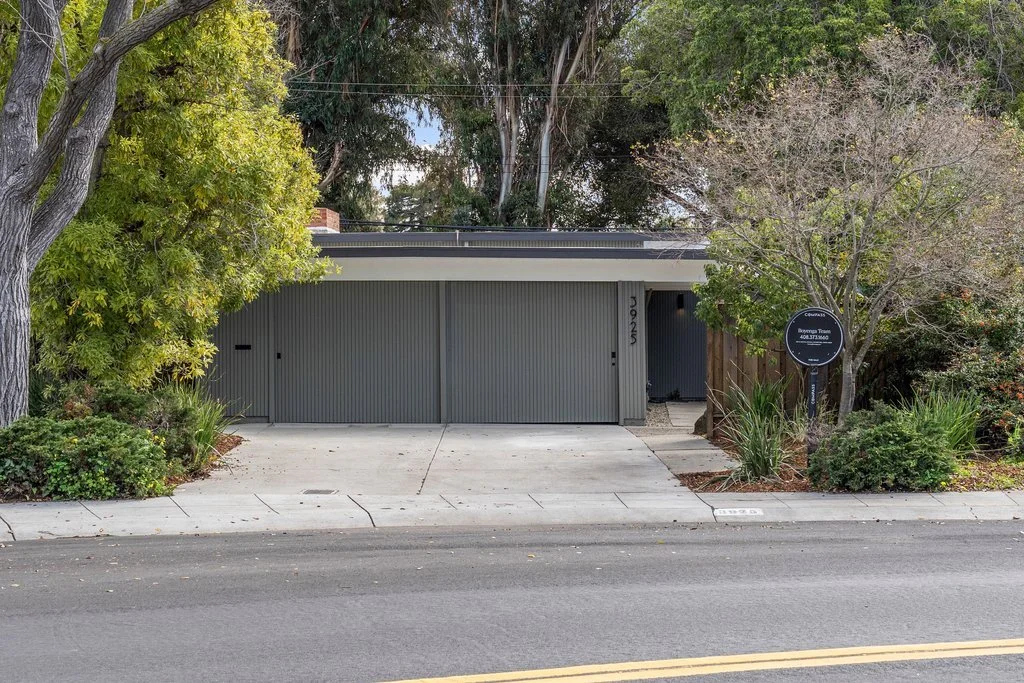
In south Palo Alto’s Greenmeadow—one of the region’s most recognized mid-century modern enclaves—our new listing at 3925 Nelson Drive pairs iconic Eichler design DNA with thoughtful, contemporary updates. The home is offered at 1,792 square feet on an approximately 8,235-square-foot lot, built in 1954, and marketed as an Eichler with an exceptionally walkable lifestyle (including a private gate with direct access to nearby tennis courts and exercise classes).
What makes this address worth a deeper look is not only the home itself, but the ecosystem around it: a neighborhood planned as both architecture and community, complete with a resident-focused recreation core, preservation momentum, and day-to-day conveniences that read like a “greatest hits” list for south Palo Alto living. Greenmeadow is listed on the National Register of Historic Places (with a recorded registration date of July 28, 2005), reflecting its architectural significance and unusually strong integrity as a mid-century district.
The home: remodeled comfort with unmistakable Eichler volume
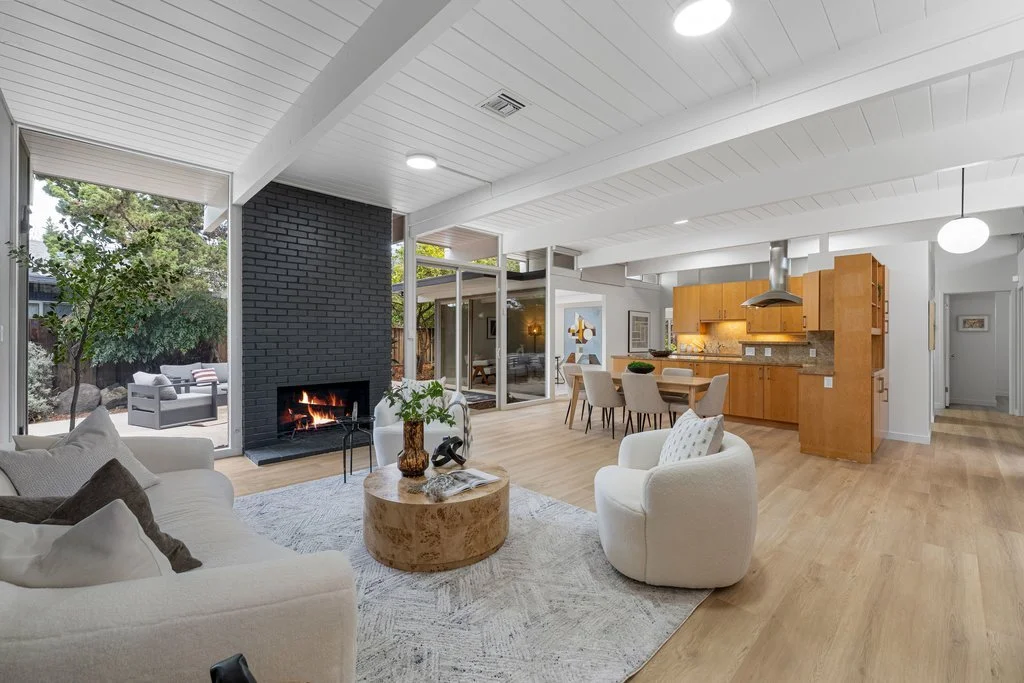
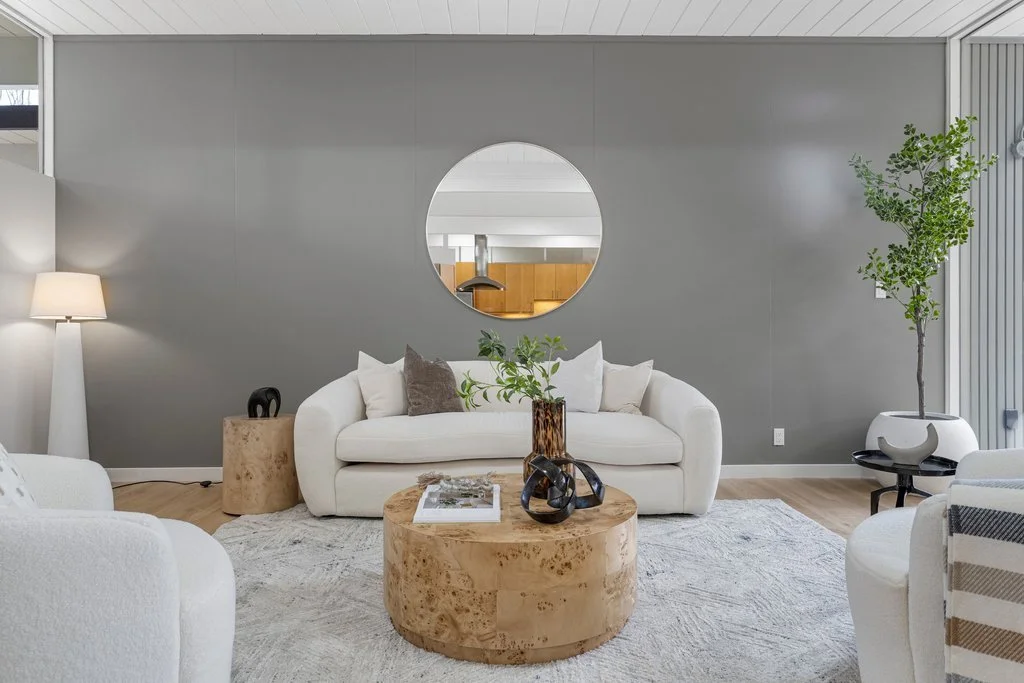
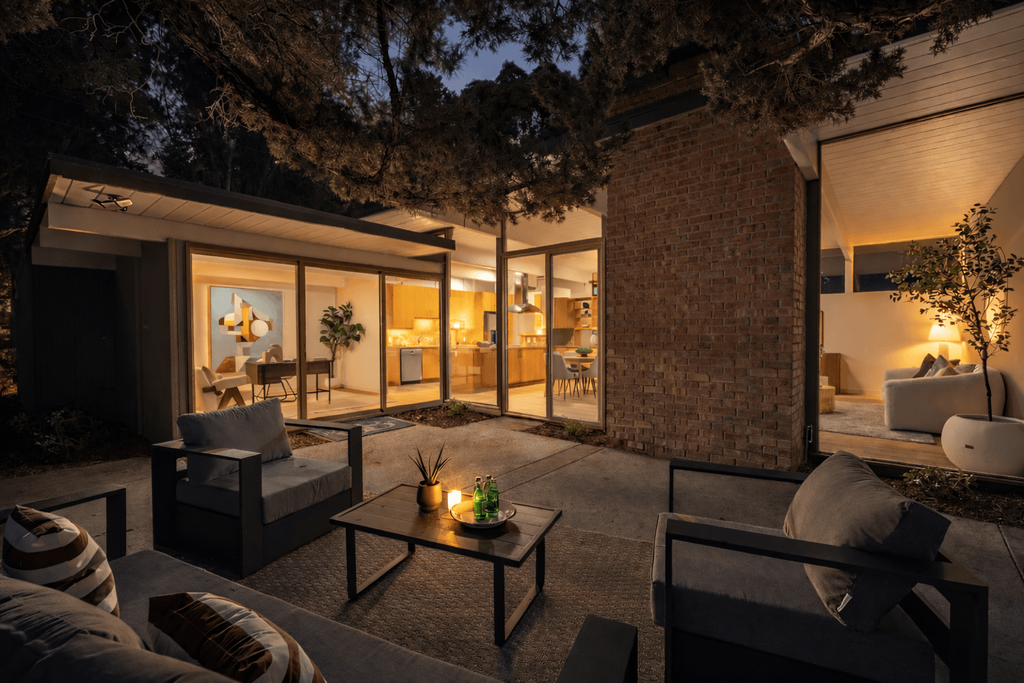
The listing at 3925 Nelson Drive is positioned as a classic Eichler experience—light, volume, and indoor-outdoor flow—updated for modern life. The marketing description emphasizes a great room with clerestory windows, an open layout, exposed beams, tongue-and-groove ceilings, and LVT flooring, along with a sliding door that opens to the patio for seamless outdoor extension.
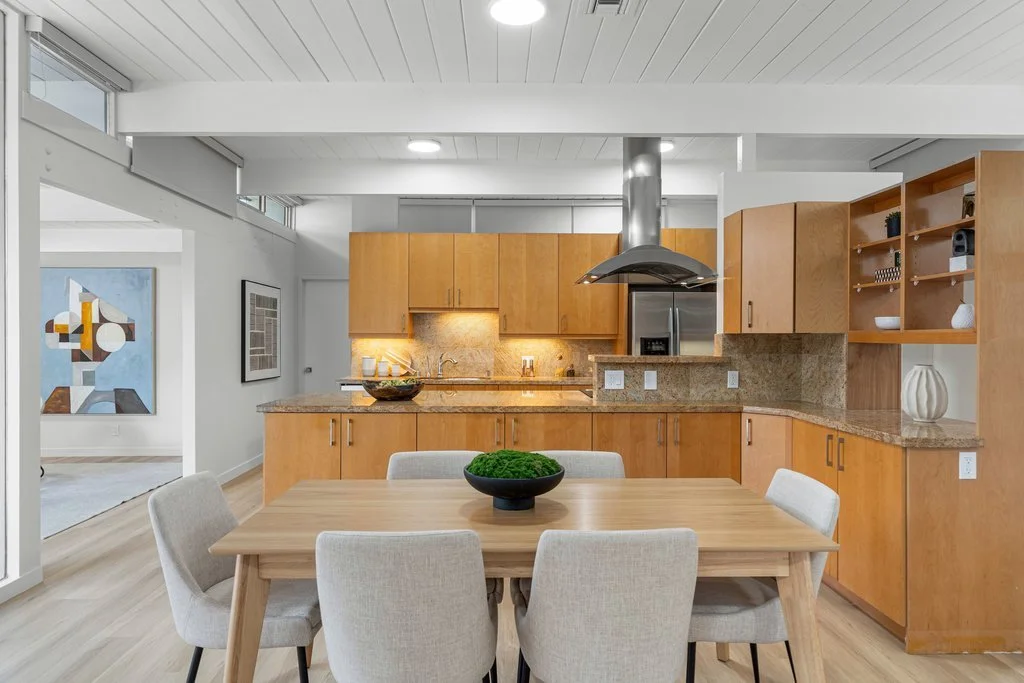
A renovated kitchen anchors the main living core, described with stainless steel appliances, a vent hood, granite counters, a sweeping peninsula, and modern cabinetry. The floor plan is also highlighted for flexibility, featuring a dedicated office that functions as a true work-from-home room rather than a carved-out corner—an important distinction for today’s buyers.
The home’s setting is a major lifestyle differentiator: the listing specifically calls out a private gate that connects directly to tennis courts and exercise classes at Cubberley Community Center. The City describes Cubberley as a city-operated community hub (in operation under the City since 1990) with broad programming and leases supporting education, health, child care, dance, and music instruction—exactly the kind of everyday amenity adjacency that can elevate “location” from a talking point to a lived advantage.
Greenmeadow’s design lineage: why Eichlers still feel “next-gen”
To understand why Greenmeadow still attracts design-forward buyers, it helps to zoom out from any single house and look at the tract as a system. The district is documented as 243 single-story residences plus a community center complex and pool—mid-century modern in style, using slab-on-grade post-and-beam construction—and built primarily in 1954 and 1955 by Eichler Homes, Inc..
Greenmeadow’s architects are identified as A. Quincy Jones and Frederick Emmons. Importantly for buyers, the district documentation is unusually specific about the “why” behind the visual language:
Street-facing privacy: relatively blank facades and minimal street-facing windows were intentional.
Rear openness: floor-to-ceiling glass and sliding doors opening to patios and private outdoor space are repeatedly described as signature features.
Light management: clerestory windows and roof forms were used to bring in diffuse light while preserving privacy—an early “daylighting strategy” that still reads contemporary.
The historic record also captures details that explain the enduring livability of Eichlers beyond aesthetics. For Greenmeadow homes, radiant heating systems are described as standard, with built-in electric kitchen appliances and average living space around 1,600 square feet—an early example of design efficiency paired with a psychologically “bigger” feel due to glass, openness, and indoor-outdoor extension.
One more layer that matters, especially for buyers who care about the values behind the architecture: the Greenmeadow significance statement explicitly links the development to a nondiscrimination policy, noting that Joseph Eichler was described as the most prominent homebuilder in the U.S. during the 1950s to practice a nondiscrimination policy, distinguishing him from nearly all contemporaries.
How Greenmeadow became a true community: planning, recreation, and preservation
Greenmeadow is not just “a tract with good houses.” It is repeatedly documented as a neighborhood planned around shared life, with a recreation-and-gathering center embedded into the subdivision’s geometry.
A district with unusually clear boundaries and integrity
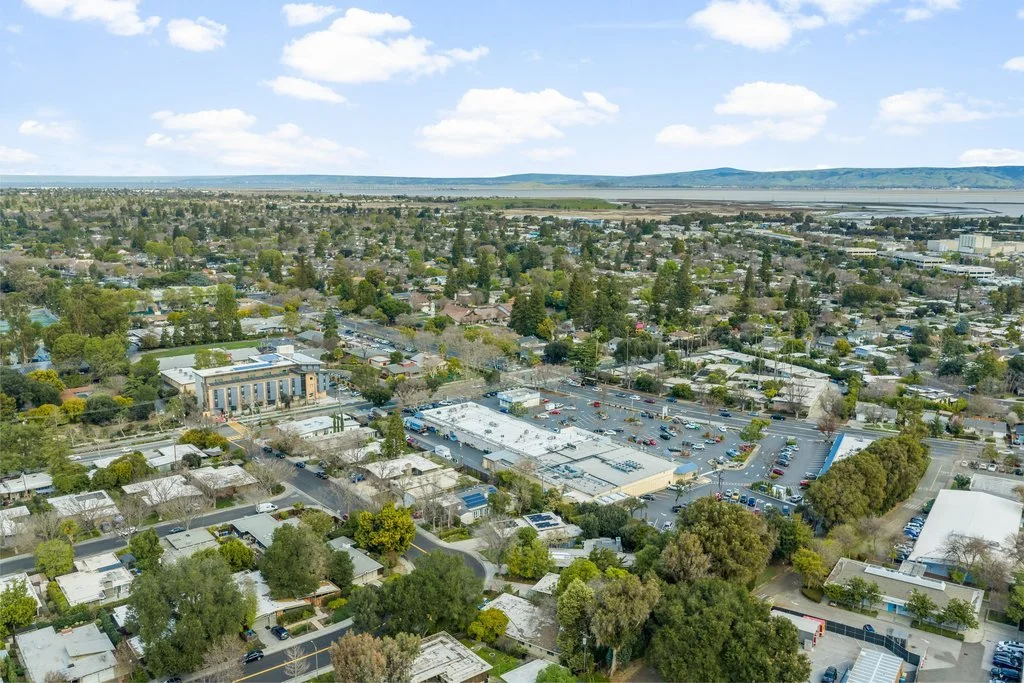
The district is described as located in the southern part of Palo Alto at the border with Mountain View, built on approximately 73 acres, with a later early-1960s phase of additional homes explicitly excluded from the nomination. The boundary description names Charleston Road, Nelson Drive, Ben Lomond and Shasta Drive, and Alma Street as defining edges—useful context for understanding what is “in the district” versus nearby but different.
One of the strongest indicators of long-term value in historic districts is integrity—how much of the original character remains legible. Greenmeadow’s documentation notes that the neighborhood is remarkably well preserved overall, with an active community emphasis on preservation and an architectural review process that has helped keep the majority of homes “true to the spirit of the original design.” It also states that 92% of buildings were classified as “contributing,” an unusually high share for a neighborhood approaching five decades of occupancy at the time of writing.
The “center” idea: carved out of the subdivision itself
The community center complex is described as a key feature of Greenmeadow’s “unique character”: about 2.9 acres of centrally located common area, created by carving small increments from each residential parcel, and designed in conjunction with the City of Palo Alto and the tract’s architects. The original center is described as including a multi-purpose building, a pool services building, an outdoor swimming pool, a park, and off-street parking, intentionally set back and barely visible from the street.
If you’ve ever wondered why some planned communities feel “real” and others feel like branding, this is part of the answer: Greenmeadow’s center is described as conceived as an integral part of community life—used for meetings, parties, dance and exercise classes, and related activities.
Landscape as part of the architecture
The district’s park and common areas are not an afterthought. The nomination credits the original landscaping of redwood trees to Thomas Church, including his work shaping the adjoining park’s experience (meandering walkways, greensward, and picnic alcoves) and adding variation to residential frontage elements like driveways and planting forms.
This matters for buyers because it helps explain an intangible that’s hard to replicate today: the way the neighborhood “feels” as you move through it—privacy, greenery, and a softness around the modernist geometry.
A local lens: the neighborhood association story
The neighborhood’s own historical narrative (as compiled by the Greenmeadow Community Association) describes Greenmeadow as emerging from post–World War II growth and identifies a community center, private park, nursery school, and swimming pool as distinctive features of the tract. It records that the association was incorporated on July 16, 1955, and describes longstanding community traditions such as a Fourth of July parade that began in 1955 and has been repeated annually.
Daily life in south Palo Alto: parks, play, fitness, and “walkable errands”
One reason Greenmeadow continues to resonate is that its mid-century planning collides—in a good way—with modern-day “15-minute life” preferences. The listing itself leans into this, calling out proximity to recreation, parks, groceries, and library access.
Cubberley: a community campus next door
Cubberley’s current role is worth understanding because it functions like a neighborhood-sized amenity stack. The City describes it as a unique facility operated by the City since 1990, supporting everything from community meetings and performances to athletics and instruction-based leases.
From a stewardship perspective, the site’s history also reinforces its civic importance. Palo Alto Unified School District describes the campus as originally built as a high school in the 1950s, closed in 1979 due to declining enrollment, and leased beginning in 1990 for community center use—framing it as an integral part of the city’s program network.
For tennis specifically, the City explains that it brokers City athletic fields and tennis courts (and school district fields/courts), with tennis courts generally available for individual use first-come/first-served outside of certain reservations.
Mitchell Park: a flagship “everyday” park with standout destination features
Just as important as courts and classes is the park network. Mitchell Park is the home of Magical Bridge Playground—a widely recognized inclusive playground that the City notes opened in April 2015 and was designed for visitors of all ages and abilities.
Close by, Mitchell Park Library is described as part of a joint library and community center facility and is identified as a LEED-certified building with features such as living walls/roof, solar panels, local landscaping, and natural heating/cooling systems.
Baylands: a nature reserve scale that feels rare inside a tech corridor
When buyers ask how Palo Alto balances “economic engine” with “quality of life,” the Baylands are often the clearest example. Baylands Nature Preserve is described by the City as a 1,940-acre preserve—one of the largest remaining tracts of undisturbed marshland in the San Francisco Bay—with about 15 miles of multi-use trails and strong birdwatching value as part of the Pacific Flyway.
Groceries and coffee that are actually close
Neighborhood convenience is more believable when it has addresses and real operators behind it. Piazza's Fine Foods lists its Palo Alto location in the Charleston Shopping Center at 3922 Middlefield Road—an easy “walk/ride for groceries” anchor for Greenmeadow living.
Demographics and housing context: what the numbers say about Palo Alto
“Demographics” can feel abstract until you connect it to real housing behavior: what kinds of homes people want, how long they stay, what improvements they value, and why neighborhoods like Greenmeadow attract both owner-occupants and design enthusiasts.
Because Greenmeadow is not a census-designated place, the most reliable public demographic baseline is citywide—then you layer neighborhood character on top. U.S. Census Bureau QuickFacts (ACS-based) provides a current snapshot for Palo Alto (2020–2024 estimates, with some 2024/2025 population figures).
A few highlights (citywide) that matter to housing demand and neighborhood life:
Palo Alto’s estimated population is 67,658 (July 1, 2024). About 22.2% of residents are under 18 and about 19.9% are 65+, a profile consistent with a city that includes both families and long-tenured homeowners.
The city is also notably international: 37.0% of residents are foreign born (2020–2024). In practice, that tends to show up in school community diversity, multilingual services, and a housing market where “classic architecture + turnkey execution” can appeal across many buyer profiles.
Education attainment is extremely high: 96.8% high school graduate or higher, and 82.3% bachelor’s degree or higher (age 25+). This helps explain why architecturally significant housing—especially well-executed remodels—often carries outsized emotional and financial value: buyers are frequently design-literate, detail-sensitive, and willing to invest in homes that feel intentional.
Economically, QuickFacts reports a median household income of $231,101 (in 2024 dollars) and a per capita income of $123,939 (2020–2024). The owner-occupied housing rate is 54.6%, and the reported median value of owner-occupied housing units is shown as $2,000,000+ (top-coded in the table). Those figures don’t describe Greenmeadow specifically, but they do frame an environment where preservation, remodeling quality, and neighborhood stability can materially affect outcomes.
Buyer notes: owning an Eichler in Palo Alto with eyes wide open
Buying in a historic Eichler district is different from buying a generic suburban house—even when the home is beautifully renovated. The upside is obvious: iconic architecture, strong neighborhood identity, and design that still feels contemporary. The responsibility side is also real: sunlight, privacy, and neighborhood character are part of the value proposition, and communities work to protect them.
Preservation culture is part of the package
One of the remarkable details in the Greenmeadow historic documentation is how explicitly it credits community stewardship. The nomination describes decades of community concern for preserving architectural style, including an active review process for remodel guidance, contributing to the district’s high “contributing” share.
Zooming out, California Preservation Foundation reports that Palo Alto has the highest concentration of Eichler homes “anywhere,” citing more than 2,000 houses in 30 tracts, and frames local design guideline efforts as a model for balancing reasonable change with neighborhood values.
City guidance exists, but it has a specific intent
The City produced Eichler Neighborhood Design Guidelines through a process initiated in 2016, following a series of Single Story Overlay rezoning requests, and contracted with Page & Turnbull to prepare the final guidelines for public review/adoption. The City’s FAQ document states the guidelines were voluntary as written (with discussion of potential regulatory approaches tied to City Council action).
Single-story protections and privacy aren’t just “policy”—they’re design logic
In Eichler neighborhoods, privacy is part of the architecture: blank street facades, inward-focused outdoor living, and daylighting strategies assume neighbors aren’t towering above each other. It’s not surprising, then, that Palo Alto has a formal Single Story Overlay (SSO) combining district mechanism. The municipal code describes processes such as signature thresholds for creating/removing an overlay and references prevailing single-story character requirements in staff materials tied to SSO amendments.
For buyers, the practical takeaway is simple: if you love the light, the privacy, and the “glass-to-garden” calm, you’re also benefiting from a neighborhood culture (and, in some cases, zoning structure) that tries to keep that experience intact.
A final “fit check” for 3925 Nelson Drive
Greenmeadow is documented as a district that introduced (for its time) more amenities and larger, more flexible layouts—double-car garages, fourth-room/all-purpose options, internal laundry, and a recreation core—while keeping the clean, modern, indoor-outdoor ethos. Our listing leans into those strengths: a flexible office, updated finishes, and a location that stitches the home into neighborhood recreation and daily conveniences.
When it comes to Eichler homes in Palo Alto, experience matters — and specialization matters even more.
Eric and Janelle Boyenga of the Boyenga Team at Compass are nationally recognized Eichler real estate specialists with deep expertise in mid-century modern architecture across Silicon Valley. Their approach goes far beyond standard marketing. They understand slab systems, post-and-beam construction, radiant heating, foam roofing, clerestory daylighting, preservation overlays, and the design guidelines that protect neighborhoods like Greenmeadow.
Having represented buyers and sellers in many of Palo Alto’s most architecturally significant Eichler neighborhoods, Eric and Janelle bring a rare blend of:
• Architectural literacy
• Strategic pricing precision
• High-impact Compass marketing systems
• Deep local preservation knowledge
• Proven negotiation results
They don’t simply list Eichlers — they position them.
For sellers, that means telling the architectural story correctly, attracting design-savvy buyers, and maximizing value within historic district dynamics. For buyers, it means evaluating remodel quality, understanding district guidelines, and protecting long-term investment integrity.
In neighborhoods like Greenmeadow — where preservation culture, Single-Story Overlay considerations, and architectural authenticity matter — representation by true Eichler specialists can materially influence outcomes.