
Atriums and Avenues: A Deep Dive into 95124’s Architectural DNA
Eichler Homes and Architectural Heritage in San Jose's 95124 ZIP Code
In the heart of San Jose’s 95124 area, nestled amid tree-lined streets, lie two neighborhoods that double as open-air museums of mid-century modern design. The Fairglen and Fairwood Eichler tracts are local treasures, defined by their iconic atriums, clean lines, and a community spirit as carefully cultivated as their architecture. These mid-century enclaves – developed by legendary homebuilder Joseph Eichler in the late 1950s and early 1960s – offer a property-nerd’s delight: post-and-beam construction, walls of glass, and indoor-outdoor living galore. In this deep dive, we explore the architectural DNA of Fairglen and Fairwood, with special attention to architect Claude Oakland’s influential designs and the model variations that give the tract its character. We’ll also trace the neighborhoods’ history, evolving remodel trends, preservation efforts (including design guidelines), and what draws today’s buyers to this Eichler-filled corner of San Jose.
Fairglen & Fairwood: Eichler’s Mid-Century Vision in Willow Glen
In the late 1950s and early 1960s, visionary developer Joseph Eichler brought his tract-home revolution to San Jose’s Willow Glen area, planting the seeds of what would become the Fairglen (and adjacent Fairwood) Eichler neighborhoods. Eichler’s development here spanned roughly 1959 to 1962 and ultimately totaled around 350 homes across several phases. The first 30 Eichlers took root near Dry Creek Road – around Margot Place and Adele Place – in the late 1950s. Buoyed by that early success, Eichler launched the main Fairglen tract in 1959–1960, adding about 218 homes laid out along aptly named streets like Fairglen Drive, Fairwood Avenue, and Fairorchard Avenue en.wikipedia.org. A final phase of 66 Eichlers was completed by 1962 around Hudson Drive and Dumbarton Avenue, solidifying this corner of Willow Glen as an enclave of cutting-edge modern architecture.
Design credit for these San Jose Eichlers goes to Eichler’s trifecta of architects. Early site plans and model homes were devised by Anshen & Allen (of San Francisco) and Jones & Emmons (of Los Angeles) – firms behind many of Eichler’s iconic mid-century designsen.wikipedia.org. As the project progressed, Claude Oakland & Associates, Eichler’s long-time collaborator (and later chief architect), took the helm to complete Fairglen’s later phasesen.wikipedia.org. Oakland’s influence is especially notable; his team introduced some of the most beloved Eichler model variations here, seamlessly integrating Eichler’s core design principles with fresh twists for the new decade. Under this trio’s guidance, Fairglen and Fairwood emerged in 1960–62 with a remarkable consistency of style and quality.
Historical acclaim: What was once simply a pleasant neighborhood of unusual modern homes gained broader recognition in recent years. In 2019, the Fairglen tract (including its Fairwood Avenue section) was officially listed on the National Register of Historic Placesen.wikipedia.orgen.wikipedia.org – a testament to its architectural significance. This honor underscored not only the distinctive design of these homes but also the community’s dedication to preserving their mid-century character. Today a small bronze plaque at the tract’s entrance quietly announces its historic status, and there’s a shared sense among neighbors that they’re stewards of a special piece of San Jose’s history.
The Eichler Architectural DNA: Atriums, Glass, and Modern Lines
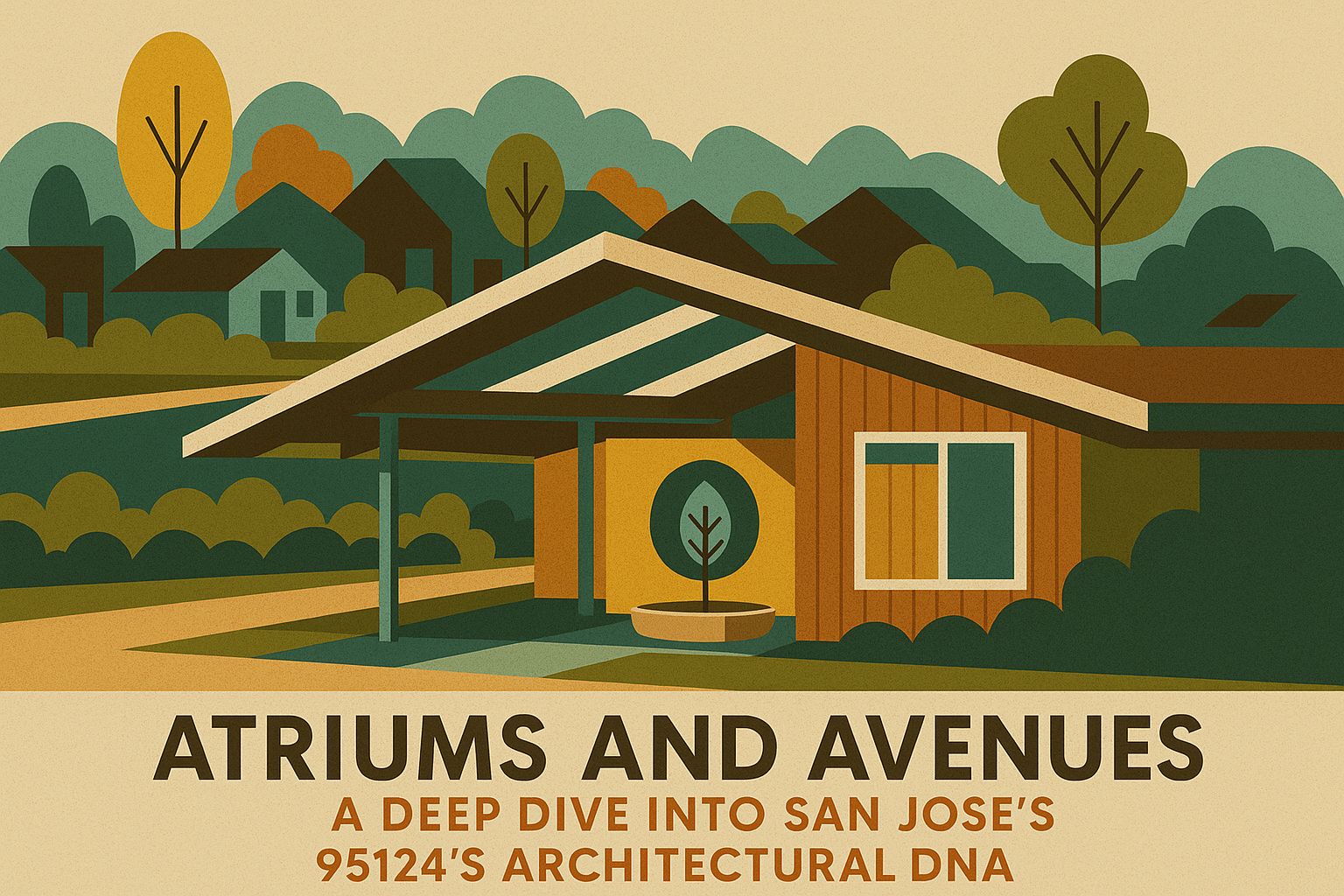
Defining features of Eichler’s architectural DNA are on full display in Fairglen and Fairwood. These one-story, post-and-beam homes sport flat or gently pitched roofs, usually with broad, beamed eaves and the occasional A-framed gable accenten.wikipedia.org. The exposed post-and-beam construction eliminated the need for interior load-bearing walls, enabling expansive, free-flowing layouts and open sight-lines. This structural approach allowed for 50-foot-wide living areas and expansive glass walls that blur the line between indoors and outen.wikipedia.org. Floor-to-ceiling windows and rows of clerestory windows tucked under the eaves flood the interiors with natural lighten.wikipedia.org. At the heart of many Fairglen homes is an open-air central atrium – essentially an outdoor room at the center of the house – which serves as the home’s focal point and “wow” factor, bringing sky, light, and nature into the core of daily life. In other models, a private front courtyard plays a similar role, providing a sheltered outdoor extension of the living space. In both cases, Eichler’s trademark indoor-outdoor integration is unmistakable: living rooms often open via sliding glass to backyard patios, and almost every room has a view to a garden, atrium, or yard, creating a sense of harmony with nature.
A classic Fairglen Eichler with a low-gable roof and integrated garage. Note the modest street façade – clean lines, carport/garage front, and uncluttered roofline – concealing expanses of glass opening to the back. This emphasis on privacy from the street and openness inside is a hallmark of Eichler designen.wikipedia.org.
The street side of an Eichler in Fairglen is often deliberately understated – a modest façade with minimal ornamentation, sometimes just a blank front wall, carport or garage door, and a discrete entry gateen.wikipedia.org. This was by design: Eichler homes “turn inward,” emphasizing privacy from the public street while opening up entirely toward their interior atrium and rear yard. It’s a dramatic contrast to the typical 1950s ranch house. Materials play an important role in this architectural DNA as well. The stained tongue-and-groove redwood ceilings extend straight out to the eaves, blurring interior and exterior, and inside, walls were originally clad in rich Philippine mahogany paneling – a warm counterpoint to the glass and concreteen.wikipedia.org. Floors were often finished in resilient 12-inch tiles or concrete, with hot-water radiant tubes embedded in the slab for gentle, invisible heatingen.wikipedia.org. Globe pendant lights, open-air breezeways, and pop-colored front doors add to the mid-century flair. Every design decision, from the famously unadorned post-and-beam skeleton to the broad panes of glass, was geared toward a modernist ideal: simplicity, openness, and integration with nature fairgleneichlers.org.
From Courtyards to Atriums: Eichler Model Variations by Oakland
One might think a tract of 1960s tract homes would be cookie-cutter, but Fairglen’s Eichlers came in a surprising variety of flavors. In fact, thirteen distinct floor plans were executed here, broadly falling into two categories en.wikipedia.org. Some homes feature an L-shaped layout with a walled front courtyard nestled between the garage and the living room – a design that offers a private outdoor foyer and a shielded approach to the glass entry wall en.wikipedia.org. Other homes use a more rectangular “square” plan with a central atrium, where a glass-lined atrium sits at the core of the home, separating the bedroom wing from the living areasen.wikipedia.org. In these atrium models, you typically step through the front door into an open-air courtyard, with the bedrooms to one side and the living/dining/kitchen on the other, all chambers opening onto the atrium. This was a radical concept for its time – effectively turning the traditional home inside-out – and it quickly became an Eichler signature in the early ’60s.
Within those two broad plan types, Fairglen’s models vary in size and detail. Most are 3- or 4-bedroom, single-story homes, generally ranging from about 1,300 up to 1,600 square feet in the Fairglen tract. Some include an attached two-car garage, while others were built with an open carport at the front (often later enclosed by owners). Roof profiles also differ: a few models sport a low-gabled roof peak over the living area, while many others have a nearly flat roof with only a slight pitch for drainage. Fairglen “boasts a variety of models including courtyard, carport, and atrium models,” notes one real estate source, with sizes spanning from modest to around 1,600 sq ft. This variety was very much intentional – Eichler and architect Claude Oakland wanted to offer options for different family needs and budgets, without sacrificing the cohesive look and feel of the neighborhood.
One notable home in the tract is located on Fairwood Avenue: it was originally built as the model home for the Fairglen development. This particular house is a carport atrium model – meaning it has a carport (not a solid garage door) and features a central atrium floor plan. Visitors entering this home step directly into an open-air atrium with views through glass walls into the living room, kitchen, and backyard. The design perfectly encapsulates Eichler’s philosophy of bringing the outside in. In original form, such a model home would have showcased features like an exposed-beam ceiling, a compact open kitchen adjacent to the atrium (ideal for indoor-outdoor entertaining), and trendy modern finishes of the era. (Interestingly, decades later a subsequent owner added a pitched roof over this home’s flat roof for insulation and storage, but it was done reversibly – it “could easily [be] converted back to [the] flat roofline,” the listing notes.) Claude Oakland’s hand is evident in these later atrium models; having worked with Eichler on earlier homes, he refined the concept with subtle changes like widened entry gallery halls and more storage built-ins, all while preserving the fundamental Eichler ethos of unified indoor-outdoor living. Oakland’s influence ensured that Fairglen’s homes felt modern yet livable, with family-friendly touches folded into the cutting-edge design.
Remodel Trends: Restorations, Upgrades, and the Eichler Ethos
More than 60 years on, Fairglen’s Eichlers have naturally evolved as homeowners personalize and update them – yet the community has largely resisted the kind of radical changes that might erase its architectural identity. Early on, in the 1970s and ’80s, some homes did receive unsympathetic “remuddles.” A few owners, not yet appreciating the historical value of Eichler’s design, attempted to conform these homes to more traditional tastes – installing ornate front doors, adding mansard roof decorations, even tacking on a second story in rare cases. Such alterations disrupted the intended lines of the houses; for example, a two-story addition breaks the horizontal plane that Eichler homes so carefully maintainen.wikipedia.org. And yet, even where these out-of-character changes occurred, Fairglen as a whole never lost its Eichler vibe – the historic district designation report noted that the neighborhood “retains significant architectural elements” and cohesiveness despite “occasional…altered rooflines or added second stories” here and thereen.wikipedia.org.
More commonly, owners over the years focused on practical updates. One frequent project was addressing the roof leaks that can plague older Eichlers: many homes had their original tar-and-gravel roofs replaced. In some cases, homeowners opted to build a new pitched roof over the flat roof (often with composition shingles), creating a vented attic for insulation and storage. The Fairwood Avenue model home is one example – a shallow gable was added atop its flat roof in later years. Purists might wince at such changes, but they were usually done in a way that could be reversed to restore the original flat profile. Other mid-life upgrades included replacing single-pane glass with double-pane for energy efficiency, updating the radiant heating systems, and remodeling kitchens and baths as styles changed. Unfortunately, in past decades some of the original interior finishes (like mahogany wall panels or 12” floor tiles) were covered up or removed in favor of contemporary trends.
The tide has turned in recent years, as a new generation of Eichler enthusiasts has moved in. The remodel trend now is toward “sympathetic” renovation and restoration. Many homeowners are stripping away earlier alterations that don’t fit the mid-century aesthetic – for instance, removing popcorn ceilings or colonial-style light fixtures that previous owners installed – and bringing back Eichler-appropriate materials. It’s not uncommon to see renovations where drywall is peeled off to reveal (or replace) the original mahogany paneling, or where vintage globe lights and period-appropriate cabinetry are reintroduced to recapture the 1960s feel. Modern upgrades are certainly happening, but they’re being done in a design-conscious way. Homeowners brag about updating with integrity: a kitchen remodel might include state-of-the-art appliances and quartz countertops, but in a clean, minimal style that complements Eichler’s lines (for example, flat-front cabinet doors echoing the originals)modernhb.com. Bathrooms get their share of luxury – new fixtures, modern tile – yet the overall simplicity and openness remain, often keeping original skylights or floor-to-ceiling windows in place. Sustainability has also entered the mix: some houses have added solar panels or high-efficiency foam roof insulation, usually tucked out of sight to maintain curb appearancemodernhb.com. As one article notes, these thoughtful upgrades “provide contemporary comforts while maintaining the home’s midcentury character.”modernhb.com In essence, Fairglen’s residents are proving that an Eichler can be both a time capsule and a comfortable 21st-century home. The best remodels honor “the authentic mid-century character” of the house even as they refresh it for the future – a balance that real estate observers say only increases the appeal (and value) of these properties.
Where Eichler Character Shines Brightest: Preserved Streetscapes
Thanks to a combination of community pride and mindful design controls, large swaths of Fairglen and Fairwood still look remarkably as they did in the early 1960s. In fact, walking down certain streets can feel like stepping back in time. The stretch of Fairglen Drive itself (the tract’s namesake road) is one such example: home after home on this avenue retains the classic Eichler roofline and façade, with original redwood siding profiles and mid-century accents clearly visible from the street. Fairwood Avenue – site of the original model home and many a block party since – is another showcase of “original Eichler lines”. On Fairwood, several houses still sport their distinctive open carports, frosted-glass garage doors, or period-appropriate paint colors (earthy tones and bold front doors) that echo Eichler’s 1960s palette. Neighbors here have been known to help newcomers source correct globe lights or recreate lost architectural elements, so the visual continuity remains strong. It’s no wonder this area was described as “Eichler crazy” in an Eichler Network feature praising its infectious pride of ownership and neighborliness.
Beyond the main drags, the smaller cul-de-sacs in Fairglen are often time capsules of Eichler design. Cul-de-sacs like Fairgrove Court, Fairoak Court, and Fairvalley Court boast clusters of homes with very few exterior alterations – you’ll see original grooved siding patterns, uncluttered roof edges (no awkward add-ons), and even vintage Eichler address numerals and doorbell chimes in some cases. Because these courts are tucked away from through-traffic, homeowners have been especially motivated to maintain their “museum piece” homes, and there’s a bit of friendly competition to see whose Eichler is most true to form. Similarly, the homes along Fairorchard Avenue and Andalusia Way (part of the third phase of construction) include some larger models that fortunately did not spur second-story additions – thus preserving the intended single-story silhouette across the whole streetscape. In the Hudson Drive/Dumbarton Circle section (the last built, in 1962), one finds some of the biggest Eichler plans in the tract, and even those remain largely intact externally. The historic district status helps: owners know that while interior changes are their prerogative, any visible exterior alteration could diminish the neighborhood’s collective historic value. As a result, over 80% of the homes in Fairglen are considered contributing structures in the National Register district, meaning they substantially retain their 1960s appearance en.wikipedia.org. For a mid-century tract in the path of Silicon Valley’s growth, that level of preservation is extraordinary.
It’s also worth noting the cultural preservation at play. The Fairglen Eichler Neighborhood Association is active in encouraging owners to respect the original architecture. There have been workshops on Eichler-friendly window replacements, referrals for sourcing mahogany paneling, and events like an annual “Eichler Home Tour” where several neighbors open their lovingly preserved homes for others to admire. These tours not only shine a light on the best-preserved gems (often the atrium models that retain original layouts and finishes), but also inspire others to restore and preserve. In essence, Fairglen’s design integrity is reinforced both by formal recognition (historic status, city guidelines) and by informal, peer-to-peer encouragement among residents.
Preservation Efforts and City Guidelines
The designation of Fairglen (and its Fairwood addition) as a historic district in 2019 was a pivotal moment in preservation. It opened the door for potential incentives (like Mills Act property tax reductions for historic home restoration) and raised awareness citywide about the neighborhood’s importance. Following on that recognition, the City of San Jose began developing tailored design guidelines to manage change in its Eichler tracts. As of 2024, a draft of the “Eichler Neighborhood Objective Design Standards” was released for public review sanjoseca.gov. These standards aim to “guide alterations of existing buildings and new construction” in Eichler neighborhoods, ensuring that any additions or changes are compatible with the mid-century modern character sanjoseca.gov. For example, the guidelines discourage adding second stories that are visible from the street, and they provide direction on everything from acceptable roof materials (flat or low-profile, avoiding tall ridges) to window styles (encouraging horizontal clerestory-like proportions) – all in an effort to protect that distinctive Eichler look. While still in draft form, the very existence of these guidelines shows the city’s commitment to accommodating growth without sacrificing architectural heritage.
Community advocacy played a big role in these efforts. Fairglen’s residents, many of whom are Eichler enthusiasts, have organized to keep the neighborhood’s voice heard. Even before the city got involved, neighbors banded together to share best practices for preservation. The neighborhood’s own newsletter often highlights restoration projects (celebrating when someone restores an exposed beam or rebuilds an atrium wall to original specs) and warns against “remuddling” faux pas. There’s also a Preservation Committee under the neighborhood association that helped drive the National Register nomination and now keeps an eye on development proposals. The result is a proactive culture of preservation: rather than waiting to react to a bad remodel, Fairglen folks actively educate new homeowners on why these homes are special and how to update them responsibly. It’s preservation by persuasion (and a bit of peer pressure), and it seems to be working.
Enduring Appeal: Community and Buyers of Today
Despite – or perhaps because of – their age, Eichler homes in Fairglen/Fairwood have become hot properties in the Silicon Valley real estate market. These homes are particularly coveted, often attracting multiple offers and selling at a premium, thanks to their iconic design and limited supply modernhb.com. What’s striking, though, is the profile of buyers and the lifestyle they seek. Many are mid-century modern aficionados – people who specifically seek out Eichlers for their architecture. It’s not uncommon to hear of a tech professional or young family saying they waited for the right Eichler to hit the market, bypassing more generic homes. As one local Eichler owner quipped, they weren’t interested in “cookie cutter houses” – they set out determined “to find an Eichler” as their home, valuing the design above all else. These buyers are often highly educated about the homes’ features and come in ready to lovingly restore or at least respect them. Realtors note that some first-time homebuyers in San Jose will choose a 60-year-old Eichler that needs a little TLC over a newer tract home, simply because of the architectural character and sense of community that comes with it.
Indeed, community is a huge part of the enduring appeal. Fairglen and Fairwood have what has been described as an “infectious neighborliness”. Neighbors truly know each other – a rarity in many modern suburbs. There are summer block parties on Fairwood Ave (the 4th of July bash is legendary, complete with food trucks and live music), holiday cookie exchanges, and the aforementioned home tour each spring. The neighborhood association even hands out playful awards (the “Joeys”) to homeowners for preservation efforts and festive decor, fostering a fun camaraderie. Newcomers are often pleasantly surprised to find that when they buy an Eichler here, they’re not just buying a house – they’re joining a club. The shared passion for their unique homes creates instant rapport; it’s not unusual for an old-timer to drop by a new neighbor’s place with a vintage catalog of Eichler fixtures or an offer to help source specialized materials. This spirit of collaboration and pride keeps the neighborhood’s original DNA alive as much as any physical preservation does.
From a market perspective, Eichlers in 95124 (Willow Glen) also benefit from their location – a blend of suburban peace and city convenience. Many buyers are thrilled to get a slice of mid-century California modernism without leaving San Jose, meaning they’re within easy reach of major tech job centers, downtown amenities, and top-rated schools (the local Booksin Elementary and Willow Glen High are a draw for familiesmodernhb.com). Thus, the buyer profile often includes professionals from the tech industry and creative fields, people who appreciate design and also value community and schooling. These are folks willing to invest not just money but time and care into their homes. And their investment has paid off: Eichler homes have seen strong appreciation, validating the idea that these aren’t just quirky old houses, but “valuable assets” with a timeless appealmodernhb.com.
Atriums and avenues – the very words conjure images of sunlit courtyards and friendly street gatherings, which is exactly the spirit of Fairglen and Fairwood. These San Jose Eichler neighborhoods have managed to keep their mid-century magic intact through careful stewardship, even as the world changed around them. The architectural DNA that Joseph Eichler and Claude Oakland embedded here – open atriums, floor-to-ceiling glass, post-and-beam simplicity – continues to define the community’s look and feel decades later. Remodels and additions have (for the most part) honored that DNA, and official historic status and guidelines will help safeguard it into the future. For residents and admirers alike, Fairglen stands as a living time capsule of California Modernism: a place where form and function, house and landscape, past and present all merge. In a city known for constant reinvention, Fairglen’s Eichlers prove that good design and good neighbors never go out of style – they only get better with age.
With decades of experience and a shared passion for mid-century architecture, Eric and Janelle Boyenga of the Boyenga Team at Compass are widely regarded as leading Eichler real estate experts in Silicon Valley. Their deep understanding of Joseph Eichler’s architectural vision—paired with innovative marketing and expert negotiation—makes them the go-to team for both buyers and sellers of Eichler homes. Whether you're restoring an atrium model in Fairglen or listing a modernist gem in Fairwood, the Boyenga Team offers Next-Gen real estate service grounded in timeless design appreciation.
Sources: Historical and architectural details were gathered from community archives and Eichler-focused resources, including the Fairglen Eichlers neighborhood association and Eichler Network features. Notable references include the Fairglen Additions National Register nominationen.wikipedia.orgen.wikipedia.org, City of San Jose planning documentssanjoseca.gov, real estate analyses, and modern home publications modernhb.com that together paint a comprehensive picture of 95124’s Eichler heritage. Each citation is provided in the text for verification and further reading.
Sources