
Clerestory Magic: How High Windows Make Eichlers Feel Limitless
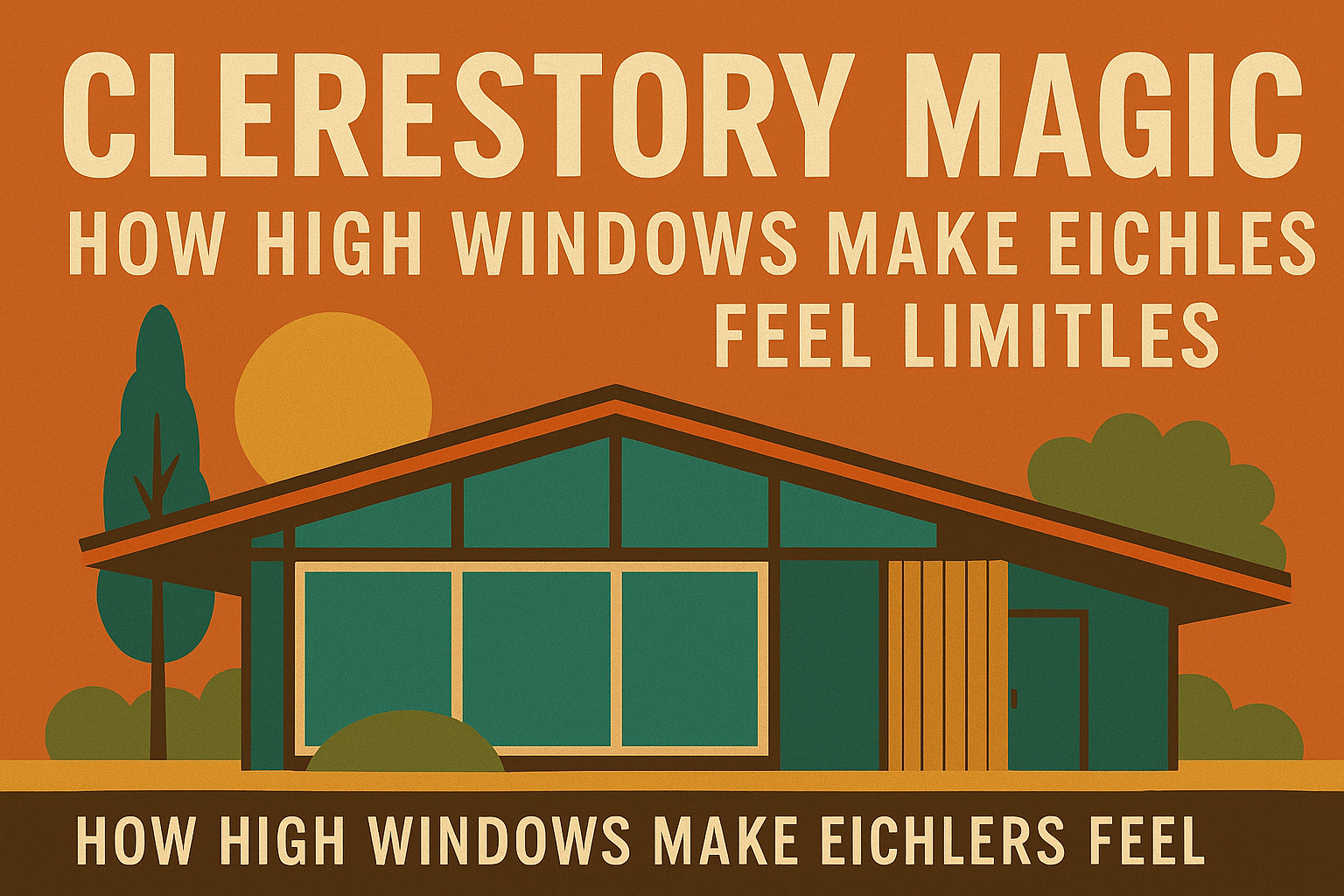
Clerestory Windows and Spatial Design in Eichler Homes
Joseph Eichler’s mid-century modern homes are icons of light and openness. Built throughout California (with many in Silicon Valley), these low-slung post-and-beam houses introduced average families to walls of glass, indoor-outdoor living, and the “clerestory” – high windows tucked under the eaves – as a secret ingredient. Clerestory windows (pronounced “CLEAR-story”) are the short strips of glass near the roofline. In Eichler homes, they aren’t just decorative; they fundamentally enhance both the architecture and the emotional experience of the space. This article explores how these high windows work their magic in Eichler homes, from daylight and structure to spatial illusions and energy performance. We’ll see how clerestories helped Eichler achieve his vision of “private-yet-open” design – a concept that has made even modest Eichler tract homes feel expansive and connected to nature.
Eichler’s Vision and the Role of Clerestory Windows
Joseph Eichler was a developer, not a formally trained architect, yet he had a bold architectural vision. Inspired by living in a Frank Lloyd Wright Usonian home, Eichler set out to bring modern design to middle-class California suburbseichlerhomesforsale.comalmanacnews.com. His houses, especially in Silicon Valley neighborhoods like Palo Alto’s Greenmeadow and San Jose’s Fairglen, were radical for their time: open floor plans, glass walls, and a seamless flow between indoors and outdoors. Yet Eichler also knew homeowners valued privacy, so he struck a careful balance. Clerestory windows became a key part of that balance.
Eichler’s early tracts, such as Greenmeadow (Palo Alto, 1954), showcase the signature features that made his style instantly recognizable: “clerestory windows (often triangular) at the front, vertical exterior redwood siding, post-and-beam interior construction, open living spaces with high ceilings, and full plate-glass rear walls.”almanacnews.com All Eichlers of that era were single-story to prevent neighbors from overlooking each other, preserving a sense of privacy even with so much glassalmanacnews.com. In this context, clerestories supported Eichler’s indoor-outdoor vision by admitting light and views of the sky while keeping walls largely solid at eye level. An authentic Eichler tends to present a “modest face” to the street – often just a blank facade or a band of high windows – while opening up entirely to the backyardeichlerhomesforsale.comeichlerhomesforsale.com. This approach of “privacy to the street, openness to nature”eichlerhomesforsale.com was revolutionary. Neighbors or passersby see little more than a low roof and perhaps a narrow strip of glass under the eaves, but inside, the house is bathed in daylight and connected to the outdoors. In Eichler’s words (as evidenced by his designs), bringing the outside in was paramount, and clerestory windows were a subtle but effective tool to achieve it.
Daylight Quality and Gentle Illumination
One of the most enchanting effects of clerestory windows is the quality of natural light they bring into Eichler interiors. Because these windows sit up high, close to the ceiling, they catch sunlight and diffuse it softly across the rooms from above. In many Eichler models (especially those with flat or low-pitch roofs), clerestories form a continuous ribbon of glass just below the roofline, creating an even wash of daylight. According to Eichler experts, “clerestory windows are a hallmark of Eichler homes, allowing light to filter into rooms while maintaining privacy”eichlerhomesforsale.com. Positioned above eye level, they let sunshine spill in throughout the day without the glare or hotspots that a full floor-to-ceiling window might create. The light often bounces off the white-painted or natural wood tongue-and-groove ceilings, resulting in a gentle, ambient glow. Architects note that “light enters through the clerestories and reflects off the roof, spreading very diffuse light around the room below.”hmcarchitects.com This means Eichler homes have fewer dark corners – even deep in the center of the house – because clerestories act like linear skylights, illuminating areas that a standard window cannot reach.
Crucially, daylight from clerestories is balanced and consistent. High windows capture the higher-angle sunlight and open sky illumination. As a result, Eichlers get more ambient light and less direct light, which helps keep interiors cool in the summer and warm in the winter by avoiding harsh sun beamsatomic-ranch.com. Many Silicon Valley Eichlers were oriented to take advantage of this: for example, some models place clerestories on the south side under wide eaves, so that winter sun can angle in for warmth, while the summer sun is mostly shaded. Homeowners often remark how, during the day, they rarely need to turn on a light. Indeed, by “allow[ing] light to flow through the home without the need for excessive artificial lighting,” clerestories contribute to the home’s sunny atmosphere and reduce electricity useeichlerhomesforsale.com. The daylight quality is bright but not blinding – perfect for showing off Eichler’s natural wood paneling and modern décor in a flattering, even light.
Post-and-Beam Design: A Canvas for High Glass
Eichler homes are built with a post-and-beam structural system, which was instrumental in making clerestory windows possible. In a conventional house, many walls are load-bearing, meaning you can’t just turn the top of the wall into glass. But Eichler’s post-and-beam construction carries the roof load on sturdy beams and columns, freeing up the walls from heavy structural dutyeichlerhomesforsale.comeichlerhomesforsale.com. As a result, architects had tremendous flexibility to insert windows – even odd-shaped or continuous ones – wherever needed. Mid-century modern designers saw this as a unique opportunity: “Post and beam construction... gave the task of load-bearing to the posts, allowing for more flexibility in wall (and window) design.”atomic-ranch.com In Eichler homes, entire walls could be replaced with glass or topped with a band of clerestories without compromising the structure.
In practical terms, clerestory windows often sit between the exposed beams of an Eichler’s ceiling, highlighting the rhythm of the structure. Many Eichlers feature exposed 4x10 beams running across the ceilings, and the clerestories slot in the spaces above the exterior walls, aligning with these structural bays. This creates a modular repetition: each bay might have a clerestory panel, producing a regular cadence of glass and beam, glass and beam. Authentic Eichler designs use this technique deliberately – “the clerestories in Eichlers also often align with the rhythm of the post-and-beam structure (e.g. a clerestory might fit between two beams)”eichlerhomesforsale.com. By contrast, imitators who slap high windows on a facade without regard to structural alignment lose that sense of ordered rhythmeichlerhomesforsale.com.
Wall design in Eichlers was also influenced by the presence of clerestories. Since windows up high take care of daylight, the lower portions of the walls could remain solid for function or decor. Eichler homes famously used uninterrupted interior mahogany paneling and built-in cabinetry; clerestories made this possible by relocating windows to the roofline. As one design writer noted, high windows “meant more open eye-level wall space, allowing for more room for art and built-ins”atomic-ranch.com. In the kitchen, for example, instead of a typical window over the sink, Eichler would often run a strip of clerestory windows above the cabinets. This allowed full-height cabinets or shelves on the wall while still admitting light from above. On the exterior, the long, low wall with a continuous clerestory strip became a hallmark of Eichler’s modernist aestheticeichlerhomesforsale.com. With a flat roof or gently sloping roof, “they allow for continuous clerestory windows and a purely modernist aesthetic.”eichlerhomesforsale.com In sum, post-and-beam construction gave Eichler architects a wide canvas on which to place windows freely, and they used it to integrate clerestories in a way that enhanced both form and function of the walls.
Spatial Perception: Expanding Volume and “Floating” Roofs
Perhaps the most magical impact of clerestory windows in Eichler homes is how they affect our perception of space. These houses are typically single-story and not particularly large by square footage, yet they often feel much larger than they are. One reason is that clerestory windows visually push the ceiling upward and dissolve the normal boundaries of the room. By inserting glass at the top of the wall, Eichler created a transparent transition between wall and roof that tricks the eye – it’s as if the roof is not quite touching the walls. Homeowners describe the effect as a “floating roof” or an expanded sense of height. In fact, one remodeling expert noted that in an Eichler atrium, “clerestory windows make the atrium roof feel like it’s floating.”westernwindowsystems.com The same is true in living rooms and bedrooms: a band of high windows separates the ceiling plane from the walls, so the roof appears to hover weightlessly above glass, rather than sitting heavily on solid walls. This floating effect elevates the perceived volume of the space, making an Eichler with 8-foot ceilings feel lofty.
Clerestories also allow you to see beyond the confines of the room. Instead of a ceiling meeting a wall at a dark corner, you get a strip of sky, tree foliage, or daylight. The result is that your gaze is drawn up and out, giving a sense that the room extends infinitely into the outdoors. Architectural historians have noted that Eichler homes “felt bigger inside than their square footage”, in part due to design features like expansive glass and open sightlinesalmanacnews.com. High windows contribute by adding an extra dimension of openness at the top of the space. In Silicon Valley’s tight subdivisions, where lot sizes were modest, this vertical opening to the sky made a huge difference – it helped “make the small lots feel bigger and promote indoor-outdoor living”, as noted in Palo Alto’s Eichler design guidelinescityofpaloalto.org.
A great example comes from a recent Eichler remodel in Palo Alto. Klopf Architecture added a new family room with a dramatic butterfly roof and clerestory windows wrapping beneath it. The effect on the interior was immediate. “Extending the living room forward added more space to the now open and airy great room.... The house now feels much larger and airier, and with all that open space, the family still has some privacy in their new family room.”klopfarchitecture.com Even though the addition wasn’t enormous, the high strip of glass made it feel “limitless” – the very quality Eichler homeowners cherish. This aligns with what Eichler’s original architects, like A. Quincy Jones, intended: by blurring where indoors ends and outdoors begins (even at the ceiling line), a modest home can inspire a sense of freedom and spaciousness.
In many Eichler neighborhoods around San Jose, Palo Alto, and Sunnyvale, you can drive by at night and peek into a clerestory strip to see rafters and the glow of interior lighting. It’s a teasing glimpse that reveals how bright and open the home beyond is. One mid-century design writer observed that from the street, “the clerestory windows… offer a tiny glimpse of the light and openness that awaits upon entry.”evadesigns.com It’s as if the house is saying: just beyond this wall, there’s an expansive, light-filled world. This clever manipulation of perception – using high windows to suggest volume and invite curiosity – is a big part of Eichler homes’ enduring “wow factor.” Even in the 1950s, visitors marveled that these tract homes felt “more modern … and bigger inside than their square footage” impliedalmanacnews.com. Clerestory magic is real: it can make a 1,500 sq ft Eichler in Cupertino feel like a much grander pavilion of light and air.
Rhythm and Repetition: Modernist Lines in Harmony
Beyond practical benefits, clerestory windows contribute to the rhythm and visual harmony of Eichler architecture. Mid-century modern design often emphasizes horizontal lines, repetitive modules, and a certain geometric order – and Eichler homes are no exception. The continuous bands of clerestory glass, often stretching across multiple rooms, create a strong horizontal datum on the facade and interior walls. Aesthetically, clerestories reinforce the horizontal emphasis of the designeichlerhomesforsale.com. They echo the flat roofline and the stretched-out profile of the house itself. In an Eichler living room, for instance, you might see a row of four or five identical clerestory panes marching along above the sliding glass doors, each panel neatly framed by the structural beams. This repetition of window modules gives a pleasing rhythm – a sense of continuity as your eye moves across the room or along the exterior elevation.
In Eichler tracts, the rhythm extends from house to house. Picture a street in Sunnyvale or Mountain View where Eichler homes sit side by side. You’ll often notice a repeating pattern: solid wall, slender clerestory band, then roof – on each home. It creates a harmonious streetscape where each facade shares the same “beat.” Architectural guides note that “if you drive through an Eichler tract, you often see a row of houses presenting blank facades or only high ribbon windows to the public… When you see that characteristic clerestory band and little else on the facade, it’s likely an Eichler.”eichlerhomesforsale.comeichlerhomesforsale.com This rhythmic use of high windows was not common on other builder homes of the time, so it became a quick identifier of Eichler’s modern approach.
Inside the home, the alignment of clerestories with the structural grid also adds to the sense of order and flow. Every post-and-beam interval is often marked by a window above or a panel of glass below. This creates a cadence of light and shadow as sunlight filters through each clerestory in sequence. During the day, as the sun moves, a delightful pattern emerges on the interior: rectangles of light slide across the walls, almost like a moving art installation. In a way, the clerestories bring movement and life into the design, reinforcing mid-century modernism’s love of integrating dynamic natural elements (light, in this case) with the static architecture. The repetitive beams and windows can also cast striped shadows, further enhancing the textural rhythm on floors and walls.
Moreover, clerestory windows often come in standard modular sizes with slim aluminum frames (Eichler’s homes originally used anodized aluminum window frames). This uniformity means each glass panel is like a repeated note in a melody. When architects like Jones & Emmons or Claude Oakland (who designed many Eichlers) laid out a facade, they treated those clerestory modules almost like musical measures, spaced evenly between the structural “notes” (the beams). The A-frame models, for example, frequently placed triangular clerestories in the peak of the gable, sometimes three in a row, creating a syncopated accent against the linear rooflinealmanacnews.com. In flat-roof models, the clerestory band might run nearly the full width of the house, only interrupted by the posts – giving a continuous rhythm of glass/wood, glass/wood. This A-B-A-B pattern is visually calming and “creates organized movement” along the design, to borrow a definition of rhythm in designstonegableblog.com.
In essence, clerestory windows help transform Eichler houses from simple boxes into elegant compositions of line and light. They are Aldo van Eyck-like strips that modulate repetition with variety (as some panes might be clear, others frosted, some triangular, others rectangular, depending on model). This subtle rhythmic integrity is one reason Eichler homes appeal so much to design lovers – there is an underlying harmony to how elements repeat and line up. The clerestories are doing double duty: lighting the home and giving it a unified, rhythmic character that is deeply satisfying to the eye.
Privacy Without Sacrificing Openness
A key challenge Eichler and his architects solved was how to create open, transparent homes that still respect privacy. Clerestory windows were a brilliant solution to this dilemma. Because they sit high on the wall, they allow in abundant natural light and even views of treetops or clouds, but they do not create direct sightlines into the living space from outside. Neighbors walking by or a passerby on the street can’t easily see through a clerestory window into your bedroom or bathroom – the angle is too steep. This means the home can be visually open and full of glass without making the occupants feel exposed. As one Eichler expert puts it, the typical Eichler presents “minimal clerestory windows up high – letting in light without compromising privacy”eichlerhomesforsale.com.
On the street side, many Eichlers have no traditional windows at all, only a narrow band of clerestory glass under the eaves and maybe a translucent entry door. This was very intentional. In the postwar era, buyers moving from conventional homes were concerned about big glass walls facing the street, so Eichler minimized those. Instead, he gave them clerestories that satisfy the need for daylight in front rooms while keeping prying eyes out. Historical accounts note that using “small high windows allowed Eichler to satisfy postwar buyers’ desire for privacy and street modesty, even as the homes were radical in turning living areas toward the rear.”eichlerhomesforsale.com In other words, clerestories were the privacy compromise that made the whole concept of an open-plan, glassy house palatable in a suburban context.
Even inside Eichler homes, clerestories contribute to privacy. Interior partitions often stop short of the ceiling (since the beams are exposed). For example, a bathroom or bedroom might have a transom-like clerestory facing a hallway or atrium. This lets light flow between spaces but preserves privacy by not having a full view through. In Eichler’s own house in Atherton (built for himself in 1959), it’s noted that clerestory and high windows provide borrowed light for rooms without giving direct views in, maintaining a sense of seclusion in personal spaces while still borrowing brightness from adjacent areasstudiodk.com. Many Eichler bathrooms use frosted glass clerestories for this reason – you get daylight, but no one can see you. As a result, even smaller or enclosed rooms in the center of the house don’t feel cave-like; they share in the openness.
From a design perspective, clerestories allowed Eichler to keep the exterior walls largely opaque up to head height. This not only gave privacy, but also space to incorporate things like closets, kitchen backsplashes, or in some cases a piece of art or a piano against the wall, things that a floor-to-ceiling window would have prevented. As mentioned earlier, “their functional purpose is to bring daylight into rooms while maintaining wall space and privacy”eichlerhomesforsale.com. An example is the front-facing music room or study in certain Eichler models: instead of a big window, there might be a solid wall (for bookshelves or a piano) capped by a strip of clerestories that flood the ceiling with light. The occupants enjoy an bright room without feeling on display to the outside world.
Clerestory windows also often came with textured or patterned glass on street-facing sideseichlerhomesforsale.com. Many original Eichlers used ribbed or frosted glass in their clerestories at the front of the house. This further obscured any view while still letting plenty of daylight in. So even if someone is tall enough or at a distance where they could see through the high window, the glass itself blurs the view. At night, these textured clerestories emit a soft glow outside (when interior lights are on) without revealing interior details – appearing almost like a glowing ribbon around the house. The overall effect is that clerestories provide daylight and openness for the occupants, but discretion towards neighbors. As one window manufacturer’s case study said, “clerestory windows deliver more than just a stylistic design feature to Eichler homes. Not only do they bring in bright natural light ☀️, but they maintain privacy by being positioned above eye level.”facebook.com (Klopf Architecture echoed a similar sentiment in a social media post).
In the tightly packed neighborhoods of Silicon Valley (like Palo Alto’s Charleston Meadows or San Jose’s Fairglen), this was especially important. Houses might only be 10 feet apart at the sides, so high windows were placed on side walls to avoid direct views into a neighbor’s home. The City of Palo Alto’s Eichler design guidelines even encourage using clerestory windows on second-story additions or accessory units, to “respect the privacy of neighbors”reddit.com. Eichler, ahead of his time, had already embedded that principle in the original homes. Privacy without darkness – that’s the genius of the clerestory.
Passive Solar and Energy Efficiency
In the 1950s and 60s, energy efficiency wasn’t the buzzword it is today, but Eichler homes nonetheless gained some passive solar advantages from their design – and clerestory windows play a part here as well. By placing windows high on the wall, Eichler’s designs take advantage of the fact that higher-positioned glass can capture daylight for longer periods and from more angles (including when the sun is low) compared to a window that might be shaded by a fence or neighboring house. Silicon Valley’s climate is mild, but managing sun exposure is still crucial for comfort.
Clerestories are often positioned under the roof eaves, which means they are naturally shaded during the peak high sun of summer (when the sun is almost directly overhead). This is ideal: in hot months, you want less direct sun heating up the interior. As noted in Atomic Ranch, “because clerestory windows were placed high upon the wall, they let in more ambient light and less direct light, keeping homes cool in the summer”atomic-ranch.com. The light that does come in is diffused (as discussed earlier), so it illuminates without overheating. In winter, when the sun is lower in the sky, sunlight can penetrate further into the space, even through clerestories. For Eichlers that have south- or west-facing clerestories, afternoon sun in winter can beam through those high windows and gently warm the dark stone floor or concrete slab (many Eichlers have a slab foundation that absorbs heat). In this way, clerestories contribute a bit of passive solar heating – harnessing the sun’s energy to warm the home when it’s needed. Indeed, those high windows help keep homes “warm in the winter” as wellatomic-ranch.com.
Another aspect of energy efficiency is daylighting for lighting energy reduction, which we already covered: clerestories significantly cut down the need for electric lights during daytime, thus saving energy. Joseph Eichler couldn’t have predicted LED bulbs and solar panels, but he did know that a house open to the sun would be both cheerful and economical to run. The Boyenga Team, who specialize in Eichler real estate, point out that clerestories “allow light to flow through the home without the need for excessive artificial lighting … contributing to the home’s energy efficiency”eichlerhomesforsale.com. In an era of rising energy costs, Eichler homes with their abundant natural light still have an edge over many dimmer contemporary homes.
Ventilation is another passive comfort strategy. Some Eichler clerestory windows were actually operable – little hopper or awning-style openings. High windows are great for ventilation cooling because they let hot air out (remember, hot air rises). On warm days, Eichler owners can open a clerestory or two (in addition to the sliding glass doors below) to flush out heat and pull in cooler air from the shaded atrium or backyard. This stack effect can cool the house naturally in the evening without air conditioning. While not all clerestories open, the ones in atriums or gable-end peaks sometimes do, functioning as high vents.
It should be noted that original Eichler clerestory windows were single-glazed and not insulated. From a pure thermal perspective, that’s not energy efficient by modern standards – a lot of heat can escape at night and cold can conduct through. However, many Eichler owners have retrofitted their clerestories with double-pane glass or added invisible insulating film. Importantly, these upgrades can be done while preserving the slim profile of the window. Western Window Systems, for example, supplied replacement thermally-broken aluminum units for a San Mateo Eichler remodel, enabling the owners to keep “the windows all aluminum like Eichler’s original single-pane windows” but vastly improve insulationwesternwindowsystems.comwesternwindowsystems.com. This means today’s Eichlers can enjoy the passive solar gains of clerestories (light and a bit of heat when desired) without the major heat loss at night. The result is a more energy-efficient home overall.
Finally, clerestories contribute to energy efficiency by enabling cross-ventilation and daylighting strategies that adapt to the site. For example, architects often placed most clerestories on the north and south sides of Eichler houses. North-facing clerestories bring in cool, consistent light (great for studios or kitchens) without heat gain. South clerestories bring in winter sun. East or west clerestories were used sparingly (because east/west sun can be intense), or given frosted glass to diffuse it. This thoughtful placement means Eichler homes were leveraging the movement of the sun for comfort – a passive solar design principle. As a government home design resource notes, “clerestory windows along the spine of the house can increase solar gain and breeze access” in designs aiming for sustainabilityyourhome.gov.au. Eichler homes, with their open plans and high vents, certainly benefit from a breeze path: open the clerestories on the windward side and the big doors on the leeward side, and the whole home becomes a cool pavilion.
In summary, while Joseph Eichler may not have been explicitly designing “green” homes in the contemporary sense, his clerestory windows inadvertently achieved many passive solar and energy-efficient outcomes. They maximized natural light (reducing electrical needs), moderated sun exposure (reducing cooling needs), and with modern enhancements, continue to be an energy asset. All of this without any active technology – just smart placement of a little strip of glass.
Conclusion: Light, Space, and the Eichler Legacy
The clerestory windows in Eichler homes might be small in size, but as we’ve seen, they have an outsized impact on the look and feel of these mid-century masterpieces. From Silicon Valley neighborhoods like Palo Alto, Mountain View, and San Jose, Eichler’s houses demonstrate how thoughtful design details can transform living spaces. The clerestories fill the interiors with heavenly light, extend sightlines to the skies, and make a humble low-roofed home feel boundless. They work in concert with the post-and-beam structure, the open atriums, and the glass walls to fulfill Eichler’s core philosophy: living in harmony with the California climate and landscape, in a way that’s modern yet comfortable.
Architects and preservationists often cite Eichler homes as brilliant examples of “how to do more with less.” Clerestory windows are a perfect example – rather than large expensive constructions, a row of simple high windows achieves multiple goals at once: lighting, privacy, aesthetic flair, and environmental responsiveness. It’s no wonder that Eichler enthusiasts today are passionate about keeping these original clerestories intact. As one Eichler real estate team notes, buyers “often seek homes with original clerestory windows intact, as they add significant charm and value”eichlerhomesforsale.com. There is just something magical about the pattern of sun and shadow that clerestories create in an Eichler home throughout the day – a daily light show that connects the occupants with the passage of time and the outdoors.
Joseph Eichler once created a lifestyle by offering “functional, open-plan houses that embraced indoor-outdoor living”, and clerestory windows were quietly instrumental in delivering that promiseyoutube.com. They allowed his architects to maintain exterior privacy and simplicity while inside, the spirit of modern openness could soar. Stand in an Eichler living room in Cupertino or Palo Alto on a bright morning: sunlight is streaming through the clerestories, the roof seems to float above you, and you feel intimately connected to the day outside even though you’re in the shelter of your home. That is clerestory magic. It’s a testament to Eichler’s design ethos that something as humble as a high window can make these mid-century homes feel truly limitless – open, airy sanctuaries that continue to inspire awe and delight well into the 21st century.
Sources:
Eichler’s Greenmeadow tract features and design intentalmanacnews.comalmanacnews.com
Boyenga Team, Essential Eichler Design Features, on clerestory function and benefitseichlerhomesforsale.comeichlerhomesforsale.com
Boyenga Team, How to Spot a True Eichler, on facade design and clerestory placementeichlerhomesforsale.comeichlerhomesforsale.com
Atomic Ranch, Clerestory Windows Pack a Punch, on historical and climatic benefitsatomic-ranch.comatomic-ranch.com
Western Window Systems, Maintaining Eichler Modern, on renovation and floating roof effectwesternwindowsystems.com
Klopf Architecture, Palo Alto Butterfly Eichler, on remodeling outcome with clerestoriesklopfarchitecture.com
Atomic Ranch, Post-and-Beam Perfection, on structural flexibility for windowsatomic-ranch.comatomic-ranch.com
Eva Designs, The Mastery of an Eichler, on indoor-outdoor openness and clerestory glimpseevadesigns.com
Sources