
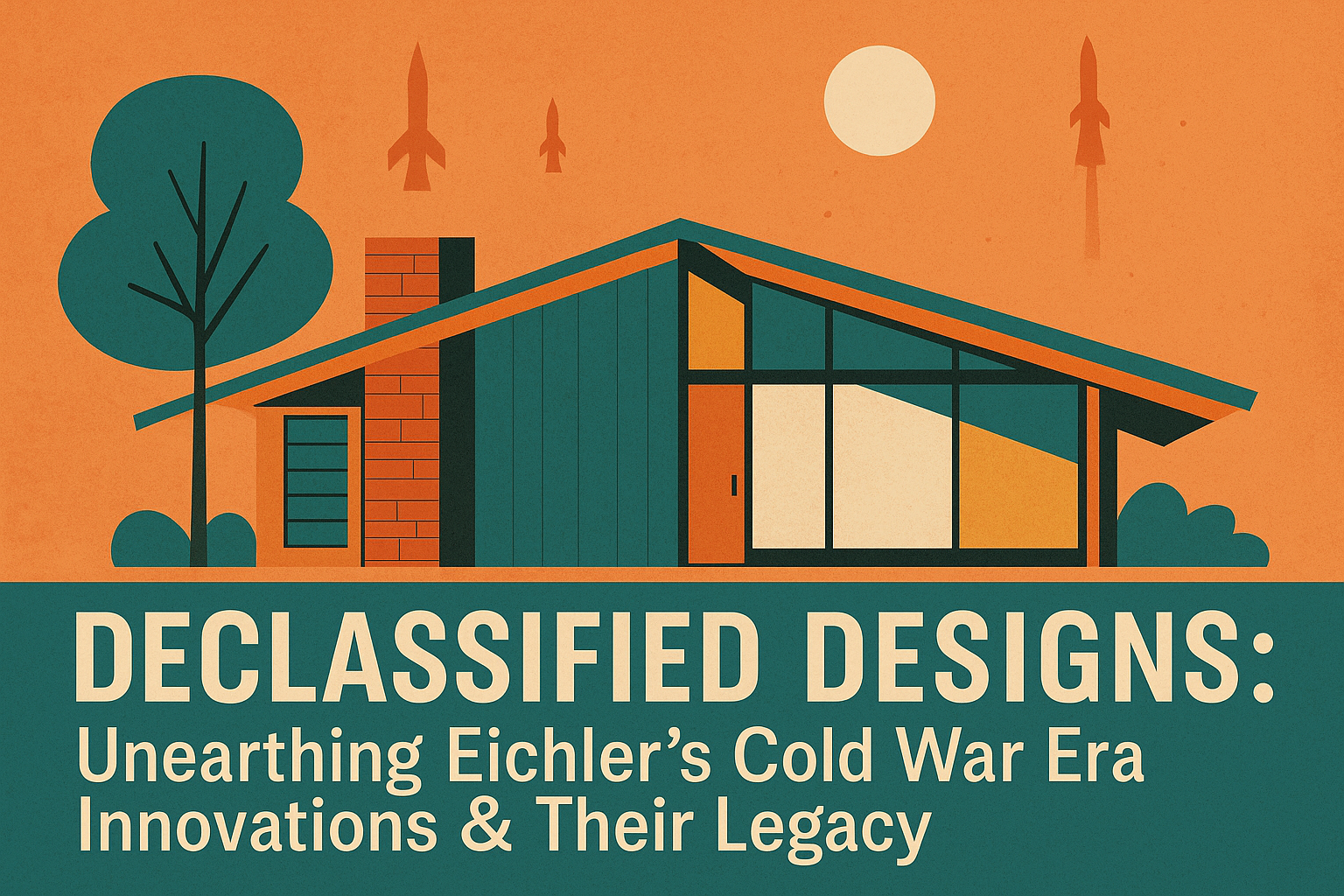
Declassified Designs: Unearthing Eichler’s Cold War Era Innovations & Their Legacy
Postwar Anxieties and Optimism in Eichler’s America
The period after World War II was marked by a mix of deep anxiety and bold optimism. On one hand, Americans faced the looming threat of the Cold War – the possibility of nuclear conflict created an undercurrent of fear in daily life. Many newly suburban families sought privacy and security in their homes even as they remained aware of nuclear dangershouzz.co.nz. On the other hand, the United States emerged from WWII economically strong and culturally confident. A housing boom was underway, fueled by returning veterans, government loans, and a belief in building a better future. The postwar housing crisis and baby boom created enormous demand for new homes, which encouraged builders to adopt new materials, modern designs, and efficient construction methodsacsa-arch.org. Mid-century modern architecture thrived in this climate of innovation. Joseph Eichler, a California developer, stepped into this milieu determined to deliver modernist homes to the masses. His work embodied both the era’s optimism about modern living and responses to its anxieties, making Eichler homes a fascinating product of Cold War influences.
Private Atriums and Walled Gardens: Homes as Secure Sanctuaries
One of Eichler’s signature innovations was the integrated atrium – an open-air courtyard at the center or entry of the home, surrounded by the house itself. Introduced in 1957 to boost sagging sales, the atrium concept was an instant hit and became an Eichler trademarkbalboahighlands.com. In design terms, the atrium created a private outdoor space within the home’s walls, an “inside-outside” room that was open to the sky yet shielded from public view by perimeter walls or frosted screensbalboahighlands.com. This feature spoke directly to Cold War era sensibilities. It gave homeowners a sense of refuge: a place to enjoy sun and fresh air within the secure perimeter of the house, safely tucked away from the street and prying eyes. Few traditional homes of the time offered anything similar – the Eichler atrium was essentially a personal courtyard oasis in an age when people craved both openness and privacy.
Not only did the atrium provide psychological comfort and seclusion, it also expanded the functional living space. Marketing materials of the era touted the indoor/outdoor lifestyle it enabled. For example, a 1960 Eichler brochure highlighted the “enormous atrium and rear patio” as extensions of the living area, blending home and garden for recreation and family lifedwell.com. This emphasis on sheltered outdoor living reflected postwar optimism – the idea that the California good life meant sunshine and togetherness – while also addressing the era’s desire for safe, contained family spaces. The street façades of Eichler houses were often nearly blank and unassuming, but upon entering, one encountered a bright, open atrium and glass-walled rear rooms. This “fortress outside, open inside” layout can be seen as a subtle answer to Cold War anxieties: the home’s exterior presented a low-profile, protected face, while the interior allowed optimism and openness to flourish in a controlled environment. As architect A. Quincy Jones, one of Eichler’s chief designers, once arranged it, approaching an austere Eichler exterior only to step into an airy atrium was a delightful surprisebalboahighlands.com – a juxtaposition of privacy and openness that perfectly suited the mindset of the 1950s and ’60s.
Efficient Design in an Era of Resource Scarcity
The end of WWII and the Korean War brought not just prosperity but also periodic materials shortages and a need for economical building. Eichler’s approach to construction was shaped by the mandate to use resources efficiently without sacrificing quality. His homes are “monuments to functionalism, minimalism, and efficiency,” with many design elements serving dual purposesarchive.curbed.com. For instance, the post-and-beam structural system in Eichler houses eliminated excessive framing lumber by using fewer, sturdier beams – this allowed large expanses of glass between supports and created open floor plans, but also meant building more with less. The open-plan layouts themselves were space-efficient and family-friendly, merging living and dining areas and using a kitchen island or peninsula in lieu of extra wallsarchive.curbed.com. Every element was carefully considered to avoid waste: “everything unnecessary is stripped away,” giving Eichlers a clean, streamlined look typically found only in high-end custom homesarchive.curbed.com. This dedication to simplicity was not only aesthetic but practical in a time of limited resources.
Eichler and his architects also leveraged new materials and technologies developed during WWII. Wartime innovations – from advanced glues and plywood to modern heating – found peacetime applications. Eichler homes came fully equipped with features that had been cutting-edge: radiant floor heating, modular cabinets, Formica countertops, and large plate-glass windows. In fact, Eichler’s houses were often sold with built-in modern appliances and fixtures included, an uncommon value at the time. As one analysis notes, his homes came “fully equipped with plywood walls, built-in ‘streamlined’ appliances and Formica-clad kitchen islands,” providing an elegant yet affordable modern lifestyleacsa-arch.org. By adopting “methods developed by war” to improve civilian products and using an “abundance of materials, new and old” becoming availableacsa-arch.org, Eichler fulfilled the postwar promise of comfort through innovation. He even experimented with alternative construction methods in response to material challenges – most famously with the Eichler X-100 “Steel House” of 1956. This prototype house, built with a steel frame instead of wood, was intended to test whether steel could be a viable, cost-effective solution for tract housingen.wikipedia.orgen.wikipedia.org. The X-100 showcased futuristic appliances and design concepts (its very name evoked the X-series rocket planes of the era) and proved that a steel home could be built for roughly the same cost as wooden.wikipedia.orgen.wikipedia.org. While Eichler ultimately stuck mostly to wood construction, such ventures demonstrate how post-WWII industrial know-how and “Space Age” optimism infiltrated residential design. In short, Eichler’s team made a virtue of thrift and innovation – houses were engineered to use material efficiently, maximize natural light, and integrate modern conveniences, all in response to the pressures and opportunities of the Cold War yearsacsa-arch.orgacsa-arch.org.
The Fallout Shelter Phenomenon: Fear on the Home Front
No examination of Cold War-era housing is complete without considering the fallout shelter craze of the late 1950s and early 1960s. As nuclear tensions peaked, civil defense authorities urged Americans to be prepared. In 1961, President Kennedy even wrote in Life magazine advising families to build fallout shelters, and from 1961 to 1963 sales of home fallout shelters surged dramaticallyen.wikipedia.org. Developers took note of the public’s fears. At the extreme, some promoted bomb shelters as a selling point: at least one Southern California tract builder in 1961–62 offered an optional underground fallout shelter with his new homestoacorn.com. Builders marketed these shelters as a prudent addition to the modern American home. Nationwide, community shelter programs were funded and well-publicized; the iconic yellow-and-black “Fallout Shelter” sign became a symbol of the eraen.wikipedia.orgen.wikipedia.org.
So how did Eichler Homes fit into this trend? Interestingly, Joseph Eichler did not integrate dedicated bomb shelters into his designs. Eichler houses in California were almost all built slab-on-grade (without basements), and the company’s focus was on open, airy layouts rather than bunker-like spaces. There is no evidence that Eichler offered a built-in shelter option in any of his 11,000+ homesarchive.curbed.com – a stark contrast to some contemporaries. It appears Eichler leaned more toward the optimistic side of the Cold War psyche, emphasizing glass walls and openness to nature rather than hunkering down. Homeowners who wanted fallout shelters had to construct them on their own. A few did: anecdotal cases exist of individual Eichler owners adding backyard or partial shelters in later years, but these were exceptions, not the rule. Instead of literal bomb shelters, Eichler Homes provided psychological shelter through design. The privacy of the atrium and fenced yard, the low profile of the house, and the sense of control over one’s environment all served as a kind of emotional bulwark against outside threats. Even Eichler’s architects dabbled in theoretical solutions to Cold War fears – notably A. Quincy Jones’s unbuilt 1961 concept of partially subterranean tract housing (Case Study House #24). That design proposed an entire community of homes set half-underground for “privacy and noise reduction” and improved energy efficiencyeichlersocal.com. While not explicitly a nuclear shelter plan, it shows how designers explored semi-buried dwellings to address the era’s concerns. In practice, Eichler’s built homes stayed above ground and full of glass. In summary, the “fallout shelter” fad influenced the cultural conversation and some housing designs, but Eichler’s contributions lay elsewhere – he chose to fight Cold War fear with openness, transparency, and the idea that a better way of living was the American answer to existential threats.
“Democracy in Housing”: Eichler’s Ideals and Legacy
Joseph Eichler’s work was driven by more than smart responses to Cold War conditions – it was rooted in a profound idealism about American society. He firmly believed in what might be called “democracy in housing”: the notion that good design and comfortable living should be accessible to the average family, not a privilege of the wealthy. Eichler homes were “aimed at young families of average means”, bringing architect-designed modernism within reach of teachers, engineers, and office workersmidcenturyhome.commidcenturyhome.com. This was very much in line with postwar American ideals. After the war against fascism, there was strong ethos of expanding freedom and opportunity at home. In housing, that meant mass homeownership in the suburbs – often touted as a patriotic reward for veterans and a bulwark of American democracy against communist critiques. Eichler embraced that spirit, but he also pushed it further by insisting on inclusivity. In an era when many builders and neighborhoods enforced racist exclusion, Eichler stood out by selling his homes to anyone qualified, regardless of racearchive.curbed.com. He was one of the first major developers in California to do so, quietly integrating his subdivisions in the 1950s. When the national builders’ association (NAHB) supported housing discrimination in 1958, Eichler famously resigned in protest, declaring that Eichler Homes “in no way practices any kind of discrimination,” and that builders have a responsibility to the community and nation beyond just making a profitmotc.orgmotc.org. This stance was decades ahead of its time and earned him both criticism and admiration. Eichler’s ultimate goal, as his son Ned put it, was to build “well-designed houses with a sense of moral purpose.”archive.curbed.com He felt that providing quality homes for middle-class families – homes that foster openness, family interaction, and neighborly equality – was a moral mission as much as a business. In the Cold War context, this was a powerful statement: it implied that the American way (inclusive, egalitarian, optimistic) could triumph over old prejudices and fears. Indeed, Eichler’s success in selling integrated housing without financial loss helped pave the way for broader fair housing efforts in the 1960smotc.orgmotc.org. It connected to postwar ideals of freedom, equality, and the pursuit of happiness, showing that the American Dream of homeownership could be shared by all.
Legacy of Eichler’s Cold War Era Innovations
The innovations Joseph Eichler and his architects pioneered during the Cold War era left an enduring imprint on American suburbia and beyond. The Eichler atrium, once a novel solution to combine security and openness, is now a beloved feature emulated in countless modern homes – the idea of a private courtyard or “outdoor room” remains popular for the same reasons Eichler identified: it brings light and nature in while maintaining refuge-like privacy. Eichler’s emphasis on indoor-outdoor integration, post-and-beam openness, and efficient use of space presaged today’s focus on sustainable and uncluttered design. Features like open-plan kitchens, floor-to-ceiling glass walls, and radiant heated floors – radical in the 1950s – have become mainstream expectations in contemporary home design, underscoring how ahead of their time Eichler’s houses were. Not least, Eichler’s principled stand on “moral” housing development helped embolden later generations to pursue diversity and inclusivity in communities, aligning with the civil rights movement and fair housing laws.
In retrospect, Eichler Homes can be seen as declassified blueprints of mid-century America’s psyche: they reveal how a nation coped with fear by redesigning its domestic life. Post-WWII anxieties and optimism are literally built into these homes – in their sheltered atriums and bold glass, their economical construction and futuristic amenities, their egalitarian neighborhoods and modern style. Eichler’s experiment proved that one could build not only houses, but also hope. In the shadow of the Cold War, Joseph Eichler’s innovations offered families a new way of living – one that was forward-looking, inclusive, and resilient. That legacy endures in the timeless appeal and social impact of Eichler’s mid-century modern neighborhoodsarchive.curbed.comarchive.curbed.com. They remain a testament to an ideal: that even in the most uncertain times, good design and good ideals can shape a better world at home.
Led by top-producing agents Eric and Janelle Boyenga, the Boyenga Team at Compass brings unmatched expertise to the Eichler real estate market. As recognized leaders in Silicon Valley luxury and mid-century modern homes, they offer insider knowledge, architectural fluency, and data-driven strategies to help clients buy and sell iconic properties with confidence. Whether you’re seeking an original Claude Oakland atrium model or a restored Eichler in a top school district, the Boyenga Team provides Property Nerdish guidance every step of the way.
Sources:
Eichler Network (Balboa Highlands) – “The Eichler Atrium”balboahighlands.com
Curbed (Leora Tanjuatco, 2015) – “They Like Eich”archive.curbed.com
Houzz Magazine (Rebecca Gross, 2014) – “Atomic Age Design”houzz.co.nz
Dwell (Jennifer Baum Lagdameo, 2021) – “Unsung Story of Eichler Homes”dwell.com archive.curbed.com
ACSA Proceedings – “Seamless Living: Legacy of Eichler Homes”acsa-arch.orgacsa-arch.org
Wikipedia – “X-100 (Eichler steel house)”en.wikipedia.org; “Fallout shelter”en.wikipedia.org
Museum of the Courageous – “Joseph Eichler” (anti-discrimination stance)motc.orgmotc.org
EichlerSoCal – Case Study House #24 (underground concept)eichlersocal.com
Local News (Thousand Oaks Acorn) – fallout shelter marketing in 1961 toacorn.com