
Designing an Eichler Home Interior with Iconic Mid-Century Furniture
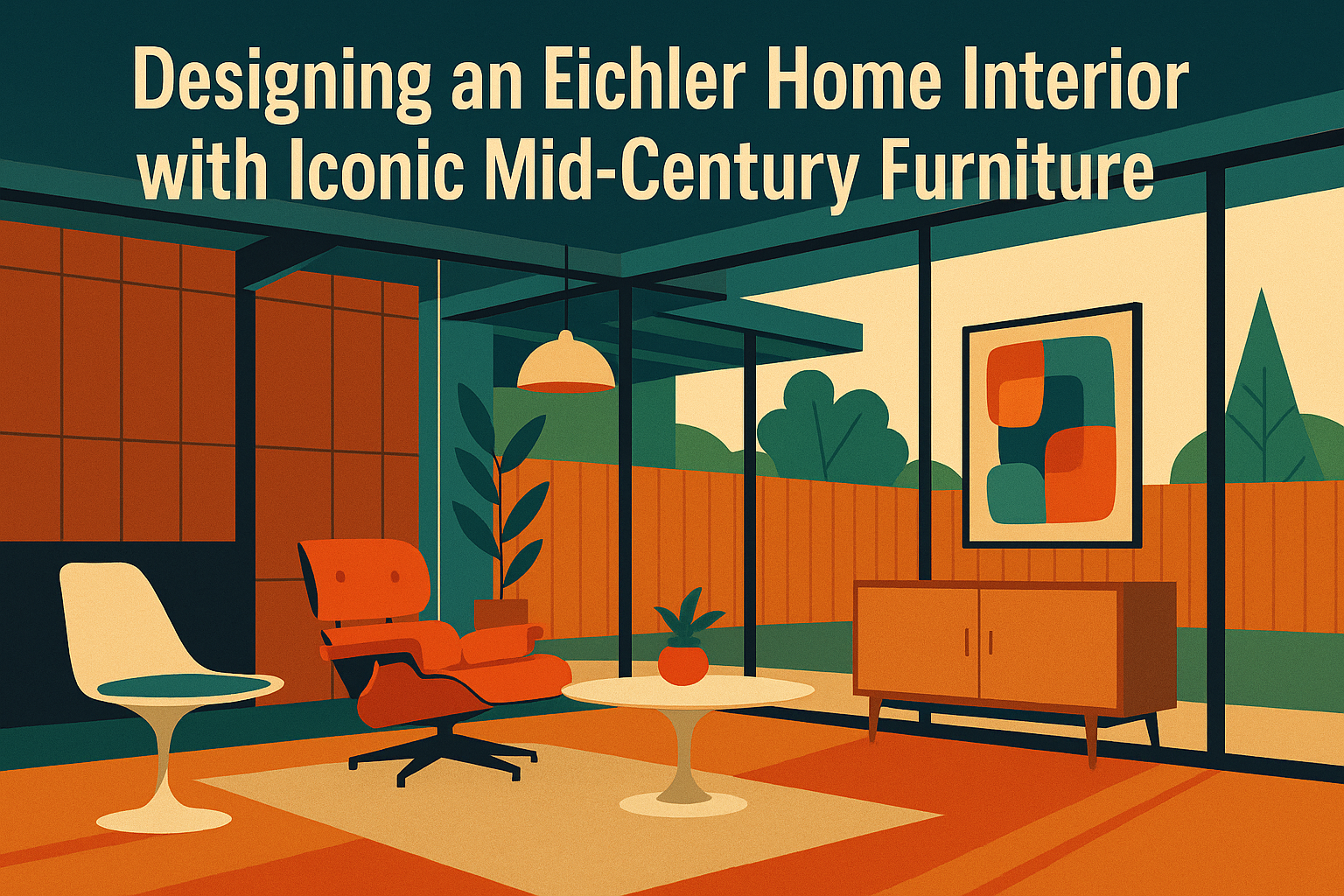
Planning Eichler Interiors Around Iconic Mid-Century Furniture
Joseph Eichler’s mid-century modern homes are famed for their open plans, post-and-beam construction, and glass walls that blur indoors and out. Furnishing these spaces offers a chance to highlight the era’s most iconic furniture pieces – designs like the Eames Lounge Chair, Noguchi Coffee Table, and Nelson Platform Bench. These classics can serve as visual and functional anchors around which an entire interior is planned. This guide will show how to leverage each piece as a focal point, craft layouts suited to Eichler architecture, balance scale and proportion, choose period-appropriate materials and palettes, and blend authenticity with comfort (including when to use quality replicas). We’ll also explore room-by-room tips for Eichler living rooms, dining areas, and bedrooms, with insights from design experts and historians throughout.
Using Iconic Furniture as Anchors
Mid-century modern design is defined by statement furniture that combines form and function. In an Eichler home, starting your design with an iconic piece gives instant character and a reference point for the rest of the room. As Eichler Network notes, designs with provenance – like the Eames Lounge, Noguchi table, or Nelson bench – help set the stage for a timeless interior. These pieces are not just famous for their looks; they’re celebrated for how they shape a space. Below we break down each of our three focus icons and how to use them as anchors in your Eichler interior.
Eames Lounge Chair & Ottoman: Comfort as a Focal Point
The Eames Lounge Chair and Ottoman (designed 1956) is perhaps the most recognizable mid-century chair – “one of the most enduring symbols of midcentury furniture”housebeautiful.com. With its wood shell and leather upholstery, it exudes luxury and comfort. Charles Eames famously said it should feel “like a well-used first baseman’s mitt” – worn, soft, and invitingscandinavia-design.fr. Indeed, the Eames Lounge was designed to surpass the comfort of a traditional club chair while looking lighter and more modernscandinavia-design.fr. This makes it an ideal anchor piece that is as comfortable as it is beautifulstore.moma.org.
How to Anchor a Room with an Eames Lounge: Place the chair in a spot where it naturally draws attention – for instance, in a corner near Eichler’s floor-to-ceiling glass to create a cozy reading nook with a view. Designers advise positioning it by a large window to soak up natural light and outdoor sceneryhomiodecor.com. In an open-plan Eichler living room, you can also give it pride of place as a centerpiece of the seating area. One approach is to angle the Lounge Chair slightly toward the sofa or coffee table, establishing a welcoming conversation clusterhomiodecor.com. This angled placement looks intentional and invites people to sit and engage.
Pair the Eames Lounge with a compatible side table or coffee table so it functions as a comfortable reading or lounging station. A classic pairing is the Lounge Chair with a low-slung Noguchi coffee tablehomiodecor.com (more on that table next) or a simple round side table to hold a book and drink. Make sure to leave breathing room around the chair – it shouldn’t be crowded by other large pieces, allowing its sculptural profile to stand out. Many Eichler enthusiasts like to position the Eames Lounge facing outward toward the view or fireplace, making it a destination spot in the room. As one design writer notes, an Eames Lounge in the living room naturally “steals the show” as a focal point while still making the space feel cozy and livablehomiodecor.com.
Designer Tip: Think of the Eames Lounge Chair as both furniture and art. It can anchor a reading corner with a tall arc floor lamp overhead, or sit by a fireplace as the ultimate lounge seat. Layer a soft throw blanket and a small pillow on it to echo colors in your palette and emphasize its inviting comforthomiodecor.com. “The Eames lounge chair is the perfect place to enjoy the surrounding view,” notes Atomic Ranch – ideal for an Eichler’s glass-walled spacesatomic-ranch.com. Use it where you would love to linger; its presence elevates the entire room’s style.
Noguchi Coffee Table: A Sculptural Centerpiece
Designed in 1944 by artist/designer Isamu Noguchi, the Noguchi Coffee Table is an elegant, biomorphic piece that can center an Eichler living area. It consists of a thick free-form glass top resting on two interlocking curved wood legs – only three pieces in total. The design is often described as “a beautiful sculptural exercise in both art and design”, an “understated and impressive 3-piece balancing act”housebeautiful.com. With its clear glass top and sculptural base, the Noguchi table brings an artful quality without adding visual heaviness. It’s “at once artful and practical”, achieving “stunning simplicity” in formhousebeautiful.com.
Using a Noguchi Table as an Anchor: In an open-plan Eichler living room, the coffee table often becomes the centerpiece of the seating arrangement. The Noguchi table is perfect for this role because its transparency and organic curves keep the space feeling open. Place it centrally on a rug with your sofa and lounge chairs grouped around it. Its low profile (about 15″ high) and rounded triangular top allow for easy flow around it – great for Eichler layouts where living and dining spaces connect. The glass top means you can even appreciate the area rug or floor pattern through the table, and it won’t block sight lines across the roomreddit.com.
Because the Noguchi table is such a sculptural focal point, ensure the pieces surrounding it complement rather than clutter it. For example, if you have an Eames Lounge Chair or a low sofa, the Noguchi’s curvy form nicely offsets those clean lines. Keep nearby seating somewhat low-slung so the table’s shape is visible (avoid tall, skirted sofas that would hide the table). Also consider shape contrast: if your other furniture has lots of straight lines, the Noguchi’s amorphous shape will stand out even more. On the flip side, if you have other organic shapes (like a curved sofa), the table will echo that for a cohesive look.
Since the Noguchi table has a delicate glass top, it’s best used to display books or a few artful objects, rather than as heavy-duty storage. Embrace its art piece quality – for instance, let a pendant light or the natural light from Eichler clerestory windows shine through it. Herman Miller (the manufacturer) praises how thoughtfully calibrated the Noguchi design is, achieving balance and stability with minimal componentshousebeautiful.com. In practical terms, that means it’s sturdy for everyday use (the thick tempered glass is durable), yet it almost “floats” in the room visually. This makes it ideal for preserving the airy, open feel of an Eichler living space.
Design Historian’s Insight: The Noguchi table was introduced by Herman Miller in 1947 and immediately lauded as a masterpiece. It blends art and function seamlessly – House Beautiful notes that with its curved wood base and simple glass top, the Noguchi table is “distinctly understated… at once artful and practical”housebeautiful.com. Expert tip: If you have a beautiful textured rug or original Eichler concrete floor, a glass coffee table like Noguchi’s lets it show through, enhancing the sense of space. Just be mindful of upkeep: the glass top can smudge, so use coasters and clean it regularly to keep that elegant, transparent look.
Nelson Platform Bench: Versatile Mid-Century Utility
The Nelson Platform Bench (designed by George Nelson in 1946) is a multitasking icon of mid-century design. At first glance it’s a simple slatted wooden bench on legs – often compared to a stylish locker-room benchirishtimes.com. Yet this simplicity is exactly its strength. Nelson, an architect-turned-designer, believed in “honest” design, and the bench’s rectilinear lines and exposed structure reflect that philosophyhermanmiller.comirishtimes.com. It was called a “landmark of modern design” upon its launchirishtimes.com. The solid wood slats (traditionally maple or walnut) are spaced to let light through and finger-jointed for strengthirishtimes.com. The result is a piece that announces its purpose clearly as a bench or low table, and does so with warmth and craftsmanship.
Anchor Uses for a Nelson Bench: The genius of the Nelson Platform Bench is its versatility. In fact, Herman Miller’s original catalog suggested it was “primarily a high base for [storage] cases, but it also serves as a low table or extra seating.” By the 1950s they noted it “proved to be one of the most flexible and useful” pieces in the collectionirishtimes.com. What does that mean for your Eichler interior? It means this one piece can anchor different spaces in different ways:
As a Coffee Table: In the living room, a Nelson bench (especially the 4-foot or 5-foot version) can substitute for a coffee table. Its long, low surface is perfect for books, decor, or a tray for drinks. The slatted design adds texture and a linear focal point. Unlike a bulky coffee table, the bench keeps a low profile, again preserving sight lines – a boon in glass-walled Eichlers. It’s “functionally frank” as Herman Miller says, so feel free to actually put your feet up on it or use it for casual setting of itemshermanmiller.com. Add a cushion or two on part of it to soften the look and provide a pop of color or pattern.
As Seating or a Bench: True to its name, it works as a bench for seating. You might use a Nelson bench in an Eichler entry or atrium as a place to sit and remove shoes, or along a window wall for extra perch seating that doesn’t block the view. Many Eichler homeowners place a Nelson bench against the glass looking onto the courtyard or backyard – guests can sit and enjoy the scenery, and when not in use the bench’s low slat-back form is visually unobtrusive. If you use it for seating for any length of time, consider adding a custom bench cushion or some pillows for comforthermanmiller.com. It was originally meant to be firm (legend has it Nelson designed it to discourage long-winded visitors in his office!), so a cushion helps blend comfort with the design.
At the Foot of the Bed: In Eichler bedrooms (which we’ll discuss later), a Nelson platform bench makes a great anchor at the foot of a platform bed. It provides a place to drape a blanket or sit while dressing, tying into the mid-century aesthetic of the home. Its horizontal form complements the typically low, horizontal lines of Eichler furniture and the post-and-beam lines overhead.
Under Storage or Display: Because it’s so sturdy, the platform bench can literally serve as a base for storage cabinets or displays. You might stack a set of Nelson Basic Cabinet Series units on a bench, as originally intended, to create a unique credenza. Or simply use it to display plants, sculptures, or a record player in the living room. It’s a piece that earns its keep through functionality, able to carry weight without fusshermanmiller.com.
In all these roles, the Nelson bench’s clean, linear look ties the room together. Its wood material also adds warmth that echoes the exposed wood in Eichler interiors (like ceilings and paneling). As a mid-century historian notes, the bench’s immediate success lay in its versatility and its honest expression of functionirishtimes.comirishtimes.com. It brings a touch of authentic 1940s modernism to your home but is utterly useful in today’s living.
Expert Tip: The Nelson Platform Bench is an ideal piece if you value flexibility. Interior designers often use it to bridge spaces in an open plan. For example, place it behind a sofa as a low divider between living and dining areas – it adds a functional surface (for magazines, decor, or extra seating) while keeping sight lines open due to its low height. Or tuck it below a large window; at only 14 inches tall, it won’t obscure the glass. As Herman Miller emphasizes, you can even make it more inviting by adding a Nelson bench cushion or pillows for a splash of color and comforthermanmiller.com. Few pieces from the 1940s feel as at home in a modern Eichler as this bench does.
Layout Tips for Eichler Architecture
Designing an interior for an Eichler means working with the unique architectural features: open concept layouts, walls of glass, exposed post-and-beam structures, and often a seamless flow between rooms. These elements were pioneering in mid-century tract homes and remain compelling today – but they do influence how you arrange furniture. Here are key layout considerations and tips specific to Eichler homes:
Embrace the Open Plan: Most Eichlers have minimal interior walls separating the main living spaces. Living, dining, and often kitchen areas flow together. To create definition without walls, use your furniture placement and rugs to delineate “zones.” Float furniture away from walls where possible – for instance, float a sofa in the middle of the living area to create a conversation grouping oriented toward a fireplace or view, rather than lining the sofa against a wall. This takes advantage of the open plan and keeps sight lines clear. A designer from Destination Eichler suggests sketching a floor plan and aiming for an “open and uncluttered arrangement that promotes flow”destinationeichler.com. In practice, that means leaving pathways for traffic (to the atrium, to the backyard sliders, etc.) and not overfilling the space. A few iconic pieces can have more impact than many ordinary pieces; let them breathe.
Don’t Block the Glass: Eichlers famously feature floor-to-ceiling glass walls and sliding doors opening to patios or atriums. You want to preserve the indoor-outdoor connection that these provide. Therefore, choose low-profile furniture near windows. As one Eichler staging expert puts it, opt for “low-slung, clean-lined seating that doesn't block the view.” For example, a low-back couch or slat bench in front of glass is far better than a tall shelving unit or high-backed armchair. This ensures the line of sight remains open to the outside, maintaining that signature Eichler feeling of “living in a glass pavilion.” Low furniture (like our Noguchi table, Nelson bench, or even an Eames Lounge, which sits relatively low) keeps views of the outdoors and the rhythm of the post-and-beam structure visible.
Leverage the Post-and-Beam Rhythm: Eichler’s post-and-beam construction means exposed beams across the ceilings and posts at structural points (often at the glass walls’ corners). This regular grid of beams creates a visual rhythm and often dictates spacing in the room. Align key furniture pieces with the structural rhythm when possible. For instance, you might center your dining table under a module of the ceiling between beams, or position a sofa so that a ceiling beam runs symmetrically above it. This alignment creates a harmonious look, reinforcing architecture with furniture placement. The exposed beams also allow for visual transparency in the home, as Atomic Ranch notes – “you’re able to see so clearly how the house was constructed”, which adds characteratomic-ranch.com. Keep that in mind: don’t obscure beams or ceiling with things like tall armoires or floor lamps that reach too high. Most Eichler interiors look best when furniture stays below the height of the window mullions or beams.
Center on the Hearth (or Atrium): Many Eichlers have a central fireplace (often a brick or concrete block hearth that may serve as a partial divider between living and dining). Use that architectural anchor to your advantage. Arrange seating in a cozy radius around the fireplace, with your iconic lounge chair and sofa oriented to both the fire and the view beyond the glass. Similarly, if your Eichler has an atrium (an open-air entry court surrounded by glass), consider the sightlines to it. Align your furniture so that when you’re seated, you can appreciate the atrium’s plants or sculpture. Orient chairs and sofas toward points of interest – a common strategy is a “U-shaped” seating around a Noguchi table, open on one side to the view or fireplace.
Create Intimate Areas within the Large Space: While Eichlers have large, open rooms, you still want human-scale comfort. Use rugs, lighting, and furniture groupings to make intimate conversation or reading areas. A pendant light (like a George Nelson Bubble Lamp) over the dining table creates a dining “room” effect within the open space. Likewise, a floor lamp arching over an Eames Lounge Chair creates a little reading zone. These cues define functional areas without any actual partitions.
Keep Circulation in Mind: Take note of how people will move through the house – from entry to living room, from living to kitchen, and from indoors to outdoors. Arrange furniture so it doesn’t impede these natural paths. In an Eichler, for example, you typically have large sliding glass doors to the backyard; don’t put a heavy credenza right in front of that door’s path. Instead, maybe flank the door with two lounge chairs or plants, leaving the center clear. Use Nelson benches or low tables as subtle space dividers that can be stepped over or around easily, rather than tall bookcases that block flow.
Remember Joseph Eichler’s original goal: democratic, livable modernism. The design strategy of post-and-beam openness with quality materials gave these mass-produced homes a high-quality environment feelingatomic-ranch.com. Your interior layout should likewise feel free, open, and accessible, with furniture enhancing the architecture rather than fighting it. When in doubt, simplicity and symmetry often work best in these spaces – they echo the simplicity of Eichler architecture itself.
Scale, Balance, and Proportion in Furniture Selection
Eichler homes tend to be moderate in scale – often single-story, with ceiling heights around 8 feet (sometimes with open beam ceilings following the roof slope). Rooms are airy but not enormous by today’s standards. Therefore, being mindful of scale and proportion is crucial when selecting furniture. Mid-century modern pieces generally align well here: they were designed for human scale and often have a low-slung, lightweight appearance. Still, you should strive for a harmonious balance in each room. Here are some guidelines:
Choose Appropriately Sized Furniture: Avoid oversized, overstuffed furniture that would overwhelm an Eichler space. For instance, a gigantic sectional couch that dominates a McMansion’s great room might simply look out of place in an Eichler living room. Instead, opt for low-profile sofas and chairs with sleek lines. Mid-century pieces (or their modern replicas) usually have compact proportions – use those to maintain good scale. Ensure that major pieces like the sofa, coffee table, and lounge chair are scaled to the room’s dimensions and to each other. A helpful step is to measure your space and map out furniture footprints before buyingdestinationeichler.com. For example, if you’re anchoring with an Eames Lounge (which is about 32″ tall and 33″ wide), a heavy, high-back sofa next to it might dwarf it; a sofa with a back height around 30″ will pair more gracefully.
Balance Visual Weight: Balance is key in mixing furniture pieces. If you have one very bold or large element, counter it with something visually lighter rather than another hulking piece. An Eichler interior often benefits from this kind of contrast. For instance, the Eames Lounge + Ottoman has a certain bulk (the dark leather, the wood, the presence of the ottoman). You could balance it by having a more slender-legged sofa across from it, or a delicately detailed side chair in a vibrant color nearby. Conversely, if your sofa is a strong color or form, you might choose a Nelson bench or transparent Noguchi table to lighten the composition. “If you have a large, bold piece of furniture, pair it with a piece that’s more delicate in detailing but vibrant in color to balance out the difference,” advises Eichler design experts. This kind of interplay creates interest and ensures no single item overpowers the room.
Maintain Proportion in Groupings: When arranging your iconic pieces together, consider their proportions relative to each other. For example, the Noguchi table has an amorphous shape roughly 50″ long; it tends to look best when the seating around it spans a similar width – a 6 to 7-foot sofa pairs nicely, with chairs on the other side, so the grouping feels proportional. The Nelson bench comes in lengths up to 6 feet; if you use a long one as a coffee table, make sure your seating spans at least that length around it so it doesn’t stick out oddly. In dining areas, proportion is about table size and chair count – a round Tulip table or a rectangular table should fit the room with enough clearance, and the chairs should fit comfortably around without crowding (ensure you can walk around the pulled-out chairs easily in an open plan).
Consider Ceiling Height and Furniture Height: Eichlers often have exposed ceiling beams that are not very high; tall furniture can make the space feel cramped. So avoid super-tall bookcases or armoires in main living areas. If you need storage, a low credenza (say 30″ high) or modular wall units kept to a lower height is better. For instance, a George Nelson Basic Cabinet on a platform bench creates storage at waist height, leaving walls above open – this keeps the visual focus on Eichler’s horizontal lines. Likewise, choose low-back chairs and sofas that align below the window height. This way, the horizontal expanse of glass and the extension of the outdoors remains the star.
Symmetry vs. Asymmetry: Mid-century design often played with asymmetrical arrangements (e.g., a off-center placement of a lounge chair relative to a sofa). This can work well in Eichler spaces to avoid formality. However, too much asymmetry might feel chaotic in an open space. A good approach is balanced asymmetry – for example, you might not place two identical chairs facing a sofa (which is a very symmetrical layout). Instead, place one Eames Lounge on one side and a pair of smaller armless chairs on the other side to balance it out. They’re not identical, but the visual weight on each side of the sofa is comparable. The goal is a sense of equilibrium. As one interior tip puts it, “strategically blending pieces together will help create spaces that are inviting and interesting”, with every area feeling resolved. Step back and look: Does one side of the room feel “heavier” or taller than the other? Adjust by adding or removing elements to even it out.
Layer in Small Pieces Proportionately: Don’t forget to size accessories and art in proportion too. In a room anchored by big design icons, the supporting cast should neither be too tiny (and get lost) nor too huge (and distract). For example, over an Eames Lounge you might hang a large abstract painting to give that wall presence (the chair can visually support it). Above a low sofa, a long horizontal artwork might echo the length. Lighting should likewise fit – a Nelson Bubble pendant comes in sizes, so pick one that suits your table and ceiling height (commonly, the 19″ or 25″ diameter works well over Eichler dining tables).
In sum, follow the mid-century principle of human scale: furnishings should feel comfortable to use and leave room to breathe. An Eichler interior achieves greatness when the furniture feels curated and balanced – each piece distinct, yet contributing to a cohesive whole. If in doubt, edit out an item rather than cram too much. A well-proportioned, balanced room with a few bold icons will always feel better than a cluttered space, no matter how beautiful the individual pieces are.
Designing Around Iconic Pieces (Reverse-Engineering Your Room)
A useful strategy for interior design is to pick your statement piece first, then build the rest of the room around it. In an Eichler home, this approach can be very effective, since one iconic piece can set the tone for the entire space. Here’s how to reverse-engineer your room design once you’ve chosen one (or more) of the mid-century icons we’ve discussed:
Start with a Focal Piece & Define Its Zone: Suppose you begin with the Eames Lounge Chair as the must-have item. First, decide where it will live in the room – this becomes a focal zone (be it a reading nook or part of the main seating area). Once placed, orient other elements to complement it. For instance, if the Eames Lounge is angled towards the center of the living space, you might position the sofa opposite it at a complementary angle, establishing a conversational layouthomiodecor.com. The Eames Lounge’s black leather and wood can also inform your color scheme (perhaps you echo the black in other accents, and the wood tone in your casework or flooring).
Pair Complementary Iconic Pieces: Many mid-century designs were meant to work together aesthetically. A classic example is pairing the Eames Lounge with the Noguchi coffee table we described. In fact, one design guide specifically suggests “pair the Eames with a Noguchi coffee table or a sleek glass-topped table to enhance the mid-century vibe.”homiodecor.com The curvy Noguchi table complements the angular lines of the Eames chair’s plywood shell. Similarly, the Nelson bench can pair well with low-slung sofas or with a couple of Eames Molded Plastic Chairs (if used in an entry or multi-use area) to create a stylish sitting spot. When you choose one iconic piece, identify 1–2 other pieces that harmonize with it in era, materials, or form. Often these combinations are well-documented in design literature – for instance, Eames chairs around a Saarinen Tulip dining table, or a Nelson bench beneath a Nelson Bubble Lamp in a foyer.
Coordinate Materials and Finishes: Reverse-engineering a room means letting the anchor piece guide your material choices. If you have a Noguchi table with a walnut base, consider a walnut finish for other wood furniture in the room (like a credenza or bookshelf) so there’s a thread of consistency. If your Eames Lounge has black leather, perhaps your sofa could be a coordinating neutral (charcoal, white, or a tweed fabric) to let the chair remain standout, with black accents in pillows or lamps tying it in. Echoing a material can unify the space: for example, the Nelson bench’s maple or walnut slats might repeat in the dining chairs or in the frames of wall art. Just avoid mixing too many wood tones or metals indiscriminately – a coherent palette of a few wood tones and metal finishes will make everything feel intentional.
Plan the Layout Around the Anchor: Use the anchor piece to determine furniture spacing and traffic flow. If the anchor is a coffee table (Noguchi), then arrange seating at appropriate distances around it (usually 14–18 inches from the edge of the table for leg comfort). If the anchor is a lounge chair (Eames), decide what it faces – maybe it faces the sofa and Noguchi table, forming a triangle of seating. Ensure the anchor has its moment: for example, don’t hide an Eames Lounge in a corner behind a plant; instead, give it open space and perhaps a floor lamp to highlight it. Layer supporting furniture strategically: a small side table next to the Eames chair provides function without stealing focus, while a textured area rug under the whole grouping can frame the anchor piece effectively.
Use Color Accents Wisely: If your iconic piece has a distinctive color (say you have an Eames Lounge in ivory leather, or a vintage Nelson bench painted black), you can pick up that color elsewhere to create cohesion. However, if the iconic piece is meant to pop (like a bold orange cushion or a bright red Eames shell chair in a dining area), then keep surrounding elements more neutral to allow that pop. Balance is important: a strong color in one anchor piece can be balanced by a different strong color in a smaller accessory across the room (think of how art or throw pillows can echo a hue). Eichler interiors often used neutral bases with “saturated accent colors” in decor – so a room built around a neutral iconic piece might invite a brightly colored secondary piece or vice versa.
Layer in Contemporary Complements: Designing around mid-century icons doesn’t mean everything else must be mid-century. On the contrary, mixing in some contemporary pieces can create a dynamic, personalized lookdestinationeichler.com. For example, if you anchor a room with a Noguchi table and Eames chair, you could choose a new sofa with modern proportions but clean lines that echo mid-century simplicity. Or incorporate a contemporary media console in white lacquer that doesn’t compete with the vintage style pieces. The key is maintaining a dialogue: let the iconic pieces be the stars, and the modern additions play a supporting role by picking up a color or geometric form from them. Keep ornamentation minimal so the focus remains on the quality of the iconic designs.
Don’t Forget Lighting and Art: Once your furniture layout is set around your anchor pieces, choose lighting and artwork to highlight them. A pendant or floor lamp can literally spotlight your anchor. Wall art can be hung to balance out an iconic piece visually (for instance, art behind a Nelson bench on a wall will draw the eye to that vignette). In Eichler homes, George Nelson Bubble Lamps or other mid-century inspired fixtures can double-down on the style and create cohesion between architecture and furnishingsdestinationeichler.com. Also consider a tall plant or two to accent your anchor pieces – a fiddle leaf fig in the corner can look stunning next to an Eames Lounge, softening its leather-and-wood masculinity with organic form, while reinforcing the indoor-outdoor vibe.
Tip from a Designer: When reverse-engineering a room around a key piece, imagine that piece as the protagonist and the rest of the furniture as the supporting cast. Everything should help tell the design story of your room. If the protagonist is a sculptural Noguchi table (story: “organic artistry”), then perhaps a sofa with subtle curves or a pair of rounded armchairs support that theme. If the protagonist is the Eames Lounge (story: “luxurious modern comfort”), then a sleek low sofa and a rich textured rug support it by creating a cozy setting. As the Destination Eichler design blog advises, “define your vision” early by deciding on that statement piece and the mood you wantdestinationeichler.com. Then all other choices become easier because they refer back to that vision.
By planning rooms this way, you ensure that your iconic mid-century pieces don’t feel randomly placed, but rather integrated into a cohesive design. The result will be an Eichler interior that looks thoughtfully curated and centered around what you truly love.
Materials, Finishes, and Era-Consistent Palettes
One hallmark of mid-century modern interiors (and Eichler homes in particular) is a thoughtful mix of materials and a strategic use of color. Authenticity in an Eichler interior often comes from embracing the materials originally used in the 1950s-60s as well as a color palette that complements the architecture. Here’s how to choose materials, finishes, and colors that reinforce your mid-century Eichler vibe:
Materials and Finishes:
Wood: Eichler homes themselves feature a lot of wood – from exposed wood ceilings (often tongue-and-groove boards) to mahogany or luan wall paneling in some models. Playing off that, mid-century furniture loves wood tones. Teak, walnut, rosewood, and ash were common in the era and pair beautifully with Eichler post-and-beam construction. Many iconic pieces are wood-based: the Eames Lounge has a plywood shell in walnut or Santos rosewood veneer; the Noguchi table base is often walnut, and the Nelson bench typically comes in light maple or walnut. Using matching or complementary wood finishes will create harmony. For example, if your Eichler ceiling beams are a warm reddish-brown, picking a chair or table in walnut will resonate. Herman Miller’s line still offers these pieces in period-correct finishes for that reason. Natural wood also adds warmth and highlights the indoor-outdoor theme (wood feels organic, tying to the outdoors).
Metal: Mid-century design made selective use of metals – often in slim, structural ways. In Eichler interiors, you might see aluminum window frames, or brick fireplace surrounds with metal trim. Iconic furniture brings metal in too: the Eames Lounge’s base is die-cast aluminum, usually black painted with chrome trim; the Nelson bench can have chrome legs; many mid-century floor lamps and table legs were brass or steel. Stick to clean-lined metal accents – hairpin legs, simple steel frames, brushed nickel or blackened steel finishes. Avoid overly ornate metalwork. A mix of metal and wood is very mid-century (e.g., a wood cabinet with slender metal pulls, or a metal-legged sideboard). Since Eichler designs are minimal, a few touches of metal (like a chrome arc lamp or the brass tips of furniture legs) will go a long way in adding sparkle without gaudiness.
Glass and Acrylic: Glass is literally built into Eichlers (all those windows!), so including glass in your interior is seamless. The Noguchi table’s glass top is a prime example – it echoes the transparency of Eichler walls. You could also incorporate glass in light fixtures (globe pendants, for instance) or accessories. Acrylic (Lucite) was a later-mid-century trend; a Lucite coffee table or chair could work, but in an Eichler context it might feel a bit too 1970s. Generally, clear or textured glass is safest for keeping the classic look. Mirrors can also amplify light and views, but use sparingly so as not to feel too retro in a dated way – maybe a small sunburst mirror nods to mid-century without overwhelming.
Stone/Brick and Concrete: Many Eichlers have concrete slab floors (often originally with cork tile or carpet, but nowadays owners might polish the concrete). If you have exposed concrete, consider leaving it visible in portions – it’s a cool, industrial counterpoint to warm wood furniture. You can always add a rug for comfort (perhaps a shag rug or a geometric patterned wool rug for mid-century flair). Brick or stone fireplaces are common; coordinate with those textures by using simpler finishes elsewhere (solid wood furniture against a brick wall creates nice contrast). You generally wouldn’t introduce new types of stone in a mid-century interior beyond what’s there (like skip the travertine coffee table, unless it’s a known vintage design). Instead, let the original materials of the house shine and choose furniture that complements them.
Textiles: Don’t overlook fabric choices – they tie into both comfort and authenticity. Classic mid-century textiles include tweeds, woven wool, and knits in furniture upholstery, as well as leather. For instance, the original Eames Lounge comes in leather (black or cigar brown are classic), and many vintage sofas were done in textured weaves or even velvet. You can incorporate era-appropriate patterns through accent pillows or curtains – think geometric prints or the occasional atomic-era motif. However, Eichlers often forego heavy drapery to keep that clean look; if you need window coverings, simple roll shades or panels in neutral tones work best, possibly paired with sheer curtains for softness. Keep any textile prints in the color scheme of the home (more on colors next). A fun nod to the 60s could be a small pop of pattern like a starburst or boomerang shape on a pillow, but moderation is key.
Color Palette:
Eichler interiors traditionally use a restrained base palette with strategic pops of color. According to Eichler design experts, “mid-century colors tend to combine darker neutral tones with saturated accent colors.” Often you’ll see white or off-white walls (or very light gray) as a neutral backdrop, which allows the architecture and furniture to stand out. Eichler homes frequently had white ceilings and beams (or natural wood ceilings) with off-white walls, creating a gallery-like backdrop for colorful art and furnishings.
Neutrals and Earth Tones: Use neutral colors for large surfaces – white, cream, light gray on walls and perhaps larger furniture pieces like a sofa. Eichlers commonly have white or tan walls with bold accents. Neutrals keep the space feeling open and airy, especially with all the natural light coming in. In addition to whites and grays, mid-century palettes love earth tones: muted shades of olive green, mustard yellow, warm browns, and burnt orange were very popular for adding warmthdestinationeichler.com. You can integrate these through accent chairs, rugs, or accessories. For example, a rich olive green lounge chair or mustard-yellow cushions on a bench can bring a vintage vibe. These earth tones echo nature, which suits Eichler’s “bring the outside in” philosophy.
Bringing the Outdoors In: Eichler designers often drew from the exterior environment for interior colors. If your home opens to a lush backyard or a pool, you might take cues from those. “We personally love using blues and greens as accent colors because it aligns with the Eichler aesthetic of bringing the outside in,” notes one Eichler interiors specialist. So a turquoise or teal accent (evoking sky or water) or various greens (leaf green, moss) can tie your interior to the landscape visible through the glass. For instance, if you have a turquoise front door (a common mid-century choice), you might repeat that color in a cushion or vase inside. Just be sure the tone complements the other colors in play.
Bold Accents: Mid-century style embraces pops of bold color against neutral backgrounds. Classics include orange (think “Eichler orange” front doors), bright red, aqua, chartreuse, even pink. The key is to use these in measured doses – an orange throw blanket on the gray couch, a pair of red ceramic vases on the credenza, or perhaps an accent wall in a subdued version of these colors. Since Eichler homes already have interesting visual elements (beams, panels, etc.), typically one wall was kept as an accent if any – like a feature wall in deep teal or burnt umber behind the sofa, while others remain white. If you do choose an accent wall, try to pick up that color elsewhere in the space for continuity.
Wood Tones as Color: Don’t forget that natural wood tones count as part of your palettedestinationeichler.com. The golden brown of teak, the reddish of mahogany, or the blonde of maple all contribute color to the room. In mid-century design, wood often served as the “warm” color balancing cooler painted surfaces. For example, if your walls and floor are cool tones (gray concrete, white walls), the warm teak legs of furniture or a walnut coffee table adds necessary warmth. In Eichler homes with Philippine mahogany wall panels (as some had), that wood is a strong color element itself – in such cases, you’d complement it with simpler colors elsewhere (cream sofa, etc.) so it’s not too busy.
Consistency Through the Home: With open concept layouts, the color scheme should flow from living to dining to kitchen. You don’t have to make everything matchy-matchy, but the colors should relate. Perhaps the living room uses orange and olive accents, and in the adjoining dining area you also include olive in the seat cushions and some orange in artwork or tableware. The repetition makes the transitions smooth. Eichler experts suggest a “good balance between warm and cool colors” for vitality. For example, warm wood + an orange accent balanced by cool blue or green accents can create dynamic equilibrium. Experiment with small touches – maybe an orange planter balanced by blue throw pillows – until it feels right.
Original Eichler Color Inspirations: Historically, Eichler interiors were relatively subdued, letting furnishings and art provide color. The exteriors often had bright door colors which sometimes were echoed inside in smaller ways. If you want a faithful mid-century vibe, lean towards vintage hues like avocado green, pumpkin orange, mustard, turquoise, and chocolate brown, rather than neon or very saturated primary colors. That said, don’t be afraid to modernize the palette a bit to your taste. You can absolutely incorporate, say, a navy blue or a maroon if it suits you – just tie it in with other mid-century elements so it feels at home. One Eichler owner mentioned drawing color inspiration from their backyard pool’s aqua tone for interior accents – a wonderful idea that personalizes the space while staying contextually appropriate.
In choosing materials and colors, quality and authenticity are your friends. Real woods, metals, and well-crafted fabrics will always elevate the design more than cheap substitutes. Not only do these echo the mid-century ethos of quality, but they also do justice to the Eichler environment, which itself was built with honest materials. Lastly, consider using original manufacturer colorways for iconic pieces when available – e.g., the classic black or ivory leather for Eames Lounge, or the Noguchi table in the original Noguchi-specified woods. These little authentic touches in finish and color will make your Eichler interior feel truly grounded in mid-century style.
Blending Authenticity with Comfort (and When to Use Replicas)
One of the joys of designing an Eichler home today is incorporating authentic mid-century furniture – but originals can be expensive, fragile, or hard to find. Additionally, living with vintage pieces means considering wear and comfort (a 1950s sofa might not be as plush as a new one). The good news is, you can achieve the iconic look while still prioritizing comfort and practicality. Here’s how to strike that balance and some advice on using replicas or reproductions wisely:
Authentic vs. Reissue vs. Replica: First, clarify the terms. Authentic vintage pieces are those made in the mid-century period (or authorized reissues by companies like Herman Miller and Knoll, which use the original designs). Replicas usually refer to unauthorized copies produced by other manufacturers, often at lower cost.
Invest in Key Authentic/Reissue Pieces: It can be deeply satisfying to own an original (or officially licensed) iconic piece – the build quality, materials, and historical value are typically superior. If budget allows, consider investing in one or two keystone authentic pieces, especially those that affect comfort. For example, an authentic Eames Lounge Chair by Herman Miller is built to a very high standard, with rich leather and impeccable ergonomics; it’s literally designed to last generations. Sitting in a well-made Eames Lounge is an experience – as MoMA’s curator noted, “Eames…attempted a lounge chair which would surpass in comfort anything an English club chair can offer”store.moma.org. It’s worth it if you can swing it, because it delivers both the look and the lasting comfort (and retains value over time).
High-Quality Reproductions: Not all replicas are bad – many modern manufacturers make high-quality reproductions of mid-century designs. The key is quality. Look for reproductions that use similar materials (real wood veneers, top-grain leather, etc.) and have good reviews. For instance, there are Eames Lounge replicas out there that, while not Herman Miller-made, offer 80-90% of the comfort and appearance at a fraction of the price. In some cases, the original manufacturers still produce the pieces (Herman Miller for Eames and Noguchi, Knoll for Saarinen, Vitra in Europe, etc.), so you can buy a newly made authentic piece – this is often the best of both worlds (authentic design + brand new condition). If those are too pricey, then look at licensed reproductions or “inspired by” pieces from reputable design retailers.
Mix Vintage and Modern for Comfort: Don’t feel pressured to furnish entirely with 1950s pieces – as design pros often advise, “mixing authentic mid-century items with high-quality reproductions and contemporary furniture can create a dynamic look.”destinationeichler.com You might have a vintage sideboard and coffee table, but choose a modern sofa with mid-century styling for better comfort, or use new lounge chair replicas for daily use while an original fragile chair is displayed slightly off the heavy traffic area. Blending eras also prevents the home from feeling like a time capsule or showroom. The end goal is a home that’s stylish and livable.
Comfort Considerations: Some mid-century designs are iconic but not super comfortable for long sits – e.g., the Nelson platform bench is a hard slatted seat by itself. To make it user-friendly, add a cushion or a pad when using it for seatinghermanmiller.com. Similarly, some vintage dining chairs (like original shell chairs or wire chairs) might need seat pads. When purchasing replicas or new versions, inquire about comfort improvements: for example, newer Herman Miller Eames Lounge chairs have updated foam that doesn’t deteriorate as older ones did. If you’re opting for a replica Eames Lounge, try to test-sit it if possible; ensure the recline and the ottoman height are correct – good replicas will closely mimic the legendary comfort, poor ones might have firmer foam or awkward dimensions. Remember that the best design in the world is meant to be used: Charles Eames said “Design addresses itself to the need.” So it’s not a betrayal to add a memory foam topper to a vintage daybed or to choose a slightly plusher new sofa – if it means you enjoy your home more, it’s in the spirit of comfort that mid-century designers intended.
Using Replicas Thoughtfully: There is sometimes a stigma about “faux” furniture among design purists, but as one House & Garden columnist observed, most people mix in some reproductions – budget and availability often necessitate ithouseandgarden.co.uk. The key is honesty and quality. Don’t pass off a replica as an original (not that you would!), and don’t buy the cheapest knockoff that might fall apart. Instead, select replicas that are well-made and faithful to the original look. Many companies make high-end reproductions that use licensed dimensions and quality materials – these can be a smart way to get the look for less. For example, a high-quality Noguchi table replica with solid wood legs and thick tempered glass can be virtually indistinguishable from Herman Miller’s version, especially to the casual eye. Just ensure it has the stability and finish you expect (some cheap ones might wobble or have poor wood grain quality).
When to Save vs. Splurge: Prioritize your splurges on items that have moving parts or that you’ll use heavily. Splurge on seating comfort – e.g., lounge chairs, sofa – because cheap construction there will literally be a pain later. Authentic or top-tier reproductions of Eames lounges, womb chairs, etc., will use better cushions and suspension. You can safely save (with replicas or non-designer pieces) on certain items: a coffee table (as long as it has the right look and proportion) can be replica since it’s basically static; sideboards or shelves likewise, as long as build quality is decent, because they don’t have the complex ergonomic element. Lighting is another area you can find great lookalikes (plenty of modern lights resemble Nelson bubble lamps or sputnik chandeliers at lower cost, and since they just hang there, no one knows if it’s a $100 or $1000 light).
Blend Old and New Aesthetically: If you do have a mix of originals, reissues, and replicas, tie them together with cohesive styling. For example, perhaps you got a real vintage teak dining table but surrounded it with new reproduction Eames dining chairs – once dressed with a period-appropriate centerpiece and under the warm glow of a pendant lamp, the scene feels authentic as a whole. Likewise, a replica Eames Lounge can be draped with a genuine vintage woven textile on the back to give it unique character. Personal comfort items (like a favorite soft throw, or ergonomic cushions) can always be integrated without ruining the aesthetic – choose them in complementary colors/patterns and they’ll look intentional.
Heirlooms and Personal Touch: Authenticity isn’t only about famous designer pieces. Maybe you have a vintage piece inherited – a 1960s credenza from family – that can be restored and used. These bring personal history into the space, which is priceless. If it’s not a known design, you can still place it alongside your icons and it will likely blend because the era is similar. Often mixing a few “anonymous” mid-century vintage pieces with the big-name designs actually makes the room feel more natural and less like a catalog. And if that heirloom chair isn’t comfy, reupholster it with new foam in a retro fabric – voilà, comfort and style.
Maintenance and Preservation: Part of blending comfort and authenticity is maintaining what you have. Original mid-century pieces might need a little TLC – for instance, shock mounts on an old Eames chair could need replacing, or wood might need oiling. Don’t be afraid to use your pieces, but also take care of them. Authentic design pieces were generally built well and can handle daily life if treated kindly. Make sure vintage wood is sealed or oiled to prevent staining, use coasters on that vintage coffee table, etc. For replicas, follow care instructions too; a decent replica can last many years if not abused.
In short, there’s no shame in mixing originals with replicas or old with new – even professional designers do this to balance budgets and practicality. As House & Garden’s expert mused, in an era where not everyone can buy a museum original, having a “variation for less” is sometimes the only way to live with a design you lovehouseandgarden.co.uk. The goal is that your Eichler interior feels authentic to the mid-century spirit while serving the needs of your daily life. If a replica or a cushy new sofa keeps you comfortable and happy in your beautiful space, it absolutely has a place in your Eichler home. After all, Eichler’s vision was modern living for real families – so make it your own blend of authentic style and personal comfort.
Room-by-Room Considerations in an Eichler Home
Finally, let’s examine some specific tips for key rooms in an Eichler: the living room, dining area, and bedrooms. Each space has its particular functions and opportunities to showcase iconic pieces, all while honoring the Eichler architecture.
Eichler Living Room Design
The living room is often the showpiece of an Eichler home – it’s typically open to views of the yard or atrium and flows directly into dining/kitchen. Here’s how to maximize it:
Create a Conversation Pit (1960s-style): Arrange seating to encourage conversation and connection to both the interior and exterior. A classic Eichler living room might have a sofa facing two lounge chairs, with a coffee table in the middle (e.g., Noguchi table) and the fireplace off to one side. You can orient the grouping toward the fireplace if you have one, but also keep the glass wall in sight for every seat. Low backs on sofas/chairs ensure that even when seated, people can see outside. If your fireplace is central and double-sided (opening to two areas), consider grouping furniture around it in a semi-circular fashion, which feels very mid-century.
Use Rugs to Ground the Seating Area: In open plans, a rug helps define the living “room.” A rug can also add color and pattern – perhaps a geometric rug with a nod to mid-century patterns (like an abstract or atomic age motif) under the coffee table. Make sure the rug is large enough that all main furniture sits on it; this connects the pieces. Shag rugs can add a vintage vibe and texture, but if you prefer low-pile, a woven wool with mod graphics works too. The rug should complement the color scheme – e.g., neutral with flecks of accent colors found in your pillows or art.
Incorporate Iconic Lighting: An Eichler living room with its tall ceilings and glass needs good lighting for evenings. Floor lamps and pendant lamps become not just functional but sculptural elements. A popular mid-century choice is the Arco floor lamp (with its long arching arm and marble base) which can sweep over a seating area – very dramatic next to an Eames Lounge or sofadestinationeichler.com. Equally, a pair of George Nelson Bubble Lamps hung at different heights in a corner can create a focal glow. Eichler living rooms often lack overhead ceiling lights (aside from maybe one in the center beam), so use plug-in pendant swag lamps or track lighting on beams if needed. The style of fixtures should be clean-lined: globe pendants, cone spotlights, or the aforementioned icons. Lighting is “crucial in mid-century design”destinationeichler.com, so don’t skimp – a statement lamp can be an art piece in itself (e.g., a sleek mid-century floor lamp with a tripod base).
Consider the View Composition: Think of how your living room looks from outside at night when lights are on – Eichlers are like glass display cases. A well-placed iconic chair or a piece of art will be visible through the glass and make a statement. It’s almost like external curb appeal from the backyard. So the placement of that Noguchi table or bright-colored chair could be intentionally aligned to be seen from the patio. During the day, the reverse view matters: from inside, the landscaping outside is part of your living room decor. Thus, position seats to face pleasurable views (like the Japanese maple in the atrium or the pool and palm in back). If privacy allows, leaving windows bare around the living area keeps that outdoor connection strong; otherwise, use very minimal window treatments (like matchstick blinds or sheer panels) that still let light in.
Media and Storage: Modern life includes TVs and devices – incorporate these without letting them dominate. A flat screen TV can be wall-mounted on a discreet wall (perhaps above a low credenza that matches other wood tones). Alternatively, some Eichler owners hide the TV in a cabinet or choose a projector to keep the ceiling clean. If you have books or collectibles, a low shelving unit or modular storage can line a wall, but keep it low (mid-century wall units like Cado or Vitsoe systems are great because they are open and airy). The Nelson bench could hold a record player or magazines to one side of the room. Keep the clutter out of sight to maintain that minimalist ethos – baskets or boxes inside cabinets for miscellany.
Personalize with Art and Decor: Eichler living rooms are perfect galleries for art. Abstract art, geometric paintings, or black-and-white photography all look at home. If your palette is mostly neutral, a large colorful artwork can really pop. Sculptural decor like ceramic vases or a George Nelson clock (like the Ball Clock or Sunburst Clock) on the wall can double as art and functional decor. Houseplants also thrive in Eichler living rooms due to ample light – a tall cactus or fiddle leaf fig gives a groovy mid-century greenhouse feel. Just don’t overdo accessories; a few choice pieces (maybe a vintage ceramic, a wooden sculpture, and some books) will suffice. Mid-century style leans more minimal, so let your furniture be the art too.
Eichler Dining Room Tips
In Eichler homes, the dining area is usually adjacent to the living room – often only defined by placement of the dining table and maybe a change in flooring or a pendant above the table. Here’s how to optimize dining in style:
Select an Iconic Dining Table and Chairs: This is a chance to bring in another mid-century classic. Some popular choices that complement Eichler spaces: Eero Saarinen’s Tulip Table (round or oval with a pedestal base) is great because its single pedestal means more open space for chairs – perfect for open plansdestinationeichler.com. Its smooth form also contrasts nicely if your living area has more wood and angular pieces. Pair it with Eames molded plastic chairs (the DAR or DSW shell chairs) or Hans Wegner Wishbone chairs for a high-design lookdestinationeichler.com. Alternatively, a solid walnut rectangular table (perhaps a classic Plank table or something Danish) surrounded by simple chairs (Eames shells or Nelson’s own thin-edge dining chairs) can echo the post-and-beam lines. Whatever you pick, ensure it’s appropriately sized (seat at least 6 if you have space, since Eichlers are made for entertaining).
Ensure Chairs Don’t Block Sight Lines: As with the living room, keep the dining chairs’ backs low or transparent. Eames shell chairs have low profiles and often were used in Eichlers originally. Wire chairs (like Bertoia chairs) with seat pads are another option for a see-through look, but they’re less comfortable for long dinners. The Wishbone chairs have an airy silhouette with the paper-cord seats. Essentially, you want to be able to look from living through dining to kitchen or atrium without a visual wall of chair backs. If you have a heavier dining table, choose more delicate chairs to compensate.
Lighting Over the Table: Eichlers practically beg for a statement pendant lamp over the dining table because of the open ceiling. A George Nelson Saucer or Ball pendant is a period-authentic and visually striking choice (and was indeed advertised in mid-century catalogs for just such use)dwell.com. Hang it centered over the table at a height that provides warm illumination at about eye level (typically bottom of pendant ~5 to 5.5 feet off floor, depending on ceiling height and fixture size). The soft glow of a Nelson Bubble Lamp will define the dining area and cast a flattering light. If not a Nelson, consider a multi-arm Sputnik chandelier for atomic-age flair or a contemporary minimalist pendant that doesn’t clash with surroundings. Make sure to put it on a dimmer for flexible mood lighting.
Dining Storage: Some Eichlers came with built-in cabinetry, but if not, a credenza or sideboard along one wall is very useful. A vintage credenza by Nelson or Ib Kofod-Larsen, etc., adds storage for dinnerware and also anchors the dining space. Keep it low and in a wood tone consistent with your table. Above it you could hang art or a mirror (mirrors can reflect light and make space feel larger – try one reflecting the outdoor scene). On the credenza, a set of ceramic dishes or a mid-century lamp can add ambiance. The sideboard also helps transition from dining to living spaces.
Indoor-Outdoor Dining Flow: Many Eichler dining areas are adjacent to a slider that opens to a patio. Arrange your dining such that you can easily extend it outside when needed. You might have the interior dining set and just outside the slider, an outdoor dining set, creating one big area for parties when the door is open. Keep the path clear between indoor dining and kitchen too – Eichlers were designed to make serving easy (often it’s a straight shot from kitchen pass-through to dining table). If you have an atrium, sometimes a casual dining set could even be placed there, leaving the formal dining inside more as a multi-use area or extension of living – it depends on floorplan.
Color in the Dining Area: You can afford a bit more punch of color in dining chairs or art since table settings often add color too. For instance, a set of Eames chairs in different vintage colors (one orange, one blue, etc.) can look playful around a white table. Or keep chairs neutral and have bright seat cushions that tie to living room accents. Dishes and linens also contribute – maybe you collect vintage Cathrineholm bowls or Fiesta ware that you display. The dining area is a great spot to show a Nelson Ball Clock or Sunburst clock on the wall for a functional art piece.
Eichler Bedroom Ideas
Bedrooms in Eichler homes are typically modest in size and maintain the same minimalist, indoor-outdoor ethos (often featuring large windows or sliding doors to the outside). To make these sanctuaries comfortable and stylish:
Use a Platform Bed: In keeping with the mid-century aesthetic, a platform bed with clean lines is ideal. George Nelson’s own Thin Edge bed or a Scandinavian teak platform are great choices, but there are many modern designs that emulate that low, horizontal look. Platform beds (without a bulky box spring) keep the bed height low so it doesn’t dominate the room – perfect if windows are above the bed or if the room isn’t huge. A headboard in walnut or even an upholstered headboard in a neutral fabric can add a touch of luxury. If your Eichler has an open-beam ceiling in the bedroom, a low bed will emphasize the vertical space and the cool ceiling line.
Nelson Bench at the Foot: As mentioned, a Nelson platform bench can be placed at the foot of a bed for both style and utility. It offers a spot to sit or lay out clothes, and ties the bedroom to the rest of the home’s design languagehermanmiller.com. Alternatively, a pair of small ottomans or a slat bench by another maker could work, but the Nelson is the classic. If you prefer a softer look, two upholstered benches or a long bouclé bench can nod to mid-century lines as well.
Storage and Closets: Many Eichlers have walls of sliding closet doors that are flush and unadorned – maintain that if possible, as it’s part of the architecture. Freestanding dressers should be low and streamlined. Consider a Danish modern dresser (often long and low with tapered legs) or the Nelson Basic Cabinet series pieces. If you need additional storage, look for pieces that match your bed wood or are painted in the wall color to blend in. Avoid overcrowding; built-in storage was common, so one or two dressers max should suffice. Keeping storage subtle ensures the tranquility of the space isn’t disturbed.
Connection to Outside: If your bedroom has a sliding door to a side yard or atrium, arrange the bed so you wake up facing the view (when privacy allows). There’s something very peaceful about an Eichler bedroom where you can see the morning light through a glass wall while lying in bed. Use simple drapery or blinds for privacy at night – for example, roller shades that disappear in the day, or linen curtains in a color that matches the walls (so when open, they frame but don’t distract). Bedrooms may also have clerestory windows; keep those unobstructed for light.
Mid-Century Bedroom Accents: A bedroom is a good place to introduce soft textures since living areas are more wood/metal. Add a plush rug next to the bed (a sheepskin or a shag rug feels era-appropriate and comfy on feet). Bedding can incorporate mid-century motifs or stay neutral and add color with a bed throw or accent pillows. For example, crisp white or gray bedding with a bolster pillow in an accent color (orange, teal, etc.) or a geometric patterned blanket at the foot can tie into your palette. Nightstands can be floating wall-mounted ones (common in mid-century to appear lighter) or small round tables. Keep lighting minimal: perhaps a pair of cone-shaped sconces or orb table lamps on nightstands for a gentle glow.
Seating Nook: If space permits, include a seating element in the bedroom – it adds function and style. This could be a classic Eames molded fiberglass rocking chair in the corner (an iconic mid-century piece that’s compact and charming). Or a simple lounge chair (the Case Study Shell Chair or an Arne Jacobsen Series 7 chair) with a tiny side table to set a book or cup of tea. It creates a private reading nook and echoes the living room’s mid-century vibe. A small Noguchi-style Akari paper lamp on the floor or dresser can also create a soft ambient light and sculptural interest at night (Noguchi’s paper lamps are very period-authentic for bedrooms).
Color in Bedrooms: Many mid-century bedrooms were quite neutral with perhaps one accent wall in a calming hue. For an Eichler bedroom, consider earthy or subdued tones to promote relaxation – maybe a pale sage green accent wall (tying to outdoor greenery) or a slate blue wall behind the headboard. These hues can complement the otherwise neutral whites/woods and provide a serene backdrop. You can also pick up colors used in your living area but in a softer tint for continuity. For instance, if your living room had bold orange, maybe the bedroom uses a softer terra-cotta or peach as an accent in art or pillows, just to maintain a link without being jarring. Ultimately, prioritize calm and comfort here: the room should invite rest while still showcasing the beautiful mid-century pieces you’ve chosen.
Keep it Uncluttered: Bedrooms are private, but in an Eichler, doors are often hollow core sliders, and sound travels – so a tidy room contributes to the overall sense of order in the home. Stick to “less is more” philosophy in furnishing the bedroom. A bed, two nightstands, a dresser, a chair/bench – that’s typically plenty. Let the few pieces of furniture and perhaps a statement art (like a vintage poster or abstract above the headboard) do the talking. It’s easier to keep a minimalist bedroom tranquil.
By addressing each room’s needs and character, you ensure your whole Eichler home functions beautifully while presenting a cohesive mid-century modern style. Each space flows into the next, with common threads like wood tones, period colors, and iconic silhouettes repeating, yet each room has its distinct purpose and feeling.
In conclusion, planning an Eichler home interior around iconic mid-century furniture is about marrying timeless design with the home’s modernist soul. Start with those classic pieces that speak to you – the Eames chair that invites you to lounge, the Noguchi table that fascinates the eye, the Nelson bench that adapts to any use – and let them guide your design. Use Eichler’s architectural cues to arrange your space: open, airy, and connected to nature. Balance the old and new, the bold and neutral, always keeping comfort in mind. As a result, you’ll create a home that not only looks straight out of a mid-century design magazine but also lives comfortably for today. Your Eichler will feel authentically mid-century yet uniquely yours – a space where good design and good living truly intersect, just as Joseph Eichler and the great mid-century designers intended.
Sources:
Adriene Biondo, Eichler Network, on integrating collectible mid-century icons in Eichler interiorshousebeautiful.comhousebeautiful.com.
Destination Eichler design blog – Mid-century living room principles and mixing vintage with reproductionsdestinationeichler.comdestinationeichler.com.
House Beautiful, “The Story Behind the Eames Lounge Chair” – iconic status and design intenthousebeautiful.comscandinavia-design.fr.
Herman Miller – Product descriptions for Noguchi Table and Nelson Bench (versatility and design details)housebeautiful.comhermanmiller.com.
Atomic Ranch magazine – Eichler layout and architecture insights (post-and-beam structure, open plan advice)atomic-ranch.com.
Homio Decor, Luxe Interiors, etc. – Contemporary styling tips for Eames Lounge Chair placementhomiodecor.comhomiodecor.com.
MoMA Design Store – Curatorial notes on Eames Lounge comfort and art-like qualitystore.moma.orgstore.moma.org.
Irish Times, “Design Moment: Nelson Bench 1946” – historical context and original usage of Nelson benchirishtimes.comirishtimes.com.
House & Garden (Fiona McKenzie Johnston) – Discussion on using reproductions in interior designhouseandgarden.co.uk.
Dwell Magazine – Eichler home case studies (furniture placement facing outdoor, use of iconic pieces)dwell.com.