
Eichler Atriums: Time Portals of Mood and Memory
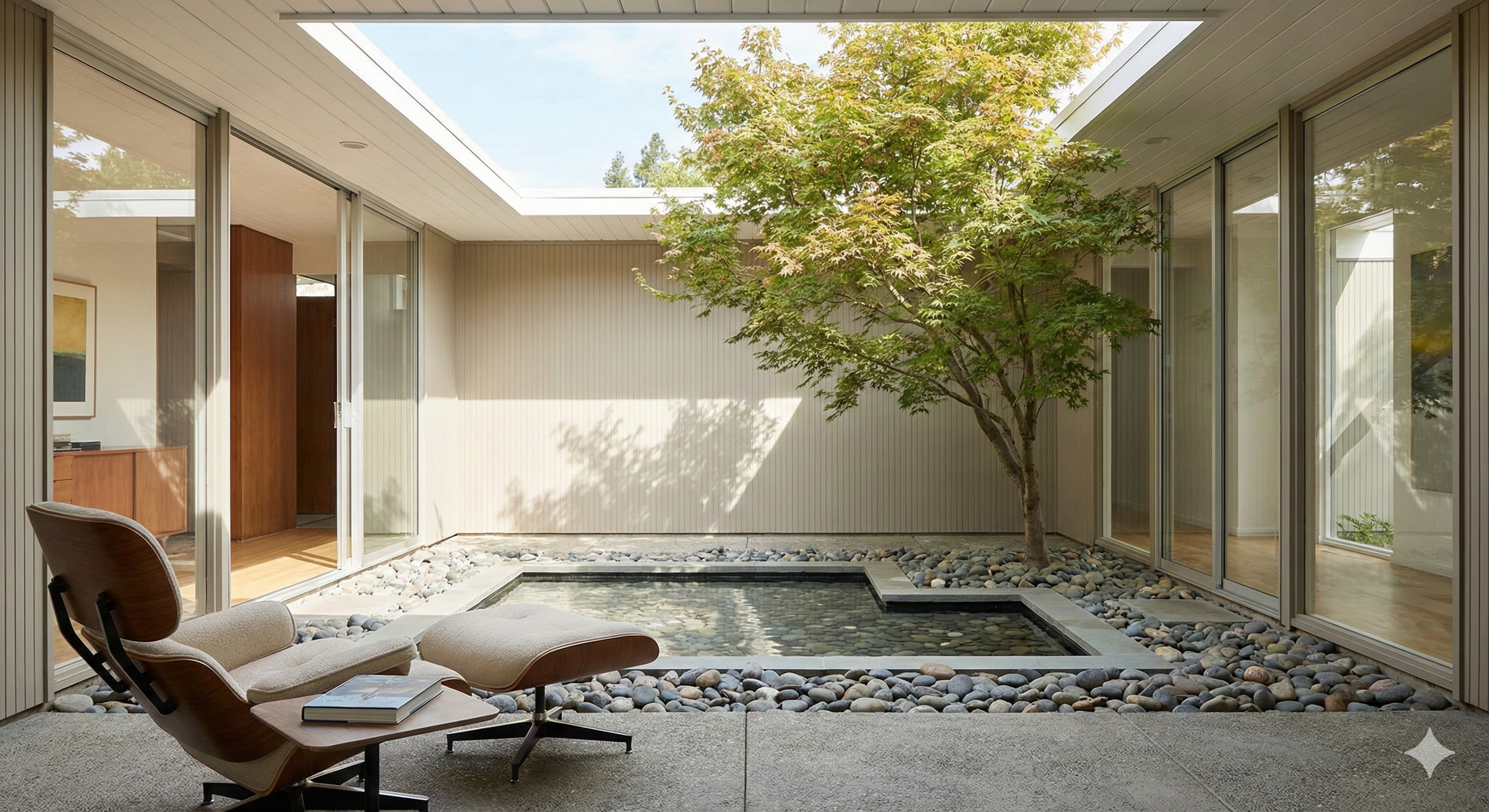
Imagine stepping through your front door and finding yourself under an open sky, surrounded by rustling leaves and mid-century modern design. In that instant, time seems to bend. Stress from the modern world falls away as you enter a different mental era. The central atrium of an Eichler home isn’t just an architectural feature – it’s a sensory and emotional portal.
In this narrative exploration, we’ll journey through the Eichler atrium as a kind of time portal, blending environmental psychology with a touch of science fiction. We’ll introduce a playful framework, the Temporal Disruption Index (TDI), to quantify how entering an atrium can alter one’s perception of time, mood, and presence. Along the way, we’ll touch on the history of Eichler homes, the psychology of indoor-outdoor spaces, mid-century nostalgia, and vivid scenarios of residents experiencing emotional shifts.

Mid-Century Vision: A Brief History of Eichler’s Atrium Design
Joseph Eichler was a visionary 20th-century real estate developer who sought to bring modern architecture to the masses. Between 1949 and 1966, he built over 11,000 sleek mid-century modern homes in California, each a clean-lined pavilion that “bring the outside in” eichlerhomesforsale.com. Unlike traditional suburban houses of the 1950s with brick facades and tiny windows, Eichler’s designs featured floor-to-ceiling glass, post-and-beam construction, and open layouts oriented around nature eichlerhomesforsale.com. His goal was to turn the house inside-out: your backyard became your centerpiece eichlerhomesforsale.com.
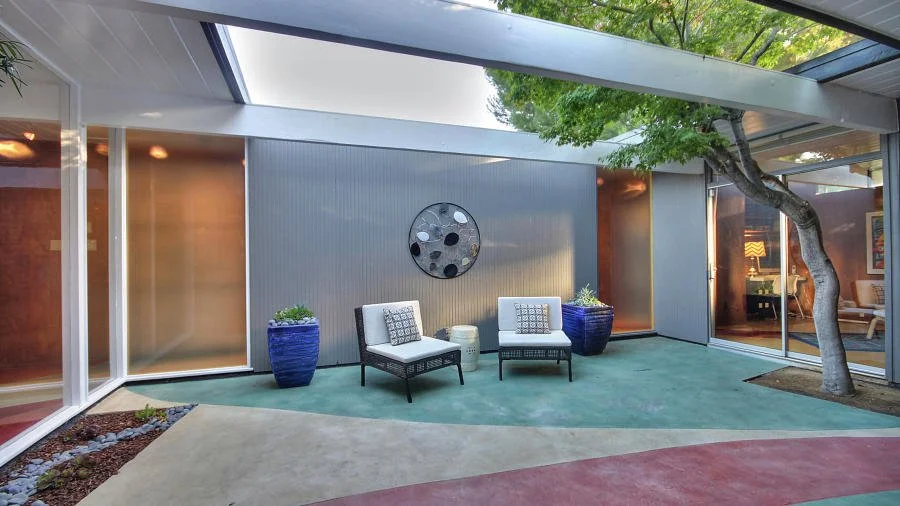
At the heart of Eichler’s innovation was the atrium – a private open-air courtyard within the home’s footprint eichlerhomesforsale.com. In 1957 Eichler introduced this signature center court, an entry atrium that meant the very first space you entered was literally under the open sky eichlerhomesforsale.com. The concept, inspired partly by ancient Roman and Greek courtyards, initially puzzled even Eichler himself – legend has it that when architect Bob Anshen first showed him the atrium idea, Eichler exclaimed, “What the hell is that?”. But homebuyers quickly embraced the concept. By 1959-60, Eichler’s son noted, “we could hardly sell a house without an atrium.”The atrium had become “the heart of the home” in Eichler’s modern design, replacing the traditional kitchen-centric plan eichlerhomesforsale.com.
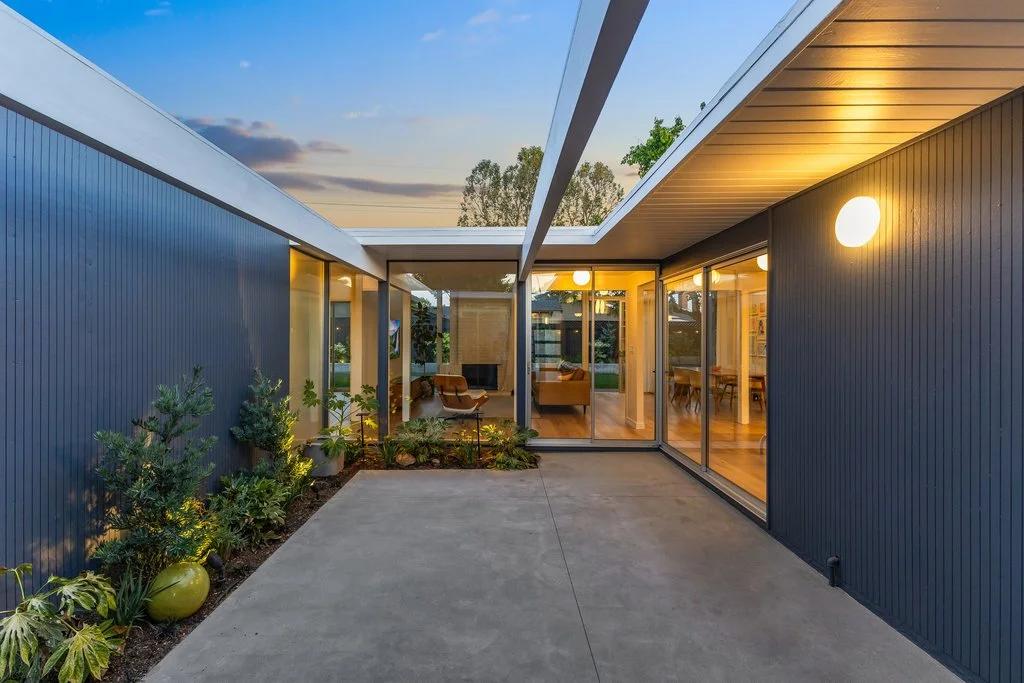
Walking through an Eichler’s bright orange front door often means stepping back outside into a tranquil courtyard before re-entering the living spaces. This was revolutionary in mid-century architecture and remains striking today. The atrium blurs the line between indoors and outdoors, offering a room that is neither fully inside nor outside. Bedrooms and living areas open onto this glass-wrapped courtyard, gaining light and airflow while preserving privacy behind high fences and clerestory windows There’s something delightful and disorienting about this design – visitors are amazed to find sky, plants, and even rain right in the center of the house. In Eichler’s time, brochures boasted the atrium’s unparalleled versatility: a space for dining, play, or relaxation that brought nature into daily life.
Psychology of the Portal: Why Atriums Affect Our Mind
What is it about an atrium that makes it feel like a portal to another dimension of mood and time? Environmental psychology offers some clues. Eichler’s atriums exemplify biophilic design – incorporating natural elements (light, plants, sky) into architecture to support human well-being eichlerhomesforsale.com. Decades of research show that access to nature, even just views of greenery, can significantly improve our mental and physical health. In a famous 1984 study, hospital patients with a view of trees healed faster and required less pain medication than those facing a brick wall eichlerhomesforsale.com. More recent studies confirm that “restorative environments” with natural scenes reduce stress, lower blood pressure, and boost mood eichlerhomesforsale.com. In short, we are hardwired to benefit from nature eichlerhomesforsale.com.

The Eichler atrium delivers a potent dose of this nature therapy. It’s a room-sized retreat where sun, breeze, and greenery are invited into the home’s core eichlerhomesforsale.com. Sunlight pours down from above, and at night you might glimpse the stars. Tall potted plants or even trees can grow in these courtyards, creating what one admirer described as a “jungle-like feel” that brings a strong sense of the outdoors into the home eichlerhomesforsale.com. Psychologically, this kind of space provides what author Clare Cooper Marcus called a “personal oasis”: a safe, enclosed garden where one can experience nature in privacy and comfort. Unlike an exposed yard, the atrium is “wrapped in the embrace of the house” – a sanctuary where you can sip your morning coffee with birds chirping, or watch rain patter while remaining sheltered eichlerhomesforsale.com. This sheltered intimacy with nature creates a powerful, calming effect. Residents often describe an “almost therapeutic” quality to their atriums – a “daily dose of nature that calms the mind,” as one Eichler homeowner put it eichlerhomesforsale.com. Life in an Eichler atrium feels good eichlerhomesforsale.com.
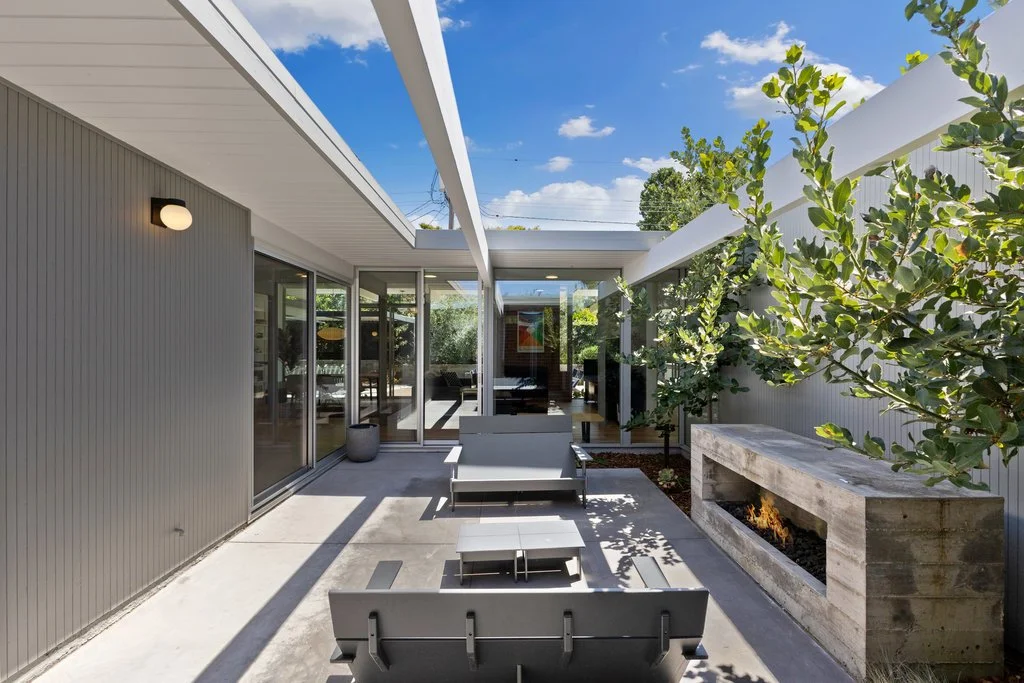
Beyond calming us, natural light and open space can alter our very perception of time and focus. Have you noticed how time seems to slow down during a peaceful walk in the park? Or how a bright, sunlit room can lift your energy? Atriums tap into these phenomena. Sunlight is known to regulate our circadian rhythms (our internal clocks) and boost serotonin, the “happiness” neurotransmitter that improves mood and alertness eichlerhomesforsale.com. In an Eichler atrium, abundant daylight and the ever-changing patterns of sun and shadow provide gentle stimulation that psychologists call “soft fascination” – enough to keep the brain engaged but not overwhelmed. This state promotes mindfulness and creativity, allowing the mind to wander in a productive, restorative way. It’s no surprise that exposure to natural environments has been linked not only to stress reduction but also improved cognitive function and creativity eichlerhomesforsale.com. Many Eichler owners find that tending to plants or simply gazing at the sky in their atrium helps clear mental clutter, often leading to bursts of creative insight or problem-solving once they return to their indoor tasks.
Crucially, an atrium is also a liminal space – a threshold between worlds (inside/outside, home/nature). Psychologists note that such liminal spaces can trigger reflection and reset our mental state. Stepping into an atrium is a bit like stepping outside time for a moment. The usual cues of the household interior are replaced by elemental sensations: warm sunlight, a breeze, the smell of foliage or wet concrete after rain. These sensations ground us in the present moment, often slowing the racing thoughts of everyday life. At the same time, they can evoke deep memories – the earthy scent of soil might transport you to childhood gardening with a parent, or the sight of mid-century architecture might recall nostalgic feelings for a bygone era. In this way, the Eichler atrium operates as a sensory time machine, gently oscillating our minds between present mindfulness and reveries of the past.
Mid-Century Magic: Nostalgia and Emotional Time Travel
There’s another layer to the atrium’s time-portal effect: cultural nostalgia. Eichler homes are products of the optimistic mid-20th century, and stepping into one can feel like traveling back to the 1960s. The design elements themselves carry “the time machine effect” of nostalgia. The warm wood paneling, the globe pendant lights, the iconic Eames furniture, and geometric breeze-blocks – all these hallmarks of mid-century modern style evoke an era known for its optimism, innovation, and post-war enthusiasm. For those who grew up in the 1950s–60s, an Eichler atrium might spark childhood memories of carefree summer days and space-age dreams. For younger generations, it conjures a romanticized past they’ve seen in movies and Mad Men-esque media. In a fast-paced digital world, the mid-century aesthetic offers a “cozy refuge from the complexities of modern life,” allowing people to reconnect with a sense of simplicity and balance from a different time.
Imagine entering an Eichler atrium on a warm afternoon: the scent of citrus from a potted lemon tree mingles with the faint vinyl crackle of a jazz record playing inside. You lounge in a low-slung chair, gazing at the breeze stirring the leaves. It’s easy to feel a wave of nostalgia wash over you. Perhaps you recall your grandparents’ home or the first house you ever lived in. The design around you – honest materials like wood and stone, the optimistic indoor-outdoor flow – whispers of a time when modern design promised a brighter future. This nostalgic aura can be emotionally powerful: it “transports us to a time when Eames chairs and clean lines became symbols of progress and prosperity,” invoking comfort and warmth through familiarity. In the atrium, you are physically in the present, but emotionally, you might be living in a treasured memory or even an imagined past era. In this sense, the space is a portal through time – not in a science-fiction sense of literal time travel, but in the very real psychological sense of temporal experience. It collapses the distance between now and then, allowing past feelings to live again in the present.
Moreover, Eichler atriums often serve as stages for human connection that feel timeless. Many families decorate their atriums with retro furniture and plants, then use the space for gatherings that create new memories. Picture a small birthday party held under the open sky of the atrium: three generations sitting around a long table, sunlight and shadows dancing on smiling faces. The design encourages an informal indoor-outdoor flow, so children dart in and out with toys, grandparents relax in the shade, and everyone feels at ease. Such scenes could be happening in 2025 or just as easily in 1965 – the nostalgic setting collapses decades, bonding people across time. In the evening, perhaps the same atrium hosts a quiet stargazing session; a parent and child lay on patio chairs, looking up through the open roof at the moon. In that moment of wonder and connection, time seems to stand still. The child feels the universe in their backyard, and the parent feels connected to both the cosmos and their ancestor, who might have done the same decades ago. These cultural and emotional associations layer the atrium with meaning, enhancing its portal-like quality.
Stories From the Atrium: Emotional Shifts in Real Life
How do real people experience these effects? Let’s explore a few mini case studies (some real, some imaginatively stylized) of Eichler residents stepping through their atriums and into altered states of mind:
A Moment of Calm: Linda, a Silicon Valley engineer, often ends her workdays by stepping into her atrium to decompress. One evening, overwhelmed by back-to-back virtual meetings, she walks through the atrium’s glass sliders into the open-air court. Instantly, the hush of the space envelops her. She closes her eyes and feels the last golden rays of sun on her face. Her racing thoughts slow to a manageable pace. “It’s like my own little world out here,” she says, “I can finally breathe.” Ten minutes of watering her fern and listening to birds, and her sense of time has shifted – the urgency of emails fades, replaced by the steady rhythm of nature. Linda’s stress level plummets, and she feels grounded in the present. In her atrium, time seems to dilate; the few minutes she spends there feel longer, richer – a gentle temporal disruption that leaves her calmer and recharged.
Creative Flow: Marcus, a novelist, likes to write in his Eichler’s atrium when the weather permits. By day, sunlight filters through the trellis, casting dappled patterns on his notebook; by night, the atrium’s pendant lights and the twinkle of stars create an intimate cocoon. Marcus finds that once he sits out there, hours can slip by without him noticing. The combination of fresh air and enclosure helps him enter a flow state – that psychological zone where concentration is deep and joyfully effortless. On one occasion, struggling with writer’s block indoors, he moved to the atrium and immediately felt a shift: the scent of night-blooming jasmine and the sight of the moon overhead sparked a burst of inspiration. He wrote for three hours straight, losing all track of clock time until he finally glanced at his watch in surprise. “The atrium puts me in a creative trance,” he explains. It’s as if the usual tick-tock of timekeeping pauses, and creative time – fluid, nonlinear – takes over. Marcus often emerges with pages of new ideas, attributing it to his home’s “magic portal” effect on his mind.
Nostalgic Daydream: Shirley and Dan, retirees who bought their Eichler from its original owners, view their atrium as a cherished time capsule. They preserved the original 1962 details – including a palm tree growing through the open roof. Every morning, they have breakfast under that palm, hearing the same rustle of fronds that mid-century owners would have heard. One warm afternoon, Shirley dozes in a patio chair and dreams of her 1960s childhood, recalling the feel of summer breezes at her grandparents’ house. The atrium’s design elements (the aggregate concrete floor, the breeze-block screen casting geometric shadows) subconsciously cue these memories. Dan, meanwhile, tends to a small vegetable patch in one corner of the atrium, a hobby that reminds him of his father’s garden. In the atrium, the past feels nearby – the couple often find themselves telling stories of “back then,” their recollections unusually vivid. “This space sparks memories we hadn’t talked about in years,” Dan says. On more than one occasion, their grandchildren have sat wide-eyed as Dan and Shirley, transported by nostalgia, recount tales from decades past as if they happened yesterday. The young ones feel it too; “the house is like a time machine,” the grandkids joke. In these moments of storytelling under the atrium sky, generational time collapses – everyone is simply sharing one big moment across time.
Connected Under the Stars: Priya, a busy young professional, was initially drawn to her Eichler home for its style. What she didn’t expect was how the atrium would strengthen her connections – both to others and to the wider world. On one memorable night, during a neighborhood power outage, Priya and her partner lay on a blanket in the dark atrium, lit only by candles and starlight. Without TV or phones, they talked for hours, feeling unusually present with each other. “It was surreal – like time stopped just for us,” Priya recalls. The intimacy of the enclosed outdoor space made them feel safe to share dreams and fears. In that candle-lit atrium, she felt closer than ever to her partner. Another time, during the peak of the Perseid meteor shower, Priya invited a few friends over for a midnight “atrium stargazing party.” They spread out pillows and watched meteors streak across the patch of sky overhead. Amid laughter and whispered awe, one friend remarked that it felt like being outside and inside at once, as if floating in a bubble out of time. That night forged a deep bond among the friends – the atrium’s unique ambiance facilitated hours of meaningful conversation and collective wonder. Priya now measures gatherings not just by fun, but by what she jokingly calls their “TDI score” – how much did the atrium experience get everyone to unplug and be truly in the moment together? That night, she says, “the TDI was off the charts.”
These vignettes illustrate how Eichler atriums can induce feelings of calm, creative flow, nostalgia, and connection. In each case, the occupants experienced a shift in time perception and emotion – whether time slowed during relaxation, sped up during creative flow, or looped back on itself through memory. To further understand these effects, let’s turn to our speculative framework, the Temporal Disruption Index, which playfully quantifies the “portal effect” of atrium living.
The Temporal Disruption Index (TDI): Measuring the Atrium’s Portal Effect
What if we could measure how much stepping into an atrium warps your sense of time and alters your mental state? Enter the Temporal Disruption Index (TDI) – a fictional yet thought-provoking concept straight out of a design sci-fi experiment. The TDI is imagined as a composite scale (0 to 10) that gauges the degree of temporal and emotional shift one experiences in a space like an Eichler atrium. A high TDI means your normal clock-time awareness and emotional baseline are dramatically disrupted (in a good way): minutes might feel like hours (or vice versa), your mood and mindset might transform, and you may feel “transported” from ordinary reality. A low TDI means the space feels ordinary, with no significant change in perception.
How might we calculate TDI in our scenario? It would incorporate several dimensions of the atrium experience:
Chronoception Shift – The change in time perception. Do you lose track of time or feel time slow down? (For example, meditating by the atrium’s koi pond might make 15 minutes feel like an hour of blissful timelessness – a positive chronoception shift.)
Emotional Elevation – The change in mood or stress levels. Does the atrium significantly calm you or uplift you? (Many report an immediate drop in anxiety and a surge of calm happiness upon entering the sunlit atrium – a big boost to this component.)
Memory Activation – The degree of nostalgia or memory immersion triggered. Does the space evoke vivid memories or a sense of visiting the past? (Seeing the mid-century design or smelling the jasmine might swirl you into reminiscence, thus “disrupting” present time with past time – a key part of the portal effect.)
Presence & Creativity – The shift in mental presence and creative thought. Do you become more “in the moment” and creatively inspired, or even enter a daydream state? (An engaging atrium can both ground you in now – increasing mindfulness – and also free your mind to wander imaginatively, which can paradoxically feel like being in another world.)
Each of these factors can be thought of as a sub-index in the TDI. When someone steps into an especially enchanting atrium, all factors might spike: time perception blurs, mood rises, memories flood in, and awareness shifts from mundane routines to a more expansive mental state. For instance, a perfect atrium moment – say, relaxing with loved ones around a fire pit as the open sky turns from dusk to starry night – might score a TDI of 9 or 10, indicating a profound portal experience where hours slip by unnoticed and the emotional resonance is long-lasting.
On the other hand, a quick pass-through of an atrium used merely as an entryway might yield a low TDI (maybe 1 or 2) – a negligible blip of “nice view” but no lasting disruption of one’s mental timeline. Interestingly, Eichler’s original idea was that atriums should be more than just a walk-through; they were meant to be lived in, to be “indoor-outdoor family rooms” as some owners call them. The more one engages with the atrium space – pausing to sit, adding personal touches like plants or art, using it for activities – the higher the TDI tends to climb. Essentially, the atrium gives back what you put into it: treat it as a portal for experience rather than a hallway, and it will reward you with richer moments.
To illustrate the TDI framework, let’s break down a few scenario readings (on our hypothetical 0–10 scale):
Morning Mindfulness – TDI 6: You step into the atrium with a cup of tea at 7 AM. The air is crisp; sunlight is just beginning to filter in. As you settle into a chair, you notice your mind shift from groggy stress about the day’s agenda to a gentle awareness of the present moment. Time feels unhurried – those 10 minutes in the atrium feel pleasantly longer, as if you’ve carved out a mini retreat before the day begins. Your mood lifts slightly (maybe from a 5 to a 7 on your personal happiness scale). TDI Breakdown: moderate chronoception shift (time felt a bit expanded), mild emotional elevation (calmer, but not euphoria), minimal memory activation (you’re mostly present-focused), high presence (you feel grounded and awake). Result: TDI 6 – a noticeable positive disruption, setting a tone of calm that lingers for hours.
Atrium Creative Jam – TDI 8: It’s Saturday afternoon and you’re painting at your easel in the atrium. Music plays softly through the open sliders. As you mix colors and brush the canvas, you enter a flow state; the atrium’s natural light makes the colors sing and you feel deeply connected to your art. Two hours pass, but it only dawns on you when the sunbeam that had been lighting your work moves off – you’ve been so immersed that clock time lost meaning. You feel joyous and invigorated. TDI Breakdown: strong chronoception shift (hours felt like minutes), significant emotional elevation (stress zero, joy high), low memory activation (you were focused on creating new ideas, not reminiscing), very high creative presence (completely “in the zone”). Result: TDI 8 – a profound engagement where the atrium served as a portal into a creative headspace, warping time perception and mood very noticeably.
Twilight Nostalgia – TDI 7: At dusk, you light a tiki torch in the atrium and sit on the vintage sofa with an old photo album. The smell of night-blooming flowers and the dimming light trigger a wistfulness. Flipping through photos of your childhood, you feel like you’re physically sitting with your past self – the atrium’s timeless atmosphere blurs the here-and-now with “then.” A breeze picks up and suddenly you recall a forgotten memory of a summer camp bonfire; you can almost hear the crackling wood and laughter of friends long not seen. Tears come to your eyes – not of sadness per se, but the poignant sweetness of nostalgia. TDI Breakdown: moderate chronoception shift (time is a bit irrelevant as you lose yourself in memories), high emotional shift (from neutral to gently sentimental, heart rate probably down, oxytocin up as you bond with memories), very high memory activation (the environment actively brought past experiences to life), moderate presence (paradoxically you are very absent to the present as you time-travel in your mind, yet the physical sensations keep you grounded enough). Result: TDI 7 – a strong temporal disruption where past and present intermingle, leaving you with a reflective, soothed state of mind for the rest of the night.
Social Connection – TDI 9: A few close friends come over in the evening, and you all end up in the atrium for dinner. Under strands of fairy lights against the open sky, the conversation flows freely. The space seems to encourage storytelling and genuine connection. Nobody checks their phone – in fact, no one feels the urge to, because the ambiance is so engaging. A simple plan to have a quick meal turns into a 5-hour heart-to-heart that none of you planned. By the time your friends depart, you’re astonished to realize it’s near midnight. TDI Breakdown: very strong chronoception shift (you all lost track of hours in the best way), very high emotional elevation (moods are buoyant, you feel bonded and content), some memory activation (stories of past experiences were shared vividly among you), high presence (despite reminiscing together, everyone felt “in the moment” with each other, not distracted by outside worries). Result: TDI 9 – an exceptional evening where the atrium functioned as a social time warp, fostering intimacy and making hours feel like a timeless bubble of friendship.
These scenarios illustrate how the Temporal Disruption Index might be used as a fun lens to understand the atrium’s impact. While TDI is a fictional construct, it’s grounded in real psychological phenomena: nature’s impact on our stress and time perception, architecture’s role in shaping social interaction, and the power of nostalgia and sensory cues to alter our mental timeline. The Eichler atrium, by virtue of its design, scores highly on all these fronts – it is almost engineered to disrupt our routine way of feeling time and emotion.
Living in a Designed Time Portal
In blending fact and speculative fiction, we find that Eichler atriums truly behave like time portals for the soul. Historically, they were ahead of their time – literally “a visionary design, ahead of its time,” as Eichler fans say eichlerhomesforsale.com. Environmentally, they fulfill biophilic principles that modern science now champions for wellness eichlerhomesforsale.com. Culturally, they connect us to a nostalgic past even as we create new memories in the present. And emotionally, they transport us – to calm, to creativity, to community – in ways that make minutes and hours wonderfully malleable.
Stepping into an Eichler atrium can feel like crossing a threshold not just in space, but in state of mind. It’s a front door that opens, quite literally, to open sky – a reminder that home can be both shelter and frontier. Perhaps that is why these mid-century homes still captivate us in the 2020s: they promise a kind of gentle time travel. In a world where so many spaces are designed to maximize efficiency or bombard us with stimulation, the atrium invites something different: lingering, reflection, presence.
So next time you find yourself in an indoor-outdoor space – be it an Eichler atrium, a sunlit courtyard, or even a lush corner by a big window – pay attention to how you feel. You might notice the Temporal Disruption Index quietly ticking up. Your heartbeat slows, your mind wanders in time, and for a little while, you are elsewhere and everywhen all at once. In the end, the true magic of these architectural time portals is how they bring us back to ourselves – calmer, happier, and more connected to the moments that truly matter.