
Eichler-Friendly Solar: Preserving the Roofline While Powering the Future
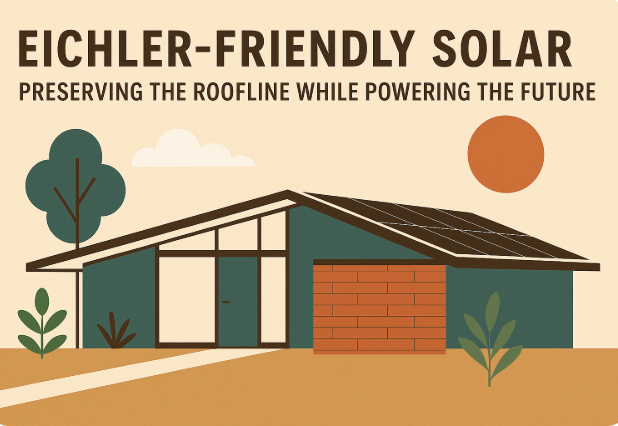
Eichler-Compatible Solar Installations in Silicon Valley
Eichler homes are mid-century modern icons known for their flat or low-slope roofs, open post-and-beam construction, and seamless indoor-outdoor design. Bringing solar power to these architectural gems in Silicon Valley requires special care to maintain their aesthetic. In this guide, we explore solar for Eichler homes – why these houses need unique approaches, and how to install Eichler solar panels in a way that preserves the famous “floating” roofline while delivering clean energy. We’ll compare suitable solar technologies (from traditional panels to Tesla Solar Roof tiles), discuss how to avoid damage to Eichler’s trademark foam roofs and radiant heating, navigate permitting/HOA concerns, and highlight real-life case studies. By the end, you’ll have a roadmap for an Eichler-friendly solar installation that powers your home’s future without compromising its mid-century character.
The Eichler Challenge: Unique Roofs and Radiant Design
Installing solar on an Eichler home comes with challenges not found in typical houses. Joseph Eichler’s homes, built in the 1950s–60s, feature distinctive construction that impacts solar installations:
Flat or Low-Slope Roofs with Foam – Eichlers have nearly flat roofs (often tar-and-gravel originally, many now updated to foam roofing) and minimal attic space. Flat roofs are great for solar exposure but require careful mounting and waterproofing. Foam roofing, a common upgrade for Eichlers, adds insulation but can be damaged by improper installation. Water drainage is also a concern on low slopes – solar panel racks must not trap water on the roof.
No Attic or Crawlspace – Unlike traditional homes, Eichlers have no attic and typically no crawlspace, meaning all electrical wiring and even some plumbing run through the roof or walls. This leaves little room to hide solar conduit. Installers often have to surface-mount conduit on the roof or exterior, so careful planning is needed to keep it discreet.
Post-and-Beam Structure – Eichler roofs are supported by widely spaced beams with tongue-and-groove wood decking and no rafters. This structure affects how solar panels are attached. Standard solar racking may not line up with the beams, and anything spanning over ~6 feet requires special mounting solutions to secure into structure. An experienced Eichler solar installer will locate and anchor into beams or use engineered racks that bridge between beams.
Radiant Heating in Slab – Most Eichlers were built with radiant heating pipes embedded in the concrete slab floor. While this radiant heat system isn’t in the roof, it’s part of the no-attic, no-basement design that demands caution during any retrofit. For example, if your solar project involves upgrading the electrical panel or adding a ground rod, drilling into the slab must avoid puncturing those radiant pipes. Always verify pipe locations (via original plans or a scanner) before any slab penetrations – a crucial Eichler radiant heat solar tip for avoiding costly damage.
In short, Eichler homes are perfectly suited for solar potential – broad flat roofs bathed in California sun – but their unique architecture means you can’t just slap panels on without a tailored approach. In the next sections, we’ll see how to respect the Eichler design while adding solar power.
Preserving Eichler Architectural Integrity in Solar Design
Eichler homes are famous for their clean lines and “floating” rooflines. Homeowners understandably worry that bulky solar panels could spoil this look. The good news is solar can be added discreetly, preserving the original mid-century aesthetic with thoughtful design choices:
An Eichler in Silicon Valley with low-profile solar panels installed flat on the roof. The panels sit close to the foam roof, barely visible above the characteristic slender eaves, thus preserving the home’s iconic roofline.
Minimize Visibility: The key principle is to keep solar installations low-profile. In Eichler Neighborhood Design Guidelines, Palo Alto officials advise installing panels on the rear-facing or flat portions of the roof, as flat as possible, to minimize visibility from the street. Because Eichler roofs are nearly flat, panels can often be laid flat (0° tilt) or at a very slight angle, so they don’t protrude above the roof’s edge. Choosing black-framed panels and black mounting hardware can also make the array less conspicuous against a dark roof surface.
Preserve the “Floating” Roof Effect: Eichlers often have deep eaves and fascia that hide the roof when viewed from the front. By setting panels back from the roof edges, you ensure the floating roof illusion remains intact. From the street, ideally only a slim outline of panels (if anything) is seen. In fact, many Eichler owners report that from curbside you can’t tell the house has solar – all you see is the unchanged mid-century profile. As one foam roofing installer notes, on numerous projects “all you can see from the street is the edge of the solar panels” when they’re kept flush with a flat roof. The small trade-off in energy output by not tilting panels is often worth the huge gain in preserving aesthetics (tilting panels on a flat roof might only improve production by ~3–10%).
Integrated Design Elements: If possible, align the panel layout with the home’s lines. For example, panels can be arranged in a grid that mirrors the module of the post-and-beam structure or centered over the home’s modules so it looks intentional. Some Eichler enthusiasts even treat panels as an architectural element – such as shading an atrium or matching the rhythm of window placement – but this must be balanced against optimal sun exposure. In most cases, discretion is better: a simple, flat installation that is invisible unless one looks directly down on the roof.
Color and Finish: Modern solar panels are typically dark blue or black. On Eichlers with white foam roofs, the contrast can make panels more visible. One solution is to apply a light gray topcoat to foam (instead of bright white) to reduce contrast, or even choose a gravel-coated foam that appears darker. Either way, using panels with anti-reflective glass (standard nowadays) prevents glare. And rest assured, flat-mounted panels won’t blind your neighbors – their angle is so low that any reflection bounces upward, not into nearby windows.
By following these practices, you can integrate solar technology seamlessly into an Eichler’s design. Countless Bay Area Eichler owners have demonstrated that it’s possible to go solar without sacrificing architectural integrity – you can keep the classic look while embracing modern sustainability.
Comparing Solar Technologies for Eichler Homes
Not all solar solutions are equally suited to Eichlers. This section compares traditional rack-mounted panels versus newer low-profile solar roofing options, with an eye toward what works best on flat or low-slope roofs:
Traditional Rack-Mounted Solar Panels: This is the conventional approach – installing standard photovoltaic panels on mounting racks. For Eichlers’ flat roofs, special flat-roof mounting hardware is used. Typically, brackets are secured through the foam into the underlying roof deck/beams, and panels are held a few inches above the roof surface. Installers often use short stanchions or flush-mount racks to keep panels nearly level on a flat Eichler roof. The advantage of traditional panels is cost-effectiveness and high efficiency. They can also be angled if needed; for example, a slight tilt toward the south or west can boost output (as one Eichler owner did, orienting panels west for better afternoon production). However, tilting too high will make them visible and catch wind, so many Eichler installations just keep panels flat. Traditional panels have a visible profile (a few inches of clearance) but when done correctly, they appear as a slim, even plane above the roof. Compatibility: Traditional panels can be installed on virtually any Eichler roof (foam, tar-and-gravel, or single-ply membrane) as long as the mounting method is appropriate for that roofing material.
Ballasted or Non-Penetrating Mounts: In some cases, installers may use a ballasted system – where panels are attached to racks held in place by weight (like concrete pavers) instead of bolting to the roof structure. This avoids penetrations in the waterproof membrane, which is a plus for foam roofs. The downside is added weight on a roof that wasn’t originally designed for heavy loads. Eichler beam structures can support solar (panels are not extremely heavy), but it’s wise to get a structural assessment if using ballasted mounts or any system that adds significant weight. Many Eichler homeowners prefer a hybrid approach: minimal penetrations with robust sealing, or using existing structural screw points (like at beam locations) to secure racks and then supplementing with some ballast. Pro tip: Always coordinate with a roofing professional when deciding on mounting – they can advise if your foam roof manufacturer approves adhesive or ballasted solutions, and how to maintain the roof warranty.
Adhesive “Peel-and-Stick” Solar Panels: A niche but intriguing option for flat roofs is thin, adhesive-backed solar modules. Products like Lumeta’s PowerPly panels are essentially solar “stickers” that lay flat on a roof with no racks at all. They bond directly to the roof surface, eliminating penetrations and keeping an ultra-low profile (~0.4 inches high). For Eichlers, this means the panels would be nearly invisible from any angle. These systems are lightweight and meet wind uplift requirements. The trade-offs: slightly lower efficiency than standard panels (due to lack of active cooling under the panel and fixed flat orientation), and currently fewer installers offer them. Also, your roof surface must be very smooth and clean (a well-coated foam or single-ply membrane works; gravel or bitumen is not suitable). If maintaining the absolute pure look of the roof is a priority, adhesive thin-film or laminate panels could be considered – they’ll keep that low-slung Eichler roofline completely intact.
Integrated Solar Roof Tiles (BIPV): What about replacing the whole roof with solar tiles, like the Tesla Solar Roof or GAF’s Timberline Solar shingles? These Building-Integrated Photovoltaic (BIPV) systems aim to blend solar cells into roofing materials. They work best on pitched roofs, however. Tesla Solar Roof uses glass shingles with built-in solar cells and is designed for slopes roughly 2:12 up to 12:12 pitch. Most Eichler roofs are below that threshold (often nearly flat, e.g. 1:12), meaning Tesla’s product isn’t technically compatible unless the roof is re-engineered with more pitch. A few Eichler models do have modest pitched A-frame sections or gable designs; in theory Tesla Solar Roof could be used there, but it would be a very costly re-roof. Additionally, the sleek glass tiles of a Tesla roof, while beautiful, present a different look than an Eichler’s original tar-and-gravel or foam surface – it might appear too glossy or reflective for purists. GAF Timberline Solar is a newer solar shingle that integrates with asphalt roofing; again, Eichlers don’t use shingle roofing and have low slopes, so this isn’t a likely choice for an original Eichler. In summary, integrated solar tiles are not yet a practical solution for most Eichler homes – they shine on conventional pitched roofs, not on flat mid-century ones. Traditional panels (or flat adhesives) on a foam roof will be more straightforward and often more efficient.
Solar Over Carports or Pergolas: One strategy some Eichler owners employ is installing solar panels over an attached carport, patio cover, or a custom trellis in the yard. This effectively makes a solar canopy that provides shade while generating power. For example, panels can be mounted atop the open carport roof structure; since carports are usually front-facing, care is needed to keep those panels flush as well. In Eichler communities, this approach is used when the main house roof is shaded by trees or if homeowners prefer to leave the main roof untouched. A solar carport or pergola can be engineered to complement the home’s lines (e.g. maintaining the flat roof appearance). It’s worth noting this still requires permits and engineering like any roof installation, but it can be a clever compromise in some cases.
In weighing these options, consider your priorities: cost, visual impact, and energy production. Traditional panels will give the most bang for your buck and have a long track record on Eichlers (with the right installer). Integrated and adhesive solutions offer the lowest profile, but may involve compromises in cost or efficiency. Many Eichler homeowners find that a standard PV array, mounted thoughtfully, strikes the best balance – delivering big electric bill savings and clean energy, while keeping the Eichler vibe alive.
Tips to Protect Your Foam Roof and Radiant Heat System
One of the top concerns when adding solar to an Eichler is avoiding damage to the roof and other systems. These homes often feature expensive foam re-roofing jobs and delicate radiant heat pipes, so you’ll want to take every precaution. Follow these tips to preserve your Eichler’s infrastructure during a solar installation:
Inspect and Recoat the Foam Roof First: If your Eichler has a spray foam roof (a very popular retrofit for these homes), ensure it’s in top condition before solar goes on. “Make sure your foam roof is in good condition and have it recoated” prior to installation, advises one Eichler expert. You won’t easily be able to recoat areas under the solar panels once they’re mounted. Foam roofs typically need a recoat (a new top layer of elastomeric sealant) every 15–20 years to protect from UV rays. So, if your roof is due soon, get it recoated right before the panels are added. A well-maintained foam roof can actually last the life of the house – 50+ years – as long as its coating is renewed periodically. Starting your solar project with a fresh roof coating also ensures a perfect seal around any new mounting penetrations.
Use Eichler-Savvy Mounting Methods: Work with installers who know how to mount panels on foam without causing leaks. Typically, they will locate the Eichler’s roof beams and anchor the racking into those structural members, rather than just into the 1½” T&G wood deck. Each penetration should be carefully sealed with compatible roof sealant and flashing. Many Eichler solar installations involve the roofing contractor coming back to apply foam or sealant over the mounts, essentially “seamlessly sealing around solar supports”. This integration is why foam roofs are considered ideal for PV – the foam can form a leak-proof envelope around racking hardware when done right. If your installer has never done a foam roof, consider having your foam roofing contractor collaborate to ensure warranty-compliant methods are used. Alternatively, ask about non-penetrating options (like ballasted racks or adhesive PV) as discussed above – these can eliminate roof penetrations altogether, though they must be engineered for Bay Area wind loads.
Avoid Crushing or Tearing the Foam: Flat Eichler roofs are often not designed for heavy foot traffic. During installation, workers will be on the roof for several days, moving panels and racks around. A conscientious installer will use walk pads or plywood sheets to distribute weight and prevent gouging the foam surface. Make sure they don’t drag sharp panel edges or tools across the foam. After installation, it’s wise to have the roof inspected for any scratches or dings. Minor damage can be patched with compatible sealant to prevent issues down the line. Also, remind anyone servicing the solar panels (or other rooftop equipment) in the future to tread carefully. Foam can dent if a concentrated load (like a pointy ladder foot) is applied – so spread the load and watch the footwear.
Mind the Wires and Pipes: As mentioned, Eichler electrical conduits often run along the roof. When adding solar, installers may need to drill through the roof to route cables (for example, running the DC wires from panels to the inverter, or connecting to the main service panel). It’s critical to identify where existing electrical lines run so as not to pierce them. An Eichler-savvy electrician can often recognize telltale conduit paths or use a detector. Likewise, if any plumbing vents or radiant heat lines (in rare cases, some Eichlers had radiant heat in ceiling panels) are in the work area, those must be avoided. One installer notes that nearly all wiring is on the roof, so you should “keep in mind that you might come across some wiring” whenever you cut or drill – plan accordingly. In practice, solar installers usually minimize new holes by routing conduits along the roof surface to the roof edge, then down to the electrical panel. This is both to avoid hidden hazards and because it’s just easier given Eichler construction.
Protect the Radiant Floor When Upgrading Electrical: Solar itself doesn’t directly touch the radiant heating system, but going solar often means upgrading your electrical service (many Eichlers originally had 100-125 amp panels, which might be upsized to 200 amps to accommodate solar backfeed, EV charging, etc.). If your upgrade involves trenching or driving a new grounding rod into the slab/foundation, make absolutely sure to locate the radiant heating pipes first. Cutting into a live radiant water line in the slab would be a disaster. Use original drawings if available, or employ thermal imaging when the radiant heat is on – the hot water lines will show up and can be mapped. Many Eichler owners have abandoned old radiant systems in favor of modern HVAC, but if yours is still active, it’s a treasure worth preserving. Communicate clearly with any contractors that “this house has radiant heating pipes in the slab – do not core drill or trench without precautions.” It’s a simple step that can save your heating system.
By following these precautions, you can avoid leaks, prolong your foam roof’s life, and keep your Eichler’s systems safe during a solar installation. A quality installation might even improve your roof’s longevity (panels will shade the foam from UV, slowing degradation). Remember that pulling off and reinstalling panels later is costly (often ~$1 per watt of system size just to remove/reinstall), so it’s worth doing everything possible to get the roof and install details right the first time.
Permitting, HOA Rules, and Historic Considerations
Navigating the regulatory side is another aspect of a successful Eichler solar project. In Silicon Valley, you’ll deal with building permits, possibly HOA guidelines, and even historic preservation rules depending on your neighborhood. Here’s how to handle each:
Building Permits & Codes: All solar panel installations require a building permit and electrical permit from your city. For Eichlers, the structural permit review is crucial – the city will ensure your flat roof can handle the equipment load (panels, racks, etc.) and that mounting is up to code. Usually, standard solar panels are lightweight (2-3 pounds per square foot) and Eichler roofs can support them, but the engineer of record may need to show that the load is properly distributed on the post-and-beam framework. If your house has an older roof or any structural quirks, an engineer might add specific instructions (e.g. “attachments must be into beams of XYZ size with these fasteners”). The flat roof will also mean fire code considerations: In California, solar arrays need a minimum set-back from roof edges for firefighter access. Because Eichlers have large roof spans, meeting those access pathways is typically easy – just be aware your installer must leave a border around the roof per fire code (often 2-3 feet from edges and ridgelines, though check local rules). Electrical permits will cover the wiring, inverter, rapid shutdown safety, etc. A seasoned installer will handle all this paperwork, but be prepared for possibly an extra structural evaluation due to the unconventional roof structure.
HOA and Neighborhood Guidelines: Many Eichler neighborhoods do not have formal HOAs (since they were built in the 50s/60s as open subdivisions). However, some areas or streets might have voluntary associations or CC&Rs. Regardless, in California the Solar Rights Act (Civil Code §714) limits any HOA or CC&R from prohibiting solar panels. HOAs cannot outright ban your solar installation – it’s your legal right. They can, however, request reasonable changes to reduce visual impact so long as those changes don’t significantly increase cost or decrease performance (by more than 10%, according to the law’s guidelines). In practice, this means an HOA could ask you to move panels a bit further back from the front or use a lower profile, but they cannot force you to hide them in a way that makes them ineffective. Most Silicon Valley Eichler communities are very solar-friendly (many neighbors likely already have panels). If you do have an HOA, let them know you’ll be installing a code-compliant solar energy system. You can point out that after installation, your system’s access to sunlight is protected by law – i.e. neighbors can’t later grow a giant tree to block your panels. Overall, given Eichler owners’ general eco-mindedness, social acceptance of solar is high. Just aim to keep it tasteful (as we’ve discussed) and any HOA will have little ground to object.
Historic Designation Issues: Some Eichler tracts (or individual homes) in the Bay Area have historic status or design guidelines to preserve their mid-century character. For example, Palo Alto has an Eichler Preservation Program with guidelines that explicitly address solar panels on historic Eichlers: “Install solar panels and skylights on roofs while attempting to minimize the visual impact of these features… If installing solar panels on a flat roof, consider installing them flat, or as far to the rear of the roof as possible”cityofpaloalto.org. These echo what we discussed in the aesthetics section. If your home is in a designated Eichler Historic District (such as parts of Palo Alto or the San Mateo Highlands), you may need to get approval from a Historical Review Board for exterior changes. The good news is that preservation authorities today are generally supportive of solar, as long as it doesn’t destroy defining features. By keeping panels flush and hidden from primary facades, you should be able to satisfy historic guidelines. It’s wise to review any local Eichler design guide – they often contain helpful recommendations (like using non-glare panels, maintaining roofline views, etc.) that align with best practices we’ve covered. And remember, even historical areas are governed by the state Solar Rights Act to some degree; they can’t make approval so arduous that solar becomes infeasible. The National Park Service has published briefs on Installing Solar Panels on Historic Buildings that emphasize reversibility and minimal visual impact – a philosophy very applicable to Eichlers.
Neighborhood Examples: In practice, Eichler neighborhoods across Silicon Valley have embraced solar. From Palo Alto’s Greenmeadow to Sunnyvale’s Fairbrae tract to Mountain View’s Monta Loma, you’ll find many homes with solar panels tastefully integrated. If you’re unsure how it will look or be received, take a drive through one of these areas – you might spot a few Eichlers with nearly invisible solar installations powering the home behind the scenes. Seeing is believing, and you can get ideas for panel placement that you can bring up during permitting (or even snap a photo to show an HOA or inspector: “This is what we intend – low-profile like this example”).
In summary, do your due diligence with permits and guidelines, but don’t be intimidated. California laws are on your side, and local communities are increasingly enthusiastic about green upgrades. By following the common-sense rules (hide the panels as much as practicable, keep things clean and safe), you’ll sail through approvals and soon be enjoying solar power in your Eichler.
Best Practices for Panel Placement on Eichlers
Placing solar panels optimally on a flat-roof Eichler requires balancing performance and preservation. Here are some best practices to guide your panel layout:
Choose the Least Visible Roof Zones: If your Eichler has multiple roof sections (for example, a main house roof and an attached garage or carport roof), prioritize the sections that are least visible from the street for panel placement. Often the rear half of the roof or above the carport can host most of the array. Since Eichler roofs are broad, you usually have plenty of real estate to work with. Concentrating panels away from the front facade helps maintain curb appeal. In cases where the front roof is the only viable sunny area, keep the array as low and flush as possible (and remember, per California law, you can use the front roof if needed for good sun – aesthetics can’t trump all solar access).
Keep Panels Flat (or Nearly Flat): As noted earlier, installing panels flat against a flat roof is the stealthiest approach. It ensures the array is not obvious from ground level. The downside is a flat orientation might slightly reduce energy yield compared to a tilted panel. However, in sunny Silicon Valley, the loss is modest – one foam roof expert estimates only a 3–10% difference between flat and optimally tilted panels. Many Eichler owners gladly accept a few percent less output in exchange for a cleaner look. If you do tilt panels, use a low tilt angle (e.g. 5–10°) and tilt them away from street view (usually tilting south on a north-south oriented house, or west if you have a west-facing street side). Low tilts can boost rain runoff on flat panels while remaining inconspicuous behind the roof parapet or eaves.
Maintain Setbacks and Spacing: Leave some margin around the roof edges and between panel rows. This not only meets fire code requirements, but also visually it prevents the panels from appearing to “overhang” or alter the roof geometry. A common approach is an inset of 2-3 feet from the roof perimeter, which often makes the array invisible from ground level due to the shallow viewing angle. Also consider the shadow of your chimney or any flue pipes – keep panels a few feet away from such projections to avoid shading and to allow access for maintenance (you don’t want to block your own access to clean a skylight or service a vent either).
Symmetry vs. Solar Production: Eichler enthusiasts sometimes debate whether panel layouts should be symmetrical for aesthetics. For instance, evenly spaced panels in a grid might look more intentional. If your main concern is visual harmony and you’re willing to give up a bit of production, you can design the array with symmetry in mind (e.g., equal margins, aligning with roof modules or beam lines). On the other hand, if you want to maximize output, you might cluster panels where sunlight is best (which could look uneven from above). Fortunately, because the roof isn’t visible, asymmetrical layouts aren’t noticeable to viewers on the ground. The general advice is: prioritize solar performance, but avoid any configuration that puts panels in odd, highly visible spots. Usually, you can find a layout that satisfies both – many Eichler solar installations manage to look tidy and balanced while still covering the sunniest roof areas.
Consider Spreading Out vs. Clumping: Flat roofs allow flexibility – you could spread panels across a large area with gaps, or clump them together. Spreading them out (with space between groups) can reduce the visual mass and allow more roof surface to show, which some prefer. Clumping into one big rectangle might make them easier to shade or screen at the perimeter. Functionally, grouping panels makes wiring easier (shorter runs) and minimizes the number of roof penetrations since racking can be consolidated. Aesthetic arguments can be made either way; what’s important is to avoid any placement that conflicts with roof mechanics (like covering the drains or scuppers – never block your rainwater flow). Most Eichler solar arrays end up as one or two rectangular blocks of panels set back from the edges, which tends to look fine.
Use the Garage/Carport If Suitable: Don’t forget the garage or carport roof if it gets sun. In many Eichler models, the garage has a slightly tilted roof of its own. Placing panels there can be efficient and keeps them away from the main living space’s roof. For example, one Eichler in Mountain View installed panels over the carport, turning it into a semi-visible solar awning but leaving the main house roof untouched. From the street, it looks like a natural extension of the carport structure, blending in with the home’s geometry. Using a secondary structure like this can also simplify wiring (if the electrical panel is in the garage) and limit any penetrations on the primary roof.
In essence, smart panel placement on Eichlers boils down to: hide what you can, and make what you can’t hide look intentional. By following the above practices, you’ll ensure your solar installation is optimized for both looks and performance. The result will be a solar-powered Eichler that still turns heads for all the right reasons.
Eichler Solar Success Stories in Silicon Valley
Nothing demonstrates the possibilities better than real-life examples. Here are a few case studies and anecdotes from Eichler homeowners around the Bay Area who have installed solar while keeping their homes’ character intact:
San Jose (Willow Glen): An Eichler owner and local artist, Harriet, transformed her flat-roof home with a new foam roof and a solar array – achieving energy efficiency and leak-proofing in one go. The project, done in partnership with a foam roofing specialist, resulted in a practically invisible solar installation. Standing on her roof, you’d see a broad expanse of white foam with a large set of solar panels, but from the street none of that is apparent. This case demonstrated how foam roofing and solar panels complement each other: the foam provides insulation and a solid base, while the solar panels generate electricity and shield the roof from UV. According to the installer, Harriet’s foam roof is expected to last decades (50+ years) with periodic recoating, and the solar array will not have to be disturbed in the meantime. Harriet enjoys a comfortable home (foam helps regulate temperature) and virtually no electric bills, all while her Eichler retains its mid-century charm – a win-win.
San Mateo Highlands: Barry and Rosemary Brisco own an Eichler in the historic Highlands neighborhood that showcases the cutting edge of solar technology. They installed a sizeable rooftop solar array and integrated it with Tesla Powerwall batteries for energy storage. This setup allows them to run their home on solar power day and night and even charge their two Tesla electric vehicles from the sun. Their system is a model of Eichler 2.0 – a mid-century home upgraded for the 21st century. Importantly, the Briscos were mindful of aesthetics: their panels are mounted flat on the gently sloping roof planes and aren’t readily visible from the street. According to an Eichler Network article, “The two Tesla vehicles in the driveway, the solar array on the roof, and everything inside [the] home… are tied in to the solar power stored within a new cutting-edge Tesla Powerwall battery system.” All photos in that feature showed an Eichler that still looked like an Eichler – open post-and-beam ceilings inside, unaltered roofline outside – except now it’s quietly running on clean energy. This case study also highlights that even in a community proud of its architecture, neighbors and preservationists embraced the solar addition because it was done tastefully.
Palo Alto & Sunnyvale Neighborhoods: Throughout Palo Alto’s Eichler tracts, numerous homeowners have added solar. For instance, in the Greenmeadow area, one Eichler owner placed about 6 kW of panels on the rear half of their roof, completely preserving the street view. Another in South Palo Alto opted for a solar thermal system for pool heating (flat panels on the roof that heat water) along with PV panels – demonstrating that even multiple systems can be integrated without a cluttered look. In Sunnyvale’s Fairbrae (an Eichler neighborhood), a resident installed solar panels over the carport as an extended eave, which actually provided additional shading to the driveway. These stories underscore that flexibility and creativity go hand-in-hand with Eichler solar projects. Each house may use a slightly different tactic (depending on orientation, trees, etc.), but the common theme is careful planning. Homeowners report that after going solar, their electric bills plummeted – often to near $0 in summer – and their homes became more comfortable thanks to efficiency upgrades done in tandem (like added insulation or new cool roofing).
An Eichler homeowner in the South Bay extended their carport roof with solar panels, creating a shaded parking area. The low-profile panels blend with the flat roofline, showing how versatile panel placement can achieve both functional and aesthetic goals. In many Eichler solar success stories, even close neighbors barely notice the addition until told about it.
These case studies prove that Eichler homes and solar panels are a perfect match, as long as installations are handled with respect for the design. Homeowners are cutting their utility costs and powering modern lifestyles (computers, air conditioning, EVs) with the sun, all while enhancing their classic homes. If they can do it, so can you – it just takes the right approach and team.
Eichler-Savvy Solar Installers and Contractors
One of the best moves you can make is to hire contractors who understand Eichlers inside and out. Fortunately, in Silicon Valley and the greater Bay Area, there are several solar installers and roofing contractors with extensive Eichler experience. Here’s a list of Silicon Valley solar installers (and related pros) known for being Eichler-savvy:
Dura-Foam Roofing & Solar Center (Menlo Park) – A specialist in SPF foam roofing for Eichlers, Dura-Foam has been pairing foam roof preservation with solar installations for decades. They know how to seal mounts in foam and even offer integrated solutions. (They were involved in the San Jose and Highlands case studies above.) Eichler owners praise their knowledge – e.g. explaining that a roof under solar should last 30+ years to avoid costly panel removal, and delivering on that with high-quality foam roofs.
SolarCraft (Novato/ Sonoma & Marin) – SolarCraft has installed solar on more than 100 Eichler homes in Northern California. They are familiar with Eichler beam spacing and have custom racking solutions for wide spans. SolarCraft is also known for low-profile designs that preserve Eichlers’ aesthetics. If you’re in the North Bay or Peninsula, they have a strong track record with mid-century modern homes.
POCO Solar (Santa Clara) – A long-running local solar company (since 1984) that has experience with Eichlers, as evidenced by their blog addressing Eichler roof questions. POCO Solar has tackled flat roof mounts and is familiar with wiring challenges on Eichler roofs. Being based in Santa Clara, they often serve San Jose, Sunnyvale, Mountain View, and surrounding areas – right in Eichler territory.
Earthwise Energy Solutions (Marin/ East Bay) – Featured in the Eichler Network directory, Earthwise is a family-owned solar and battery installer that understands architectural preservation. They operate across the Bay Area and have worked on Eichler and other historic homes, offering custom system design (including energy storage integration).
Got Watts Electric & Solar (East Bay) – An electrical contractor that explicitly markets experience with Eichler homes. They handle solar installations, panel upgrades, and even HVAC for Eichlers. If your Eichler needs an electrical heavy-up for solar + EV, a company like this can do it while respecting the quirks of Eichler construction (like hidden conduits and fragile ceilings).
Armstrong Installation (Bay Area) – Armstrong Roofing is known for Eichler roof replacements (foam, single-ply, etc.) and sometimes partners with solar installers. While not a solar company themselves, their understanding of Eichler roofs is invaluable. They have likely coordinated on projects adding solar, ensuring the roof work and solar work hand-in-glove. Consider engaging your roofer and solar installer in conversation together for the best outcome.
When selecting an installer, don’t hesitate to ask: “How many Eichler solar installations have you done?” A qualified pro will be able to discuss previous jobs, challenges overcome, and show photos. The companies above are a great starting point, but whichever installer you choose, make sure they appreciate the importance of preserving your Eichler’s roofline and waterproofing. A little expertise goes a long way – as evidenced by the many Eichler owners who report smooth solar projects and beautiful results when working with the right team.
Solar Power, Batteries, and EV Integration: Eichlers Embracing the Future
One exciting aspect of installing solar on an Eichler today is how it can be part of a broader modernization of the home’s energy system. Many Eichler owners don’t stop at just panels – they are also adding battery storage and electric vehicle (EV) charging to fully capitalize on their solar investment. This whole-home approach turns a mid-century residence into a cutting-edge sustainable home without altering its appearance.
Home Batteries for Energy Storage: Adding a battery backup like the Tesla Powerwall or LG Chem battery is a popular upgrade with solar. In Eichler homes, batteries are typically wall-mounted in the garage or utility area (which works well since Eichlers often have the main electrical panel on the garage wall). With a battery in place, your solar energy harvested in the daytime can be stored for use at night or during power outages. This is a big bonus given California’s push for resiliency and the desire of many to backup against blackouts. Technologically, the battery ties into your solar inverter and main panel – your installer will configure it so that excess solar charges the battery after meeting home loads. A battery system in an Eichler can run critical loads like the refrigerator, some lights, and internet for many hours during an outage, and if the sun is up, the panels will keep recharging it. From an aesthetic perspective, batteries are completely out of sight (indoors or in the garage), so they don’t impact the home’s look at all. But they do elevate the home’s capabilities into the future. The Brisco home in San Mateo is a prime example – their Powerwall setup stores solar power to run the home and their cars after dark.
EV Charging Integration: Silicon Valley Eichler owners are often EV owners as well. The good news is an Eichler with solar can directly fuel your electric car with sunshine. Most homes will need a 240V circuit run to the garage or carport for a charging station. Because Eichlers lack attics, this usually means running conduit along a wall or ceiling in the garage – a straightforward job for an electrician familiar with Eichlers (they might surface-mount it neatly or hide it in a strip). Once in place, you can charge your Tesla, Chevy Bolt, or other EV each day knowing that the electrons are coming from your own roof. It’s an amazing feeling and very cost-effective: driving on solar power can reduce your “fuel” cost to just a few cents per mile. One consideration: if you plan for an EV charger, upgrade your electrical panel if it’s still the original. Most Eichlers have upgraded by now, but ensure you have sufficient amperage to handle solar, EV, and other appliances together. A new 200A panel (or even better, a smart panel like Span) might be part of your solar project – coordinate this with your installer.
Future-Proofing with All-Electric Upgrades: Solar can be the catalyst for other energy improvements in an Eichler. For instance, some homeowners decide to swap out old gas appliances (like the radiant boiler or a gas water heater) for efficient electric heat pumps once they have solar to offset the electricity use. An Eichler with solar panels, a heat pump HVAC, and an induction cooktop becomes a zero-emission home, something Joseph Eichler probably never imagined but certainly aligns with his innovative spirit. These upgrades typically don’t affect the outward appearance (except perhaps adding a heat pump unit outside, which can be placed unobtrusively). The result is a home that preserves its 1950s style yet operates at 2025 standards of efficiency – often net-zero energy or even net-positive (producing more than it consumes annually).
The combination of solar + storage + EV is particularly powerful. You can program your battery and EV charger to maximize self-consumption of solar (for example, charging your car at noon when solar output is high, or drawing from the battery during peak utility rate times). Essentially, your Eichler can become its own mini power plant and filling station, dramatically reducing reliance on the grid. And all of this happens behind the scenes; your home’s classic silhouette and open-beam interior remain the same, just now powered by the sun.
In summary, embracing solar in an Eichler is about more than just panels on a roof – it’s about bringing a mid-century marvel into the future of energy. With careful planning, you’ll preserve the look that makes your home special while equipping it to be greener, more resilient, and cheaper to run. Whether it’s installing a few panels to shave off your electric bill or creating a state-of-the-art solar+battery+EV ecosystem, the possibilities are exciting and achievable.
Conclusion: Powering the Future, Respecting the Past
Eichler homes hold a beloved place in Silicon Valley’s architectural heritage. By implementing the strategies in this guide – from using flat roof-friendly solar panels and preserving the foam roof, to following design guidelines and working with experienced contractors – you can join the growing league of Eichler solar panel success stories. Your home can generate clean energy without one iota of mid-century magic lost. In fact, many owners find that going solar deepens their appreciation of the Eichler ethos of innovation and living in harmony with the California climate.
“Eichler-Friendly Solar” isn’t just a catchphrase – it’s a reality that countless homeowners in Palo Alto, Sunnyvale, Mountain View, and beyond are enjoying today. They’ve proven that you can honor the roofline while powering the future. Now, it’s your turn. With the information and examples provided here, you have the blueprint to make your Eichler a model of sustainable living, all while keeping that classic profile that neighbors and Eichler aficionados adore. Here’s to preserving the past and empowering the future – under the same iconic roof.
Sources: We drew on expert insights from Eichler-focused resources, including the Eichler Network, city preservation guidelines, solar installers’ case studies, and first-hand homeowner experiences to ensure this guide is as authentic and helpful as possible. Enjoy your journey to an Eichler that’s sunnier than ever!
Sources