
Eichler Homes: Icons, Archetypes, and the Mythology of Modern American Living
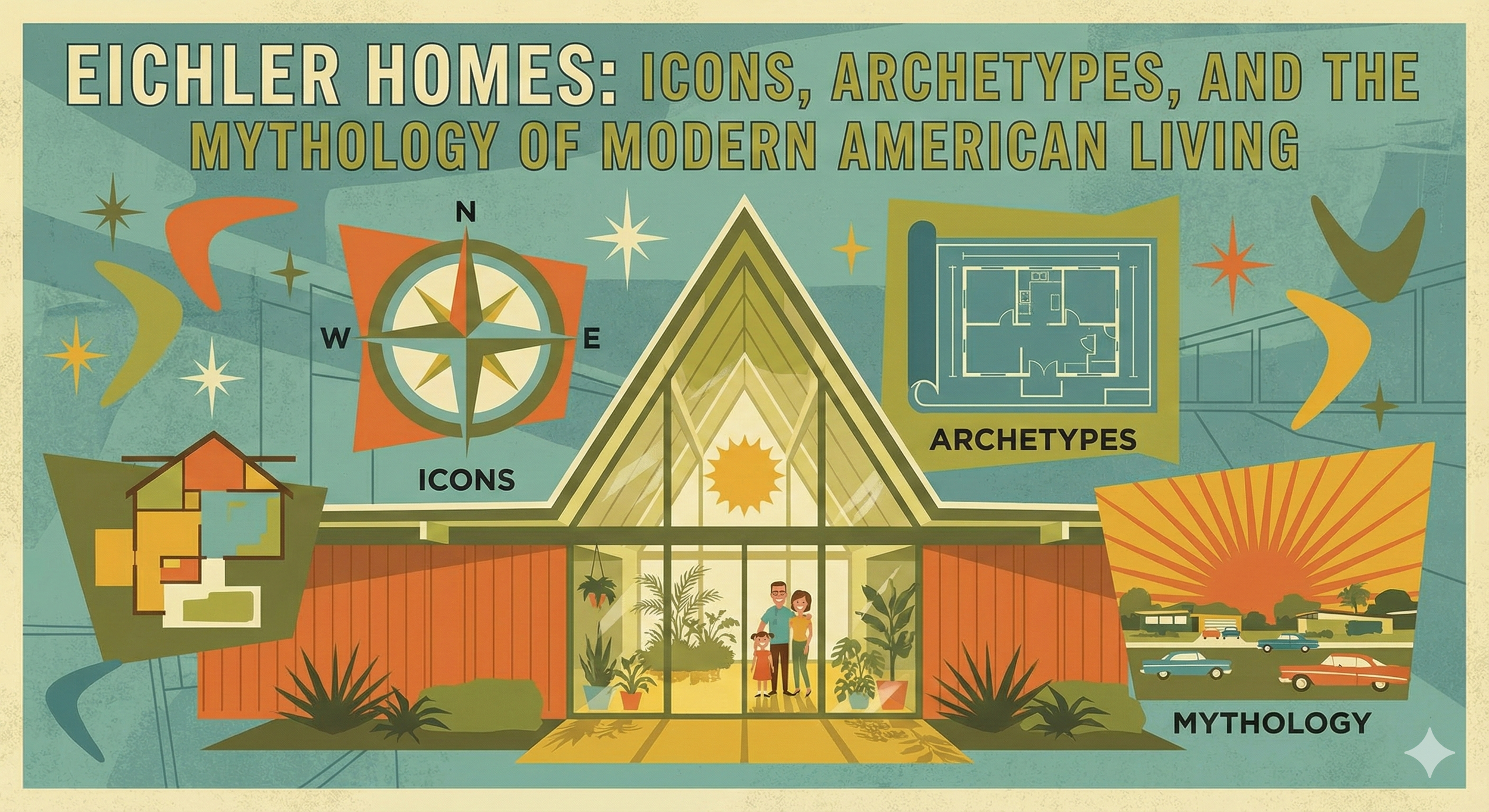
Joseph Eichler’s mid-century modern houses have attained an almost legendary status in American culture eichlerhomesforsale.com. These California tract homes—built between the late 1940s and 1960s—are more than just stylish dwellings. To their devoted fans, “Eichlers” represent a bold vision of how ordinary families could live in the postwar era, embodying ideals of openness, equality, and optimism. Eichler homes inspire a “cult” following of homeowners and enthusiasts who treat them as cultural touchstones rather than mere buildings eichlerhomesforsale.com. What makes these homes so iconic, and why are they often described in archetypal or even mythological terms? This report explores how Eichler’s architectural design, spatial philosophy, and inclusive vision connect with deep-seated cultural archetypes and mid-century American ideals. It examines Joseph Eichler’s utopian ethos of “modern design for the masses”, and how features like open floor plans, glass walls, and indoor-outdoor integration carry symbolic weight – evoking desires for freedom, transparency, harmony with nature, and the American Dream of reinvention. We also discuss the mythos that has grown around Eichler communities – aspirational yet accessible – and their enduring influence on contemporary architecture, real estate, and design nostalgia.
Joseph Eichler’s Vision: Modern Utopia for the Middle Class
From the outset, Joseph Eichler was a visionary developer driven by ideals. He believed that good, modern design should not be the privilege of the wealthy elite, but available to everyday American families eichlerhomesforsale.com. In the booming post-World War II housing market, as GIs returned home and cities expanded, most builders assumed middle-class buyers wanted traditional houses. Modernist architects like Frank Lloyd Wright or Richard Neutra designed mostly for wealthy patrons. Eichler defied this norm: he hired talented modern architects (Anshen & Allen, Jones & Emmons, and others) to design affordable tract homes with the same bold ideas as high-end architecture. He “democratized modern design and made it appealing to middle-class families,” delivering “clarity, simplicity, and design integrity” in houses that met everyday needs . This egalitarian ethos was not just aesthetic but moral – Eichler saw providing “well-designed, well-built tract homes” for the masses as a “sense of moral purpose” eichlerhomesforsale.com.
Crucially, Eichler’s vision included social inclusivity. In an era of rampant housing discrimination, Eichler was the first tract builder to sell homes to buyers of all races eichlerhomesforsale.com. He refused to adopt restrictive covenants barring non-white families, and even resigned from the National Association of Home Builders in 1958 when the organization supported racist policies sfchronicle.com. Eichler’s company instituted an “open occupancy” policy years before fair-housing laws, welcoming Black and Asian American buyers into its subdivisions. This stance, radical at the time, stemmed from Eichler’s belief in democratic values – that the American Dream home should be open to anyone who could afford it. As a result, Eichler neighborhoods in the 1950s became some of the first truly integrated suburban communities in California. Neighbors of all backgrounds mingled in the new tract’s parks, pools, and schools, fulfilling a small part of the postwar utopian ideal of inclusive community.
Eichler’s personal background helped shape this mythos. Famously, in 1943 he lived for a time in a Frank Lloyd Wright–designed Usonian house (the Bazett House), which deeply inspired him. Wright’s Usonian homes were themselves conceived as affordable, modern housing for middle America – a utopian concept Eichler would realize at scale. Eichler carried forward Wright’s philosophy of unifying house and landscape, and his conviction (echoing Wright) that “integrity of design” mattered more than maximizing profit eichlerhomesforsale.com. Indeed, Eichler often put quality over profit, sometimes building homes that cost more than conventional tract houses to achieve the design excellence he envisioned eichlerhomesforsale.com. As a result, Joseph Eichler is remembered as a kind of folk hero in the housing world – “the man who did not compromise” and proved that modern architecture could be accessible to all eichlerhomesforsale.com. This heroic narrative imbues each Eichler home with a sense of higher purpose. Owning an Eichler, as one admirer put it, is like “owning a little piece of that optimistic post-war American dream where modern design would build a brighter future.” eichlerhomesforsale.com
Iconic Design Elements and Spatial Philosophy
Eichler homes are instantly recognizable and have become archetypes of “California modern.” At first glance, an Eichler is a low-slung, single-story house with a simple geometric form and unassuming street facade. Many Eichlers present a blank face or clerestory windows to the street, with vertical wood siding and a flat or gently sloping roofline. The drama happens inside: beyond the modest front, the houses open up to light, air, and space through courtyards and glass. Eichler’s architects employed post-and-beam construction, eliminating the need for interior load-bearing walls and allowing open, flowing layouts eichlerhomesforsale.com. Floors were often a concrete slab with radiant heating pipes embedded, an innovative feature that freed the ceilings from ducts and radiators eichlerhomesforsale.com. Perhaps the most iconic flourish was the central atrium in many models – an open-air courtyard in the middle of the home. In Eichler’s words, this was about “bringing the outdoors in,” blurring the line between interior and exterior space eichlerhomesforsale.com.
An Eichler home in San Jose’s Fairglen tract, exemplifying mid-century modern style. Note the broad, low roof and minimal street-facing windows (aside from high clerestories and a bold entry door). Eichler designs often present a modest face to the street for privacy, while opening up the interior with glass walls and courtyards in back eichlerhomesforsale.com. This inversion – privacy outward, transparency inward – embodies what Eichler called an “inside-outside” lifestyle eichlerhomesforsale.com, seamlessly integrating home and nature.
Table 1. Signature Eichler Design Features and Their Symbolic Impact
Architectural FeatureDescription & Symbolic ImpactOpen Floor PlanTraditional 1950s houses had compartmentalized rooms (separate kitchen, dining, living areas). Eichler homes instead featured free-flowing, open layouts where family spaces merge. This fostered a more egalitarian and informal family dynamic – parents and children could interact across spaces, and the cook in the kitchen was no longer isolated. Symbolically, breaking down interior walls suggested freedom and social harmony, mirroring a cultural shift away from rigid formality toward openness. Eichler’s open plans satisfied a deep desire for a more connected, transparent way of living.Floor-to-Ceiling Glass WallsMost Eichlers include entire walls of glass in the form of large fixed windows or sliding glass doors opening onto the atrium or backyard eichlerhomesforsale.com. These “walls of glass” flood the interior with natural light and provide expansive views of greenery and sky eichlerhomesforsale.com. Living in an Eichler often gives a calming, uplifting feeling from this light and visual openness eichlerhomesforsale.com. Metaphorically, the glass wall represents transparency and a lack of barriers – the occupant is connected to the wider world of nature. Architecturally, modernists celebrated glass for exactly these qualities: as Mies van der Rohe proclaimed, “glass walls alone permit … a measure of freedom in spatial composition… [They] open [space] up and connect it to the landscape, thereby filling the spatial needs of modern man.” In Eichler homes, the seamless indoor-outdoor vista fulfills an almost archetypal yearning for freedom and unity with the environment.Indoor–Outdoor Atrium: Many Eichler models (especially after 1958) were built around a central atrium, essentially a private, open courtyard at the heart of the house. Often, one steps through the front door into this open-air atrium under the sky, before entering the enclosed rooms. The atrium brings nature into the center of the home: original designs even preserved existing trees growing through the open roof eichlerhomesforsale.com. This feature provides a tranquil inner garden sheltered from the street – a modern re-interpretation of the ancient Roman atrium or traditional courtyard house. Symbolically, the atrium serves as an inner sanctuary and gathering place (a “private outdoor room” eichlerhomesforsale.com), representing the ideal of harmony with nature and community. Psychologically it is the “heart” of the home, open to sunlight, rain, and stars, giving residents an almost spiritual connection to the elements in daily life. Fans often describe an almost zen-like serenity when standing in an Eichler atrium, feeling “amber light filtering through the leaves and a breeze gently flowing from outside to in.” eichlerhomesforsale.comPost-and-Beam StructureEichler houses were built with exposed post-and-beam framing, a hallmark of mid-century modernism eichlerhomesforsale.com. The beams not only allowed for the open layouts and dramatic, low-pitched rooflines, but they became aesthetic features themselves (often visible in the ceilings). The clean, linear geometry of exposed beams and the lack of ornate trim or fuss is part of Eichler’s minimalist look eichlerhomesforsale.com. This structural honesty (showing the wood or steel that holds the house up) was symbolic of the transparency and integrity valued in modern design. It rejects unnecessary ornament, aligning with the era’s ideals of authenticity and truth to materials. The strong horizontal roof planes with broad eaves also convey a sense of shelter and openness at once – an embodiment of “modern shelter” that is pragmatic yet elegant.“Inside-Out” OrientationUnlike typical suburban homes that present picture windows and showy facades to the street, Eichler homes turn inward. The public-facing side is often high-walled or unadorned for privacy, while the living areas open expansively to the rear yard or central atrium eichlerhomesforsale.com. Eichler’s architects even called this a “reverse plan,” surprising to newcomers but beloved by owners for its mix of seclusion and openness eichlerhomesforsale.com. Culturally, this layout resonates with the idea of one’s home as a personal oasis (“privacy in front, party in back,” as fans joke eichlerhomesforsale.com). It reflects the archetypal American notion that home is a refuge – one’s castle – yet Eichler’s “castle” opens its walls to sunlight and nature rather than barricading against them. This duality of modesty and transparency gives Eichler homes a unique psychological appeal: one feels safe and enclosed, yet free and connected at the same time.Modern Amenities & MaterialsEichler homes incorporated advanced amenities for their time, reinforcing a forward-looking, technologically progressive image. For example, radiant floor heating (hot water pipes in the slab) provided invisible, even warmth – a quiet luxury in the 1950s eichlerhomesforsale.com. Kitchens were outfitted with built-in modern appliances and open breakfast bars, and some models had then-novel features like second bathrooms with outdoor access (for kids coming in from play). Construction materials were humble but used thoughtfully: walls of Philippine mahogany paneling added warmth; concrete block and plywood were left exposed as honest textures eichlerhomesforsale.com. This embrace of “honest” materials and new technologies symbolized faith in progress – the belief that modern science and design could greatly improve everyday life. During a period of space-age optimism, Eichler houses felt cutting-edge (imagine a “House of the Future” that a Jetsons-era family could actually buy). Living in an Eichler tract in 1960 meant participating in a utopian experiment of modern living – an experiment that for many proved both practical and emotionally resonant (many original features “still live well in the 21st century” and adapt to contemporary needs eichlerhomesforsale.com).
Key Emotional and Symbolic Themes: Across these features, Eichler’s spatial ethos clearly mirrors archetypal human desires. The emphasis on open, communal spaces speaks to a yearning for togetherness and harmony in family life. The expansive use of glass, skylights, and courtyards satisfies an instinctual desire for light, air, and connection to nature – evoking feelings of freedom and transparency (both literally and as cultural metaphors for openness). The integration of indoor and outdoor realms suggests a life lived in synchrony with the environment, fulfilling what psychologist Carl Jung might call a collective ideal of wholeness. In fact, Jungian theory posits that buildings in our dreams and imagination often carry symbolic weight – archetypal meanings that resonate unconsciously. It is no coincidence that house dreams are common in psychology, with the house seen as a symbol of the self. Eichler homes, with their transparent walls and centered gardens, can be read as a powerful metaphor for a balanced self: open to new experiences yet grounded and secure, embracing nature while providing shelter. As one modern architect observed, architecture at its best “gestures towards a greater meaning than merely practical purpose” – it “imparts an emotional story” and affects our psyche. Eichler’s designs tell a story of optimism, equilibrium, and freedom that people feel, even if they don’t consciously articulate it. Stepping into an Eichler’s open atrium or sun-drenched living room can trigger a visceral sense of calm and possibility, as if one has entered a space where the mundane and the ideal meet. This emotional impact is a key reason Eichler homes are often described in almost mythic terms by those who love them.
American Mythologies: Reinvention, Frontier, and Technological Progress
Eichler homes emerged from—and contributed to—American postwar mythologies. In the 1950s and ’60s, the United States was infused with optimism about the future. The economy was booming, suburbs were expanding, and a new middle class aspired to a better life symbolized by the single-family home. Eichler’s California developments tapped directly into the American Dream of reinvention and upward mobility. Many families who bought Eichlers were young and starting fresh—often moving west to California, a state long seen as a land of opportunity and new beginnings. “My father was convinced he could build a career in California… his faith that the newness of California would support his dreams of a better life never wavered,” writes Paul Adamson, an Eichler historian, about his own parents immigrating from postwar England to the Bay Area. California’s sunny climate and open spaces offered a kind of modern frontier for these families, and Eichler’s houses became the stage for their reinvention as modern Americans.
The Frontier Myth: American culture has long idealized the frontier as “a wide-open land of unlimited opportunity for the strong, ambitious, self-reliant individual”. While Eichler homes were firmly suburban, they embodied a domesticated frontier. Instead of a log cabin on the prairie, the pioneer’s shelter was now a glass-walled ranch house on a cul-de-sac. The myth of the West lingered in California’s DNA: spacious tract developments like Eichler’s evoked the idea of taming new territory (in this case, former orchards and fields) and building a community from scratch. Each Eichler neighborhood, often built on former undeveloped land at the edge of cities, was a kind of modern frontier settlement. The architecture reinforced this: wide expanses of glass facing open yards gave residents a continual view of their own private horizon. In an Eichler living room, you could gaze out at your garden and the sky beyond, free from the confinement of solid walls – a subtle echo of the cowboy gazing over open ranges, now translated into mid-century suburbia. Eichler’s use of the ranch-house form (one-story, horizontal homes) even draws on the romantic imagery of the western ranch. This connection between the design and America’s frontier ethos imbued the homes with a sense of individual freedom and potential. In a literal sense, families “on the frontier” of suburbia were testing new ways of living, just as earlier pioneers tested new lands.
Reinvention and Utopian Communities: Postwar America was also permeated by ideals of utopia – the belief that society could be engineered for the better. Modern planners and developers often spoke in utopian terms, designing model communities for the good life. Eichler was explicit about this goal. He didn’t just build houses; he planned neighborhoods with shared parks, community centers, and pools to encourage a healthy, neighborly lifestyle. One famed example is the Greenmeadow Eichler tract in Palo Alto (1954), which Eichler envisioned and built as an “experimental utopia” . The 270 homes in Greenmeadow were arranged around a centrally located community center and swim club – a deliberate social core for “neighborly activity.” Eichler even sold the community facilities to the residents’ association at half price to jumpstart this shared suburban dream. Greenmeadow today remains “virtually unchanged… a pristine example of Eichler’s vision to create a utopian community for middle-class families in the post-war era.” Residents recall an idyllic 1950s scene of kids walking to nearby schools and families gathering for barbecues – an image right out of a mid-century dream of democratic community. The fact that Eichler’s communities were racially inclusive adds to their mythos as aspirational neighborhoods that lived up to American ideals. They were marketed as aspirational yet accessible: a schoolteacher or engineer could afford a cutting-edge modern home with access to shared amenities and good schools. In this way, Eichler homes straddled a line between aspiration and attainability. They promised a lifestyle that was elevated (architecturally distinguished, socially progressive) but still within reach of an ordinary family – a profoundly American proposition.
The Space-Age and Technological Optimism: Another mid-century mythology that Eichler homes embodied is the faith in technological progress. The era was marked by excitement over space travel, atomic power, and modern science improving daily life. Eichler houses were often described as futuristic. Magazines featured them as “houses of tomorrow” with their daring use of glass and novel gadgets. The inclusion of radiant heat, for example, gave the thrill of invisible technology making the home environment uniformly comfortable – no old-fashioned radiators or ugly vents. Eichler models with built-in appliances, sliding glass doors, and carports were the height of convenience and “Jet Age” style. It’s no surprise that Eichler homes became popular among scientists, engineers, and other tech-forward individuals. In the early 1950s, as Silicon Valley’s proto-tech industry (like aerospace and electronics firms) grew, many engineers were drawn to Eichler’s developments. They appreciated the functional elegance and innovative construction. “The Eichlers stunned us. The low lines, all that glass – it had this California look to it,” recalled one Lockheed engineer who moved into an Eichler in 1953archive.curbed.com. To these early tech professionals, the Eichler home symbolized progress and a break from stuffy tradition, much like the technologies they were developing. It was a product of modern ingenuity, using prefabrication and new materials to efficiently create something beautiful. This alignment with technology extended to the ethos of continuous improvement: Eichler and his architects iterated constantly on designs, introducing atriums in later years, experimenting with prefab components, even attempting urban Eichler high-rises. Though not all experiments succeeded (the Eichler Homes company faced financial troubles by the mid-1960s when it overextended into apartments and new marketsrostarchitects.com), the narrative of innovation remains part of the Eichler legend. It casts the Eichler homeowner as a participant in a grand mid-century project to build a better world through design and technology – essentially living in a modest utopia powered by science and good design.
Cultural Legacy and Nostalgia
Over time, Eichler homes have transcended their original context to become cultural icons. They are now seen as “one-story pieces of art” that homeowners take deep pride in preservingeichlerhomesforsale.com. In the 21st century, mid-century modern design has experienced a huge revival, and Eichler’s work is at the forefront of this nostalgia. Part of the reason is practical: these houses “still live well in the 21st century” – their open plans suit contemporary tastes, and their aesthetics remain strikingly fresheichlerhomesforsale.com. But beyond practicality, there is a powerful romance attached to Eichlers. Enthusiasts lovingly restore original details, furnish rooms with Eames chairs and Nelson clocks, and drive vintage cars that match the mid-century vibeeichlerhomesforsale.com. As one writer observed, Eichler homes occupy a “sweet spot between past and present – retro and yet still accessible.”eichlerhomesforsale.com They allow people to step back into a “Mad Men”-era ideal of cool modernity without sacrificing comfort or community. Owning an Eichler is, for some, a way to reclaim a bit of the “optimistic post-war American dream” and hold it in the presenteichlerhomesforsale.com.
This phenomenon has produced an almost mythological aura around Eichler homes and communities. There are Eichler-specific newsletters, historical societies, and neighborhood tour events that attract devotees from around the worldeichlerhomesforsale.com. Homeowners talk about feeling like “custodians” of something greater than themselves – stewards of a legacy. In Eichler tracts, neighbors form tight bonds; original owners swap stories with younger buyers who moved in because they idolized the Eichler mystique. It’s common to hear of Eichler neighbors keeping “spare keys to each other’s homes and taking care of each other,” reflecting an unusually strong community spiriteichlerhomesforsale.com. This too feeds the mythology: the idea that Eichler neighborhoods are special, almost like extended families linked by a shared appreciation for their environment. One long-time resident noted that these enclaves foster “true pride of ownership” and collective identity, turning erstwhile ordinary suburbs into living museums of mid-century cultureeichlerhomesforsale.com.
The media and pop culture have also cemented Eichler’s archetypal status. Coffee-table books and documentaries (such as “People in Glass Houses”) celebrate Eichler’s work. Publications often refer to Eichler homes as exemplars of the “American Dream home.” In architecture circles, Joseph Eichler is studied as a unique figure who “bridged high design and humble tract housing in a way few others have”eichlerhomesforsale.com. His developments are taught as case studies in making modern architecture mainstream. The term “Eichler” itself has entered the lexicon as a byword for a certain style and lifestyle. Realtors advertise “authentic Eichler for sale” to attract enthusiasts, and Eichler homes in desirable areas now fetch a premium, sometimes breaking price records for their neighborhoods. Paradoxically, the houses once meant to be affordable are now prized collectibles – “coveted collectibles” as one article quipped, “only instead of rare shoes or iPhones, the prized objects are mid-century modern houses designed for California living.”eichlerhomesforsale.com In this way, Eichlers have become status symbols, but ones that carry a narrative. To buy an Eichler is to buy into a story – of California mid-century cool, of progressive ideals, of indoor-outdoor living as a form of personal fulfillment.
Finally, Eichler’s mythos endures because it strikes a chord of nostalgia for a hopeful era. The mid-century period in America, despite its social imperfections, is often remembered (or re-imagined) as a time of confident forward-looking design and a strong middle class. Eichler homes encapsulate that hopeful mid-century modernism. Dave Weinstein of the Eichler Network noted that while nostalgia is part of the appeal, it’s not the whole story – it’s also that “these homes still make people feel something – a connection to design, to history, to each other.”eichlerhomesforsale.comeichlerhomesforsale.com The emotional connection people experience in Eichler spaces is real, and it creates “true believers”eichlerhomesforsale.com. In a fast-paced, hi-tech world, stepping into an Eichler can feel like a return to something fundamental – a harmonious vision of home that is mythic in its simplicity and optimism. It’s a testament to how well Eichler executed his vision that even today, new generations “discover their charm” and join the fanbaseeichlerhomesforsale.com. The cult-like devotion (Facebook groups, preservation societies, sold-out home tours) isn’t just about mid-century nostalgia; it’s about the enduring relevance of the ideals Eichler homes represent. They remind us that good design can improve daily life, that communities can be welcoming and inclusive, and that living in harmony with nature and each other is an achievable dream.
Conclusion
In summary, Eichler homes have achieved an iconic, archetypal status because they successfully fused architecture with idea. Physically, they are beautiful examples of mid-century modern design – all glass, post-and-beam, atriums, and clean lines – which have become archetypes in architecture textbooks and popular imagination. But beyond their physical form, they carry a symbolic and emotional weight that taps into American cultural mythology. They stand for a time when average people believed in utopia at home: a sunny suburban utopia of equality, community, and modern comfort. Joseph Eichler’s personal crusade to “build better houses for better living” endows these homes with a near-mythic narrative of righteousness and innovation. Living in an Eichler means inhabiting a story – one of optimism, transparency, and reinvention.
These houses echo archetypal human longings: the transparency of glass walls speaks to honesty and openness; the hearth-like atrium centers the home in nature, recalling ancient courtyards and the archetype of a sacred inner garden; the open plan and modest facade reflect a spirit of democracy and unpretentiousness, rejecting old hierarchies of space; and the harmony with the landscape fulfills the age-old ideal of living in balance with our environment (what Frank Lloyd Wright called “bringing nature, houses, and human beings together in a higher unity”placesjournal.org). In Jungian terms, Eichler homes resonate with collective symbols of refuge, light, and unity – no wonder they evoke such strong feelings.
Over decades, as families raised children under their butterfly roofs and neighbors gathered in their cul-de-sacs, the mythology only grew. Today, to drive through an Eichler tract is to move through a living museum of the American mid-century imagination – almost a mythic landscape. Yet it’s one that is real, that you can touch and live in. This blend of the mythic and the tangible is perhaps the most enchanting aspect of Eichler homes. They are at once ordinary tract houses and extraordinary symbols. They remind us that the environments we build can reflect our highest ideals, and that even a humble suburban home can become, in the cultural psyche, a temple of optimism, an archetype of the Good Life, and a mythic emblem of an era when modern design and democratic ideals walked hand in hand into the California sunset.
The Boyenga Team at Compass is widely recognized as one of the foremost authorities on Eichler and mid-century modern real estate in Silicon Valley. As founding partners of Compass and long-time modern-architecture specialists, Eric and Janelle Boyenga bring unmatched expertise, architectural insight, and innovative marketing strategies to every Eichler transaction.
Their representation goes far beyond traditional real estate. Eric and Janelle understand the structural nuances, radiant systems, floor-plan variations, orientation patterns, and historical significance that define Eichler homes. They educate clients on preservation-minded upgrades, value-add opportunities, and the lifestyle benefits that make Eichlers so beloved. Whether guiding first-time modernist buyers or helping sellers maximize the emotional and architectural value of their home, the Boyenga Team blends tech-forward marketing with deep cultural and design knowledge.
Their passion for mid-century architecture and community storytelling positions them not just as agents—but as trusted stewards of Silicon Valley’s modernist legacy. For anyone buying or selling an Eichler, working with true experts like the Boyenga Team ensures exceptional care, clarity, and results.
Sources: The analysis above draws on architectural histories, firsthand accounts, and cultural critiques of Eichler homes. For detailed references, see the cited sources, including Eichler Homes For Sale Blog eichlerhomesforsale.com, The Almanac (Palo Alto) almanacnews.com, Curbed archive.curbed.com, Eichler Network and Dwell archives, among others, as indicated in the text. Each citation points to the original source material that informed this exploration of the Eichler legacy.