
Energy Efficiency in Mid-Century Modern Homes: A Comprehensive Buyer’s Guide
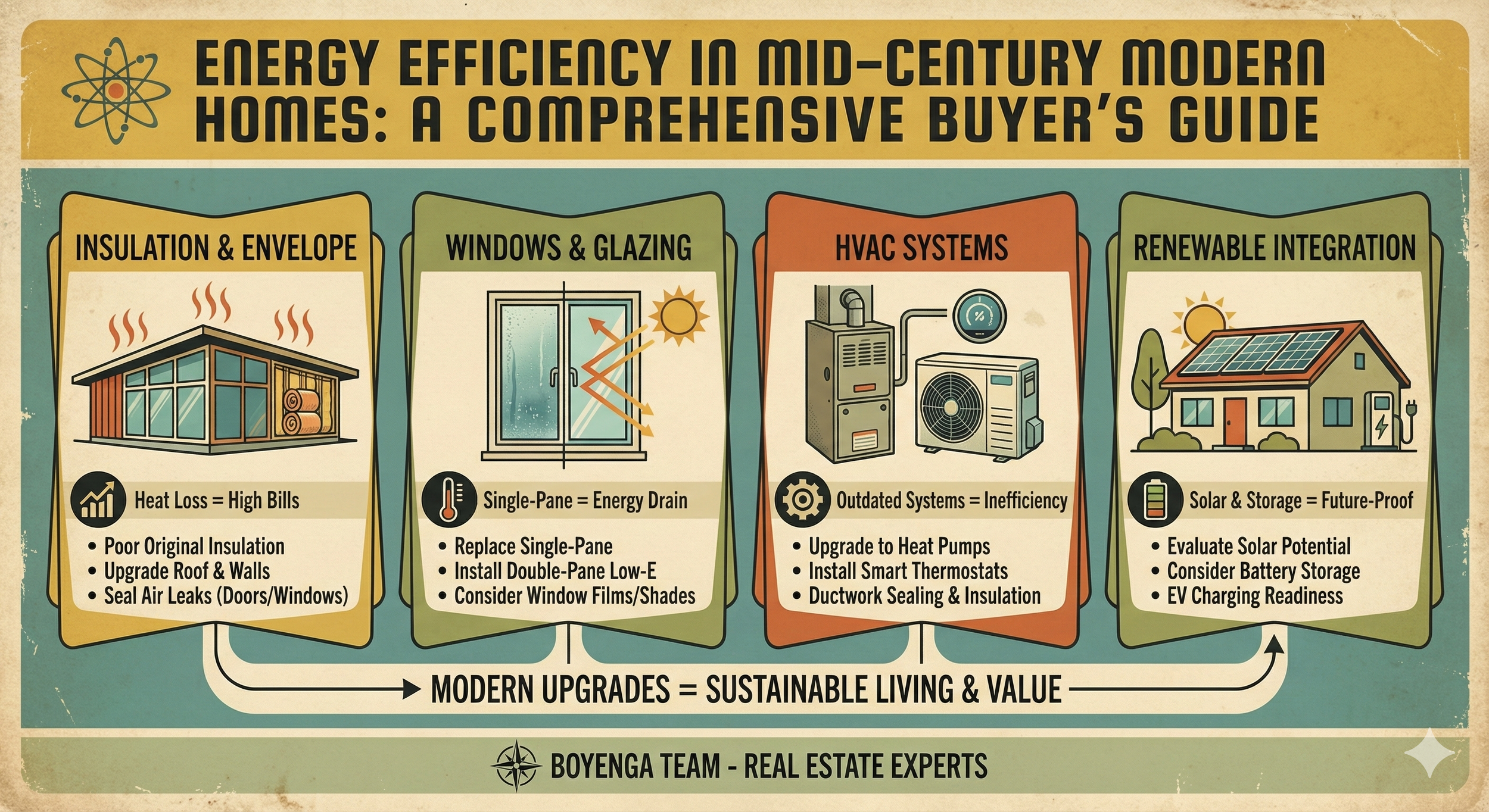
Mid-century modern (MCM) homes (built roughly 1945–1970) are celebrated for their iconic design – open layouts, walls of glass, and seamless indoor-outdoor connections. However, prospective buyers should be aware that these very features often come at the expense of energy efficiency. In fact, many mid-century homes were built before energy performance was a priority, and the 1970s energy crisis highlighted how costly they could be to heat and cool. Homeowners were frequently caught between paying exorbitant utility bills or bundling up in winter. Aside from high energy costs, original MCM houses can feel drafty and uncomfortable due to leaky walls, single-pane windows, and inadequate heating systems. This guide provides a detailed look at why mid-century modern homes tend to be inefficient, how they compare to newer houses, and what upgrades or strategies can improve their performance – all tailored for buyers who love the style but care about energy use.
Original Mid-Century Modern Construction and Insulation
An original mid-century modern home with a low-pitched roof, slab-on-grade foundation, and large glass areas. Such homes are architecturally stunning but were typically built with minimal insulation and single-pane glazing, making them thermally inefficient.
Mid-century modern homes were revolutionary in design but often basic in thermal engineering. Key elements of their construction include minimal insulation, expansive single-glazed windows, unconventional roof designs, and unique heating systems. Here’s an overview of typical features and materials in original MCM homes and how each affects energy efficiency:
Little to No Insulation: Many mid-century homes were built when insulation standards were lax or nonexistent. It was common to have no insulation in walls or very little in roofs. For example, 1950s-era wall insulation (if present at all) might consist of only a thin mineral wool batt with an R-7 value – far below today’s standards. Some MCM houses have uninsulated slab foundations and minimal ceiling insulation, leading to heat loss through the envelope.
Single-Pane Windows: Floor-to-ceiling glass is a hallmark of mid-mod design, but initially these were single-pane and often set in aluminum or steel frames with no thermal break. Such single-glazed windows provide almost no insulation, with an R-value of approximately 1.0. They allowed heat to radiate out in winter and seep in during summer, turning the home into “an energy sieve” in its original state. Large glass walls oriented poorly (e.g., facing north or west) only compounded heat-loss or solar-gain issues. In the 1950s and ’60s, modern energy-efficiency standards weren’t on builders' radar, so comfort was often sacrificed for style.
Unconventional Roofs (and Thin Roof Decks): MCM homes often feature flat, low-pitched, or butterfly roofs with exposed beam ceilings. While visually striking, these roofs usually lack attics or deep cavities for insulation. The tongue-and-groove wood decking and beams were often left exposed on the interior, preventing insulation from being installed between rafters without covering the architecture. As a result, many original mid-century roofs had only a thin layer of insulation (if any) in the roof deck. In homes with flat roofs, limited roof cavity space often meant inadequate insulation by today’s standards. Warm air readily escapes through such roofs in winter, and the hot sun can bake the interior in summer.
Slab Foundations and Radiant Heat: To achieve a low-profile aesthetic, many mid-century modern houses were built slab-on-grade (a concrete slab directly on the ground, with no basement). Some, like the famed Eichler homes in California, embedded radiant heating pipes in these slabs. Radiant floor heating can be wonderfully comfortable, but in mid-century installations, it was often done without any insulation beneath the slab. Tubing was buried deep in uninsulated concrete, so a lot of heat was lost into the ground, and response was sluggish. With the slab poured directly on earth, floors tended to get cold and could even accumulate condensation in humid weather. Modern practice would insulate and moisture-seal beneath slabs, but that was not common in the 1950s.
Older HVAC Systems: It’s not unusual for original mid-century homes to lack central ducted HVAC. Many relied on electric baseboard heaters, in-wall gas furnaces, or the aforementioned radiant floors. Air conditioning was often absent or added later as a window unit. These piecemeal systems often left cold or hot spots and were generally inadequate by modern comfort standards. Where forced-air furnaces were used, they were much less efficient than today’s (older gas furnaces from that era might be only ~60% AFUE). Fireplaces were common focal points and provided some heat. Still, they are actually energy losers – an open masonry fireplace can exhaust huge volumes of heated air up the chimney and draw cold air in. In fact, experts call an open fireplace “one giant open hole” in your thermal envelope.
Materials and Thermal Mass: Mid-century designs favored materials like brick, concrete block, wood paneling, and large glass. While masonry adds thermal mass (which can help stabilize temperatures if used properly), uninsulated brick or block walls have a low R-value. Some mid-century modern homes have single-wythe masonry or wood-panel walls without insulation, which provide minimal resistance to heat flow. Likewise, the post-and-beam construction, where structural members span from inside to outside, creates thermal bridges – conductive paths for heat to bypass insulation. Metal window frames and concrete elements readily conduct heat, creating drafts and cold spots around these beautiful yet poorly insulated design elements.
Bottom line: Original mid-century modern homes were built with an emphasis on design innovation, not energy conservation. As a result, they tend to be drafty in winter, overheated in summer, and generally far less efficient than modern houses. It’s no coincidence that the spike in energy prices in the 1970s made these homes notoriously expensive to heat and cool. For a buyer today, understanding this gap is key – but fortunately, upgrades can significantly narrow it (more on those later).
Mid-Century vs. Modern Homes: Energy Performance Comparison
How does a 1955 mid-mod stack up against a 2025-built home when it comes to energy use? In short, modern homes benefit from decades of advances in building science and stricter energy codes, whereas mid-century homes typically require retrofits to approach similar performance. A few high-level comparisons:
Insulation Requirements: A mid-century house may have R-7 or less in the attic and no insulation in the walls. Today’s building codes mandate roughly R-38 to R-49 in attics and R-13 to R-20+ in walls, depending on climate. Modern homes also insulate floors over crawl spaces or slabs (often R-10 to R-20 slab-edge insulation), which was unheard of in the 1950s.
Window Technology: Original single-pane windows (U-factor ~1.0) have essentially one-tenth the insulating value of a modern double-pane low-E window. Contemporary energy-efficient homes use double- or triple-pane windows with low-emissivity coatings and argon gas fill, yielding U-factors of 0.25–0.35 (R-3 to R-4). They also have insulated frames or thermal breaks to prevent conductive heat loss. In contrast, mid-century aluminum or steel window frames readily conduct heat, and large single-glazed sections can make entire rooms cold. According to the U.S. Department of Energy, just replacing single-pane windows with double-pane units can save an average of $126–$465 per year in energy costs for a typical home.
Airtightness: Mid-century homes are often leaky. They were built at a time when houses “breathed” (infiltration was even considered beneficial to prevent moisture buildup). Gaps around old windows, unsealed joints in tongue-and-groove ceilings, and wall vents for furnaces or fireplaces all contribute to drafts. In fact, one energy audit of a 1960s home found it was leaking over 4,000 CFM50 (cubic feet per minute at 50 Pa), far above what a house that size should. By comparison, modern codes require houses to achieve air leakage rates of around 3–5 ACH50 (air changes per hour at 50 Pascals) or better, which equates to a very tight envelope. High-performance new homes (e.g., Passive House standard) target as low as 0.6 ACH50, virtually airtight. Sealing every gap reduces heat loss and drafts in winter.
Heating & Cooling Systems: A new home today will typically have a high-efficiency furnace (90–98% AFUE) or a heat pump rated 200–300% efficiency (COP 2–3+), along with a central AC or heat pump for cooling (minimum SEER 14–20+). Ductwork is insulated and balanced for even distribution. Many mid-century homes, if they haven’t been updated, run on equipment that is far less efficient – think of 50+ year-old boilers, electric resistance baseboards, or clunky wall heaters. They often also lack air conditioning or use inefficient add-ons. The result is not just higher energy bills but often uneven comfort. For instance, a 2025 code-built home might have an energy recovery ventilator (ERV) and smart zoning, keeping temperatures even, whereas a 1955 home might have one warm room by the fireplace and cold bedrooms at the edges. It’s not surprising that an energy audit on a late-1960s house in Melbourne rated it only 2½ to 3 stars out of 10 for efficiency, which is about the average for older homes – new construction, by contrast, often scores much higher on such rating scales.
Overall Energy Use: Despite being larger on average, newer homes often use the same or even less total energy than older ones, thanks to these improvements. One U.S. Department of Energy report noted that houses built after 2000 use about 21% less energy (on average) than those built in earlier decades. Another analysis found that, on a per-square-foot basis, homes from the 2010s are roughly twice as efficient as those from the 1950s. In essence, a modern home can heat and cool the same area for a fraction of the energy a mid-century modern home would require without upgrades.
To illustrate the differences, the table below summarizes a few key comparisons:
Wall Insulation
Mid-Century Modern (c. 1950s)
Typically none or very thin fiberglass batts
Approx. R-7 or less
Stud cavities often empty; no exterior sheathing insulation
Modern Home (2020s)
Fully insulated wall cavities
R-13 to R-21, often with continuous exterior insulation
Designed to reduce thermal bridging
Roof / Ceiling Insulation
Mid-Century Modern
Minimal insulation, often R-0 to R-10
Exposed tongue-and-groove ceilings common
Little separation between indoor space and roof deck
Modern Home
Code-required insulation levels
R-38 to R-49 in many climate zones
Insulated attics or insulated roof assemblies
Windows
Mid-Century Modern
Single-pane glass
No low-E coatings
Aluminum or wood frames
U-factor ≈ 1.0 (very poor thermal performance)
Modern Home
Double or triple-pane glazing
Low-E coatings and gas fills
Thermally broken or insulated frames
U-factor ≈ 0.25–0.35 (much more efficient)
Air Tightness
Mid-Century Modern
Leaky construction with many gaps and penetrations
No air-sealing standards
Estimated ACH50 often greater than 10
Modern Home
Continuous air barriers, sealants, and housewraps
Blower-door tested
ACH50 typically 3–5 or better
Heating & Cooling Systems
Mid-Century Modern
Older gas furnaces (~60% AFUE)
Electric resistance heat or oil boilers in some cases
Often no central air conditioning
Modern Home
High-efficiency gas furnaces (90%+ AFUE) or electric heat pumps
Heat pump systems often 200%+ efficient
Integrated heating and cooling standard
Energy Code Compliance
Mid-Century Modern
Built before energy codes existed
No mandated insulation, window performance, or air-sealing
Modern Home
Must meet current energy codes
Regulated standards for insulation, windows, HVAC efficiency, and air-leakage testing
What this means for a buyer: If you purchase a mid-century home that hasn’t had efficiency upgrades, you can expect higher heating and cooling costs than in a newer home of similar size. As an example, one family living in a 1968 mid-mod in Australia was paying about $700 in gas for just 60 days of winter heating (plus $130/month in electricity) – a significant expense that could be lowered with improvements. The good news is that mid-century houses can be upgraded to significantly higher performance through retrofits. In the next sections, we’ll explore how the signature architectural features of these homes affect efficiency, and then dive into upgrades (insulation, windows, HVAC, solar, etc.) that can transform a drafty 1950s gem into an energy-wise home.
Architectural Features of MCM Homes and Their Impact on Efficiency
Mid-century modern architecture introduced bold new features – but some of those same features pose challenges for energy efficiency. Let’s look at how key design elements of MCM homes affect heating and cooling performance:
Expansive Glass Walls and Windows
Large windows and sliding glass doors are quintessential to mid-century modern design. They blur the line between indoors and outdoors, flood the interior with natural light, and offer great views. The trade-off is significant heat loss and gain through all that glass. Even under ideal conditions, windows have a lower R-value than insulated walls. In mid-century homes, it’s often the worst case: entire walls of single-pane glass. These windows allow warm indoor air to escape rapidly on cold nights and allow intense sunlight to overheat the interior on summer afternoons. The effect is magnified if the glazing faces unfavorable directions – for instance, north-facing glass contributes nothing to solar warming in winter (only heat loss), and west-facing glass can cause overheating on summer evenings. Many MCM homes still have their original single-pane windows decades later, meaning their thermal performance is stuck in the 1950s.
Modern glass technology offers solutions (double- or triple-pane units with low-E coatings and argon gas fill) that significantly improve insulation. But replacing large expanses of glass can be expensive and challenging – especially if you want to preserve the thin profiles and clean sightlines of mid-century-style windows. Some owners choose to install high-quality storm windows or interior window panels as a stopgap measure to improve insulation on the original glass. Others invest in new, thermally broken steel or aluminum windows that replicate the mid-century look while delivering improved performance. Even with upgrades, glass will always be a weaker point in the envelope than a solid wall, so mitigation measures help: insulating curtains or blinds can be used at night to trap heat (thermal-backed drapes on a ceiling-mounted pelmet can noticeably reduce drafts from glass). Similarly, exterior shading such as eave overhangs, awnings, or roll-down blinds can block summer sun on large panes, reducing cooling loads. In short, buyers should appreciate the beauty of an MCM’s glass walls, but plan for solutions to their inherent inefficiency – whether that’s window replacement, adding low-E film, or simply using strategic coverings and shades.
Open Floor Plans and High Ceilings
Mid-century modern homes pioneered the open-plan concept – fewer interior walls, large multi-purpose living spaces, and often higher or vaulted ceilings following the roofline. From a lifestyle perspective, this is wonderful: it creates an airy, spacious feel and allows light to penetrate the house. However, open layouts can be harder to heat and cool evenly. With fewer doors, you can’t easily zone the heating (for example, you can’t just heat a rarely used room – all areas are connected). A single thermostat may struggle to detect and adjust to temperature variations across different areas of an open space. High, sloped ceilings also mean that warm air rises out of the living area; in winter, heat may stratify up at the ceiling level, where it’s less useful, making the lower living zone feel chilly. If the ceiling follows the roof, as in many mid-mods, you have more exposed surface area for heat loss at the top of the room, and any lack of insulation there will quickly show.
On the other hand, open plans can facilitate natural ventilation. Many MCM homes were designed with windows on multiple sides that can be opened to capture cross-breezes. In a temperate climate, an open-plan mid-century home can cool quickly in the evening by simply opening sliders and allowing air to flow through. That’s a passive cooling advantage, especially in regions where air conditioning was initially absent. High ceilings also allow hot air to collect overhead, potentially keeping the occupied zone cooler in summer (ceiling fans can help destratify or push that hot air down in winter). There are some climatic benefits to the open design, but overall, the lack of compartmentalization results in higher heating/cooling loads. Modern homes combat this with multi-zone HVAC (e.g., separate thermostat controls for different areas or floor levels), something worth considering adding to a mid-century home during an HVAC upgrade.
Flat and Low-Pitched Roofs (and Exposed Ceilings)
The sleek rooflines of mid-century modern houses are a defining characteristic – flat or gently sloping planes that hug the home’s horizontal form. These roofs often have little or no overhang, creating a boxy, clean-edged look. The downside is reduced attic space and insulation. Traditional pitched-roof homes have attics where it is easy to add a thick blanket of insulation; mid-century modern homes with flat roofs typically do not. Many have open-beam or tongue-and-groove wood ceilings exposed on the interior, meaning the ceiling is essentially the underside of the roof deck. If these ceilings were insulated at all initially, it might have been a thin layer of fiberglass or rigid board above the decking, far below today’s R-value recommendations. In snow-prone climates, this led to heat escaping through the roof and causing ice dams – a clear sign of insufficient insulation. In warm climates, the sun beating on a minimally insulated flat roof can turn the house into a hotbox.
Buyers should examine the roof construction: does the home have a small attic crawl space or is it a vaulted ceiling? Has the roof been re-roofed with added insulation at any point? A common retrofit is to add rigid foam insulation on top of the existing roof deck when replacing the roofing materialhouzz.comhouzz.com. This “outsulation” preserves the interior look (exposed beams) while greatly boosting thermal performance. For example, placing several inches of foam board above a T&G ceiling can bring it up to R-30 or more, and an air-tight membrane can be installed at the same time to cut down on leakagehouzz.comhouzz.com. This approach was recommended in a Houzz renovation article: “use rigid foam board along with an air barrier above the ceiling… the interior appearance is not compromised, and a high level of insulation is achieved”houzz.com. Similarly, during one deep-energy retrofit of a 1960s home in Washington, the project team painstakingly sealed every seam in the tongue-and-groove roof decking to stop air leaks before adding insulation abovemillerhull.commillerhull.com.
Another issue with flat roofs is drainage and moisture – if water pools or seeps, wet insulation is worse than none. Ensure any flat roof has been well maintained or upgraded with proper membranes. Because mid-century roofs often lack overhangs, the walls and windows don’t get as much rain protection, and this can introduce moisture or rot issues that indirectly affect energy (a damp wall insulates poorly). In summary, the iconic rooflines of MCM homes make insulating a challenge, but solutions exist (above-deck insulation, reflective “cool roof” coatings to reduce heat gain, etc.). Prospective buyers should factor in the condition and insulation level of the roof, as improving it can yield one of the biggest comfort and efficiency gains.
Exposed Structure and Thermal Bridging
Mid-century modernism embraced the idea of revealing structure – instead of hiding the skeleton of the house behind drywall and ornament, posts and beams were left visible as part of the interior aesthetic. It’s common to see exposed wood or steel beams, and floor-to-ceiling posts in MCM homes. While beautiful, this design has a hidden cost: those structural members often span from inside to outside without a break, creating thermal bridges. A thermal bridge is a path of least resistance for heat to flow through an assembly. For example, a wood post that goes through the wall interrupts the insulation and allows heat to conduct along its length. Metal components are even worse – steel has high thermal conductivity. The result is localized cold spots, condensation potential, and an overall reduction in the effective insulation of the wall or roof.
In mid-century homes with post-and-beam construction, insulating and air-sealing can be tricky. Special care must be taken at these transition points. During renovations, one effective strategy is to use spray foam insulation around exposed posts and beams where they meet the building envelopehouzz.com. Closed-cell spray foam both insulates (higher R-value per inch than fiberglass) and seals air gaps around the wood or steel, which can significantly reduce leakage and conduction at those pointshouzz.com. In one Bay Area mid-century remodel, architects sealed between the beams and infilled wall sections with spray foam to stop the seepage that was occurring at every beam-to-wall junctionhouzz.com. Another approach when doing a major exterior renovation is to add a continuous layer of insulation over the entire exterior (rigid foam or mineral wool boards) which covers the studs and beams from the outside, thus mitigating bridges. This was done in a project called Loom House – a mid-century gem renovated to net-zero-energy standards. The team focused on “improving overall assemblies (walls, roof, and floors), including triple-pane insulated glass and an effort to eliminate thermal bridging” to meet high performance goalsmillerhull.com. They targeted an airtightness of 1.0 ACH50 (far tighter than code) and achieved it by carefully sealing every T&G ceiling seam and insulating the shell thoroughlymillerhull.commillerhull.com.
For buyers, it’s useful to recognize that those cool exposed rafters or support columns you see are likely not insulated. If you feel a cold draft around a beam in winter, it’s not your imagination. Solutions exist (many mid-mod enthusiasts have found ways to discreetly insulate while preserving the look), but it requires a thoughtful retrofit – something to plan for in an energy upgrade budget.
Radiant Floor Heating in Slabs
Not all mid-century modern homes have radiant heat, but it was a popular feature in certain regions (notably, Joseph Eichler’s developments in California). The concept – warm water running through pipes in the floor slab – was ahead of its time and can deliver very comfortable, even heating. The issue is how it was executed back then versus now. In mid-century installations, the radiant tubing (often copper pipes) was embedded directly in the concrete slab with no insulation underneath or around the slab edgeshouzz.com. This means a huge amount of the heat went downward into the soil. In addition, placing pipes deep in the slab made the system slow to respond and sometimes unreliable (many old radiant systems have failed due to pipe corrosion or leaks).
Modern radiant design would place the heating tubes closer to the floor surface and lay them over a layer of rigid insulation so that nearly all heat goes upward into the living spacehouzz.com. Also, today we’d put a vapor barrier and insulation under the entire slab when pouring it, which keeps the slab at interior-conditioned temperatures and prevents moisture issueshouzz.com. None of that was common in 1950s builds. So, if you find a mid-century home with original radiant heat, know that while it might feel nice on the feet when working, it’s likely inefficient and possibly a ticking maintenance time-bomb (if the pipes fail, you have to jackhammer the floor to fix them). Many homeowners in colder climates ended up abandoning old radiant slabs in favor of new heating systems rather than attempt costly repairs.
That said, some have been restored or upgraded. If you love the idea of radiant heat (silent, no blowing air, pleasant warmth), you could retrofit a new system by laying modern PEX tubing on top of the old slab with an insulation layer and a thin new concrete or gypcrete topping. Or consider radiant panels or underfloor heating for select areas. In any case, be aware of what you’re getting: ask if the radiant system is still functional, and whether the slab has any insulation. If not, you might use it sparingly or plan to supplement it. Many mid-century homes without ductwork now use ductless mini-split heat pumps for primary heating and cooling, keeping the old radiant as backup. In fact, experts often recommend adding a heat pump because relying on 1960s radiant alone can be costly – “using the reverse-cycle A/C (heat pump) for heating can be a third of the cost of running old gas heaters,” one energy adviser notedthedesignfiles.netthedesignfiles.net. The radiant floors were a great idea limited by mid-century tech; with modern approaches they can be part of an efficient home, but by themselves they’re usually not enough for today’s expectations of comfort and efficiency.
Fireplaces, Chimneys, and Wall Vents
Mid-century modern homes frequently feature fireplaces – often a central hearth dividing living spaces, or a dramatic floor-to-ceiling brick or stone chimney at the end of a great room. While wonderful for ambiance, traditional wood-burning fireplaces are extremely inefficient for heating. Most send far more heat up the chimney than they provide to the room. When not in use, they can create a drafting chimney effect that pulls warm air out. As mentioned earlier, a fireplace flue is essentially an open hole in your house unless it’s closed – and many older units don’t have airtight dampers. One 1960s home expert flatly stated that an open fireplace “lets in cold air, significantly reducing the thermal efficiency of the home”thedesignfiles.net. It’s recommended to cap or plug the flue when not in use; for instance, using a removable chimney balloon or a foam board stopper in the firebox to seal it on cold daysthedesignfiles.net. If you love fires, consider installing an energy-efficient wood stove insert or at least glass doors to minimize heat loss.
Additionally, mid-century houses with gas heaters or wood stoves often have wall vents or floor grilles that were originally required to supply combustion air. You might notice weird gratings in walls or crawlspace vents that seem always open. In the past, these were intentional to provide fresh air for heaters or to relieve pressure from fireplaces. Now, they’re usually just another source of drafts. If you modernize heating to sealed combustion or electric, you can typically seal off those old vents (as long as you address any moisture concerns). An energy assessor in one case pointed out that between an open fireplace and multiple wall vents for old heaters, a mid-century house had “a lot of draughts,” and that in the old days these were needed, but now we should be reducing the air leaks throughout the house for efficiencythedesignfiles.net.
In summary, features like big fireplaces and vintage vents are part of the mid-century character, but you’ll want to evaluate and likely retrofit them. Ensuring a fireplace has a damper (and keeping it closed when not in use), or sealing unused vents, will immediately improve energy performance. And if you adore the look of a fireplace but not the heat loss, consider converting it to a sealed gas insert or ethanol burner purely for aesthetics.
Improving a Mid-Century Modern’s Efficiency: Retrofits and Upgrades
It’s absolutely possible to enjoy a mid-century modern home and have reasonable energy bills and comfort – but achieving that usually means investing in upgrades. Here we cover the most impactful retrofits, typical costs and return on investment (ROI), and how to implement them without spoiling the home’s character. Think of this as your roadmap to bringing a 1950s house up to 21st-century performance.
1. Upgrade Insulation and Seal Air Leaks
Insulation is the first line of defense for any home’s efficiency, and most mid-century houses are under-insulated by today’s standards. Adding insulation can yield huge benefits in comfort and savings. Key areas to address:
Roof/Ceiling: As discussed, many MCM roofs have minimal insulation. If the roof will be replaced or can be added to, plan to put rigid foam insulation above the deck or spray foam below (if the ceiling isn’t exposed). Increasing a flat roof from, say, R-8 to R-30 could cut ceiling heat loss by 75%. In practice, homeowners have added layers of polyiso foam board on flat roofs, then a new membrane, which both insulates and solves old leak issueshouzz.com. Cost: Roof insulation retrofits typically cost a few thousand dollars ($3k–$10k depending on roof size and material). ROI: Relatively high – you’ll not only save energy but also prevent issues like ice dams. If your heating bill drops by 15% from this, the investment pays back over time and adds to resale value.
Attic (if present): Some mid-century homes (e.g. ranch styles) do have small attics. Blowing in fiberglass or cellulose insulation is one of the most cost-effective upgrades. It’s common to bring an attic up to R-38 or R-49. According to one insulation contractor, adding attic insulation (at a typical cost of $1,500–$3,000) can save around $150 per year in heating/cooling costs, paying back in 8–15 yearsnealoninsulation.comnealoninsulation.com. If the attic is accessible, also seal any gaps (like around light fixtures or ducts) before insulating – air sealing + insulation gives the best resultenergystar.gov.
Walls: Many mid-century walls are uninsulated 2x4 cavities or masonry. Blowing insulation into closed walls (e.g. dense-pack cellulose or injection foam) is possible in many cases and can dramatically improve comfort. A case study in Michigan involved drilling small holes in wall cavities and filling them with cellulose, significantly reducing heat lossecotelligenthomes.com. Cost: Wall insulation retrofits can range from $3,000 to $8,000 for an average homenealoninsulation.com. Savings: Perhaps 15–25% on heating bills, depending on climate – one source estimates around $600/year savings for a full wall insulation jobnealoninsulation.com. That’s a payback in under 8 years in many casesnealoninsulation.com, one of the highest-ROI efficiency upgrades you can do. Plus, it cuts drafts and improves noise reduction as a bonusnealoninsulation.com.
Floors/Slab: If the home has a raised floor (crawlspace), adding insulation beneath the floor and sealing gaps can make floors warmer. For slab-on-grade homes, you can’t insulate under the slab without major renovation, but you can insulate slab edges (perimeter) if accessible by digging around the outside and adding rigid insulation. It’s also possible to install insulated flooring (e.g. a thermal break layer under new flooring) if you are replacing finishes. These are less impactful than roof and walls but still help, especially in cold climates.
Air Sealing: While adding insulation, always think about air leak sealing. This includes weather-stripping doors, caulking gaps around window frames, sealing plumbing/electrical penetrations, and closing off those old vents or any holes in the thermal envelope. A blower door test can identify where leaks are. Many 1950s homes, as noted, have measured ACH50 above 10; bringing that down to 3–5 can slash heat loss. Even a basic DIY approach (foam gaskets on outlets, door sweeps, chimney balloon) can make a noticeable difference in draftiness.
Overall, insulating and air-sealing a mid-century home can reduce heating/cooling costs by an estimated 15–30% or more. The EPA estimates that sealing leaks and adding insulation saves about 15% on heating and cooling costs for the average homeownerenergystar.gov. In an older uninsulated house, the percentage could be higher. Beyond dollars, this upgrade greatly improves comfort – no more cold walls to lean on or super-heated ceilings. It’s usually step one in any efficiency makeover.
2. Replace or Improve Windows and Glazing
Windows are often the make-or-break feature for mid-century aesthetics. Those big panes and sliders are part of the charm – but they’re also typically the weakest link in efficiency. Window upgrades can take several forms:
Full Window Replacement: Installing modern energy-efficient windows will yield the best thermal improvement. New double- or triple-pane units with low-E coatings can cut heat loss through the glass by 50% or morehouzz.com. Many homeowners opt for replacements that preserve the mid-century style (for example, there are companies that make thin-profile thermally broken steel windows that mimic the originalshouzz.com). Cost: Window replacement is not cheap – average ~$700–$1,000 per window installed (can be $15,000–$30,000+ for a whole house). Because MCM homes have so much glass, this can be a large expense. Energy savings: moderate – perhaps 10–20% off heating/cooling bills in a leaky glass-heavy house. The U.S. DOE suggests savings of $100–$400 a year when going from single to double-pane across a homewindowdepotnashville.com. That can be a very long payback on energy alone. However, consider ROI in terms of home value: new windows often recoup ~70–80% of their cost in increased property valuerickmacdonaldsiding.ca because buyers value both efficiency and the fact that windows won’t need replacing for decades. And there’s a big comfort gain – fewer drafts and cold spots near windows.
Retrofitting Glazing: If you want to retain original window frames for historical or cost reasons, an option is to retrofit double-glazing into them. Some specialty companies can add a second pane or replace the glass in situ. This was noted as possible in an energy audit: you can “retrofit double-glazing into existing window frames so as not to impact the home’s design integrity, but it does come at a high cost”thedesignfiles.net. So it’s feasible but not widely available everywhere.
Storm Windows and Window Inserts: A less expensive way to improve old single-pane windows is adding storm windows (secondary glazing). Exterior storms are common in cold climates – essentially a second window installed outside the primary one, creating an insulating air gap. These can be taken off seasonally if needed. Interior acrylic or glass panels that magnetically attach inside each window are another approach (they are virtually invisible and can cut drafts significantly). Storms/inserts can approach much of the performance of a full double-pane, at a fraction of the cost (maybe $100–$300 per window). The downside is a bit of inconvenience and, for exterior storms, a change to the exterior look (though you can get very sleek, low-profile ones). Still, for large fixed windows, a well-fitted interior insert can dramatically improve comfort (no more “cold wall” effect from big glass).
Window Films: Low-E window films applied to existing glass can reduce radiant heat gain and loss. They won’t improve the pane’s R-value a ton, but they can cut summer solar heat and block UV, and slightly reflect interior heat back inside in winter. These are low-cost and maintain the original windows – a possible interim solution if replacements are down the road.
Weather-Stripping and Repairs: For any windows that open (casements, sliders), ensure the weather seals are in good shape. Replacing dried-out weatherstripping or installing new sweeps on doors can reduce air leakage around these big openings. Also, fix any broken panes or poor-fitting frames – sometimes efficiency is lost simply due to a window that doesn’t close properly or has gaps.
One thing to keep in mind is preservation vs. efficiency: if the home is historic or you adore the original steel frames, you might choose to keep them and accept some inefficiency (mitigating with storms or heavy drapes at night). If your priority is comfort and savings, plan for window upgrades in phases. Perhaps do the north-facing or worst-condition windows first and others later. And remember, shading and window coverings are your friends. For example, the owners of an Alistair Knox mid-century house found that their existing heavy curtains (with pelmets) helped trap heat in winter, and an expert suggested adding exterior blinds to the large west-facing windows to cut summer heatthedesignfiles.net. These kinds of add-ons can make a notable difference and are much cheaper than full replacements.
3. Heating, Cooling, and Ventilation Upgrades (HVAC)
Many mid-century modern homes need a mechanical systems makeover to run efficiently and meet modern comfort expectations. When evaluating or planning upgrades, consider the following:
Heat Pump Systems (Ductless or Ducted): If the home doesn’t have ducts (common in MCMs), ductless mini-split heat pumps are a game-changer. These are wall-mounted units (connected to an outside compressor) that provide both heating and cooling very efficiently. They can be installed with relatively little disruption – just a small hole through the wall for lines – preserving the home’s architecturelivethedmv.com. Heat pumps are much more efficient than electric baseboards or old gas furnaces, especially in moderate climates. One misconception is that they are costly to run, but in reality a modern heat pump can often heat for a third the cost of an older gas heater in some areasthedesignfiles.net. A single split-system can service a large open area, and additional units can be added in bedrooms as needed. Cost: Roughly $3,000–$5,000 per indoor zone for a ductless system (so a few zones could be $10k+). ROI: Medium – you’re trading fuel (especially if you switch from expensive gas or oil to electricity, or if you offset with solar). Many jurisdictions have rebates that can offset costs. The payoff is lower energy bills (particularly if going from electric resistance heat to heat pump, you can save 50%+ on heating costs) and air conditioning capability where there was none. Plus, using electricity instead of combustion improves indoor air quality and aligns with renewable energy trends.
High-Efficiency Furnace/AC: If the home already has ductwork or you plan to add it (perhaps feasible in a single-story ranch with an attic, or via ceiling registers), then a high-efficiency furnace and central AC is an option. This could be a conventional gas furnace (95% AFUE) paired with an electric AC unit (or a heat pump that does both). Adding ductwork to a mid-century home can be challenging without attic or crawlspace, which is why alternatives like high-velocity mini-duct systems or ductless systems are often used. Evaluate if existing ducts (if any) are leaky or uninsulated – sealing and insulating ducts can greatly improve delivered efficiency.
Smart Zoning and Controls: Whatever heating/cooling system you have, using smart thermostats or multiple zones can optimize energy use. For example, a Nest or ecobee thermostat (cost ~$150–$250) can learn your schedule and cut energy use by 10–15% by avoiding unnecessary heating/coolingkiplinger.com. Many mid-century homes are single-zone; consider splitting into two zones (living vs sleeping areas) so you can, say, let the bedrooms cool down during the day and the living area set back at night. Zoning can be achieved with multiple ductless units or dampers in a central system. The investment is usually modest and the comfort and savings payoff is solid – studies show smart thermostats save around 10–12% on heating and 15% on cooling bills on averagekiplinger.com, roughly $130 a year or more depending on your usage.
Water Heating: The old gas or electric water heater in a mid-century home is another opportunity. High-efficiency options include heat pump water heaters (which use electricity much more efficiently by extracting heat from air) or on-demand tankless systems. Heat pump water heaters can be 2–3 times more efficient than a standard electric tank. They do cool and dehumidify the space they’re in (essentially acting like a small AC unit), which can be a perk in a muggy basement. Cost is about $1,500–$2,500 for a unit, but many places have rebates. An example from Australia: replacing an inefficient gas storage water heater with a heat pump unit cost about $2,000 (after rebates) and will save significantly on gas bills going forwardthedesignfiles.netthedesignfiles.net. If your home still has a 50+ year old water heater or, say, an oil-fired water tank, this is worth upgrading for both efficiency and reliability.
Mechanical Ventilation: When you tighten up a formerly leaky mid-century house, it’s wise to add some controlled ventilation for fresh air. Modern homes often have heat recovery ventilators (HRVs) or energy recovery ventilators (ERVs) to continuously bring in fresh air and exhaust stale air while transferring heat between them. In moderate climates, you might simply use exhaust fans and passive vents. But if you are going for maximum efficiency (say you’ve sealed the house to passive-house levels), an ERV will ensure good air quality without losing much heat. This is a lower priority than insulation/HVAC in most retrofit scenarios, but worth noting. In the deep retrofit “CarMic” project of a 1954 home, the renovators included an ERV as part of the overhaul to maintain air quality in the now almost airtight housegreenbuildermedia.comgreenbuildermedia.com.
Decommissioning Inefficient Systems: Often, part of upgrading is removing or properly sealing off old systems. If there’s an abandoned furnace flue, have it sealed. If the radiant floor is defunct, decide whether to recommission it or cap it and move on. If window AC units are used, replace them with a whole-house solution. Reducing redundancy can save energy too (for instance, an old fridge or freezer in the garage can be a big energy hog – not an architectural feature per se, but common in older homes; consolidating to one efficient fridge can save a couple hundred dollars a year easily).
In summary, a mid-century home can be outfitted with a 21st-century HVAC system that will vastly improve comfort and likely reduce energy use despite offering more conditioning. Yes, it’s an investment – expect to spend perhaps $8,000–$15,000 for a comprehensive heating/cooling upgrade (less if just adding one or two mini-splits). But doing so solves the “inadequate mechanical systems” complaint that has long plagued these houseshouzz.com. Given that heating is often the single biggest energy expense (e.g. it was ~75% of the gas bill in that Melbourne examplethedesignfiles.net), making your heating system efficient can yield immediate savings each winter.
4. Solar Panels and Renewable Energy
Mid-century modern homes, especially those in sunny climates or with flat roofs, can be excellent candidates for solar photovoltaic (PV) panels. Adding solar doesn’t improve the home’s insulation or envelope, but it can offset the energy you do use, effectively cutting your utility bills and carbon footprint. Here’s how solar can play into an MCM energy plan:
Solar on Flat Roofs: Many mid-mod houses have large flat or low-slope roofs (often out of street view), which is perfect for mounting solar panels. You can usually orient the panels for optimal sun exposure without worrying about the exact house orientation. A flat roof may even allow more panels because you’re not constrained by the roof shape. Ballasted racking systems can often be used (minimizing penetrations). One thing to ensure is that the roof is in good shape and can handle the weight; if you’re re-roofing, coordinate to have it solar-ready.
Solar on Pitched Roofs: If your home has a broad gable roof (some ranches do) facing south or west, that’s also great for solar. Even if the pitch is low, panels can be attached flush. They will be visible, but some don’t mind the tech-meets-mid-century look, and others place them on the less street-visible side.
System Size and Cost: A typical residential solar system these days might be around 5 to 8 kW, which could produce 6,000–10,000 kWh/year depending on sun conditions – enough to cover a significant portion of an efficient mid-century home’s needs (especially if you convert heating and hot water to electric). At an installed cost of roughly $2.50–$3 per watt (after federal tax credits), a 6 kW system might net around $12,000. Incentives like the U.S. 30% federal tax credit and various state/local rebates can reduce this. Solar has a good ROI in many areas – often a ~10-year payback or less with incentives, and thereafter essentially free electricity. It’s one upgrade that pays for itself and then some, over the panel lifespan of 25+ years.
Net Zero Renovations: Ambitious projects have demonstrated that even older homes can reach net zero energy or better by combining efficiency with solar. For example, a 1954 mid-century home in Maryland was transformed through an 8-year deep energy retrofit that included 36 solar panels (≈10.8 kW), super-insulation (cellulose, cork, mineral wool in walls and roof), triple-pane windows, and all-electric heat pump systemsgreenbuildermedia.comgreenbuildermedia.com. The result was a net-zero modern home that actually produces more energy than it uses annually, without losing its mid-century charmgreenbuildermedia.comgreenbuildermedia.com. While not every buyer will undertake such a massive overhaul, it’s encouraging to know that the combination of solar + efficiency can completely offset an old home’s energy appetite.
Other Renewables: Solar PV is the most accessible. Solar thermal (for hot water) is another option, though heat pump water heaters have somewhat supplanted it in popularity. If the property has room and zoning, even a small wind turbine could be a possibility (less common in residential settings). Also consider battery storage if you have solar – it can provide backup power and allow you to use more of your solar energy in the evenings.
In conclusion, adding solar panels won’t directly make your mid-century home tighter or better insulated, but it will reduce or eliminate your electricity bill and make the home much greener. It’s often the capstone of an energy retrofit – after you reduce demand with insulation and efficient systems, you supply the remaining needs with clean energy. Many buyers find the idea of a mid-century modern net-zero home very appealing: you keep the timeless design but run it on 100% sunshine.
5. Other Upgrades: Thermostats, Lighting, Appliances, etc.
Beyond the big-ticket items, there are plenty of smaller improvements to boost efficiency:
Smart Thermostats and Zonal Controls: As mentioned, installing a smart thermostat can yield ~10% savings and typically costs only a couple hundred dollarskiplinger.com. They’re especially useful in homes with variable occupancy or ones that heat up/cool down quickly (as many mid-century homes do due to low thermal mass in wood structures). If you have multiple heating zones, smart thermostats on each can optimize comfort schedules. Also consider smart TRV (thermostatic radiator valves) or zone controllers if you retain something like radiant heat – they now make wireless controls to zone hydronic systems without major replumbing.
Efficient Lighting: Mid-century homes often rely on floor and table lamps (since ceiling fixtures were less common in open-plan designs). Switching to all LED bulbs will reduce lighting energy by 70–90% compared to the original incandescent lamps from the 1950s. It’s a quick win. If the home has any built-in fixtures (e.g. globe lights, track lighting added later, or outdoor lights), those can be refitted with LED equivalents. LEDs also run cooler, which is helpful in the summer. And for that cool retro pendant or sputnik chandelier you install, rest assured there are filament-style LED bulbs that maintain the vintage look while sipping power.
Appliances: Replacing old appliances (fridge, oven, washer/dryer) with modern Energy Star models will further cut energy use. A 1960s fridge might have used 4x the electricity of a new one. This is often part of general renovations. Similarly, if the home still has an ancient pool pump (for those mid-century pools) or an extra freezer in the garage from 30 years ago, upgrade those or retire them – they can be surprising energy hogs.
Window Treatments: We’ve touched on this but it bears repeating: appropriately using window coverings improves comfort and efficiency. In winter, close drapes at night to keep heat in; in summer, use reflective blinds or solar shades especially on east/west windows to cut down heat. Exterior shading (trees, awnings, shade sails) can be very effective for mid-century homes since they often have large glass and minimal eaves. Landscaping can play a role – deciduous trees that leaf out in summer but allow sun in winter align perfectly with mid-century design ethos of integrating with nature while helping the home’s performance.
Energy Monitoring: If you’re really keen, install an energy monitoring system (like Sense or Emporia) in the electrical panel. It gives real-time data on energy use, which can help identify what’s using the most power and track the impact of improvements. It’s a bit more tech-forward, but some homeowners enjoy the feedback loop of seeing, for example, that their new heat pump is using far less power than the old baseboards, or catching if an old sump pump is stuck on, etc.
To bring these upgrade ideas together, the table below provides a snapshot of typical retrofit costs and energy savings for a mid-century home:
UpgradeTypical CostEnergy SavingsPayback / ROIAdd Attic/Roof Insulation$2,000 – $5,000 (depending on area)Save ~10–15% on heating/cooling (≈ $150/yr)nealoninsulation.com~10 years (faster with rebates), >100% ROI on resale (insulation often returns its cost)Blow Insulation into Walls$4,000 – $8,000Save ~20% on heating (≈ $500–$600/yr)nealoninsulation.com5–8 years paybacknealoninsulation.com; high comfort gain (eliminates cold drafts)Air Sealing (professional)$1,000 – $3,000Save ~10–20% on heating/coolingenergystar.gov5–10 years; also improves durability by reducing moisture ingressHigh-Efficiency Windows$15,000 – $25,000 (whole house)Save ~10% on heating/cooling (maybe $200–$300/yr)windowdepotnashville.com50+ years on energy alone; however, ~70% of cost may be recouped in home valuerickmacdonaldsiding.caInstall 5-kW Solar PV~$12,000 (before credits) / ~$8,400 (after 30% credit)Generate ~7,000 kWh/year (worth $800/yr at $0.12/kWh)~10 year payback (depends on utility rates); increases home value (solar often adds ~$15k value)Heat Pump Mini-Splits (2–3 zones)$8,000 – $12,000Save 30–50% on heating vs. electric or oil; also provides efficient AC5–15 year payback (varies with fuel costs); improves comfort & adds A/C, boosting appeal to buyersSmart Thermostat$200 – $300 installedSave ~10–12% on heating, ~15% on coolingkiplinger.com (~$100–$150/yr)1–3 years; very high ROI and convenience
Table: Typical energy upgrades for mid-century homes, with ballpark costs and benefits. Actual results vary by climate and house condition. Many upgrades qualify for rebates or tax incentives, improving payback. Even when the pure dollar ROI is modest (e.g. windows), consider the comfort, aesthetics, and resale benefits as part of the equation.
As you can see, insulation and air-sealing tend to give the best bang for the buck, while windows, though costly, offer other benefits. Solar is a standout if you have good sun – it essentially fixes your energy cost and pays dividends once the system is paid off. HVAC upgrades are often driven by necessity (old systems failing) but when done, they can significantly lower operating costs and modernize the home.
One tip: check for government and utility programs. Many places offer rebates for insulation, efficient HVAC, smart thermostats, and solar. For instance, as of this writing, U.S. federal tax credits under the Inflation Reduction Act can cover 30% of solar costs, and various state programs can cover hundreds to thousands of dollars for heat pumps or insulation upgrades. These can tilt the economics very much in your favor as a homeowner doing improvements.
How Do MCM Homes Compare to Other Home Styles?
If you’re considering a mid-century modern home, you might also be looking at other houses from similar eras (or at least comparing what you’re getting into efficiency-wise). Here’s a quick comparison:
Mid-Century Modern vs. Mid-Century Ranch: A mid-century ranch (the more common tract house style of the 1950s–60s) often shares some vintage inefficiencies – likely minimal insulation and single-pane windows – but ranches usually have simpler forms. A typical ranch has a pitched roof with an attic and a more compact window area (maybe a big picture window in the living room, but not walls of glass on every side). This means it can be a bit easier to retrofit; you can blow insulation into the attic and walls without major aesthetic concerns, and the smaller window-to-wall ratio means less heat loss to begin with. However, ranches are usually sprawling single-story structures, which actually have more roof and foundation area per square foot of living space than a two-story. More exposed surface means more heat loss potential. Still, in most climates a two-story is inherently more efficient than a one-story: one analysis finds two-story homes tend to be 5–15% more energy-efficient than single-story of the same area, due to less exterior surface area and the fact that heat rises (warming the upstairs)thehouseplancompany.com. That suggests a colonial or split-level might perform better than a ranch or mid-century modern one-story. But between a ranch and a custom mid-mod of the same size, the ranch likely has fewer windows and a higher-pitched roof (more insulation), so it could edge it out in efficiency. Both will need insulation and window upgrades to reach parity with new homes. The ranch might have had ducts and central heat more commonly than custom moderns, which could make adding AC easier (though those ducts might be uninsulated in the crawlspace – worth checking).
Mid-Century Modern vs. Colonial Revival (or other older styles): Colonial revival homes (think 2-story, symmetrical facade, often built in mid-20th century as nostalgic throwbacks) have some efficiency advantages by design: two-story format, so the footprint is smaller and the roof area is half the size for the same square footage (meaning less roof heat loss, less foundation exposure). They also tended to have attics and sometimes basements, allowing for more insulation opportunities. Window-wise, a colonial might have many windows, but they’re usually standard sizes (double-hung, etc.) and not floor-to-ceiling glass, and often were paired with storm windows. So an unrenovated 1960 colonial could actually feel less drafty than a 1960 mid-century modern simply because its windows were smaller and possibly had storms. On the other hand, colonials often have little insulation in walls (unless added later) and can have their own quirks (like uninsulated crawlspaces over porch extensions, etc.). The colonial’s saving grace is the compact shape – as noted, a two-story design can be ~10% more efficient just from reduced exterior surfacethehouseplancompany.com. So, if both a mid-mod and a colonial have zero insulation, the colonial will lose heat more slowly. Once properly insulated and updated, the colonial likely remains a bit easier to heat simply because of shape and typically less glass. That said, many colonial revivals have big central chimneys (multiple fireplaces) which, like in mid-mods, can leak heat if not sealed. And some have attached garages which, if not insulated and sealed off, can be a cold air entry point.
Mid-Century (1940s–60s) vs. 1970s–80s Homes: If you expand your search to slightly newer homes (late 1970s or 1980s contemporary homes, for instance), you’ll start seeing some built-in efficiency improvements. The first energy codes came in the late 1970s after the oil embargo. Homes in the late 70s often have at least some wall insulation and double-pane windows became common by the 1980s. However, many 1970s tract homes were still pretty poorly insulated by today’s standards, and design-wise they might have their own challenges (e.g. elaborate cathedral ceilings in 1980s contemporaries that are hard to insulate, or cheap aluminum windows that have failed seals). So, a well-renovated mid-century could outperform a neglected 1980s house. Don’t assume newer is always better without looking at what’s been updated.
Contemporary Sustainable Designs: Here’s where the contrast is stark. If you compare a 1955 home to a Passive House or modern green home, the difference is huge. Passive House (Passivhaus) standards require ultra-tight construction, thick insulation (often R-40+ walls, R-60 roof), and triple-pane windows, resulting in homes that use 75–90% less heating and cooling energy than average new housespassivehouse.com. These homes maintain steady temperatures with minimal active heating/cooling. A new net-zero or LEED Platinum home will have solar orientation, thermal mass, radiant barriers, and all the bells and whistles like LED lighting, ENERGY STAR appliances, etc. The average mid-century home, in original form, wouldn’t come close to these performance levels – it might have a HERS (Home Energy Rating System) index of 120 (20% worse than baseline new home), whereas a passive or net-zero home might be 0 or even negative (producing more energy than it uses).
However, it’s worth noting that mid-century modern homes can be brought to surprisingly high performance with deep retrofits. We’ve mentioned examples: the Loom House in Washington achieved net-positive energy (generating more than it uses) under the rigorous Living Building Challenge, all while preserving its 1960s architecturemillerhull.commillerhull.com. Key steps included meticulous air sealing (hitting 1.0 ACH50 in an old house is impressive) and adding enough insulation plus a solar array to offset usagemillerhull.comgreenbuildermedia.com. Another project in California upgraded an MCM home with passive house principles – continuous exterior insulation, high-efficiency HVAC, and so on – slashing its energy needs while keeping the mid-century style intacteichlerhomesforsale.com. These projects are showcases and often expensive, but they prove that the gap between a 1950s design and today’s standards can be closed if one is willing to invest.
For a buyer, the practical takeaway is: expect a mid-century modern home (especially unrenovated) to lag behind a typical new home in efficiency unless those upgrades have been made. If comparing to other older homes (ranches, colonials, etc.), the mid-mod will likely have more challenges (mostly due to the extensive glass and uncommon roof design). But if you compare a renovated mid-century to an unrenovated generic older home, the equation could flip. It all boils down to which improvements have been done.
The flip side: mid-century modern homes were sometimes ahead of their time in passive design. For example, some were sited thoughtfully – big window walls facing south for winter sun, with deep eaves to block high summer sun. Overhangs, cross-ventilation, and thermal mass in floor slabs are passive tactics that many green builders use today. An MCM home that employs these well might perform better than expected. As a buyer, look for clues: does the house get good winter sun? Are there sufficient roof overhangs? Is the prevailing breeze able to flow through? A well-sited mid-century home in a mild climate might have fairly low energy needs to start with, and then it’s about adding insulation and efficient systems to capitalize on that design.
Tips and Checklists for Energy-Conscious Buyers
If you love mid-century modern houses but worry about energy efficiency, don’t be discouraged. Do your due diligence and have a game plan. Here’s a checklist of practical tips for prospective buyers concerned about energy use:
Get a Thorough Inspection (and Energy Audit if Possible): During the inspection period, have the inspector specifically check insulation levels, HVAC functionality, window condition, and look for any obvious air leakage points. You can even request a blower door test or thermal imaging as part of an energy audit. This can reveal insulation voids or leaks in real-time. Knowing where the home stands will help you prioritize upgrades.
Ask About Past Upgrades: Inquire with the seller about which efficiency improvements have been done. Key questions: Have the windows been replaced, or are they original? Has the roof been insulated or redone in the last decade? What is the age and type of the heating system? If a home already has, say, all new dual-pane windows and added attic insulation, that’s a big plus (and saves you money on upgrades). Conversely, if everything is original, use that information to budget for improvements (and possibly negotiate a price based on the need for those updates).
Examine Windows and Doors Closely: During your walkthrough, check the windows for drafts, single vs double-pane glass, and frame condition. Open and close a few – do they seal well? Look for condensation or fogging (a sign of failed seals on double-panes). Similarly, check exterior doors – are they solid core and weather-stripped? A beautiful original wooden door is great, but you may need to add a weatherstripping or a storm door. Tip: On a cold or windy day, you can often feel air movement or temperature changes near windows/doors – that’s an intuitive test of where improvements are needed.
Inspect the Roof and Attic Area: If it’s a flat roof, ask about its maintenance history – any added insulation or coatings? If accessible, peek into any attic or crawlspace. You may find only a couple of inches of old insulation (or none). This is not a deal-breaker, but it’s evidence that you’ll want to blow in new insulation. Check for staining or watermarks, as insulation doesn’t perform when wet, and water issues will need to be addressed. Knowing the roof structure also helps plan for solar installations and future reroofing and insulation projects.
Understand the Heating and Cooling Setup: Identify the type of heating system (radiant floor, wall furnace, baseboards, forced-air furnace, etc.) and its age. If it’s an old gas furnace, for example, you may plan to replace it with a high-efficiency model or heat pump soon – factor ~$5-10k for that. If there’s no AC and you’re in a hot climate, plan to add cooling (e.g., mini-splits). Check the energy source – oil boiler? (Consider conversion to electric or gas.) Electric baseboards? (Definitely budget for a heat pump upgrade in a cold climate, as baseboard electric can be very expensive to run.)
Fireplace and Chimney: If the home has a fireplace, ensure it has a damper that closes. Ask if they use it or if it’s been sealed. An unused open chimney can be capped or stuffed to stop drafts. If you adore the fireplace, consider adding an insert later to provide efficient heat (some inserts can deliver significant warmth while maintaining the fire's ambiance and minimizing heat loss up the flue).
Look for Wall Vents or Unusual Openings: As mentioned, older homes often have odd vents. During your tour, note any vents in walls near floors or in closets (could be old gravity furnace returns or combustion vents). If you see them, it means the house has intentional openings that you might want to close later. Not a huge issue, but part of the to-do list.
Evaluate Site and Orientation: A mid-century home’s lot and orientation can significantly affect its energy efficiency. If the house faces north and has large glass areas, it may be consistently cold in winter without major upgrades (or you’ll need to add exterior insulation or plan for heavier heating). If it faces south or west with big glass, plan for summer heat control (trees, shades, or window film). Ideally, find out if the previous owner had any particular strategies (e.g., “We plant annual vines that cover this west trellis in summer,” or “We open the clerestory windows at night to flush out heat”). These can serve as clues for managing the home’s environment. Also, a quick site check: are there large deciduous trees shading the house (great for summer, bare in winter to allow sun)? What’s the condition of weather-exposed materials (peeling paint can hint at sun exposure or moisture issues)?
Budget for Key Upgrades: Go in with eyes open that you may need to invest in efficiency. It doesn’t all have to be done at once. A sensible plan might be: in the first year, address any low-hanging fruit (seal ducts, add weather-stripping, insulate the attic). Then schedule window replacements or HVAC upgrades as needed or when you’re renovating for other reasons. Also factor in maintenance upgrades: for example, if the roof is due for replacement in a few years, that will be a prime opportunity to add insulation above the deck – so allocate a bit more for that combined project. Many energy improvements can be completed alongside necessary replacements (roof, HVAC, etc.), making them cost-effective.
Use Available Incentives and Programs: Research local programs. Utilities often offer free or low-cost energy audits. They might offer rebates for insulation (sometimes covering 50–100% of the cost, up to a limit) or discounted smart thermostats. Government incentives can significantly offset the costs of heat pumps or solar. For example, in the U.S. as of 2025, federal rebates are available for insulation and heat pumps (depending on income eligibility), and the aforementioned tax credits for solar, heat pumps, windows, and more. Some states have zero-interest loans for energy efficiency. Taking advantage of these can make a renovation much more affordable.
Consider Energy Efficient Mortgages or Renovation Loans: If you’re stretching to buy the house itself, you might look into an Energy Efficient Mortgage (EEM) or a renovation loan (like FHA 203k or Fannie Mae Homestyle) that wraps upgrade costs into the mortgage. EEMs allow you to qualify for a bit more by factoring in the lower utility bills after upgrades. Essentially, you borrow extra to cover improvements that will reduce energy bills, under the logic that your overall monthly expenses remain affordable. This is a way to finance, for instance, $15k in improvements at closing, so you can immediately replace the single-pane windows and add insulation, rather than waiting years. It requires some paperwork and projections of energy savings, but it’s worth asking your lender about if you know upgrades are needed.
Don’t Neglect Simple Fixes: Not every improvement is expensive. Some are literally $20 DIY jobs that can collectively make a dent. For example: adding door sweeps on exterior doors; using outlet seal inserts on exterior wall outlets; caulking along baseboards or trim where you feel cold air; wrapping the hot water pipes and heater in insulation; tuning up the furnace; installing a programmable or smart thermostat; swapping old light bulbs for LEDs. These small actions can be weekend projects after you move in and will start saving you energy immediately.
Leverage the Mid-Century Design Features: Finally, use the inherent design to your advantage. If you have operable clerestory windows or vents, use them for cooling as intended. If there’s an eave that can support it, consider adding a retractable awning or a shade sail for summer use. Many MCM homes have an atrium or courtyard – you can experiment with ventilation (open windows on opposite sides of the atrium to induce airflow). If you’re re-landscaping, plant a shade tree or tall shrubs strategically where the house bakes in afternoon sun. In winter, if you have a sun-exposed slab floor, keep the blinds open to capture solar gain (thermal mass). These passive techniques won’t solve an insulation problem, but they can make the home more comfortable and reduce HVAC use by a small margin.
By following this checklist, you can approach the purchase of a mid-century modern home with a clear understanding of what may be required to make it energy-efficient. You’ll know what questions to ask and what upgrades to plan for. Importantly, you can prioritize – not everything has to be done at once. You might decide the windows can wait a bit if you add insulation first and perhaps install storm windows, whereas the ancient furnace should be replaced before another winter. Or the house is surprisingly well-kept, with insulation already installed by a prior owner; in that case, you can focus on fine-tuning other aspects.
In conclusion, mid-century modern homes have character and style that many of us appreciate, and with thoughtful improvements, they can offer comfortable, efficient living. They will never be as inherently insulated as a brand new passive house without significant renovation, but for most buyers the goal is to reach a practical level of efficiency – trimming those utility bills, eliminating the major drafts, and adding modern comforts like AC – while preserving the essence of the home. With the right upgrades, you can enjoy panoramic windows and vaulted ceilings and sleep comfortably knowing your mid-century marvel isn’t an energy guzzler. Many owners have successfully done it, and as a new buyer, you have more resources and better technology than ever at your disposal to make your mid-century home both cool and climate-friendly. Enjoy the process of bringing new life (and efficiency) to these wonderful homes!
🏡 The Boyenga Team at Compass — Eichler & Mid-Century Modern Experts
When it comes to evaluating energy efficiency in mid-century modern and Eichler homes, Eric & Janelle Boyenga of the Boyenga Team at Compass bring a rare blend of architectural fluency, market analytics, and hands-on renovation insight.
As long-time Silicon Valley real estate experts—and nationally recognized Eichler specialists—the Boyenga Team understands that energy efficiency in these homes is never one-size-fits-all. They help buyers decode what’s original vs. upgraded, assess radiant heat systems, window integrity, roof insulation strategies, and HVAC retrofit potential without compromising architectural authenticity.
Rather than blanket recommendations, Eric and Janelle guide clients through:
Realistic utility cost expectations
Upgrade ROI vs. resale value
Preservation-minded retrofit strategies
How energy improvements affect buyer demand and long-term appreciation
Whether representing buyers seeking a thoughtfully upgraded Eichler or sellers positioning a mid-century home for maximum market appeal, the Boyenga Team approaches every transaction with a data-driven, design-literate, and client-first mindset—helping clients make confident decisions rooted in both performance and preservation.