
Hidden Mathematics and Geometry in Eichler Homes
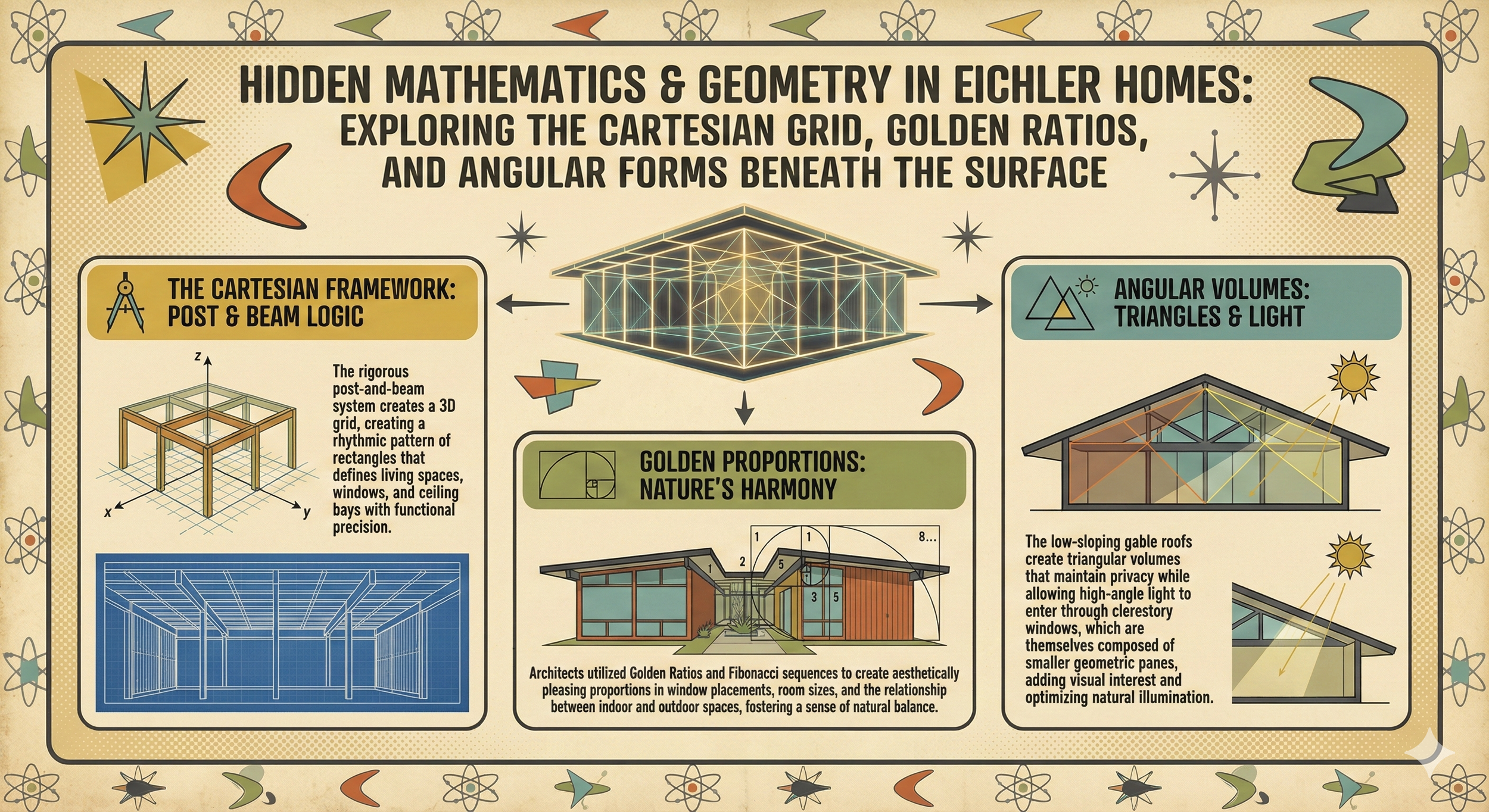
Joseph Eichler’s mid-century modern homes are celebrated for their perceived perfection and harmony. At first glance, an Eichler house is all clean lines and simple forms – but beneath that apparent simplicity lies an intricate web of geometric principles. From the strict post-and-beam grid that organizes each floor plan to the carefully proportioned atrium courtyards and calculated roof overhangs, Eichler’s architects leveraged mathematics (often subtly) to create balance. Every line and space in an Eichler home feels intentional, guided by modular dimensions, rhythmic repetition, and even classical ratios. This report explores how hidden math underpins Eichler design: the regular beam spacing and modular grid system, the spatial rhythm of structural elements, the use of harmonic proportions (like the golden ratio), and the influence of Japanese and mid-century modern philosophies. We also compare Eichler’s geometric approach to other architectural styles to understand why these homes feel so intuitively balanced.
Modular Post-and-Beam Grid: Order by Design
One defining feature of Eichler houses is their post-and-beam structural grid, which brings order to the entire design. Instead of irregular stud framing, Eichler’s architects laid out each house on a regular module or “beam bay” grid eichlerhomesforsale.com. Structural posts and beams are spaced at even intervals and left exposed, effectively becoming the bones and the aesthetic of the home. This consistent module governs room sizes, window placements, and even furniture layout eichlerhomesforsale.com. For example, rooms were often built to span a whole-number of beam bays – a typical bedroom might be 2 bays wide, a master bedroom 3 bays, and a living area 4 or 5 bays eichlerhomesforsale.com. In this way, the post-and-beam grid “scaled” the spaces and ensured each room was proportional to its importance (larger bays for communal living areas, fewer for smaller private rooms) eichlerhomesforsale.com. Crucially, as architect John Klopf notes from his Eichler renovation experience, “rooms and walls are all composed according to the beam bay” – meaning if you extend the house along the same grid, it will still feel like an Eichler eichlerhomesforsale.com. This modular discipline allowed Eichler designs to be flexible (many models existed) yet remain harmonious: any addition adds another bay in the grid, preserving the original rhythm eichlerhomesforsale.com.
Beyond aesthetics, the modular grid also had practical math benefits. Building components were standardized to the module, reducing waste and simplifying construction. Many Eichler beams were spaced about 8 feet on-center, partly to fit the spans of 2×8″ tongue-and-groove roof decking eichlerhomesforsale.com. This is a straightforward structural calculation that doubled as a design motif: the 8-foot rhythm became the house’s measuring stick. Need a bigger living room? Just add one bay (8 feet) and the proportions stay balanced eichlerhomesforsale.com. In essence, the beam spacing served as a human-scaled unit of measure, subdividing the architecture into comprehensible chunks. Much like musical meter divides time evenly, Eichler’s structural grid divided space evenly, giving occupants an unconscious sense of order eichlerhomesforsale.com. Notably, Eichler homes reveal this order rather than hiding it: the beams, posts, and joists are usually exposed, making the home’s geometry visible. “What you see is what you get” quipped the architects – the structure itself becomes the decoration in an Eichler eichlerhomesforsale.com. Looking up, you literally see the pattern of evenly spaced beams marching across the ceiling, a constant reminder of the home’s geometric logic eichlerhomesforsale.com. Every window, wall panel, and skylight aligns with that underlying grid, so nothing ever feels out of place.
Rhythmic Repetition: The Visual Cadence of Beams and Panels
When you step into an Eichler living room or atrium and gaze upward, you’ll likely notice a procession of ceiling beams creating a steady pattern overhead. Far from being hidden by a finished ceiling, these beams run in parallel, often extending through the clerestory and out under the eaves, establishing an indoor-outdoor continuity eichlerhomesforsale.com. This repetitive alignment of structural elements – beam, window, beam, window, and so on – generates a visual rhythm that guides the eye through the space eichlerhomesforsale.com. Design theorists often compare architectural rhythm to music: repeating components at regular intervals give a sense of movement and coherence. Eichler homes capitalize on this effect brilliantly. The evenly spaced posts, beams, and glazing panels read like a kind of architectural tempo. One architectural essay notes that rhythm in buildings comes from “the recurrence of components like windows, columns, and other aspects,” producing order and predictability that is calming and visually pleasing eichlerhomesforsale.com. In Eichler interiors, this translates to a gentle cadence that our brains respond to, even if we don’t consciously count the bays (eichlerhomesforsale.com). The effect is almost like the house has a heartbeat in its design.
Importantly, this rhythmic repetition fosters a powerful sense of balance and expansiveness. Because elements line up on a grid, nothing feels arbitrary or jarring – every line has a job to do. As one Eichler expert put it, the regular ceiling-beam rhythm makes the space feel stable and balanced; even visitors who don’t know why will subconsciously feel that “nothing is arbitrary, everything has its place” (eichlerhomesforsale.com). The exposed beams also draw the eye upward along their length, which has a trick of making a low-slung single-story home feel loftier than it is eichlerhomesforsale.com. In fact, Eichler’s architects often continued the interior beam lines straight outside: when all the beams line up from the living room through the atrium to the carport, the whole composition feels unified, almost like living inside a carefully composed grid eichlerhomesforsale.com. One can literally count the structural rhythm – slender posts at set intervals with large glass panels filling the gaps – and this regular alternation of solid and void becomes a hallmark of authentic Eichler design eichlerhomesforsale.com. (In a faux-Eichler, by contrast, you might spot misaligned beams or random window placements that break the cadence.) Thanks to this rigorous repetition, Eichler homes achieve a quiet visual music: a steady beat of posts and beams that yields an underlying harmony. The occupant may just feel “everything looks right” without realizing the math – a testament to how well-integrated the pattern is.
Atrium Proportions and the Golden Ratio
One of Eichler’s most iconic design moves was the introduction of the central atrium in late-1950s models. This open-air courtyard, placed literally at the heart of the house, exemplifies Eichler’s indoor-outdoor ideal: you enter through the front door and find yourself under the open sky before continuing into the living room eichlerhomesforsale.com. But creating this feature raised a question of geometry: how to size and shape the atrium so that it felt naturally in tune with the rest of the house. Eichler’s architects were meticulous about proportions, knowing that if the atrium were too small it would feel like a cramped light-well, and if too large it could overwhelm the adjacent rooms eichlerhomesforsale.com. In practice, they often designed atriums to echo the same modular grid as the house – for example, an atrium might span an integer number of beam bays in each direction (2×2 bays was a common solution, forming a near-square courtyard) eichlerhomesforsale.com. Real-world data backs this up: in Orange County’s Fairhaven tract, one popular Eichler model “LA-91” dedicates 668 square feet to its central atrium out of a 2,070 sq ft house – roughly one-third of the home’s footprint eichlerhomesforsale.com. Other Eichler atriums ranged from about 220 to 550 sq ft, but always scaled to feel significant yet balanced relative to the house eichlerhomesforsale.com. In essence, the atrium was treated as another room – an outdoor living room – and thus sized proportionately to the whole plan.
Floor plan of a mid-century Eichler home (circa 1960s) showing a central atrium (open courtyard) at the core. The layout is organized on a modular grid: notice how the living areas and bedrooms are arranged around the atrium “void,” and structural beams (indicated as lines) run in a regular rhythm. Proportion and alignment were key – in many Eichler models the atrium spans an integer number of structural bays, ensuring it feels in harmony with the rest of the house eichlerhomesforsale.com. (Source: The Architects’ Take / Klopf Architecture)
So what makes an atrium or any room feel well-proportioned? Architects often rely on timeless mathematical ratios. One famed ideal is the Golden Ratio (approximately 1:1.618), which since antiquity has been considered an inherently pleasing proportion eichlerhomesforsale.com. Many classical buildings and Renaissance facades employed golden rectangles, and mid-century modernists were not immune to its allure eichlerhomesforsale.com. In plain terms, a space where the length is about 1.6 times the width tends to feel “just right” – not too squat and static (like a square), and not too long and tunnel-like. Eichler’s tract house architects (folks like A. Quincy Jones, Frederick Emmons, and Claude Oakland) did not explicitly cite the golden ratio in their blueprints, but they were trained in a design tradition that praised classical proportions eichlerhomesforsale.com. It’s no surprise, then, that many Eichler rooms and courtyards approximate simple harmonic ratios. In fact, if you measure Eichler spaces you’ll often find dimensions in ratios like 1:1 (a perfect square) or 3:4, 2:3, 5:8, etc. eichlerhomesforsale.com. These whole-number ratios are close cousins of Fibonacci numbers and the golden section, and they tend to produce a sense of harmony that occupants subconsciously feel eichlerhomesforsale.com. For example, an Eichler atrium might be about 18 by 30 feet (which simplifies to a 3:5 ratio) or a living room perhaps 15 by 25 feet (again roughly 3:5) eichlerhomesforsale.com. Such dimensions “resonate” better than arbitrary combos like, say, 17×23. By using layouts based on simple fractions or Fibonacci ratios, Eichler’s designers created rooms that just feel balanced to the human eye.
Just as important was maintaining proportional consistency between the atrium and the enclosing house. Often the atrium aligns with the home’s central axis or the ridge of a gable roof, creating a satisfying symmetry (or a deliberate balanced asymmetry) in plan eichlerhomesforsale.com. If you stand in an Eichler atrium, you might notice how the tops of the surrounding windows and doors align to form a continuous horizontal frame around the courtyard space eichlerhomesforsale.com. The width, height, and depth of the atrium all relate to the house’s larger geometry, giving a calm, resolved quality to the experience eichlerhomesforsale.com. Architectural theory tells us that proper proportion “gives a feeling of order and harmony in a place, making it seem more comfortable and balanced” eichlerhomesforsale.com – and indeed, standing in an Eichler atrium on a sunny day, one often feels an inexplicable comfort and balance, even if you can’t pinpoint that it’s the math working quietly in the background eichlerhomesforsale.com. The brilliance of Eichler’s design is that the numbers stay hidden; you simply feel the result as a space that’s neither too empty nor too cramped, neither chaotic nor monotonous.
Finally, these geometric decisions weren’t only about aesthetics – they also enhanced the spatial and sensory experience. The generous atrium proportions, for instance, were key to Eichler’s indoor-outdoor living philosophy. By dedicating significant square footage to an open-air heart of the home, Eichler signaled that void space could be as important as enclosed rooms. The atrium functions as a breathing space that knits the house together. It even contributes to comfort: many Eichler atriums act as natural lightwells and ventilation chimneys. When surrounded by operable clerestory windows, the atrium helps pull warm air up and out, drawing cool breezes through the house – a passive cooling effect born of smart sizing and placement eichlerhomesforsale.com. In other words, the atrium’s form was also calculated for function. Landscaping in these courtyards (a small tree, ferns, a fountain, etc.) introduces organic shapes within the strict rectangular bounds of the architecture eichlerhomesforsale.com. That contrast between lush natural forms and crisp right-angled modern framing creates a dynamic equilibrium – a hallmark of Eichler design eichlerhomesforsale.com. It’s a balance of opposites made possible by careful spatial proportions: the atrium is large enough to bring the outside in, yet geometrically contained enough to feel like an integral room of the house.
Calculated Overhangs: The Geometry of Sun & Shade
Another often unnoticed mathematical consideration in Eichler homes is the depth of the roof overhangs (soffits or eaves). Those broad, planar eaves extending beyond the exterior walls are instantly recognizable in Eichler silhouettes. Aesthetically, they form a strong horizontal crown that visually “grounds” the low-slung house, but they also serve a precise functional purpose: controlling sunlight through the seasons eichlerhomesforsale.com. In essence, Eichler’s architects were doing passive trigonometry with the sun’s angles. They calculated how far the roof should project to best shade the interior in summer yet allow sun in during winter, based on California’s latitude and solar path eichlerhomesforsale.com. The idea is simple geometry: in summer the sun rides high in the sky, so a wide eave casts a shadow over the floor-to-ceiling glass and prevents the high-angle rays from baking the interior eichlerhomesforsale.com. In winter the sun is lower; its rays can slip under the eave to illuminate and warm the rooms when warmth is desired eichlerhomesforsale.com. Eichler houses, with their extensive glass walls, especially benefited from this kind of built-in sun shade. With the right soffit length, the architects ensured that the famous glass facades would bring in light and heat on cool days, but stay in shadow during summer scorchers eichlerhomesforsale.com. In effect, they solved a seasonal equation: a horizontal plane (the roof) intercepts a moving angle (the sun’s trajectory) in such a way that the result changes over time.
Typically, Eichler eaves are quite generous – often on the order of 4 to 6 feet deep – which was empirically found to work well for the Bay Area’s climate eichlerhomesforsale.com. Conveniently, this depth often corresponded to other design modules and looked “right” to the eye. Many Eichler models end the rafters or beams exactly at the edge of a post-and-beam bay, or they use the eave to cover an outdoor walkway width – hitting structural, functional, and aesthetic targets at once eichlerhomesforsale.com. The result is an elevation view where the eave might project, say, one-quarter of the building’s height – a proportion that feels far more graceful than a skimpy little overhang eichlerhomesforsale.com. These deep eaves give Eichler homes that distinctive horizontal emphasis and sense of shelter. Homeowners might not realize it, but the cool shaded patio running along the back of their Eichler is the product of deliberate design calculus. One expert notes that the “generous overhanging eaves” on Eichlers not only block summer sun but also create usable outdoor space in light rain – essentially an outdoor room along the perimeter eichlerhomesforsale.com. Indeed, the eaves blur the boundary between indoors and outdoors, creating a transitional zone where you can enjoy fresh air while still protected by the roof.
This attention to sun angles and climate was part of a broader mid-century trend (e.g. architects in Palm Springs took it to extremes with elaborate brise-soleil screens). Eichler’s team optimized it for the milder Bay Area conditions eichlerhomesforsale.com. Geometrically, however, the principle is universal: by studying the solar arc, they derived an appropriate overhang length, effectively solving for X where X = eave depth. The payoff is both visual harmony (a nicely proportioned roof visor) and thermal comfort (passive solar performance). It’s another layer of hidden math that makes an Eichler home functionally and visually harmonious with its environment.
Japanese Aesthetics and Mid-Century Modern Influence
The mathematical precision in Eichler homes didn’t arise in a vacuum – it was nurtured by the wider design philosophies of the mid-20th century, including a profound respect for Japanese architecture and the Modernist ethos of “less is more.” Joseph Eichler himself was inspired by architect Frank Lloyd Wright’s Usonian houses eichlerhomesforsale.com, which championed open plans, modular grids, and integration with nature. (Wright, in turn, was famously influenced by Japanese design, having studied Japanese art and architecture.) This lineage is evident: Eichler’s architects embraced a zen-like simplicity and clarity of form. In fact, mid-century architects often explicitly admired Asian architecture for its relationship to nature, its simplicity, and the way it expressed structure through elegant post-and-beam construction eichlernetwork.com. Pasadena architecture docent David Nufer described mid-century modernism as a “continuation of Arts and Crafts…with Asian influence,” noting that many early California modernists (like Greene & Greene and Bernard Maybeck) drew from Japanese principles. Eichler’s houses carry on that thread: the honest expression of structure, the blurring of indoor and outdoor boundaries, and the use of courtyards all resonate with Japanese precedents. Even the idea of building a light, flexible wood framework that can sway in an earthquake has parallels in traditional Japanese temples – as John Klopf quipped, “it’s the Japanese method of surviving earthquakes – build a flexible, light wood structure” thearchitectstake.com. In short, Eichler’s “precision” owes a debt to Japanese notions of order and harmony with nature.
Perhaps the most direct concept Eichler homes share with Japanese design is the importance of empty space. In Japanese aesthetics, the concept of ma refers to the space between elements – an intentional emptiness that gives shape to the whole. Eichler’s use of negative space – large glass walls opening to empty atriums and backyards – is very much in this spirit. As one analysis notes, ma is “an emptiness that is not an absence, but an essential part of the composition” eichlerhomesforsale.com. Mid-century modernism similarly valued clean lines and open space, letting a few structural elements repeat without clutter so that the overall composition feels tranquil eichlerhomesforsale.com. Eichler’s architects excelled at framing voids. For example, the atrium can be seen as a deliberate void at the center of the house that organizes all the rooms around it eichlerhomesforsale.com. The floor-to-ceiling glass walls turn the outside yard into a visual extension of the interior, making the empty outdoors part of the perceived living space eichlerhomesforsale.com. Inside, the lack of interior partitions means space flows continuously – one area “borrows” a sense of openness from the next eichlerhomesforsale.com. This was a radical break from traditional homes, which chopped up interiors into many small rooms. In an Eichler, the voids make the solids more meaningful: by sparing use of walls and ornament, attention falls on the proportions and materials that are there (the warm wood ceilings, the grid of beams, the pattern of shadow and light). It’s a very Zen-like idea – that what’s not there is just as important as what is. As Mies van der Rohe famously said, “Less is more,” and Eichler homes truly embody that maxim eichlerhomesforsale.com. By doing away with extraneous details, they achieve a clarity and functional beauty that cluttered traditional homes often lack eichlerhomesforsale.com. The minimalist canvas allows subtle details to shine: one might notice the grain of the mahogany paneling or the way the living room furniture aligns perfectly with the structural grid, things that would be lost in a busier interior eichlerhomesforsale.com. In summary, Eichler’s geometry feels precise and serene partly because it was guided by philosophy: a fusion of Japanese-influenced appreciation for simplicity/void, and mid-century modern faith in grids, honest materials, and the removal of the unnecessary.
Comparisons: Eichler’s Geometry vs. Other Styles
To appreciate what makes Eichler homes feel so balanced, it helps to compare them to other residential styles of the time. In the 1950s–60s, most suburban tract houses were conventional ranches or builder-designed homes that lacked a unifying geometric order. Walking through a typical neighborhood of eclectic mid-century houses, one might see a jumble of roof heights, window shapes, and arbitrary additions. Eichler developments, in contrast, present a cohesive rhythm and proportion from house to house. For instance, along a street in the Greenmeadow Eichler tract of Palo Alto, you notice a consistent low roofline and repeating post-and-beam modules on each home – a very different scene from the jumble of heights and styles in a conventional neighborhood eichlerhomesforsale.com. This consistency wasn’t boring; rather, it created a soothing visual unity at the community scale. Eichler homes were modest in size, but they feel larger and more expansive than their square footage, thanks to their open planning and aligned sightlines. Architectural historian Cory Buckner notes that huge walls of glass in these modern houses allowed one’s view to extend to the property lines, making a 1,200-square-foot house seem twice the size because the interior and exterior read as one continuous space. In a traditional house of the same size, each room’s walls would stop your gaze and fragment the space, whereas Eichler’s geometric openness tricks the eye into experiencing more breadth.
Compared to classical architecture, Eichler homes achieve harmony in a looser, more asymmetrical way. Classical designs often rely on formal symmetry, centered entrances, and ornate proportional systems (think Palladian villas using golden ratio in their facades). Eichler houses, being modern, do not look classical at all – they have flat or gabled roofs with no ornament – yet underneath they share the classical obsession with proportion and module. In a sense, Eichler’s approach was democratic: instead of an elite villa composed with golden rectangles, he delivered humble tract homes composed with 8-foot grids and simple ratios, accessible to middle-class families. It’s telling that Le Corbusier’s Modulor system (a famous 1950s proportional grid marrying human scale to the golden ratio) emerged around the same time, reflecting a broader mid-century belief that architecture should be based on mathematical harmony. Mies van der Rohe’s designs, too, often featured strict grids – for example, the Farnsworth House (1951) sits on a precise 1.52×1.52 meter column grid that unifies its floor, ceiling and facade into a minimalist order. Eichler homes were part of this zeitgeist. While they were “just tract houses” on paper, their architects applied the same kind of rigorous planning – modular bays, axial alignments, careful proportions – that one would normally find in high-end modernist masterpieces. The result is that Eichlers give an intuitively balanced feel akin to those famous architect-designed homes, even though they were mass-produced.
In contrast, more vernacular styles or Eichler’s contemporaries who tried to copy the look often missed these subtleties. Competing tract builders produced “Eichler-esque” houses with post-and-beam styling but sometimes failed to align structural elements perfectly or used conventional framing in spots, yielding a less coherent result eichlerhomesforsale.com. You can spot a true Eichler by the way everything lines up: posts, beams, and glass form a seamless composition without gratuitous trim or off-the-shelf windows breaking the pattern eichlerhomesforsale.com. Imitators often stuck fake decorative beams on a standard plan or added busy divided-lite windows – moves that disrupt the underlying geometry. Authentic Eichlers have an integrity that comes from design-by-geometry rather than design-by-decoration. As another comparison, look at the flamboyant Desert Modernism of Palm Springs in the same era: desert modern homes embraced dramatic butterfly roofs, angled facades, and decorative breeze-block screens to cast shadows in the bright sun eichlerhomesforsale.com. They are delightful in their context, but they achieve appeal through bold sculptural form and texture. Eichler homes, by contrast, tend to be understated – a simple boxy form with a flat or gently pitched roof and a blank street facade. They rely on hidden geometric discipline for their charm, not on overtly dramatic forms. The understated exterior simplicity of an Eichler (often just a low wall, a carport, and a band of clerestory glass) belies the rich spatial experience inside eichlerhomesforsale.com. Where a Palm Springs modern might immediately catch your eye with its roofline, an Eichler reveals its magic more gradually: as you enter the atrium and the post-and-beam rhythm unfolds, you suddenly sense the balance and clarity of the space.
In summary, what sets Eichler’s geometry apart is its thorough integration into the design and its service to multiple ends. Structure = module = aesthetic motif in these homes. Classical and some high-modern architecture achieved beauty via proportion and order, but Eichler brought those same timeless principles into everyday housing. Compared to cookie-cutter ranch houses, Eichlers feel composed. Compared to exuberant custom modern houses, Eichlers feel disciplined. There’s a harmonious interplay of components – from the spacing of beams to the shape of the atrium to the reach of the eaves – all working in concert. This is why living in an Eichler often gives a sense of calm delight: the design “just works.” Even if one can’t articulate it, the hidden mathematics – the grid, the rhythm, the ratios – are quietly creating an environment of balance, where each part of the house resonates with the whole. As one owner described, the massive windows and sliding doors in an Eichler allow the inside space to merge with the outside, erasing boundaries and making everything feel unified eichlerhomesforsale.com. That seamless merging is the product of geometric thinking. Ultimately, Eichler homes demonstrate that rigorous math and warm living are not opposites but partners – a well-proportioned, thoughtfully ordered space feels better to be in. And that is the secret of their perceived perfection and harmony: a marriage of Mid-Century Modern ideals with age-old geometric wisdom, packaged in the friendly form of a California tract home.
About the Boyenga Team — Silicon Valley’s Eichler Real Estate Authorities
As founding partners at Compass, Eric and Janelle Boyenga have built one of the most trusted names in Mid-Century Modern real estate across Sunnyvale, Palo Alto, Cupertino, and the greater Silicon Valley region. Known as the Property Nerds and celebrated as Next-Gen Agents, the Boyenga Team blends deep architectural knowledge with data-driven strategies and state-of-the-art marketing.
Their expertise extends far beyond transactions—they decode the geometry, structure, and design logic that make Eichlers extraordinary. Buyers rely on the Boyenga Team to identify authentic architectural features, evaluate renovation potential, and understand the underlying spatial math that defines true Eichler integrity. Sellers benefit from immersive storytelling, VR tours, SORA-powered listing videos, and positioning that celebrates the architectural significance of their home.
Eric and Janelle represent clients with precision, advocacy, and a rare appreciation for the mathematical and architectural craftsmanship that makes Eichlers timeless.
Sources:
Eichler Homes For Sale Blog – “The Hidden Geometry of Eichler Homes: Balance, Proportion, and Harmony in Design.” eichlerhomesforsale.com
Eichler Homes For Sale Blog – “Eichler’s Design Secret: Every Line Has a Job.” eichlerhomesforsale.com
Eichler Homes For Sale Blog – “The Eichler Difference: Hidden Architectural Hallmarks vs. Imitators.” eichlerhomesforsale.com
The Architects’ Take (John Klopf interview) – “Respectfully Renovating Eichler Homes.” thearchitectstake.com
Re-Thinking The Future – Design analysis on architectural rhythm and proportion eichlerhomesforsale.com
Eichler Network (Dave Weinstein) – “The Rustic Roots of Mid-Century Modern.”eichlernetwork.com
City of Palo Alto – Eichler Design Guidelines (historical/architectural context) eichlerhomesforsale.com
Dwell Magazine – “Midcentury Eichler Renovation in San Mateo” (Klopf Architecture)dwell.com