
Los Altos vs. Sunnyvale: A Comparative Study of Two Silicon Valley Communities
Silicon Valley homebuyers often weigh Los Altos against Sunnyvale—two cities with distinct histories, school ecosystems, and housing profiles that shape long-term value. This HBR-style guide compares neighborhood DNA—from Eichler-home enclaves and mid-century architecture to commute patterns, parks, and downtown amenities—alongside data on demographics, schools, and the housing market. Whether you’re targeting Los Altos’ estate-style exclusivity or Sunnyvale’s dynamic, tech-proximate mix of townhomes and single-family homes, this analysis clarifies trade-offs so you can invest with confidence.
Origins and Early Development
Los Altos, incorporated in 1952, was envisioned as a semi-rural retreat for San Francisco commuters. Early zoning emphasized large lots and single-family homes, giving rise to a suburban character with village-like commercial cores.
Sunnyvale, incorporated much earlier in 1912, grew as an agricultural hub (notably orchards and canneries). The transition from the “Valley of Heart’s Delight” to the “Silicon Valley” was accelerated here, as aerospace and semiconductor companies established a strong mid-century industrial base.
Key Transformations
Los Altos: Strict zoning reinforced its residential exclusivity, limiting commercial development. Architectural waves included Ranch-style estates and significant enclaves of Joseph Eichler’s Mid-Century Modern homes, particularly in North Los Altos and South Los Altos.
Sunnyvale: Benefiting from federal defense contracts and proximity to Lockheed Martin, Sunnyvale transformed into a working-class to middle-class suburb. Its zoning was more permissive, allowing for apartments, tech campuses, and denser residential pockets.
Notable Figures and Developments
Los Altos: Joseph Eichler’s subdivisions stand as testaments to mid-century social and design innovation—open floor plans, glass walls, and indoor-outdoor living.
Sunnyvale: The arrival of Atari, Yahoo, and later LinkedIn marked its transition into a full-fledged tech hub.
Demographic and Socioeconomic Profile
Current Population
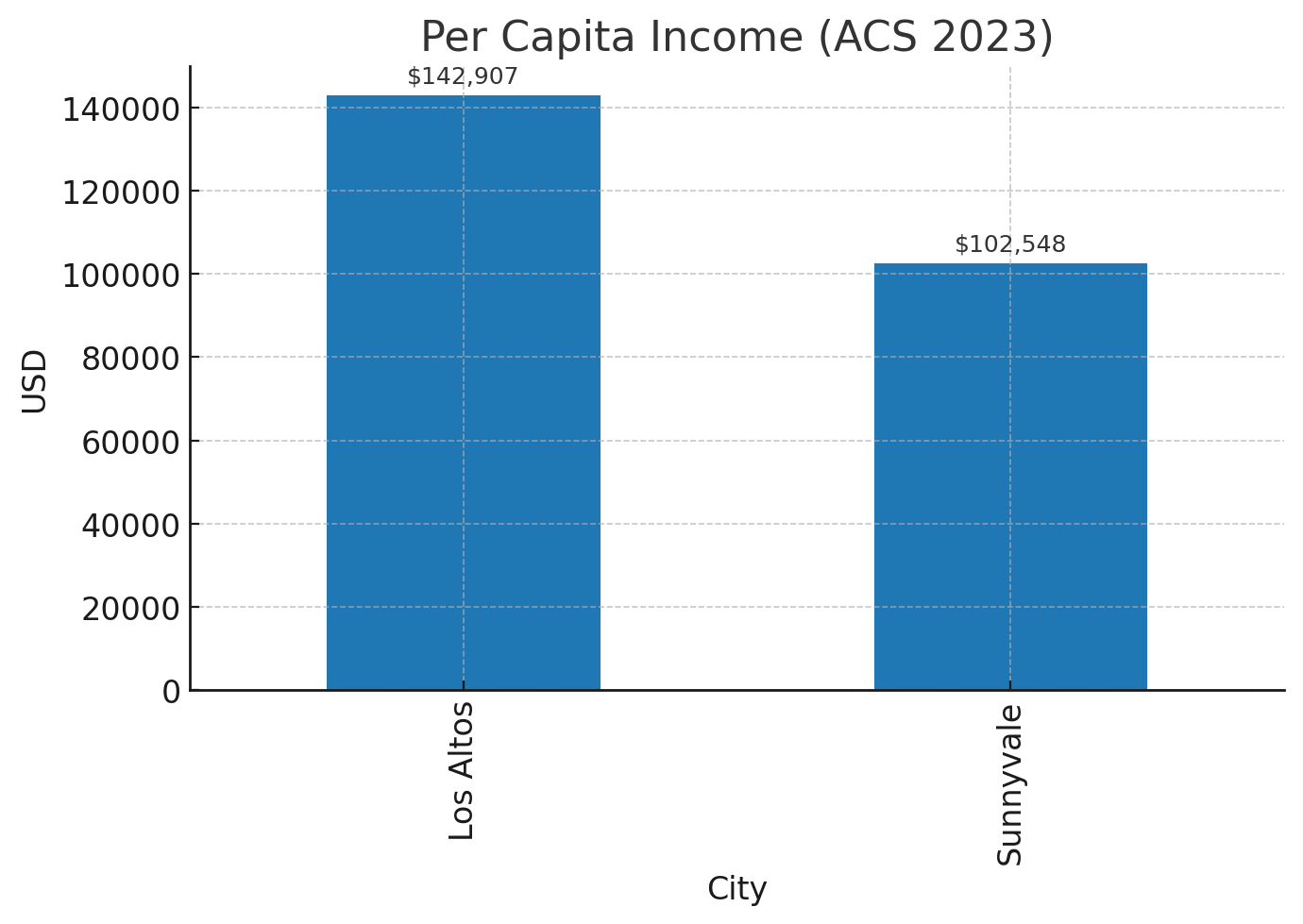
Los Altos: ~31,000 residents. Median household income exceeds $250,000, among the highest in California. Over 80% of adults hold bachelor’s degrees or higher.
Sunnyvale: ~155,000 residents. Median household income ~$160,000. Educational attainment is high but more varied, reflecting its diverse housing mix and workforce base.
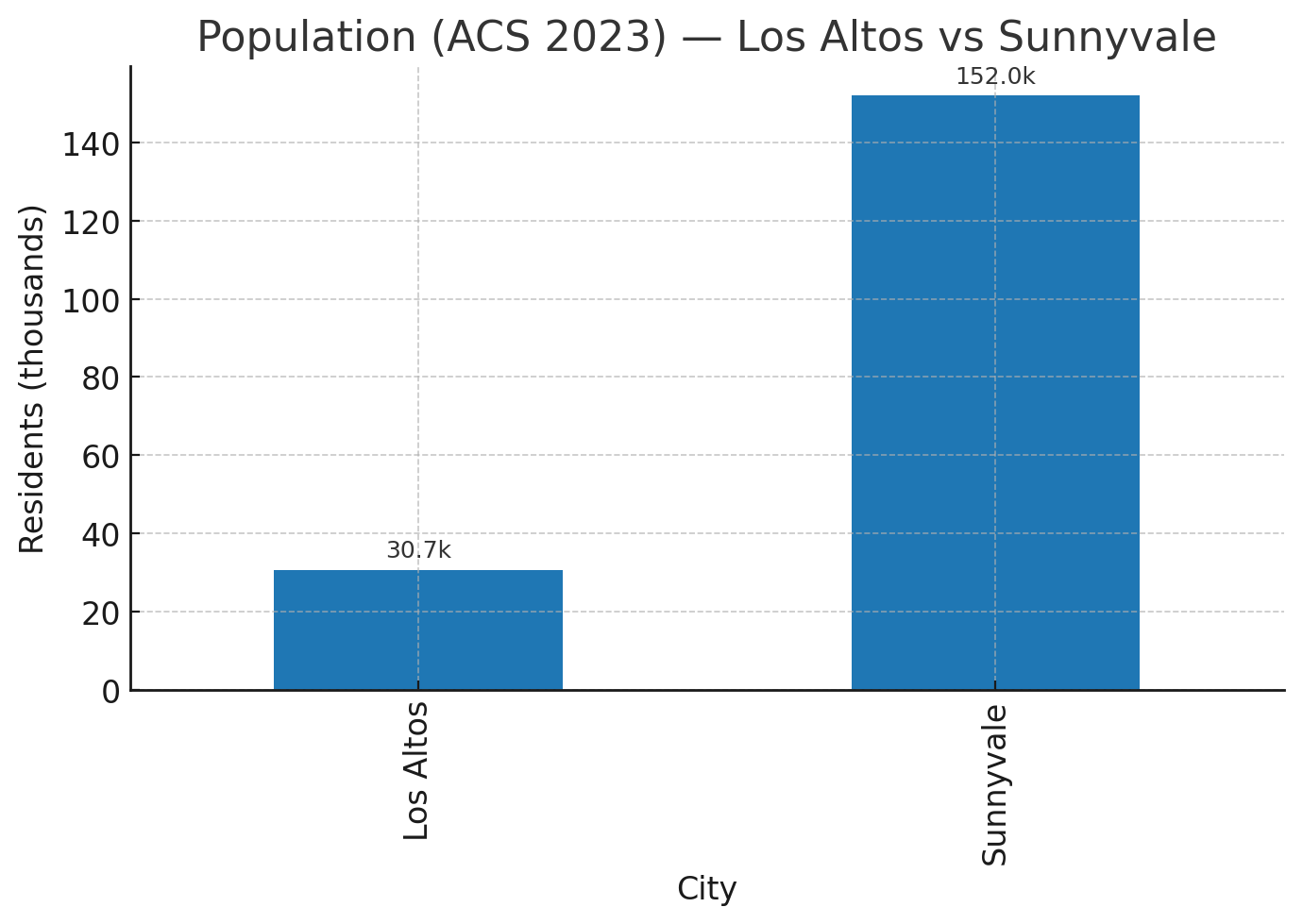
Sunnyvale is ~152k residents vs. ~31k in Los Altos
Diversity
Los Altos: Less diverse, though recent migration from Asia has increased representation among Chinese and Indian professionals.
Sunnyvale: One of the most diverse cities in Silicon Valley, with Asian Americans comprising over 40% of the population. Strong South Asian, Chinese, and Latin American communities shape local schools and businesses.
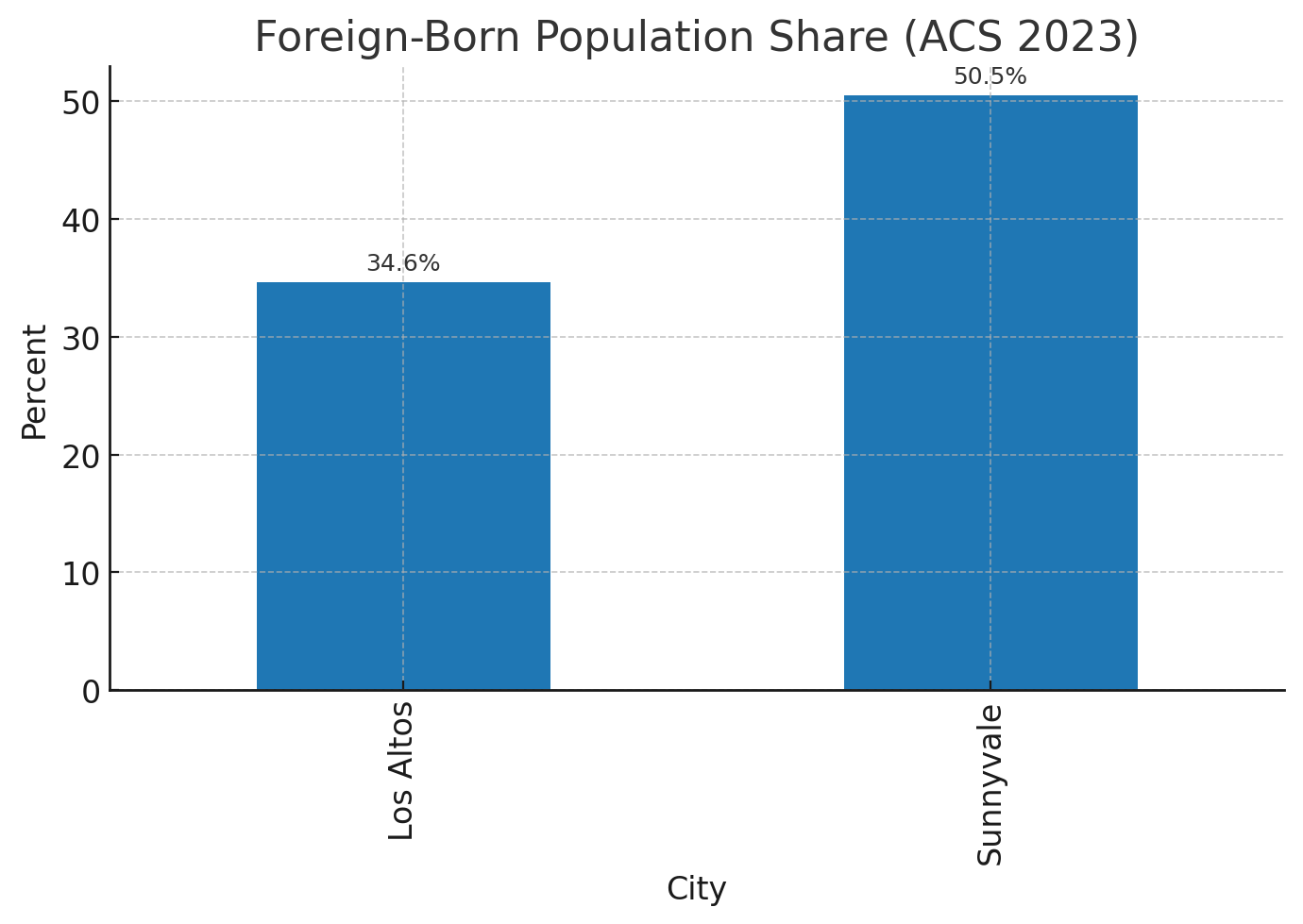
Foreign-born share is ~51% in Sunnyvale vs. ~35% in Los Altos
Trends
Los Altos is characterized by wealth concentration, estate upgrading, and gentrification through exclusivity. Sunnyvale reflects tech-driven in-migration, with younger households and renters balancing an upwardly mobile immigrant population.
School Districts and Education Landscape
Los Altos
Districts: Los Altos School District, Mountain View-Los Altos Union High School District.
Performance: Consistently among the highest in California, with national Blue Ribbon recognitions.
Private Schools: Pinewood, Bullis Charter, and nearby Harker and Castilleja.
Sunnyvale
Districts: Sunnyvale School District, Fremont Union High School District (home to Cupertino High and Fremont High).
Performance: Strong but variable. Schools like Homestead High rival Los Altos in outcomes, while others show more mixed achievement metrics.
Proximity to Higher Education
Both communities benefit from adjacency to Stanford University, Foothill College, and De Anza College—feeder networks for Silicon Valley talent.

Bachelor’s-or-higher attainment is very high in both (Los Altos ~87%, Sunnyvale ~72%)
Neighborhood Attractions and Lifestyle
Los Altos
Assets: Village-like downtown, with curated retail and dining. Extensive park network, including Rancho San Antonio Preserve.
Lifestyle: Quiet, affluent, family-centered. Cultural offerings are modest but proximity to Palo Alto expands access.
Sunnyvale
Assets: Sunnyvale Bay Trail, Murphy Avenue’s revitalized downtown corridor, and multiple ethnic dining hubs.
Lifestyle: Vibrant, international, with a stronger rental culture and younger demographic profile.
Architectural Highlights and Housing Inventory
Los Altos
Styles: Ranch homes on large parcels, custom contemporary estates, and prized Eichler neighborhoods (e.g., Fallen Leaf Park, North Los Altos).
Inventory: Predominantly single-family; condos are rare.
Builders: Eichler, Mid-century developers, and modern custom builders dominate.
Sunnyvale
Styles: Eichler enclaves (Fairbrae, Rancho San Miguel) represent architectural gems, while Gavello and Stern & Price tracts expanded the mid-century market. Contemporary townhomes and apartments now balance the mix.
Inventory: More diverse—single-family homes, townhouses, and condominiums.
Market: Appeals to first-time buyers and tech commuters.
Real Estate Market Analysis
Los Altos: Median home price ~$4.5M (2025). Appreciation is steady, driven by scarcity and zoning constraints. Market velocity is moderate; luxury estates dominate sales.
Sunnyvale: Median home price ~$2.2M. Velocity is high, with multiple-offer situations common. Condos and townhouses provide affordability relative to neighbors like Cupertino or Mountain View.
Comparison: Los Altos attracts ultra-high-net-worth households seeking exclusivity. Sunnyvale appeals to dual-income tech households balancing affordability and proximity.
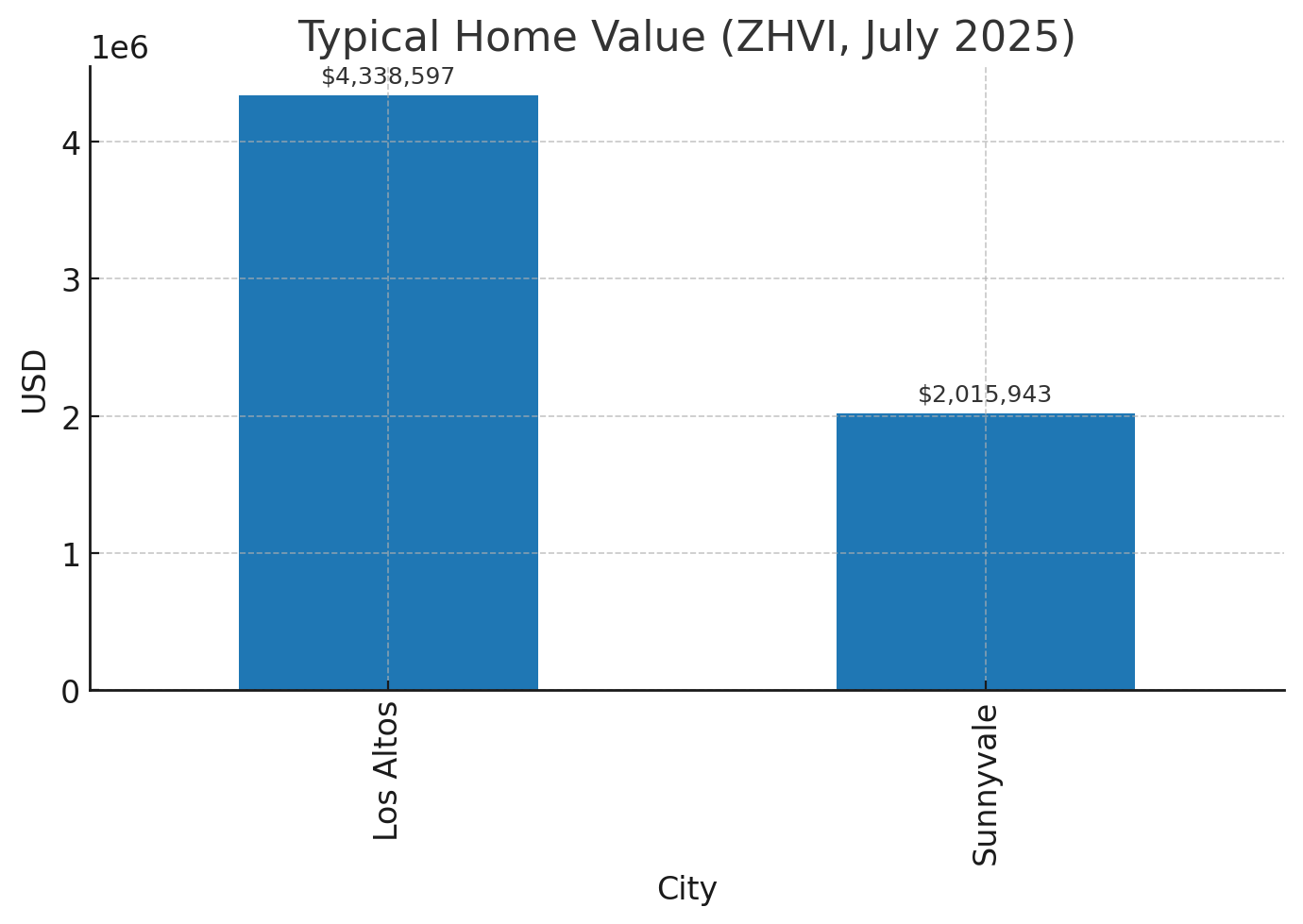
Zillow Home Value Index (ZHVI) typical values are ~$4.34M (Los Altos) vs. ~$2.02M (Sunnyvale)
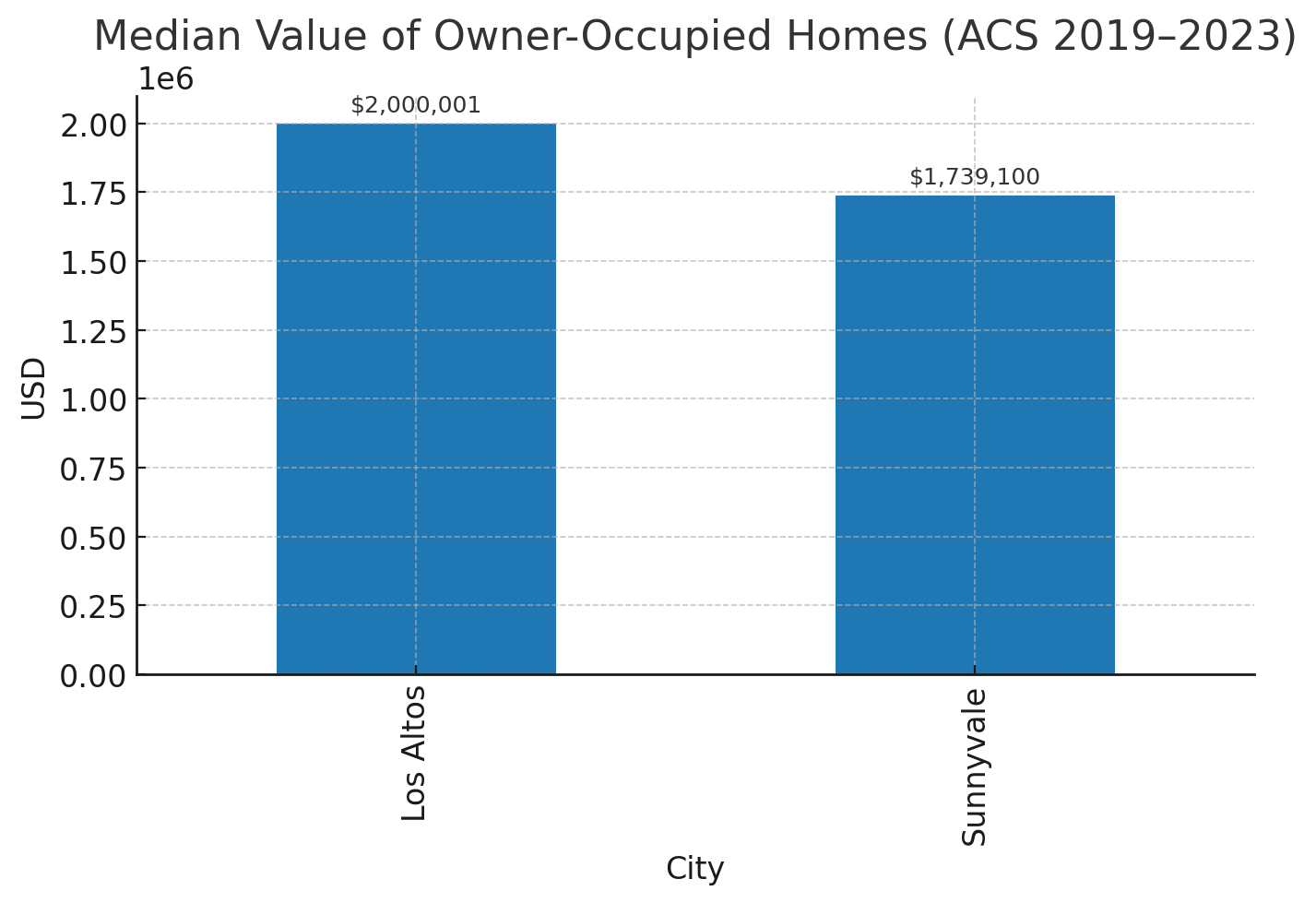
Owner-occupied median values (ACS) are ~$2.0M in Los Altos vs. ~$1.74M in Sunnyvale
Boyenga Team Experience in the Area
The Boyenga Team has successfully represented clients across both markets:
Los Altos Eichler: A staged and Compass-optimized listing closed 15% above asking, leveraging architectural marketing.
Sunnyvale Townhome: Positioned off-market and priced strategically, it drew 20+ offers within a week, maximizing seller returns.
Cross-Market Strategy: For relocating families, the Boyenga Team has navigated school-boundary-driven purchases, highlighting comparative value propositions across ZIP codes.
The Boyenga Team Advantage
Eric and Janelle Boyenga exemplify the Next-Gen Agent model. As Compass-affiliated innovators, they leverage:
Exclusive partnerships: HomeLight and Compass Concierge, enabling upfront improvements and financing to drive higher ROI.
Architectural expertise: Specializing in Eichler and Mid-Century Modern homes, the team offers unmatched insight into a niche but influential segment.
Market authority: With decades of experience in Silicon Valley, they combine deep local networks with data-driven marketing strategies.
Positioning: For high-net-worth buyers in Los Altos, or tech-driven households in Sunnyvale, the Boyenga Team delivers bespoke solutions with measurable outcomes—anchoring their reputation as Silicon Valley’s luxury real estate strategists.
Conclusion
Los Altos and Sunnyvale embody two distinct trajectories of Silicon Valley urbanism—one defined by exclusivity and architectural heritage, the other by dynamism and diversity. Both, however, reflect the region’s core DNA: innovation, transformation, and global magnetism. For discerning buyers and sellers, navigating these complexities demands not just market access but also strategic interpretation—precisely the Boyenga Team’s edge.