
Mid-Century Modern Hillside Gems in Oakland’s 94611: Montclair, Skyline & Sequoyah Hills
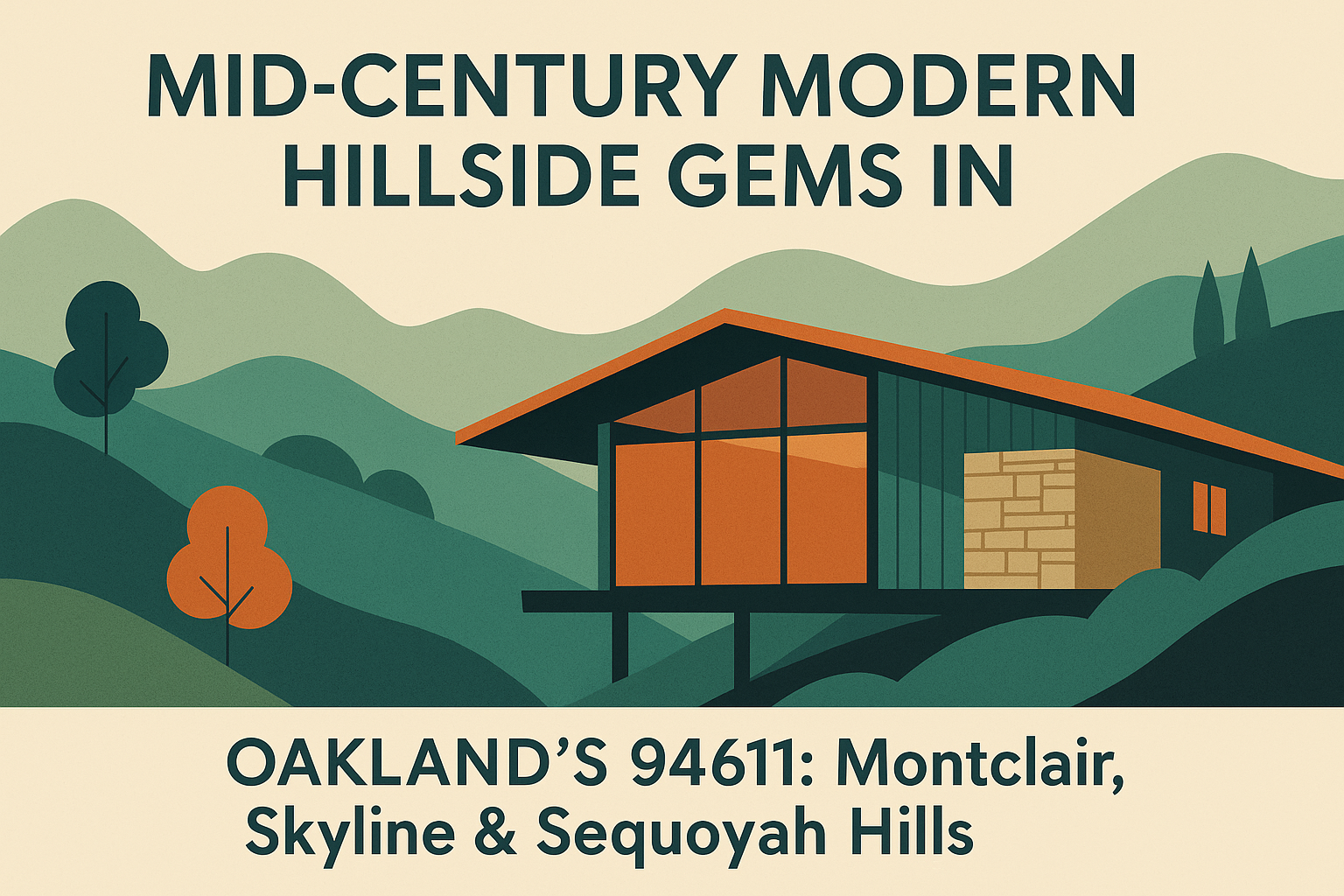
Comprehensive Guide to Oakland 94611 MCM Homes for Eichler Fans
Oakland’s 94611 ZIP code is home to a trove of mid-century modern (MCM) hillside homes that offer Eichler-like style in a unique setting. Nestled in neighborhoods like Montclair Hills, along scenic Skyline Boulevard, and even stretching toward Sequoyah Hills, these residences are not Eichler tract homes – yet they embody many hallmark Eichler features such as walls of glass, open-beam ceilings, seamless indoor-outdoor living, and harmony with nature. This blog post will explore the neighborhood context and history of these Oakland hill communities, delve into their architectural characteristics (and the architects/builders behind them), compare them to traditional Eichler homes, and provide current (2024–2025) insights on the real estate market, schools, safety, and community vibe. If you’re an Eichler fan or a mid-century enthusiast looking for an alternative to the usual Eichler neighborhoods, Oakland’s 94611 hillsides might just be the perfect fit.
Neighborhood Overview & Historical Context
Montclair and the Oakland Hills: Montclair is a verdant hillside district in Oakland, spanning from the valley near Highway 13 up to the ridge of the Oakland Hills en.wikipedia.org. The area remained largely rural into the early 20th century – a redwood forest and ranchland – until development picked up mid-century. In fact, a regional railway (the Sacramento Northern) ran through Montclair in the 1900s, with tracks tunneling through Shepherd Canyon; today its former route is a pedestrian trail weaving through the neighborhood’s wooded ravine. After World War II, Oakland’s growing population pushed into Montclair’s steep canyons. By the 1950s and 60s, many of the winding roads were lined with new homes designed to embrace the terrain. Montclair’s real estate “runs up and down the canyons, and the architecture is designed to showcase the natural character of the area”, with some lots even several acres in size. Home styles here vary from pre-war storybook cottages and Craftsman bungalows to a plethora of mid-century ranches and split-level houses from the 1950s, 60s and 70s. The result is an eclectic neighborhood that feels like a tranquil retreat: “Nestled amongst the pine trees in the upper Oakland hills, the friendly Montclair District maintains a refreshing and laid-back mountain atmosphere reminiscent of Mill Valley”. Indeed, tall trees and pocket redwood groves are part of the scenery – third-growth redwoods are now protected in nearby parks (Reinhardt Redwood Regional Park, Joaquin Miller Park, Roberts Regional) and “redwoods of various ages are found in many Montclair neighborhoods”en.wikipedia.org, a reminder of the area’s natural heritage.
Skyline Boulevard: As you ascend to the ridge, Skyline Boulevard is the main scenic drive tracing the hilltops. This road lives up to its name, delivering sweeping views of San Francisco Bay on one side and dense woods of regional parks on the other. Development along Skyline accelerated in the 1960s as families sought suburban tranquility with city proximity. Homes perched on Skyline and its side streets (like Broadway Terrace, Snake Road, and Shepherd Canyon) often had to contend with tricky geography – steep downslope lots or craggy outcrops – leading builders to get creative. Many houses from the mid-century era here are multi-level or cantilevered designs, maximizing views and sunlight. Some of Oakland’s most dramatic mid-century houses can be found along Skyline, taking advantage of the ridge’s panoramic vantage. (Notably, a few miles north along the ridge lies Hiller Highlands, rebuilt with modern homes after the 1991 Oakland Firestorm, but Montclair’s core MCM housing lies mostly in areas that the fire spared or that were rebuilt in a mid-century spirit.)
Sequoyah Hills: Further south (technically in the 94605 ZIP but often discussed by mid-century buffs in the same breath), Sequoyah Hills is another Oakland hillside area with a rich MCM legacy. In 1965, renowned developer Joseph Eichler planned a community here adjacent to the Sequoyah Country Club. Although Eichler only completed 48 homes before ending the project, those houses became known as the “lost Eichlers of the Oakland hills”sequoyahhome.org. Designed by Eichler architects like Claude Oakland, Sequoyah’s Eichler tract offers “distinctively modernist Eichlers” in a gorgeous hill settingsequoyahhome.org. These rare Eichlers – just a tiny fraction compared to Eichler enclaves elsewhere – are prized for their authentic design and relative lack of unfortunate remodels over the yearssequoyahhome.org. Surrounding those, other builders filled in the neighborhood with mid-century homes that complement the modern aesthetic (along with some more traditional ranch and split-level homes). Today, Sequoyah Hills retains a quiet, woodsy feel; its Eichler homes, tucked among cul-de-sacs like Hansom Drive and Coach Drive, are sought-after gems when they hit the market. While Sequoyah Hills itself isn’t in 94611, it represents the kind of mid-century hillside living that Eichler fans gravitate to – a useful point of comparison for Montclair and Skyline area homes.
Architectural Characteristics & Notable Architects
The mid-century modern hillside homes of Oakland’s 94611 share many qualities with Eichler designs, yet they each have a unique flair thanks to custom architecture and adaptation to the rugged terrain. Key architectural elements commonly found in these homes include:
Post-and-Beam Construction: Exposed beams are a hallmark. Inside, you’ll often see open-beam ceilings (frequently of rich wood) that draw the eye upward and create clean, linear forms. This construction allows for large open spaces and plenty of glass. Homes by architect Mark Mills in Montclair, for example, showcase “beamed ceilings” and “clean angles” true to mid-century modernismsfgate.com. The structural beams aren’t just aesthetic – on steep lots they often support wide cantilevers or decks extending into the view.
Walls of Glass & Indoor-Outdoor Flow: Floor-to-ceiling windows, sliding glass doors, and even glass corners are widely used to embrace nature. In one striking Montclair design (a 1961 house by architect Benjamin Fishstein), “staggered levels and corner glass-to-glass windows” give the home a dramatic lookthespaces.com. Many hillside homes lack the central atrium of an Eichler, but they compensate with expansive panoramic windows facing the canyon or bay, plus multiple decks or patios. The intent is the same as Eichler’s: blur the line between indoors and outdoors. Large windows flood the house with light, and picture windows frame the trees and sky outsidesfgate.com – a description that could apply to numerous Montclair residences.
Open-Plan Living Spaces: Mid-century design principles favored open, flowing interiors. In these homes you’ll often find a combined living/dining area with a lofty, vaulted ceiling and a wall of glass. Kitchens may open to this space as well, especially in post-1960 homes. An Oakland hillside home designed by Beverley David Thorne (more on him shortly) features open and airy living and dining rooms, oriented toward a view deck and anchored by a dramatic “floating fireplace”, with clerestory windows and exposed beams overhead secondshelters.com. This open-concept layout fosters the casual, inclusive lifestyle that mid-century modernism championed.
Integration with Nature: Perhaps the defining trait of these houses is how they sit in the landscape. Rather than leveling the hill, architects often worked with it. Houses might be split-level or terraced, following the slope. Entrances are sometimes on an upper floor with bedrooms half a flight down, or vice versa, to adapt to grade. The use of natural materials – wood siding, stone planters, slate entry floors – is common, echoing the surrounding earth. Extensive decks, balconies, or covered breezeways (as seen in Thorne’s Montclair design secondshelters.com) extend living space outdoors into the fresh air. Many homes are nestled among towering pines and redwoods, so architects strategically placed windows to capture glimpses of greenery at every turn. This biophilic approach – bringing nature’s tranquility into daily life – is a big part of the appeal.
A Montclair hillside mid-century home (designed by architect Beverley David Thorne) exemplifies the fusion of modern design with rugged terrain. Note the post-and-beam construction perched on steel supports and the broad deck projecting into the forested canyon – a perfect platform for indoor-outdoor living.
Notable Architects & Builders: Unlike Eichler tracts (which were developed by one company), the 94611 hillside homes were built by a mix of independent architects and builders, giving the area an architectural diversity. However, several notable mid-century architects left their mark here:
Beverley David Thorne: A Bay Area architect famous for designing jazz legend Dave Brubeck’s Oakland home in 1954, Thorne specialized in steel-framed modern houses on difficult sites secondshelters.com. He was even part of the famed Case Study House program, which explored innovative affordable modern designs for postwar living secondshelters.com. In Montclair, Thorne designed at least one striking home (featured in Architectural Record and other outlets) that demonstrates his style: a hillside structure balanced on steel I-beams, with expansive glass walls. Thorne’s Montclair creation (recently listed around $1.38M in 2019) shows how “a forbidding hillside” can become “a home site with splendid views” through clever design secondshelters.com. Features like exposed structural beams, wraparound decks, and that floating fireplace speak to Thorne’s talent and make his work especially appealing to mid-century enthusiasts.
Mark Mills: An apprentice of Frank Lloyd Wright, Mark Mills brought organic modern principles to the Bay Area. After working under Wright, Mills contributed to Eichler home designs and then developed his own practicesfgate.com. In Montclair, he designed a late-1950s mid-century home that still stands as a “time capsule” of his philosophysfgate.com. Mills emphasized natural wood, clean geometric forms, and harmony with site. In the 2,024 sq ft Montclair house he designed (recently sold for ~$950K), “Mills’ commitment to mid-century modernism shines: clean angles, beamed ceilings, large windows that flood the house with light,” and strategic smaller windows act as picture frames for the surrounding trees sfgate.com. Such details recall Wright’s organic architecture legacy (think exposed wood and corner windows at Fallingwater) while aligning perfectly with Eichler-esque ideals. Mills’ designs in the Oakland hills are relatively rare but treasured.
Other Architects & Builders: A number of custom homes were crafted by lesser-known modernists during the 1950s–70s. For instance, architect Benjamin Fishstein designed a dramatic hillside home in Montclair (built 1961) that was recently on the market. This house consists of “three volumes stacked on an overlapping diamond plan” with an M-shaped roof, and boasts “exposed structural beams, all-round views of trees and glass walls that meet at angles” thespaces.com. Its living spaces wrap around a sculptural floating staircase and spill out to a wraparound deck thespaces.com – a true mid-century dream home. There are also homes by architects who primarily worked in the East Bay; some local builders in the 60s created small subdivisions of modern ranchers in the hills (for example, Piedmont Pines – a Montclair sub-neighborhood – saw many mid-century split-levels built on newly cut streets like Ascot Drive and Chelton Drive). While not every home’s designer is famous, collectively they exhibit the era’s design trends: low-slung profiles, open beams and clerestory windows, and a focus on views and privacy.
Finally, it’s worth noting Joseph Eichler’s indirect influence: Eichler’s team planned the Sequoyah Hills tract and built dozens of homes there, so a few authentic Eichlers do grace Oakland’s hills. These Eichler-built models (designed by Claude Oakland and others) introduced features like central atriums, globe pendant lights, and radiant floor heating to the hills. Even though Montclair and Skyline didn’t get entire Eichler tracts, the popularity of Eichler’s design in the Bay Area meant other builders took inspiration. Many Oakland hillside homes from the mid-century have Eichler-esque attributes because that style was “in the air” – open carports, clean facades with geometric rooflines, and an emphasis on bringing the outdoors in. In Sequoyah Hills, the 48 original Eichlers (built 1965–66) remain as superb examples of authentic Eichler architecture in Oakland sequoyahhome.org, and fortunately many escaped the gaudy remodels that altered Eichlers elsewhere in later decades sequoyahhome.org. Those houses, tucked in cul-de-sacs beneath redwood trees, are a living museum of California modernism.
Eichler Comparisons: Why These Homes Appeal to Eichler Fans
How do Oakland’s hillside mid-century homes compare to the classic Eichler homes? For starters, Joseph Eichler built homes mostly in suburban tract settings – flat or gently sloping lots with uniform designs and often with community amenities like swim clubs. In contrast, the 94611 hillside homes are typically one-off custom or small-scale developments on dramatic terrain. Yet, for Eichler enthusiasts, these Oakland homes offer a very familiar appeal:
Mid-Century Modern Aesthetics: If you love “California Modern” style, you’ll feel right at home. The same palette of post-and-beam ceilings, warm wood paneling, expansive glass, and minimalist lines is present. Many Montclair houses could easily grace the pages of Eichler Network magazine. In fact, architects like Mark Mills and Beverley Thorne had direct ties to the modernist movement that Eichler was part of – Mills literally “worked on Eichlers” early in his career sfgate.com. So the DNA is shared. Walking into a Montclair MCM home, an Eichler fan might notice the familiar glow of natural light on mahogany walls, the way the roof extends beyond glass walls to create a sheltered patio, or a courtyard-like entry atrium that echoes Eichler’s signature atrium (even if not fully enclosed). The vibe is unmistakably mid-century.
Indoor-Outdoor Living: Eichler’s philosophy was to “bring the outside in”, and these hillside homes do it in spades. Thanks to Oakland’s mild climate, huge sliding doors can stay open to catch breezes from the bay and invite you onto decks among the treetops. Some homes feature interior courtyards or atrium-like foyers; others simply achieve the effect with wraparound decks and large glass expanses facing lush scenery thespaces.com. The feeling of an Eichler – that you’re connected to nature from every room – is very much alive here. Instead of looking onto a contained courtyard or a fenced backyard as in many Eichler tracts, you might be gazing at a redwood canyon or a sunset over the Golden Gate. For many, that grand natural context is even more inspiring.
Modern, Open Interiors: Eichler homes are famous for their open-concept great rooms and exposed post-and-beam construction. Oakland’s MCM homes share this openness. High vaulted ceilings with beams are common, creating airy living spaces often anchored by a central fireplace (yes, many mid-century houses here have original brick or stone fireplaces, sometimes two-sided or freestanding fireplaces like the “floating” one in Thorne’s design secondshelters.com). The continuity of flooring from inside to out (through glass sliders) is another Eichler trick often seen in these homes, blurring boundaries. And like Eichlers, most of these homes are unapologetically modern – they lack the fancy crown moldings or divided formal rooms of traditional homes. Instead, you get sleek, functional design. Eichler fans will appreciate details like tongue-and-groove wood ceilings, globe or period pendant lighting, and original 1960s built-ins that some Oakland homes retain.
Unique Settings & Privacy: One difference from typical Eichler neighborhoods is the level of privacy and uniqueness. Eichler tracts have multiple homes with identical floor plans; in Montclair or Skyline, nearly every house is distinct. This appeals to those who want mid-century character but also a one-of-a-kind home. The spacing between houses in the hills can be larger too – many are on winding lanes or cul-de-sacs with plenty of foliage in between. For an Eichler lover used to suburban tract lot sizes, the hillside lots can feel expansive and secluded. There’s no sidewalk foot traffic or tract-home uniformity; instead, you might have a long driveway and a house hidden from the street, which many find romantic and peaceful. It’s mid-century modern without the suburban cookie-cutter context. You trade the cohesive look of an Eichler tract for the natural cohesion of the forest and hillside. For many buyers, especially those coming from dense urban areas, the privacy and tranquil vibe of these neighborhoods are a huge draw.
Architectural Prestige: While Eichler homes carry a certain cachet, the Oakland hills MCM homes have their own pedigree. Owning a one-off architect-designed home (say, a custom 1965 post-and-beam with a story behind it) can feel even more special. There’s also often more flexibility to update or remodel without community restrictions – Eichler neighborhoods sometimes have design review committees to maintain Eichler-faithful appearances, whereas in Montclair you have freedom as long as you follow city codes. This means buyers can get the mid-century bones and then tailor the home to their taste, blending vintage and modern conveniences (many have done tasteful renovations, updating kitchens and baths while preserving exposed beams and other period features).
In summary, Eichler fans find these 94611 hillside homes appealing because they deliver the essence of Eichler – the glass walls, indoor-outdoor flow, post-and-beam chic – but in a setting that offers more dramatic landscapes and often a more spacious, individualistic lifestyle. For someone specifically seeking an Eichler, Oakland does have Sequoyah Hills’ limited supply; but those willing to look beyond the Eichler brand discover that mid-century modern magic is abundant in the Oakland hills, often at a relative value compared to more famous Eichler enclaves in Silicon Valley or Marin.
A renovated Montclair mid-century modern living room showcasing classic elements that Eichler enthusiasts adore: open-beam ceilings, floor-to-ceiling windows, and seamless flow to an outdoor deck. Surrounded by greenery and natural light, the indoor space feels like an extension of the outdoors – a hallmark of the Eichler-inspired California modern style.
Real Estate Market Trends in 94611 (2024–2025)
The real estate market in the 94611 area – which includes Montclair and parts of Piedmont – has remained robust and competitive through 2024 and into 2025. Mid-century modern homes, in particular, are in high demand due to their rarity and architectural appeal. Here’s an overview of the current market and inventory:
Home Prices: The median sale price in 94611 is around $1.5 million as of spring 2025 redfin.com. This is down only about 1–2% from the previous year redfin.com, indicating that values have held strong despite broader market fluctuations. In fact, Zillow’s Home Value Index for 94611 is about $1.43M (down 4.4% year-over-year) zillow.com, which reflects a slight cooling from the frenzied pandemic-era market, but still a very healthy price point. For context, this is nearly double Oakland’s overall median (~$766k) due to the desirability of the hills. Many mid-century homes in these neighborhoods have sold in the $1.3M–$1.8M range recently, depending on size, condition, view, and of course the “wow factor” of the design. (A particularly stunning, fully restored MCM with a view can fetch north of $2M, whereas a smaller original-condition ranch might go for just under $1M – though the latter are rare finds.)
Market Competitiveness: Homes in 94611 tend to sell quickly and often above asking. Redfin classifies the 94611 market as “most competitive”, noting that the average home receives about 4 offers and goes pending in around 15 days redfin.com. That’s a fast pace – roughly two weeks on market median – showing that well-priced homes don’t linger. Even with higher interest rates tempering some buyer enthusiasm in 2024, turnkey properties (especially those with unique architectural appeal like mid-centuries) can ignite bidding wars. In April 2025, there were 102 homes sold in the ZIP, with houses spending a median of just 15 days on market redfin.com. Compared to 2023, sales volume is slightly down (a hint of limited inventory), and days-on-market ticked up by only 2 days redfin.com – so demand remains strong relative to supply.
Inventory & Availability: Inventory in these hillside neighborhoods has historically been tight. Many residents stay long-term, and turnover is limited. A housing market report in April 2025 showed about 196 homes for sale in 94611 (all property types) with a median list price around $1.17M zillow.com. The median list is lower than the sale price partly because some listings are smaller condos or fixers, whereas the homes that actually sell skew toward larger, updated properties. The slight year-over-year dip in prices (low single digits) suggests the market stabilized after the peak of 2022, but it hasn’t dropped dramatically – a testament to the area’s enduring desirability. For buyers, this means you may find a bit more negotiating room than in the ultra-hot 2021 market, but prime mid-century homes still often attract multiple bidders.
Trends (2024–25): Broadly, the Bay Area market cooled in 2023 due to higher interest rates and economic uncertainty, but Oakland’s hill neighborhoods fared better than many areas. In 2024, as the market adjusted, Montclair and Piedmont Pines saw renewed buyer interest, especially from families and professionals who were priced out of San Francisco or Silicon Valley. By 2025, with the economy stabilizing, there’s cautious optimism. Prices in 94611 have “only” decreased a few percent year-on-year redfin.com (versus larger declines in some Bay Area markets), and some months even show slight upticks. High-end renovations of mid-century properties are also yielding strong returns – for example, a tastefully updated 4-bedroom hillside home with a view might list for $1.6M and still receive multiple offers. The limited inventory of true mid-century modern gems means they often create a buzz when one comes up for sale. Realtors have noted that Eichler-style or architect-designed mid-century homes in Oakland often attract a niche but passionate subset of buyers who will drive up the price due to the home’s design pedigree.
Sequoyah Hills Market: Although not in 94611, a quick note on Sequoyah Hills (since Eichler fans will ask): The Eichler homes there, when available, tend to list in the high $1M range if well-preserved. For instance, a 5-bed, 2-bath Eichler in Sequoyah Hills was recently listed around $1.8M, fully renovated with its iconic mid-century design intact (according to a 2025 Zillow listing). Sequoyah’s non-Eichler ranch homes often list lower (closer to $1M), making that area a slightly more affordable pocket for those who want the Oakland hills lifestyle on a budget – but with trade-offs in commute and school (more on that below). Montclair (94611) generally commands higher prices due to its location and Piedmont border influence.
Bottom line for buyers: Be prepared for competition and act fast when you find “the one.” Work with an agent who knows mid-century homes – they can alert you to off-market opportunities or upcoming listings (some sellers of architecturally significant homes quietly seek enthusiast buyers). While the market isn’t as overheated as it was at the peak, desirable homes in 94611 can still sell over asking price. Having pre-approval and even being flexible on terms (like rent-backs for sellers) can give you an edge. Importantly, do your homework: many of these mid-century homes are 50-70 years old, so inspections are key – check those foundations, drainage, and mid-century quirks (e.g. some Eichler-style radiant heating systems, if present, or older electrical panels). Most owners have upgraded major systems over time, but it’s wise to budget for some maintenance on these architectural beauties.
Safety, Schools & Family-Friendliness
One of the reasons families are drawn to Montclair and the Oakland hills is the reputation for relative safety and a strong community environment – a bit of a refuge from the more urban flatlands. That said, as part of Oakland, these areas do face some city challenges. Let’s break down the key factors:
Safety: Montclair and its surrounding hill neighborhoods consistently rank as some of the safer areas in Oakland. Crime statistics show that while Oakland’s overall crime rates are high, Montclair’s violent crime rate is lower than national averages (about 18% below) areavibes.com. The more common issues in the hills are property crimes like car break-ins or package theft, which elevate the total crime figures to about 69% above the national average areavibes.com – largely due to those opportunistic incidents at trailheads or quiet streets. In practical terms, residents report feeling safe walking their dogs or jogging in the neighborhood, and it’s not uncommon to see kids playing in front yards or neighbors chatting on evening walks. The streets are generally quiet, and there’s little foot traffic from outside the area (no through-streets mean strangers stand out). Community forums and the local Neighborhood Crime Prevention Council keep residents informed. Like any area, basic precautions (security cameras, not leaving valuables in cars) are advised, but Montclair’s vibe is peaceful and low-crime compared to many parts of Oakland. It’s telling that on a popular forum, one local quipped: “Montclair is a very safe neighborhood... The only thing to worry about is a wandering deer in your yard” (and indeed, deer are frequent visitors!).
Public Schools: The Oakland hills neighborhoods boast some of the higher-performing public schools in the city, which is a big draw for families. For elementary grades, Montclair Elementary School (located right in Montclair Village) and Thornhill Elementary (off Thornhill Drive) are the two primary schools serving the 94611 hills. Both have strong reputations. Montclair Elementary is a California Blue Ribbon School that is rated 7/10 by GreatSchools, performing above average for the state greatschools.org. Thornhill Elementary is similarly rated around 7/10 greatschools.org and is known for its tight-knit parent community and excellent test scores. These schools each have a neighborhood catchment, and many local kids can walk or bike to school (though hills can be steep!).
After elementary, most students funnel into Montera Middle School, located off Ascot Drive in Montclair. Montera has a more mixed reputation; GreatSchools gives it a 5/10 ratinggreatschools.org, reflecting average test scores, but it also offers solid programs (including an honors/AP path and various clubs). Many families report that Montera has improved in recent years, but some choose to explore alternatives for middle school (charter schools or private options – more on that shortly). For high school, the neighborhood public school is typically Oakland Technical High School (Oakland Tech) or Skyline High School, depending on your address. Interestingly, parts of Montclair are zoned for Skyline (which is up on Skyline Blvd toward Redwood Road), and parts for Oakland Tech (located in North Oakland). Oakland Tech is considered one of the top high schools in OUSD – it has a rich history and strong AP program, and it’s the alma mater of many notable figures. Tech’s GreatSchools rating is around 6 or 7/10 (scores above state average) and it’s seen as a high-quality urban high school. Skyline High (the local school for the southeast hills) has struggled more, with a 3/10 GreatSchools rating, but it’s on a beautiful campus and has specialized academies (like performing arts). Many Montclair families, if zoned to Skyline, apply for transfers to Tech or consider other options, as Skyline’s performance has been improving but is still catching up.
Private and Alternative Schools: Because of Oakland’s challenges, a considerable number of families in Montclair opt for private schools, especially by middle/high school. The good news is there are excellent private schools within a short drive. Some noteworthy ones: Head-Royce School, a top-tier K-12 prep school (located about 10 minutes away in the Lincoln Highlands area), is a big magnet for hill families seeking small class sizes and rigorous academics. For high school, Bishop O’Dowd High School (Catholic, co-ed) is in the nearby hills (in 94605, by Sequoyah) and offers strong academics, sports, and community values – O’Dowd is a popular choice for those who want a faith-based option with a solid reputation. Additionally, The College Preparatory School in Oakland (an elite 9-12 private high school near Rockridge) draws some of the area’s most academically inclined students. There are also smaller private and parochial schools (St. Theresa School for K-8 in Piedmont Pines, Redwood Day in Upper Fruitvale for K-8, etc.). Montclair itself has a few preschools and Montessori schools that are well-regarded. In short, families have many choices, and the presence of these options means living in Montclair can work for a variety of educational preferences.
Family-Friendliness: With its quiet streets, good schools, and abundance of parks, the 94611 hillside area is incredibly family-friendly. Many families move here specifically for a suburban-like environment within a big city. Yards in Montclair can be larger than typical Oakland lots (though often sloped or wooded). You’ll see trampolines, treehouses, and the occasional deer wandering through backyards. Neighbors tend to know each other, at least on a friendly wave basis, and there are active parent networks and community groups. Montclair Park, near the Village, is a hub for families – it has a playground, a duck pond, and tennis courts. On weekends it’s full of kids after soccer games and families enjoying picnics.
Community safety is bolstered by organized groups like Montclair Neighborhood Association and firefighting fuel reduction crews (hills residents take wildfire safety seriously, maintaining defensible space and participating in annual chipper days to clear yard debris). The Oakland Fire Department has a station in Montclair and hydrants are everywhere – important peace of mind in wildfire country. Many neighborhoods have an emergency preparedness committee and share info on wildfire evacuation routes, etc., which adds to the sense of a caring community.
One thing to note: The hillside geography means fewer sidewalks and streetlights than a flat suburb. Kids here learn to be mindful of curvy roads when biking or walking. Some parents prefer SUVs or larger cars for navigating the steep drives (especially on those rare winter mornings when there’s a touch of frost). But overall, families find the trade-offs well worth it – they get a serene upbringing for their children, surrounded by nature and a supportive community, while still being a 15-20 minute drive from the cultural and urban amenities of Oakland/Berkeley.
Community Vibe, Amenities & Lifestyle
Life in Oakland’s 94611 hillside neighborhoods offers a blend of serene retreat and engaging community – an ideal balance for many. Here’s a look at the local vibe, amenities, parks, and cultural factors that define the area:
Neighborhood Character: Montclair and its adjacent hill communities are often described as having a “small-town feel.” There’s a strong sense of pride and identity among residents – people here say they’re from “Montclair” the way someone might say “Rockridge” or “Piedmont.” It’s a decidedly residential enclave: “tidy, very residential, and decidedly a bedroom community”, as one local profile puts it. Homes are tucked into the hillsides, hidden by foliage; this gives the area a calm, private atmosphere. At the same time, Montclair isn’t isolated – it has a busy little commercial village and active community organizations. The vibe is friendly and laid-back. Don’t expect a trendy nightlife scene or edgy street art; do expect neighborhood block parties, kids riding scooters, and friendly shopkeepers who recognize you.
Montclair Village: The heart of daily life is Montclair Village, a charming shopping district centered around Mountain Blvd, La Salle Ave, and Medau Place near Highway 13. Montclair Village has everything a resident might need: grocery stores (Lucky and Safeway are nearby, and a Sunday farmers’ market brings farm-fresh produce montclairvillage.com), coffee shops (several local cafes and a Starbucks), restaurants (from casual pizzerias and bakeries to sushi and upscale bistros), boutiques, and services like banks, salons, and a US post office. The architecture of the Village is a mix – some buildings date back to the 1930s (one even built in a storybook “Hansel and Gretel” style as a nod to the forest setting), while others are mid-century commercial style. The Village often hosts community events: there’s an annual Montclair Beer & Wine Festival each summer, seasonal street fairs, and holiday parades. Every Sunday morning, the Montclair Farmers’ Market takes over a block of La Salle Avenue – it’s a beloved routine where neighbors bump into each other, kids enjoy fresh pastries, and local musicians sometimes play. This market has run year-round since 2005 montclairvillage.com and is known for its friendly, “urban village” atmosphere. In short, Montclair Village gives the hills a communal gathering place and spares you from having to drive “down the hill” for basics.
Parks & Outdoor Recreation: If you love the outdoors, 94611 is paradise. Montclair is flanked by some of the East Bay’s best parks. Joaquin Miller Park (just off Skyline Blvd) offers over 500 acres of trails, an amphitheater, picnic spots, and even a horseback riding arena. It’s named after the poet Joaquin Miller who once lived there – and the park still contains his old cabin and monuments. Hikers and mountain bikers frequent the Sinawik Trail or Cinderella Trail in Joaquin Miller. Adjacent to that is Reinhardt Redwood Regional Park, a vast redwood forest with a peaceful creek and miles of trails; you can hike from Montclair’s neighborhood edges straight into towering redwoods in minutes. Families enjoy cooling off at Lake Temescal (on the northern edge of 94611) – it’s a scenic lake with a beach for summer swimming and picnic areas. And for a quick playtime, Montclair Park in the Village has that playground and lawn space. Another gem is Roberts Regional Recreation Area, which has an accessible playground (great for all abilities) and an outdoor public pool – all under a canopy of redwoods. If that’s not enough, the Huckleberry Botanic Regional Preserve along Skyline provides a short interpretive loop trail through rare native plants, and Sibley Volcanic Regional Preserve (just past the Caldecott Tunnel) lets hikers explore ancient volcano remnants with panoramic views. With all these parks, residents have “endless biking and hiking opportunities to enjoy the beautiful mountain scenery” right at their doorstep. You’ll frequently see neighbors in hiking attire heading for the trails on weekends, and local kids learn to appreciate nature early on.
Amenities & Conveniences: While Montclair Village covers everyday needs, a short drive opens up even more options. The nearby Rockridge and Piedmont Avenue neighborhoods (10-15 minutes away) offer additional dining, shopping, and the Rockridge BART station (making San Francisco commutes feasible). There’s also easy access to the Montclair Golf Course (a private club at the base of Shepherd Canyon) and the Chabot Space & Science Center up on Skyline – a fantastic science museum and observatory that’s literally in the neighborhood for hill residents. Chabot offers planetarium shows, telescope viewings, and STEM programs for kids; having it so close is a perk for curious families. Culturally, being in Oakland means you’re never far from attractions like the Oakland Zoo (a 15-20 minute drive south, near Sequoyah), the Oakland Museum of California, or vibrant districts like Uptown and Jack London Square for nightlife and art – but you can retreat back to the quiet hills when done.
Community and Culture: Montclair has an engaged community. The Montclair Neighborhood Council and Montclair Village Association coordinate on improvements and events (beautification projects, community clean-up days, etc.). There’s a hyper-local news blog (“Today in Montclair, 94611”) that shares stories of local history and happenings. Culturally, the population here is diverse but leans towards professionals, creatives, and academics. You’ll find a mix of long-time residents (some original owners from the 60s still in their mid-century homes) and a newer generation of tech workers or young families. This brings a blend of perspectives – from old Oakland stories to new ideas for the community. Montclair also has a bit of an artistic undercurrent; perhaps it’s the legacy of poet Joaquin Miller or jazz musician Dave Brubeck (who, as mentioned, lived in a Thorne-designed home in the Oakland hills). Don’t be surprised if your neighbor is a musician, author, or professor – the hills have long attracted those who want inspiration from nature but proximity to the Bay Area’s cultural hubs.
In terms of dining and culture within Montclair, many restaurants are family-friendly (think hearty breakfast at Montclair Egg Shop or pizza at Italian Colors), but there are a few upscale spots for date night too. Montclair’s beloved independent bookstore (once found in the Village) has gone, but nearby Laurel District or College Avenue in Rockridge fill that niche. One cultural quirk: Montclair traditionally hosts an annual Halloween Parade for kids in the Village, where costumed families trick-or-treat at local businesses – it’s adorable and speaks to the family-centric culture. During the winter holidays, the Village streets are strung with lights and local schools perform carols. It’s a slice of small-town Americana, in the Oakland hills.
Conclusion: Oakland’s 94611 hillside neighborhoods offer something truly special – an alternative to the traditional Eichler tracts that combines architectural mid-century cool with a tranquil, nature-infused lifestyle. The history of development in Montclair and Skyline has given us striking homes that echo Eichler’s ideals but in unique, custom ways. Buyers drawn to glass walls, open beams, and indoor-outdoor living will find plenty to love here, often with bigger lots, bigger views, and a tight-knit community thrown in. You’ll be joining a neighborhood where you can hike among redwoods in the morning, enjoy coffee at a Village café, watch the sunset from your living room through floor-to-ceiling glass, and know that your children are in a supportive, enriching environment. In short, the mid-century modern homes in Oakland’s hills are more than just houses – they are “mountain modern” retreats offering peace, design excellence, and a way of life that feels a world apart from the city, even as the city twinkles below. For Eichler fans seeking that next-level connection with nature and individuality, 94611’s hillside gems might just be your perfect home.
Sources: Neighborhood and architectural insights were compiled from local history archives and real estate profiles secondshelters.com. Descriptions of home designs reference specific Oakland mid-century examples by notable architects sfgate.com thespaces.com. Eichler home context and Sequoyah Hills history are drawn from the Sequoyah Hills homeowners association archives sequoyahhome.org. Current real estate data (2024–2025) including median prices and market trends are sourced from Zillow and Redfin market reports zillow.com redfin.com. School ratings are confirmed via GreatSchools.org greatschools.org greatschools.org. Community vibe and amenities are informed by local guides and the Red Oak Realty neighborhood description, as well as park information from East Bay Regional Parks. These sources collectively paint a detailed picture of why Oakland’s mid-century hillside homes in 94611 are a captivating choice for lovers of architecture and nature alike.
Sources