
Roofline Styles of Eichler Homes in Northern California
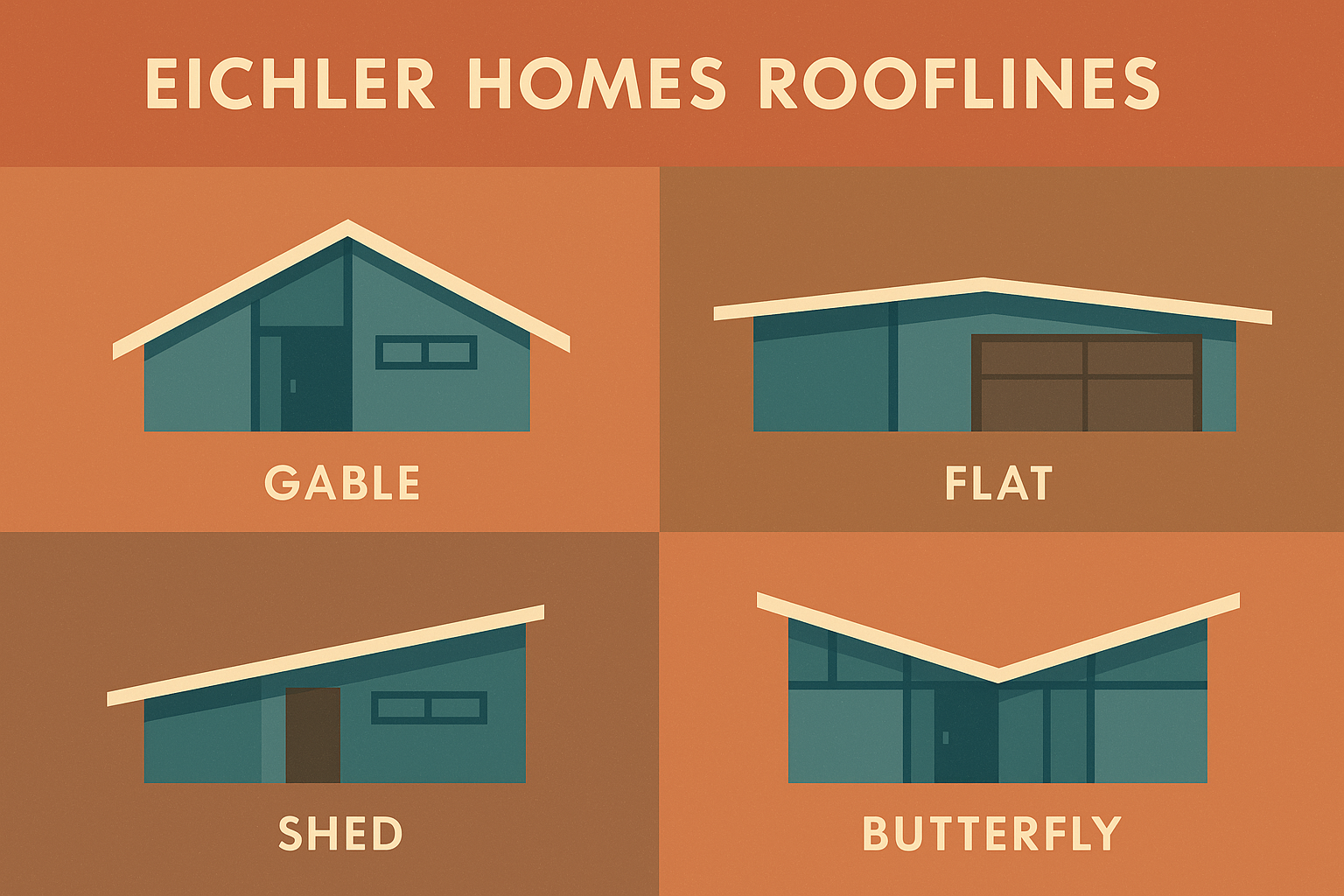
Eichler Roofline Styles in Northern California
Joseph Eichler’s mid-century modern homes are famed for their distinctive rooflines. From the flat-roofed models of the early 1950s to the later gabled designs (including dramatic double-gable atrium layouts) and the striking A-frame peaks of the 1960s, each roof style defined not only the home’s look but also its structure, light, and livability. In this guide, we explore the three main Eichler roofline styles – flat, gabled, and A-frame – highlighting which architects popularized each, the Northern California neighborhoods and models where they appeared, and how these rooflines evolved from the early 1950s through the late 1960s. We’ll also provide an architectural analysis of each style’s impact on light, ventilation, and aesthetics, and discuss practical implications for today’s owners (resale value, restoration, insulation, drainage, solar readiness, and curb appeal).
Evolution of Eichler Rooflines (1950s–1960s) in Northern California
Eichler homes were built between 1949 and 1974, with the 1950s being the “golden years” of expansionpastheritage.org. Early Eichlers were almost exclusively single-story with flat or very low-pitched roofs, a radical modernist departure from the steep roofs of traditional homesen.wikipedia.orgalmanacnews.com. Developer Joseph Eichler initially worked with architect Robert Anshen of Anshen & Allen, whose AA-1 model (a flat-roof design) formed the template for the first Eichler subdivisions in 1950pastheritage.org. By the mid-1950s, Eichler had built hundreds of these flat-roof homes across the San Francisco Peninsula, notably in Palo Alto’s Green Gables and Greenmeadow tracts, and in San Mateo and Sunnyvalealmanacnews.com.
Around the late 1950s, Eichler and his architects began experimenting with new roof profiles. Low-gabled roofs (shallow-pitch gables) appeared on a few models – for example, Eichler’s first duplexes in 1956 sported low-gable roofs instead of flat tops (an early hint of change). The big turning point came around 1958–1960, when architect A. Quincy Jones and Frederick Emmons (Eichler’s principal designers after 1954) introduced the atrium model: homes built around an open-air entrance atrium, now capped by a soaring central gable roof in some designs. This steep central gable (often flanked by flat-roof sections for the bedrooms and garage) was a “revolutionary new roof style” for Eichler that broke from the purely flat formseichlernetwork.com. It added dramatic volume to the interior and instant curb appeal – truly taking Eichler design to “new heights” with more drama and buyer appealeichlernetwork.com.
By the early 1960s, two main gabled variants had emerged in Eichler’s Northern California developments: single-ridge gables (one continuous peaked roof over the living space), and double-gable atrium designs (two gable peaks forming an M-shape, often with an open atrium between them). These were popularized by both Jones & Emmons and longtime Eichler associate Claude Oakland. In fact, Oakland (a former Anshen & Allen associate) was instrumental in some of the most iconic late Eichler roof designs. A Claude Oakland–designed atrium model in 1960 introduced what Eichler fans dub the “double A-frame” roof – a dramatic twin-peaked atrium entry that wowed visitorssf.curbed.comsf.curbed.com. Just a couple of years later, Jones & Emmons rolled out similar plan 1505/1605 series gabled models (with central atrium gables) in tracts like Lucas Valley in Marin Countyeichlernetwork.com. By the mid-1960s, steep A-frame accents and bold roof structures were a hallmark of many new Eichlers, even as the company’s building program wound down.
Throughout this evolution, Eichler never abandoned the flat roof entirely – rather, he intermingled styles. A 1962 Sunnyvale tract (Rancho Verde) exemplified this mix, featuring flat-top models, low-gable designs, and even a few “A-frame” peaks – all within one neighborhoodeichlerhomesforsale.com. As David Eichler (Joe Eichler’s grandson) noted, the various roof and atrium permutations were still variations on Eichler’s core design principles of clean lines, glass walls, and indoor-outdoor livingpastheritage.org. Below, we delve into each roofline style in detail.
Flat Roof Eichler Homes (Early 1950s Modernism)
Defining Features: Eichler’s flat-roof homes have nearly level rooflines, with only a slight invisible pitch for drainage. From the street, the roof appears completely flat – a bold, “modern rebel” aesthetic in the 1950satomic-ranch.com. These homes typically featured deeply overhanging eaves and exposed beam tails, emphasizing horizontal lines. Many had open carports integrated under the main roof and floor-to-ceiling glass walls opening to the rear yard. The overall effect was a low-slung, streamlined profile that hugged the ground and put the focus on the home’s horizontal plane rather than a towering roof. In Eichler’s words, this helped “bring the outdoors in,” seamlessly connecting to patios and gardensen.wikipedia.org.
Architects and Origins: The flat roof was pioneered by Anshen & Allen in Eichler’s very first prototypes. In 1949–50, Joe Eichler commissioned Robert Anshen to design affordable modern tract houses; the result was a simple post-and-beam house with a flat roof (the AA-1 model) that Eichler built in Sunnyvale – 100 homes in 1950 alonepastheritage.org. These sold out rapidly, proving the appeal of this unadorned modern style. Eichler continued to build flat-roof models throughout the early 1950s, expanding into neighborhoods like Palo Alto’s Greenmeadow (1954), which offered several floor plans but “all shared similar exterior features, such as low-pitched or flat roofs and clerestory windows.”almanacnews.com Architect A. Quincy Jones and his partner Frederick Emmons took over much of Eichler’s design work by this time and kept the flat-roof theme going (while refining the plans for better light and flow). For example, in Greenmeadow, Jones & Emmons designed one model with a nearly flat roof and a distinctive rectangular clerestory window band in front – providing visual interest while maintaining the low profilealmanacnews.com. Throughout the Peninsula and South Bay, hundreds of mid-’50s Eichlers were flat-roofed. Even into the 1960s, flat roofs remained part of Eichler’s repertoire – often alongside newer gabled models. (In Rancho Verde Sunnyvale circa 1962, flat roofs could be found next to low-gable and A-frame homes in the same tracteichlerhomesforsale.com.) This continuity shows that the flat roof was a core Eichler trademark from start to finish.
Light, Space, and Ventilation: Flat-roof Eichlers ingeniously balanced their low ceilings with strategies to invite in light. Since there was no high peak to allow tall windows, architects used clerestory windows tucked just below the roofline and floor-to-ceiling glass panels along the rear. In Greenmeadow and similar homes, triangular or rectangular clerestories were often placed above the front entry or living room to bring daylight into the middle of the housealmanacnews.com. The flat roof also made it easy to include skylights; many later flat-roof models featured small skylights in halls or bathrooms (and today owners often add them). Inside, the post-and-beam structure meant no attic and no ceiling joists – the exposed T&G (tongue-and-groove) roof decking is the ceiling. This gave even flat ceilings a textured, warm look (often stained wood), and the lack of attic kept interior volumes feeling open (albeit not vaulted). One benefit was that the “simple roofs emphasize the home’s horizontality and make them seem larger than they are,” as one historian noted of early Eichlerseichlernetwork.com. Ventilation in original flat-roof Eichlers relied on the operable glass – swing-open clerestories, jalousie windows, and sliding glass doors. There were no ridge vents (since no ridge) and typically no mechanical AC in 1950s homes, so cross-ventilation was key. The large openings at front and back – when aligned – could create a cooling breeze through the low space. However, warm air had a tendency to collect near the flat ceiling. Eichler later addressed this with the introduction of the atrium (an open-air atrium acts as a thermal chimney when you open the atrium door and sliders). Still, flat-roof Eichlers can be warm in summer and chilly in winter without upgrades – a point we address below.
Aesthetics and Era Significance: In the 1950s, the flat roof was the emblem of Eichler’s “California Modern” aestheticen.wikipedia.org. It symbolized a break from tradition – no lofty attics or ornamental gables – just pure clean lines. This roofline often went hand-in-hand with vertical 2-inch wood siding and nearly blank street facades, creating the famously minimalist Eichler curb appearanceen.wikipedia.org. The low profile also preserved privacy (neighbors can’t peer in over a tall fence when your house isn’t towering above). Many flat-roof Eichler neighborhoods, such as Fairglen in San Jose (built 1958–60), have a quiet cohesion – the houses sit low behind their lawns or landscaping, blending into the Midcentury-modest vibe of the block. Enthusiasts adore the flat-roof look for its “clear message of retro charm” and simplicityatomic-ranch.com. With deep eaves and flat façade, these roofs create a strong horizontal emphasis that harmonizes with the California landscape of flat lots and sprawling trees. There is also a subtle elegance in the way sunlight creates deep shadow lines under the eaves of a flat Eichler roof – a favorite sight in late afternoons.
Modern Considerations for Flat Roofs: Owners of flat-roof Eichlers today enjoy the iconic look but also face some practical challenges (all solvable with modern methods):
Insulation & Energy Efficiency: Original Eichler flat roofs had minimal insulation (often just some tar and gravel on plywood). This made them notorious for heat loss in winter and heat gain in summersolarcraft.com. Today, the go-to solution is a spray foam roofing system, applied on top of the roof. A polyurethane foam roof adds a thick insulating layer and a seamless waterproof membrane in one go. This upgrade “transforms an Eichler from the least comfortable summer or winter residence to a haven of energy efficiency,” dramatically reducing heat transfereichlernetwork.com. Many Eichler owners report that a new foam roof cuts heating/cooling bills by 30–50% and eliminates leaksdura-foam.com. (It’s even recommended by energy experts for flat-roof homesarmstrong1234.com.) If foam isn’t used, other options include installing rigid insulation boards under a new membrane or adding a single-ply PVC or TPO roofing layer with insulation. In any case, adding insulation is a must for comfort.
Roof Drainage & Maintenance: A flat roof, by definition, must handle rainwater carefully. Eichler’s designs do have a slight slope and use scupper drains or internal downspouts, but ponding can occur if drains clog or if the roof sags over time. Homeowners must keep leaves and debris cleared from drain openings. When adding solar panels or skylights, it’s crucial not to impede the water flowsolarcraft.com. Modern foam roofs help by creating a monolithic, joint-free surface and can be contoured to improve drainagearmstrong1234.com. It’s wise to re-seal or re-coat a flat roof every ~20 years (foam roofs often come with reflective elastomeric coatings that need renewal)armstrong1234.comarmstrong1234.com. With proper maintenance, a quality flat roof can last 30+ years.
Solar Panel Installation: The good news is that flat Eichler roofs have “plenty of roof space” for solar and no steep pitch to worry aboutsolarcraft.com. Panels can be placed at the optimal angle on racking, oriented for maximum sun – the flat surface actually offers flexibility that angled roofs do notsolarcraft.com. Also, working on a flat Eichler roof is safer and easier for installers than on a sloped roofsolarcraft.com. The challenges: Eichlers have widely spaced beams (often ~8–10 feet apart), so mounting racks must span those distances or align with structural memberssolarcraft.com. Additionally, there’s no attic to hide conduit, so wiring runs on the roof surface (installers mitigate this by tucking conduit in low-visibility areas)solarcraft.com. Care must be taken not to drill too many holes – typically mounts are secured into the beams through the decking, and after running wiring, the penetrations are sealed and re-coated. Experienced contractors note that flat foam roofs sometimes have drainage quirks that solar can complicate, so they plan panel layout to avoid creating water trapssolarcraft.com. Overall, yes – you can put solar on a flat Eichler roof (many have, very successfully)youtube.com – it just requires a knowledgeable installer.
Resale Value & Curb Appeal: Flat-roof Eichlers tend to appeal strongly to mid-century modern purists. In Northern California’s hot Eichler market, a well-preserved flat-roof home with original details (mahogany paneling, globe lights, etc.) can be just as valuable as a gabled model. However, broadly speaking, some buyers unfamiliar with Eichlers may be cautious about flat roofs (due to the lingering stigma of leaks). The key for resale is demonstrating that the roof has been updated (e.g. “new foam roof with warranty”) – this assures buyers that the flat roof is an asset, not a headache. In terms of curb appeal, the flat-roof Eichler presents a classic, low-profile modern look that many find very attractive in context. For instance, Greenmeadow in Palo Alto is revered as a historic Eichler tract partly because it offers “22 blocks of pristine midcentury modern homes” all with flat or gently sloped roofs evoking a unified design visionalmanacnews.com. The consistency of flat rooflines under the mature trees creates a special atmosphere. Yet, next to a more eye-grabbing A-frame, a flat roof house might seem understated. Some realtors note that adding small enhancements – like period-appropriate exterior color accents or updated landscaping – can help a flat Eichler “pop” in listing photos even without a dramatic roof. Overall, flat Eichlers have timeless appeal to those who appreciate authentic modernist architecture, and in Eichler-only neighborhoods they are the norm (so there’s no market discount). In mixed areas, a flat-roof Eichler will stand out as unique and stylish – it “breaks away from the multiple rooflines of previous eras” and proudly soatomic-ranch.com.
An Eichler home in Palo Alto’s Greenmeadow neighborhood with a low-pitched, almost flat roof. This 1950s design by Jones & Emmons exemplifies the flat-roof Eichler style – deep eaves, exposed beams, and a horizontal profile blending into the landscape. Greenmeadow Eichlers came in several models, but all featured flat or very low-gable roofs and clerestory windows to bring in lightalmanacnews.com.
Gabled Roof Eichler Homes (Single-Gable and Double-Gable Variants)
Defining Features: Gabled Eichlers introduce a triangular peak to the roofline, creating a traditional gable shape but executed in a mid-century modern way. There were two main gable configurations: single gables (one continuous roof peak, usually spanning front-to-back over the living areas) and double gables (two distinct peaks, often with an open atrium between them, also known as twin gable or double A-frame designs). Unlike typical suburban homes, Eichler gables were often low-slung – i.e. a relatively shallow pitch – at least in early iterations. Many are centered over the atrium or main living space, while the bedroom wing or garage might remain flat-roofed, creating a dynamic composition of volumes. A hallmark of Eichler gabled designs is the presence of clerestory windows in the gable ends or beneath the eaves, taking advantage of the taller ceiling to let in more light. The open beam pattern continues, with beams following the slope of the roof and a prominent ridge beam along the peak. From the exterior, these gabled Eichlers still lack ornamentation (the gable ends are plain panels or wood siding, often with triangular glass inserts) – but they offer a more eye-catching silhouette than the flat-top models.
Architects and Development: Eichler’s first forays into gabled roofs came in the mid-1950s. There is evidence that Anshen & Allen experimented with adding a small gable over entries in some custom Eichlers. However, the true launch of Eichler gable-roof models is credited to Jones & Emmons. In 1958, the firm (in partnership with Anshen & Allen) designed one of the first atrium models for Eichler’s San Mateo Highlands development, which featured a central open atrium flanked by a gabled roof – this may have been a prototype with a modest pitchsah-archipedia.org. By 1962, Jones & Emmons had refined a series of gabled atrium plans. Notably, Eichler model numbers 1505, 1605, 1905 (design codes used internally) were all gable-roof atrium designs introduced around that timeeichlernetwork.com. These made their debut in Northern California in communities like Lucas Valley in Marin County and later appeared in Eichler’s Orange County tracts (e.g. the Fairhills tract in Orange, 1964, where “model OJ-1605 featuring a central gable roof designed by Jones & Emmons” was common)storymaps.arcgis.com.
Meanwhile, Claude Oakland was also advancing the gabled concept. In fact, “two years before” the Jones & Emmons model 1505 hit Lucas Valley, Claude Oakland had been experimenting with similar peaked-roof atrium designseichlernetwork.com. Oakland’s big moment came around 1960, when he designed what would become known as the Double A-Frame Atrium model. One such house at 1230 South Mary Ave. in Sunnyvale (built 1960) showcases a steep front gable covering the atrium, immediately behind the entry courtyard fence. The atrium itself is open, but around its perimeter rise two A-frame peaks (one front, one back) with a peaked glass skylight over the entryway – yielding a “jaw-dropping effect”sf.curbed.com. Eichler aficionados nicknamed this design the “Double-A” Eichler, and “the peninsula features a number of homes boasting the look”sf.curbed.com. The architect of record was Claude Oakland, working in concert with Eichler, and together they built many of these in 1960–62sf.curbed.com. Oakland would continue to include both single and double gables in his Eichler designs through the mid-’60s (for instance, the Greenridge Eichler tract in Castro Valley (1960–65) has numerous gable-roof and double A-frame models, all designed by Oakland & Jones/Emmons in tandemeichlerhomesforsale.com).
In summary, Jones & Emmons popularized the central gable atrium Eichlers (their designs were used in high-profile tracts like Lucas Valley, San Mateo Highlands, and Palo Alto’s later Eichler enclaves such as Los Arboles), while Claude Oakland helped pioneer the more extreme double-gable (double A-frame) variant and carried the torch on many 1960s Eichler developments (Sunnyvale, Castro Valley, Walnut Creek, etc.). By the mid-60s, gabled Eichlers were found in almost every Bay Area Eichler tract, either as one model among many or the dominant style. For instance, Marin County’s Lucas Valley Eichlers (circa 1962–65) are best known for their twin-peaked atrium models – a design so iconic that local agents say “the double-gable atrium Eichler, better known as the double A-frame, is the most iconic and popular model in the Marin County Eichler real estate market”youtube.com. Palo Alto’s Los Arboles (1962) tract also featured a mix of gabled and flat-roof models, reflecting the transition. Even in Southern California (Orange), the gabled Eichlers made a splash – but our focus here is NorCal, where it all began.
Light, Volume, and Ventilation: Gabled rooflines gave Eichler homes a significant boost in interior volume and light. The living and dining areas now had vaulted ceilings, following the pitch of the roof up to the ridge. This allowed for large clerestory windows in the gable ends. Many gabled Eichlers have a triangular glass window mounted high in the A-shape of the facade (often fronting the street, but filled with obscured or patterned glass for privacy). Others have a band of clerestories just below the eaves on the tall walls. For example, in some single-gable models, you’ll find a row of clerestory windows above the sliding glass doors along the back, capitalizing on the higher rear wall. The result is a brighter interior – sunlight can penetrate from above, not just through the sliding doors. One Eichler Network article noted that the steep central gable not only added drama but also “allowed copious amounts of natural light into the house” via high windowsatomic-ranch.com (this quote was about butterfly roofs, but equally applies to any raised roof design). In double-gable atrium Eichlers, the atrium itself often had open sky (no roof) in the middle, plus clerestories facing into the atrium from the gable peaks. The atrium thus became a light well for the surrounding rooms. Standing in an atrium model Eichler, one typically sees exposed beams radiating upward to a central ridge and often a glazed triangle at the peak that frames views of the treetops and sky. At night, these clerestories and skylights give glimpses of the stars or moon, enhancing the indoor-outdoor vibe.
Ventilation improved somewhat with gables because hot air could rise to the peak. Eichler didn’t usually include ridge vents, but many gable-end clerestory windows could be opened to vent out heat. Some owners later installed small electric exhaust vents near the ridge to pull hot air out on summer days. The atrium, if present, acted as a breezeway – opening the atrium doors would flush air through. Thus, gabled Eichlers stayed a bit cooler than flat ones (still, many owners today add HVAC since our expectations for comfort have risen).
Structurally, the gable roof introduced a ridge beam and sloping rafters but still no attic space. The same tongue-and-groove ceiling continues, following the roof slope. Eichler’s engineers ensured the ridge beams were hefty enough for the spans; often a king post or support column is hidden in a partition to carry the ridge in large rooms. Despite the added complexity, these remained true post-and-beam homes – the gable didn’t change the fundamental construction method, it just altered the geometry. One interesting structural aspect: in double-gable atrium models, the gables meet the flat-roof sections at the atrium’s edges. The junctions required careful engineering (and flashing) but created a wonderfully open courtyard in between. As one Eichler article described it: “Flanked on two sides of an open atrium by flat-roofed bedroom areas and a garage, this revolutionary new roof style was a radical departure from the flat...” designs prioreichlernetwork.com. In other words, the core living areas got the dramatic gable, while the periphery remained flat, marrying two roof types in one home. This hybrid approach maximized drama where it counts (the entry and great room) without raising the whole house.
Aesthetics and Appeal: The introduction of the gable was, in large part, to increase buyer appeal. By the late ’50s, some buyers wanted a more “conventional” roof form or simply more visual excitement. The Eichler gabled models delivered that “soaring central peak” and “greater buyer appeal”eichlernetwork.com. From the curb, a gabled Eichler is instantly distinguishable: many have the classic A-framed porch or entry – often with exposed beams or rafters under the gable forming a bold geometric pattern. (The City of Palo Alto design guidelines note that in “Flat-with-Gable” Eichlers, a steeply pitched gable over the entry – either front- or side-gabled – is a character-defining feature, often showing exposed beams or braces under the gable and clerestory windows below itcityofpaloalto.org.) This description perfectly fits the beloved “flat-top with A-frame entrance” look of many 1960s Eichlers. A famous example is the “Life House” Eichler in San Mateo Highlands (featured in Life magazine 1958): it had a mostly flat roof but a front-facing gable over the entry, complete with open-trellis beams – a subtle preview of the forthcoming full-gable designs. By the 60s, Eichler homes with a full gable (covering the living room) often present a striking facade to the street: sometimes the entire A-shape is glass (for instance, some models in Walnut Creek have a two-story-looking glass gable front, though the house is one story), or other times the gable is filled with wood siding but the outline is emphasized by deep eaves and beam extensions. Curb appeal was undoubtedly enhanced. As Curbed SF quipped about the Sunnyvale double A-frame Eichler, “not all Eichlers are created equal” – that one’s dramatic roof “shows off the goods and then some.”sf.curbed.com
Inside, the aesthetics were equally improved: gabled Eichlers feel more spacious due to the volume of the vaulted ceilings. Many owners celebrate the “wow moment” when guests see the high ceilings and atrium for the first time. Photos of these models often highlight the exposed ridge beam and roof planks, which add a cathedral-like rhythm to the space. One renovated Sunnyvale twin-gable Eichler (Plan OJ-1605) was described as “a sanctuary” after its update – the design logic of the twin gable layout wraps rooms around the atrium and gives almost every room a view of either the atrium or backyardbouhaus.com. This underscores how the roofline and floorplan together achieved Eichler’s goal of integrating indoors and out.
In terms of design lineage: the single-gable Eichlers can be seen as bridging pure modernism and the popular California ranch style. They still had Eichler’s modern DNA – no attic, minimal ornament – but the low gable roof nodded to the familiar ranch house form (just executed more cleanly). The double-gable atrium Eichlers, on the other hand, were unlike anything in traditional tract housing. They were unabashedly modern showpieces. The dramatic twin peaks and center atrium were more in line with custom architect-designed homes of the era. It’s telling that the double A-frame Eichlers remain highly “coveted” – they encapsulate the Eichler mystique of being both a livable family home and a work of art.
Modern Considerations for Gabled Roofs: Owners of Eichlers with gabled roofs face a mix of benefits and challenges today:
Roof Repairs & Waterproofing: The gable design brings in valleys and junctions that flat roofs don’t have. For instance, where a gable meets a flat section (as in many atrium models), the intersection must be carefully maintained with proper flashing and membrane to prevent leaks. With age, some Eichler owners experienced leaks at the ridge skylight or where the atrium meets the house. The modern fix is usually to re-roof with a single-piece membrane or foam that covers both flat and sloped sections seamlessly. Foam roofing works on sloped Eichler roofs too and can “conform to any shape and size of the roof, including curves [and] angles” while eliminating jointsarmstrong1234.com. Many owners of double-gable models opt to foam over the entire roof and even across the atrium gutter areas, then install a modern glass skylight over the atrium. (Originally, Eichler atriums were open-air with internal gutters; some owners now cover them with retractable or fixed glass for weather protection – turning an open atrium into a sunroom while keeping the aesthetic. This, however, alters ventilation and isn’t for everyone.) Generally, a gable Eichler that’s been re-roofed with contemporary materials and techniques will be well-protected. It’s crucial to hire roofers who understand Eichler details – especially that ridge cap and beam-end flashing must be handled differently than on conventional homes (because Eichler beams often penetrate the exterior and are exposed). Some cities, like Palo Alto, provide Eichler maintenance guidelines to help owners preserve features like the exposed beams under gablescityofpaloalto.org. Keeping those beams painted and sealed prevents dry rot where they project beyond the eaves.
Insulation & Comfort: Like flat roofs, gabled Eichlers originally had little insulation. The larger volume can actually exacerbate temperature stratification (heat rises to the peak, leaving lower areas cooler – fine in summer, not as great in winter unless you have radiant heat which Eichlers do). Many owners use the same solution: foam roofing on top for insulation. Another technique is to carefully install foil-faced batt insulation between the rafters from below if the ceiling is opened during a renovation, then add a thin wood veneer or reinstall planks to mimic the original look. But most purists don’t want to disturb the exposed T&G ceiling. Thus, insulating above is preferred. There are also radiant barrier coatings that can be applied under the roof deck to reflect heat. In any case, once insulated, a gable Eichler is easier to heat and cool than before. Ceiling fans can help destratify warm air in winter (gently push it down). Because these homes now have dramatic ceilings, some owners do add A/C discreetly (often mini-split systems to avoid ducts, since no attic for ducts).
Solar Panels: Gabled Eichlers present a slightly different scenario for solar than flat ones. If the gable faces south or west, one can attach solar panels flush to that slope for a clean look and good energy production. This avoids the need for tilted racks. For example, an Eichler with a broad south-facing gable could sport a row of panels near the ridge that might barely be visible from the street (due to the deep eaves and low angle of view). However, if the gable faces the street and an owner is concerned about aesthetics, they might choose to instead mount panels on a backside flat section (like over the bedrooms or garage). Fortunately, Eichlers often have multiple roof sections. The peninsula double-A Eichlers typically have a front A-frame and a rear A-frame; the rear A-frame (facing the backyard) is an ideal spot for solar if it faces south, as it’s out of street view. Additionally, the remaining flat roofs (garage, etc.) can host panels on low racks as needed. The main consideration is again structural attachment: ensuring the mounts hit the beam or purlin locations on the sloped roof. Solar installers experienced with Eichlers have custom solutions, as noted earlier. The drainage issue is usually less on gabled sections (water runs off), but one must be cautious not to trap debris in any valleys or behind panel racks on lower-slope sectionssolarcraft.com. Overall, solar is quite feasible on gabled Eichlers – and many owners report that preserving the beam-and-deck ceiling (by insulating above) plus adding solar has made their mid-century home as efficient as a new build, while maintaining its character.
Resale and Value: Gabled-roof Eichlers often enjoy a wider buyer audience. Some Eichler real estate experts note that buyers who might shy away from “flat-top” houses are pleasantly surprised by Eichlers with vaulted ceilings. The gable adds a sense of “traditional home” comfort without giving up the modernist vibe. In competitive Eichler neighborhoods, homes with atrium gables or double gables sometimes fetch premium prices simply because they are rarer models. For instance, an Oakland Hills Eichler with a double gable atrium might generate extra buzz among enthusiasts (an example on Curbed highlighted a double A-frame Eichler listing that had Eichler fans excited months before it hit the marketsf.curbed.comsf.curbed.com). That said, all Eichlers tend to command strong prices in NorCal. Gabled models may sell a bit faster due to their photogenic interiors and curb appeal. As one article put it, “it’s a killer every time” – the double A-frame atrium invariably impressessf.curbed.com. From a value-add perspective, if an owner is restoring a gabled Eichler, it’s wise to restore the clerestory windows (often they’ve been painted over or removed in bad remodels) and highlight the beams. These authentic details enhance appeal. Also, maintaining or recreating the open atrium (if it has one) is crucial – some owners enclosed atriums in the past for more interior space, but that can hurt value because it destroys the original concept. Buyers today usually prefer the atrium be intact (even if covered with glass, it should feel like an atrium). In summary, gabled Eichlers are highly marketable – they blend mid-century charm with a dash of classic roofline that many find the perfect combination.
Neighborhood Character: It’s worth noting how these rooflines contribute to neighborhood look. In tracts like San Mateo Highlands, the introduction of gable models alongside flat-roof models in late 50s/early 60s added variety – you’ll see streets with alternating flat and gable homes, providing an undulating rhythm of rooflines. In Fairglen (San Jose), where a few gabled examples stand among flat-top peers, the gables punctuate the street scene. Meanwhile, in Lucas Valley (Marin) where double-gable atrium models predominated, the whole subdivision reads differently – the silhouettes of twin peaks repeating down the street create a dramatic vista, especially at twilight when the clerestory windows glow. These differences underscore Eichler’s evolving design language and give each Eichler tract a unique identity. Owners in such neighborhoods often feel part of a living museum of mid-century design, and many take pride in preserving their home’s iconic roofline.
View from the open-air atrium of a “Twin Gable” Eichler (Plan OJ-1605, designed by Jones & Emmons in 1962). Here you can see the double-gable roof form: two steep gable peaks on either side of the atrium, creating an M-shaped roofline. The atrium (center) is open to the sky, and each wing of the house has a vaulted ceiling under a gable. This innovative layout was a radical departure from earlier flat-roof models – “flanked on two sides of an open atrium by flat-roofed...areas,” the dramatic twin gables added volume and lighteichlernetwork.com. Almost every room opens onto the atrium or backyard, exemplifying Eichler’s indoor-outdoor ethos. (Architect: A. Quincy Jones/Frederick Emmons; Photo © Ryan Leidner Architecture)
A-Frame and Steep-Pitched Eichler Roofs (Dramatic Mid-’60s Peaks)
Defining Features: In Eichler lexicon, “A-frame” typically refers to the steeply pitched gable roofs that were used as bold design statements on certain models. These are essentially an extreme subset of the gabled roofs, but deserve their own discussion because of their distinct appearance and structural implications. An Eichler A-frame roof is characterized by a tall, triangular façade – often extending almost to the ground – like a classic ski chalet or chapel, but adapted to a single-story plan. On Eichler homes, you most commonly see A-frame roofs at the entry atrium or porch. For example, an atrium might be covered by an A-frame that starts at the front door and peaks above the atrium, then slopes down toward the center of the house. In some cases, there are double A-frames: one at the front and one at the back, giving a symmetric “twin peaks” profile (hence the term double A-frame). These roofs have a much sharper pitch than Eichler’s regular low-gables – so much so that the front A-frame forms an A-shaped entry portal, often with the front door centered under the “A”. Large triangular glass panels typically fill the space beneath the A-frame eaves, alongside the door, creating a grand entrance with views to the sky. The eaves on A-frame Eichlers are open, showcasing the thick ridge beam and rafters like a skeletal framework. Inside, the A-frame yields a soaring atrium or living space ceiling that can be two stories high at the apex (even though the home is one level). These designs were eye-catching and somewhat experimental – they pushed Eichler’s architecture to its creative limits in tract housing.
Architects and Notable Models: The steep A-frame concept was strongly associated with Claude Oakland, who is credited with the first double A-frame atrium Eichlers around 1959–60. The Sunnyvale atrium Eichlers (circa 1960) mentioned earlier are a prime example – Oakland’s design there featured the A-frame over the atrium, creating a “peaked glass skylight right over the entryway” that made the house instantly recognizablesf.curbed.com. That model (sometimes referred to as the Claude Oakland Double A-Frame Atrium model) was built in small numbers in Sunnyvale (Fairbrae tract) and likely in other Bay Area locations like San Jose or Concord. Jones & Emmons also adopted steep pitches in some of their designs around the same time. In fact, the Eichler plan code OJ-1605 (Jones/Emmons, 1962) used in Orange and Lucas Valley had a pronounced central gable that was quite steep for an Eichler – not a full A-frame to the ground, but definitely a higher pitch than earlier modelseichlernetwork.com. By the mid-1960s, Greenridge in Castro Valley (1963–65) included “models with steeply pitched A-frame style gables flanked by flat sections”, according to local real estate descriptionseichlerforsale.com. Marin County’s Eichler tract in Lucas Valley also saw variants of the double A-frame – some homes have a front A-frame entrance combined with a secondary gable. The double A-frame design in Lucas Valley is sometimes called the Model 52 and is highly sought-after (Marin Eichler experts often point to the double A-frame as the pinnacle of Eichler design in that area, as noted beforeyoutube.com).
Beyond Oakland and Jones & Emmons, architectural trends of the era influenced Eichler’s A-frames. Mid-century architects across California were playing with bold rooflines – e.g., Krisel’s butterfly roofs in Palm Springs, and developers like Streng (in Sacramento) doing peak-roof Atrium hybrids. Eichler, ever the innovator, tried out an even steeper “A” in some later custom builds. For instance, Eichler built a small number of two-story homes and even a chalet-like model in the late ’60s, but those were outliers. The main A-frame Eichlers remain the 1960–65 single-story atrium models described.
Light and Spatial Experience: Steep A-frame roofs were a way for Eichler to “bring the outside in” in a new fashion. According to Atomic Ranch magazine, “Joseph Eichler used the A-frame as an opportunity to bring the outside in – setting the pitch over a courtyard at the center of the home or creating a deep, plant-filled entrance that feels like an interior entryway.”atomic-ranch.com This is exactly what you feel in a double A-frame Eichler: the front entrance is often an indoor-outdoor transition space, essentially a covered atrium or foyer with plants, furniture, and sky views above. The steep pitch over this space protects it from the elements but it’s often open at the sides or filled with glass, so it blurs the line between indoors and outdoors. Daylighting is dramatic – the entire A-frame acts like a giant skylight. In the Sunnyvale example, the atrium’s A-frame was filled with frosted glass, so the whole space glows with diffuse lightsf.curbed.com. In others, the gable might be open with beams and slats (creating dappled light). Either way, the entry atrium becomes a bright focal point, and interior rooms get borrowed light from it. Additionally, the steep A-frames allowed for very tall windows or glass walls at the ends. Some double A-frame Eichlers have a full-height glass wall at the rear gable opening to the backyard, essentially a floor-to-peak window wall – which is stunning for views and light. The sense of volume inside these homes is unparalleled in Eichler’s catalog; even though floor area might be 1,600-2,000 sq ft, the cubic volume feels huge due to the high ceilings.
Ventilation could be both a challenge and an advantage. On one hand, the heat rises into the peak of the A-frame (which might make the upper area hot if not vented). On the other hand, if there are operable windows or vents at the top of the A, hot air can escape very effectively (stack effect). Not all A-frame Eichlers had those originally, but many owners install small operable panels at the gable apex now. The open atrium concept also means that if you open the atrium to the sky (some had retractable covers or were simply open air in good weather), it’s like opening a giant chimney. So, overall, an A-frame Eichler can breathe well if utilized, but it needs thoughtful use of openings. Structurally, the steep A required beefier supports – often the A-frame is supported by two or four posts that frame the atrium, forming almost a “triangular tunnel” you walk through at the entry. These posts and beams carry a lot of weight. Oakland’s designs managed this without interior columns in the living space, which is impressive. Engineers likely treated the A-frame like a rigid bent frame.
Aesthetics and Impact: The A-frame Eichlers are show-stoppers. They took the mid-century “wow factor” up a notch, giving tract houses a custom, almost whimsical feature. A visitor approaching a double A-frame Eichler is greeted by a dramatic A-shaped roof swooping down over the entrance, often with Eichler’s signature globe pendant light hanging from the peak to mark the front door. It’s very theatrical – a blend of modern minimalism with a dash of alpine fantasy. These houses have been compared to churches (due to the high pitched roof resembling a chapel’s) – indeed, the living rooms often have a cathedral-like ambiance, with the ridge soaring and maybe a tree visible through the clerestory glass. This drama translated into what one article called “romance” in Eichler designeichlernetwork.com – an emotional appeal not present in the more stoic flat-top models.
On the streetscape, A-frame Eichlers break the horizontal line and create focal points. Many Eichler tracts only have a few A-frames, making those particular homes landmarks in the neighborhood. For example, in Palo Alto’s Fairmeadow (different from Greenmeadow) or in South Palo Alto’s later Eichlers, an occasional steep-gable “Models 45/46” (to use Eichler’s numbering) pops up and is immediately noticeable among the flat roofs. In Upper Lucas Valley, by contrast, numerous homes have the A-frame entry, giving that whole development a unique identity distinct from earlier Eichlers. The A-frame became part of Eichler’s branding in the 60s – featured in sales brochures and even on the cover of CA-Modern magazine decades later to epitomize Eichler style.
It’s also worth noting that these A-frame roofs had a functional purpose beyond looks: by covering the atrium, they addressed homeowner feedback about leaves and rain in the atrium while still retaining the indoor-outdoor feel. Some Eichler buyers in the late 50s loved the atrium concept but wanted it more usable year-round. The A-frame cover provided that shelter. It’s a clever example of Eichler listening to customers and innovating (though it also added cost and complexity, possibly cutting into profit – one reason such designs weren’t in every house).
Modern Considerations for A-Frame Roofs: Owning an Eichler with an A-frame or double A-frame roof today means embracing a truly iconic piece of architecture, with a few extra responsibilities:
Maintenance & Restoration: The A-frame portions require vigilant maintenance of their glazing and wood. Many A-frame Eichlers have large fixed glass panels in the triangles – these need to be kept sealed and occasionally re-puttied or gasketed to prevent leaks. If the glass is original (single pane), some owners upgrade to double-pane tempered glass for safety and insulation, while matching the original look (possibly with tint or frosted pattern if it was that way). The ridge beam and rafters are exposed to view and sometimes partially to weather at the eaves – they should be kept painted or stained and checked for any signs of water intrusion where they meet roofing. Because the roof pitch is steep, water runs off quickly, which is good, but it can also cause more wear on the ends of beams and faster runoff at the base. Ensuring the ground or drains at the base of an A-frame handle the cascade of water is important (splash blocks, etc., to avoid foundation issues). If the A-frame covers an atrium that’s open, the valley where the A-frame meets the flat roof might have internal gutters – those gutters are infamous in Eichlers for rusting out. A common restoration is to fiberglass-line or replace atrium gutters or redesign that juncture to slope out to exterior gutters. Some owners eliminate the atrium gutter by glazing over the whole atrium; others convert it to a different drainage design. It’s a key focus area.
Roofing & Insulation: Like the other roofs, A-frames benefit from modern roofing. Foam roofing works but is trickier to apply on a steep slope (usually they spray the flat parts and roll a membrane on the steep part). Alternatively, many A-frame owners choose a single-ply PVC or TPO membrane which can handle both flat and steep sections, or even standing-seam metal for the A-frame for longevity (though metal changes the look and is not common due to aesthetic departure). Insulating the A-frame is vital because of the stack effect – without insulation, heat rises and escapes quickly. Foam above or rigid insulation under new roofing can be done without affecting the interior appearance. Once insulated and re-roofed, an A-frame Eichler can be very cozy despite the large volume. As with gabled models, adding a ceiling fan in the peak area can help push warm air down in winter. Some owners have cleverly hung modern fans or even automated vent windows in those high points.
Living with the Atrium/A-Frame: If the atrium is covered by the A-frame, it effectively becomes an indoor atrium (foyer). Today’s owners often treat this space as an extension of the living room – a place for plants, a reading nook, or a dramatic entry hall. One practical tip: ensure that any added cover or enclosure for the atrium is done sensitively. For example, if one installs glass at the front A-frame opening (to fully enclose the atrium and make it a true interior foyer), it should be done in a way that doesn’t spoil the exterior look. Many have done this by putting a clear glass wall/doors just inside the A-frame, preserving the exterior appearance while creating an airlock. Others leave it exactly as originally intended – semi-open, which requires sweeping out leaves and maybe not using that space during rain. It’s a lifestyle choice. Importantly, if you enclose the atrium fully, you might need to add mechanical ventilation or ensure windows can open, because you’ve removed the natural vent.
Solar Panels: Most owners of double A-frame Eichlers opt to keep panels off the dramatic A portion to maintain curb appeal. Instead, they use the flat roof areas (which still exist over bedroom or garage wings). In some cases, if the rear A-frame faces south and is not easily visible, they might put a few panels there. The steep angle of an A-frame in NorCal (~45–60 degrees) is actually not bad for winter sun, but a bit steep for summer optimal angle (which is more like 30 degrees). However, the loss isn’t huge, and the panels would self-clean better in rain due to steepness. Attaching to an A-frame requires long rail runs or individual mounts on rafters. Given the complexity, many just stick to flat areas. Since Eichlers often have “plenty of roof space” overallsolarcraft.com, even excluding the A-frames leaves enough room for a substantial solar array. As always, attention must be paid to not drilling into wiring or weakening beams – hiring a solar installer who has done Eichlers is key.
HVAC: One modern issue with the high A-frame ceiling: if you do decide to heat/cool with forced air, there’s no attic for ducts and a huge area to condition. Radiant floor heating (original Eichler) works nicely still, warming the space from below. Many A-frame owners, if original radiant failed, go for mini-split heat pumps: wall-mounted units that can cool and heat the large space without ducts. Those can be placed on a wall that isn’t too visually obvious (perhaps in a corner of the living room), preserving the open look. This is preferable to dropping a ceiling or building soffits for ducts (which would ruin the aesthetic).
Resale and Rarity: Steep A-frame Eichlers are highly prized by collectors of mid-century homes. They don’t come up for sale often, and when they do, they tend to be marketed highlighting the unique roofline. For example, a recent Oakland double A-frame listing was headlined by Curbed as “asks $1.55M, and I say yes”, emphasizing the rarity of the double-gabled construction and calling it “an uncommon treat for fans of the iconic developer.”sf.curbed.com. In Marin, a double A-frame with original details is like the holy grail for some buyers. Of course, condition matters: a stunning roofline won’t overcome neglect. But assuming one has maintained it, these models often see competitive bidding due to their architectural significance. For resale, it’s smart to retain as much of the original open character as possible (enclosed atriums or altered beam configurations could disappoint the purists who are your likely buyers). Even among Eichlers, the double A-frames can command a premium simply because there are fewer of them.
Curb Appeal: In terms of curb appeal, it’s hard to beat an A-frame Eichler. It has the advantage of instant visual intrigue – even people who don’t know who Eichler is will notice the house with the “big A roof” on the street. It’s a conversation starter. The curb appeal can be enhanced with period-correct touches: Eichler placements of the address numbers on the front, a bright colored door (many have that already), and landscaping that frames the A shape (like low shrubs or rocks that don’t hide the façade). Since the A-frame already provides vertical interest, most owners keep other elements low-profile (e.g., no tall trees blocking it). At night, shining uplights on the A-frame or having the interior atrium light glow out adds drama. Essentially, an A-frame Eichler can be the showcase home of the block. This can be a selling point for those who love to stand out (in a stylish way). The only caveat: if the neighborhood is under historic review or has guidelines, they will certainly require preserving that roofline – so any addition (like adding a second story) is virtually off the table. This is usually fine, as Eichler owners rarely want to add a story, but it’s worth noting the roof is sacrosanct in these homes.
In all, owning a steep A-frame Eichler is like owning a piece of art that you live in. It demands a bit of extra care (those high points and intersections to mind), but rewards you with an inspiring space and strong value retention.
An iconic Double A-Frame Eichler in Sunnyvale (circa 1960, designed by Claude Oakland). The steep A-frame atrium roof creates a dramatic A-shaped facade, sheltering the open-air entry courtyard behind the red front door. Triangular clerestory glass fills the peak, washing the atrium in light. Eichler enthusiasts refer to this roof design as the “double A-frame” and consider it “a killer every time” for its jaw-dropping visual impactsf.curbed.comsf.curbed.com. Steep A-frame roofs like this appeared in Eichler tracts of the early ’60s (Fairbrae in Sunnyvale, Greenridge in Castro Valley, Lucas Valley in Marin), and remain highly sought for their mid-century modern curb appeal. (Courtesy Mark P. Easterday/Keller Williams)
Comparison of Eichler Roofline Styles
To summarize the key characteristics of the three main roof styles, the table below highlights differences in form, architects, examples, and modern considerations:
Roof StyleProfile & DesignKey Eichler ArchitectsNotable NorCal Tracts / ModelsModern Notes (Insulation, etc)Flat RoofNearly flat (very low slope for drainage); one-level roofline emphasizes horizontal form. Deep eaves and exposed beams at the edges. Interior ceilings are flat exposed wood decking (no attic).Anshen & Allen (Robert Anshen) – original 1949–50 designs;
Jones & Emmons – built many flat-roof Eichlers through 1950s.Early 1950s: Sunnyvale’s first Eichlers (100 homes in 1950)pastheritage.org; Palo Alto Greenmeadow (1954, J&E design – flat/low-pitch across 270 homes)almanacnews.com; San Mateo The Highlands (Phase 1 mid-50s).
Also common in most 1950s Eichler tracts.Easiest to re-roof with foam (adding insulation and waterproofing)armstrong1234.com. Must keep drains clear (ponding risk). Ideal for solar panels (flat surface allows optimal orientation)solarcraft.com. Lower visual profile – subtle street presence but quintessential MCM look.Single-Gable
(Ridge Gable)Low or moderate-pitch gable roof spanning main living areas. Triangle peak often faces front or forms over atrium. Usually combined with flat-roof sections over bedrooms/garage. Vaulted interior in living spaces. Clerestory windows under the gable eaves or in end walls.Jones & Emmons – introduced central gable atrium models (late ’50s onward)eichlernetwork.com;
Claude Oakland – later adapted and refined gable designs (early ’60s).San Mateo Highlands (1958 atrium model by Anshen+Allen/J&E – one of first gablessah-archipedia.org);
Los Arboles, Palo Alto (1962 Eichlers by J&E – many with front gables);
Fairhills, Orange (SoCal) – 1964 tract of central-gable Eichlersstorymaps.arcgis.com;
Marin Lucas Valley (circa 1962, models 1505, 1605 by J&E – central gable atrium common)eichlernetwork.com.More complex roof junctions (needs good flashing at atrium and valleys). Better natural ventilation than flat (heat rises to ridge). Can be foam roofed or single-ply membrane for leak-proofing. Supports solar – panels can go on gently sloped sections. Higher ceilings = add insulation to control heat. Strong resale appeal – the mix of modern and slight traditional form attracts many buyers.Double-Gable Atrium
(Twin Gable)Two gable peaks (forming an “M” shape or twin A-frames) usually flanking an open atrium. Often one gable faces front, one faces rear. Steeper pitch than single-gable in many cases. Creates a dramatic vaulted atrium space between. Beams and ridge of each gable exposed.Jones & Emmons – e.g. Plan 1605 atrium model with twin gables (used in Orange, Marin, etc.)bouhaus.com;
Claude Oakland – Double A-Frame Atrium design (1960) credited to himsf.curbed.com. Collaborated on many twin-gable homes (e.g. Castro Valley).Sunnyvale Fairbrae (Rancho Verde) – a few 1962 homes with double A-frame atrium roofseichlerhomesforsale.com;
Castro Valley Greenridge (1960–65, Oakland & J&E – numerous double-gable atrium Eichlers)eichlerhomesforsale.com;
Lucas Valley, Marin (many houses have twin-gable atriums – iconic model)youtube.com;
Sunnyvale 1230 Mary – famous 1960 Claude Oakland double A-frame Eichlersf.curbed.com.These are essentially hybrid roofs – flat + gable – so upkeep involves both systems. Atrium drainage is key (often internal gutters – consider upgrades). Spectacular light and space, but ensure atrium wood/door frames are well-sealed against weather. Modern fixes: some owners add retractable glass roofs over atriums for rain, or new skylights. Highly coveted – maintain original atrium and beams for maximum value.Steep A-Frame
(High-Pitch Gable)High-pitched “A” roof, usually highlighting the entry or central atrium. Forms an A-shaped facade; roof may extend down to near ground level at the ends. Often used in pairs (double A-frame front and back). Very open, soaring interior volumes under the A-frame. Large triangular glass inserts common.Claude Oakland – signature double A-frame atrium model designersf.curbed.com;
Jones & Emmons – incorporated steep pitches in some 1960s models as well.Sunnyvale (1960 Claude Oakland atrium Eichlers – steep front A-frame)sf.curbed.com;
Oakland Hills (Sequoyah) – a few rare double A-frame Eichlers;
Lucas Valley – select models with pronounced A-frame entries;
Concord/Walnut Creek – late Eichlers with steep gables.
(Many double A-frames overlap with “double-gable” above.)Structural drama comes with maintenance needs: keep A-frame windows watertight; monitor beam weathering. Usually no attic – plan for insulation when re-roofing (steep sections can use foam+coating or membrane). Solar typically mounted on other sections (to preserve look), but can be done on rear slope if needed. Huge curb appeal payoff – these models often sell at a premium. Ensure any atrium cover or enclosure is well-designed (to keep the A-frame effect).
(Table: Comparison of Eichler Roof Styles – form, architects, examples, and modern considerations. Flat, Gable, and A-Frame each contributed to Eichler’s design evolution, and many neighborhoods feature a mix.)
Conclusion
Eichler homes in Northern California showcase a rich evolution of roofline styles from the 1950s into the 1960s – each with its own architectural logic and present-day implications. The flat-roof Eichlers of the early ’50s established the developer’s modernist credo with their streamlined, indoor-outdoor focused design. As the decade progressed, the introduction of gabled roofs – first modest low-pitch gables, then bolder atrium-centered peaks – brought new heights of drama and functionality, marrying modern design with a touch of familiar form to win over buyers. Finally, the mid-’60s A-frame innovations pushed Eichler design to its creative zenith, resulting in some of the most iconic mid-century homes ever built in tract form. Architects Anshen & Allen gave Eichler his start with the daring flat roof; Jones & Emmons helped refine and expand the palette with atriums and gables; and Claude Oakland infused late-period Eichlers with innovative double gables and A-frames that have since become prized gems of mid-century architecture.
For today’s homeowners, each roof style carries lessons and opportunities. Flat-roof owners embrace a pure MCM aesthetic and can, with modern materials, overcome the old challenges of leaks and insulation – enjoying sleek lines with new-era comfort. Gable-roof Eichler owners benefit from soaring spaces and a blend of modern/traditional that often simplifies upgrades (like easier drainage and straightforward solar installs on a pitched plane) while savoring the atrium lifestyle Eichlers are known for. Those living under the sweeping A-frames hold a piece of Eichler history that turns heads; with thoughtful stewardship – preserving the dramatic roof and atrium while updating the envelope – these homes continue to perform as both cozy dwellings and conversation-starting works of art.
Across Northern California Eichler neighborhoods – from Greenmeadow’s flat-top tranquilityalmanacnews.com to the San Mateo Highlands’ experimental mix, from Fairglen’s bridging of eras to the sculptural peaks of Lucas Valley – the variety of rooflines adds to the rich tapestry of design. It’s a testament to Joseph Eichler’s vision that even within the “standardized” context of tract developments, such architectural diversity could flourish, each evolution building on the last. Eichler rooflines were never just about shelter from the rain – they were (and are) an integral part of the light, structure, ventilation, and aesthetics of the home, actively furthering the goal of “bringing the outside in” and crafting harmonious modern living spacesen.wikipedia.org.
In the end, whether flat, gabled, or A-framed, Eichler roofs have proven adaptable and enduring. With proper care (and a bit of 21st-century technology), these mid-century homes continue to be comfortable and efficient. And in terms of curb appeal and resale, the market consistently shows strong appreciation for authentic Eichler features – rooflines included. A well-preserved or properly restored roof, true to its Eichler style, often boosts value by appealing to the sense of history and design integrity. Conversely, an altered roof (e.g. a misguided addition of a faux tile roof or an enclosure that ruins the lines) can hurt value – a mistake most owners now avoid thanks to better awareness and often, protective neighborhood associations.
For current and prospective Eichler owners, understanding the nuances of your home’s roof style is crucial. It guides you in maintenance priorities (be it re-coating a flat roof or reglazing clerestories in an A-frame), informs your upgrades (like how to best insulate or where to place solar panels), and connects you to the legacy of mid-century design innovation. When you stand in an Eichler atrium and look up – whether at open sky framed by a flat roof, at a ridgeline of a gable with sun streaming through, or at the sloping planes of a dramatic A-frame – you’re experiencing a space purpose-built to create delight and harmony. Joseph Eichler succeeded in turning rooflines into art forms and experiential elements, not just structural necessities. This guide has walked through that journey from the 1950s to the 1960s, focusing on Northern California’s treasure trove of Eichler communities where these roofline styles can be seen in their original glory.
As you restore or live in an Eichler, remember that each beam, each pane of glass, and each roof slope was carefully considered by some of the era’s best architects to shape a better way of living. Embrace the light that pours through the clerestories, relish the ease of indoor-outdoor flow under the generous eaves, and take pride in that distinctive roofline – flat, gabled, or A-framed – above your head. It’s more than a roof; it’s the hallmark of an Eichler home, an enduring symbol of mid-century California modernism that still turns heads and warms hearts well into the 21st century.
Sources