
Unlocking the Mills Act: Tax Savings and Preservation for Eichler Homeowners
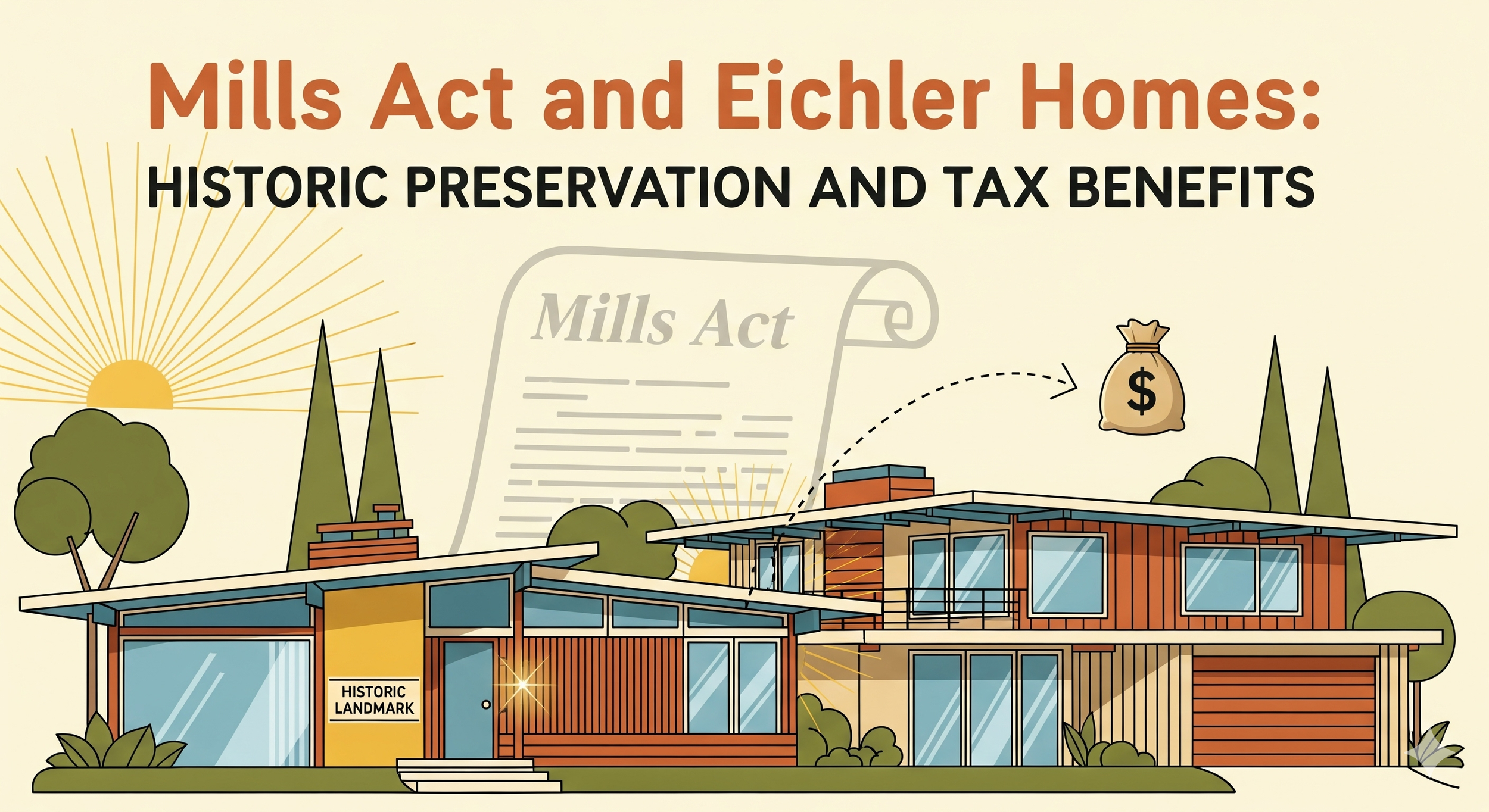
Mills Act and Eichler Homes: Historic Preservation and Tax Benefits
California’s Mills Act (enacted 1972) is a powerful preservation incentive: it empowers local governments to contract with private owners of historic properties to greatly reduce property taxes in exchange for repairing and maintaining those homesohp.parks.ca.gov. In fact, the California Office of Historic Preservation calls the Mills Act “the single most important economic incentive program in California for the restoration and preservation of qualified historic buildings by private property owners”ohp.parks.ca.gov. Under the Act, a homeowner with a qualified historic house (see below) can sign a 10-year initial contract (automatically renewed each year) in which they pledge to restore and protect the home. In return, the county assessor will value the property by an income-based formula (treating it like rental income rather than market sale value), which usually yields substantially lower tax assessmentsohp.parks.ca.gov.
Owners enter a formal Mills Act contract with the city or county, agreeing to “restore, maintain, and protect” the property according to specific preservation standardsohp.parks.ca.gov. Each contract includes a detailed scope of work (e.g. roof repairs, repainting, landscape work, etc.) and a timeline for those projectseichlernetwork.com. City officials periodically inspect the property, and failure to uphold the contract can trigger penalties or even cancellation of the tax breakohp.parks.ca.gov. Importantly, the contract stays with the house: if you sell your Eichler, the new owner inherits the same obligations (and benefits)ohp.parks.ca.gov. Local governments negotiate the exact terms, but the result is clear: owners save thousands of dollars each year while keeping their homes’ historic character intact.
How the Mills Act Works
Local participation: Not all cities/counties have Mills Act programs. Owners must first verify that their jurisdiction offers it (the California OHP maintains a list)ohp.parks.ca.gov. If not, homeowners can lobby their planning departments to adopt a Mills Act ordinance for the communityohp.parks.ca.gov. Each participating city can set rules (such as annual caps on new contracts, though some cities waive them – see Orange beloweichlernetwork.com).
Contract terms: A Mills Act contract is typically for 10 years initially, then auto-renews each yearohp.parks.ca.gov. During the contract, owners must regularly rehabilitate and maintain the home. For example, Orange’s historic districts require a formal rehabilitation plan: “each [Mills Act] contract has a scope of work attached…that calls for specific projects on a timeline”eichlernetwork.com. Owners agree to invest the amount of their tax savings back into the house’s preservationeichlernetwork.com. In practice, anything that needs repair – like the roof, paint, foundation – is covered in this plan.
Tax calculation: Crucially, properties under Mills Act contracts are assessed via the Income Approach rather than market valueohp.parks.ca.gov. In other words, the assessor estimates how much rent the home could fetch and divides by a capitalization rate. Because Eichlers (and most single-family homes) produce modest “rental” values, this method typically yields an assessed value far below market price. Homeowners often see their tax bills slashed by roughly 40–60% compared to normal assessmentsohp.parks.ca.gov. (Precise savings vary by county and original home value.)
Obligations: In return for the tax break, homeowners must preserve the home’s historic features. Mills Act contracts generally require keeping the facade and character-defining elements intacteichlerhomesforsale.com. Any alterations usually need approval from the city’s historic preservation review. As Eichler Network columnist Adriene Biondo notes, owners on Mills Act must “maintain things like the facade, not demolish the home, and generally keep the mid-century spirit” of their Eichlereichlerhomesforsale.com.
Eichler Homes as Historic Resources
Figure: A restored mid-century modern Eichler home in Los Angeles’s Balboa Highlands (owned by David Edminster). This glass-walled Eichler, like many in that tract, is covered by a local historic overlay. Its owner reports that the Mills Act tax break on his home “has been a windfall for us”eichlernetwork.com – in effect, the saved taxes fund ongoing maintenance and upgrades.
Legally, a “qualified historical property” under the Mills Act is one that is not tax-exempt and is either: (a) listed on the National Register of Historic Places (or in a registered historic district), or (b) listed in any state, county or city official historic registerohp.parks.ca.gov. In practice this means an Eichler can qualify if it or its neighborhood has formal historic status.
Several Eichler neighborhoods in California already fit the bill. For example, Palo Alto’s Green Gables and Greenmeadow tracts were added to the National Register in 2005eichlernetwork.com. Likewise, the Fairglen Eichler tract in San Jose (218 homes) was added in 2019eichlernetwork.com. Every home in those registered districts meets the Mills Act definition of “qualified.” In Southern California, all 339 Eichlers in Orange’s Fairhaven, Fairhills and Fairmeadow tracts were declared local historic districts (2018)eichlernetwork.com, and Los Angeles’s Balboa Highlands Eichlers have been in a Historic Preservation Overlay since 2010eichlernetwork.com. (By contrast, note that National Register listing alone is mostly honorary and imposes no local restrictionseichlernetwork.com – but it does make a property Mills-Act-eligible. Local designation often brings enforceable design guidelines as welleichlernetwork.com.)
In short, many Eichler homes can meet the eligibility criteria once their neighborhood or the house itself is officially recognized. As one Eichler blog explains, even if your Eichler is merely in an honorary national district (like Greenmeadow), “owners can opt into incentives like the Mills Act for property tax reductions in exchange for preserving the home”eichlerhomesforsale.com. In practice, that means an owner whose Eichler retains its original integrity might seek city landmark status and then a Mills Act contract, as preservation-minded Californians have done in both Orange and L.A. districts.
Mills Act in Action: Eichler Case Studies
Orange County Eichlers (SoCal): In 2019 the city of Orange (with 339 Eichlers) created local historic districts and preservation standards for its Eichler neighborhoods. The city’s historic planner reports 26 applications from Eichler homeowners for Mills Act contracts, “all [of which] were approved by the City Council” and went into effect the next tax yeareichlernetwork.com. Marissa Moshier notes significant homeowner interest: “We received 26 applications over two cycles… all were approved”eichlernetwork.com. Those contracts immediately cut property taxes – in many cases by roughly half. In fact, EichlerHomesForSale reports that dozens of Orange Eichler owners have achieved “significant property tax reductions under a state law called the Mills Act,” often saving “up to 50% or more” on their tax billseichlerhomesforsale.com. (The exact savings depend on each home’s situation – newer buyers with higher assessed value see more absolute savings than very long-time owners under Prop 13, for exampleeichlernetwork.com.) In exchange, owners commit to preserve their homes’ exteriors. As Moshier explains, every Mills Act contract in Orange has a required rehabilitation plan, and owners must invest their tax benefits back into those planned improvementseichlernetwork.com. To date there have been no complaints: Orange planners report that Eichler homeowners have been able to upgrade and remodel in ways that “look nice” without violating the guidelinese. One local said the design standards “haven’t stopped people from upgrading the homes” – as long as permitted projects follow the standards (especially for street-facing changes)eichlernetwork.com.
Los Angeles (Balboa Highlands): As noted above, Los Angeles established the Balboa Highlands Eichler tract as a Historic Preservation Overlay in 2010. Owners there are eligible for Mills Act relief. One example is David Edminster’s Eichler (above) in Granada Hills. Edminster reports that the Mills Act property tax break has been “a windfall for us,” easily covering upcoming maintenance (he plans a new paint job and roof re-coating)eichlernetwork.com. Eichler Network notes that other owners in Balboa Highlands are “in line to qualify” for the program as welleichlernetwork.com. (A preservation-minded real-estate columnist, Adriene Biondo, has highlighted Balboa Highlands as a working case of Eichler Mills Act useeichlernetwork.come.)
San Jose (Fairglen and Others): Fairglen Eichlers (1950s) became a National Register district in 2019, and residents adopted enforceable design/landscape guidelines to preserve their charactereichlernetwork.com. The Fairglen community explicitly notes that with this listing, owners “may apply for the Mills Act to get significant property tax savings in exchange for maintaining their Eichler home”eichlerhomesforsale.com. San Jose is even drafting Eichler-specific Objective Design Standards for its historic districts, which will clarify what renovations are allowedeichlerhomesforsale.com. While Mills Act signups in San Jose’s Eichlers are just beginning, the framework is in place. (Other San Jose Eichler tracts – Morepark, Hudgins, original Fairglen, Fairhaven – are also under study for future recognitioneichlerhomesforsale.com.)
Palo Alto (Green Gables & Greenmeadow): Palo Alto’s Green Gables and Greenmeadow neighborhoods were listed on the National Register in 2005eichlernetwork.com. These are two of the oldest and most intact Eichler tracts in the world. Importantly, the NR listing itself does not impose local review or guarantee Mills Act benefitseichlerhomesforsale.com – it is largely honorary. However, local planners have strong preservation policies (Single-Story Overlays and design guidelines)eichlerhomesforsale.com. Technically, a homeowner in Greenmeadow could seek a local landmark designation for their individual house and then pursue a Mills Act contracteichlerhomesforsale.com. (This step has been rare in Silicon Valley, since most owners trust the general protection of guidelines and SSOs. Still, a standout model home might justify it.)
These examples show that the Mills Act is not limited to Victorian or Craftsman houses – modern Eichlers are already participating. Wherever an Eichler community can document its historic significance (through local register or NR listing), owners can use the Mills Act as a funding mechanism to preserve that mid-century design.
Benefits for Eichler Homeowners
Eichler owners who enroll in the Mills Act program can reap impressive financial rewards while contributing to preservation:
Big Tax Savings. Under the Mills Act, assessed value is reset by an income approach, so taxes often drop by roughly 40–60%. In documented cases, Eichler owners report their property taxes have been slashed in half. For example, Orange residents saved “up to 50% or more” of their prior tax billseichlerhomesforsale.com. A longtime Orange broker emphasized that “the value of having [a Mills Act contract] is substantial”eichlernetwork.com. Typically, owners who have recently bought or upgraded a home (thus triggering a higher assessment) see the largest dollar savings.
Financing Improvements. A key benefit is that the tax break essentially finances your rehab work. Since Mills Act rules require reinvesting savings into the propertyeichlernetwork.com, owners often use the break to fund repairs anyway needed. David Edminster notes that the cost of repainting and reroofing his Eichler would exceed his annual tax discounteichlernetwork.com – meaning the program is paying for his maintenance. In this way, the amount you save on taxes is roughly equal to the work you agreed to do, making major repairs much more affordable.
Boosted Value and Appeal. A Mills Act contract is a transferable asset. Future buyers of a Mills-Act house automatically gain the lower taxes (and incur the preservation obligations). As a result, a house with a Mills contract can be more attractive to buyers interested in historic homes. In Orange, supporters noted that offering tax incentives helps stabilize values in the Eichler tractseichlernetwork.com. Anecdotally, Eichler marketers say some buyers consider historic status and tax breaks as selling points.
Preservation Legacy. Beyond dollars, Mills Act participation signals a commitment to stewardship. Homeowners often report a sense of pride in protecting their Eichler’s design. (Even without a contract, many Eichler enthusiasts restore original elements by choice.) But with the Mills Act’s support, preserving Eichler charm is more financially viable. In the long term, this can raise the profile of Eichler neighborhoods as coveted, well-maintained enclaves.
Responsibilities and Restrictions
The Mills Act’s benefits come with clear responsibilities for owners. Each Mills Act property is bound by a contract with the local government:
Historic Preservation Standards: Owners must preserve the home’s historic and architectural character. The contract typically lists specific “character-defining” features to protect (e.g. rooflines, siding, atrium, original windows). Major exterior alterations are restricted. For instance, the City of Orange mandates that owners maintain the mid-century facade and only make changes consistent with Eichler designeichlerhomesforsale.com. One Orange homebuyer noted that under the new rules, “the only restrictions…have to do with the front of your house, and what you see from the street”eichlernetwork.com – in other words, curb appeal must remain true to the original.
Investing in the Home: Mills Act law explicitly requires that property owners spend their tax savings on the property’s maintenance and restorationeichlernetwork.com. Local staff verify this by checking receipts or progress on the agreed scope of work. In practice, cities include in the contract a scope-of-work document. As Orange’s planner explains: each contract carries a rehabilitation plan and timeline for specific projectseichlernetwork.com. Owners must complete those projects (for example, reroofing, seismic retrofitting, painting).
Term and Inspections: A Mills Act contract runs at least 10 years and then renews each year indefinitelyohp.parks.ca.gov. The property is inspected periodically to ensure complianceohp.parks.ca.gov. If an owner fails to honor the contract (for instance, by neglecting maintenance or making forbidden changes), the city can impose fines or void the contract, reversing the tax benefitsohp.parks.ca.gov.
Transferable Obligations: The contract is tied to the property, not the person. As soon as you sign, any future buyer of your Eichler will take on the remaining term and its conditionsohp.parks.ca.gov. This means sellers should disclose the Mills Act status, but it also means buyers get the reduced taxes immediately.
Local Limits: Some jurisdictions cap the number of Mills Act contracts. For example, Orange previously limited new contracts per year, but officials removed that limit when the Eichler districts were createdeichlernetwork.com. If a city still has a cap or does not participate at all, new applicants may have to wait or petition the council. (California law encourages communities to adopt the program – homeowners can request a Mills Act program even if their city hasn’t had oneohp.parks.ca.gov.)
In summary, Mills Act homeowners get a rare bargain, but they must keep their Eichler largely original and well-maintained for the long haul. Thankfully, Eichler design is durable and functional; the needed work (e.g. HVAC, roofing, window upgrades) tends to preserve or enhance, not erase, the home’s character.
Preservation vs. Renovation
A common question is what renovations are allowed on a Mills Act Eichler. The guiding principle is that improvements must be compatible with the historic design. In practice:
Permitted Upgrades: Owners are generally free to upgrade interiors and mechanical systems. You can modernize a kitchen or bath, install insulation, replace old concrete slabs, add AC units, or put in solar panels – so long as these changes don’t alter the visible modernist form. For example, Edminster’s plan to repaint his home and re-coat the roof was fully approved under his Mills Act contracteichlernetwork.com. Window replacements are allowed if they match Eichler style (narrow frames, large panes). In Orange and other cities, staff have observed that homeowners continue to “do work on their houses, and it looks nice…[guidelines] haven’t stopped people from upgrading the homes and making repairs”eichlernetwork.com.
Design Guidelines: In designated Eichler districts, cities often adopt specific design guidelines. These guidelines spell out allowed materials and styles. A common rule is no second story visible from the front (i.e. maintain the single-story profile). Stucco, heavy tile roofs, or ornate trim are usually prohibited as non-Eichler featureseichlerhomesforsale.com. Orange’s Eichler design standards, for instance, emphasize preserving the low-slung, glassy aesthetic. When homeowners submit plans (like for an addition or new siding), city preservation staff review them against these guidelines. In Orange, staff report that no major conflict has arisen yet: proposed projects have been “good collaborations” to implement the standardseichlernetwork.com.
Street-Facing Changes: As noted, restrictions focus on the street-visible facade. Because Eichlers have their most iconic features (clerestory windows, flat roof, atrium view) facing the street, these must be preserved. Side and rear modifications are more flexible. For example, an atrium in the front center is rarely enclosed, but an owner might add a discreet rear addition or interior upgrades. (One Palo Alto renovation – not under Mills Act but illustrative – added a small rear wing and mirrored the original roofline so the front view was unchanged.)
Examples of Allowable Work: Typical approved Mills Act work on Eichlers includes roof replacements (in kind), repainting in original colors, replacing deck patios or walkways, fixing or upgrading radiant heating, seismic retrofits, and updating electrical systems. Essentially any repair or improvement that restores or maintains the house’s original look.
In short, the Mills Act encourages “respectful renovation.” It doesn’t lock your Eichler in amber – it just ensures that any changes honor its mid-century design. The goal is to prevent insensitive alterations (e.g. a faux-Victorian facade or a giant second story) while allowing modern living standards. As one Orange homeowner put it, the rules “certainly haven’t stopped people from upgrading” – they simply steer projects to keep the historic lookeichlernetwork.com.
Advocating for Mid-Century Preservation
For Eichler homeowners interested in the Mills Act, advocacy and community action are key. Historic designation (and thus Mills Act eligibility) often comes from grassroots efforts:
Form a Group: Organize with neighbors. The most successful programs have involved neighborhood associations. In San Jose, Fairglen’s preservation effort was led by residents who held meetings and worked with city planners to create design guidelineseichlernetwork.com. Similarly, Orange’s move to historic status was driven by local advocates (including real estate professionals and architects) working with the cityeichlernetwork.com.
Gather Documentation: Prepare a nomination packet showing the Eichler tract’s history and architectural significance. The National Park Service and State OHP require evidence that the buildings are “well-tended” and largely unalteredeichlernetwork.com. Often that includes photos, original plans, and narratives about the architect (Joseph Eichler, A. Quincy Jones, etc.) and the community.
Engage Officials: Meet with the city’s planning or historic preservation department early. In some cases (like Orange), the city may take the lead on district designation. In others, residents can apply for Historic Resource Inventory listings or local landmark status for individual houses. If your city has a Historic Resources Commission, present to them how Eichlers fit the definition. Many local plans (for example, San Jose’s General Plan) now explicitly encourage preserving Eichlerseichlernetwork.com. Remind officials that Eichler tracts contribute to the region’s heritage.
Use Available Resources: Organizations like the Eichler Network and Docomomo US (modernism preservation) offer guidance and publicity. The Boyenga Team (via the EichlerHomesForSale blog) has published multiple articles on Eichler preservation and Mills Act eligibilityeichlerhomesforsale.com. These can inform homeowners about strategy and connect them to historic consultants. The California OHP also maintains a Mills Act contacts list by jurisdictionohp.parks.ca.gov, so you can find the right person in your city to talk to.
Leverage Financial Incentives: Emphasize to neighbors and officials that Mills Act is a win-win: it funds home improvements, saves owners money, and preserves community character. In Orange, proponents pointed out that Mills Act contracts bring reinvestment into the city and can even boost property valueseichlernetwork.comohp.parks.ca.gov. Cite successes: Kelly Laule, a broker in Orange, notes that passing Mills Act relief is part of “boosting property values” in Eichler tractseichlernetwork.com. Show that Eichler preservation has public support: dozens of owners in Orange requested contracts within a yeareichlernetwork.com.
In summary, Eichler owners have powerful tools at their disposal. By documenting their homes’ historic value and working with local governments, they can qualify for the Mills Act and enjoy significant tax relief. Advocates in Silicon Valley can draw on the examples of Orange, Los Angeles, Palo Alto, and San Jose – not to mention communities elsewhere (e.g. Sacramento’s South Land Park Hills Eichlers) – to make the case. As the Eichler community likes to say: preserving the past pays dividends for the future. With the Mills Act, Eichler homeowners can literally save for the future while saving the pasteichlernetwork.com.
