
Palo Alto Unified School District & Real Estate: A Comprehensive Guide
Palo Alto Unified School District (PAUSD) is renowned as one of the top public school systems in the nation, making Palo Alto real estate highly sought-after by families. In this in-depth guide, we explore the best Palo Alto neighborhoods for schools, the district’s strengths and challenges, community demographics, and housing market trends. We also highlight why the Boyenga Team at Compass – Silicon Valley’s Eichler home experts – is the premier resource for Palo Alto real estate.
PAUSD at a Glance – Top-Ranked Schools and Stellar Outcomes
PAUSD consistently ranks at the pinnacle of California and U.S. school districts. In 2024, Niche rated PAUSD the #1 Best School District in California, and even #1 in America among districts with over 8,000 studentspausd.org. The district serves over 10,300 students across 18 public schools (12 elementary, 3 middle, 2 high schools, plus an alternative high school)pausd.orgen.wikipedia.org. Academic outcomes are exceptional: 96.3% of PAUSD students graduate high schoolpausd.org, and its graduates matriculate to top universities. Class sizes are moderate (about a 17:1 student-teacher ratio on average)en.wikipedia.org, and the district employs highly qualified staff, including 47 National Board Certified Teacherspausd.org. Every student has access to comprehensive programs in the arts, music, and librariespausd.org, reflecting a well-rounded curriculum.
High School Excellence: PAUSD’s two flagship high schools – Henry M. Gunn High School and Palo Alto High School (Paly) – are nationally recognized. Gunn is an academically focused campus, ranked #180 in the U.S. by U.S. News & World Report (2023-24) and #3 in California by Nicheen.wikipedia.org. Paly is similarly esteemed, ranked #239 nationally by U.S. News and #7 in California (Niche)en.wikipedia.org. Both high schools boast extensive Advanced Placement and extracurricular offerings, modern facilities, and strong college matriculation records. The slight differences in school culture are noted by locals – “Paly has a reputation for being more laid-back academically/‘fun’ than Gunn, and Gunn ranks slightly higher on test scores,” as one resident observedreddit.com – but both schools deliver superior education and even enjoy a healthy crosstown rivalry in academics and athletics.
To summarize the district’s prestige, here is a snapshot of key rankings for PAUSD and its high schools:
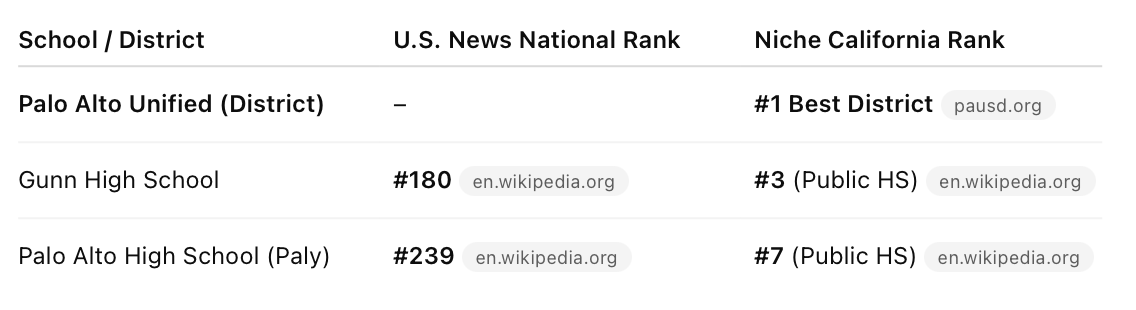
(Table: PAUSD’s top rankings highlight its academic excellence. Gunn and Paly are among California’s highest-rated public high schools.)
Best Palo Alto Neighborhoods for Top Schools
One of the most common questions for families moving to Palo Alto is “Which neighborhood has the best schools?” The short answer is that you can’t go wrong anywhere in Palo Alto – all PAUSD schools are excellent. Every elementary school in the district is high-performing, and they feed into the same outstanding middle and high schools. As a local parent quipped, “All of the elementary schools are excellent – you really can’t go wrong. There are not any bad districts in PAUSD.”reddit.com In other words, every Palo Alto neighborhood offers access to a great education.
That said, specific neighborhoods correspond to certain school attendance areas, and families may have preferences. Palo Alto is roughly divided into north (feeding into Palo Alto High) and south (feeding into Gunn High) by the Oregon Expressway/Embarcadero Road corridor. Both high schools are elite; choosing between them often comes down to personal fit rather than quality. For elementary schools, neighborhood nuances include school size, pedagogy, and community vibe. Here are a few sought-after areas and their schools:
Old Palo Alto / Professorville / Crescent Park (North Palo Alto): These prestigious neighborhoods are zoned to Walter Hays or Addison Elementary (both top-rated), Greene Middle School, and Palo Alto High. The areas feature tree-lined streets and historic homes, and benefit from close proximity to Stanford University and downtown. Addison and Walter Hays elementaries each boast strong parent involvement and enrichment programs; homes here are among Palo Alto’s most expensive (often $4–$7 million+). Families in north Palo Alto appreciate the slightly more “laid-back” culture at Paly High, known for strong arts and humanities programs alongside academicsreddit.com.
Duveneck/St. Francis & Green Gables (North Palo Alto): Centered around Duveneck Elementary, this area (sometimes called Green Gables) is prized for its mid-century Eichler homes and excellent schools. Duveneck Elementary consistently earns a 10/10 rating and feeds into Greene Middle and Paly High. The Green GablesEichler tract is even listed as a historic district for its mid-century architecturekqed.org. Homes here range from original Eichlers to modern rebuilds (roughly $3–5 million). The tight-knit community and nearby parks make it a family favorite.
Midtown & South Palo Alto: Neighborhoods like Midtown, Charleston Meadow, Greenmeadow, Palo Verde,and Fairmeadow are in south Palo Alto, feeding into J.L. Stanford (JLS) Middle School or Ellen Fletcher Middle School, and on to Gunn High School. Elementary schools in this area (such as Palo Verde, Fairmeadow, Briones, El Carmelo) all hold high ratings (often 9 or 10 on GreatSchools)greatschools.org. South Palo Alto is known for its many Eichler subdivisions and community facilities. Notably, Greenmeadow (near Charleston Road) is another historic Eichler neighborhood with a community pool and park. Families here value the strong STEM orientation at Gunn High (which ranks among the top 3 public high schools in CAen.wikipedia.org). Homes in south Palo Alto, while still expensive, tend to be slightly more affordable than north – many are in the $2.5–$4 million range for a typical 3-4 bedroom house, depending on size and condition.
Barron Park & Ventura (Southwest Palo Alto): The Barron Park neighborhood has a more relaxed, almost semi-rural feel (some streets without sidewalks) and its own small elementary (Barron Park Elementary). It feeds into Fletcher Middle and Gunn High. Ventura, nearer California Ave, is an up-and-coming area with a mix of older cottages and new townhomes (zoned for Escondido Elem. and Greene or JLS Middle, depending on exact location). These areas still enjoy PAUSD’s advantages but have historically been a bit more modest in price, making them entry points for Palo Alto (with some single-family homes in the lower $2 millions – relatively “affordable” by Palo Alto standards).
Overall, Palo Alto’s school quality is uniformly high. Many families base their neighborhood choice on commute preferences, housing style, or community feel rather than on school differences. Wherever you live in the city, your children will attend schools that are among the best in California, with rigorous academics, ample resources, and a pathway to top colleges. This citywide excellence is a huge driver of local real estate demand.
Academic Excellence and District Positives
What makes PAUSD so special? The district offers a combination of academic rigor, enriched programs, and community support rarely found elsewhere. Below are some of the key positives and strengths of Palo Alto’s schools:
🏆 Elite Academic Reputation: PAUSD’s top rankings speak for themselves – #1 in California and #1 nationally (large districts) per Nichepausd.org. Test scores and college admission rates are well above state and national averages. Both Gunn and Paly High are regularly recognized among the nation’s best public high schools, with dozens of National Merit Scholars each year. High expectations are the norm, and students rise to meet them.
👩🏫 Quality of Teaching and Resources: The district attracts excellent educators. It was ranked #3 of 674 for Districts with the Best Teachers in Californianiche.com. Teachers are well-supported by a community that values education – local parcel taxes and PTA fundraising contribute significant supplemental funding. Classrooms are equipped with modern technology, and specialized staff (counselors, librarians, etc.) are readily available. The student–teacher ratio around 17:1 allows for personal attentionen.wikipedia.org.
🎓 Holistic Student Success: PAUSD emphasizes educating the “whole child.” In addition to core academics, there are robust arts and music programs (100% of students have access to art, music, and library programspausd.org), a wide range of AP and honors courses, and extracurriculars spanning robotics to debate to athletics. The graduation rate is over 96%pausd.org, and a large proportion of graduates attend four-year universities. Many students also benefit from programs linked with nearby Stanford University (e.g. academic enrichment, events, internships).
🤝 Engaged Community & Culture of Excellence: Palo Alto’s parent community is highly educated (many Stanford faculty, tech entrepreneurs, professionals) and deeply involved in the schools. This creates a culture of support – from volunteering in classrooms to fundraising through groups like PiE (Partners in Education). The expectation that education matters is imbued in students from an early age. As one local described, Palo Alto schools benefit from “strong feeder patterns from Stanford-affiliated families [which] enhance appeal”eichlerhomesforsale.com. There is also a commitment to continual improvement; the district is fiscally strong (AAA bond ratingspausd.orgpausd.org) and invests in facility upgrades and innovative programs.
🗺️ Safe, Well-Rounded Environment: Palo Alto is a safe suburban community, and the schools reflect that. Campuses are well-maintained and secure. Student life includes not just academics but also athletics (both Gunn and Paly have won state championships in various sportsen.wikipedia.org), performing arts (Paly’s theater program is excellent), and civic engagement. A focus on wellness has grown in recent years (e.g. hiring more counselors and launching mental health initiatives) to ensure students are supported emotionally in a high-achieving environment.
In short, PAUSD provides an environment where motivated students can thrive. It’s no surprise that families from around the world move to Palo Alto to give their children a chance to attend these schools. This demand keeps local home prices resiliently high, as discussed later in this guide.
Challenges and Considerations – The Flip Side of an Elite District
While Palo Alto’s schools are undeniably excellent, it’s important to acknowledge some challenges and potential downsides that come with this territory. Families and homebuyers should consider these factors:
🔥 High-Pressure Academic Culture: The same drive for excellence that makes PAUSD great can also create a competitive, high-stress atmosphere. From an early age, many students feel pressure to excel. As one parent noted, “some of the parents are pretty intense – a good portion of my daughter’s kindergarten class... was taking after-school tutoring… it really feels a bit dystopian in terms of ‘letting kids be kids.’”reddit.com By high school, competition for top grades and college admissions can be fierce. There have been well-documented concerns about student mental health; tragically, Palo Alto experienced a cluster of teen suicides in past years, drawing national attention and even a CDC investigationreddit.com. The district responded with increased counseling and stress-management programs, but academic pressure remains a concern. Prospective families should be mindful of their child’s temperament and resilience in such an environment.
💸 Cost of Living and Limited Diversity: Palo Alto’s sky-high housing costs mean that only affluent families can buy into the district. The median household income is about $194,000eichlerhomesforsale.com, and even that pales in comparison to home prices (discussed below). This can result in less socioeconomic diversity among the student body. While the community is ethnically diverse (with significant Asian and international populations), there is an opportunity cost: students are largely surrounded by high-achieving, high-income peers. Some families may feel the environment is an “academic bubble” not reflective of the broader world. Additionally, not everyone can afford the extensive extracurriculars or tutoring that many Palo Alto parents provide their kids, which can create social pressures.
🏫 Intense Parental Competition: Along with engaged parents comes a degree of “hyper-parenting.” There can be competition not just among students but among parents (over test scores, college admissions, etc.). This intensity can spill into community debates around school policies, academic tracking, or things like excessive homework. The district has grappled with finding balance – e.g., implementing later start times, homework caps, and wellness centers – but it’s a work in progress. Families who prefer a more low-key public school experience might find Palo Alto’s laser-focus on achievement to be overwhelming.
🏘️ Housing Affordability & Enrollment: Because PAUSD is so desirable, housing in Palo Alto is extremely expensive. This creates a barrier to entry – essentially, only those who can purchase or rent in the city can access the public schools. The high cost can put financial strain on young families who stretch to move in. Moreover, enrollment fluctuates with housing trends; during boom periods, some schools have faced crowding. (PAUSD previously closed some schools in the 1980s when enrollment dipped, then re-opened or added schools as population grewen.wikipedia.org.) Currently, enrollment is stable, but if more families move in, there could be pressure on class sizes or the need to redraw boundaries. The district’s excellent reputation is tightly interwoven with real estate, which is a double-edged sword.
It’s telling that some families “opt out” despite the district’s reputation. As a local forum commenter observed, “This is why you hear of many opting out of PAUSD. The after-school tutoring and pressure… [If] you want a highly competitive school then PAUSD is it. Otherwise you might want to look elsewhere.”reddit.com. Of course, many more families opt in and thrive here, but it’s wise to approach Palo Alto with eyes open to the intensity that comes with its excellence.
Palo Alto Demographics and Community Profile
The context of Palo Alto’s schools cannot be separated from the community itself. Palo Alto, located in the heart of Silicon Valley, is a city of ~68,000 residents with a world-class socioeconomic profile. The median household income is roughly $180,000-$200,000eichlerhomesforsale.com, reflecting the many tech professionals, entrepreneurs, and Stanford University affiliates who call the city home. Palo Alto is one of the most highly educated cities in America – a large majority of adult residents hold bachelor’s or advanced degrees. This translates to a community that strongly values education, innovation, and quality of life.
Diversity: Palo Alto’s population is a mix of ethnic backgrounds and nationalities, thanks in part to Stanford and the tech industry drawing talent globally. The city is about 47% White, 37% Asian, 6% Hispanic/Latino, and 2% African American (with the remainder being multiracial or other groups, per recent census estimates). In PAUSD schools, Asian and Caucasian students each make up a significant portion; for example, one middle school’s enrollment was ~40% Caucasian, ~30% Asian, ~14% Hispanicen.wikipedia.org, and other schools show similar profiles. This cultural diversity brings a richness to the classroom – students may have peers from families recently arrived from China, India, Europe, or various parts of the U.S. There is also a notable international presence due to Stanford (children of visiting professors or tech executives). Cultural competence and inclusivity are emphasized in the schools.
Despite the diverse backgrounds, one commonality is that Palo Alto’s families tend to have high expectations and resources for their children. Outside of school, many kids attend enrichment classes, music lessons, or coding camps. Weekends might involve sports leagues or science fairs. The community also values civic engagement and volunteering – high schoolers often have significant community service experience, and parents serve on school boards or education foundations.
Community Character: Palo Alto manages to feel like a college town, an affluent suburb, and a tech hub all at once. Neighborhoods are generally quiet, green, and safe, with numerous parks and libraries. The city has vibrant commercial areas (University Avenue downtown, California Avenue, Stanford Shopping Center) yet retains a residential charm with its historic homes and tree-lined streets (indeed, “Palo Alto” means tall tree). Crime rates are low, and kids often bike or walk to school. The presence of Stanford University adds an intellectual buzz – lectures, museums, and campus events are open to the community. All these factors contribute to a stimulating environment for children to grow up in.
From a real estate perspective, Palo Alto’s demographics mean a stable demand for housing. Buyers are often dual-income tech or professional families or international buyers seeking access to Silicon Valley and PAUSD. The city’s entrenched affluence and limited land supply result in intense competition for homeseichlerhomesforsale.com. As we will see, home prices here rank among the highest in the nation, but buyers justify the cost with the superb schools and quality of life.
Palo Alto Home Prices & Housing Market Trends
Palo Alto’s real estate is legendary for its high prices, driven in large part by the desirability of PAUSD and proximity to Silicon Valley jobs. The market here can be summarized in two words: expensive and competitive. Let’s delve into some data and trends:
Median Home Price: As of mid-2025, the median sale price for a home in Palo Alto is around $3.8 millionredfin.comalmanacnews.com. This is up about 6% from the prior year, indicating robust appreciation. In fact, Palo Alto home values surged ~18% year-over-year by mid-2025redfin.com, rebounding strongly after a brief cooling in late 2022–2023. By comparison, the U.S. median home price is around $430,000 – Palo Alto’s median is nearly 9 times higher. Even within the Bay Area, Palo Alto stands out; for example, neighboring Sunnyvale’s median is about $2.0Meichlerhomesforsale.com, and the only city pricier than Palo Alto on the Peninsula is Los Altos (which hit a $5.7M median in early 2025)reddit.com.
Price Ranges by Neighborhood: Home prices vary across Palo Alto’s neighborhoods, though nearly all areas are in the seven figures. Generally, North Palo Alto (zip 94301 and 94303 portions) is the most expensive due to larger lots and historic cachet, whereas South Palo Alto (94306) has slightly more modest post-war homes and Eichlers. According to first-half 2025 sales data, Crescent Park was the priciest neighborhood with a median of $5.93 million, followed by Old Palo Alto at $5.6 millionalmanacnews.com. These northern enclaves are characterized by luxury estates and have limited inventory. By contrast, areas like Midtown or South Palo Alto see many sales in the $3 million range, especially for original Eichler-style homes or smaller ranch houses. Even the “entry-level” Ventura or Barron Park neighborhoods often fetch $2.5–3M for a fixer-upper on a standard lot. The table below highlights median prices in a few Palo Alto areas:
Area (2025)Median Sale PriceCity of Palo Alto (overall)$3.8 millionalmanacnews.comCrescent Park$5.93 millionalmanacnews.comOld Palo Alto$5.6 millionalmanacnews.comPalo Alto Hills (Estate area)$4.49 millionalmanacnews.comMidtown / South Palo Alto~$3.0–3.5 million (typical range)*
*(Median for Midtown/South PA aggregated was not explicitly reported, but citywide data indicates roughly mid-$3M. These areas constitute the bulk of sales, with South Palo Alto alone accounting for 44 of 212 sales in H1 2025almanacnews.com.)
Market Competitiveness: Despite the stratospheric prices, homes sell quickly and often above asking. The Palo Alto market is rated “somewhat competitive” with most listings receiving multiple offers and the average home selling about 4% over list priceredfin.com. In hot sub-markets, bidding wars can drive sale prices 10-20% over asking. The average days on market is only around 2–3 weeksredfin.com, and well-priced homes can go pending in under 10 days. Even condos and townhomes (which have medians around $1.3–1.5M) often sell at or above list in a short time framechriseckert.uschriseckert.us. Inventory is limited – in mid-2025 there were only ~1.8 months of single-family home supply availablechriseckert.us, indicative of a seller’s market. This tight supply, combined with continual demand from new tech wealth and school-focused buyers, keeps upward pressure on prices.
* Figure: Palo Alto quarterly home price trends. This graph shows the median (green) and average (red) sale prices for single-family houses over time, illustrating the steady long-term appreciation and recent record highs in Palo Alto’s marketjulianalee.comjulianalee.com. Even minor dips (e.g. 2019 or 2020) were followed by strong gains, underscoring Palo Alto’s resilience.
Luxury Segment: Palo Alto has a significant luxury segment. Approximately 13 sales over $8 million closed in the first half of 2025, a 36% jump from the previous yearalmanacnews.com. Ultra-high-end properties (estates in Old Palo Alto, new modern homes in Crescent Park, or historic Professorville mansions) can command $8M, $10M, even $20M+. In early Q3 2025, the average sale price (which can be skewed by a few big sales) was a staggering $6.47 millionjulianalee.com, indicating how top sales pull the average above the median. Crescent Park and Old Palo Alto see many of these luxury deals – in fact, Old Palo Alto alone accounted for 6 of the 13 ultra-luxury ($8M+) sales in H1 2025almanacnews.com. Nevertheless, it’s notable that even the “cheapest” single-family home in Palo Alto still usually trades north of $2 million, illustrating that luxury is the baseline in this market.
Trends and Outlook: Palo Alto real estate has shown consistent appreciation. Over the past 5 years (2020–2025), the effective annual growth rate in median price was about 4.9%julianalee.com, and over 10 years it was ~3.3% annually, outpacing inflation. The run-up in prices during the pandemic tech boom (2020-2022) saw prices per square foot hit new highs (surpassing $2,000/sqft in 2023/24)julianalee.com. There was a brief cooldown in late 2022 as interest rates rose, but 2023-2024 saw a rebound – median house prices climbed from ~$2.9M in Dec 2023 to ~$3.4M by Dec 2024chriseckert.us, and have continued rising through 2025. Market activity in 2025 shows robust buyer interest, though volume of sales is slightly down (a 7% dip in transactions year-over-year) as some owners hold onto their homesalmanacnews.comalmanacnews.com. With Silicon Valley’s economy remaining strong and PAUSD sustaining its reputation, demand is expected to remain high. While macro-economic factors (like interest rates) can affect the market, Palo Alto’s limited supply and global demand (including buyers from China, India, Europe who target Palo Alto for education) create a long-term floor under prices.
For homebuyers, this means Palo Alto is both a coveted investment and a challenging market. Working with an experienced local real estate team is essential to navigate the competition and identify the right opportunities – especially if you have specific needs like proximity to a certain school or a preference for an Eichler home, as we discuss next.
Eichler Homes and Mid-Century Modern Charm in Palo Alto
One distinctive aspect of Palo Alto real estate is its abundance of Eichler homes – the mid-century modern houses built by Joseph Eichler in the 1950s and 60s. In fact, Palo Alto has more Eichler homes than any city in America – over 2,700 Eichler houses were originally built herekqed.org, and roughly 2,200+ remain today after some were replaced over timeverdemagazine.com. These single-story homes are characterized by open floor plans, floor-to-ceiling glass, post-and-beam construction, and integration with nature (“indoor-outdoor living”). Eichlers are prized by architectural enthusiasts and young families alike for their modernist aesthetic and light-filled interiors. Two Palo Alto Eichler tracts – Green Gables (in north PA) and Greenmeadow (in south PA) – are even listed on the National Register of Historic Places for their exemplary mid-century design and community layoutkqed.org.
Eichler neighborhoods in Palo Alto include Green Gables, Greenmeadow, Fairmeadow, Charleston Meadow, Palo Verde, and parts of Barron Park, among otherseichlerforsale.com. Strolling through these areas, you’ll see distinctive low-pitch rooflines and carports, children playing on the cul-de-sacs Eichler favored, and often neighbors chatting in front yards – a scene intentionally fostered by the Eichler philosophy of community. Many Eichlers have been lovingly maintained or restored, while some have been expanded or remodeled (with care to preserve the style). Owning an Eichler in Palo Alto is a lifestyle choice as much as a real estate choice, offering a blend of design, history, and neighborhood camaraderie.
The Boyenga Team are recognized Eichler Home Experts in Palo Alto. With a specialized focus on mid-century modern properties, the Boyenga Team (led by Eric and Janelle Boyenga) has over two decades of experience helping clients buy and sell Eichlerseichlerhomesforsale.com. They understand the unique value and appeal of these homes – from identifying original features and quality Eichler-friendly renovations to knowing the specific Eichler tract histories. The Boyenga Team even offers “persistent and aggressive Eichler marketing and the best Mid-Century Modern web exposure in Silicon Valley”boyengateam.com, leveraging their niche expertise to connect with the passionate Eichler buyer community. Whether you’re looking for a pristine Eichler time-capsule in Green Gables or planning to modernize an Eichler in Fairmeadow, the Boyengas have the knowledge, contractor connections, and marketing savvy to maximize your Eichler ownership or sale experience.
Palo Alto’s Eichler presence adds to the city’s rich architectural tapestry – which also includes classic Craftsman bungalows in Professorville, Spanish Colonials in Old Palo Alto, and cutting-edge contemporary builds. Yet, Eichlers hold a special place in the market, often attracting multiple offers from devotees. Having expert representation is key, which is where the Boyenga Team’s reputation truly shines.
The Boyenga Team – Your Palo Alto Real Estate Experts
Eric and Janelle Boyenga, founders of the Boyenga Team at Compass, are widely recognized as the experts in Palo Alto and Silicon Valley real estate. With over 30 years of combined experience (the team was established in 1996) and a track record of 2,100+ homes sold totaling over $2.1 Billioneichlerhomesforsale.com, the Boyenga Team has earned their place as Compass’s #1 real estate team in Silicon Valleyeichlerhomesforsale.com. They are often referred to as “Property Nerds” for their data-driven approach and deep knowledge of local market trendseichlerhomesforsale.com.
What sets the Boyenga Team apart, especially in a competitive market like Palo Alto, is their unparalleled local expertise and client-first philosophy. They have offices in Palo Alto itself and neighboring communities, positioning them to serve clients wherever needed across the mid-Peninsulaeichlerhomesforsale.com. As Compass founding partners in Silicon Valley, Eric and Janelle have built a dynamic team of agents and support staff (a “dynamic group of 12” core team members, backed by specialists)eichlerhomesforsale.com who cover every facet – from pricing strategy and home prep to marketing and negotiation.
Eichler and Mid-Century Mastery: The Boyenga Team has carved out a niche as the Eichler Home Experts. They have been “guiding clients through the intricacies of Eichler home sales for over two decades”eichlerhomesforsale.com. This includes advising on restoration versus rebuild, understanding Eichler market premiums, and maintaining a network of mid-century modern enthusiasts. Their website EichlerHomesForSale.com and marketing materials specifically target this segment, giving Eichler sellers unparalleled exposure. “Boyenga Team offer persistent and aggressive Eichler marketing and the best Mid-Century Modern web exposure in Silicon Valley,” attests one description of their servicesboyengateam.com. For buyers, the team’s insight can mean early tip-offs on off-market Eichlers and guidance on how to competitively bid for these architectural gems.
Client Advocacy and Results: The Boyengas’ success stems from an ethos that “We always do what is best for our clients,” as Eric Boyenga puts iteichlerhomesforsale.com. They pride themselves on exceptional client care, taking time to educate buyers (especially those relocating or unfamiliar with Palo Alto’s nuances) and to meticulously prepare listings for sellers. Their listings often feature high-end staging, professional storytelling, and targeted outreach that results in top-dollar sales – indeed, “the Boyenga Team aggressively negotiates top-dollar for your Eichler home” in Palo Altoboyenga.com. This level of dedication has earned them accolades: Zillow has branded the Boyengas as “Next Generation” agentseichlerhomesforsale.com, and they are frequently quoted in media on Silicon Valley real estate trendseichlerhomesforsale.comeichlerhomesforsale.com.
Market Knowledge: In a fast-moving market (where knowing about a listing even 1 day sooner can make the difference), the Boyenga Team’s finger-on-the-pulse awareness is invaluable. They often know of upcoming listings through their extensive network, and they use proprietary data analysis to advise on pricing. Being the #1 Compass team in Silicon Valley means they handle a large volume of transactions – giving them insight into every micro-neighborhood in Palo Alto, from College Terrace near Stanford to Palo Alto Hills overlooking the valley. Their expertise spans not just Palo Alto but also Los Altos, Menlo Park, Mountain View and beyondeichlerhomesforsale.com – useful for clients comparing districts or considering multiple areas.
Conclusion & Call to Action
Palo Alto’s unified school district is the crown jewel of this community, and it goes hand-in-hand with a real estate market that is dynamic and demanding. For families prioritizing education, Palo Alto offers an unbeatable combination of top-tier public schools, a vibrant and intellectual community, and homes that, while costly, tend to hold their value and then some. We’ve explored how different neighborhoods each have their charms – whether it’s the legacy of mid-century Eichler homes in South Palo Alto or the grandeur of Old Palo Alto – and how the entire city benefits from PAUSD’s excellence and the economic engine of Silicon Valley.
If you’re considering making Palo Alto your home, having the right real estate partner is essential. This is where the Boyenga Team at Compass stands out. As local experts deeply versed in schools, neighborhoods, and market trends, Eric and Janelle Boyenga and their team can guide you to find the perfect home that fits your family’s needs – or, if you’re a seller, help you achieve the maximum value for your property. They are not just agents but trusted advisors who understand the nuances of Palo Alto real estate inside and out.
Ready to Explore Palo Alto? Contact the Boyenga Team.
The Boyenga Team is ready to assist you 24/7 with your Palo Alto area home buying or selling needs. Whether you’re drawn by the outstanding schools or the unique mid-century architecture, put Palo Alto’s #1 real estate team to work for you. With their proven “Property Nerd” expertise and client-first approach, Eric & Janelle Boyenga will ensure your real estate journey in Palo Alto is a successful and rewarding one. Get in touch with the Boyenga Team today to take the next step toward your Palo Alto dream home!