
1484 Kingfisher Way in the Fairwood Eichler Tract: A Strategy-Grade Deep Dive Into Design, Neighborhood Economics, and Next-Gen Representation
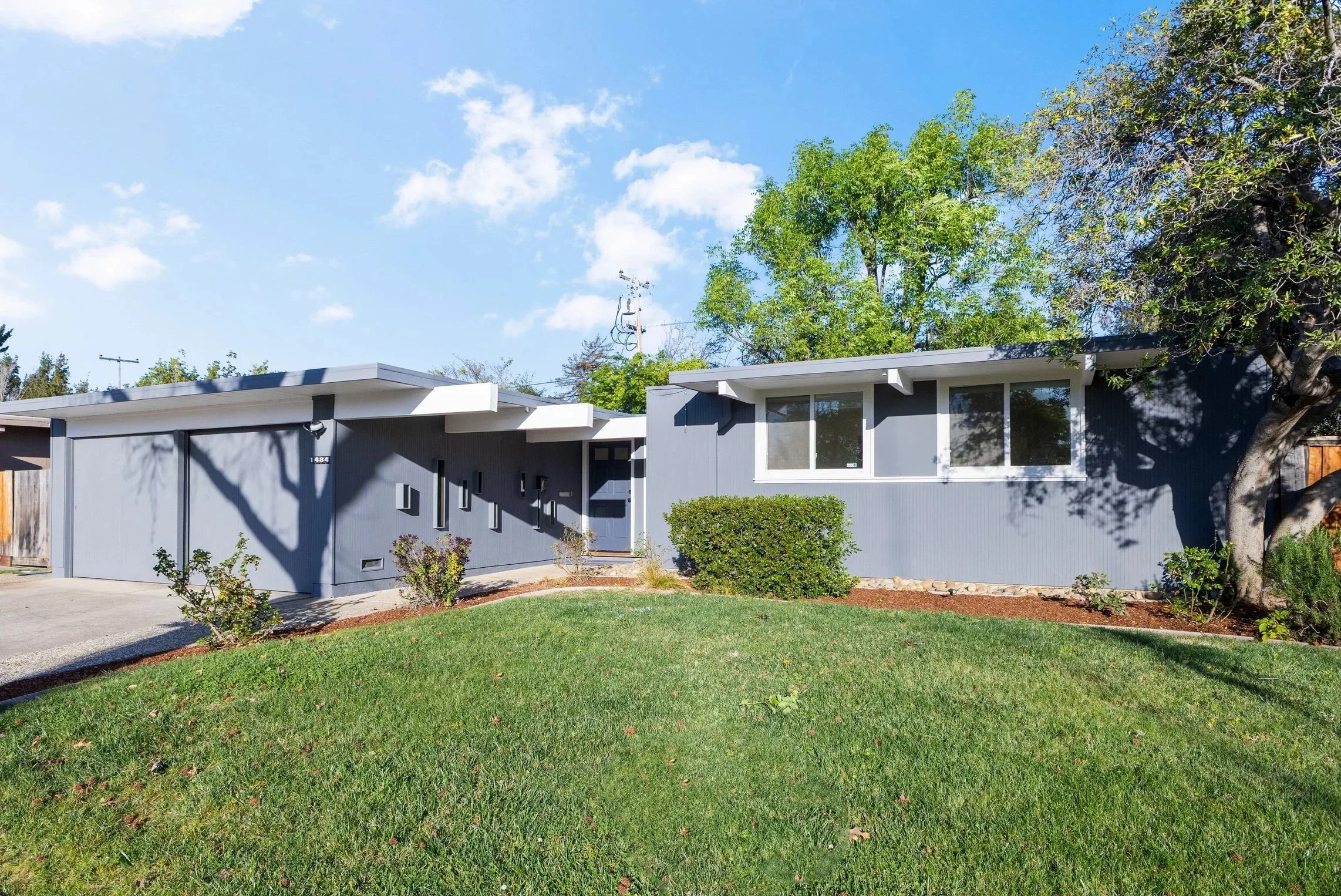
1484 Kingfisher Way is a single-family Eichler built in 1961, offered as a 3-bedroom, 2-bath home with 1,328 square feet on a roughly 6,324 square foot lot in Santa Clara County. The listing positions the home within the Fairwood complex name and describes it as a beautifully remodeled mid-century modern residence with hallmark features—walls of glass, dramatic floor-to-ceiling windows, signature brick fireplace, tongue-and-groove ceilings, multiple skylights—paired with contemporary comfort upgrades including LVT flooring, designer paint, updated lighting, dual-pane glass, and energy-efficient mini-split/heat pump systems.
The open house is scheduled for Saturday and Sunday (March 7–8) from 1:00–4:00 p.m., per the current Compass listing, updated on March 5, 2026. The listing also calls out proximity to Panama and Ortega Parks, access to shopping/dining and Town Center amenities, and convenient commutes to major Silicon Valley tech campuses and highways 280, 237, and 85.
In business terms, this home sits at the intersection of three persistent demand engines in Silicon Valley housing: (1) location utility (job access + transportation networks), (2) lifestyle utility (parks + everyday amenities), and (3) design utility (mid-century modern architecture as a differentiated “product” that buyers actively seek out).
To frame the opportunity set: Sunnyvale is a high-performing employment hub with a large, affluent resident base (U.S. Census Bureau QuickFacts shows a population estimate of 156,792 in July 2024 and a 2020–2024 median household income of $186,170 in 2024 dollars). That macro context matters because a design-forward home is ultimately “priced” by a market that has both the means and the motivation to pay for architectural identity, commute optionality, and park-adjacent quality of life.
A strategy lens for Eichler homes in Silicon Valley
Eichler homes are not merely a housing subtype; they are a durable consumer preference category—closer to a “design brand” than a commodity floor plan. The City of Sunnyvale adopted formal Eichler Design Guidelines in 2009 specifically because the Eichler housing stock is distinctive, vulnerable to incompatible remodeling, and frequently subject to design-review questions (especially around privacy impacts from taller homes, exterior changes, and the integration of systems like HVAC and windows).
Why Eichler works as a long-lived “product”
The City’s guidelines outline the core “product attributes” that make Eichlers recognizable and persistently desirable: post-and-beam construction; low, horizontal rooflines (flat or low-slope); large areas of glass that emphasize interior/exterior relationships; tongue-and-groove roof decking; recessed entries; and (in many models) interior or entry atriums. Importantly, the guidelines also articulate the business problem Eichlers solve for residents in a high-pressure housing market: these homes can feel larger than their measured square footage because the architecture amplifies light, visual depth, and indoor-outdoor flow.
The “California-modern” promise is not a vibe—it is a design system. When executed well, it converts ordinary daily routines (breakfast, remote work, entertaining, playtime) into experiences framed by daylight, garden views, and flexible indoor/outdoor circulation. The academic literature on biophilic design and health outcomes supports the broader thesis that integrating natural elements and daylight into the built environment can improve well-being and reduce stress.
The historical context that adds intangible value
The City’s own Eichler Design Guidelines explicitly tie the “birth” of Eichler homes to Sunnyvale and describe the early arc: initial homes constructed in 1949, followed by the more refined architect-designed cycle that involved prominent architects and architectural firms. This detail matters because it anchors Sunnyvale Eichlers not only as “mid-century” in style, but as locally foundational in the region’s postwar housing narrative.
From the civic history side, Sunnyvale Heritage Park Museum documents that Sunnyvale contains roughly 1,100 Eichler homes across multiple tracts, and presents Sunnyvale as one of the most important Eichler concentrations after Palo Alto. The City’s Eichler Design Guidelines similarly state that over 1,000 Eichlers were constructed in Sunnyvale within the broader 1949–1972 period, reflecting the scale of the local inventory.
Social history as “brand equity”
One reason Eichlers retain cultural gravity is that the developer’s story intersects with fair housing history: multiple mainstream and historical sources recount that Joseph Eichler’s company sold to buyers regardless of race and actively pushed against discriminatory norms, including resigning from industry organizations that would not support nondiscrimination.
In market terms, this matters because architecture is rarely “just architecture.” It is also narrative, identity, and community signaling. A home type that embodies modernism and a widely discussed social stance becomes more collectible—especially among design-oriented buyers who value authenticity and provenance.
Fairwood Eichler tract and Birdland micro-geography
Fairwood is one of the best examples of how Sunnyvale’s mid-century inventory is not random, but systematically produced—and therefore systematically valued. Several sources converge on the tract’s timing: Fairwood was built in the early 1960s, with many references placing it in 1961–1962.
Architectural authorship and tract-level credibility
The strongest archival evidence for Fairwood’s production details comes from Environmental Design Archives records (Oakland & Imada Collection) describing “Fairwood Units 1B & 2, Tract No. 2944” in Sunnyvale, dated 1961–1962, with the creator listed as Jones & Emmons. This is consequential for buyers and sellers because tract-level architectural authorship is a value driver: it reduces ambiguity (“Is this really an Eichler?”) and increases buyer confidence in the home’s authenticity and design lineage.
That authorship also aligns with the City’s Eichler Design Guidelines, which cite architect-led evolution involving Southern California architects, including A. Quincy Jones and Frederick Emmons, and note that Eichler’s refined post-and-beam designs followed the early precursor phase.
Unit counts and why precision varies
You will see different unit counts for Fairwood depending on the source and whether the count includes additions. One Sunnyvale Eichler reference page summarizes “Fairwood” as consisting of 215 homes and lists the core street network (including S Wolfe Rd, Dartshire, Mallard, Kingfisher, Carlisle, Duncardine, Firebird, Dunholme, and others). Meanwhile, the Compass listing metadata references a minimum number of units in the complex as 230.
In practice, the strategic takeaway is not the exact integer; it’s that Fairwood is large enough to sustain a recognizable neighborhood identity and an active buyer pool, while still being scarce enough (relative to overall Silicon Valley single-family inventory) to behave like a specialty market.
A note on neighborhood labels: Fairwood, Panama Park, Birdland, and Ponderosa Park
Real estate “neighborhood” labels in Sunnyvale are often overlapping layers rather than mutually exclusive boxes.
The Compass listing uses “Fairwood” as the complex name and describes the home as being in the Panama Park neighborhood.
The “Birdland” identity is widely associated with bird-themed street names (including Kingfisher), reinforcing a cohesive micro-brand that is easy for consumers to remember and easy for agents to market.
The Ponderosa Park neighborhood functions as both a local geographic reference and a civic community identity—visible in the citywide neighborhood association map that lists Ponderosa Park as an active neighborhood association.
In Harvard-style market terms, these overlapping labels are not noise—they are segmentation. Different buyer personas search by different heuristics: some by schools, some by commute corridors, some by tract architecture, some by parks. A listing that legitimately “belongs” to multiple mental maps is advantaged in organic discovery and referral-based search.
Governance and preservation as part of the neighborhood’s “operating system”
Sunnyvale’s Eichler neighborhoods demonstrate an important dynamic: architectural identity increases collective action.
The City’s Eichler Design Guidelines were adopted to preserve and enhance the exterior character of Eichler neighborhoods and to help owners plan additions and exterior changes that respect the scale and character of the surrounding tract. The guidelines also explain why Eichlers are especially sensitive to privacy impacts: large expanses of glass and open plans can become vulnerable when a neighboring lot adds a second story.
Sunnyvale also has a parallel tool: single-story combining districts (overlay zoning) designed to preserve predominantly one-story neighborhood character. City council materials describe rezoning requests that modify low-density residential zoning by adding an “S” designation that limits homes to one story and establishes floor area ratio thresholds, explicitly grounded in Sunnyvale Municipal Code intent to preserve single-story neighborhoods.
For buyers, this ecosystem can reduce downside risk (fewer surprise two-story builds next door) while also limiting vertical expansion options depending on the specific block and zoning overlay status.
The Ponderosa Park neighborhood adjacency and everyday attractions
A high-performing “livability” neighborhood isn’t defined by one amenity; it’s defined by how quickly households can get to multiple daily needs without friction—parks, schools, groceries, dining, transit, and community institutions. The area around 1484 Kingfisher Way is particularly strong on parks and active recreation.
Parks as lifestyle infrastructure
Ponderosa Park is a Western-themed park that includes tennis courts, basketball courts, sand volleyball, bocce ball, and additional site amenities; the City’s facility directory lists it as 9.1 acres with daily hours generally from 6 a.m. to 9 p.m. (with some court lighting later).
Panama Park is listed by the City as a 5.0-acre park with reservable multi-use sports fields and a ballfield, with daily hours typically 6 a.m. to 9 p.m. and rules around picnic area use and specialized equipment.
Ortega Park is also a major neighborhood resource frequently referenced alongside Panama Park in the property’s location narrative, reinforcing the idea that this submarket’s “day-to-day value” is anchored in multiple parks rather than a single signature destination.
The existence of formal neighborhood associations tied to Panama Park, Ortega Park, and Ponderosa Park underscores that these areas operate as organized micro-communities, not just map pins—associations create social infrastructure that tends to increase neighborhood stability and local engagement.
Parks, walkability, and economic value
There is a robust body of research indicating that proximity to parks and green space can increase property values, though the magnitude varies by city, park type, and context. A peer-reviewed review of studies on parks/green spaces and property values summarizes a general conclusion that closer distance to parks is associated with increased real estate value.
Separately, market research also shows buyers place value on walkability and proximity to amenities. The National Association of REALTORS® has reported persistent demand for walkable community features, reinforcing the logic that nearby parks, cafés, and daily destinations are not “nice-to-haves” but measurable drivers of search behavior and willingness to pay. The implication for Fairwood and adjacent neighborhoods is that parks are not just recreation—they are part of the neighborhood’s value proposition and resilience as buyer preferences evolve.
Downtown Sunnyvale, reinvestment, and the “gravity” of mixed-use
Downtown matters even when you live in a residential pocket because it concentrates culture, dining, and transit—creating a recurring destination that households use weekly, not yearly.
The City describes the Cityline project as a large mixed-use development site in the core of downtown, bounded by key downtown streets, with a new developer taking over major blocks and the plan emphasizing retail, dining, entertainment, and additional residential/office uses. For homeowners, this kind of ongoing downtown reinvestment is meaningful: it tends to compound the “option value” of living nearby—more choices for dining, more reasons for visitors to come to you, and (over time) more transit-oriented convenience.
Transportation: the commuter rail and active transportation ecosystem
On the regional mobility side, Sunnyvale’s Caltrain station is a key node. Caltrain lists Sunnyvale Station amenities (including accessibility and bike facilities) and places the station in Zone 3.
On the local mobility side, Sunnyvale’s transportation planning emphasizes building a safer, connected network for bicycling and walking through an Active Transportation Plan framework. This matters because “bikeability” is increasingly part of Silicon Valley’s lifestyle calculus—especially in neighborhoods where proximity to parks and schools makes non-car trips realistic for morning and afternoon routines.
Schools and the learning ecosystem
School assignment is both a quality-of-life issue and a capital markets issue in Silicon Valley. It affects household decision-making, time allocation, and resale liquidity.
How to evaluate school assignment responsibly
Because boundaries and assignments can change, the most verification-driven approach is to use district and county tools rather than relying solely on third-party summaries.
Santa Clara County Office of Education provides a district locator resource and instructs families to contact the relevant district for the official school assignment tied to a particular address or parcel.
Cupertino Union School District’s own locator tool explicitly states that its results are preliminary and that official assignment is provided at registration through the Student Assignment department.
Fremont Union High School District notes that its boundary map is the governing tool for attendance areas, and also recommends checking the SCCOE district locator when making major housing decisions.
This “verification stack” is the same discipline you’d apply to a business acquisition: validate from primary sources before underwriting the decision.
The schools cited for 1484 Kingfisher Way
The property marketing and listing information emphasize top Cupertino-area schools—Stocklmeir Elementary, Cupertino Middle School, and Fremont High School. The Compass listing’s school section explicitly states that the home is within the Fremont Union High School District and presents those schools as serving the home, alongside distances and third-party ratings as displayed at the time of the listing.
From the state’s school/district profile perspective, the California Department of Education’s database provides official address and district context for Cupertino Middle School (Sunnyvale address within Cupertino Union) and for Stocklmeir Elementary (Sunnyvale address within Cupertino Union). The schools’ own district websites also publish their addresses and contact information.
At the high school district level, Fremont Union High School District provides an official district site and attendance boundary resources. Fremont High School’s site and the district’s “Our Schools” directory confirm the school’s Sunnyvale location and district affiliation.
Why schools influence home value and market liquidity
There is extensive research demonstrating that school quality and school district attributes can be capitalized into home prices, often modeled through hedonic pricing approaches that isolate the “implicit price” of school-related variables after controlling for other characteristics. More recent work continues to examine how public disclosure regimes and school quality indicators affect housing market behavior and price gradients.
For a home like 1484 Kingfisher Way, the strategic significance is not simply “good schools.” It’s that school alignment expands the qualified buyer pool, supports demand durability, and reduces time-to-sale risk in softer cycles—because education remains a top-tier household priority even when interest rates or tech hiring cycles fluctuate.
1484 Kingfisher Way as a design-forward, modernized Eichler asset
A Harvard-style way to evaluate this home is to treat it like an operating asset with three layers: (1) design integrity, (2) systems modernization, and (3) location utility. The listing has been positioned to signal strength on all three.
The architecture and the lived experience
The listing description emphasizes classic mid-century modern architecture with walls of glass that connect indoor and outdoor living and flood interiors with natural light. It also highlights the living room’s floor-to-ceiling windows, a brick fireplace, and French doors that extend living space to the patio, alongside preserved Eichler details such as tongue-and-groove ceilings and multiple skylights.
This aligns closely with the City’s characterization of Eichler “home characteristics” that define the style: interior/exterior relationships with large glass areas, post-and-beam construction, horizontal emphasis, and (in many cases) atrium-centered planning.
Modernization as “capex,” not cosmetic
The remodel is described as including LVT flooring, designer paint, updated lighting, heat pumps, dual-pane glass, and remodeled kitchen and baths—an upgrade bundle that targets comfort, efficiency, and buyer expectations without repudiating the home’s mid-century identity. The kitchen package called out includes granite countertops, custom cabinetry, stainless steel appliances, a skylight, and an island open to the dining area.
From a risk-management perspective, this is exactly where many Eichler transactions succeed or fail: the home must satisfy a design-forward buyer and de-risk the operational issues that mid-century construction can bring (energy performance, thermal comfort, glazing, and system integration). The City’s guidelines explicitly note that many Eichlers were built in a period with different energy cost assumptions and that upgrades like window replacement and HVAC improvements are common—yet challenging to execute sensitively given flat roofs and modernist forms.
Building facts and “known unknowns” buyers should underwrite
Key listing facts and features include:
Year built: 1961.
Living area: 1,328 square feet.
Lot size: 0.15 acres / 6,324 square feet.
Foundation: concrete slab; post-and-beam structure.
Roof: tar and gravel.
Heating/cooling: heat pump with multi-zone cooling and 2+ zone heating per listing features; the narrative describes energy-efficient mini-split systems.
Energy-related features listed include double-pane windows, ENERGY STAR appliances/lighting, a tankless water heater, and thermostat controller.
Where the “property nerd” analysis becomes valuable is in separating what’s materially de-risked (windows + heat pump systems + updated finishes) from what commonly remains a diligence item in Eichlers (roofing lifecycle, slab-related plumbing considerations, and the condition of specialized materials). The City’s Eichler Design Guidelines encourage using architects/contractors experienced with Eichler homes because material sourcing, window detailing, and system integration are specialized.
Heat pump mini-splits and why they fit Eichlers structurally
The listing calls out energy-efficient mini-split systems as part of the home’s comfort profile. In an Eichler context, ductless and duct-minimized strategies can be especially attractive because they avoid the performance penalties of ductwork and can be easier to integrate with architectural constraints. The U.S. Department of Energy notes that ductless mini-split heat pumps avoid duct losses (which can be a significant share of energy consumption for space conditioning) and can achieve high efficiency ratings.
For buyers, this can translate to a simpler story: modern comfort without needing to compromise the ceiling structure or the home’s clean interior lines in the way some retrofitted duct systems might. For sellers, it becomes an easier “value narrative” to defend during inspection negotiations: upgrades align with both comfort and efficiency logic.
Outdoor space as an extension of the product
The listing references a professionally landscaped yard with interlocking brick hardscape and drought-tolerant planting—low-maintenance outdoor design aligned with California water realities and Eichler indoor-outdoor tradition. At the policy level, California Department of Water Resources promotes water-efficient landscaping as a strategy that saves resources while supporting biodiversity and pollinators—useful framing when positioning drought-tolerant landscapes as both practical and environmentally responsive.
Open house as demand proof, not just marketing
The open house schedule (Saturday and Sunday, 1–4 p.m.) matters because it signals that the home is being launched into the market with a “high intent” retail moment—designed to concentrate buyer attention and accelerate price discovery. For architecturally distinct homes, the open house is often the first time buyers can feel the spatial psychology—glass lines, daylight movement, ceiling volume—in a way photos cannot completely transmit.
Why representation matters for Eichler buyers and sellers in Sunnyvale
Eichler transactions reward specialization. The more a home diverges from conventional construction norms, the more the transaction behaves like a niche product sale—where buyer education, vendor networks, and design credibility directly affect outcome.
The Boyenga Team / Compass positioning: “Property Nerds” as an operating model
The Compass agent profile for the Boyenga Team describes a specialization in Eichler and mid-century modern architecture alongside luxury homes, emphasizing detailed knowledge of architecture, construction/development background, and tech-enabled strategy—explicitly branding the team as “Property Nerds.”
This matters because “representation” in an Eichler sale is not only negotiation and paperwork. It’s also:
translating architectural features into buyer-facing value language without over-claiming;
managing inspection and repair narratives in a way that is specific to mid-century construction realities;
sourcing design-sensitive vendors; and
targeting the right micro-audience—design buyers, modernist enthusiasts, tech households optimizing commute time, and lifestyle buyers prioritizing parks and schools.
The City’s Eichler Design Guidelines themselves implicitly support the specialization thesis by encouraging the use of professionals experienced with Eichler design and construction, precisely because renovations and replacements are non-trivial in this housing type.
Compass programs as a distribution and value-capture strategy
Two Compass programs are particularly relevant to an Eichler sale strategy because they map cleanly to the economics of architecturally significant homes:
Compass Private Exclusives. Compass describes Private Exclusives as listings accessible only within the Compass agent network and their serious buyers—a pre-marketing channel that can allow a seller to test positioning without accruing public days on market or visible price drops. Compass also states (in its press communications about related Private Exclusives initiatives) that many off-MLS Private Exclusives that sell are co-brokered with non-Compass agents, and frames the program as consistent with fair housing access when implemented properly.
Compass Concierge. Compass describes Concierge as a program that fronts the cost of home improvement services (such as staging, flooring, painting, and related preparation work) with zero due until closing—explicitly oriented toward helping sellers prepare a home for market.
For Eichlers, this is strategically important because the value premium often depends on how well modernization is executed relative to the original architectural language: the wrong window profiles, roofline additions, or materials can destroy buyer confidence, while design-sensitive prep can expand the buyer pool and reduce objection friction.
The platform layer: data, collaboration, and buyer experience
Compass positions itself as a modern real estate platform pairing technology with agent talent, and the company’s investor communications highlight the launch of client-facing tools designed to connect clients and agents through the transaction journey. In Eichler transactions—where buyers often ask deeper questions about architecture, remodeling constraints, and neighborhood preservation norms—transaction transparency and documentation discipline can be especially valuable in maintaining momentum through inspections and negotiations.
A practical synthesis: why this listing is “on brand” for Fairwood
The listing’s narrative is aligned with the City’s definition of what should be preserved (mid-century character, the exterior identity, and design sensitivity) while addressing the exact modernization themes the City anticipates Eichler owners will pursue (window upgrades, HVAC improvements, and compatible exterior-visible changes).
That alignment is the heart of “Property Nerd” representation: it treats the home as both a cultural artifact and a high-value residential asset—protecting the design DNA while optimizing comfort, efficiency, and market readiness.