
Architectural Evolution of Eichler Homes: Anshen & Allen, Jones & Emmons, and Claude Oakland
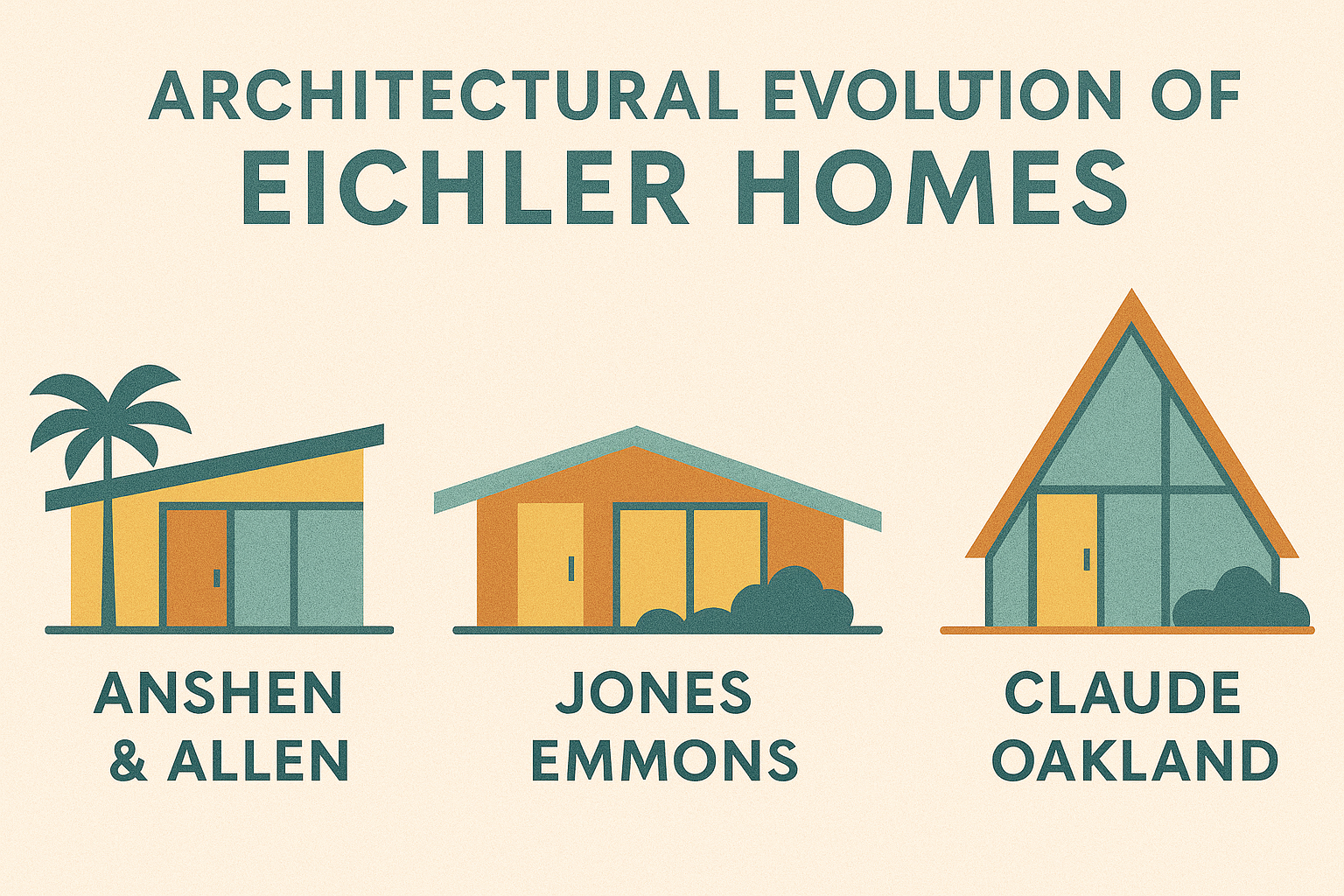
Architects Behind Eichler: Anshen & Allen, Jones & Emmons, and Claude Oakland
An open-plan Eichler living area extends to the outdoors through glass walls and exposed beams – hallmarks of the “California Modern” style pioneered in Joseph Eichler’s postwar homes.
Introduction: Eichler’s Vision and the Architects Behind It
Joseph Eichler was a visionary mid-century developer who insisted on using real architects to design even his tract homes – a radical approach in the 1950s eichlerhomesforsale.com. Eichler believed “the masses could have good design”, an ideal inspired by living in a Frank Lloyd Wright house during WWII sfgate.com. Between 1949 and 1966, his company built over 11,000 modern homes across California en.wikipedia.org, each embodying open-plan layouts, indoor-outdoor harmony, and clean modernist lines. To achieve this, Eichler partnered with a team of forward-thinking architects: first Robert Anshen & Steve Allen (Anshen + Allen) in the early 1950s, then A. Quincy Jones & Frederick Emmons (Jones & Emmons), and later Claude Oakland, among others en.wikipedia.org. Each architect brought a distinct philosophy and innovation to Eichler’s developments, collectively shaping a new paradigm of “modern homes for the middle class”sfgate.com. Below, we explore each firm’s design approach, key contributions – from the introduction of atriums to bold roof forms – and how their work evolved Eichler Homes from modest single-story ranches to inventive townhouses and even high-rise condominiums.
Anshen & Allen: Establishing the Eichler Aesthetic (circa 1949–1960)
Profile & Philosophy: Founded by Robert “Bob” Anshen and William “Steve” Allen in San Francisco, Anshen & Allen set the template for Eichler Homes. Anshen, a devotee of Frank Lloyd Wright, infused Wright’s Usonian principles into Eichler’s first models eichlerhomesforsale.com. The firm shared Eichler’s belief in modern design for the average family, embracing open floorplans, honest materials, and integration with nature. Eichler’s decision to hire Anshen & Allen in 1949 for his very first prototypes was unheard of at the time – most tract developers offered generic plans without architects rostarchitects.comrostarchitects.com. But Eichler and Anshen saw eye-to-eye. As one account notes, “Eichler’s vision of affordable, stylish homes for the postwar middle class resonated with the architects’ modernist leanings”eichlerhomesforsale.com. This partnership would prove pivotal in defining what came to be known as the California Modernist tract house.
Early Eichler Designs: Anshen & Allen’s initial Eichler homes (1950–54) established the core features that all Eichlers share. In Eichler’s first architect-designed tract (Sunnyvale Manor in 1950), they introduced open-plan living areas, exposed post-and-beam construction, and floor-to-ceiling glass facing private yardseichlerhomesforsale.com. Houses were typically single-story with simple, rectangular layouts – for example, a 3-bedroom “T-plan” prototype of ~1,050 ft² that Eichler built in Sunnyvale in 1950 rostarchitects.com. These plans erased the stuffy formality of traditional homes: living and dining spaces flowed together, and walls of glass opened onto patios to “bring the outside in” en.wikipedia.org. At a time when most builders offered period revival styles, Eichler’s glassy, flat-roofed homes (often called “finger plans” or “rancho-styles”) were avant-garde. Anshen & Allen’s designs featured clean geometric façades with little ornament – often just vertical wood siding and a blank street face aside from the carport, as Eichler homes “shunned the street” to focus on private indoor-outdoor living sfgate.com. The architects were influenced by Wright’s organic architecture, extending interior materials to the exterior for continuity (for instance, Philippine mahogany paneling inside and out) and employing radiant heated concrete floors for comforteichlerhomesforsale.com sfgate.com. This honest, “less is more” aesthetic became Eichler’s signature, thanks to Anshen & Allen’s early leadership.
Innovations and Atrium Concept: Anshen & Allen also planted the seeds of Eichler’s most famous innovation – the atrium. As early as 1951, they designed an Eichler model with a front court and covered loggia (Plan 37) that presaged the full atrium concept eichlernetwork.com. Bob Anshen was keen on the idea of a central courtyard and is credited with “specifically adding the atrium to Eichler’s building plans”, recognizing it as a “classic Eichler feature” in the making eichlerhomesforsale.com. These early courtyards were initially semi-enclosed entry patios; nonetheless, they represented a break from conventional house plans by carving out a private outdoor room at the heart of the home. Later in the decade, Eichler’s other architects would expand this into the open-air, glass-sided atrium we now associate with Eichlers – but the concept originated under Anshen & Allen’s watch eichlernetwork.com planning.lacity.gov. Beyond atriums, Anshen & Allen introduced distinctive material and layout ideas that defined Eichler homes for years: open-web post-and-beam roofs (no attics or crawl spaces) to allow vaulted ceilings and clerestory windows en.wikipedia.org; and the use of modular prefab components (like plywood panels, sliding doors, and standardized cabinets) to keep costs in line with Eichler’s affordability goals rostarchitects.com en.wikipedia.org. They also embraced Wright’s notion of “breaking the box” – eschewing hallways when possible to make even compact homes feel expansiveeichlerhomesforsale.com. Anshen famously considered these tract houses a new form of architecture, noting in 1953 that “a house for Mr. Everyman need not be a tract house cliché” – and proved it with Eichler’s award-winning models escholarship.org.
Key Projects and Legacy: Working closely with Eichler through the early-to-mid 1950s, Anshen & Allen designed dozens of Eichler tracts around the San Francisco Peninsula and South Bay. Notable developments include Green Gables (Palo Alto, 1950) and Greenmeadow (Palo Alto, 1954) – neighborhoods now celebrated as mid-century historic districts. In 1955, House & Home magazine spotlighted Eichler homes (by Anshen & Allen) for their excellence, and Eichler’s subdivisions won industry awards usmodernist.org. The firm didn’t shy away from experimentation: in 1956, Anshen & Allen (with young associate Claude Oakland) designed Eichler’s first multi-family project, a cluster of five unique duplex buildings in Redwood City eichlerhomesforsale.com. These duplexes – each two units under one low-gabled roof – demonstrated that Eichler’s modern style could work in higher density; from the street they are “nearly indistinguishable from Eichler single-family homes” eichlerhomesforsale.com. Such forays would inform Eichler’s later townhomes and condos. By 1960, however, this initial chapter closed. Robert Anshen’s untimely death in 1964 and some creative friction led Eichler to end his contract with Anshen & Allen and work directly with Claude Oakland’s new firmplanning.lacity.gov. Anshen & Allen’s legacy was already cemented: they had defined Eichler’s ethos and proved that modern architecture could be implemented on a tract scale without sacrificing quality. As historian Paul Adamson observed, Eichler’s early homes “went far beyond mass-produced housing typically built in the suburbs after the war”, illustrating “the enduring value that good design can bring to any housing project.” sfgate.com Eichler Homes would soon evolve in new directions, but it was Anshen & Allen who laid the solid modernist foundation.
Jones & Emmons: Expansion, Experimentation, and the Atrium House (1951–1969)
Profile & Collaboration with Eichler: In the early 1950s, Joseph Eichler sought additional architectural talent to keep pace with his growing developments. He found it in A. Quincy Jones and Frederick Emmons, an LA-based duo who became Eichler’s most prolific design team alongside Oakland. A. Quincy Jones (an acclaimed modernist and later Dean at USC) had already won national awards for innovative tract designsrostarchitects.com. Impressed by Jones’s work (one magazine named Jones “Builder’s House of the Year” in 1950), Eichler invited him to tour an Eichler development in Palo Alto and soon “suggested they join forces.”usmodernist.org Jones partnered with his former Navy colleague Fred Emmons, and from 1951 onward “their partnership lasted until Emmons’ retirement in 1969.” usmodernist.org During this time, Jones & Emmons designed roughly half of all Eichler homes – around 5,000 houses by their own estimate usmodernist.org. They worked in parallel with Anshen & Allen through the ‘50s and continued as principal architects through the ‘60s, even as Claude Oakland assumed lead responsibilities. Eichler’s collaboration with Jones & Emmons was extraordinarily fruitful: Jones was given freedom to plan entire Eichler communities, incorporating park-like greenbelts and common areas that were rare in tract housing usmodernist.org usmodernist.org. In fact, the San Mateo Highlands (Eichler’s largest contiguous development, 1956–64) reflects Jones’s influence in its curving streets and open space integration en.wikipedia.org. The respect was mutual – Eichler provided Jones “a venue to implement” these forward-thinking ideas usmodernist.org, and in turn Jones & Emmons helped elevate Eichler Homes to national prominence, culminating in Jones & Emmons being named the AIA’s National Firm of the Year in 1969 (due in large part to their Eichler work)usmodernist.org.
Design Innovations – The Atrium and Beyond: If Anshen & Allen set the stage, Jones & Emmons pushed Eichler design into new territory. Perhaps their greatest contribution was the evolution and popularization of the Eichler atrium house. By 1958, working closely with Eichler, Jones & Emmons debuted the first fully realized “atrium model” – a house built around a central open-air courtyard, enclosed by glass wallsrostarchitects.com eichlerhomesforsale.com. This feature became standard in most Eichler subdivisions after 1958 eichlernetwork.com. The atrium was typically placed at the entry, surrounded by the home’s living spaces, so that one stepped through the front door into a private outdoor room at the core of the house. This brilliant concept achieved what Eichler and his architects wanted: complete privacy from the street, yet abundant light and indoor-outdoor connection at the home’s center eichlerhomesforsale.com. As one analysis noted, “the architects and Eichler saw that an atrium created a private outdoor room that brought natural light into all spaces while maintaining privacy from the public way.” planning.lacity.gov Jones & Emmons executed this idea to perfection – their atrium plans (often designated with model numbers like “Plan 64 Atrium”) featured floor-to-ceiling glass on all atrium sides, sometimes with entire window-walls that slid open to seamlessly join living room and courtyard eichlerhomesforsale.com. The result was indoor-outdoor living taken to the next level: even the most basic 3-bedroom Eichler felt like a mini-resort, with a light-filled garden at its heart. Homebuyers loved it – the atrium models were hugely successful and remain the most iconic Eichler homes. (By the late ’60s, some later Eichlers evolved the concept into a covered “Gallery” – a skylit foyer in place of an open atrium – but the open-air atrium is Eichler’s enduring trademarksfgate.com.)
Jones & Emmons were also masters of layout and structural innovation. They tended to design “larger, flowing plans” than the earliest Eichlers eichlerhomesforsale.com, often adding a separate family room or bonus room to the core plan to accommodate the growing needs of 1950s families boyengateam.com. Many Jones & Emmons models feature a distinct bedroom wing and a multi-purpose room apart from the main living area – an early nod to what we’d call a den or home office. They also weren’t afraid of bold structural expressions. While Eichlers are known for flat or modestly pitched roofs, Jones & Emmons introduced dramatic gabled rooflines on some models. A famous example is the “Double A-Frame” Eichler, a design Jones & Emmons used in the mid-1960s (for instance, in Orange County’s Fairhills tract and the Oakland Hills)boyengateam.com. These homes have two steep A-frame gables that intersect, forming a striking silhouette and a soaring high-ceilinged atrium space inside. Such a house in Oakland (built 1965) was noted for its “double gabled construction…two high-pitched roofs which form an atrium that starts in a courtyard entrance and runs to the back of the living room highlighted by glass walls and a soaring brick fireplace.”sf.curbed.com Jones & Emmons proved that modern tract homes need not be monotonous – they could be dynamically sculptural. Even in more conventional models, the duo played with variations: peaked roof sections over the living area for drama, or wide butterfly roofs on a few experimental designs. Under their tenure, Eichler homes received several architectural awards, including a 1959 AIA Award of Merit for an atrium model designoac.cdlib.org.
Another area where Jones & Emmons left a mark was materials and technology. Eichler Homes famously built one all-steel house – the X-100 experimental steel house – and it was Jones & Emmons who designed it. Built in 1956 as a showcase in the San Mateo Highlands, the X-100 was a futuristic prototype with a steel frame, corrugated steel walls, and even steel interior partitions en.wikipedia.org eichlerx-100.com. This house featured cutting-edge amenities (GE kitchen of the future, etc.) and drew crowds of visitors, demonstrating Eichler’s and Jones’s shared spirit of innovation. While the X-100 remained one-of-a-kind, some of its ideas (like advanced insulation and prefabricated components) filtered into Eichler’s standard homes. Jones & Emmons also helped implement foam roofing and better insulation in Eichler homes by the mid-’60sboyengateam.com, as well as the extensive use of skylights (for example, over atriums and bathrooms) to enhance natural light boyengateam.com. Throughout, they maintained Eichler’s commitment to affordable quality – standardizing construction details to keep costs down while delivering high design. By constantly tweaking and improving Eichler models each year, Jones & Emmons kept the homes fresh and responsive to how families actually lived. As Eichler Network later wrote, “Eichler’s architects constantly revised old plans and created new ones” even though the homes were mass-produced sfgate.com – a practice largely driven by Jones & Emmons’ prolific output of ideas.
Notable Developments: Jones & Emmons were involved in virtually every Eichler community during the builder’s peak years. In Northern California, they contributed heavily to San Mateo’s Highlands (1956–64) – a tract of about 700 Eichlers, including the X-100 and many atrium models, which is often cited as the largest Eichler tract en.wikipedia.org. In Palo Alto, the Greer Park and Greenmeadow expansions and the later Los Arboles tract (circa 1962) saw elegant Jones & Emmons designs. They also took Eichler’s concept statewide: Eichler entered the Southern California market in the early ’60s, and Jones & Emmons, being LA-based, were natural choices to design those projects. They created models for Fairhaven and Fairhills in Orange (1963–64) – neighborhoods where flat-roof Eichlers sit alongside dramatic A-frame versions atomic-ranch.com. In 1962, they designed the homes of Balboa Highlands in Granada Hills (Los Angeles), Eichler’s only San Fernando Valley tract, co-designed with Claude Oakland. Balboa Highlands is especially notable as it introduced some two-story and split-level Eichler designs adapted to hilly terrain, and nearly all 108 homes there have atriums or atrium-like galleriesplanning.lacity.gov. Jones & Emmons even worked on high-profile custom projects for Eichler – for instance, they were involved in Eichler’s attempts at building urban high-rises (one unbuilt design for a tower in San Francisco’s Marina in 1963)eichlernetwork.com. Their versatility was impressive: from flat-top modest homes to bold new formats, they reliably translated Eichler’s modernist vision across different contexts.
By the late 1960s, as Eichler’s company ran into financial difficulties, Jones & Emmons’ role wound down (Emmons retired in 1969, and Joseph Eichler’s firm ceased tract development by 1966) rostarchitects.com. But their impact was lasting. They had shown that a tract developer could “supercharge” the modern ranch house, as one comparison put it, with features like “entire corners of the living room in glass” and an atrium that “literally put outdoor space inside the house.” eichlerhomesforsale.com The partnership between Eichler and Jones & Emmons is now regarded as a benchmark in mid-century design collaboration. It not only produced beautiful homes but also advanced the notion of community-oriented design (with greenbelts, neighborhood coherence, etc.). In sum, Jones & Emmons took the Eichler home to its creative zenith – larger, brighter, and bolder – while never losing sight of Eichler’s core principle: that good design should be available to everyone.
The open-air atrium of a mid-1960s Eichler (a rare “double A-frame” model by Jones & Emmons) creates a sheltered outdoor foyer, encircled by glass walls. This signature atrium layout, introduced in 1958, brought light and nature into the heart of Eichler homesplanning.lacity.gov sf.curbed.com.
Claude Oakland: Refinement, New Formats, and Eichler’s Late Evolution (1960–1974)
Profile & Role: If any one person can be called “Eichler’s architect”, it is Claude Oakland. Oakland was involved with Eichler Homes virtually from the beginning to the very end. He joined Anshen & Allen as a young architect in 1950 and soon became the primary designer for Eichler projects within that firm sfgate.com planning.lacity.gov. Colleagues recall that Oakland was designing most Eichler model plans behind the scenes in the ‘50s, while Anshen & Allen’s principals managed client relations sfgate.com. In 1960, chafing at the lack of public credit, Oakland left Anshen & Allen – and Joseph Eichler promptly hired him directlyplanning.lacity.gov. This began a new chapter: Claude Oakland & Associates became Eichler’s chief architectural firm for the 1960s. The Eichler-Oakland relationship was extremely close. Eichler would literally lean over Oakland’s drafting table as they brainstormed designs; “their tastes meshed,” and they shared an “unwavering, no-fuss insistence on racial tolerance and modern design,” reflecting common valuessfgate.complanning.lacity.gov. Oakland, a quiet modernist and passionate liberal, was perfectly aligned with Eichler’s mission of socially conscious development sfgate.com. From 1960 until Eichler’s death in 1974, Oakland was the lead architect for thousands of Eichler homes, both single-family and the new multi-family ventures. In fact, sources estimate Oakland ultimately had a hand in designing over 5,000 Eichler residences – first as Anshen & Allen’s in-house talent, then as Eichler’s principal architect through the ’60splanning.lacity.gov. Little wonder that many “classic Eichler” elements often attributed to Eichler generically were actually the work of Oakland refining and standardizing the designs.
Design Philosophy & Evolution: Claude Oakland’s architectural language built upon his predecessors but also adapted to changing times and needs. He was not a flashy conceptual architect; peers noted he “never theorized nor blew his own horn…he would just do it.” sfgate.comsfgate.com This pragmatic streak made him ideal for taking Eichler homes into a phase of mass-refinement. By the 1960s, Eichler homes had to appeal to more upscale buyers and meet new code standards, and Oakland delivered by updating the palette of forms and materials while preserving the beloved Eichler aesthetic. For instance, Oakland kept the post-and-beam structure and glass walls, but he began to introduce more variety in roof profiles – adding high peaked gables over some atriums or living rooms to create dramatic interiors and street appeal boyengateam.com. In Upper Lucas Valley (Marin County), where he was the master architect for tracts built 1963–65, Oakland implemented entire streets of atrium models with uniform low-pitch roofs, but punctuated them with occasional steep gable “profile” models for visual interest boyengateam.com. He also invented the “Gallery” plan, a unique layout where a long, skylit atrium-like hallway became the organizing spine of the house – effectively a covered atrium for wetter climates boyengateam.com. These gallery models (seen around 1966–69) still had the Eichler openness and indoor garden feel, but the central space was roofed with large skylights, bringing in light while solving drainage and leaves-cleaning issues of open atriums sfgate.com. It was Oakland’s way of subtly adapting Eichler design to evolving tastes without losing its soulboyengateam.com.
Oakland was also practical in material choices. He retained the warm mahogany paneling inside Eichler homes well into the ’60s and the tongue-and-groove wood ceilings – touches that owners cherishedeichlerhomesforsale.com boyengateam.com. But he wasn’t afraid to incorporate new textures: for example, some late Eichlers feature concrete breeze-block or brick accent walls (often used as courtyard screens or planters) that added visual interest and a bit of structural heft boyengateam.com. In response to stricter energy codes, Oakland adopted better insulation and foam roofing on Eichlers, improving comfort while keeping the rooflines flat and clean boyengateam.com. Throughout, Oakland’s guiding principle was continuity – he wanted Eichler homes to stay true to their mid-century modern roots even as lifestyle needs changed. By most accounts, he succeeded. As one retrospective noted, even into the late ’60s, Oakland “ensured the homes remained fresh, contemporary, and aligned with evolving tastes” while “adapting [the design] subtly rather than abandoning it.” boyengateam.com In short, if Jones & Emmons brought Eichler homes to their creative peak, Oakland sustained that excellence and consistency across an expanding range of housing types.
Atriums, Clusters, and Condos – New Formats: In the 1960s, Eichler Homes ventured beyond its core product (the one-story single-family house) into new residential formats. Claude Oakland was instrumental in these expansions. First, he took the atrium concept and ran with it. Virtually every Eichler design Oakland oversaw had either an atrium or a variant (courtyard or gallery). In fact, Oakland is often “said to have created the Eichler atrium” in its fully realized form sfgate.com – he certainly standardized it. All through the ’60s, Eichler models in Palo Alto, Sunnyvale, San Jose, and Marin were atrium-centric. For example, the Rancho San Miguel tract in Walnut Creek (built 1960–62), which Oakland designed after going independent, features atrium Eichlers that are considered some of the East Bay’s best mid-century homes sfgate.com. When Eichler expanded into two-story homes to tackle steep sites, Oakland devised clever ways to preserve the Eichler feeling. In Diamond Heights, San Francisco (1962), he designed a group of Eichler houses on a hill – they appear as flat-fronted modern boxes from the street, but actually are two-story homes stepped down the slope, with high ceilings and big windows to maintain the light, airy quality Eichlers are known for tiktok.comnewstimes.com. A newspaper noted that these Diamond Heights designs by Oakland marked “a significant departure…introducing boxy modern two-story layouts” yet still instantly recognizable as Eichlersnewstimes.com. Only a few dozen two-story Eichlers were ever built eichlerforsale.com, making them rare, but Oakland proved Eichler’s principles could scale vertically when needed.
Perhaps Oakland’s biggest leap was into multi-family and “cluster” housing. Eichler in the ’60s developed several townhouse and apartment/condo complexes – a response to the burgeoning demand for higher-density housing. Oakland, again, was central. He “pioneered cluster-home developments,” designing attached Eichler residences that preserved the feel of a detached home sfgate.com. A prime example is Pomeroy Green (Santa Clara, 1962) – a cooperative community of 78 Eichler townhouses arranged around common gardens. Oakland (with Jones & Emmons consulting on site plan) designed these two-story townhomes with courtyard entrances and atrium-like lightwells, so that each unit still had a private outdoor space and glass walls eichlernetwork.com. The development was so well-regarded that it was featured in CA-Modern magazine and is now on the National Register of Historic Places ohp.parks.ca.goveichlerhomesforsale.com. Oakland also designed Pomeroy West (1963), a nearby Eichler condo complex, and the Laguna Heights townhouses in San Francisco (1964), again blending privacy, greenery, and modern lines in a denser formateichlernetwork.com sah-archipedia.org. In these projects, you can see Oakland’s talent for site-sensitive planning: he often used clustered courtyard plans, staggering units for privacy, and maintained Eichler trademarks like post-and-beam construction and expansive glass wherever possible. Even more ambitiously, Eichler dove into high-rise development in the mid-’60s – and while those towers had separate specialist architects, Oakland’s influence was present as well. The best example is The Summit (1965), a 32-story condominium tower on Russian Hill in San Francisco. Oakland’s firm did the initial design (in partnership with architect Neill Smith) en.wikipedia.org The Summit’s sleek modernist look and emphasis on view-oriented living spaces echoed Eichler’s philosophy, but the project proved financially draining and effectively marked the end of Eichler’s building era flickr.com. (It’s often said that The Summit and a few other Eichler towers “bankrupted the developer” flickr.com, as Eichler Homes, Inc. folded by 1967). Nonetheless, through Oakland’s hand, Eichler’s design DNA was translated into apartments and condos, ensuring that the Eichler legacy included more than just single-family homes.
Signature Works & Neighborhoods: Claude Oakland’s imprint can be found across many Eichler neighborhoods, especially those built from 1960 onward. A few stand-outs: Greenmeadow Palo Alto (Phase II, early ’60s) – while the initial Greenmeadow was by Anshen & Allen, later sections show Oakland’s refinements; Upper Lucas Valley in Marin County (1963–65) – Oakland was sole architect here, creating a harmonious enclave of atrium homes against a stunning natural backdrop sfgate.com. Lucas Valley Eichlers are often cited as the pinnacle of Eichler design: one-story homes with both flat and double-gable models, integrated with open space and consistent detailing. Oakland deliberately planned Lucas Valley as a cohesive modernist statement, going so far as to keep all utility lines underground and designing a community center in the same style. Another Oakland highlight is Fairhills in Orange (1964) – a Southern California tract co-designed with Jones & Emmons, featuring some of the most dramatic A-frame Eichlers ever built (often attributed to Jones) and other models attributed to Oakland. Eichler’s personal devotion to integration and diversity in housing also saw Oakland design custom homes for notable clients like Franklin Williams of the NAACP in 1951, which influenced Eichler’s non-discrimination policy dwell.com. In short, Oakland didn’t just produce individual models; he often acted as a master planner, shaping the look and feel of whole Eichler communities. By the time Joseph Eichler passed away in 1974, Oakland had designed Eichler homes spanning the full gamut – from $10,000 starter homes to high-end custom builds, from single-story ranches to vertical townhouses. He continued practicing after Eichler’s era (designing other modern homes in the Bay Area) until his own death in 1989 planning.lacity.gov.
Oakland’s legacy within the Eichler story is one of continuity and gentle evolution. A 2005 SFGate tribute dubbed him “the most prolific architect for mass builder Joe Eichler,” noting that “few, if any, architects anywhere produced as many modern homes” as Claude Oakland did sfgate.com. It was Oakland who made sure that Eichler homes of the late ’60s still felt like Eichlers, even as trends shifted. He was the steady hand that carried Eichler’s modernist dream into new realms without diluting its essence. The iconic “Eichler atrium” is as much Oakland’s baby as Eichler’s – a fact recognized when people say “Oakland created the Eichler atrium.”sfgate.com And importantly, Oakland shared Eichler’s progressive values: under his design guidance, Eichler developments remained open to all races and religions, an stance Eichler famously enforced (even at personal cost) during the 1960s dwell.comdwell.com. This humanistic touch in design – planning communities for everyone – is a through-line in Oakland’s Eichler work.
A Collaborative Legacy in Mid-Century Modernism
Through the collaborative genius of Anshen & Allen, Jones & Emmons, and Claude Oakland, Joseph Eichler accomplished something remarkable: he democratized high-quality modern architecture, bringing what had been the domain of custom homes for the elite into the reach of middle-class families. Each of these architects contributed key ingredients to the Eichler recipe: Anshen & Allen established the architectural language of the Eichler house (honest materials, open plans, and that daring rejection of ornament)eichlerhomesforsale.com en.wikipedia.org; Jones & Emmons expanded the possibilities with atriums, experimental materials, and community planning on a grand scale eichlerhomesforsale.com eichlerx-100.com; and Claude Oakland refined and diversified the designs to keep Eichler neighborhoods state-of-the-art through the 1960s, all while maintaining the uncluttered, indoor-outdoor ethos that defined the brandboyengateam.com. The architectural evolution is evident when comparing an early-1950s Eichler to a late-1960s one: the former (Anshen & Allen’s work) might be a compact 3/1 ranch with a carport and patio, modest in profile yet revolutionary for its timeeichlerhomesforsale.com; the latter (Oakland’s work) could be a sprawling 5-bedroom atrium home or an attached townhome with a courtyard, more complex in form yet instantly recognizable as an Eichler in spirit boyengateam.com. And bridging the two, you’d find a mid-’50s Jones & Emmons model – perhaps with a daring steel post here, a butterfly roof there – signaling that this was no ordinary tract house.
Crucially, these architects didn’t work in silos; there was a real cross-pollination of ideas. Anshen & Allen’s courtyard layouts paved the way for Jones’s atrium; Jones & Emmons’ bold roof experiments may have inspired Oakland’s later gallery halls; Oakland, in turn, had been Anshen’s protégé and continued collaborating with Jones & Emmons on combined projects (like co-designing entire tracts)eichlerhomesforsale.com boyengateam.com. Eichler effectively created a brain trust of architects, and he often had them vet each other’s ideas and critique plans in charettes rostarchitects.com. This synergy ensured a continuity in Eichler Homes even as styles evolved. It’s no wonder Eichler developments are instantly identifiable – “virtually all centered around open-air atriums…floor-to-ceiling glass…post-and-beam construction” as one description of a 1962 tract co-designed by Jones & Oakland noteseichlerhomesforsale.com. The common DNA is clear, yet the variety and innovation kept things from ever growing stale.
Today, Eichler Homes are celebrated as icons of mid-century modernism. Architectural historians point out that these houses “illustrate the advantages of socially-responsible development” and “the enduring value of good design” even in mass housing sfgate.com. That achievement is due in no small part to the architects who translated Joe Eichler’s lofty ideals into blueprints and nail-by-nail reality. Many of the best-preserved Eichler neighborhoods have been recognized for their design significance – from Palo Alto’s Greenmeadow (Anshen & Allen’s era) to Orange’s Fairhaven (Jones & Emmons’ era) to San Rafael’s Lucas Valley (Oakland’s era). Enthusiasts conduct Eichler home tours, and original model floor plans are studied and restored like works of art. What’s particularly striking is how modern and livable these designs remain. The open-plan concepts and indoor-outdoor layouts that Anshen, Jones, and Oakland pioneered feel perfectly attuned to 21st-century living, which prizes flexibility and connection to nature. In the end, Eichler’s architects succeeded in shaping not just subdivisions, but a California lifestyle. They proved that progressive architecture and tract housing need not be at odds – a legacy still influencing architects and developers today.
Joseph Eichler once walked prospective buyers through his model homes and famously said he “couldn’t understand why other builders weren’t doing the same” eichlerhomesforsale.comsfgate.com. The reason Eichler Homes were so ahead of their time is because of the architects who poured their creativity into them. Robert Anshen gave Eichler houses their soul, Quincy Jones and Fred Emmons gave them ambition, and Claude Oakland gave them longevity. Together, they transformed rows of houses into showcases of mid-century innovation. As Eichler himself showed, and his architects affirmed, good design is good for everyone – a truth that lives on in every glass-walled atrium and every beamed ceiling of an Eichler home, half a century later.
Sources: Architectural plans and records from Eichler Homes (1949–1974); Eichler: Modernism Rebuilds the American Dream by P. Adamson (2002); Eichler Network archives and CA-Modern articles sfgate.comsfgate.com; SFGate and Dwell features on Eichler developments sfgate.com dwell.com; and historic analyses of Eichler tracts in Los Angeles and the Bay Area planning.lacity.govplanning.lacity.gov boyengateam.com, which document the contributions of Anshen & Allen, Jones & Emmons, and Claude Oakland.
Sources