
Field Guide to Silicon Valley Mid-Century Modern Homes: Eichler vs. Mackay, Gavello, Alliance, Bahl & Stern & Price
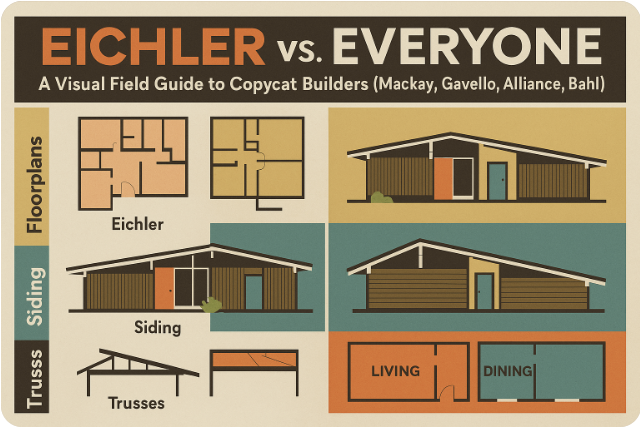
Distinguishing Eichler Homes from Mackay, Gavello, Alliance, Bahl, and Stern & Price
Mid-century modern housing flourished in Silicon Valley during the postwar boom, with Joseph Eichler’s homes setting the standard for California modern design. But Eichler was not alone – several other builders crafted Eichler-like neighborhoods, each with their own twists on the style. This guide provides a comprehensive comparison of authentic Eichler homes and five key competitors – Mackay Homes, Gavello Homes, Alliance Homes, Bahl Homes, and Stern & Price Homes – to help you visually and architecturally distinguish who built a given mid-century modern home. We’ll examine differences in architecture (roof pitch, structural system, siding), floor plans (atriums, courtyards, and layouts), exterior aesthetics (facades, materials, carports vs. garages), and even how to use permits or tract names to identify a home’s builder. Real estate professionals, buyers, and sellers can use this as a field guide to these mid-century modern gems of Silicon Valley.
Eichler’s Signature Style: Eichler homes (built 1949–1974) are known for single-story post-and-beam construction with exposed beam ceilings, floor-to-ceiling glass walls, and open floor plans that blur indoors and outdoors boyengateam.com. Many Eichlers feature an open-air atrium at the center – an entry courtyard open to the sky and surrounded by glass – creating a dramatic indoor/outdoor foyer. They typically sit on slab-on-grade foundations with radiant heating pipes embedded in the floor (an innovative but maintenance-prone system) aplosgroup.com. Eichler exteriors are often minimalist: flat or low-pitched roofs with broad eaves, vertical wood siding (often grooved plywood or board-and-batten), and modest street fronts (limited windows facing the street for privacy). Early Eichlers had open carports, while later models introduced attached two-car garages as tastes evolved. This Eichler template of “bringing the outside in” influenced many contemporaries – and the rivals we discuss below often emulated Eichler’s glass-walled atriums, clean lines, and indoor-outdoor ethos, while adjusting aspects of construction and style.
Comparison Chart of Eichler and Competitor Builders
To quickly summarize, the table below highlights key differences between Eichler’s designs and those of Mackay, Gavello, Alliance, Bahl, and Stern & Price:
Aspect Eichler Homes (Joseph Eichler) Mackay Homes (John Mackay) Gavello Homes (Elmer Gavello)Alliance Homes (Alliance Const.)Bahl Homes (George Bahl)Stern & Price Homes (Stern & Price)Era & Scale1949–1974; ~11,000 built across CA boyengateam.com (large tracts in Palo Alto, Sunnyvale, etc.)1950s; a few hundred modern tract homes in Mountain View, Santa Clara, etc. boyengateam.com (plus many conventional homes)Mid-1950s; limited number of homes (notably Sunnyvale’s “Gavello Glen”) boyengateam.com Early 1950s; ~200 homes in Terra Linda (San Rafael, Marin County) aplosgroup.com Late 1960s–early ’70s; small clusters (courts) of a few dozen in Sunnyvale, Cupertino, Mountain View, and San Jose boyengateam.comLate 1950s–1970s; boutique infill developer (custom lot-by-lot homes in Sunnyvale, Santa Clara, West San Jose, Campbell) eichlerhomesforsale.com Layout & AtriumOpen plan, combined living/dining; many models centered on an open-air atrium courtyard boyengateam.com. Bedrooms often in separate wing.Open plans but sometimes a more defined entry or enclosed foyer.boyengateam.com Occasional atriums or patios in designs boyengateam.com, but generally more traditional layout than Eichler.L- or U-shaped layouts on larger lots boyengateam.com. No true central atrium, but homes integrate patios and big backyards for indoor-outdoor living boyengateam.com.Generally L-shaped layouts aplosgroup.com, slightly smaller rooms. No atrium; some models had a covered patio off a bedroom as a play area (a unique child-friendly feature)aplosgroup.com. Efficient courtyard-centric layouts – each home is built around a private enclosed patio (interior courtyard) instead of an open atrium boyengateam.com. Very compact, no wasted space; usually 3BR/2BA in ~1,200–1,600 sq ft.Custom layouts blending MCM and ranch. Many are L- or U-shaped with a central courtyard or rear patio eichlerhomesforsale.com. Floor plans emphasize flexible rooms and were adapted lot-by-lot (not cookie-cutter tracts). Roof Design & Structure Predominantly flat or low-pitched tar-and-gravel roofs with wide eaves. Exposed post-and-beam structure (no attic); load-bearing posts around atrium. Built on slab foundation.Often low-gable or modest pitch roofs; some models had peaked or butterfly roofs for flair boyengateam.com. Built with post-and-beam framing by Eichler’s architects (Anshen & Allen), but many on raised foundations (crawl space) instead of slabs boyengateam.com.Low-pitched gable roofs with broad eaves (distinctive A-frame look on some) boyengateam.com. Post-and-beam construction with open-beam ceilings. Typically built on larger lots (some homes set farther back from street). Foundation may vary (some likely slab, others perimeter) – Gavello data on this is sparse, but era suggests both types used.Moderate pitched roofs (more slope than Eichler for better drainage) aplosgroup.com. Post-and-beam construction on slab foundation (like Eichler) for most. No open atriums, so roof spans the whole house footprint. Slight pitch means they avoided some water pooling issues of flat Eichlers aplosgroup.com.Flat or gently pitched rooflines with extended eaves boyengateam.com. Traditional post-and-beam on a perimeter foundation (raised crawlspace) boyengateam.com – no slab. Exposed beams inside with T&G wood ceilings. The flat roofs and courtyards give a very Eichler-like profile, but structurally these homes are more conventional underneath.Low-slung rooflines (often low gable or hip) with wide overhangseichlerhomesforsale.com. Post-and-beam elements combined with some conventional framing. Often had attics or insulation space (blending ranch construction for practicality)eichlerhomesforsale.com. Roof design was about balancing modern looks with durability – many Stern & Price have deeper eaves and sturdier roof construction to age well.Heating & SystemsRadiant floor heating in slab (hot water pipes in concrete) – silent and invisible, but original steel pipes are prone to corrosion/leaks over decadesaplosgroup.com. No conventional ducting (no attic). Often no A/C originally.Forced-air heating (furnace with ducts) or occasional wall furnaces – easier to service than radiantmontaloma.org. Raised foundations made it simpler to run ducts or add systems later. No in-floor heat means no slab leaks. Many Mackays thus have had HVAC updates over time.Likely forced-air heated (or wall furnaces) – Gavello homes were built in the mid-50s when many builders avoided complex radiant systems. Note: Gavello’s exact heating varies by house; some may have had hydronic heat, but most evidence points to conventional heating.Radiant heating in floors with copper pipes instead of steelaplosgroup.com. Alliance embraced Eichler’s hydronic heat idea but improved durability with copper (less corrosion)aplosgroup.com. This means Terra Linda Alliance homes often still have working radiant heat, whereas many Eichlers needed replacements.Conventional heating (forced-air) – no radiant slabs at allboyengateam.com. Bahl’s perimeter foundations and attics allow easy addition of modern HVAC. The builder prioritized easy maintenance; many Bahl homes have upgraded furnaces or added A/C since original construction.Conventional heating systems – Stern & Price deliberately avoided Eichler’s radiant heat and opted for furnaces and insulationeichlerhomesforsale.com. Their homes often had better original insulation in walls and roof, making them more energy-efficient for the era. Many have ducts or crawlspaces that simplify adding A/C or other upgrades.Exterior & FacadeMinimalist facades: often a blank front wall or clerestory windows only, with the main glass oriented to atrium/backyard. Vertical wood siding (redwood or grooved plywood) is common, sometimes with accent panels or brick near entry. Early models have open carports; later ones include garage doors.Similar mid-century curb appeal but a bit more conventional. Mackay exteriors use wood siding very much like Eichler. One distinguishing trait: Mackay often used painted Celotex panels on interior ceilings instead of Eichler’s natural wood planksmontaloma.org (not visible outside, but an interior clue). From the street, Mackays might have more visible garage doors (1- or 2-car attached garages were common)montaloma.org, whereas many Eichlers of the 50s had carports.Blended modern-ranch look: Gavello homes feature redwood siding with brick or stone accents on the façade for warmthboyengateam.com. They tend to have a more open street presence than Eichlers – e.g. a picture window or two facing front – due to larger setbacks and lot sizes. Many have attached two-car garages. Overall, they can look like a cross between an Eichler and a classic ranch: open-beam A-frame touches, but with bigger lawns and a less inward-facing designboyengateam.com.Nearly indistinguishable from Eichlers at first glance. Alliance homes were designed to resemble Eichler’s style closelyeichlerforsale.com – they have similar low profiles, exposed beams, and vertical siding. One subtle difference: the slightly higher roof pitch means you might see a bit more gable end on an Alliance. Otherwise, Alliance facades are very Eichler-like (often with carports or garages and simple fronts). Because they weren’t in Eichler tracts (Terra Linda Alliance tract is separate), confusion is avoided by location.Privacy-focused fronts: Bahl Homes usually present a blank or closed façade to the street – e.g. a tall planar wall or an attached garage with almost no front windowsboyengateam.com. They often have decorative screen block or wood siding on the front, but the living areas face the interior patio or backyard, not the street. Materials include textured plywood or concrete block siding paired with natural wood beams and ceilingsboyengateam.com. The mix of wood and masonry gives a bit more traditional feel compared to all-wood Eichlers.Custom eclectic facades: Stern & Price exteriors vary, but common elements are redwood siding (sometimes vertical groove, sometimes horizontal) combined with aggregate concrete or stone detailseichlerhomesforsale.com. Their homes often have more street-facing windows than Eichlers (being a ranch influence), but still maintain a clean mid-century look with eaves and clerestories. Attached garages are typical (often integrated smoothly into the design). Because S&P homes were built individually or in small groups, you’ll see more variation in façade design, trim, and materials – a deliberate lot-by-lot uniquenesseichlerhomesforsale.comeichlerhomesforsale.com.
(Sources: mid-century modern builders’ brochures, Eichler Network archives, and Boyenga Team mid-century blog posts.)
As the chart shows, each builder put a unique spin on Eichler’s mid-century modern formula. Below, we break down each builder in detail – with tips to recognize their homes by sight, notes on construction differences, and where in Silicon Valley (or the Bay Area) you’ll commonly find them.
Mackay Homes (John Mackay)
In the 1950s, John Mackay emerged as Eichler’s friendly rival, developing affordable modern homes that closely emulated Eichler’s style. Mackay actually hired Anshen & Allen – the same architects who designed many early Eichlers – so it’s no surprise that Mackay tract homes look very Eichler-like at first glance. They feature open beam construction, floor-to-ceiling glass, and post-and-beam layouts much like Eichler’s. In fact, Mackay’s models were often marketed as “patio homes” to capture that indoor-outdoor vibeeichlernetwork.com.
However, Mackay Homes can be distinguished by a few key differences:
Foundation & Heating: Most Mackay homes were built on raised perimeter foundations (with crawl spaces) rather than slabs, and opted for forced-air heating or wall furnaces instead of radiant floor heatboyengateam.commontaloma.org. This means a Mackay will usually have floor vents or a furnace closet (Eichlers lack those due to in-floor heat). The raised foundation also makes Mackays easier to remodel (plumbing and ducts are accessible)boyengateam.com. A few early Mackays were slab-on-grade, but many have accessible crawlspaces.
Roof Pitch: While Eichlers often have flat or nearly-flat roofs, Mackays sometimes sport a peaked or butterfly roof profile boyengateam.com. Some models introduced gentle gable roofs (A-frames) or twin-peaked designs that Eichler didn’t use until later. These low-gable or butterfly roofs still have wide eaves and exposed beams but create a taller facade silhouette that can hint it’s a Mackay.
Ceilings & Interior: Look up at the ceiling: Eichler interiors have natural wood tongue-and-groove planks between exposed beams. Mackay homes, by contrast, often have painted Celotex tile ceilings (soft fiberboard panels) between the beams montaloma.org. The beams might be concealed or painted over in Mackays, whereas Eichler beams are usually stained dark and left exposed. Also, Mackay’s interior walls were typically drywall (sheetrock) instead of the lauan mahogany paneling Eichler favoredmontaloma.org.
Layout Tweaks: Mackay homes tend to have slightly more traditional layouts. For example, many have a defined entry foyer or a hallway separating the kitchen, which Eichler models often did not (Eichlers usually enter directly into the living space or atrium) boyengateam.com. Kitchens in Mackays might be more enclosed or front-facing. Some Mackay models included a small courtyard or covered patio at the entry, but none had the expansive atriums of later Eichlers. Overall room sizes and total square footage were similar to Eichlers (many Mackays are 3 bed/2 bath ~1,200–1,400 sq ft, comparable to 1950s Eichlers).
Exterior Details: From the street, Mackay homes are very close to Eichlers – usually single-story with panelized wood siding and big glass sliders to the back. One giveaway can be the garage: Eichler’s 1950s homes often had a carport or open 2-car carport, whereas Mackays commonly have an attached one- or two-car garage with a door montaloma.org. For instance, in Mountain View’s Monta Loma neighborhood, Eichlers have open carports, while Mackays on the next street have enclosed garages. If you see original hardwood flooring, that’s also a clue – Mackays on raised foundations sometimes came with hardwood, whereas Eichlers on slab had vinyl tiles originally montaloma.org.
Neighborhoods & Tracts: Mackay built notable tracts in Mountain View (e.g. Monta Loma’s 1955–56 section) and Santa Clara. In Santa Clara’s Maywood and Fairmede tracts, hundreds of Mackay homes were built amid Eichler neighborhoods boyengateam.com. Cupertino and Palo Alto also have a few Mackays. A fun fact: the house Steve Jobs grew up in (Mountain View) was a Mackay home often mistaken for an Eichler eichlernetwork.com. Permit tip: On original building permits or subdivision maps, look for the name “Mackay Homes” or architect Anshen & Allen, which would point to a Mackay development, especially in 1955–1960 permits.
Gavello Homes (Elmer Gavello)
Gavello Homes are mid-century modern gems mostly found in Sunnyvale, developed by brothers Elmer and Leon Gavello in the mid-1950s. The Gavellos worked with Anshen & Allen as well, so their designs also echo Eichler’s hallmarks: post-and-beam construction, open beam ceilings, and large glass panes. In fact, at first glance people often mistake Gavello Homes for Eichlers eichlerhomesforsale.com. The Gavello tract (notably Gavello Glen near Sunnyvale’s Ponderosa Park) was relatively small – only a few dozen homes – making these houses a rare find today boyengateam.com.
Here’s how to distinguish Gavello Homes and understand their design:
Architectural Features: Gavello homes usually have low-pitched gable roofs with wide eaves, giving a classic mid-century profile boyengateam.com. Many are A-framed or broad-gabled ranch in form. They feature floor-to-ceiling windows and clerestory windows under the eaves, similar to Eichler. Inside, you’ll find open vaulted ceilings with exposed beams, and an open-plan living area. In essence, Gavello houses hit all the notes of mid-50s California modernism (thanks to the A&A architects influence).
Layout and Yard: A key difference is the lot size and layout. Gavello built on more expansive lots (~10,000 sq ft) than Eichler typically did boyengateam.com. Homes often have L-shaped or U-shaped floor plans wrapping around a patio or opening to a big backyard boyengateam.com. Rather than an internal atrium, the design integrates an outdoor patio off the living/dining area – often covered by the roof extension. This creates a private outdoor living space, though it’s along the side or rear of the home, not a central atrium. The larger yards and setbacks mean Gavello neighborhoods have a more spacious, suburban feel (think lawns and driveways), whereas Eichler tracts feel more compact.
Foundation & Heating: Documentation on Gavello construction is limited, but given the era and location, many Gavello homes likely used raised foundations with forced-air heat (similar to Mackay’s approach). Some owners note their Gavello houses had original radiant heating – if so, it would likely have been a later addition, as most evidence suggests conventional heating. In any case, radiant heat is not a signature of Gavello like it is for Eichler; expect to find a furnace or floor vents. The roofs being pitched also suggests there may be attic space for insulation/ducts (something Eichlers lack).
Exterior Aesthetics: Gavello homes blended modern design with ranch touches. Exteriors feature redwood or cedar siding (often vertical groove) combined with brick or stone accents on the façadeboyengateam.com. For example, a Gavello might have a brick planter or partial brick wall around the entry, adding warmth and a traditional element Eichlers usually don’t have. The front often includes a full garage (typically 2-car) as an obvious element. While Eichler fronts are sometimes blank, a Gavello front may have a picture window or pop-out in a front bedroom. These homes still look very mid-century modern, but the extra detailing and wider street frontage give them a bit more curb appeal in the conventional sense.
Neighborhoods: The core Gavello tract is in Sunnyvale’s Gavello Glen (around Quail, Ponderosa, and Snapdragon streets) eichlerhomesforsale.com, intermingled with some Stern & Price houses and more traditional ranches. A few Gavello homes are found in Santa Clara and Mountain View as well boyengateam.com. If you are in Sunnyvale’s Ponderosa Park area and see a mid-century home that isn’t in an Eichler tract, there’s a good chance it’s a Gavello. Identification by records: Gavello homes may be labeled under the builder name “Gavello Construction” on original subdivision maps. The tract name “Gavello Glen” itself is a giveaway – Eichler did not build there. Sunnyvale permit records from 1956 for streets like Gavello Ave, Quail Ave, etc., list Anshen & Allen as architects, which is a clue since A&A only worked with Eichler, Mackay, and Gavello at that time.
Distinctive Models: Because of the small scale, Gavello homes didn’t get catchy model names, but their designs are distinct. One noted model is a U-shaped home with an entry courtyard and an asymmetric A-frame roof that stands out – something Eichler didn’t do in Sunnyvale. Enthusiasts sometimes refer to these as “Gavello ranches” due to their ranch-like lot size combined with MCM design boyengateam.com. These under-the-radar homes offer slightly more space on average and often a lower price per square foot than Eichlers in the same areaboyengateam.com, making them a sweet find for MCM lovers.
Alliance Homes (Terra Linda Alliance)
Alliance Homes were built by Alliance Construction Company in 1954 in the Terra Linda area of San Rafael (Marin County). While not Silicon Valley (geographically Marin is North Bay), they are often mentioned alongside Eichlers as a parallel development. Locals jokingly call them “Lik-Eichlers” (like Eichlers) because at a glance they could be mistaken for Eichler tract homes. The Alliance tract predated Eichler’s Terra Linda development, and their goal was very much aligned with Eichler’s: bring modern architecture to middle-class families aplosgroup.com.
Key characteristics of Alliance Homes include:
Eichler Resemblance: Alliance houses were explicitly designed to resemble Eichler homes in style eichlerforsale.com. They have post-and-beam construction, open floor plans, plenty of glass, and exposed wood elements. Walking through one, you’ll see the same globe light fixtures, sliding glass doors, and sliding closet doors typical of 1950s Eichlers. This was modern tract housing, not custom – about 200 Alliance homes were built together as a planned community aplosgroup.com.
No Atrium, L-Shaped Plan: One obvious difference is the floor plan configuration. Alliance homes did not have atriums (Eichler’s atrium concept came a bit later in the late ‘50s). Instead, most Alliance models are L-shaped in layout aplosgroup.com. The living and bedroom wings form an L, often embracing a back patio. In fact, some Alliance homes have a covered patio off a bedroom, which was marketed as a “children’s play patio” where kids could clean up before entering the house aplosgroup.com. This was a unique selling point in 1954. So, if you see an atrium in the center of a house, it’s not an Alliance (likely an Eichler or later copy); Alliance kept all courtyards to the exterior.
Roof and Drainage: Alliance homes feature gently pitched roofs – more so than Eichler’s flat designsaplosgroup.com. From the street you might notice a low gable or a hint of slope. This slight pitch actually gave Alliance an advantage: better roof drainage and fewer leak issuesaplosgroup.com. Many Eichlers in Marin had flat tar-and-gravel roofs that required maintenance; Alliance used a low slope with shingles or rolled roofing that held up better in rain.
Radiant Heat (Improved): Impressively, Alliance homes did use radiant floor heating like Eichlers, but with a crucial improvement: copper piping for the radiant tubes aplosgroup.com. Eichler’s early radiant systems used steel pipes which rusted; Alliance chose copper, which resists corrosion aplosgroup.com. As a result, original Alliance radiant heat systems often lasted longer without leaks. If you find an Alliance home, it very likely still has its slab and possibly functioning radiant heat (or at least an easier upgrade path). This is a big internal difference that won’t be visible until you inspect the mechanical system or see the copper manifold in the utility area.
Size and Rooms: Alliance houses were generally a bit smaller than Eichlers of the same era – around 1,200–1,500 sq ft for 3-4 bedrooms aplosgroup.com, whereas Eichlers in Terra Linda are more like 1,500–1,700+ sq ft. This means slightly more compact bedrooms or combined spaces. They were efficient and no-frills, sticking to one story and simple shapes. None had the larger models or atrium variations Eichler later introduced in the 1960s.
Exterior Clues: Externally, Alliance homes are extremely similar to Eichlers: low profile, broad eaves, vertical wood siding, and big glass windows to the rear. You might notice that many Alliance homes have two gable ends (from the L-shape) visible from certain angles, whereas Eichler’s atrium models show one big roof span. Also, because Alliance built only in Terra Linda, location is the biggest clue – if you’re looking at a mid-century modern home in Terra Linda on streets like Wakerobin, Briarwood, or Peacock, and it doesn’t match Eichler tract maps, it’s probably an Alliance. Eichler’s Terra Linda homes were built a couple years later and in different sections (upper Terra Linda), whereas Alliance occupied a specific part of the valley (around Las Pavadas and Golden Hinde area) eichlernetwork.com. Permit tip: Marin County records or original sales brochures explicitly mention “Alliance Development.” Also, Alliance homes often have block and lot numbers distinct from Eichler tracts – no Eichlers were built between Las Gallinas and Las Pavadas in 1954, that entire cluster is Alliance eichlernetwork.com.
Neighborhood: All Alliance homes are in Terra Linda, San Rafael (Marin). So, they’re not actually in Santa Clara Valley. They’re included in this guide because of their historical significance as Eichler contemporaries. For Silicon Valley house-hunters, you won’t encounter Alliance homes unless you’re looking in Marin. But if you do venture there, know that Terra Linda has four mid-century tracts: one by Alliance, and three by Eichler (Terra Linda South, Terra Linda North, and Terra Linda Oaks). Marincognito: The Alliance tract is sometimes overlooked in favor of Eichler’s better-known homes aplosgroup.com, but they offer a similar vibe often at a slightly more affordable price.
Bahl Homes (George Bahl)
Bahl Homes represent a “quieter chapter” in Silicon Valley’s MCM history boyengateam.com. Developer George Bahl built a series of small enclaves in the 1960s–early 1970s, mainly in Sunnyvale, Cupertino (Monta Vista), and a few in west San Joseboyengateam.com. These homes are often called “Bahl Patio Homes” for their signature design: each centers around a private enclosed courtyard boyengateam.comboyengateam.com. They took Eichler’s indoor-outdoor concept even further in some ways, maximizing privacy and efficient use of space on small lots.
Distinctive features of Bahl Homes:
Central Patio (Atrium-like): Every Bahl Home is built around an interior walled patio – essentially an atrium, although often at the rear or middle rather than right at the entryboyengateam.com. This private outdoor room is the heart of the house, with multiple rooms opening onto it via sliding glass doors boyengateam.com. Unlike Eichler’s atriums (open to front entry), Bahl’s courtyards are more hidden – you typically enter the house first, then access the patio from inside. This design creates a secluded oasis effect: the street side is almost fortress-like, while the interior is all glass facing the patio and backyard boyengateam.com. It’s a clever twist that gives homeowners even more privacy than an Eichler atrium.
Post-and-Beam Construction: Bahl homes were built with classic post-and-beam engineering, including exposed beam ceilings and open interior spans boyengateam.com. They have the mid-century modern bones – open layouts, few interior load-bearing walls, and lots of glass. You’ll see tongue-and-groove wood on the ceilings and exposed beams, much like Eichlers. Decorative detail is minimal; Bahl embraced the “honest” materials aesthetic (natural wood, simple lines) just as Eichler did boyengateam.com.
Flat/Low Roofs: The rooflines on Bahl Homes are typically flat or very low-pitched with large overhangsboyengateam.com. From the street, many appear flat (some slightly sloped for drainage). They have a distinctly modern profile, often only one story tall with a parapet or broad fascia. This again echoes Eichler’s look and serves to shade the interior. If you drive down a court of Bahl homes, the unbroken flat rooflines and uniform height make it immediately clear these are mid-century modern, not typical ranchers.
Small but Efficient: Bahl Homes were generally modest in size – often 3-bedroom, 2-bath in the 1,300–1,600 sq ft range boyengateam.com. However, owners often remark that they feel larger because almost every room opens to the patio or yard, creating a sense of spaceboyengateam.com. The floor plans waste no space: there are minimal hallways and a great room concept for living/dining. By clustering around the patio, the design achieves both openness and privacy. In essence, Bahl distilled the mid-century modern home to a compact, “less is more” package boyengateam.com.
No Radiant Heating: By the late 1960s, radiant slab heating had fallen out of favor due to maintenance issues. Bahl homes were built on raised perimeter foundations and did not use radiant heat boyengateam.com. Instead, they have conventional forced-air heating. This makes them easier to modernize (and indeed many owners have added new HVAC, etc.). If you see a mid-century home with a crawlspace and not on a slab, that’s one hint it might be a Bahl or Mackay rather than an Eichler (though late Eichlers also moved away from radiant by early ’70s, they built few then).
Facade and Street Presence: Perhaps the biggest giveaway for a Bahl Home is the nearly blank street façade. Bahl deliberately oriented these homes inward. The front often features a tall privacy wall or the side of the garage, with maybe a thin strip of clerestory but no big windows facing the street boyengateam.com. This is even more closed-off than most Eichlers. For example, on a Bahl court in Sunnyvale, you might see a continuous wall along the front of each lot, with entrances tucked away. Often the front door is not visible from the street (it might be set back in a covered breezeway). This design was to guard the private patio and interior from public view boyengateam.com. In contrast, Eichler atrium models do have a glass wall by the front door (looking into the atrium). So, a completely opaque front facade strongly suggests a Bahl. Bahl exteriors used simple materials: often textured plywood siding, concrete block, and board-and-batten elements, combined with the flat roof and sometimes a decorative screen or slatted fence segment for style boyengateam.com.
Locations: Look for Bahl Homes in Sunnyvale – there are a couple of short cul-de-sacs off Mary Ave and Fremont Ave; in Cupertino/Monta Vista – e.g. Rancho Rinconada area has a “Rancho del Patio” court; and in West San Jose near Lawrence Expressway at the Cupertino borderboyengateam.com. These enclaves are tiny (maybe 10–20 homes each), often with “court” or “way” names. Because of their scarcity, Bahl Homes have become cult favorites among mid-century enthusiasts, sometimes selling as high as Eichlers on a per-square-foot basisboyengateam.com. If unsure, check county records – George Bahl is listed as builder on many of the original deeds. Real estate listings also now highlight “Bahl Patio Home” as a selling point.
Identification: If you have access to building permits, a Bahl Home’s permit (circa 1962–1970) might list “Bahl & Co.” or the architect (some were by Birge Clark or other local architects). Tract names aren’t widely known since they’re so small; often they were just marketed as “Bahl [Court Name] Patio Homes.” The word “Patio” in a tract or model name is a hint (Eichler used “Atrium” but not “Patio” in model names).
In summary, Bahl Homes take the Eichler concept of post-and-beam modernism and package it into a very private, efficient design. They’re perfect for buyers who want the mid-century style but with a bit more privacy and less upkeep (no massive atrium to re-roof, no old radiant pipes to worry about) boyengateam.com. Because they’re so rare, finding one is like discovering a hidden time capsule.
Monta Loma neighborhood map (Mountain View) showing which mid-century homes were built by Eichler (green), Mackay (orange), Mardell (blue), etc. Knowing the original tract or subdivision can help identify a home’s builder – for instance, if a house lies in the orange section (John Mackay’s tract), it’s a Mackay, not an Eichler. Community resources and permit records often label developments by builder, providing valuable clues.
Stern & Price Homes (Stern & Price)
Stern & Price was a development partnership that built mid-century modern homes in the late 1950s through the 1960s, somewhat under the radar compared to Eichler. They focused on Santa Clara Valley (Sunnyvale, Santa Clara, San Jose, Campbell), often doing one-off custom homes or small groups within existing neighborhoodseichlerhomesforsale.comeichlerhomesforsale.com. Stern & Price homes can be thought of as a blend between true MCM and the California ranch style – they aimed for modernist design with a bit more mainstream appeal.
Key points to recognize Stern & Price Homes:
Hybrid Design: Stern & Price homes “exhibit a thoughtful mix of MCM principles and postwar practicality.” They share common mid-century features like low-slung rooflines, expansive panes of glass, redwood siding, and open floor plans, combined with more conventional elements like ample insulation, slightly larger rooms, and varied façadeseichlerhomesforsale.comeichlerhomesforsale.com. This means from the street they still look modern (wide eaves, big windows, clean lines), but you might notice they have a bit more ornamentation or variation than the average tract Eichler.
Courtyards and Indoor-Outdoor Flow: Many Stern & Price designs include central courtyards or private rear patios – continuing the Eichler-like indoor/outdoor integrationeichlerhomesforsale.com. Not every home has a courtyard atrium, but those that do are often more California ranch in how they’re landscaped (think of a U-shaped home around a garden, for example). Even without an atrium, virtually all have large glass sliders to the yard and clerestory windows bringing in lighteichlerhomesforsale.com. So the ethos of bringing the outdoors in is definitely present.
Construction: These homes are typically post-and-beam as well, but Stern & Price didn’t shy away from mixing techniques. In some cases, they might use conventional framing for portions of the house to allow for attic space or better insulation (which Eichler eschewed)eichlerhomesforsale.com. Deeper roof overhangs are a hallmark – providing shade and a visual flair. They consciously opted for insulation and overhangs instead of Eichler’s all-glass walls and slab heatingeichlerhomesforsale.com. So, practically, a Stern & Price might have a thicker roof profile (insulation packed) and perhaps ceilings that are not exposed wood (some have flat drywall ceilings, meaning the beams are above, not exposed inside).
Roof Styles: The roof on a Stern & Price home is often a low-pitched hip or gable. They avoided flat roofs for the most part. You will see wide eaves with tongue-and-groove soffits. Some have distinct clerestory window rows under the eaves, similar to other MCM homes. The key difference is these roofs tend to have more substantial fascia and sometimes a bit of decorative trim – bridging the gap between stark modern and cozy ranch. The roofs have held up well over time; it’s noted that Stern & Price’s quality construction means “rooflines remain straight and framing remains solid” even decades later eichlerhomesforsale.com.
Exterior Materials: Redwood siding is frequently used – a natural wood exterior was common, often left unpainted or stained originally eichlerhomesforsale.com. They also employed aggregate concrete or stonework in entries or chimneys eichlerhomesforsale.com, giving a rustic accent that pure Eichlers usually didn’t have. Think of a stone fireplace or an aggregate stone facade on the lower half of a wall. They wanted a bit of texture in the design. Trim details like elegant breeze block or decorative front doors might also appear, as they were less minimalistic than Eichler. Each home was somewhat unique, so one house might have a brick planter, another might have a board-and-batten accent.
Layout & Amenities: Stern & Price were catering to slightly more traditional buyers, so their layouts often include features like a foyer, a separate family room, or more bedroom closet space than an Eichler of similar size. They kept the concept of open living-dining areas, but perhaps with a partial wall or bookcase divider (more compartmentalized than Eichler’s completely open great rooms). They might include a bit of higher ceiling drama in living rooms (some have vaulted ceilings) while keeping bedrooms cozy. This flexibility in design was a selling point – essentially MCM style without some of Eichler’s quirks that not everyone loved.
Neighborhood Identification: Unlike Eichler tracts which are large and uniform, Stern & Price homes are usually sprinkled within traditional neighborhoods. Some known pockets: Sunnyvale’s Ponderosa Park area – here Stern & Price homes sit alongside Gavello homes and ranchers eichlerhomesforsale.com. They built several on streets like Quail Ave and Daffodil Way. In Santa Clara, look around the Homestead Road corridor (near Lawrence Expressway) for custom Stern & Price builds on streets like Woodhams and Mauricia eichlerhomesforsale.com. In West San Jose, a small enclave east of Calabazas Creek has a cluster of themeichlerhomesforsale.com. And in Campbell, the Hacienda Gardens area saw some Stern & Price infill in the late ’60s eichlerhomesforsale.com. In these areas, you might have to rely on real estate agent knowledge or permit records to pinpoint which house is Stern & Price – since they don’t announce themselves. Check if the original permit or architect name is noted; Stern & Price often worked with local architects (one known name is Stewart Willey, who designed some Stern & Price homes). The developers’ name might not be on public record, but clues like similar design elements on a few houses in the same vicinity can tip you off.
Distinguishing vs Eichler: If you suspect a house is Stern & Price vs an Eichler: Does it have a garage facing front (most Stern & Price do, Eichlers vary)? Is the neighborhood not a known Eichler tract? Does the house have features like a higher pitch roof or a mix of materials on the exterior? Those all lean Stern & Price. Also, many Stern & Price homes have larger lot sizes than Eichlers – one reason their owners love them eichlerhomesforsale.com. The developers intentionally chose bigger lots when available, so the feeling of space (both in yard and between houses) is noticeable.
Modern Livability: Because Stern & Price homes were built with more mainstream comforts (attics, insulation, attached garages, etc.), they are sometimes easier for new owners to adapt. Upgrades like kitchen remodels or expansions can be simpler than in an Eichler, where one must work around load-bearing beams and slab plumbing. A number of these homes have been updated beautifully without losing their character. Preservation-wise, they don’t have the same cult following as Eichlers, but there is growing appreciation as people realize these are authentic mid-century designs. They’ve been described as an “accessible version of modernism” – less radical but still stylisheichlerhomesforsale.com.
Using Permits, Tract Names, and Neighborhood Clues
Beyond visual cues, there are practical ways to identify a home’s builder:
Permit Records: Original building permits (often held by city building departments) usually name the builder or tract developer. For example, an Eichler home’s permit might say “Eichler Homes, Inc.” as the owner or contractor. A Mackay home’s permit could list “Mackay Homes.” If you have the block & lot number or a permit number, you can often trace it to the subdivision name. In cities like Palo Alto or Mountain View, these records are sometimes online or available via historical associations.
Tract Maps and Names: Each mid-century subdivision had a tract number or name. Eichler tracts often have the name “Eichler” informally attached (e.g. “Fairmeadow Eichler tract”). Mackay tracts in Santa Clara were called things like Fairmede #3, Maywood etc., but not Eichler. In Mountain View’s Monta Loma, the tract built by Eichler was named “Fairview” (1954) while Mackay built the adjacent tract in 1955–56 montaloma.org. If you obtain a subdivision map from the county, look at the date and developer: Eichler’s are 1950s–60s and say Eichler or sometimes the architect’s name; Mackay’s will say Mackay. Alliance’s Terra Linda development is clearly marked in Marin County records separate from Eichler’s Terra Linda unitseichlernetwork.com. Neighborhood associations (like Monta Loma’s) sometimes have maps (such as the one above) color-coding which builder did which section.
Neighborhood Knowledge: Real estate agents who specialize in mid-century modern homes (like those in the Eichler Network or specialized brokerages) often know by heart which streets are Eichler vs Mackay vs others. Ask local experts or historians – Silicon Valley has an active mid-century modern community. Online forums (e.g. Redfin or Eichler Network forums) have threads where owners ask “Is my home an Eichler or a Mackay?” and knowledgeable folks can tell based on the address or photos. In Sunnyvale, for instance, the differentiation between Fairbrae Eichlers and nearby Gavello homes is known: if the house is in the Gavello Glen tract (off Hollenbeck and Danforth), it’s Gavello, whereas one street over it might be an Eichler tract.
Architectural Details: As this guide has detailed, things like ceiling materials, presence/absence of atrium, type of heating, and foundation can all be used as diagnostic tools. If you’re inspecting a home, finding a radiant heat thermostat or copper manifolds in the utility closet could signal an Alliance home (since Eichlers of that era had radiant too, check the location!). Eichlers in the South Bay mostly stopped radiant heat by the late 1960s, so a radiant system in a later home might mean Alliance (in Marin) or possibly a one-off case. Clerestory window configurations can also hint at architect – for example, Claude Oakland-designed Eichlers have distinct patterns of high windows. Mackay (Anshen & Allen) designs might use a different clerestory rhythm or none at all.
Historical Resources: Utilize resources like the Eichler Network, local historical societies, or books on Bay Area modern architecture. They often list the known tracts of these builders. For example, “Developers of the Mid-Century Modern West” might have chapters on Mackay or Stern & Price. The Eichler Network’s CA-Modern Magazine ran articles on Mardell in Monta Loma montaloma.org and comparisons of Bay Area modern tracts which can provide deeper insight (e.g., the Summer 2016 issue mentioned in Monta Loma’s site montaloma.org).
In practice, combining all these clues gives the best result. For instance, say you’re a buyer eyeing a mid-century house in Sunnyvale: it has a low gable roof, no atrium, lots of glass, and it’s on Quail Ave. The address and layout suggest it’s not an Eichler tract (no Eichlers on that street), but it does match known Gavello characteristics – so likely it’s a Gavello Home. Or, if you’re in Santa Clara and the house has an atrium but the MLS listing says “Mackay” in the remarks – that’s feasible because Mackay had a few atrium models. Checking the permit could confirm “Mackay.”
Conclusion
Silicon Valley’s mid-century modern homes offer a rich mosaic of designs influenced by Joseph Eichler’s pioneering vision. Eichler Homes remain the most iconic – with their daring atriums, floor-to-ceiling glass, and radiant-heated slabs, they set the benchmark for “California modern”. But the Mackay Homes provided a slightly more conventional (and often more affordable) twist on that template boyengateam.com, appealing to families who wanted Eichler style with fewer quirks. Gavello Homes blended true modernist features with the comforts of larger lots and a touch of ranch tradition – an underappreciated gem now gaining recognitionboyengateam.com. Alliance Homes demonstrated that Eichler’s ideas could be adopted by others – sometimes improving on them (copper radiant pipes, pitched roofs) – to deliver modern living to new markets. Bahl Homes came along a decade later to distill the Eichler ethos into petite private courtyard homes, which today feel like jewel boxes of mid-century design. And Stern & Price Homes showed that custom-quality craftsmanship and modern style could go hand-in-hand, creating a bridge between avant-garde modernism and the mainstream ranch houseeichlerhomesforsale.com.
For buyers and real estate professionals, understanding these differences is crucial. It helps in marketing a home (e.g. a Mackay can be a selling point as a “Eichler alternative” with easier upgrades boyengateam.com, a Bahl can be touted as a rare collectible MCM with privacy, etc.) and in properly valuing the property. It also deepens appreciation – each builder’s homes come with a story and a context in the region’s development. By looking at rooflines, atriums, siding, and even permit records, one can confidently distinguish an authentic Eichler from its talented contemporaries.
Ultimately, all these homes – Eichler, Mackay, Gavello, Alliance, Bahl, Stern & Price – contribute to the unique mid-century modern landscape of Silicon Valley. They each embody “precise architectural language” of the era, from post-and-beam geometry to indoor-outdoor harmony. This field guide should equip you to walk through neighborhoods like Monta Loma, Fairmede, Ponderosa Park, or Terra Linda and identify the lineage of the houses around you. Whether you’re a seller highlighting your home’s pedigree or a buyer deciding which style suits you best, knowing these differences turns confusion into clarity. Embrace the sleek lines, bold ideas, and subtle nuances that differentiate each builder’s vision – and enjoy exploring these living pieces of architectural history.
Sources: South Bay historical permit records, Eichler Network & CA-Modern archives, Boyenga Team MCM blog posts boyengateam.com, aplosgroup.com, eichlerhomesforsale.com, and neighborhood documentation (Monta Loma community analysis montaloma.org, etc.).
Sources