
Atomic Influences: How the Space Race and Suburbia Shaped Eichler Design
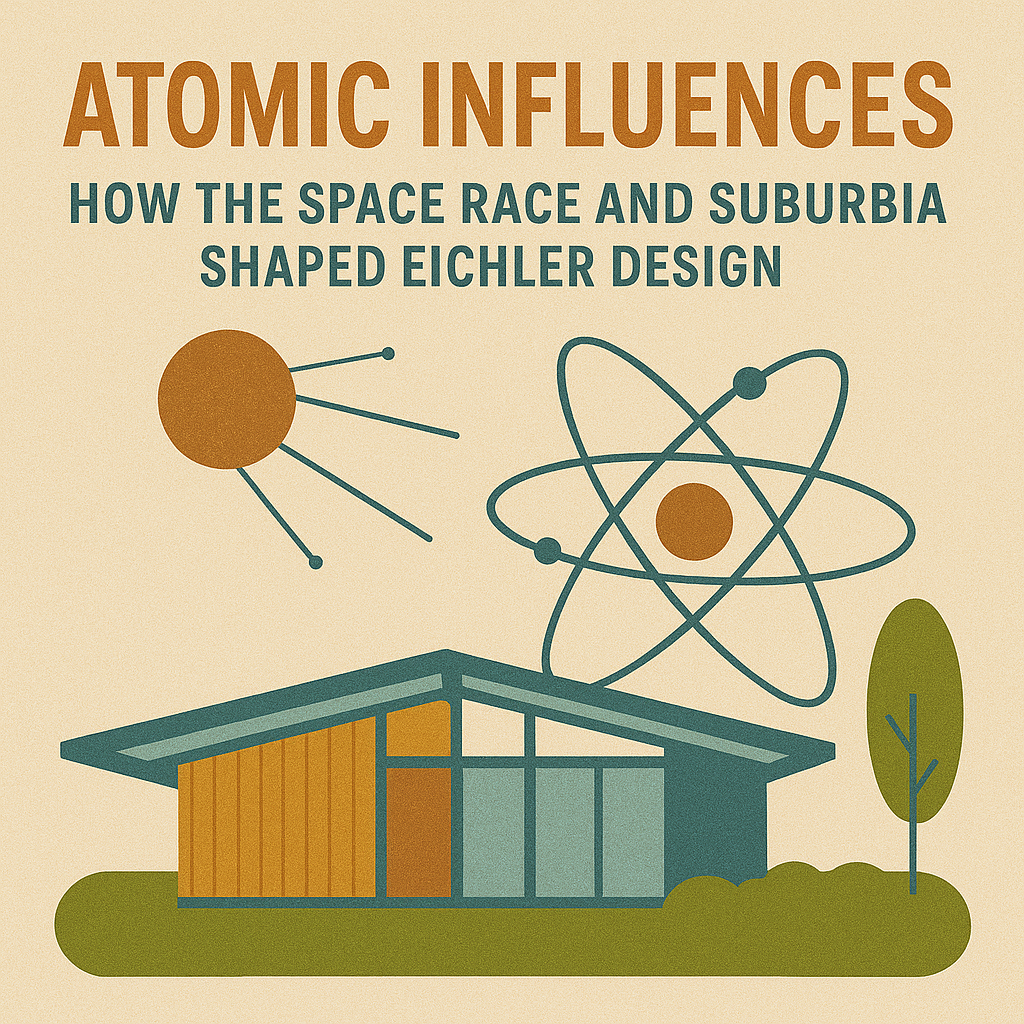
The mid-20th century was an era of rocket-fueled optimism and atomic anxiety, a time when Americans gazed toward outer space even as they settled into new homes on earth. Nowhere was this dynamic more evident than in California’s postwar suburbs, where Space Age dreams and Atomic Age aesthetics found their way into everyday living. Among the palm-lined streets and cul-de-sacs of 1950s and 60s suburbia, Joseph Eichler built modern homes that captured the zeitgeist – combining futuristic design cues from the Space Race and Cold War culture with the easy-living ethos of California’s booming suburbs. Eichler homes, with their glass walls, open plans, and bold materials, stand as time capsules of an optimistic era when modern design, technology, and the American Dream all converged. In this article, we explore how mid-century cultural forces – the Space Race, atomic-age design, and the rise of suburbia – directly shaped Eichler’s design philosophy, material palette, and architectural choices. Along the way, we’ll see how California’s aerospace industry inspired streamlined forms, how postwar optimism fostered indoor-outdoor living, and how even furniture and gardens took on “atomic” flair, from Eames chairs to starburst clocks. Ultimately, these influences were woven into Joseph Eichler’s progressive vision, as his developments mirrored the broader social currents of the 1950s and 60s.
Postwar California: Suburbia and the Space Age Spirit
By the late 1940s and 1950s, America was on the move – literally and figuratively. Millions of families left crowded cities for sprawling new suburbs, spurred by the GI Bill, a booming economy, and the allure of owning a home with a yardhouzz.com.au. In California, this suburban explosion coincided with the rise of high-tech and aerospace industries, from San Francisco’s budding electronics firms to Los Angeles’s rocket and aircraft factories. The cultural climate was a mix of hope and uncertainty: on one hand, vigorous postwar growth and scientific advances; on the other, Cold War tensions and nuclear anxieties. This mix gave birth to what we now call the Atomic Age – a design and cultural phenomenon in which even ordinary households felt the influence of atoms and astronauts.
Mid-century designers channeled the era’s contradictions – excitement about the future tempered by atomic fears – into the products and environments of daily life. The term “Atomic Age design” describes the playful, futuristic style that emerged, incorporating imagery of atoms, satellites, and rockets into everything from architecture to dishwarehouzz.com.auhouzz.com.au. During these years, as families furnished their new suburban homes, they surrounded themselves with symbols of the new age. George Nelson’s famous Bubble Lamp (designed 1947) took the shape of a mushrooming atomic cloud or a flying saucer, reflecting both the specter of the A-bomb and the lure of UFOshouzz.com.au. The Ball Clock (1949) by Irving Harper for Nelson looks like a model of an atom, with orbiting electrons as colorful ballshouzz.com.au. Even kids’ toys and fabrics joined in – Charles and Ray Eames created a “Small Dot” textile print of 1947 that abstractly depicts a molecular structurehouzz.com.au. In short, atomic motifs were everywhere, serving as a coping mechanism for nuclear anxieties and a celebration of scientific progress in the homehouzz.com.auhouzz.com.au.
This atomic enthusiasm went hand-in-hand with Space Race fever. After Sputnik launched in 1957, American pop culture became obsessed with space and futurismnps.gov. The Space Age aesthetic took off, especially in California. Futuristic “Googie” architecture – think of coffee shops and drive-ins with upswept roofs and starburst details – captured the era’s exuberance, advertising motion and modernity to passing motoristsnps.gov. Buildings sprouted parabolic shapes, boomerang angles, and neon rockets in a light-hearted homage to the space racenps.gov. While Eichler’s residential designs were far more refined than kitschy Googie diners, they still breathed the same optimistic air. His architects embraced clean lines, horizontal profiles, and expansive glass that evoked a forward-looking, streamlined future – a subtle residential echo of the jet-age styling seen in cars and aircraft. Importantly, Eichler’s houses were “accessible to the middle class”, just like the populist Googie style, reflecting a postwar belief that the future should be for everyonenps.gov. As we’ll see, many early Eichler buyers were scientists, engineers, and professors who “instantly understood the new materials [and] inventive design” of these houses and appreciated the liberating feeling of their opennesslatimes.com. In both Northern and Southern California, an educated, future-minded clientele was ready to make these modern tract houses their homes.
Joseph Eichler’s Vision: Modern Homes for the Atomic Age
Into this milieu stepped Joseph Eichler, a developer with an almost utopian vision of what a home could be. Eichler was not an architect himself – in fact, he hadn’t even worked in construction until middle age – but a wartime experience changed his life. In the early 1940s, Eichler lived for a time in a Frank Lloyd Wright Usonian house (the Bazett House in Hillsborough, CA), and it ignited his imaginationatomic-ranch.comeichlerx-100.com. Wright’s influence convinced Eichler that modern architecture – with its open layouts, integration with nature, and lack of pretentious ornament – was the way of the future. Eichler set out to bring high-quality modern design to the masses, founding Eichler Homes, Inc. in 1949eichlerx-100.com. Working with talented architects (like Robert Anshen, A. Quincy Jones, and Claude Oakland), he built nearly 11,000 homes in California between 1949 and 1974atomic-ranch.comatomic-ranch.com. These weren’t custom mansions for the elite; they were tract homes for middle-class families, but with an architectural pedigree and progressive philosophy that set them apart from typical suburban houses.
From the start, Eichler marketed “a new way of life” to postwar buyerseichlerhomesforsale.com. His developments in Northern California – places like Sunnyvale Manor, Greenmeadow in Palo Alto, and the San Mateo Highlands – and later in Southern California – such as Fairhaven in Orange and Balboa Highlands in Los Angeles’s San Fernando Valley – were laboratories for a bold idea. Eichler believed that modern design could improve people’s lives, fostering family togetherness and community. Floor plans were revolutionary for the time, ditching the formal dining rooms and compartmentalized parlors of pre-war homes in favor of free-flowing spaces. As one vintage Eichler flyer proclaimed, these houses offered more “usable living space, inside and out… [with] step-saving, work-saving space-arrangements” than any otherseichlerhomesforsale.comeichlerhomesforsale.com. Every inch was “planned” for maximum livabilityeichlerhomesforsale.com. And yet, Eichler’s marketing boasted, there were “no frills and no gimmicks” – this was modern design with integrity, not a gimmickeichlerhomesforsale.com.
What made Eichler’s vision especially progressive was not just the architecture, but the social ethos behind it. He was decades ahead of his time in promoting integration and equality in housing. Unlike most developers of the 1950s, Eichler refused to discriminate – he sold homes to anyone of any race or religion, at a time when segregation and restrictive covenants were still common. In fact, Eichler even resigned from the National Association of Home Builders in 1958 to protest their policies of racial discriminationatomic-ranch.comatomic-ranch.com. One Eichler tract in the San Fernando Valley was among the first open to Black and Asian buyers in that area (pre-dating the Civil Rights Act) – and when some neighbors objected, Eichler retorted that the only color he cared about was “green, as in money,” offering to buy back homes from anyone unhappy with integrated living (no one took him up on it)balboahighlands.com. This commitment to fair housing for all was part and parcel of Eichler’s optimistic outlook. His goal was, as one historian noted, to quietly demonstrate that integrated neighborhoods “worked just fine as a business”, thus paving the way for broader acceptanceatomic-ranch.comatomic-ranch.com. In Eichler’s mind, the American Dream of the postwar era – a home, a family, a better life – should be accessible to everyone, delivered in a modernist wrapper that spoke to the future.
Space-Age Style: Futuristic Forms and Materials in Eichler Homes
While Eichler’s ideals set the direction, it was the design of the homes themselves that truly captured those atomic age influences. Walk up to an Eichler home and you immediately sense how different it is from a traditional 1950s house. Instead of a tall facade with a big picture window, you often see a low-slung horizontal roof, sometimes with a modest peak or A-frame at the center to mark the entrance atriumlatimes.com. The street face is purposefully subtle – blank carport walls or sparse windows maintain privacy – but the drama unfolds inside. Passing through the front door of an Eichler is like stepping into the future as imagined in 1955: suddenly you are in a glass-lined atrium or foyer that opens up to the sky and garden. From there, the interior expands outward, blurring the line between indoors and outdoors at every turn. Glass walls stretch from floor to ceiling at the rear and around courtyards, inviting nature in and making the house feel boundless.
This openness was made possible by innovative construction that Eichler’s architects borrowed from high-tech commercial building. Instead of heavy supporting walls, Eichler houses use a lightweight post-and-beam framework, akin to the skeleton of a modern airplane hangar or pavilion. Wooden posts and steel beams around the perimeter carry the load, freeing up the interior. The result is large spans of glass and the ability to configure space with movable panels rather than static wallslatimes.com. As the Los Angeles Times noted, Eichler’s use of this nontraditional structure meant far fewer support walls were needed, which enabled the hallmark “unobstructed movement from room to room and visibility inside and out”latimes.comlatimes.com. For the average 1950s family used to boxy bungalows, living in an Eichler felt thrillingly modern – “like a glass box set outside,” where you could see your yard (and even the stars) from almost anywhere in the houselatimes.com. Matt Kahn, who helped decorate Eichler model homes, quipped that modern architecture is like a nudist colony – it strips down to essentialslatimes.comlatimes.com. In Eichlers, those essentials were glass, wood, and concrete, composed in clean lines that were radical in their simplicity. This stripped-down, transparent quality echoed the era’s fascination with transparency and openness – a counterpoint to the secrecy and fear of the Cold War. Space Age design was not only about literal rockets and atoms, but also about an underlying idea: that the future would be open, airy, and efficient.
Several Eichler models even pushed the envelope of futurism in materials. In 1956, Eichler built an experimental all-steel house known as the X-100 in San Mateo Highlands – a showcase of modern engineering applied to suburbia. This model home featured a steel frame (rather than wood), advanced amenities, and ultra-modern styling; it was like a Case Study House come to life in a tract development. Visitors flocked to see its “house of tomorrow” features, which reportedly included novel ideas like movable partitions and an indoor barbecue, capturing the imagination of a public enchanted by science and technology. While most Eichler homes stuck to wood post-and-beam construction (due to cost and practicality), the X-100 steel house demonstrated Eichler’s willingness to incorporate aerospace-grade materials and ideas into domestic architecture. Indeed, California’s aircraft industry was pioneering new alloys, glass technologies, and plastics in the 1950s – and those often found civilian uses. Large panoramic windows and sliding glass doors, for instance, benefited from better glass manufacturing (including tempering techniques) developed in part for industrial needs. Radiant heating – coils of hot water tubing embedded in the concrete slab floors of Eichler homes – was a modern comfort borrowed from commercial and military applications (radiant heated hangar floors, etc.)atomic-ranch.com. Eichler made this high-tech feature standard, eliminating the need for radiators or ducts and keeping interiors uncluttered. Even the roof designs were forward-looking: many Eichlers have thin-shell flat roofs with deep eaves that extend dramatically, a bit like the cantilevered wings of an aircraft. These thin roofs were made possible by new waterproofing materials and insulation methods just coming into use. In Southern California Eichler tracts, some models sported double-pitched “butterfly” roofs or exaggerated gables, touches that gave them a Jetsons-like profile against the sky (and indeed made them landmarks of mid-century style in places like Orange County and Granada Hills).
It’s no surprise that Eichler developments attracted scientifically minded buyers. As one writer noted, “academics in San Francisco as well as architects and aerospace engineers in Southern California instantly understood the new materials [and] inventive design” of Eichler’s houses, appreciating their “liberating” open layouts with a minimum of interior wallslatimes.com. In the Bay Area, many Eichler residents were Stanford University faculty or tech industry professionals who loved the connection between the modern lifestyle and the burgeoning tech future around them. In Orange County and the San Fernando Valley, it was common for Eichler owners to be employed in the aerospace and defense industry – the very folks building rockets by day were coming home to live in a space-age house by night. One can imagine an engineer at Lockheed or Northrop in 1962, driving back to his Eichler in Orange, admiring the clean, horizontal lines of the house that looked as streamlined as an aircraft hangar. Perhaps he’d step inside and marvel at the way the clerestory windows (a row of high windows) brought in the late afternoon light, or how the polished concrete floor and open beam ceilings created an atmosphere of cool, modern calm. In short, Eichler homes embodied the Space Age spirit – not with gaudy spaceship forms, but with an underlying commitment to innovation, efficiency, and looking forward. As a 1960s Eichler brochure put it, these were “houses that go beyond the ordinary…with much more thought and care,” offering a lifestyle that felt cutting-edgeeichlerhomesforsale.com.
Indoor-Outdoor Living: Optimism in Architecture
Perhaps the most cherished aspect of Eichler design – and one directly influenced by California’s postwar optimism – is the concept of indoor-outdoor living. In the 1950s, the idea of seamlessly connecting the interior of a home to the outdoors was novel. Earlier houses had front porches or back patios, but they were clearly separate realms. Eichler homes obliterated that separation. “Rooms and patios as one living space,” proclaimed Eichler’s marketing, and this wasn’t just ad-speakeichlerhomesforsale.com. It was literally built into the architecture. Every Eichler was oriented around nature in some way – many have a central atrium, essentially an open-air courtyard inside the footprint of the house, bringing sunlight, breezes, and maybe even a tree or garden right into the heart of the home. Those without atriums still have expansive glass walls and multiple sliding doors linking to private yards. The effect is that the home extends outward: a small 1,500 sq. ft. Eichler can feel twice that size when the glass walls are opened to the yard and the patios are furnished as outdoor rooms.
This blurring of indoors and outdoors was perfectly suited to California’s mild climate, but it was also a philosophical statement. Postwar California embodied the good life – sunshine, fresh air, swimming pools, and backyards for BBQs. Architects of the time (like Richard Neutra and Cliff May, alongside Eichler’s team) believed that connecting to nature improved one’s well-being. There was a healthful optimism in opening up the house – a sense that we had nothing to hide and everything to gain from sunlight and transparency. In Eichler’s case, indoor-outdoor living also reinforced family togetherness. Parents in the kitchen could easily watch children playing in the atrium or yard through floor-to-ceiling glass. Entertaining friends? The party could flow from the living room out to the patio seamlessly, with music drifting between the spaces. One Eichler advertisement highlighted this “usable living space, inside and out,” noting that the design created more living area than any conventional home by treating the patio as essentially another open-air living roomeichlerhomesforsale.comeichlerhomesforsale.com.
Inside the houses, open floor plans further fostered a casual, communal lifestyle. Eichler homes featured free-flowing living, dining, and kitchen areas without the partitions or formal dividers common in older homeslatimes.com. This was family-friendly design: Mom or Dad could cook dinner on the new built-in appliances (Eichlers were sold with state-of-the-art appliances) and still chat with guests in the living room or keep an eye on homework at the dining table. Such layouts encouraged a democratic use of space – no “best parlor” reserved for guests only, but rather one continuous space for everyone to live in daily. It’s no coincidence that this era saw the birth of the “family room” or den as a concept (Eichler plans often included a multipurpose room for TV or hi-fi listening, acknowledging new leisure activities)latimes.com. Even the bedroom areas were arranged with modern living in mind: Eichlers commonly had a kids’ wing of secondary bedrooms and a small second bathroom that opened to the yard – perfect for children running in and out from playlatimes.com. Every design move was about informality and ease, hallmarks of the optimistic postwar lifestyle.
Material choices reinforced the indoor-outdoor vibe. Eichler’s architects often used the same materials on interior and exterior, creating continuity. For example, the interior ceilings were clear tongue-and-groove redwood or cedar that extended out to form the eaves of the house, visually blurring where house ends and yard begins. Interior flooring was usually a concrete slab (finished often with linoleum or tile) that continued out to the patio as concrete paving – sometimes even the exact same level, so that when the sliding door was open the floor just flowed outside. In some models, brick or stone walls ran from inside fireplaces right through the glass to become exterior garden walls, again merging inside and outside. The use of large glass panels was itself a way of dematerializing the wall – instead of a solid barrier, you had a transparent plane. One restored Eichler model even painted an entire wall the same color on both the interior side and the exterior side to create an “unbroken, flowing look” when viewed through the glassatomic-ranch.com. These tricks made the home and yard feel like one continuous environment.
Landscaping of Eichler homes also embraced a mid-century modern aesthetic aligned with atomic-age trends. Forget fussy Victorian rose gardens; Eichler yards were often minimalist and geometric. Many front courtyards and back patios featured breeze block screens – decorative concrete blocks with atomic-era patterns (like starbursts or diamonds) that not only looked chic but cast cool shadows in the California sun. Plant choices tended toward the exotic and easy-care: succulents, Japanese maples, palms, and sculptural evergreens that provided form and color year-round. The landscaping was considered part of the design: a curated backdrop for the home’s architecture. In fact, Eichler initially delivered homes with simple modern landscaping includedeichlerhomesforsale.com – a clean slate of young trees, lawn, and maybe gravel or lava rock accents – knowing that owners would personalize later. In the backyard, the 1950s outdoor living craze often led Eichler owners to add their own Space Age touches. Kidney-shaped pools became a coveted feature (especially in Southern California), echoing the amoeboid shapes celebrated in mid-century design. These pools, with their curvy forms and turquoise blue water, perfectly complemented the straight lines of the houses – a little bit of playful Atomic-Age glamour under the sun. Poolside, one might find retro patio furniture: butterfly chairs or chaise lounges with angular metal frames, perhaps a freestanding fireplace or an “astro” barbecue grill looking like a flying saucer. Nighttime entertaining might be lit by tikis and string lights, as Polynesian Tiki culture was another escapist trend of the atomic era, harmonizing surprisingly well with the Eichler vibe.
For Eichler’s California, outdoor living was an expression of postwar optimism. It spoke to confidence that the backyard was safe, private, and yours – a little domestic paradise where the world’s troubles (at least for a moment) could be kept at bay. During the Cold War, many Americans built bomb shelters; but Eichler’s designs implied openness instead of bunker mentality. (It’s telling that Eichler’s experimental X-100 steel house did not really emphasize a fallout shelter, but rather showcased futuristic conveniences – the focus was on living in style, not hiding in fear.) This isn’t to say Eichler owners ignored Cold War realities – some probably did add shelters – but the architecture itself projected hope and confidence in the future. Floor-to-ceiling glass, after all, is an expression of trust: trust in one’s neighbors, in one’s environment, and in the idea that tomorrow will be bright. As one Atomic Ranch writer put it, Eichler designs “emphasized the designs of the future and created optimism for all of those who lived in or visited one of his homes.”atomic-ranch.com Indeed, stepping into an Eichler, then as now, one can’t help feeling a certain uplift. The home surrounds you with light, sky, and the greenery of your own yard, as if saying: welcome to the good life. This was the California Dream that Eichler offered – a modern utopia at an affordable price, wrapped in glass and bathed in sunlight.
Atomic-Age Decor: Eames, Nelson, and the Modern Interior
If the architecture set the stage, the furnishings and decor of Eichler homes completed the atomic-age picture. Joseph Eichler not only built houses; he sold a lifestyle. His model homes were famously well-appointed with contemporary furniture and artwork chosen to appeal to forward-looking buyers. In the mid-20th century, that meant Eames chairs, Nelson clocks, Noguchi tables, and more – pieces that have since become classics of modern design. Many of these designs were directly inspired by the same Space Age and atomic currents that influenced the houses.
Take, for example, the living room of a 1960 Eichler: one might find a low-slung Eames lounge chair in the corner – Charles and Ray Eames’s 1956 masterpiece of molded plywood and leather. Its organic curves and innovative use of materials (techniques honed from WWII plywood molding experiments) perfectly suited the Eichler’s mix of natural wood and high-tech vibe. Across the room, hanging from the exposed beam ceiling, there could be a George Nelson Bubble Lamp emitting a soft glow. The Nelson Bubble Lamp, first produced in 1952, was actually inspired by military technology – Nelson used a spray-on self-webbing plastic developed for WWII to create the lamp’s cloud-like formhouzz.com.au. The result was a pendant light that looked a bit like a UFO or an atom’s nucleus, a subtle nod to the atomic age hanging over the Eichler dining table. On the wall, perhaps tick-tocking away, a Nelson Ball Clock or Sunburst Clock might be mounted as functional art. With radiating spokes and brightly colored spheres, the Ball Clock (1949) explicitly “recalls the diagram of an atom”houzz.com.au – it’s essentially the atomic model turned into cheerful wall decor. Such clocks, along with starburst mirrors and artworks, were extremely popular in mid-century homes, adding a dash of atomic symbolism to everyday life.
The influence didn’t stop at major furniture pieces. Even the small accents and textiles echoed atomic and space motifs. The Eameses, for instance, designed whimsical textiles like the “Hang-It-All,” which isn’t a textile but a coat rack (1953) composed of wooden balls on a wire frame – it looks like a molecular model that you hang your hat onhouzz.com.au. They also made actual fabrics with abstract patterns evocative of constellations and atoms. Kitchens might feature Formica countertops with boomerang or star patterns, and serving dishes might be in the shape of atomic orbits (the classic atomic age dish design features starbursts and little atom icons). Color schemes in Eichler interiors were often a mix of earthy and bold, reflecting both nature and technology. The backdrop of the house was natural – warm wood paneling and white ceilings – but accents popped with “bright colours” emblematic of the erahouzz.com.auhouzz.com.au. Turquoise, citrus orange, chartreuse green, and pink were all in vogue and signaled a certain futurist cheer. As one design historian noted, having a range of colorful objects in the home was seen as “a testament to American prosperity and democracy” in the 1950shouzz.com.au. In other words, the ability to choose a bright pink sofa or an aqua blue refrigerator (yes, colorful appliances were a thing) symbolized the freedom and abundance of postwar life. Eichler homeowners often embraced these palettes – a turquoise front door here, an orange Sputnik hanging lamp there – to personalize their modern abode.
And speaking of Sputnik: no discussion of mid-century decor is complete without the iconic Sputnik chandelier. This multi-armed light fixture, exploding in all directions with bulb-tipped rods, was directly inspired by the 1957 satellite that kicked the space race into high gear. Designers took the literal form of the Sputnik satellite and made it a stylish home accessory. In Eichler homes, especially in later years and modern restorations, Sputnik chandeliers often serve as a crown jewel in the living or dining area. They are described as “the quintessential mid-century centerpiece” – “an Atomic Age motif” that is both retro and futuristic, mimicking Sputnik’s radiating shapeeichlerhomesforsale.comeichlerhomesforsale.com. To an Eichler owner in the early 1960s, installing a Sputnik light would have been the ultimate declaration of hip, space-age taste. It is literally space race décor in action. Even today, Eichler enthusiasts seek out these starburst lights to honor the home’s rootseichlerhomesforsale.com.
Moving to the kitchen and appliances, Eichler homes were outfitted with the latest gadgets which themselves were often styled in the language of the future. Many Eichlers boasted built-in Thermador ovens, Frigidaire refrigerators, and other “push-button” marvels advertised as space-age conveniences. Brochures touted “the latest built-in appliances” that would “add time to your day and years to your life,” underscoring how technology was sold as the key to better livingeichlerhomesforsale.com. One can imagine an Eichler sales center in 1960 with a model kitchen on display: gleaming metal appliances with sleek dials (perhaps styled after airplane instrument panels) and maybe even a futuristic clock above the range. The cabinetry in Eichlers was often flat-front and unadorned, very different from the carved wood cabinets of traditional homes – again a sign of modernity. Some kitchens had sliding partition walls or pass-through windows to the patio (for serving outdoor meals), features that emphasized ease and a modern lifestyle of leisure. Period advertising for such kitchens often showed a housewife smiling as she pressed the buttons of her new appliances, usually with a slogan about “the miracle kitchen of tomorrow – today.” In Eichler’s case, this wasn’t far from reality; he really did install then-cutting-edge appliances and features like radiant heat to make his homes feel like the future had arrived.
Period advertising and media played a huge role in broadcasting Eichler’s atomic-influenced vision. Eichler’s own marketing campaigns were clever and ahead of their time. He invested in glossy brochures and magazine ads that often sold the dream more than the product. For example, a 1955 Eichler Homes brochure boasted “1,680 sq. ft. of space… and every inch of it planned!”, emphasizing efficient use of space as a selling pointeichlerhomesforsale.com. In the 1960s, Eichler ads proclaimed the “Wonderful World of Eichler”, an optimistic play on Disney’s “Wide World” perhaps, promising buyers an idyllic life of comfort and convenienceeichlerhomesforsale.com. These pamphlets were richly illustrated, sometimes even featuring people (unusual at the time) to help buyers imagine the lifestyle. One promotional postcard from the Terra Linda Eichler tract showed a fashionable woman in her Eichler living room looking out to the terrace, with text noting that Eichler Homes had won many national design awards and were featured in Life magazine – effectively associating Eichler with cutting-edge design and national pride (indeed, Eichler homes did appear in magazines and won accolades). Eichler’s ad man understood that to sell a modern house, you sell a modern life. Thus, ads mentioned *“step-saving” layouts, “picture windows,” and “indoor-outdoor flow”, highlighting features that resonated with the space-age consumer mindseteichlerhomesforsale.comeichlerhomesforsale.com. Even the graphic design of Eichler’s marketing was modern: clean sans-serif fonts (a “just the thing for the transition into the ‘New Atomic Age’”, as one design review quippedultraswank.net) and bright colors were used to convey a break from old-fashioned ways.
Beyond Eichler’s own marketing, the broader media was celebrating the Atomic Age home. Popular magazines like Better Homes & Gardens and Sunset regularly ran features on “The House of Tomorrow” or “California Living”, showing floor-to-ceiling glass houses with families enjoying indoor-outdoor living. Advertisements for everything from televisions to Tiki torches showed suburban backyards as spaceships of leisure, with modern furniture and smiling space-age families. In movies and TV, the mid-century modern home became a symbol of affluent futurism – consider The Jetsons (which was animated fantasy, but reflected the era’s ideals of domestic automation and style) or the set designs of films like Monsanto’s House of the Future. Eichler homes, for their part, occasionally appeared in print and film as exemplars of the trend. This media environment reinforced to Eichler buyers that they were part of something big and exciting: a nationwide movement toward progressive design. Buying an Eichler wasn’t just purchasing a house; it was like joining a club of the future-oriented.
Legacy: Eichler Homes as Mid-Century Time Capsules
Standing in front of an Eichler home today – say, in Palo Alto’s Greenmeadow or Orange’s Fairhills – you can still feel the atomic influences radiating from its design. The Space Race and the rise of suburbia left a permanent imprint on these houses. From their daring use of glass and openness (a legacy of space-age optimism) to the starburst chandeliers and Eames furniture that often adorn them, Eichler homes are living museums of the 1950s/60s ethos. They embody a time when society believed in progress through design: when a house could be an engine of social change and personal happiness.
Joseph Eichler’s developments indeed reflect broader social currents of their era. They capture the postwar optimism and faith in technology – the notion that new materials like steel, concrete, and plate glass, arranged in new ways, could fundamentally improve daily lifeatomic-ranch.com. They mirror the democratization of good design: Eichler proved that you didn’t have to be a millionaire or an avant-garde tastemaker to live in a home with floor-to-ceiling glass and cutting-edge style. As architectural historian Marty Arbunich observed, Eichler gave architects a starring role in tract housing in a way no one else did, essentially mass-producing the kind of modernism that had been seen only in custom homes beforeatomic-ranch.comatomic-ranch.com. In doing so, Eichler’s homes became architectural icons of American mid-century modernismatomic-ranch.com. They were truly ahead of their time – so much so that by the 1970s, some found them passe or odd, but by the 21st century, a wave of appreciation came full circleatomic-ranch.com. Many Eichler neighborhoods are now protected historic districts, and the homes are highly sought after by enthusiasts who cherish their design and heritagelatimes.comlatimes.com.
Crucially, Eichler homes also stand as monuments to a progressive social vision. They remind us that in an age of conformity (the proverbial “cookie-cutter suburbia” of the 50s), one developer dared to be different – not only aesthetically, but morally. Eichler’s open housing policy and inclusive communities anticipated the social revolutions of the 1960s. In an Eichler cul-de-sac, you might find a diverse mix of families gathered for a block party, children of all backgrounds playing together on the shared green spaces that Eichler sometimes incorporated into his plans (he even attempted a tract with communal parks between homes, an idea “ahead-of-its-time” that local authorities initially rejected)balboahighlands.com. Those images foreshadow the breaking of barriers that would come nationally. It’s fitting that Eichler homes themselves broke the physical barriers between inside and outside. It’s as if the architecture’s openness was a metaphor – or perhaps a catalyst – for open-mindedness in living.
Today, stepping through the atrium of an Eichler, under the gentle patter of an integrated courtyard fountain or the shade of a Japanese maple, one can imagine the original owners in their Mad Men-era attire, full of hope for the future. The styling may be retro, but the feeling of optimism and clarity in these spaces is timeless. The Atomic Age influence – that blend of space-age wonder and atomic-inspired art – gives Eichler homes a unique charm. It’s in the angled glow of a Nelson lamp at dusk, the way the home glows like a lantern. It’s in the outline of a butterfly roof against a starry sky, looking a bit like a rocket about to take flight. It’s in the playful starburst patterns you might still find in original bathroom tiles or decorative screens. These touches keep the 1950s dream alive within Eichler walls.
In the end, Eichler design shows that a house is more than wood and glass – it is a cultural artifact. Eichler homes were forged in the crucible of the Cold War, shaped by the Space Race and suburbia as surely as NASA’s rockets or GM’s tailfin cars were. They are Atomic Ranches in the truest sense: ranch-style family homes energized by atomic-age innovation. Joseph Eichler’s legacy is that he allowed thousands of families to “live the true California lifestyle” with “designs of the future”atomic-ranch.comatomic-ranch.com. Those futures have become our history, and thanks to Eichler’s vision, we can still walk through those doors and experience the optimistic mid-century spirit today. In a world that’s very different from 1955, Eichler homes remind us of a time when design was brimming with belief in a better tomorrow – an atomic influence that continues to inspire architects and homeowners alike. The Space Race may be long over, but its imprint endures in every glass-walled Eichler atrium opening up to the Californian sky.
Sources:
Gross, Rebecca. “Atomic Age Design: Still Blasting its Way into Homes Today.” Houzz, 2014.houzz.com.auhouzz.com.au
National Park Service. “The Space Age in Construction.” (Transcript, Caroline Guay) 2021.nps.govnps.gov
Los Angeles Times. “A Rousing Encore for the Eichlers,” Mar. 2, 2006.latimes.comlatimes.com
Boyenga Team. “Marketing Modernism: How Eichler Sold a Vision, Not Just a House.” EichlerHomesForSale.com, 2020.eichlerhomesforsale.comeichlerhomesforsale.com
Jarvis, Lindsay. “Experimental Eichler: Tour the Restored X-100.” Atomic Ranch, Mar. 26, 2019.atomic-ranch.com
Sanders, Brooke, and Rabekah Henderson. “Joseph Eichler: His Work + Designs.” Atomic Ranch, Aug. 17, 2020.atomic-ranch.comatomic-ranch.com
BalboaHighlands.com. “History – Balboa Highlands – An Eichler Neighborhood.” (n.d.)balboahighlands.combalboahighlands.com
Marcum, Anna. “The Age of Eichler: Mid Century Modern Residential Architecture.” Atomic Ranch, May 28, 2021.atomic-ranch.comatomic-ranch.com
Eichler Network. CA-Modern Magazine. “Eichler’s Ad Man Ran Clever Campaigns.” (blog snippet)eichlerhomesforsale.comeichlerhomesforsale.com
Eichler Lighting Guide. “The Best Mid-Century Modern Light Fixtures for Authentic Eichler Style.” EichlerHomesForSale.com, 2021.eichlerhomesforsale.com
Sources