
Atrium Addicts Anonymous: Why Eichler Courtyards Are the Original Wellness Rooms

Imagine stepping through your front door and into a sun-drenched, open-air courtyard – a private garden under the sky, right at the heart of your home. For owners of mid-century Eichler houses, this scenario wasn’t a fantasy but everyday life. Decades before “wellness architecture” and biophilic design became buzzwords, visionary developer Joseph Eichler was integrating nature into suburbia by building atriums (open courtyards) directly into his homes. These atriums provided natural light, fresh air, and a calming connection to nature that today’s wellness-driven homeowners crave. In essence, Eichler’s mid-century atrium was the original home wellness room – promoting serenity and healthful living long before anyone gave it that name.
A Radical Mid-Century Idea: The Eichler Atrium
In the late 1950s, Eichler and his architects unveiled a bold new concept in tract housing: the central atrium, essentially a room that’s outdoors eichlerhomesforsale.com. First debuted in 1958 by architects A. Quincy Jones and Frederick Emmons, the “Atrium Model” Eichler featured a fully enclosed courtyard at the center of the home, open to the sky above eichlerhomesforsale.com. This was a radical departure from the typical suburban ranch house of the era. Instead of a closed-off foyer or formal living room, you entered directly into an open-air oasis. Multiple rooms – living, dining, even bedrooms – faced into this glass-walled courtyard, so that the bright core of the house filled with natural light and a sense of the outdoors eichlerhomesforsale.com. What had essentially been a hole in the house became Eichler’s most popular and defining feature, flipping conventional home design inside-out. Rather than presenting big picture windows to the street, Eichler homes put their best face inward: the atrium was the jewel-box garden hidden within, while the street side remained modest and private eichlerhomesforsale.com.
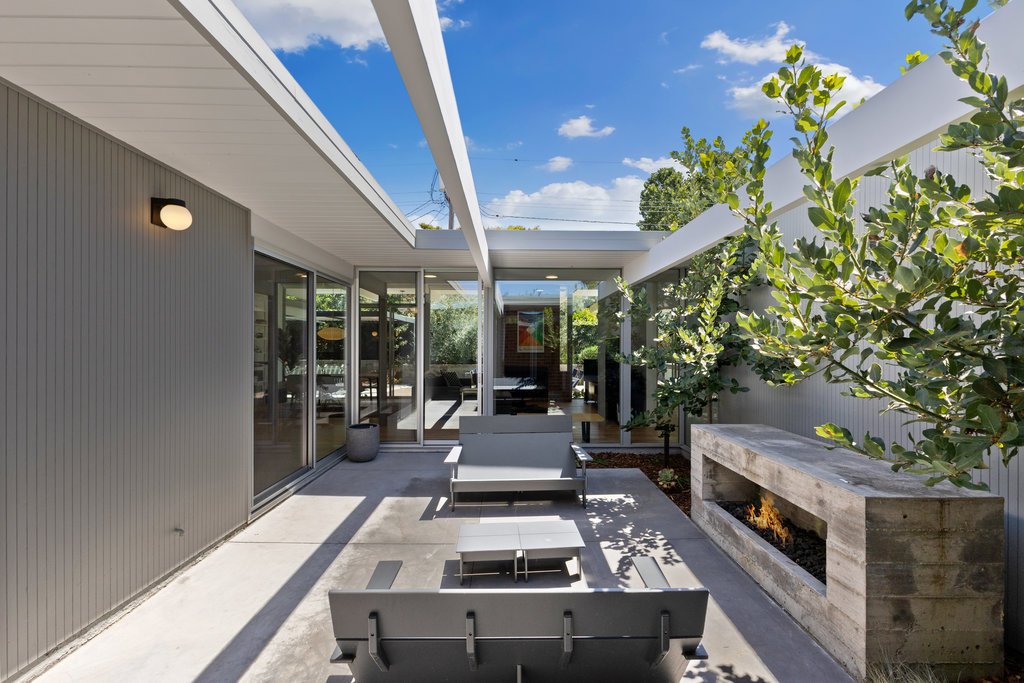
An Eichler atrium brings the outside in – a private open-sky courtyard at the center of the home, surrounded by glass walls and greenery. This mid-century design turned a simple suburban house into a light-filled indoor/outdoor sanctuary.
It’s hard to overstate how innovative this was in mid-century tract developments. In a time when most builders were churning out cookie-cutter ranches, Eichler homes offered a wow factor from the moment you stepped inside. Visitors would be greeted by an unexpected vista of sky, plants, and modern architecture “in the middle of the house,” as one awed Eichler owner described eichlerhomesforsale.com. Eichler’s atriums were typically landscaped with pavers, planters, and even small trees, creating a serene courtyard garden that was completely enclosed yet felt boundless eichlerhomesforsale.com. Privacy was paramount: behind a relatively blank street façade, the family could lounge or dine under the sun with no neighbors peeking in. Entering an Eichler atrium was like discovering a secret garden – an experience worlds apart from the closed-in living rooms of a traditional 1950s home. Little wonder that the atrium quickly became Eichler’s signature; by the early 1960s, nearly every new Eichler model included one, and it was “the defining feature of Eichlers for many owners” eichlerhomesforsale.com.
Biophilic Design Before Its Time: Bringing the Outside In
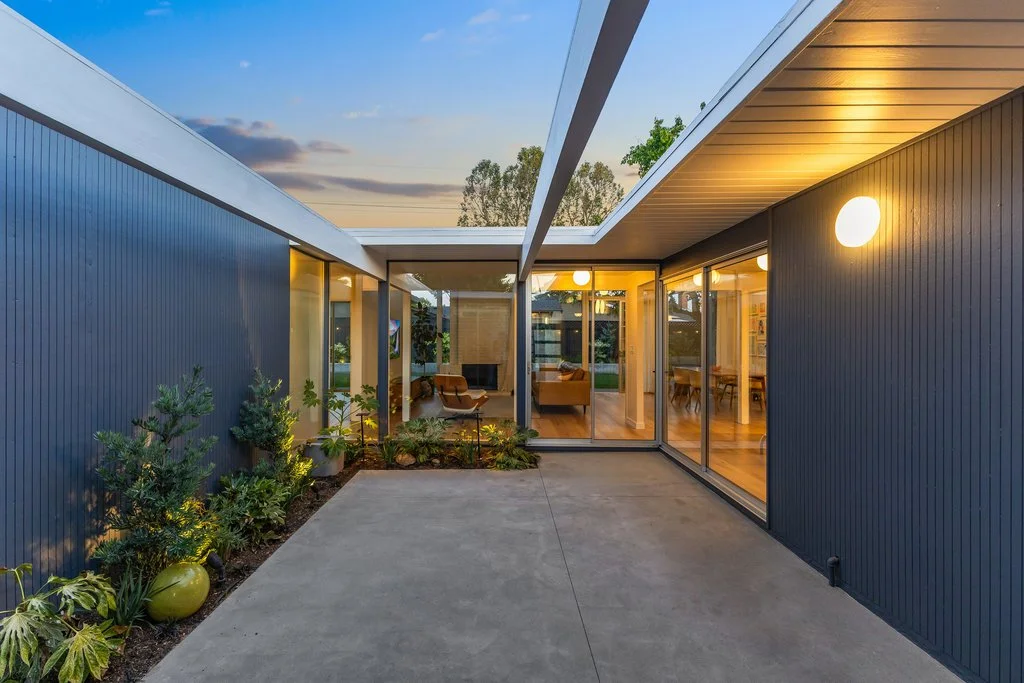
Eichler didn’t use the term “biophilic design” in the 1950s, but he intuitively grasped its principles. He believed in “bringing the outside in” – dissolving the boundary between home and nature eichlerhomesforsale.com. Each Eichler atrium was a tangible expression of this philosophy. Instead of treating the outdoors as something separate, Eichler homes made nature an integral part of the house. Sunlight, plants, and even rain and stars were invited into daily life via the atrium. Joseph Eichler felt that exposure to nature made for happier living eichlerhomesforsale.com, a view influenced by Frank Lloyd Wright’s indoor-outdoor Usonian designs and California modernists. The result was decades ahead of its time: “The biophilic design aspect – connecting occupants to sunlight, plants, and the rhythms of nature – was decades ahead of its time,” as one analysis notes eichlerhomesforsale.com.
Original Eichler brochures and photos proudly showed families using their atriums as an extra living room – kids playing under open skies, parents reading by lush foliage, or everyone dining alfresco inside the house eichlerhomesforsale.com. One Eichler homeowner famously said “the atrium provides drama and an additional living area” unlike any conventional foyer eichlerhomesforsale.com. In other words, the atrium wasn’t wasted space – it was a functional extension of the home’s living space, imbued with a kind of everyday magic. Surrounded by floor-to-ceiling glass, you could sip your morning coffee next to ferns and flowers, watching the clouds above, all while being sheltered in the center of your home. This daily connection to nature wasn’t just aesthetically pleasing; it was restorative. Modern research now validates what Eichler’s instinct told him: even indirect exposure to nature can reduce stress and improve well-being buchan.com. By surrounding residents with natural light and greenery, Eichler homes were essentially providing wellness benefits long before “wellness” was a design goal.
Crucially, Eichler’s indoor-outdoor design was inclusive. These weren’t elite custom homes with expansive estates – they were middle-class tract houses that gave everyday families access to modern architecture and its benefits. Eichler’s communities were known for their diversity and openness (he famously refused to discriminate in sales), and the atrium symbolized that ethos of healthy, joyful living for all. In an Eichler, nature was democratized: anyone could enjoy a private slice of California sunshine and a view of the sky, right at home. Fast-forward to today’s design trends, and it’s clear Eichler’s ideas presaged our current emphasis on healthy, human-centered homes. The atrium was effectively a mid-century meditation garden, a place to decompress and enjoy “sunlight, plants, and the rhythms of nature” on a daily basis eichlerhomesforsale.com.

Light, Air, and Flow: Designing for Natural Comfort
Beyond its beauty, the Eichler atrium was highly functional, engineered to improve the home’s environment through passive design. Natural light was one obvious benefit. In Eichler’s single-story layouts, exterior street-facing walls often had few or no windows (both for privacy and to reduce heat loss). The atrium cleverly solved what could have been a dark interior by flooding the center of the house with daylight eichlerhomesforsale.com. With bedrooms and living spaces opening to the atrium, many rooms received light from two sides – the outside and the atrium side – eliminating the gloom of long internal hallways eichlerhomesforsale.com. The effect was a bright, uplifting interior throughout the day. Homeowners enjoyed sunlit kitchens and lounges without sacrificing privacy, since all that glass faced the enclosed courtyard.
Crucially, Eichler’s architects also understood the sun’s path and seasonal dynamics, employing design elements to keep the home comfortable year-round. For example, Eichler homes feature broad roof eaves (overhangs) that act as built-in sunshades. These overhangs were sized to block the high-angle sun in summer, preventing the interiors from overheating eichlerhomesforsale.com. In winter, when the sun is lower in the sky, the sunlight can stream under the eaves to help warm the house. This passive solar shading strategy meant that an Eichler living room could be bathed in gentle daylight without becoming a sweltering greenhouse – the roof itself provided seasonal moderation eichlerhomesforsale.com. Many owners also embraced landscaping as a tool for comfort: deciduous trees were often planted around Eichlers, especially on the west and south sides, to cast cooling shade in summer and then drop their leaves in winter to let the sunshine in eichlerhomesforsale.com. In essence, the home and its garden worked in tandem with nature’s cycles. It’s a simple but ingenious approach to climate control – one that sustainable architects today still recommend (think of how modern passive solar homes use overhangs and leafy trees exactly the same way). Eichler homes were responsive to their environment, leveraging sun and shade to maintain a pleasant indoor temperature without mechanical intervention.
Fresh air flow was another area where Eichler’s atrium shined. These homes were built in an era of mild California climates and relatively scarce air-conditioning, so passive ventilation was critical. The atrium acted as a central lung, enabling the house to breathe. Open the sliding glass doors that ring the atrium and cool breezes can flow through the heart of the house, naturally cooling the interiors on warm days eichlerhomesforsale.com. In fact, the open-sky atrium creates a classic cross-ventilation pattern: air enters from the perimeter windows and is drawn through the atrium, then exits on the opposite side, carrying heat out with it. Eichler owners have long cherished this ability to throw open their atrium doors and let the whole house ventilate at once eichlerhomesforsale.com – an experience far more delightful than the hum of an air conditioner.
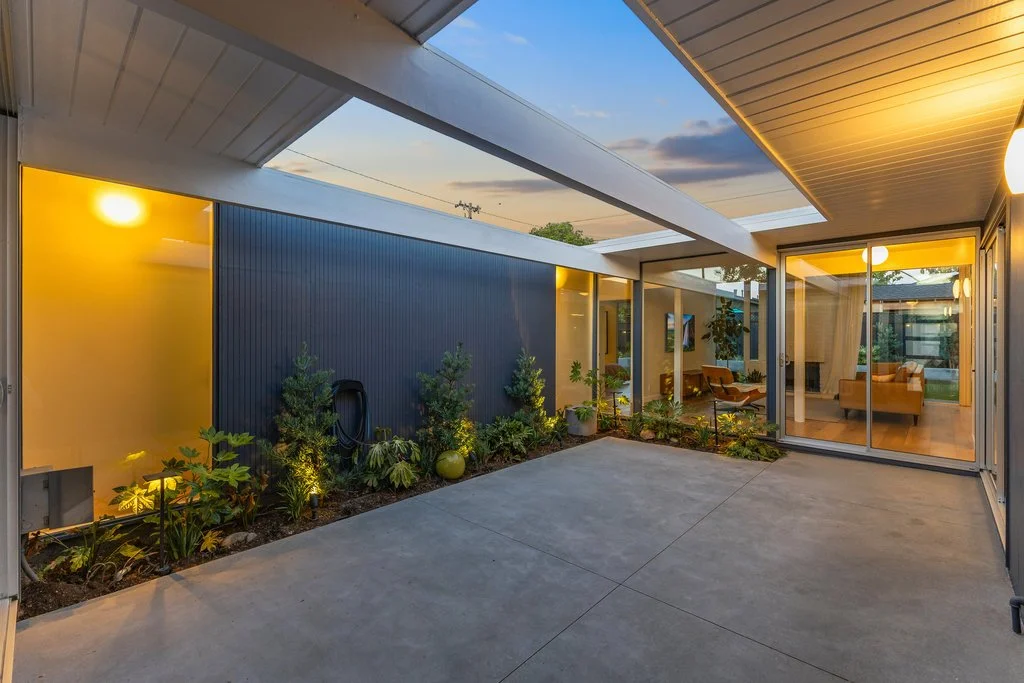
Even more impressively, the atrium can function as a thermal chimney. Hot air naturally rises, and with an Eichler atrium open to the sky, warm air from the house will escape upward out of the courtyard. This creates a slight vacuum that pulls cooler air in through lower windows, setting up a convection current. As one guide notes, “If your Eichler has a central atrium, use it! Open the atrium’s sliding doors and any high windows – the atrium will act like a chimney, allowing warm air to rise out and drawing breezes through the surrounding rooms.” eichlerhomesforsale.com In effect, the whole house vents its heat through that open roof. On summer evenings, homeowners can flush out lingering heat by opening up the atrium and letting the cool night air sink in. This stack effect ventilation is a key reason Eichler’s original owners often managed without A/C – the design itself encouraged active climate moderation by Mother Nature. Many mid-century Eichler residents found that on all but the hottest days, these passive tricks kept the indoor temperature comfortable eichlerhomesforsale.com. It’s a lesson in sustainable design that remains relevant: why not harness cross-breezes and convection to cool your home, instead of cranking up the HVAC? Modern eco-conscious builders are coming back around to these ideas, but Eichler was doing it in the 1960s with just wood, glass, and clever planning.
Finally, the atrium contributed to comfort in less obvious ways too. The concrete slab floors in Eichler homes provided thermal mass – soaking up heat during the day and releasing it slowly – which helped even out temperature swings. At night, the exposed slab would cool off (especially if atrium breezes were invited in), ready to absorb the next day’s warmth. This was essentially an accidental passive solar design element that Eichlers employed eichlerhomesforsale.com. And let’s not forget: those same floor-to-ceiling windows that opened to the atrium also offered uplifting views and daylight that have been shown to improve mood and even sleep cycles. By aligning design with the sun and wind, Eichler homes achieved a level of natural comfort that many contemporary homes are still trying to emulate.
The Atrium as a Wellness Sanctuary – Then and Now
What makes Eichler atriums so relevant today is not just their architectural novelty, but their profound impact on quality of life. In the mid-century context, they created what we’d now call a wellness sanctuary within the home. Homeowners didn’t use that terminology, but they certainly felt it. The atrium became a place of refuge and restoration, where one could step outside mentally without leaving the house physically. Surrounded by greenery, dappled light, and fresh air, everyday activities took on a more relaxing rhythm. Eichler owners would do everything from sip morning coffee to entertain friends in their atriums. These spaces were perfect for a moment of mindfulness long before “mindfulness” was trendy – one could simply lie on a chaise under the open sky and feel the stress of the day melt away. “It brings a certain inner peace… a tranquility to it,” one Eichler resident said of living with an atrium at the center of the home eichlerhomesforsale.com. This intangible sense of calm is precisely what modern wellness design tries to achieve, be it through zen gardens or meditation rooms. Eichler accomplished it by default, just by virtue of his indoor-outdoor design ethos.
The atrium’s advantages for mental and physical well-being are now well recognized. Natural light is known to boost mood and regulate circadian rhythms, while fresh air improves indoor air quality and comfort. Views of nature and access to outdoor space can reduce anxiety and aid relaxation. Remarkably, Eichler atriums delivered all these benefits in one package. They also offered something priceless in suburban life: privacy in nature. As noted earlier, the atrium was open-air yet secluded – a personal outdoor haven. Owners could sunbathe, read, practice yoga, or even eat under the stars without a fence or neighbors overlooking them eichlerhomesforsale.com. In a typical suburban backyard, those activities might feel exposed or require tall fences; in an Eichler atrium, you had freedom to breathe and unwind under the open sky, completely in peace. This combination of openness and enclosure made the atrium uniquely therapeutic. It was simultaneously a social space (for family dinners or parties) and a contemplative one (for solitary relaxation), adapting to the occupants’ needs. We hear of some Eichler devotees who even keep indoor gardens or fountains in their atriums, cultivating their own little slice of nature. In essence, each atrium became a personal wellness retreat—decades before the term existed—supporting activities from play to exercise to quiet reflection, all in a verdant setting.
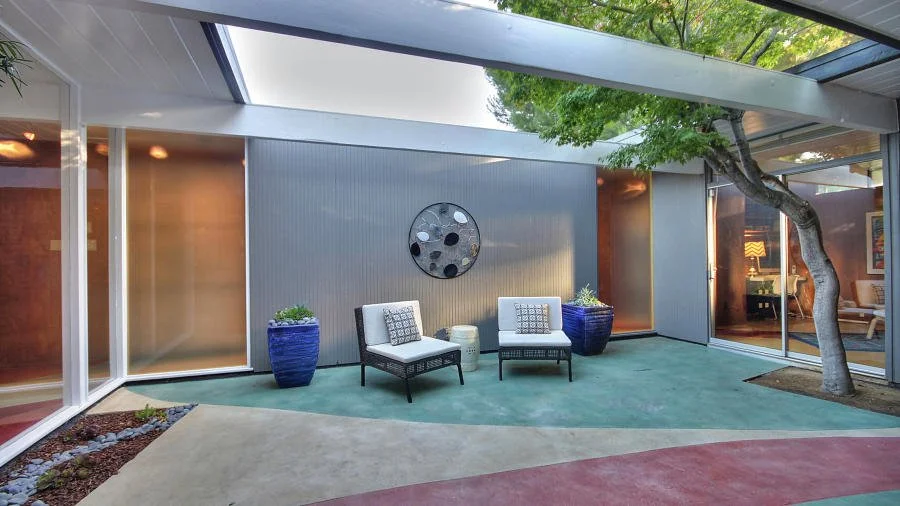
It’s no surprise, then, that today’s homeowners and designers are re-discovering the value of such spaces. The recent trend toward creating “wellness rooms” or home sanctuaries is really an echo of what Eichler built in mid-century California. Post-2020, people are especially conscious of the need for restorative spaces at home – a light-filled corner for yoga, a plant-filled nook to escape screens, or a meditation courtyard to recharge in. Biophilic design (integrating natural elements into interiors) is now a mainstream concept, and studies consistently show it’s more than just decor: connecting with nature indoors has measurable benefits like stress reduction, improved mood, and enhanced focus. Wellness-focused homebuyers, particularly younger generations, are seeking features that align with sustainability and mental health: things like ample daylight, good ventilation, indoor plants, and connections to the outdoors. Sound familiar? Eichler’s atrium homes check all those boxes. What was once seen as a quirky mid-century design is now highly coveted for the lifestyle it enables.
Contemporary architects and developers are taking note. Some new home designs (especially in temperate climates) are reincorporating interior courtyards, skylit atriums, and sliding glass walls to blur indoor-outdoor boundaries – essentially updating Eichler’s ideas with modern tech. In Palm Springs, for example, modern Eichler-inspired builders have kept the iconic atrium entry in their designs because today’s buyers love that indoor-outdoor feel eichlerhomesforsale.com. And designers in the wellness space emphasize the same principles Eichler championed. As wellness retreat designer Sue Glasscock says, “Since being around nature has such a positive impact on our health, I would recommend incorporating elements like reclaimed wood, plants, large windows or glass doors…into your home.” veranda.com Her advice sounds like a checklist for an Eichler atrium: bring in plants, maximize windows, use natural materials. The fact is, an Eichler courtyard is a ready-made wellness room – it already has fresh air, natural light, greenery, and calming privacy by design.
Homeowners who are lucky enough to live in an Eichler today often adapt their atriums into exactly the kind of wellness spaces others are trying to create from scratch. You’ll find Eichler atriums turned into yoga studios, art studios, or zen gardens, all while retaining their original mid-century charm. And even if you don’t live in an Eichler, there are lessons to learn here for any home. Prioritize a connection to nature: maybe it’s adding a small interior garden, a skylight, or French doors to an outdoor deck. Embrace natural light and ventilation: think of your home as a living organism that needs sunlight and air. Create a sanctuary for yourself: a corner with plants, a comfy chair by a window, or a patio retreat – somewhere to unplug and recharge. These ideas are at the core of wellness design, and Joseph Eichler was exploring them 60+ years ago.
As we look ahead, it’s clear that the fundamentals of Eichler’s atrium homes are timeless. Sustainable, wellness-oriented design isn’t actually a new invention – it’s often about rediscovering smart principles from the past. Eichler courtyards prove that connecting people with nature is a key to comfortable, healthy living. One modern analysis of Eichler’s legacy summed it up perfectly: the goal remains what it was in 1955 – to give residents a daily dose of sky, sun, and natural breeze, “bringing the outside in” in a way that “connects people with the outdoors.” eichlerhomesforsale.com In our era of high-tech smart homes and air purifiers, that daily dose of nature is still the most refreshing “amenity” a house can have. So whether you’re a mid-century modern enthusiast or a wellness design devotee (or both!), there’s something profoundly inspiring about these atrium-centered homes. They remind us that good design cares for the human spirit as much as for the eye. Little wonder many of us have become atrium addicts, drawn to that blend of home and garden, shelter and sky. Eichler’s courtyards were indeed the original wellness rooms – and their influence continues to bloom, as fresh and vital as the plants in an atrium planter box.
As Silicon Valley’s leading Eichler Real Estate specialists, Eric and Janelle Boyenga of the Boyenga Team at Compass help clients understand not only the architectural value of these homes, but also the wellness experience they offer. With decades of hyperlocal expertise, exclusive market knowledge, and a “Next-Gen Agent” marketing approach, the Boyenga Team guides buyers toward the right orientation, model type, and atrium configuration—and helps sellers elevate their home’s indoor-outdoor strengths with strategic preparation. Their deep appreciation for Eichler design and modern lifestyle trends allows clients to make confident, informed decisions in a competitive market.
Sources:
Eichler Homes For Sale Blog – “Atrium Archetypes: Exploring Eichler Atrium Designs in Northern California” eichlerhomesforsale.com
Eichler Network – “The Mystery of the Eichler Atrium” (Dave Weinstein)eichlernetwork.com
Eichler Homes For Sale Blog – “Cooling Eichler Homes: Passive Design & Smart HVAC Tips” eichlerhomesforsale.com
Atomic Ranch / SFGate excerpts on Eichler philosophy eichlerhomesforsale.com