
Blueprints in the Basement: How to Identify Your Eichler’s Original Floorplan, Model, and Architect
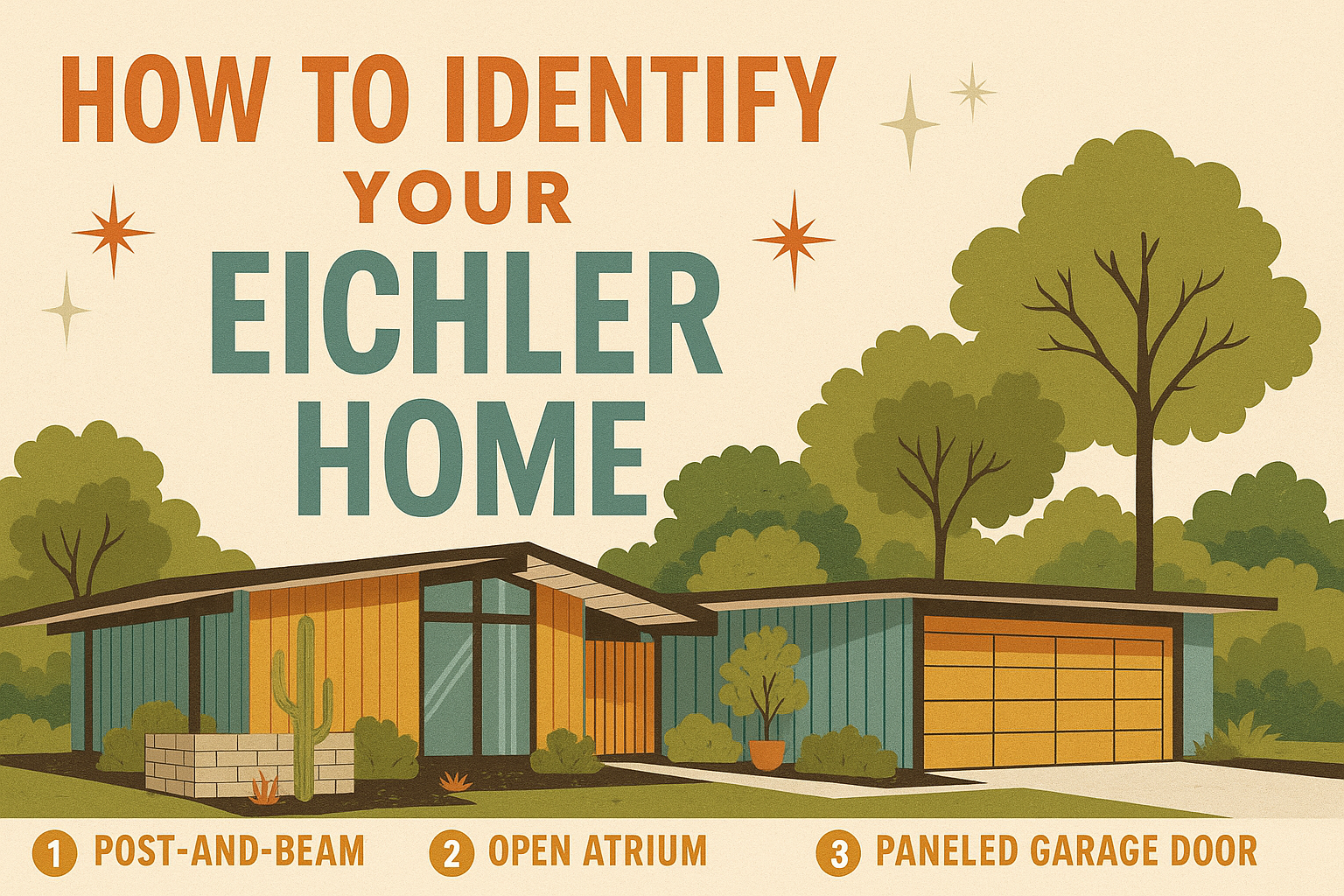
How to Identify Your Eichler’s Original Floorplan, Model, and Architect in Silicon Valley
Introduction – Every Eichler home has a story written in its blueprints. If you’re lucky enough to own (or are thinking of buying) an Eichler in Silicon Valley – from Palo Alto and Mountain View to Sunnyvale, Cupertino, or San Jose – you might be curious about its architectural pedigree. Which model is it? Who was the architect behind it? And where can you find the original floor plan? This guide will walk you through the detective work of tracing your Eichler’s origins, step by step. We’ll cover how to dig up building permits and tract maps, decode Eichler model numbers (Plan 614, X-100, M-140 – what do those mean?), identify whether your home was designed by Anshen & Allen, Jones & Emmons, or Claude Oakland, and where to find those vintage Eichler brochures and catalogs. Along the way, we’ll point out key design features (atrium vs. gallery models, L-shape vs. U-shape layouts, etc.) to help you visually identify your floorplan family. Finally, we’ll share tips on accessing archives and preserving those precious plans for future restoration projects. Let’s unlock the history hidden in your Eichler’s blueprints!
Unearthing Your Home’s Records: Permits, Parcels, and Tract Maps
Your first step is to gather all the official records associated with your property. These documents often contain clues about your Eichler’s original plan:
Building Permit Records: Head to your city’s building department (or online permit portal) and look up the original building permit for your house. The permit, typically filed when the house was built, can reveal the construction date, the builder (often listed as “Eichler Homes, Inc.”), and sometimes even the model or plan number. Many Silicon Valley cities keep microfilm or digital archives of 1950s–60s permits, so ask if they can retrieve yours. For example, a permit might describe the project as “Tract __, Lot __, Model __” – which is a goldmine if a model number is given. Even if the model code isn’t obvious, the year built and tract name will help narrow down which Eichler development (and architect) it belongs to.
Assessor Parcel Data: Check your county assessor’s parcel information for your property. The assessor’s records will confirm the year built (important for determining the Eichler era) and often reference the subdivision (tract) name or number. In Santa Clara County, many Eichler subdivisions have tract names like “Fairglen Addition” or numbers. Knowing your tract name/number is key to matching your home to a specific Eichler project and plan set. For instance, if the records show your home is in “Tract 7458 – Fairglen Eichlers,” you can focus your research on that tract’s plans.
Tract Maps: Once you have the tract name or number, find the original recorded tract map. These are the subdivision maps filed with the county when the neighborhood was laid out. Tract maps (available from the county recorder’s office or city planning department) show the lot layout and sometimes include notes like the developer’s name (e.g. Eichler Homes) and the year of subdivision approval. While they won’t show individual floor plans, tract maps confirm you’re dealing with an authentic Eichler tract and can sometimes hint at how many models were used (if some lots are drawn with different footprints). Identifying the tract also lets you tap into community knowledge – often Eichler tracts have names (Greenmeadow, Fairbrae, etc.) that enthusiasts recognize and have documented.
Pro tip: As you comb through records, keep an eye out for any plan numbers or model names. Occasionally, a building permit or early sales document might refer to the house as “Model X” or “Plan 614.” Also, search your own house – literally! Homeowners have discovered old builder’s certificates tacked to garage walls or inside electrical panels. These certificates (on cardstock, often pencil-filled) list details like the parcel, builder, year, and model of the housedearhouseiloveyou.com. If you find one, you’ve hit the jackpot – it will directly tell you the original Eichler model name/number. Don’t worry if you come up empty; we have plenty of other ways to identify your model.
Decoding Eichler Model Numbers (Plan 614? X-100? M-140?)
Eichler homes often came with cryptic model codes. Understanding these codes is crucial to pinpointing your floorplan. Over the years, Eichler and his architects used several numbering systems for their designseichlernetwork.com:
Plain Numbers: Many Eichler floor plans were simply numbered. For example, Plan 614 might appear on a blueprint or brochure. These numbers were internal design IDs – think of them as model numbers for a given layout. In some cases the numbers were in the 500s or 600s for mid-century designs. If you encounter a number like this in your research (say on a permit or written on the back of an old blueprint in your attic), it likely corresponds to a specific Eichler plan used in that tract.
Letter Prefixes: In some model numbering schemes, letters indicated the development or regioneichlernetwork.com. For instance, Eichler’s team sometimes prefixed model codes with a letter tied to the location. An example is the “OC-584” plan in Orange County – the OC denotes Orange Countypinterest.compinterest.com. In the Bay Area, an “M” might denote a series (possibly Marin County or a particular tract series), whereas “PA” could stand for a Palo Alto series, etc. One example is M-140, which likely was a model designation in an Eichler tract (some enthusiasts speculate “M” stands for Marin, as Eichler’s Marin County homes had M-series plan codes). The key takeaway is that if you see a combination like letter-number (X-, M-, OC-___), it’s an Eichler model code telling you both the design and a hint of its origin.
Special Codes (Prototypes and Experiments): Eichler also had some one-off designs with unique codes. The most famous is X-100, an experimental steel-framed Eichler built in 1956 in the San Mateo Highlandseichlerx-100.com. The “X” signified its experimental nature. If by some chance your home is an outlier (e.g. the only steel Eichler on the block), you might find a special code like this. For typical homeowners, though, it’s more likely you’ll be dealing with the standard numeric or letter-number model designations.
So how do you match the code to your house? If you obtained a model number from permits or the builder’s certificate, you can cross-reference that with Eichler plan catalogs or archives (more on those shortly). For example, suppose you discover your home was “Plan 566.” By checking Eichler brochures from that year or contacting the Eichler archives, you could find that Plan 566 corresponds to a 3-bed/2-bath courtyard model used in 1958. In many Eichler communities, neighbors have the same model, just rotated or with minor variations. Comparing notes with longtime residents or local Eichler experts can help decode a model number. In fact, Eichler enthusiasts have created lists of model numbers used in each tract. One Eichler Network discussion noted that Eichler employed multiple model numbering systems – some codes include letters for the town or tract, while others (like those in Greenmeadow in Palo Alto) use straight numberseichlernetwork.com. Don’t let the variety confuse you; focus on linking any code you find to a time/place: the goal is to figure out “this code means the 4-bedroom atrium model designed by Jones & Emmons in 1962,” for instance.
What if you have no idea what your model number is? Then you’ll do it by sleuthing through the floorplan itself – which we’ll cover in a moment (see Floorplan Features). But first, let’s talk about identifying the architect, as that often goes hand-in-hand with the model.
Matching Your Eichler to Its Architect (Anshen & Allen, Jones & Emmons, or Claude Oakland?)
One of the joys of Eichler ownership is knowing who drew up your home’s design. Joseph Eichler worked with a handful of forward-thinking architectural firms to create his mid-century modern tract homesen.wikipedia.org. In Silicon Valley neighborhoods, the “big three” architects behind Eichler homes are Anshen & Allen, Jones & Emmons, and Claude Oakland (Claude Oakland & Associates). Identifying which of these designed your model will not only satisfy curiosity – it can also guide you to the right set of plans in archives or old catalogs.
Here’s a quick rundown of these architects and how to tell which might have designed your home:
Anshen & Allen (circa 1949–1953): This San Francisco firm, led by Robert Anshen, designed Eichler’s earliest homesen.wikipedia.org. If your Eichler was built in the early ’50s, especially if it’s in one of Eichler’s first subdivisions (like the original Sunnyvale Manor homes of 1949 or Palo Alto’s early developments around 1950–51), Anshen & Allen is the likely architect. Hallmarks of their designs include the first use of Eichler’s signature post-and-beam construction and integrated indoor-outdoor living concepts. Their early plans (sometimes labeled “AA-1”, etc., with “AA” standing for Anshen & Allenpastheritage.org) often did not yet have the iconic atrium feature, but did pioneer the open-air courtyards and floor-to-ceiling glass walls that Eichlers are known for. If your Silicon Valley Eichler has a low-pitch or flat roof and a mostly straightforward layout without an atrium (typical of 1950-53 models), it could be Anshen & Allen’s work. (Example: The 36 homes of Sunnymount Gardens in Sunnyvale (1950) were Eichler’s first under the “Eichler Homes” name, and though modest, they were an extension of Anshen’s basic design from Sunnyvale Manoratriare.com.)
Jones & Emmons (circa 1954–1960s): A. Quincy Jones and Frederick Emmons, an LA-based duo, took Eichler homes to the next level in the mid-’50s. They designed hundreds of Eichlers and introduced many classic features. Notably, Jones & Emmons are credited with some of the first atrium-model Eichlers in the late 1950seichlerhomesforsale.com. If your Eichler has an open-air atrium (an open courtyard at the center of the house, typically right as you enter), there’s a good chance it was designed by Jones & Emmons – especially if built around 1957–1962. For example, Palo Alto’s Greenmeadow (1954-55) and Los Arboles (1959-61) tracts were Jones & Emmons projects, as were the iconic San Mateo Highlands Eichlers. Jones & Emmons designs also include many courtyard models (L- or U-shaped houses with a private front courtyard). By the late ’50s, Eichler’s output was so large that Jones & Emmons became a primary architect for entire communities. A tract map or brochure might list model numbers like “JE-___” – indeed in Greenmeadow, Palo Alto, house models were numbered JE-2, JE-14, etc., referring to Jones & Emmons designs for that tract. In short, if your home was built in the mid-1950s through early 60s in the South Bay, Jones & Emmons is a strong candidate. They had a hand in many Silicon Valley Eichler neighborhoods, continually evolving the Eichler look (flat and low-gabled roofs, open plans, and by ’58, the first central atriums). Fun fact: Jones & Emmons even designed an experimental all-steel model, the X-100 in 1956 eichlerx-100.com, showing the extent of innovation during their tenure.
Claude Oakland & Associates (circa 1960s–1974): Claude Oakland worked with Eichler for years (he was originally on staff with Jones & Emmons before taking on a bigger role) and ultimately became Eichler’s chief architect in the 1960s. Many later Eichler tracts – especially those built in the early to mid-1960s – were Oakland’s designs. Oakland is known for refining the atrium model and also creating the “gallery” model in late Eichlers. If your Eichler was built in the 1960s in Silicon Valley (for example, Cupertino’s Fairgrove Eichlers of the mid-60s or San Jose’s 1962 Fairglen additions), chances are Claude Oakland was behind it en.wikipedia.org. His firm’s designs often have larger square footages, more variation in roof profiles (some peak-roof or double-gable Eichlers are Oakland designs), and by the late ’60s introduced the “gallery” concept (an enclosed atrium-like foyer). Oakland continued designing Eichlers up to the very last built in 1974, including some two-story models in the East Bay and South Bay. To identify an Oakland design, use the year and tract: e.g., Rancho San Antonio Eichlers in Cupertino (built mid-60s) or Bell Meadows in San Jose (early ’70s) were Oakland’s. Sometimes his plans are labeled with “O” or other internal codes. Interestingly, Claude Oakland’s archive at UC Berkeley contains plans identified as HPO-15, HPO-33, etc., which correspond to Eichler model numbers in his catalog exhibits.ced.berkeley.edu. If you come across a plan code with an “O” or even see Oakland’s name on old drawings, you’ve got a match.
Now, there were other architects who designed a handful of Eichlers – for instance, Raphael Soriano designed a few prototypes for Eichler around 1950 en.wikipedia.org. But in Silicon Valley tracts, Soriano’s work is not common (most of his Eichler prototypes were not mass-built). Thus, for our region, focus on the big three.
How can you be sure which architect designed your specific home? One way is by identifying the tract and year as we discussed, since each development was typically done by one firm (with a few exceptions where designs overlapped). A good example of overlap is the Fairorchard tract in Sunnyvale, developed in 1958. Fairorchard’s 54 homes actually featured designs by both Anshen & Allen and Jones & Emmons – it marked a transition point where Eichler introduced atrium models in Sunnyvaleeichlerhomesforsale.com. If your home is in Fairorchard, it could be either architect, which requires comparing your floorplan to known plans from each firm. In most other cases, though, once you know the tract, you know the architect. Neighborhood websites, Eichler community forums, or historical resources often explicitly state the architect for each Eichler subdivision. For instance, “All of the Eichlers in Palo Alto’s Green Gables (1950) were by Anshen & Allen, whereas Greenmeadow phase II (1962) were by Claude Oakland.” This can be verified in city historic survey documents or Eichler Network articles. Don’t hesitate to reach out in Eichler owner groups with your tract name; usually someone can tell you, “Oh yes, that tract was a Jones & Emmons project.” Knowing the architect will enhance your search for the original plans, since archives are often organized by architect (more on that in the Archives section).
Finding Original Eichler Brochures and Catalogs (and Using Them as Clues)
One of the most rewarding parts of researching your Eichler is discovering the original sales brochures or plan catalogs from when the home was built. Eichler Homes, Inc. was known for its beautifully illustrated brochures in the 1950s and 60s – full of mid-century optimism, stylish furniture in the photos, and of course floor plan diagrams of each model. These vintage materials are a treasure trove for identifying your floorplan and model.
Cover of Eichler Homes: Designed for Better Living (circa 1957). Eichler’s marketing brochures often contain photos, floor plans, and descriptions of each model – invaluable for owners seeking their home’s original design.
Where to find these brochures? Start with online archives and enthusiast collections. There are dedicated Eichler fans who have scanned and shared brochures over the years. For example, Flickr has an “Eichler Homes Ephemera” album containing brochures and documents (some contributed by the Eichler Network and collectors) flickr.com. The Eichler Network itself (a website/magazine for Eichler homeowners) has at times offered reprints or images of classic brochures. Additionally, sites like EichlersoCal.com and realtor pages specializing in Eichlers may have PDF downloads of original Eichler model catalogs. The Sacramento Modern community has shared a 1955 Eichler catalog scan, and some local historical societies or libraries might have copies of Eichler sales literature from developments in their area. Don’t overlook contacting neighbors or the local neighborhood association – original owners sometimes kept the brochures and have handed them down or donated them to archives.
If your Eichler is in Silicon Valley, focus on brochures from Northern California Eichler tracts in the same time period. For instance, a 1962 Eichler brochure for Palo Alto might show models that were also used in Cupertino or Sunnyvale around that year. Often Eichler would reuse successful designs across multiple tracts (with maybe slight tweaks), so even if you find a brochure from another Eichler neighborhood of the same era, you might see your floorplan in there. Homeowners have been known to get lucky by finding a picture of their exact model in a period advertisement or newspaper article as well.
Once you have some brochures or catalog pages, here’s how to use them:
Compare Floor Plans: This is like a matching game. Take the floor plan sketch from the brochure and compare it to your house’s layout. Pay attention to distinctive elements: location of atrium (if any), number of bedrooms and their arrangement, placement of bathrooms, shape of the roof outline, and the orientation of the garage or carport. When you find one that matches your home’s configuration, you’ve identified the model. For example, you might recognize “Plan 4-B” as exactly what your house looks like – 4 bedrooms in a wing and an atrium entry. Cross-referencing in this way is exactly how one Eichler owner managed to identify her home’s plan: she scoured online archives and found a matching floor plan image on Eichler SoCal’s website that was “just about dead-on” her housedearhouseiloveyou.com. The few small differences she noted confirmed it was the same base model with minor tract-specific tweaks.
Look at Model Names/Numbers: The brochures often give the model number or name. You might see something like “Model 140, 4-bedroom Deluxe Atrium” or a plan number in fine print. If you already found a model number from your records, seeing it in a brochure will confirm you have the right one. If not, now you learn it – and sometimes Eichler plans had marketing names too (e.g., “Queenston” model, etc., though most were just numbers or letters). Jot this down, as it ties together your property record and what you’re seeing.
Photographic Clues: Those glossy black-and-white photos of Eichler interiors and exteriors can also help. Is there a photo of a living room with a brick fireplace on the left and glass wall on the right that looks exactly like your living room? That’s a clue you have the same model as pictured. Exterior shots in brochures may show the facade of each model – compare it to your home’s facade (allowing for later alterations or landscaping differences). Some models have distinct roof profiles: e.g., a double A-frame roof over the living room (as seen in some late-60s Claude Oakland models) or a flat roof with a central atrium pop-up. If a brochure image and description match these features, you’ve likely zeroed in on your model.
Plan Descriptions: The text in brochures can be revealing too. Eichler marketing copy might say “Model 130: A compact 3-bedroom designed for young families, featuring a galley kitchen and private front courtyard.” If that sounds like your house (say you do have a small 3BR with a front courtyard), it helps confirm the ID. Features like “expandable hobby room option” or “convertible fourth bedroom/den” mentioned in the catalog might correspond to odd quirks in your house (maybe a strange extra storage room that was optional).
The goal is to cross-reference multiple sources – your house itself, permits, brochures – until everything aligns. When you find a match, you’ll know it. It’s a bit like finding your car’s VIN in a registry and seeing the original window sticker – suddenly you have the full picture of what you’ve got.
And don’t restrict yourself to one source. Check the UC Berkeley Environmental Design Archives (which we’ll discuss next) for any “sales plan” drawings; they have scans of Eichler sales materials like the “Eichler Homes: designed for better living” booklet from 1957 (which we saw above) and many floor plan diagrams. The Environmental Design Library at Berkeley, local museums, or historical archives might also have house plan books from the mid-century that include Eichler designs.
Finally, consider reaching out on Eichler-centric forums or social media groups. Often, if you describe your home (“I have a 4-bed, atrium model in Fairglen, built 1962, looking for original plan”), someone with the same model might pop up and share a scan of their brochure or even an original blueprint copy. The Eichler community is passionate and generous in this regard, always excited to connect puzzle pieces of Eichler history.
Floorplan Features: Atrium vs. Gallery, L-Shape vs. U-Shape (Visual Clues to Your Model Family) {#floorplan-features-atrium-vs-gallery-l-shape-vs-u-shape}
Eichler homes can be broadly categorized by a few key architectural features. Recognizing which category your home falls into will help validate its model and era. Here are some defining features to look for:
Atrium Models: Perhaps the most iconic Eichler feature is the atrium – an open-to-the-sky courtyard located at the heart of the house. In an atrium model, you typically enter through a front door or gate and find yourself in an open-air atrium, with the actual front door into the living space being a sliding glass or swinging door on the other side of the atrium. Atrium models usually form a squared-off U-shape or even a full courtyard around the atrium (almost like a donut with a hole in the middle – the hole is the atrium). Eichler introduced the central atrium around 1958 and it became common in the 1960s designs eichlerhomesforsale.com. If your house has this feature, it’s a strong indicator of a late-50s or 60s Jones & Emmons or Claude Oakland model. Visually: Atrium Eichlers often have a low gable or flat roof with a rectangular cut-out in the middle for the atrium. They maximize indoor-outdoor flow, as most rooms have sliding doors or windows facing the atrium in addition to the backyard.
Courtyard (or Gallery) Models: Before the advent of the atrium, Eichlers often had a courtyard space at the front or side, but not fully enclosed by the house. For example, an L-shaped Eichler will have two wings of the house forming an L, creating a courtyard either in the crook of that L (usually the entry area) or as a side yard extension of the living space. A U-shaped layout can create a more enclosed front courtyard, albeit typically open on one side to the street (often with a fence or gate for privacy). These courtyard models were prevalent in early and mid-50s Eichlers. Many Sunnyvale and Palo Alto Eichlers of 1950-57 have such layouts: a visible courtyard at the entry (sometimes behind a low fence or screen wall) and then you enter the living room directly from that courtyard. They might lack an atrium but still embody Eichler’s indoor-outdoor ethos by having large glass walls facing that private outdoor area. If your Eichler’s front door opens directly into the living space (and not into an atrium), and you have a side or front patio that’s semi-private, you likely have a courtyard model. Some Eichler plans of this type are literally called “Courtyard Model” in literature.
Gallery Models: In the late 1960s, Eichler (with Claude Oakland) experimented with the gallery model – essentially an enclosed atrium design. Think of it as the atrium concept but roofed over to create a grand atrium-like foyer or interior gallery space. The gallery is usually a large, skylit entry hall that would have been open air in earlier models. One way to tell a gallery model is if your home’s center has a large indoor space (often with a high ceiling or skylights) that feels a bit like an atrium but is fully inside. These models were relatively rare and came towards the end of Eichler’s building era (around 1971–1973 in places like San Jose’s Bell Meadows or Marin County’s Lucas Valley). They are prized by some as they offer even more interior square footage while maintaining the dramatic open feel. A rule of thumb noted by Eichler experts: “Gallery model” basically means an enclosed atrium by original design (not a later enclosure by an owner) eichlernetwork.com. So if you have what appears to be an atrium but with a solid roof and it’s clearly part of the original house structure, congratulations – you have a Gallery model Eichler. These usually also have multiple skylights and a very spacious feel when you step inside, as the entire core of the house is open (but covered) space.
Roof Profile Clues: Eichlers come in flat-roof, single-slope (shed roof), and gabled versions. The roof itself isn’t a floorplan, but it correlates with certain models and eras. For example, almost all gallery models have some form of gabled or hipped roof to cover that large central space (often a shallow peak or hipped roof). Early courtyard models often had flat or modest shed roofs. Double-gabled Eichlers (the ones with two peaked gables visible from the street) tend to be later models, many by Claude Oakland. Some atrium models have a “Clerestory” roof where the atrium is open and around it the roof has a higher section with glass for light. Noting your roof type can further confirm which family your house belongs to. Some say Eichler designs can be distilled into about six archetypes – combining roof form (flat, shed, single-gable, double-gable) with plan form (courtyard, atrium, gallery)pastheritage.org. So, for instance, you might classify your home as a “double-gable atrium model” or a “flat-roof L-shaped courtyard model.” This kind of categorization helps compare with documented models.
“L” vs “U” vs “Atrium” shape: Stand back and look at your house’s footprint (or sketch it out). An L-shape Eichler usually indicates a wing for bedrooms and a wing for living area intersecting. A U-shape indicates two wings in front connected by a central section at back (or vice versa), often creating a mostly enclosed courtyard. A square donut shape (with a hollow center) indicates an atrium model. These shapes often align with the model numbering – e.g., Eichler might have offered four models in a tract: two L-shaped courtyards and two U-shaped atriums. If you can determine the shape, you can eliminate any models in brochures that don’t match that general form.
To illustrate, imagine you have a 4-bedroom Eichler with an atrium. Immediately you know it’s not an early-50s design – it’s likely 1960s. If it’s 4-bedroom and atrium, that narrows it to the larger models of that time. If the roof is a high-peaked A-frame over the living room, that points to specific late 60s series. By identifying these feature combos, you essentially funnel down to the exact blueprint among Eichler’s repertoire.
One more example: Suppose your Eichler has no atrium, a flat roof, and a fenced front patio off to the side – plus it was built in 1955. That sounds like a classic mid-50s gallery (not atrium) model, likely by Jones & Emmons, often termed a “gallery” because the entry is a closed corridor (gallery) rather than open atrium. However, note that “gallery” in Eichler parlance usually refers to the later enclosed-atrium models – but even some earlier homes had an entry gallery (a long hallway) instead of an atrium or courtyard, and these were sometimes informally called gallery models too. The terminology can be a bit confusing, but context matters (era and design intent).
In summary, use your home’s physical features as evidence: count the courtyards/atria, sketch the shape, observe the roof. These clues, matched with descriptions from Eichler literature, will cement your identification. As an owner, getting familiar with these architectural terms also enriches your appreciation of what makes your Eichler special compared to other mid-century homes.
A 1957 Eichler floor plan from a marketing brochure, illustrating a “medium-priced Eichler Home.” Note the open “Terrace” (atrium/courtyard) at the center and the layout of rooms around it. The brochure highlights features like an “open plan for spaciousness,” glass walls, a central entry hall, and a private outdoor living area away from the street – classic Eichler elements. By comparing such plans and features with your own home’s layout, you can visually confirm your Eichler’s model family.
Tapping Archives and Experts: From Berkeley’s Archives to City Planning Departments
By now, you hopefully have a good idea of your Eichler’s model and architect. The next step is obtaining authentic plans or documentation for that model – either the original blueprints or at least a copy of the floor plan and elevations. This is where archives and expert resources come into play.
UC Berkeley Environmental Design Archives (EDA): This is perhaps the ultimate repository for Eichler plans. The EDA holds the collections of many architects, including Eichler’s architects. For example, they have the Claude Oakland & Associates collection, which contains Eichler house plans (we saw references to HPO-15, HPO-33 models in their catalog)exhibits.ced.berkeley.edu. They likely also have materials from Jones & Emmons and Anshen & Allen. You can contact the EDA with a request for Eichler plans by providing details like your tract name, year, or model number. They are used to fielding inquiries from Eichler homeowners and researchers. In fact, Eichler Network once noted that while they used to sell blueprint copies, you can get them “at a fraction of the cost at the UC Berkeley Environmental Design Archives.” eichlernetwork.com The EDA charges a nominal fee for copies/scans, and their staff can guide you to the right documents if they exist.
How to contact them? According to one source, the best approach is to email designarchives@berkeley.edu or call their reference line eichlernetwork.com. Provide as much info as you can (owner name, tract, lot, model number if known, or at least address and year built). The archives staff can then search their index for matching plans. Hours are typically Monday–Thursday, 9:30 am to 4:30 pm eichlernetwork.com (if you wanted to visit in person, it’s by appointment). But most requests can be handled remotely – they can scan and email you PDFs of blueprints or drawings. Keep in mind, not every Eichler model is necessarily preserved in their archives, but many are. Since Eichler built thousands of homes, the archives might have representative plans for each series.
When you obtain plans from EDA, you might get the full blueprint sheets: site plan, floor plan, roof plan, elevations, etc. This is a fantastic item to have for your house – essentially the “birth certificate” of your Eichler. It’s also incredibly useful if you plan to renovate or restore, as it shows the original dimensions and details.
City Planning/Building Departments: Another route is through your local city’s records. Some cities maintain copies of original building plans for homes (especially if the city has historic preservation interest in Eichlers, like Palo Alto or Orange has for their Eichler tracts). The accessibility of these plans varies: in some cases, plans may be purged after a certain number of years, but often they keep them on microfiche indefinitely. As the homeowner, you can request copies (there may be a small copying fee and a wait time). For example, City of Palo Alto has a Development Center where owners can request records on their property, and they have a lot of Eichler info due to their historic districts. Sunnyvale and San Jose also have permit centers – while they might not hand out blueprints without a reason, if you’re doing a remodel you can sometimes get the originals for reference. It doesn’t hurt to ask: “I am researching my mid-century home built in 19XX; do you have any original plan on file?” You might be surprised. Even if they don’t have the full plans, they often have a “job file” that could include at least a basic floor plan sketch or site plan. This can corroborate what you found elsewhere.
Local Historical Archives: In Silicon Valley, institutions like the Palo Alto Historical Association, the Sunnyvale Heritage Park Museum, or the Cupertino Historical Society may have collections on local Eichler subdivisions. Sometimes, when a group of Eichler owners band together (for example, to seek historic designation), they compile tract histories. Check if your Eichler neighborhood is listed on the National Register or as a local historic district – if so, a historic report might have been written, which could include original plans or brochure excerpts. (Palo Alto, for instance, has the Greenmeadow and Green Gables Eichler districts with documentation available.)
Eichler Network and Community Experts: Don’t overlook reaching out to the Eichler Network’s forums or contacting authors of Eichler books. People like Dave Weinstein (who writes about Eichler history) or Marty Arbunich (of Eichler Network) have amassed lots of data. Sometimes a quick post on the Eichler Network forum, “Looking for model 111 plans,” will get a response from someone who has it. The Eichler Network also launched an interactive Eichler tract map tool to help people find what models were in each developmenteichlernetwork.com – exploring that could provide leads, like site plans showing which lots had which models.
Why archives? Beyond just obtaining your floor plan, archives might have extras: alternate versions of the design, documentation of any revisions during construction, or even correspondence. For example, the Jones & Emmons papers might have notes on Greenmeadow’s community center and the model numbers used there (which they do: model numbers JE-2, JE-14, etc., were recorded for that project). This is deeper research, but for an enthusiast homeowner, it can be fascinating.
Lastly, when dealing with archives or anyone sharing plans, respect any usage guidelines. The plans are usually fine to use for personal/home purposes (restoration, etc.), but if you plan to publish them, get permission from the source. Generally, though, there’s no issue with you having and using your home’s plans – it’s part of your house’s history after all!
Preserving and Recreating Your Eichler’s Plans
Once you’ve gathered your Eichler’s floor plan, model info, and maybe even original blueprints, you’ll want to preserve these documents and use them wisely, especially if you’re planning a restoration.
Preserve Original Blueprints: If you were fortunate enough to obtain (or already possess) an original blueprint set, treat them with care. These prints are often on fragile paper (or blue diazo paper) that can fade. Consider scanning them at high resolution for a digital copy. Store the originals flat if possible (large art portfolio folders or archival tubes work well) in a dry, climate-controlled environment. Remember, these are one-of-a-kind pieces of history – your home’s “DNA.” Future owners or even local preservationists might appreciate that you safeguarded them.
Create a Home Archive: Keep all the materials you gathered – brochures, copies of permits, the blueprint or floor plan printouts – in a dedicated folder or binder. This becomes your Eichler Home Archive. It’s not only useful for you, but if you ever sell the home, it’s a wonderful dossier to pass on to the next caretaker of the Eichler. It documents the provenance and could even add to the home’s value (Eichler buyers love this stuff!). Include any before-and-after photos if you do restoration work, with notes referencing the original plan (e.g., “Removed 1980s added wall to restore original open atrium per plans”).
Recreating Missing Plans: What if you never found the original plans? You can recreate them. One way is to draw your own floor plan – even a hand-drawn or software-drafted plan of the current layout. This is useful as a baseline. If your goal is restoration, compare your sketch to the likely original (from brochures or neighbors’ homes) to identify what was changed. Many Eichlers have undergone alterations (garage conversions, kitchen remodels, etc.). Knowing the original layout can guide you in bringing back lost features (say, reopening a wall that was originally movable partitions, or reinstating a destroyed atrium wall). If drafting isn’t your forte, you might hire an architect or designer familiar with Eichlers; some specialize in MCM home remodels and could draft a plan for you relatively easily given the simple geometry of Eichlers.
Use Plans for Restoration: Armed with original plans, you can do things like locate where the original globe lights were, or how the closet doors were arranged, etc. Maybe your house lost its Philippine mahogany paneling – the plans might note paneled feature walls you could reinstall. Also, plans help in working with the city for permits if you’re restoring original features – you can show, “See, this atrium was part of the original design in 1962,” which can sometimes smooth approvals or avoid code confusion.
Share and Give Back: Consider contributing a copy of your plans or research findings to the community. The person who scanned that 1956 Sacramento Eichler brochure on Flickr noted they did so for “historical interest and information empowerment for Eichler Home owners.”flickr.com This spirit of sharing means the archive of Eichler knowledge keeps growing. You might donate a copy of your blueprint to the local historical society or even back to the UC Berkeley Archives if they’re missing that sheet. This way, the next homeowner of an Eichler like yours will have an easier time.
Document Current Changes: If you are making changes, consider drawing “as-built” plans of your house before and after. That way, the lineage of the house is documented – from original blueprint to various modifications over time. Eichler homes are now historical artifacts in their own right, so keeping a record is part of being a good steward of mid-century architecture.
Preserve Original Elements: Along with the plans, try to preserve any original architectural elements of your Eichler during restoration. The plans can clue you in to what materials or layout was intended. For instance, if the plan shows a built-in planter in the atrium that a previous owner removed, you might restore it using the dimensions on the drawing. These little details add authenticity.
Lastly, enjoy the process. Not every homeowner gets to become an amateur architectural historian for their own house! By identifying your Eichler’s floorplan, model, and architect, you’ve forged a personal connection with Joseph Eichler’s legacy. You’ve gone from just living in an Eichler to being part of the Eichler story, preserving it for the future. The next time you invite friends over, you can proudly show them the original plan on the wall and say, “Did you know our house is a Model ___ designed by ___? Let me tell you the story…”. That kind of insight is priceless – and it ensures that “Eichler’s design ideals,” as the old brochures called them, live on in more than just wood and glass, but in knowledge and appreciationpastheritage.org.
Conclusion: Tracing your Eichler’s provenance may take some legwork, but as we’ve outlined, there are clear steps and abundant resources to guide you. From digging up permits at City Hall to pouring over mid-century brochures and contacting archives, each piece of information will illuminate your home’s design DNA. In Silicon Valley’s Eichler enclaves, no two models are exactly alike, yet all share the visionary principles of bringing modern architecture to everyday living. By identifying your home’s original floorplan, model number, and architect, you not only satisfy your curiosity – you become a custodian of that vision. So head down to the “basement” (or more likely, the garage cabinet) and see what blueprints you might find, reach out to the networks of Eichler aficionados, and embrace the rich architectural heritage that comes with your post-and-beam paradise. Your Eichler’s past is now part of your present, helping you make informed decisions to preserve its future. Happy sleuthing, and enjoy living in your very own piece of mid-century modern history!
Sources:
Palo Alto Stanford Heritage – Eichler and His Houses: 1955–1974 (architects and design evolution)pastheritage.orgpastheritage.org
Eichler Network Forums – Discussion on Eichler blueprint/model numbering systemseichlernetwork.com
Eichler Homes For Sale (Boyenga Team) – Fairorchard Eichler Neighborhood blog (example of architects and atrium intro in 1958 Sunnyvale)eichlerhomesforsale.com
Dear House I Love You blog – “Geek-out time: our floorplan!” (finding builder’s certificate and original plans via online communities)dearhouseiloveyou.comdearhouseiloveyou.com
Eichler Network – Forum post on “Gallery model vs. Atrium” (definition of gallery model as an enclosed atrium design)eichlernetwork.com
Wikipedia – Joseph Eichler (architects employed by Eichler and timeframe)en.wikipedia.orgen.wikipedia.org
UC Berkeley Environmental Design Archives – Catalog entry for Eichler house plans (Claude Oakland collection, e.g. HPO-15 model)exhibits.ced.berkeley.edu
UC Berkeley Environmental Design Archives – Eichler Homes: designed for better living (1957 Eichler catalog images)
Eichler Network – Forum post “Eichler Blueprints” (note on obtaining plans from UC Berkeley Archives at low cost)eichlernetwork.com
Eichler Network – Blog by Dave Weinstein “An Easy Way to Find Eichler Home Plans” (contact info for UC Berkeley archives)eichlernetwork.com
Sources