
Eichler Homes and the Car That Parked Next to Them
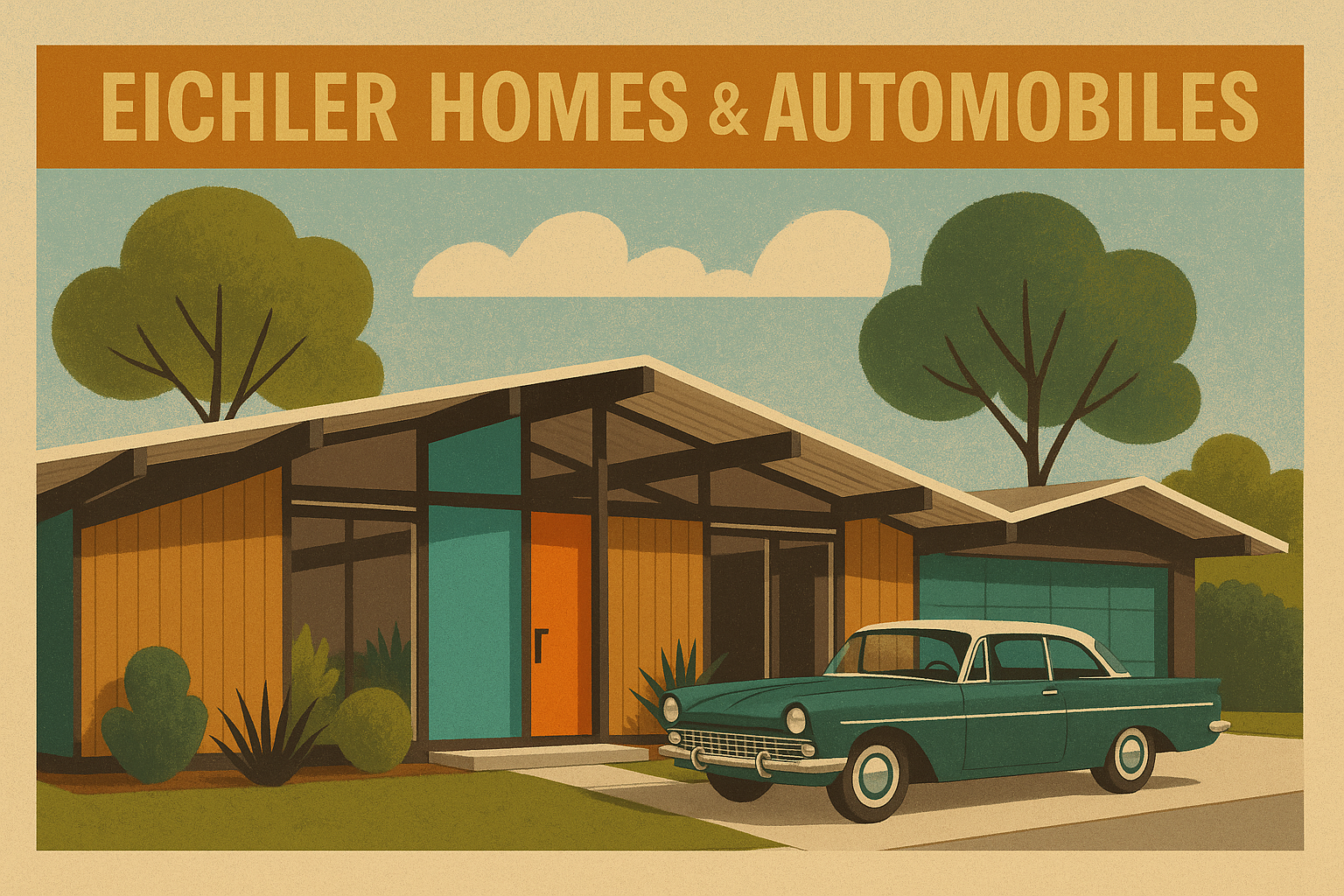
Imagine pulling up to a low-slung Eichler home on a sunny 1960s afternoon, the lines of your chrome-accented car reflecting the modern geometry of the house. In mid-century California suburbs, Joseph Eichler’s innovative homes formed a striking backdrop for the automobiles of the era. These houses and cars weren’t just props in a nostalgic scene – they were parallel expressions of a design ethos that celebrated optimism, innovation, and the idea that good design could shape better lives. Both Eichler homes and the mid-century vehicles parked in their driveways embodied the spirit of “form follows function” while indulging in a bit of Jet Age flair. They were products of a time when Americans looked “toward the future”, embracing modern features, a hopeful future, and an environment that was bright, sunny, and full of possibilitieshouseplans.net. In this story-driven exploration, we’ll journey through the cross-disciplinary relationship between Eichler’s mid-century modern homes and the cars of the 1950s–1970s that complemented them in both form and spirit.
The Era of Optimistic Design: Mid-Century Dreams on Wheels and Walls
The post-WWII mid-century era in America brimmed with confidence. Prosperity was rising, and design – from houses to cars – reflected an almost “impossibly optimistic” outlook newgeography.com. Modern designers believed that technology married to imagination could produce better lives for all eichlernetwork.com. Freedom was the mantra: in homes, the freedom to live openly in new ways; in cars, the freedom to hit the open road eichlernetwork.com. Nowhere was this more apparent than in the stylish new subdivisions of California, where Eichler homes and shiny new automobiles coexisted as symbols of a “highly stylish life” driven by design progress ndion.de.
Mid-century modern design was a holistic cultural movement – its influence was instantly recognizable in vehicles, household objects, and architecture alikewestgrovecommunity.com. Common threads ran through everything from the Eames lounge chair to the tailfins of a Cadillac: bold lines, sweeping curves, and forms pared down to essentials, always showcasing their function westgrovecommunity.com. Materials like steel, glass, and new plastics came to the forefront, and vibrant colors (think turquoise or orange) added a sense of playfulness and futurismwestgrovecommunity.com. In both houses and cars, designers shed past traditions and looked to a Space Age future – one where design could be, as one film of the time put it, a “paean of praise” to making everyday life more “beautiful, graceful and elegant”ndion.dendion.de.
This was the Populuxe era – a term coined by historian Thomas Hine for the late-1950s convergence of popular taste and deluxe living ndion.de. Magazines and movies showed Americans the dream: a stylish family living in a glass-walled modern home, a futuristic car in the carport, kids playing and Mom with the latest appliances – “always Sunday in this highly aesthetic paradise,” as one commentator quipped ndion.de. Both Eichler’s tract homes and Detroit’s latest models were marketed as tangible pieces of the American Dream, attainable by the growing middle class. In fact, by the mid-1950s, residential design had become “car-based” – houses were often designed to show off the car, putting it out front for display newgeography.com. In some extreme cases, architects even imagined homes where “tailfinned beauties” would be on display in the living room newgeography.com – an idea of a “living garage” that perfectly encapsulates how intertwined car culture and home life had become.
Eichler Homes: Modernism in the Suburbs
An iconic Eichler home (Foster Residence, Granada Hills, 1962) exemplifies mid-century modern architecture – note the low profile, A-frame roof over the entry, and an attached carport seamlessly integrated into the design. Even the cinder block planters echo the home’s clean lines and emphasize the horizontal layout eichlerhomesforsale.com.
Joseph Eichler’s homes brought cutting-edge modern architecture to suburban subdivisions. Between 1949 and 1966, Eichler built over 11,000 houses in California, designed to provide middle-class Americans with stylish, contemporary homes at moderate prices houseplans.net. Working with progressive architects like Anshen & Allen, Jones & Emmons, and Claude Oakland, Eichler developed a distinctive tract home that looked nothing like the cookie-cutter colonials of earlier suburbs. Instead, Eichler homes were unabashedly modern – flat or low-pitched roofs, post-and-beam construction, and walls of glass. They drew inspiration from Frank Lloyd Wright’s Usonian principles and the open-plan Case Study houses of the era, but were built on a mass scale. Each Eichler neighborhood was a futuristic vision of indoor-outdoor living, one that “reflected perfectly what [postwar Americans] were looking for – modern features [and] a hopeful future”houseplans.net.
Key architectural features of Eichler homes included:
Exposed post-and-beam structure: The heavy posts and beams were left visible, displaying the home’s “skeleton” with pride eichlerhomesforsale.com. Without many interior load-bearing walls, Eichlers could have open floor plans and walls of glass – a dramatic break from traditional home design eichlerhomesforsale.com. The exposed beams created strong horizontal lines and an “honest expression of structure” eichlerhomesforsale.com, much like an engineered chassis might in a car. It was beauty through function: nothing fake, nothing ornamental.
Floor-to-ceiling glass and seamless indoor-outdoor flow: Huge glass sliders and windows opened to patios, backyards, or even central atriums (open-air courtyards in the middle of the house). This blurred the line between interior and exterior, fostering that California ideal of living in harmony with the outdoors. Natural light flooded in, and views of gardens became living art on the walls. (Many car ads of the time similarly featured convertibles or panoramic windshields, promising buyers a flood of sunshine and scenery as they drove.)
Clean lines and minimal ornamentation: Eichler exteriors were characterized by vertical wood siding, simple geometric forms, and plain facades facing the street. Often, the front entry was hidden behind a screen or inside an atrium, so the first thing you saw was the roofline and the carport or garage door – a deliberately unpretentious front that prioritized privacy and simplicity eichlerhomesforsale.com. Decorative flourishes like shutters, cornices, or brickwork – common in other tract homes – were entirely absent. In the same vein, many mid-century cars (especially by the early ’60s) began shedding the gratuitous fins and chrome of the ’50s in favor of cleaner designs.
Carports integrated into the design: Rather than tucking the car away, Eichler often gave it pride of place. Many models came with an open carport at the front (or a modest garage), structurally integrated under the main roof. The carport was essentially an extension of the house – same roofline, same beams – just open-sided for the car eichlerhomesforsale.com. This was both practical and stylistic. Functionally, an open carport was cheaper to build and suited California’s mild climate (who needs a full garage when it rarely snows?) eichlerhomesforsale.com. Aesthetically, it kept the facade low and welcoming, avoiding the visual bulk of big garage doors and instead creating a sort of modern pavilion for the family automobile eichlerhomesforsale.com. It also meant that as you drove down an Eichler street, the cars themselves became part of the architectural vista – one more element of the design composition. As one analysis notes, “homes…had their entry hidden behind a…carport, with the carport being the main thing visible from the street”, a hallmark of Eichler’s unpretentious yet car-centric planningeichlerhomesforsale.com.
Inside, Eichler homes were just as forward-thinking. They featured radiant heated floors (no ugly radiators – heat came silently from the slab), open-plan kitchens (to keep the family connected), and often a separate family room for the kids – all very “space-age” ideas about how a modern family could live. The palette of materials was warm but spare: mahogany wall paneling, cork or linoleum floors, tongue-and-groove wood ceilings, and brick fireplaces. It was a look that felt contemporary and optimistic – as if to say, the future is here, and it has come home.
Eichler’s marketing and branding emphasized this modern lifestyle. Brochures showed happy families in bright atriums, mom serving canapés in a sleek open kitchen, dad lounging in the glass-lined living room that “brings the outside in”. Advertising for Eichler homes, like much of mid-century marketing, traded on themes of space, freedom, family, and modernity. One 1958 promotional film sponsored by Chevrolet, American Look, could almost be describing Eichler neighborhoods when it speaks of “the freedom of personal choice” in a “highly stylish paradise” shaped by designers ndion.dendion.de. In the film, modern houses and cars are both held up as examples of America’s “ongoing progress through design” ndion.de. It’s no coincidence that American Look features scenes of futuristic homes and then pans to the latest Chevrolet models – the message was that owning a modern home and a modern car were both part of living the American Dream.
Automotive Reflections of Modernism
If Eichler homes were the architectural embodiment of mid-century ideals, the cars of the 1950s and 60s were the automotive embodiment. In the same years that Eichlers were popping up in California, Detroit and European automakers were unleashing designs that ranged from wildly space-age to elegantly minimalist. Many of these cars look right at home next to an Eichler’s clean lines and glass walls – and that’s no accident. Automotive designers and architects alike were drinking from the same cultural well, influenced by the Jet Age, the Space Race, and new materials and technologies. As architecture historian Richard Reep notes, “gentle angles [in mid-century buildings] suggested motion, and the theme of mobility was everywhere in the architecture”newgeography.com – a nod to how car culture influenced even stationary buildings. Houses took on long, low forms and horizontal lines to complement the wider roads and sleek cars of the era newgeography.com. Driving through a 1960s modern tract, you’d see an almost aerodynamic rhythm to the streetscape: houses that looked ready to take off in flight, cars that looked at ease in their carports.
Early in the 1950s, automotive design actually leap-frogged architecture in flamboyance – we got “chrome-washed, finned-out paeans to ostentatiousness” (think 1957 Cadillac) even as houses were becoming more subtle curbsideclassic.com. One commentator wryly observed the contrast: “We got clean, subtle mid-century modern homes the same time as [outrageously styled cars] filled our garages.”curbsideclassic.com But by the turn of the 1960s, the two disciplines started to sync up. The excess curves and ornaments on cars were dialed back, replaced with smoother, simpler shapes – just as modern houses had already eschewed ornament for rectilinear form. A great example is the Studebaker Avanti, introduced in 1962. From the get-go, the Avanti was intended to “make a clean break from the design trends of the ’50s” – it sported minimal chrome, a leaner profile, and an overall aerodynamic lookmotortrend.com. Park an Avanti in an Eichler driveway, and the shared design language is obvious: both car and house are low-slung and unadorned, almost deceptively simple, yet unmistakably modern. In fact, the Avanti’s chief designer was Raymond Loewy, a famed modernist who also created streamlined locomotives and sleek appliances; it’s no wonder his car would harmonize with a modern home.
By the mid-60s, many American cars took on a crisp, architectural look. The 1961 Lincoln Continental is a classic case – with its sharp-edged, slab-sided body and restrained trim, it was arguably as architectural as a car could get. One could easily draw parallels between a Lincoln Continental’s design and, say, a Mies van der Rohe building: both favor straight lines, flat surfaces, and perfect proportions. (Indeed, observers noted that the Continental’s style was “modern, sparse, boxy” at a time when that was seen as upscale – the car was essentially a luxury product for the same people who loved modern art and homes curbsideclassic.com.) Meanwhile, European designers were also embracing modernism: the French Citroën DS (introduced 1955) stunned the world with its spaceship-like form and engineering. It had a smooth, aerodynamic body with almost no gratuitous decoration, looking like nothing else on the road. Citroën’s ads even photographed the DS against modern architecture, reinforcing its identity as a car of the future. At its debut, the DS so astounded audiences with its “sleek styling, pivoting headlights, [and] beguiling hydraulic suspension” that Citroën received hundreds of orders within minutes wired.com. This was a car that perfectly matched the futuristic optimism also seen in mid-century modern architecture.
Perhaps the best example of a direct parallel between cars and buildings was the notion of “form follows function.” Modern architects preached that a building’s shape should be dictated by its purpose and structure, not by historical ornament. Similarly, some mid-century cars began to express their engineering honestly in their appearance. A standout is the 1960-1964 Chevrolet Corvair, with its rear-engine layout. Because the Corvair didn’t need a front radiator grille (it was air-cooled), it presented a clean front face to the world – essentially design following function. The second-generation Corvairs (1965-69) in particular had very pure, uncluttered lines. One enthusiast noted that “the Corvair rocked its grille-less face with élan,” zigging where others zagged curbsideclassic.com. This unconventional design was metaphorically similar to what Eichler was doing with houses – bucking tradition in favor of a new logic. As that enthusiast put it, “much like mid-century architecture bucked more traditional design trends in favor of looking to a perceived future, the unconventionally engineered Corvair…was unquestionably iconoclastic” curbsideclassic.com. In other words, both the Corvair and an Eichler defied the norm (be it typical car engineering or conventional home styling) to offer a radical alternative vision of how we could live and move.
It’s also worth noting materials and color: 1950s cars embraced bright two-tone paint jobs, pastels, and metallic hues, reflecting the same love of color seen in mid-century decor (Eichler front doors were famously painted in vivid oranges, yellows, or teals). By the ’60s, car color palettes included earth tones and bold primaries that wouldn’t look out of place on an Eichler’s exterior. Automakers even coordinated with interior design trends – for instance, the 1958 American Look film showed color-coordinated ensembles where the kitchen appliances, car, and living room all shared a fashionable hue ndion.de. Dealers sometimes held promotions at model homes, placing a new car in the driveway to complete the aspirational tableau for potential buyers. After all, what better way to sell “the good life” than to display a new Ford Thunderbird under the glowing cantilevered roof of a modern ranch house, with a happy family moving seamlessly from car to home?
Form, Function, and Futurism in Both Industries
Let’s break down a few of the shared design values that Eichler homes and mid-century cars embodied:
Form Follows Function: Both Eichler’s architects and forward-thinking car designers stripped away unnecessary ornament. In an Eichler home, every element served a purpose – the post-and-beam structure wasn’t covered by a fake ceiling; it was the aesthetic, lending the interior its rhythm eichlerhomesforsale.com. Similarly, cars like the Studebaker Avanti or the Corvette Sting Ray started to feature forms dictated by aerodynamics or engineering necessity (low profiles, engine bulges on hoods, etc.) rather than decorative chrome. Even tailfins, as wild as they were, originated as an attempt to stabilize the car at high speeds (though they became largely stylistic by the late ’50s). By the mid-60s, the “unnecessary” trim on cars was toned down, much as Eichler avoided any superfluous trim on his houses. The result in both cases was a cleaner, more honest look that still managed to be beautiful. In fact, the beauty came from the proportions and the details of construction: the way an Eichler beam extends outward, or the way a car’s fender line flows uninterrupted. Both were designed, not decorated.
Optimism and The Space-Age Aesthetic: Mid-century modern is sometimes dubbed the “Jet Age” style, and indeed both cars and houses embraced a space-age futurism. Eichler homes had space-open planning and futuristic amenities (imagine having radiant floor heating in 1955 – it felt like living in Tomorrowland). They were often described as “futuristic” or “contemporary” in marketing materialshouseplans.net. Cars, meanwhile, literally took inspiration from jets and rockets: the 1959 Cadillac’s fins, the twin bullet tail lights on a ’61 Thunderbird, the afterburner look of a 1963 Corvette’s tail. By the 60s, concept cars like GM’s Firebird or Ford’s Levacar looked like spacecraft on wheels. While Eichler homes didn’t look like rockets, they shared the sense of stepping into the future. Walking into a glass-clad Eichler must have felt like a scene from The Jetsons compared to grandma’s Victorian house. Likewise, sliding behind the wheel of a push-button transmission Chrysler or a Citroën DS with its single-spoke steering wheel felt like sci-fi come to life wired.com. Both industries projected optimism: the house and car of the future are here, they proclaimed, and life will be better and more fun because of them.
Engineering Innovation: Under the hood (literally and metaphorically), Eichler homes and many mid-century cars were technically innovative. Eichlers introduced engineered lumber, prefab components, and novel heating and insulation techniques to residential building. Cars of the era saw an explosion of new technology: disc brakes, fuel injection, independent suspensions, safety features, new engine layouts. The Citroën DS famously had a hydro-pneumatic suspension that “astounded audiences” and an automatic leveling system – an almost architectural approach to making the ride smooth wired.com. In Eichler homes, the large spans of glass were made possible by new glass technology and postwar manufacturing advances. Both the houses and the cars were pushing the envelope of what their industries could do. For example, the Studebaker Avanti’s body was made of fiberglass (unusual for the time), to speed up production and allow those swoopy shapes motortrend.com, just as an Eichler’s lightweight wood beams allowed wide-open rooms. This spirit of innovation gave both cars and homes a sense of cutting-edge credibility – owning them meant you were part of the progress of the 20th century.
Visual Aesthetics and the Human Experience: At the end of the day, all the design theory boiled down to one goal – make daily life more enjoyable and efficient for ordinary people. Eichler homes did this by simplifying housework (open kitchens, easy-to-clean materials), by providing pleasant spaces (sunny atriums, backyard patios for BBQs), and by catering to family togetherness (no formal parlors; instead, a big great room). Car designers similarly thought about the experience – wraparound windshields to eliminate view-blocking pillars, Safari windows on a VW Microbus that hinge open for a breeze, or convertible roofs that let you enjoy California weather just like your Eichler’s sliding glass walls did. The Volkswagen Microbus in particular was a triumph of functional design that became “an enduring symbol of innovation, freedom, and travel,” thanks to its adaptable interior (seats that turn into a bed!) and efficient use of space floridainsider.com. It’s no wonder the Microbus became beloved by surfers and road-trippers – it was the vehicular equivalent of a casual indoor-outdoor Eichler lifestyle. Both the Eichler and the Microbus said: go ahead, live a little, break out of the stuffy old constraints. Host a pool party, take a spontaneous road trip, let the kids draw chalk on the patio or pile into the van – these were designs that encouraged living.
Now, let’s get specific and pair some iconic cars of the 1950s–70s with Eichler homes, to see how they complemented each other visually and culturally.
The Perfect Pairings: Cars That Belong in an Eichler Driveway
Mid-century car culture was wonderfully diverse – from swoopy sports cars to family wagons – yet certain models particularly resonate with the Eichler vibe. Below are a few standout examples of cars that “pair” beautifully with Eichler homes, as if they were made to park under those open carports. Each of these cars not only looks great alongside mid-century modern architecture, but also shares in the era’s zeitgeist of optimism and innovation.
Studebaker Avanti (1962–63): The Space-Age Coupe for a Space-Age Home
The 1963 Studebaker Avanti, designed by Raymond Loewy’s team, was a radical departure from ’50s car styling. With its clean fiberglass body, minimal chrome, and jet-age detailing, the Avanti looked utterly modern – a perfect automotive match for an Eichler’s forward-looking design motortrend.com. (This Avanti’s streamlined form and pale gold color would nicely complement the muted earth tones of many Eichler exteriors.)
When Studebaker launched the Avanti in 1962, they pitched it as “America’s Only 4 Passenger High-Performance Personal Car” – but it was more than just marketing hype. The Avanti truly was high design. Created in Palm Springs by Loewy (a modernist designer who, incidentally, loved modern architecture and even had a famous mid-century home of his own), the Avanti embodied Jet Age elegance. It had an uncanny absence of ornament – no grille at all on the nose, just a smooth fiberglass snout with a bottom breather intake. Its shape was dictated by aerodynamics and style in equal measure: a subtle coke-bottle waist, a lean hood with a central bulge, and asymmetrical headlights tucked in shapely fenders. Studebaker wanted a car that would “dazzle buyers and restore prestige”motortrend.com, and they got it. The Avanti looked like a concept car that escaped onto the street.
Pairing an Avanti with an Eichler seems only natural. Both were mavericks in their field. An Eichler owner in the early ’60s was someone willing to buck tradition (no Victorian or ranch house for them – they chose glass walls and flat roofs!). Likewise, an Avanti owner was an individualist who said no to a Cadillac or Lincoln in favor of something truly different. Visually, the Avanti’s low, planar hood and roof would mirror the low roofline of the Eichler carport, and its expansive glass windows (especially on the airy pillarless hardtop coupe) echoed the expanses of glass on the house. The color palettes even aligned – Studebaker offered the Avanti in mid-century hues like turquoise, gold, and red. One could imagine an Avanti’s paint matching an Eichler’s front door or accent wall.
Design-wise, the Avanti was ahead of its time, just as Eichler homes were. While typical 1962 cars still had plenty of chrome and fuss, the Avanti had a near “minimal chrome, wedge shape” philosophy from the start motortrend.com. It made the ’57 Chevy in the neighbor’s driveway look instantly dated. Similarly, an Eichler made the older tract homes look like antiques. Both were statements of future-oriented taste. And fun fact: Studebaker engineers even set multiple speed records with the Avanti at Bonneville – it wasn’t just a pretty face. That blend of style and engineering prowess makes the Avanti a great analogue to an Eichler, which was both a stylish living environment and a product of advanced construction techniques for its day.
In essence, picture pulling your Avanti into an Eichler carport as dusk falls. The car’s interior lights glow through the wraparound glass, the Eichler’s globe pendant lights glow through the living room wall of glass – together, car and home form one continuous mid-century modern scene. It’s easy to imagine a magazine ad from 1963 doing exactly this, captioned: “Modern living, inside and out.”
Chevrolet Corvair (1960–69): The Rebel Compact with a Modern Flair
A second-generation (1965–69) Chevrolet Corvair convertible in a period-appropriate aqua blue. The Corvair’s clean lines, especially in the later years, made it one of the most “modern”-looking American cars of the ’60s. With no grille and a European-inspired shape, it complemented mid-century modern houses. Here, a ’66 Corvair Monza droptop shows off its sleek front and tidy proportions – one can imagine it parked happily in front of an Eichler, matching the house’s turquoise door or patio furniture.
When Chevrolet introduced the Corvair in 1959 for the 1960 model year, it broke a lot of rules. This was a compact car with a rear-mounted, air-cooled engine – practically unheard of in Detroit (it was GM’s answer to the VW Beetle and other imports). The Corvair’s engineering meant that it looked different too: it had no conventional grille (since there was no radiator up front), just a smooth panel between its headlights. Its silhouette was lower and lighter than other Chevys, and its styling took cues from Europe – in fact, it was one of the first American cars with that “European” modern look. A character line ran around the entire body, a design motif so distinct it got dubbed the “Corvair Line,” influencing other cars afterwards autouniversum.wordpress.com.
By the mid-60s, the Corvair matured into a truly beautiful design. The 1965 redesign is often praised by collectors for its graceful, uncluttered form – “a graceful profile, clean overall styling and European-influenced details,” as one fan describedcurbsideclassic.com. The greenhouse (window area) was airy, the proportions balanced. It was a car that looked sophisticated, not just for Detroit but by any standard. And indeed, park a ’65–’69 Corvair next to an Eichler and the two could almost have been styled by the same ethos. Both have a certain lightness and balance: the Eichler roof seems to float on glass, and the Corvair’s thin pillars and large windows give it a floating roof as well. Neither has extraneous decoration. If anything, the Corvair’s simplicity highlights the Eichler’s lines and vice versa.
Culturally, the Corvair is an interesting companion to Eichler homes. Both represented innovation accessible to the average American. The Corvair was not a pricey sports car; it was marketed to regular families as a second car or an economical alternative. Likewise, Eichlers were upscale but still tract homes, meant for middle-class buyers (teachers, engineers, young professionals, etc.). There’s a sense that both the Corvair owner and Eichler owner saw themselves as a bit different from their more conventional neighbors – willing to try a new idea. (The Corvair famously attracted controversy with Ralph Nader’s Unsafe at Any Speed, but many design enthusiasts defend it as a misunderstood gem that was no more dangerous than other cars of its era when driven properly.)
One can easily imagine a 1962 Eichler family with a Corvair in the carport – Dad proudly explaining the rear engine to a curious neighbor while Mom loads groceries into the front trunk (“frunk”) and the kids run inside through the atrium. It’s a scene of mid-century ingenuity: a house and car that both zigged when others zaggedcurbsideclassic.com. In fact, the Corvair even came in a station wagon and a Greenbrier van form in the early ’60s, which would have been perfect for Eichler-dwelling families with lots of kids or hobbies. (The ultimate Eichler garage might contain a Corvair van next to a VW microbus – talk about unconventional tastes!)
Notably, a commentator drawing parallels between architecture and the Corvair said: “One could say that much like mid-century architecture bucked more traditional design trends in favor of looking to a perceived future, the unconventionally engineered Corvair...was unquestionably iconoclastic for an American car.”curbsideclassic.com Driving a Corvair meant embracing the future (rear engine, modern styling) over the past (front engine, tailfins). Living in an Eichler meant a similar embrace of the new. Together, they signaled that the owners were forward-looking and maybe a touch rebellious in their modernism – but enjoying every minute of it.
Volkswagen Microbus (Type 2, 1950s–70s): Family Freedom on Wheels, Meet Indoor-Outdoor Living
The Volkswagen Microbus (Type 2) became an icon of freedom and casual living. This split-window VW Bus with Safari windows open exudes the friendly, functional design that made it a ’60s symbol. Its two-tone paint and simple, honest form mirror the approachable style of mid-century modern homes. It’s easy to picture a Microbus like this one parked in a California Eichler neighborhood, surfboards on the roof rack, ready for the next adventure – the automotive extension of the Eichler lifestyle of leisure and openness.
If one vehicle captured the easygoing, communal spirit of the 1960s, it was the VW Microbus (also known as the VW Bus or Kombi). With its boxy, utilitarian shape and focus on functionality, the Microbus was the ultimate form-follows-function van. It practically invented the category of the minivan/camper. So how does this relate to Eichler homes? Think about the values: family, freedom, versatility, and informality. Eichler homes were designed for laid-back California living – sliding glass doors to let kids run in and out, flexible spaces for gatherings, a carport for casual coming and going. The VW Bus was the wheeled embodiment of that ethos: no pretension, just a reliable box on wheels that could haul kids, groceries, or camping gear with equal ease.
Design-wise, the VW Microbus might not be sleek in the way some other cars on this list are, but it shares key modernist traits. It’s essentially a simple geometric form (a rounded rectangle) with minimal ornament – just the big VW emblem up front and maybe a two-tone paint scheme. In the same way an Eichler’s facade is a clean rectangle with maybe an accent color door, the Bus presents a friendly, uncluttered face. The early “split-window” Microbuses (through 1967) even have a wide V shape on the front that adds visual interest, almost like the peaked A-frame entry on some Eichler models. And both the Eichler and the Bus use a lot of glass: Eichlers have glass walls; the Microbus has those panoramic windows (and optional Safari front windows that hinge outward for ventilation, as seen in the image). This focus on openness makes both the house and the vehicle feel connected to the environment. Just as an Eichler atrium brings the sky and plants into the home, a VW Bus with its windows open brings in the breeze, the scent of the ocean, the sights of a road trip.
Culturally, by the mid-60s, many Eichler neighborhoods were home to young, active families – the kind who might pile into a Microbus for a weekend at the beach or mountains. It’s easy to see how the Microbus became “ingrained in popular culture and a representation of the counterculture movement of the 1960s”, favored by adventurers and community-oriented folks floridainsider.com. Not every Eichler owner was a hippie, of course, but the general mindset of valuing experience over formality was common to Eichler living and VW Bus travel. A neighbor in a formal Tudor-style house might prefer a Cadillac; the Eichler folks, with their fondness for Eames chairs and fondue parties, might gravitate to the funky charm of the Microbus.
In terms of usage, the Microbus was designed for utility and adaptability – “its versatile interior can change from a roomy family car to a portable camping site”floridainsider.com. Eichler houses too were versatile, often blurring zones (the living room opens to the atrium for parties, the carport doubles as a covered play area, etc.). Both were somewhat modular in concept. It’s fun to note that a number of Eichler homeowners today are indeed vintage car buffs who own VW Buses and host “cars and coffee” meetups. One Eichler home tour event specifically invited “50s or 60s classic cars” to park in the tour home driveways as part of the ambiance instagram.com – and you can bet a beautifully restored two-tone VW Bus would be a highlight, conjuring images of 1960s barbecues and surf outings.
In short, the VW Microbus pairs with an Eichler not because of shared luxury or sleekness, but because of shared spirit. Both are innovations that became beloved symbols of freedom and ingenuity floridainsider.com. Park the Bus in the open carport, pop the top on the Westfalia camper conversion, and it almost looks like an annex of the house – another casual living space. In the 1960s, one could imagine an Eichler family having a “camp-out” in the Bus right in the driveway, or using it to ferry guests to the neighborhood pool. The boundaries between home and vehicle life blurred in the most delightful way.
Ford Thunderbird (1955–1966): Jet-Age Personal Luxury for the Modern Household
A pristine 1957 Ford Thunderbird convertible in Colonial White with a bright red interior – an icon of 1950s automotive design influenced by the Jet Age. The first-generation Thunderbird’s clean, sporty lines and moderate tailfins exude mid-century style. Its upscale yet optimistic character aligns with Eichler homes, which were stylish yet accessible. One can picture this T-Bird gliding into an Eichler neighborhood, its port-hole hardtop echoing the circular breeze block patterns sometimes seen in MCM architecture.
The Ford Thunderbird holds a special place in American car lore. Debuting in 1955 as a two-seater “personal car,” it was Ford’s answer to the Chevy Corvette, but with a more refined spin – sporty, yes, but also comfortable and dripping with style. The 1st-generation T-Bird (’55–’57) is perhaps the most iconic: a low roadster with a removable hardtop (featuring those famous circular port-hole windows), modest tailfins, and lots of chrome detailing that somehow remained tasteful. It was a design very much of its time – “influenced by the burgeoning jet age, evident in its streamlined shape and aviation-inspired details” facebook.com. For example, the tail end had small fins and round taillights that looked like jet exhausts, and the side “vents” hinted at engine air intakes on a fighter plane.
How does the Thunderbird pair with Eichlers? In several ways. First, the aesthetic of the mid-50s T-Bird was forward-thinking but not wild. It has a simplicity of form (especially compared to bigger ’50s cars). A ’57 T-Bird in a single pastel hue with a white hardtop has a certain graphical purity to it – much like an Eichler with its simple palette of wood, glass, and paint. Both have an appealing horizontal emphasis: the T-Bird is long and low, with a “low-profile jet-age design” that was “crisp and racy” hemmings.com, while Eichlers stretch out low against the ground.
The Thunderbird also symbolizes the optimistic affluence of the mid-century. Eichler homes were often bought by upwardly mobile professionals who enjoyed the good life in California – what better accessory than a Thunderbird for the driveway? Ford advertised the T-Bird with imagery of stylish couples enjoying leisure time, which fits perfectly with the Eichler image of a relaxed suburban lifestyle (cocktails on the patio after a drive up the coast in the T-Bird). Period ads for the Thunderbird often showed it in front of contemporary homes or upscale apartments, accentuating its role as part of a modern lifestyle ensemble.
By 1958, the Thunderbird grew into a four-seater (2nd generation) and by 1961 a whole new design arrived – the “Bullet Bird” (’61–’63), named for its projectile-like profile. This third-gen Thunderbird is a great match for late Eichlers of the early ’60s: it had a very unusual horizontal trim line and a pointed front end reminiscent of a rocket, as well as afterburner-esque round tail lights. Pulling a 1962 Thunderbird into a 1962 Eichler carport would have been the ultimate expression of contemporary taste – both brand new, both the talk of the block. Where the early T-Bird is more classic 50s, the ’61–’63 is futurism on wheels, which pairs with the increasingly bold Eichler designs of the 60s (which by then included dramatic A-frame roofs and even more glass).
Furthermore, color and trim synergy: Thunderbirds came in some fabulous colors like Torch Red, Aquamarine, Dusk Rose (pink), and Peacock Blue. Eichler exteriors, often in neutral tones, were enlivened by bright front doors – imagine an Eichler with a turquoise door and inside sits a matching turquoise ’57 Thunderbird; it’s a magazine cover waiting to happen. The whitewall tires and chrome of the T-Bird would contrast beautifully with the earthy textures of an Eichler’s landscaping and wood siding.
Driving a Thunderbird was about personal pleasure – it wasn’t a family station wagon, it was a statement that you valued style. Eichler owners similarly valued design (they literally chose their house because it looked and felt stylishly modern, not because it was the cheapest shelter). There’s a certain self-selection at play: the person who opted for a Thunderbird likely had a home environment to match. In fact, contemporary Sunset Magazine spreads or others from late 50s often showed the burgeoning California good life – and it’s easy to find photos of Thunderbirds parked outside mid-century modern homes in Palm Springs or Newport Beach, so the association is more than theoretical.
In summary, the Thunderbird – especially the early two-seater – pairs with Eichler homes like a classic pair of martini and olive. Both are mid-century icons that balanced form and function, delivering performance (be it a V8 engine or a livable floor plan) wrapped in unforgettable style. The T-Bird in the Eichler carport is the cherry on top of the mid-century sundae.
Lincoln Continental (1961–1967): Clean Lines and Executive Elegance Meet Architectural Simplicity
A 1961 Lincoln Continental convertible in black, showcased at a car show. The ’61 Continental, with its suicide doors and formal, unadorned lines, is often compared to modern architecture for its elegance and simplicity. Here the car’s linear profile and chrome grille are on display. In an Eichler neighborhood, such a Continental would project sophistication – its design restraint mirroring the Eichler home’s own understated facade. (Note: gathering of hot rods around emphasizes how the Continental stood apart with its refined modern look.)
The 1961 Lincoln Continental is frequently cited as one of the finest automotive designs of the 20th century. When it debuted, its look was a radical departure for American luxury cars: where competitors were still doing big fins or excessive chrome, the Continental went understated and classical. It had knife-edge fenders, flat sides, and a simple, rectangular grille – almost a Bauhaus on wheels. This was no coincidence; the design team under Elwood Engel was steeped in modern design influences. The Continental’s restrained elegance earned it comparisons to architectural aesthetics even back then. One commentator in recent times noted how “modern, boxy architecture became available to the masses in the 1950s… and at the same time the opposite was true with automobiles”, until the Continental and similar designs turned the tidecurbsideclassic.com. In other words, the ’61 Continental brought cars into alignment with the mid-century modern ethos that Eichler homes already embodied.
Why does the Continental pair so well with an Eichler? Picture the scene: a long, low black Continental gliding down a street of flat-roofed Eichlers. The car’s horizontal emphasis and low height complement the one-story horizontal homes. The Continental convertible, top down, almost has the profile of some modernist furniture – sleek and low. It doesn’t have any ostentatious bits to clash with the clean Eichler lines. In fact, it might elevate the scene to pure Mad Men-esque coolness. Both car and house exude confidence without needing to scream about it.
The Continental also introduced features like the rear suicide doors (hinged at the back) that, while a technical novelty, were executed with such subtlety that they became a design signature. Eichler homes likewise had subtle but impactful innovations – say, a sliding ceiling panel to close the atrium, or pivoting glass doors. They weren’t gimmicky; they were integrated. The Continental’s door handles were tucked into the chrome strip, almost hidden – much like an Eichler’s front door often blends into a feature wall, revealed only to those “in the know.”
In cultural terms, a Lincoln Continental owner in the 1960s was likely a successful, design-conscious individual – perhaps an executive or professional who might very well live in an upscale neighborhood (maybe even an Eichler development in Atherton or the San Mateo Highlands). The pairing suggests a certain status with style. You didn’t choose the gaudiest Cadillac; you chose the Continental for its design. Similarly, you didn’t choose a faux-Georgian mansion; you chose the modern flat-top Eichler because you had taste. If a magazine were profiling a Silicon Valley executive in 1965, they might show him in front of his Eichler with a Continental in the drive, both signaling that this is a man of the future, not bound by old traditions.
Interestingly, contemporary advertising for cars like the Continental often used modern architecture as a backdrop. One vintage ad for the 1969 Continental Mark III (a later model) lamented that “the residential architectural world seems to be 180 degrees out of sync with automotive fashions” in some eras, noting that in the 1950s we had modern homes and excessive cars, and now (late ’60s) it was flipped curbsideclassic.com. But the 1961–63 Continental was an exception – it was perfectly in sync with the mid-century modern houses of its day, an example of the two worlds coming together just right.
To put it succinctly, the early ’60s Continental was to cars what Eichler was to houses: a bold yet elegant redefinition of American luxury, stripping away ornament to focus on proportion, quality, and livability. Seeing one parked by an Eichler is like seeing two parallel lines meet – a satisfying harmony of design. Even the colors offered for Continentals (deep charcoal, navy blue, white, etc.) would complement the earthy and neutral exterior colors of Eichler homes eichlernetwork.com, which often were painted in olive, grey, or beige with white trim. Add in a pop of color (maybe the Continental’s interior leather or the Eichler’s front door), and you have a coordinated mid-century palette.
Citroën DS (1955–1975): Avant-Garde Engineering Meets Avant-Garde Architecture
A Citroën DS 21 in a mid-60s blue, parked on a city street. The DS’s otherworldly shape – aerodynamic, smooth, with a curious mix of curves and edges – still turns heads. Its roof seems to float above generous windows, much like an Eichler’s flat roof hovers over glass walls. As an import, a DS in 1960s California was rare and sophisticated, likely owned by a true connoisseur of design. One can imagine an Eichler homeowner with European taste choosing the DS for its shared modernist philosophy and technical marvels.
Ah, the Citroën DS – dubbed “La Déesse” (The Goddess) in French, it’s often considered not just a car, but a mid-century design masterpiece. The DS was unveiled in 1955 in Paris and looked like it had driven out of a science fiction comic. It had a low, tapering nose, semi-enclosed rear wheels, and a cabin that seemed to defy car proportions – long and wide, but extremely sleek. It was decades ahead in technology too: first mass production car with front disc brakes, hydropneumatic self-leveling suspension, power steering, etc.retrothing.com. Roland Barthes, the philosopher, likened the DS to a magical object fallen from the sky, a modern myth, wired.com.
While the DS was European, it had admirers in the US, especially among the design and tech-savvy crowd (some architects and professors imported them, for instance). It’s not hard to imagine an Eichler owner with a penchant for the ultra-modern splurging on a Citroën DS instead of a conventional American sedan. The DS would look spectacular in an Eichler’s carport – almost like a piece of art on display. Its shape is quite complementary: the DS’s roofline is very smooth and horizontal, echoing the planar roof of the house, and its body has an organic quality, which would contrast nicely with the rectilinear architecture yet still feel harmonious thanks to the shared minimalism. Both DS and Eichler are free of ornament and determined by pure design logic.
In terms of shared values, the DS and Eichler homes both put function at the forefront, yet achieved a kind of sculptural beauty. For the DS, “futuristic design proved timeless”wired.com – it still looks stunning today, much like Eichler homes have aged gracefully and still feel “modern”. They also both democratized luxury: the DS offered limousine comfort and advanced tech to middle-class families in Europe, while Eichler offered architect-designed modern houses to middle-class families in California. It’s fitting that the DS was honored at the 1957 Triennale in Milan (an exhibition of design) where it was showcased among modern architecture and furniture motor1.com – the worlds literally collided.
Visually, one charming alignment: Eichler homes at night often have a kind of glow – the interior light shining through big glass walls. The Citroën DS in later years (1967 on) had cool covered headlights that swiveled with the steering – giving it a distinct glow and high-tech vibe at night. So imagine an evening scene: an Eichler’s living room glowing through glass, and a DS’s yellow headlights softly illuminating the driveway as it turns in, the car leveling itself to a stop (its suspension gently hissing). It’s almost poetic – a meeting of two mid-century innovations.
While few in number, DS owners in America often were design professionals, some of whom indeed lived in modernist enclaves. There are anecdotes of DS sightings in places like Los Angeles’ modern neighborhoods or near university campuses. An Eichler owner with a DS would probably be someone like an expatriate European scientist working in Silicon Valley or an avant-garde art dealer – someone who truly lived and breathed the mid-century modern ethos, unconstrained by convention.
In essence, the Citroën DS pairs with an Eichler the way avant-garde art pairs with a modern gallery. The Eichler is a perfect blank-yet-stylish canvas for the DS’s sculptural form. And philosophically, both say: We believe the future is now.
These examples – from the Avanti to the DS – show how mid-century cars and homes often spoke the same design language. Whether American or European, whether mainstream or niche, the cars that “parked next to” Eichlers in our imagination (and often in reality) all share qualities of innovation, clarity of form, and that undeniable mid-century optimism.
Advertising the Dream: Modern Homes and Cars in Mid-Century Media
The connection between Eichler-style homes and cars of the era wasn’t only apparent in driveways – it was intentionally crafted in advertising and media. Mid-century advertisers frequently entwined the imagery of the modern home with the modern car, selling a complete lifestyle.
A notable example is the 1958 film American Look, a Technicolor promotional short by Chevrolet eichlernetwork.com. Ostensibly about cars, the film actually spends a good deal of time showing off modern furnishings, home interiors, and architecture. It opens with a scene of “the typical American housewife in her elegant sitting room” surrounded by stylish objects ndion.de, and later pans to children playing in a “beautifully staged” modern backyard ndion.de. Only after establishing this design utopia do the gleaming Chevys appear. The message was clear: buy the car, and you’re buying into this entire world of good design and “pure joy” in everyday life ndion.de. Designers were the heroes of the story – whether they were designing the tailfins on a car or the chairs in the living room. This film even explicitly lauds the contributions of “interior designers, industrial, product and automotive designers” together in shaping the “Populuxe” era ndion.de. In other words, home and car were two sides of the same coin of progress.
Print advertising likewise often showed cars in residential settings that would appeal to the mid-century sensibility. Pontiac’s famous ads in the 1960s, illustrated by Fitzpatrick and Kaufman, frequently placed the car in aspirational scenarios – quite a few show modern homes or luxury condos as backdrops (often with sharp angles or glass walls visible). For example, a 1963 Pontiac ad might depict a couple stepping out of their new Bonneville at dusk, the car’s turquoise paint complementing the glow from the chic house behind them. These compositions were deliberate, tapping into consumers’ desires for the total package of modern living.
Eichler Homes themselves were marketed in magazines like Sunset and local newspapers, emphasizing “modern living for Today’s family”. Photos in Eichler brochures nearly always included cars in the driveway – but notably, the cars shown were not ultra-luxurious ones (no gigantic Cadillacs with fins in the early brochures). More often you’d see a modest American sedan or wagon, to underline that Eichlers were for regular families. Still, the car is present to complete the picture of suburban bliss. Even the open carport feature was often highlighted as family-friendly and convenient: one could unload groceries right at the kitchen door, kids could keep tricycles there, or Dad could tinker with the car on weekends. Some ads pointed out that the carport could double as a covered patio for parties, implicitly suggesting you might even showcase your car as part of the gathering – much like today’s “cars and coffee” meets, but in your own home.
Color theory played a role in these advertisements. The 1950s loved coordinated color schemes. One might find an advertisement where the color of the car matches the color of the front door, or the patio furniture. A mid-60s Ford ad, for instance, might show a pale yellow Mustang convertible parked by a house with a pale yellow accent wall. These subliminal cues tied products together in consumers’ minds. Car companies also capitalized on the popularity of certain “modern” colors – for example, Thunderbird offered a light pink in 1957 (they called it Dusk Rose) which aligned with the trendy pink bathrooms and appliances of the era. Eichler color palettes for exteriors and doors included chartreuse, turquoise, and other vibrant hues westgrovecommunity.comeichlernetwork.com, which weren’t too far off from the paint options on a new Chevy or Oldsmobile. The effect was a harmonious blend when the two came together.
Dealerships and developers sometimes worked hand in hand. There are anecdotes of grand opening events at new housing tracts where local car dealers would display the latest models in front of the model homes. Conversely, car dealerships with modern showroom buildings (often Googies or mid-century design themselves) might use a facade that looked like a stylish home to make customers feel at ease. It was all about selling lifestyle. In the 1960s, some progressive homebuilders even gave away free cars with a house purchase – e.g., “Buy a home, get a new Pontiac free!” – a gimmick that again underscored how intertwined these two major purchases were in the American dream.
And who can forget the family-oriented ads: Ford and GM ran many magazine spreads showing a happy family arriving home in a new car – children bounding out, carrying toys or school projects, with a contemporary suburban house as the backdrop. The themes of space, freedom, and family were common. A 1965 Chevrolet ad might read, “For the trips to school or cross-country – the Chevrolet wagon is your family room on wheels,” while a contemporaneous home ad might proclaim, “Open-plan living – giving your family the space to grow together.” The language often overlapped. Both industries sold the idea of freedom: the car gave you freedom of movement; the modern house (with its open design) gave you freedom of personal expression and casual livingeichlernetwork.com.
So advertising reinforced and disseminated the relationship: if you aspired to a modern lifestyle, you would ideally have both a modern home and a modern car. They were a matching set in the ideal American life of the 50s/60s. For Eichler, who was not a car manufacturer, the presence of cool cars in his neighborhoods was essentially free advertising for the cachet of his developments. And for automakers, the ubiquity of modern tract homes meant they needed to ensure their car didn’t look old-fashioned sitting in those carports. (There’s a famous quip in a Curbside Classic discussion noting that by the late ’50s, “clean subtle ‘mid-century modern’ homes [existed] the same time as chrome-washed finned-out [cars] filled garages”, highlighting a bit of disconnectcurbsideclassic.com. The best car designs corrected that, bringing cars into aesthetic alignment with the architecture.)
In summary, mid-century advertising did not treat homes and cars as separate domains – it often merged them into one narrative of modern living. Whether through film, print, or promotional events, the message was synergistic: a modern home deserves a modern car, and vice versa, to fully live the dream of the era.
Carports, Breezeblocks, and the Aesthetics of Parking
One of the most distinctive elements of Eichler homes (and many mid-century modern houses) is how they handle the automobile architecturally. Instead of hiding the car in a detached garage or out back, Eichler homes welcomed the car as part of the composition. The open carport was not just a cost-saving measure but a stylistic choice – it kept the front elevation of the house low and open, in tune with the horizontal landscape of suburbia eichlerhomesforsale.com. It also put the car on display in a casual way, acknowledging that in the mid-century, the car had become an extension of the home.
Carports often featured interesting design touches. Many Eichlers included a perforated concrete block screen (breeze block) or slatted wood screen at the side of the carport. These screens did double duty: they provided a bit of privacy or hiding for whatever was in the carport (be it your station wagon or storage cabinets), and they added visual interest to the facade. The breeze block in particular became an MCM icon itself. Patterns of diamond or floral-cut concrete blocks created a mid-century mashrabiya – decorative, yet functional, allowing air and light through. If you look at photos of Eichler tracts from the 1960s, you’ll see many carports with screen walls of breezeblocks facing the street, sometimes painted in an accent color to contrast the house paint. This gave the houses a decorative face without resorting to traditional ornament. And when a car was parked inside, you’d catch tantalizing glimpses of it through the pattern – a sort of peek-a-boo that made the car even more of a curiosity piece.
Driveways themselves were often part of the design thinking. Instead of standard concrete slabs, mid-century driveways might use exposed aggregate concrete (showing small pebbles – a popular 60s look), or they might have two parallel strips of concrete with grass in between (the “ribbon” driveway, which looked lighter on the landscape). Some Eichler homes even integrated the driveway with the entry walkway for a unified look, using the same concrete pavers or aggregate finish. When combined with the minimalist landscaping Eichlers favored (low shrubs, maybe a sculptural tree, lots of open space), the driveway became an important foreground to the house – often where the eye traveled first. If an attractive car was parked there, it became almost a lawn ornament of its own.
Garages, when present in Eichlers, were typically flat-front and flush with no extra adornment – sometimes clad in the same siding as the rest of the facade to blend in. Eichler’s philosophy was to avoid drawing too much attention to the garage door (a stark contrast to today’s homes that often have three-car garages dominating the front). If you had a garage, it might be set back behind a carport or behind a screen. The emphasis was always to keep the “machine for living” (the house) and the literal machine (the car) in aesthetic harmony.
Interestingly, Eichler originally felt one covered car spot was enough – many families in the 50s had a single car. But as two-car families became common in the 60s, later Eichlers or renovations often enclosed the carport into a full garage or added a second car bay. Still, in Eichler neighborhoods you rarely if ever see front-facing ornate garage doors. Instead, the additions maintain the Eichler look: flat panels, often painted to match the house, and still with an open feel (some leave one side of a two-car carport open, for example).
The informal use of carports is another aspect: because they were open and integrated, families treated them like extra outdoor rooms. People would pull up a couple of chairs in the carport to shell peas or watch the kids play in the street. Or, an Eichler carport might double as a workshop area for the handy homeowner – since it’s visible, some took care to keep it neat, effectively making a mini exhibition of their tools or hobbies. There’s a kind of transparency to life when you have an open carport; you can’t hide the clutter as easily, so mid-century homeowners often had stylish storage solutions (like modular cabinets) to keep the carport looking tidy. This again parallels how mid-century cars often came with matching luggage or tidy fitted toolkits – appearance and order mattered.
Breezeblocks, as mentioned, weren’t just pretty; they also created patterns of light and shadow that enlivened the facade. Come late afternoon, the low sun might cast the silhouette of the block pattern onto the driveway or the car’s hood, literally projecting mid-century motifs onto the automobile. The car, when parked, became part of the shadow play and pattern composition of the home’s front elevation. If the car was brightly colored, it might reflect onto the house as well. (E.g., a red convertible parked in an Eichler carport might cast a gentle red glow onto the white underside of the roof overhang.)
In Eichler neighborhoods, the street itself was part of the aesthetic experience. Houses were set back just enough, and the absence of tall fences or hedges in front (Eichler discouraged them to keep the neighborhood open) meant you saw a continuous vista of architecture and automobiles. Contemporary accounts from the 60s noted how “wider streets and lower, longer horizontal lines” in architecture reinforced a theme of motion – it was as if the whole street was designed for the view of a driver cruising by slowlynewgeography.com. The carports and facades created a sort of kinetic sculpture gallery when seen through a windshield. One could drive home and feel they were part of a modern painting, moving between the alternating rhythm of houses and the gaps where carports revealed glimpses of cars.
Some Eichler tracts even had communal parking areas or drive-through courts, where multiple houses shared a wider ingress – these were opportunities for neighbors to casually interact around their cars. Oral histories from Eichler owners speak of how kids would run over to see a neighbor’s new car and how adults bonded over open hoods and impromptu car washes in driveways. The driveway culture was friendly and on display, much like the architecture itself. Nothing was entirely hidden behind walls – not even the family Chevy.
In essence, Eichler’s approach to garages and carports treated the car as a welcome companion. The architecture embraced the automobile aesthetically and socially, weaving it into the fabric of home life. The breezeblock screens and thoughtful driveway designs ensured that even when the cars were absent, the space still looked intentional and attractive. And when a beautiful car was present, it was the perfect finishing touch – the houses were almost a stage, and the car was the star prop that completed the scene.
Living the Legacy: Classic Cars and Eichler Homes Today
Fast forward to the 21st century, and both Eichler homes and mid-century cars have acquired passionate followings. What’s fascinating is how often those passions intersect. The same people who painstakingly restore an Eichler mid-century home often have a soft spot for the automobiles of that era, and vice versa. This has given rise to a convergence of collector cultures that celebrate the mid-century lifestyle in a holistic way.
In several Eichler neighborhoods in California, homeowners have organized events like classic car shows right in the tract. For instance, in Rancho San Miguel (a Walnut Creek Eichler tract), residents held a gathering where about 40 vintage vehicles lined the Eichler streets, turning the mid-century homes into an impromptu open-air car museumeichlernetwork.com. Neighbors and visitors strolled by to admire a ’57 Bel Air here, a ’64 Porsche there, all against the backdrop of the low-slung Eichlers. One could say the neighborhood “united behind classic cars” as a point of pride and communityeichlernetwork.com. It’s a natural fit – the houses and cars complement each other and draw complementary crowds.
Realtors have caught on too. When selling an Eichler or other MCM home, some realtors will stage not just the interior with period-appropriate furniture, but the exterior with a period-appropriate car. It’s not unusual to see a real estate photo where a classic Corvette or a Ford Falcon is parked in front just for the ambiance. It helps potential buyers feel the lifestyle that could be theirs – the same tactic used in the original ads, revived for modern marketing. There are even staging companies or enthusiasts who loan out their vintage cars for photo shoots of architecture (a win-win, as the car gets a nice photoshoot and the house looks groovy). An Instagram post from an Eichler home stager in 2025 showed a beautifully restored vintage car in the driveway of a San Mateo Eichler, noting they “seamlessly blended the seller’s vintage [style]” with the staginginstagram.com.
Enthusiast clubs sometimes collaborate. Cars & Coffee meetups – informal car shows typically held on weekend mornings – have been hosted in mid-century modern settings, including Eichler clubhouses or community center parking lots in Eichler developments. Imagine sipping coffee in the breezy Eichler community center atrium while a lineup of 1960s cars sparkles in the morning sun outside – it’s a slice of heaven for those who love this era. In Orange, CA, there’s a tract of Eichler homes where owners have been known to bring out their classic Mustangs, VW buses, etc., during neighborhood gatherings, essentially recreating that Edward Scissorhands-like unified time period vibe (minus the satire).
Individual stories abound of collectors who specifically pair a home and car. A designer couple featured in Dwell magazine not long ago restored their Eichler in Orange and are avid vintage collectors – the article mentions the husband Greg taking his wife Paula on dates in his classic Buick through canyons dwell.com. They treated the house to a “funky, vintage style” refresh and clearly their love of vintage extends to automobiles (the mention “the interior is cherry red and platinum – totally exquisite… feels like a spaceship” about the car shows how the car’s design excites them as much as the home’s dwell.com). Another Eichler owner in San Jose might tell you about his 1960s Datsun roadster that he parks out front – he paints the garage door in matching red to play off the car’s color. These are intentional aesthetic choices to unify their love of design across platforms.
Furthermore, online communities (on forums, Facebook groups, etc.) dedicated to Eichler homes often have discussions about “what classic car do you think goes best with our house?” It’s fun fantasy matchmaking. Some say an MG convertible for a compact Eichler, others vote a 1960s Cadillac for a larger Model, or a Studebaker Hawk to mirror an A-frame peak. These playful debates underscore how ingrained the car-house duo is in the appreciation of mid-century lifestyle.
One cannot overlook photography and media: Many architectural photographers, when documenting mid-century homes, will wait for a cool car to be in frame or even borrow one. Likewise, automotive photographers love using mid-century buildings as backdrops for car shoots. A quick browse through classic car calendars or mid-century modern calendars will show cross-pollination – an E-Type Jaguar in front of a Palm Springs Alexander home, or a 1950s Eichler ad with a period car re-created for a current photo series. It’s eye candy, but it also serves to evoke the context that gives each object greater meaning.
Preservationists on both sides also collaborate. Mid-century modern home tours sometimes incorporate classic cars as part of the experience, as we saw with the San Mateo Highlands Eichler Home Tour inviting classic cars instagram.com. Attendees get not just architecture but a sort of living diorama of mid-century suburbia. Conversely, classic car rallies like the California Mille (vintage sports car event) might have mid-century modern homes or landmarks as stopovers, giving drivers a taste of period architecture along with period motoring.
In living neighborhoods like those in Palo Alto or Fairhaven in Orange, you might simply see a higher-than-average number of vintage cars parked on any given day. It’s as if the environment encourages it. An owner of a 1970 BMW 2002 (a small vintage sports sedan) on one Eichler street said he was partly inspired to buy it because the car “just looked right” in front of his house – modern cars felt too bulky or incongruous. That’s an interesting twist: not only do people pick classic cars because they love them, but sometimes because aesthetically, their mid-century house “demands” a companion from its era to truly sing.
Lastly, this cultural pairing has found its way into pop culture and media. TV shows and films set in mid-century often use authentic locations (like Neutra houses or Eichler neighborhoods) and fill the driveways with era-appropriate cars to set the mood. Think of movies like A Single Man (set in a Lautner mid-century house, with a vintage Mercedes) or The Incredibles (animated, but clearly riffing on mid-century design, complete with retro-futuristic cars). They highlight the synergy of the design in storytelling – the audience just feels the period through those visual cues.
In the end, the current-day collector culture around Eichler homes and mid-century cars is a celebration of an era where design was optimistic, unified, and human-centered. Enthusiasts find that pairing the two heightens the appreciation of both. A classic car show at an Eichler home is more than doubled nostalgia – it’s a resonance, each amplifying the other’s story. It’s quite heartwarming that what was once just daily life in 1965 – a family, their home, and their car – is now honored and preserved by communities of people in 2025 who find beauty and meaning in those artifacts of daily life. The car that parked next to the Eichler is now in the spotlight alongside the home, both fixtures of a time that continues to inspire.
Conclusion: A Cross-Disciplinary Love Affair
Mid-century modern homes and mid-century automobiles were born of the same spirit. They emerged in a time when design and innovation were trusted allies, when optimism about the future was at an all-time high. The story of Eichler homes and the cars that parked next to them is ultimately a story of synergy: how architecture and industrial design can reflect and amplify each other. In the 1950s and ’60s, that meant elegant post-and-beam houses with glass walls pairing naturally with sleek cars sporting tailfins or panoramic windshields. Both offered new freedoms – the house freed families from stuffy formal living, the car freed them to explore new horizons. Both turned ordinary daily routines (living, commuting) into something inspired by design and even art.
It’s fascinating to realize that neither the houses nor the cars would feel as complete in isolation. Picture an Eichler without any car in the driveway – it can still be beautiful, yes, but add a period-correct car and suddenly the scene comes alive, as if the missing character in a play walked on stage. Similarly, a ’61 Lincoln or a ’63 Avanti is gorgeous on its own, but put it in front of a bland McMansion and it loses some magic; place it by a mid-century modern home and it’s in its natural habitat. They belong together, speaking the same visual language of low lines, clear forms, and forward thrust.
Moreover, the cross-pollination of ideas between architects and car designers in that era set a precedent. It taught us that design is not siloed – good design principles are universal, whether you’re designing a living room or a steering wheel. Form follows function, but form can also be beautiful – Eichler and the automakers proved that in tandem. They also proved that modernism could be popular – millions of people lived in these homes and drove these cars, embracing the modern aesthetic in a way high-brow design often hadn’t achieved before.
Today, driving through an Eichler neighborhood is like traveling in time. Not just because the houses are mid-century, but because often the whole scene has been preserved or re-created – the classic cars, the vintage color schemes, even retro lawn furniture. It’s a testament to how strongly that integrated vision of living resonates. Current generations, many of whom weren’t alive in the 60s, are nonetheless enchanted by this cohesive lifestyle image. They restore Eichlers with the same care as one restores a classic car – sourcing period-appropriate materials, respecting the original lines. They drive ’64 Mustangs or VW Beetles not just for fun, but as a statement that they appreciate the timeless design of those objects.
In the end, the mid-century was a golden era for design precisely because all facets of life were being re-imagined together – architects, car stylists, furniture makers, graphic designers, all pushing boundaries. Eichler homes and stylish cars were two very visible, tangible fruits of that zeitgeist. And while times changed (the 1970s brought very different houses and cars), the legacy of that alignment has come full circle in the appreciation we see today.
Joseph Eichler once said he wanted to create not just houses, but “the houses that people will remember with warmth”. Many do – they remember growing up in an Eichler, pulling into the carport with dad’s old Pontiac, sunlight coming through the clerestory windows and glinting off the car’s chrome. That memory lane is a special one, lined with Eichler homes and the cars next to them, each enhancing the other. As we’ve explored, that connection isn’t just nostalgic fancy; it’s rooted in shared design DNA. Form, function, optimism, innovation, and aesthetics – mid-century homes and cars pursued these values hand in hand westgrovecommunity.com eichlernetwork.com.
Standing in an Eichler neighborhood today, one might see a restored home with a vintage car out front and feel a certain wholeness. It’s as if a mid-century family might walk out the door any minute, hop in, and drive off to a drive-in burger stand or on a weekend road trip. The stage is set, and the story lives on. The Eichler home and the car next to it continue to inspire new generations about the beauty of integrating our living spaces and our moving spaces under the unifying vision of great design.
In that enduring vignette, we find not just eye-catching scenes but a lesson: when designers of different disciplines strive toward common ideals, the results can shape an entire culture – and leave a legacy worth cherishing decades later. That’s the true tale behind Eichler homes and the car that parked next to them, a cross-disciplinary love affair that still revs the engines of our imagination.
Sources:
Mid-century design ethos and its optimism newgeography.com houseplans.net
Car-centric planning in 1950s suburbs newgeography.com
Architectural integration of cars (carports, etc.) eichlerhomesforsale.com
Mid-century design commonalities across domains westgrovecommunity.com
Avanti design philosophy motortrend.com
Corvair and mid-century architecture parallels curbsideclassic.com
Volkswagen Microbus cultural impact floridainsider.com
Eichler homes history and features houseplans.net eichlerhomesforsale.com
Contrast of 1950s houses vs cars, converging in 60s curbsideclassic.com
Enthusiast events uniting Eichlers and classic cars eichlernetwork.cominstagram.com
Sources