
Converting Eichler Carports to Enclosed Garages: Pros, Cons, and Considerations
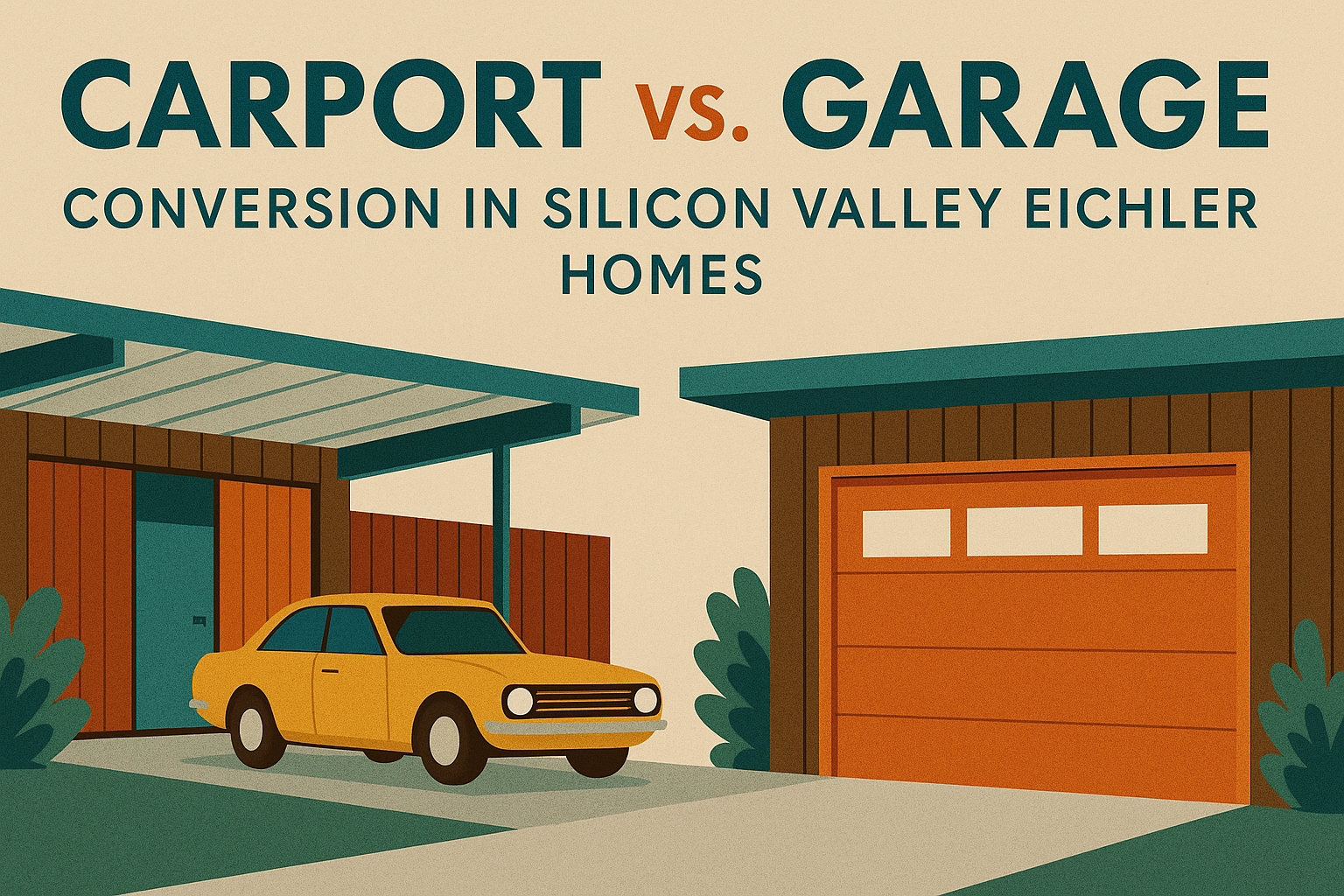
Carport vs. Garage Conversion in Silicon Valley Eichler Homes
Introduction: Eichler homes, iconic mid-century modern residences found in Silicon Valley neighborhoods like Palo Alto, Sunnyvale, and San Jose, often feature open carports instead of fully enclosed garages. Homeowners today frequently debate whether to convert these original carports into enclosed garages. This report provides a comprehensive analysis of that decision – weighing practical benefits against architectural and regulatory challenges. We’ll examine local zoning rules, building codes, and permit requirements in Palo Alto, Sunnyvale, and San Jose, and discuss how to preserve the hallmark Eichler aesthetics during a garage conversion. We’ll also explore storage, security, and weather protection considerations, and evaluate how an enclosed garage might affect property value and buyer perceptions (especially among Eichler enthusiasts). Clear headings and structured sections below outline the key factors to guide Eichler homeowners through this complex decision.
Eichler Carports vs. Garages: Architectural Context
Joseph Eichler’s designs intentionally embraced the carport as an integral part of the home’s modernist aesthetic and function. Many classic Eichler models came with an open carport at the front (or a modest garage), structurally integrated under the main rooflineeichlerhomesforsale.com. This design was both practical and stylistic: functionally, an open carport was cheaper to build and perfectly suited to California’s mild climate, and aesthetically, it “avoided the visual bulk of big garage doors”, keeping the facade low, open, and invitingeichlerhomesforsale.com. In fact, Eichler architects at times shunned double garages – one Eichler design replaced a two-car garage with a one-car garage plus a carport to prevent the front of the house from looking too much like a blank boxatomic-ranch.comeichlerhomesforsale.com. Instead of a prominent garage door dominating the street view, Eichler homes present an unpretentious profile: often the first things you see are the low roofline and the carport itself, which prioritizes privacy and simplicityeichlerhomesforsale.com. Carports were essentially an extension of the house – sharing the same roof, beams, and materials – giving Eichler tracts their distinctive open and cohesive look.
Given this context, converting a carport to an enclosed garage represents a significant exterior alteration. It introduces a large door and enclosing walls that could disrupt the original mid-century lines if done poorly. Eichler purists value the carport as a key character-defining feature – for example, Sunnyvale’s Eichler design guidelines explicitly discourage enclosing an entryway or carport space, noting that filling in the carport would cover up distinctive atrium walls and other character featuresscribd.comscribd.com. Some dedicated Eichler restorations have even reversed prior garage conversions to reopen the carport and restore the home’s authentic appearanceatomic-ranch.com. However, not all Eichlers had carports; some later models included garages, and many homeowners today seek the added convenience of a garage. The challenge is to achieve this without erasing the home’s “mid-century soul.”
In Silicon Valley Eichler neighborhoods, there is an ongoing balancing act between modernizing for today’s needs and preserving the original design. Before moving ahead with a carport conversion, homeowners should understand local regulations and get a sense of how city guidelines view such changes.
Zoning and Permit Regulations in Palo Alto, Sunnyvale, and San Jose
Converting a carport to a garage will require navigating city zoning rules and obtaining permits. Each city has its own regulations, but all three (Palo Alto, Sunnyvale, and San Jose) recognize the unique character of Eichler neighborhoods and have adopted guidelines or standards to steer alterations:
Palo Alto: Palo Alto has formal Eichler Neighborhood Design Guidelines (adopted in 2017-2019) that, while voluntary, strongly encourage preserving the Eichler aesthetic. These guidelines cover everything from roof forms and materials to windows, doors, and garagesmedium.commedium.com. In Eichler tracts, it is explicitly allowed for a garage or carport to project forward of the front facade, as Eichler homes often do, but there are size and height limits (e.g. max 21 feet width, low roof pitch ≤3:12, height ≤12 feet) to ensure any new garage remains in scalecityofpaloalto.org. If you plan to enclose a carport, Palo Alto’s guidelines advise keeping the design in harmony – for example using simple, flat garage doors with minimal or no glazing to blend with Eichler’s clean lookmedium.com. Ornate or panelized garage doors are to be avoided. While the guidelines encourage preservation of original carports, they do provide direction if an owner chooses to enclose one. Homeowners will need a building permit from Palo Alto’s Development Services; since a carport-to-garage conversion doesn’t expand the building footprint or add floor area (if it remains a parking space), usually only a building permit and not a separate planning entitlement is required (assuming the design stays consistent with zoning standards on setbacks, height, etc.). Palo Alto typically requires two off-street covered parking spaces for single-family homes, but an existing Eichler with one-car carport is grandfathered as legal – enclosing it won’t change the count. If converting a garage to living space, Palo Alto and other cities require replacement parking or use of new state ADU lawseichlerhomesforsale.com, but simply enclosing a carport to make a garage keeps the parking in place, so it generally meets zoning parking requirementsreddit.comreddit.com. It’s wise to consult Palo Alto Planning staff early; as one local noted, if the carport enclosure stays within the existing footprint and setbacks, it’s “relatively simple” to get permits, but still requires proper plans and inspectionsreddit.com. Palo Alto’s building permit process will scrutinize structural details and exterior appearance (especially if you’re in an Eichler overlay or a Single-Story Overlay zone), but many homeowners have successfully converted carports here.
Sunnyvale: Sunnyvale is home to several large Eichler tracts (such as Fairbrae and Rancho San Miguel), and in 2009 the city adopted Eichler Design Guidelines for these neighborhoodsscribd.com. Sunnyvale’s guidelines echo many of Palo Alto’s in spirit, emphasizing maintaining the one-story, low-profile look of Eichlers. Notably, Sunnyvale’s guidelines state “Do not enclose an entryway or carport space” as a recommended practicescribd.com. This strong language highlights that filling in a carport is seen as altering a major character feature – for instance, an Eichler atrium model’s translucent front wall or open atrium feel could be lost by enclosing the carportscribd.com. If front additions or enclosures must be done, Sunnyvale advises designing them to appear as if part of the original house, using identical materials and keeping the distinctive Eichler features visiblescribd.com. In practical terms, this means any garage addition should use matching vertical groove siding, consistent roof pitch, and clean lines so it doesn’t stick out. From a regulatory standpoint, converting a carport to a garage in Sunnyvale will require a standard building permit. As long as the carport is within current setback requirements (most Eichler carports are at the front and usually set back enough from the street and side property lines), enclosing it is permissible. However, if an Eichler carport is very close to a side property line, adding a wall there may trigger setback or fire-code rules (e.g. you might need a fire-rated wall if the new garage wall is under a certain distance from the lot line). Sunnyvale also requires two covered parking spaces for most single-family homes, but existing Eichlers typically already comply or are grandfathered. There is no separate “Eichler permit” in Sunnyvale, but city planners will likely refer to the Eichler guidelines during plan check to ensure the exterior changes remain subtle. In short, it’s allowed with permits, but the city encourages keeping the carport if possible to maintain neighborhood characterscribd.com.
San Jose: San Jose has a few Eichler neighborhoods (for example, the Fairglen tract in Willow Glen), and in recent years the city developed Eichler Neighborhood Objective Design Standards (ODS) to guide changes in these areas. Similar to Palo Alto and Sunnyvale, San Jose’s standards permit the classic Eichler configuration of a forward-facing carport or garage, with limits to preserve the look (e.g. height and width caps, low-slope roofs, and required Eichler-like materials such as vertical siding)cityofpaloalto.orgcityofpaloalto.org. While San Jose’s guidelines may not outright forbid enclosing a carport, they emphasize retaining Eichler characteristics like flat or low-pitch roofs, broad overhangs, and vertical board siding on new exterior wallscityofpaloalto.org. Any garage addition should continue these patterns. Enclosing a carport in San Jose will go through the normal building permit process; if the home is in a designated conservation area or historic tract, there could be additional review, but most Eichler tracts in San Jose are not officially historic (they rely on the objective standards for guidance). Zoning in San Jose also typically requires two covered parking spaces for a single-family house, which a converted carport-to-garage would satisfy. As in the other cities, no conditional use or variance is needed provided the enclosure stays within the home’s existing silhouette and meets codes. It’s recommended to check with San Jose’s Planning Department if any Residential Design Review is triggered by exterior changes – in many cases a carport enclosure can be handled ministerially if it’s a single-story change in keeping with design standards. San Jose’s focus will be ensuring the result doesn’t erode the mid-century modern feel of the streetscape.
Permitting: Across all three cities, a building permit is mandatory for converting a carport to a garage. This involves submitting plans (showing the new walls, door, and any structural reinforcements), paying permit fees, and getting inspections. Neighbors typically are not involved unless the project triggers a discretionary design review (which, for a simple enclosure that matches original style, is uncommon). However, being mindful of neighborhood context is important – Eichler communities are often tight-knit and value their area’s look, so an out-of-character garage could invite criticism even if legally permitted. On the flip side, some neighbors may welcome the enclosure because it hides clutter; as one Palo Alto resident noted, carports packed with storage can be eyesores, and enclosing them into a tidy garage “would make neighbors happy” by keeping the mess out of sightreddit.com. Still, any exterior changes in an Eichler tract should be done in a way that respects the overall aesthetic, as encouraged (and in some cases required) by these city guidelines.
Building Code and Construction Considerations
Converting a carport into a code-compliant garage isn’t just about adding walls and a door – there are important building code requirements and structural considerations to address. California’s building codes (based on the CBC/CRC) will apply, and your permit plans must show that the new garage meets all relevant standards for an attached garage. Key considerations include:
Foundation and Slab: Many Eichler carports share the same concrete slab as the rest of the house (a slab-on-grade with integrated radiant heating pipes in the living areas, though usually not under the carport). You’ll need to ensure the slab edges where new walls will sit can support them. Often, footings are required under new exterior walls. If the original carport was built with the option of future walls, there might already be thickened concrete or footings at the perimeter. If not, the contractor may have to saw-cut the slab edges and pour new footings beneath the proposed wall linesdoityourself.com. This provides a stable, frost-protected base and prevents the walls from settling or water seeping under them. Additionally, code requires protection of wood framing from moisture – typically an 8-inch separation from soil or the use of pressure-treated lumber at the basegatheradu.com. In practical terms, this means the bottom plate of your new wall should be pressure-treated and sit on a concrete curb or sill if the slab is at grade. A vapor barrier (6-mil plastic sheeting) may also be needed under any new slab sections to prevent ground moisture intrusiongatheradu.com. Before construction, an engineer or contractor will inspect the condition of the slab – it should be sound, without large cracks or settlement. If the slab is damaged or too thin at the edges, it may need repair or partial replacement to safely carry new loadsdoityourself.com.
Framing and Structural Support: The existing carport has a roof held up by posts or beams. When you add walls, those posts can often be incorporated into the new walls, but the design must account for lateral loads (earthquake/wind). Open carports have very little wall to resist horizontal forces, so the new garage walls will likely need plywood shear panels or other bracing to meet shear requirements. An engineer might specify new anchor bolts into the slab, steel brackets, or even a moment frame around the big garage door opening for stability. Additionally, you must add a header beam above the new garage door to carry the roof load across the wide opening. Standard garage doors (7-8 feet wide for single, 16+ feet for double) need appropriately sized beams – for example, a double 2x12 or engineered lumber header – which requires enough clearance under the roofthespruce.com. Many Eichler carports have low roof heights, so you’ll need to ensure there is room to frame in a header and still fit the garage door. If the roof is very low, you might have to use a low-profile garage door track or even slightly modify the opening height. It’s crucial that the new garage door header and framing don’t alter the roofline visible from the street; in Eichlers, often the roof extends as a flat or slight slope over the carport – that should remain visually the same, with structural work concealed.
Fire Safety and House Interface: Building code treats an attached garage as a different fire zone than living space. Thus, any wall that the new garage shares with the house must have a fire-resistance rating (typically 1/2-inch drywall on the garage side at a minimum, or 5/8-inch Type X for one-hour rating, depending on local code) and the door into the house must be a fire-rated, self-closing doorthespruce.com. In Eichler carports, there is often an entry door from the carport into the home (sometimes into the kitchen or a hallway). That existing door, if you enclose the carport, becomes an interior garage access door. It will need to be solid core or metal (20-minute fire rating) and have self-closing hinges to comply with codethespruce.com. If the wall between the carport and house was an exterior wall, it may or may not have insulation or drywall – converting to a garage, you’re generally required to separate the garage from living areas with proper drywall and seal any penetrations (for example, if there’s a electrical panel or plumbing on that wall). Also, any fuel-burning appliances that might be in the new garage space (such as a water heater or furnace closet common in Eichlers) must be protected: gas water heaters in garages need to be elevated 18 inches off the floor (to avoid igniting gasoline fumes) and secured, with combustion air provided. This usually is already the case in Eichler utility closets, but confirm whether the closet will now open into the garage and if it needs adjustments.
Electrical and Lighting: By code, an attached garage requires certain electrical installations – at least one wall switch controlling a light (so you’re not in the dark) and GFCI-protected outlets for general use. If your carport had an exterior light, that can likely be reused or upgraded to a garage interior light. You might need to run new wiring for additional outlets along the new walls. Given modern needs, many owners also add wiring for automatic garage door openers, EV charging outlets, or security systems during the conversion. All electrical work must be permitted and up to current code (e.g. using grounded circuits, GFCI receptacles, and adequate lighting).
Ventilation and Gasoline Fumes: While not always explicitly mandated for garages (garages usually aren’t required to have powered ventilation), you should consider how to keep exhaust and fumes from accumulating. With a carport, exhaust dissipates freely; an enclosed garage, however, can trap carbon monoxide if a car is running. The best practice is simply not to run vehicles inside and to vent any heaters or dryers properly. Some homeowners choose to install a louver or vent grille to the exterior for a bit of passive ventilation. If you store chemicals or paint, an operable window (if it doesn’t breach fire code on a setback wall) or just opening the garage door occasionally will handle it. The main concern is sealing the house walls so no air seeps into living quarters – weatherstrip the house entry door and ensure any attic or crawlspace is isolated.
Roof and Drainage: If the carport shares the house roof, enclosing it doesn’t usually change the roof itself (which is good for maintaining Eichler lines). However, pay attention to eaves and gutters – if the carport had open sides, rainwater simply fell off the roof edges; now, with walls, you may need to tweak gutter and downspout locations to route water away from the new garage walls or the driveway. Keep the Eichler-style wide roof overhangs unaltered if possible – they are a defining feature, and also help shield the new garage door from rain. Ensure the roofing material is in good shape over the carport; many Eichlers use tar-and-gravel or foam roofs, which should extend seamlessly over the enclosed area. If the roof needs re-roofing, do it during the conversion for best results. Structurally, if you add significant weight (like new roofing or skylights), have an engineer verify the carport roof framing (many Eichlers have 4x8 beams and 2x lumber decking which usually can handle typical loads, but any alterations should be checked).
Insulation and Energy Code: A garage that remains simply a garage (unconditioned space) typically does not need to be insulated to the same degree as living space. In California, you don’t have to insulate garage walls unless they separate conditioned interior space. So the new exterior walls of the garage may not require insulation if the garage will not be heated or cooled. However, some homeowners choose to insulate and even drywall the interior of the new garage walls for future flexibility (and it can slightly moderate temperature swings). If you plan to use the garage as a workshop or gym occasionally, consider insulating and installing drywall for comfort (and it gives a more finished look). Note that any common walls with the house should remain insulated as they were (or be upgraded to current standards if opened up). Also, the garage door itself typically is not required to be an insulated model by code, but an insulated door can help with temperature and noise.
Height and Door Size Constraints: Eichler carports often have lower clearance than modern garages. Standard garage doors are around 7 feet tall. Make sure the design allows at least this height at the opening. If the existing opening is shorter, you might have to order a custom size door or modify the opening (which could involve raising a portion of the roof or using a different door style). Eichlers with A-frame or high-gable carports (in some models) might allow a taller door, while those with flat roofs have a fixed low height. Fortunately, companies can provide low-clearance tracks and even retrofit options to make roll-up doors work in tighter spaces. Original Eichler garages sometimes used sliding or bifold garage doors due to low headroomeichler.blog, but modern solutions mean you can usually use a standard sectional roll-up with the right hardware. It’s worth consulting a garage door specialist on what door size and mechanism will best fit your Eichler without requiring major changes to the structurethespruce.com.
In summary, the construction phase of a carport conversion must transform an open, likely non-structural space into a sturdy, enclosed one that meets all safety codes. This will involve foundation work, framing, and adherence to fire and structural standards. Hiring a contractor or structural engineer with Eichler experience can be invaluable – Eichler homes have some unique aspects (e.g., slab with radiant heat pipes, post-and-beam construction without attic space, etc.) that a knowledgeable professional will navigate carefully. By meeting the building code requirements diligently, you’ll ensure the new garage is not only legal but also safe and durable for decades to come.
Preserving Eichler Aesthetics in a Garage Conversion
One of the biggest challenges – and most important goals – in enclosing an Eichler carport is to preserve the home’s mid-century modern aesthetic. A poorly executed conversion can stick out like a sore thumb, undermining the very qualities that make Eichlers so appealing. To avoid this, homeowners should take a design-conscious approach, using materials and details that honor the Eichler style:
Maintain the Roofline and Overhangs: Eichlers are known for their distinctive roof profiles – whether flat, low-pitched, or the occasional A-frame, they have deep overhangs with exposed beams. When adding garage walls, do not alter the roof’s shape or fascia. Keep the same eave depth and exposed rafter tails (if present) at the front. Any new framing should be tucked underneath the existing roof. The goal is that from the street, the silhouette of the house remains unchanged from its carport daysscribd.com. If you have to extend a beam or add a post, use similar dimension lumber and align it with the existing pattern. Avoid adding a visible gable or raising the roof for more headroom – this would break the horizontal emphasis of Eichler design. In cases where a carport has a higher gable, infill the gable triangle with materials like wood or glass that match the original design (for instance, some models had open gable peaks or decorative screens – replicate those rather than just boxing it in solidly).
Use Matching Siding and Materials: A critical aspect is cladding any new exterior walls in Eichler-appropriate siding. Most Eichler homes feature vertical grooved plywood siding or T1-11 with specific groove spacing (often 1-2 inch grooves at regular intervals)scribd.com. For a seamless look, use the same pattern on your new garage walls. Plywood panels with the exact groove spacing are available today specifically to match Eichlersscribd.com. For example, if your house has 3/8” grooved panels at 8″ on center, the new wall should continue that pattern. Some homeowners even salvage original panels or use skinning techniques for consistency. In one Eichler renovation, the owners “blended” a new roll-up garage door with the front elevation by skinning it with Eichler-style siding – essentially applying the same siding onto the face of the garage dooreichlernetwork.com. This clever trick can make a closed garage door almost disappear into the facade when shut, maintaining the flat planar look. Additionally, use the same paint color on the new garage exterior as the rest of the house, and keep to Eichler’s historically subdued palette (earthy tones or retro pastels) unless your house already sports a bolder scheme. Avoid introducing brick, stone, or busy textures that Eichlers never hadmedium.com – the Palo Alto guidelines explicitly warn against adding materials like brick or shingles that aren’t in line with Eichler’s original simplicitymedium.com.
Choose an Eichler-Friendly Garage Door: The garage door itself is the most prominent new feature, so select one that complements mid-century modern design. Eichler guidelines recommend simple, flat-panel doors with minimal or no glazingmedium.com. A flush panel door painted to match the house or covered in wood veneer to match surrounding siding is ideal. Some Eichler owners have custom garage doors made with grooved panels or planks that align with the house siding, or use clear frosted glass panel doors for a modernist look that echoes the large glass windows elsewhere (though be cautious – too much glass on a garage door may stand out). What to avoid are ornate carriage-house doors, raised panels, or excessive decoration. Even adding windows to the door should be done carefully: if the neighborhood guidelines say “minimal glazing,” that might mean a small row of clerestory-like lites or none at allmedium.com. A horizontal band of glass near the top can sometimes mimic Eichler clerestory windows. Also consider the door operation – sectional roll-up doors are standard, but if headroom is an issue and the original Eichler had sliding doors, one could consider modern sliders or bifold designs (there are specialty companies that do this) to keep the look authentic. However, most find a well-chosen sectional door works fine.
Respect the Entry and Atrium Features: Often, Eichler carports are adjacent to the front entry or an atrium wall. These areas were designed to be partially open, providing a layered transition from outside to inside. When enclosing the carport, try not to block or darken the entryway. For example, if your carport has a frosted glass privacy screen or a open-slat wall next to the front door, retain that feature rather than replacing it with a solid wall. If the carport leads into an atrium, consider leaving a portion as an open breezeway or adding a pergola element in front of the garage to echo the openness. Design guidelines note that enclosing the carport can cover up the “distinctive translucent front wall of the entry atrium” on some modelsscribd.com, so see if there’s a way to preserve a sense of light or see-through element. Some homeowners have added a narrow vertical window or transom windows above the garage door to maintain some visual connection. For instance, one Palo Alto Eichler conversion added clerestory windows where the garage door had been, keeping the horizontal siding below and clerestory glass above to mimic the original facade rhythmeichlerhomesforsale.com. The result was a garage that still looked like part of the Eichler’s design, rather than a tacked-on feature.
Privacy and Street Presentation: Eichler neighborhoods value a modest street presence – no big blank walls facing the street if possible. A carport, by nature, is open; when you enclose it, you introduce a broad wall or door plane. To avoid a monolithic look, you can incorporate subtle design elements that are true to Eichlers. For example, some Eichlers had breeze block screens, slatted fences, or planters in front of carports – those could be reintroduced in front of a new garage wall to soften it. If your garage door is very wide, breaking it up with a center post (making two single doors) could look more proportional to a mid-century house, though that sacrifices some parking flexibility. Pay attention to the scale: keep the garage door width within what was typical (Palo Alto’s Eichler standards limit garage fronts to 21 feet width maximumcityofpaloalto.org, which is about a two-car garage). Also ensure any new exterior lighting added by the garage is in a mid-century style (e.g. simple globe or cone fixtures) and not an ultra-modern or overly ornate fixture.
Professional Design Input: It may be worthwhile to consult an architect or designer experienced with Eichler remodels. They can propose creative solutions like custom perforated panels, matching wood textures, or even glass walls to replace what would be the garage door when closed, thereby maintaining an Eichler-esque look. For instance, some Eichler garage conversions treat the former carport as a flex space with a glass storefront system – essentially turning the “garage” into a multi-use room with full-height glass that still lets one park a car behind it. This is more common when converting to living space, but the idea can inspire a compromise between enclosure and openness. At minimum, look at examples from neighbors or Eichler remodel photos to see what garage doors and designs have worked aesthetically. There are community resources (Eichler Network forums, etc.) where owners share their experiences and sometimes the names of garage door vendors who can do Eichler-style custom doors.
By thoughtfully integrating the new garage with the original design, you can end up with an enclosed space that feels “Eichler original.” A good test is to ask: if a stranger drove through the neighborhood, would the converted garage catch their eye as something out of place, or would it blend in naturally? The aim is the latter. Use the same materials, proportions, and simplicity that Joseph Eichler’s architects did. City guidelines and Eichler experts all stress that any exterior changes should be “in harmony with the neighborhood” and consistent with Eichler design sensibilitieseichlerhomesforsale.com. When in doubt, err on the side of subtlety – it’s better to have a slightly plain garage front than one that draws attention. Successful conversions have been described as “nearly invisible from outside” when executed thoughtfullyeichlerhomesforsale.com. Achieving that level of seamlessness is possible with careful planning, preserving the iconic mid-century charm even as you upgrade functionality.
Practical Benefits of Enclosing a Carport (Pros)
Despite the caution and care needed, there are compelling practical advantages to converting an Eichler carport into an enclosed garage. Homeowners undertake this project largely to improve everyday convenience and utility. Here are the key benefits and pros of an enclosed garage:
Enhanced Security and Privacy: An open carport leaves your vehicles and any stored items exposed to anyone passing by. In Silicon Valley cities, property crime (like theft of bicycles, tools, or even items from cars) can be a concern. A garage provides a lockable barrier, greatly reducing the risk of opportunistic theft. You can securely store not just cars but also expensive gear (bicycles, electric scooters, lawn equipment) out of sight. Additionally, a garage offers more privacy – anything in there is hidden from street view. If your carport is visible to many neighbors, you might feel uneasy storing personal items there; enclosing it resolves that. During a regional rash of burglaries, Eichler owners were advised to not leave ladders or valuables in open carports that could entice intrudersalansfactoryoutlet.com. Simply having a garage door can be a significant deterrent. Moreover, you can equip the garage with motion-sensor lights or an alarm on the door for added peace of mind. From a neighborly standpoint, enclosing a cluttered carport can also improve curb appeal by removing unsightly piles from view – instead of your overflow storage being on display, it’s tidily behind closed doors. Neighbors often appreciate this tidinessreddit.com. In essence, a garage lets you control access and visibility, creating a more secure environment for both your belongings and entry into your home.
Improved Storage and Organization: Storage space is at a premium in Eichler homes, which famously have minimal attic or basement space and only small closetseichlerhomesforsale.comeichlerhomesforsale.com. Converting to a garage can dramatically increase your storage capacity. You gain walls where you can install shelving, cabinets, or hooks – something not really feasible in an open carport exposed to weather. Many Eichler owners long for a place to put bulk Costco purchases, holiday decorations, sports equipment, etc., and a garage answers that need. You can add overhead storage racks for bins and boxes since the garage will be enclosed (keeping items clean and dry). As Eichler-focused realtors point out, Eichler buyers and owners “love when added storage is elegant and seamless – it addresses the fact that ‘lack of storage is an issue Eichlers are notorious for’”eichlerhomesforsale.com. By enclosing the carport, you create that added storage in a way that can be made to blend with the home’s style (using built-ins or cabinets that match the interior paneling, for example). Practically, having a garage means you can store items that you wouldn’t leave in a carport for fear of rain or theft – think power tools, a second fridge or freezer, or bulk pantry goods. The garage can also serve as a hobby/workshop area for DIY projects; you can have a workbench and not worry about wind or public view. Essentially, a well-organized garage can significantly enhance the functionality of a smaller Eichler house, giving you a bit of “flex space” that the original floor plan lacked.
Weather Protection for Vehicles and Belongings: While the Bay Area has a mild climate (no snow, and only seasonal rains), an enclosed garage still offers better protection from the elements than a carport. Cars parked in a garage stay cleaner and suffer less UV exposure – no more sun-baked paint and interiors or sap and leaves accumulating. During the winter rains, you’ll appreciate that your car (or kids’ strollers, etc.) are completely dry and shielded when you load and unload, rather than at the edge of an open carport where wind can blow rain in. Enclosed garages also buffer against dust and pollen which are common year-round; in an Eichler carport, you might find your car covered with leaves or dust that float in. In a garage, that’s minimized (especially if you keep the door closed). Weather protection isn’t just for cars: any additional appliances or storage in the garage benefit too. For example, many people keep a washer/dryer, water heater, or chest freezer in the carport storage closets – enclosing the space provides a more stable environment for those. It can prevent pipes from the brief freezes we occasionally get and generally prolong the life of anything stored by keeping out moisture and pests. Also, consider heat: in the peak of summer, a carport leaves vehicles in whatever heat the shade can’t stop, whereas a garage, while not air-conditioned, stays cooler without direct sun and can be ventilated at night. And in terms of convenience, not having to scrape dew or frost off your windshield on chilly mornings (yes, it happens even in Silicon Valley) is a small but nice perk of a garage.
Convenience and Cleanliness: With an enclosed garage, you have the convenience of privacy when coming and going. You can unload groceries or kids from the car and then close the garage door before carrying everything inside, all out of public view. In a carport, you’re effectively outside until you reach your front door or interior – an enclosed garage creates a semi-interior transition space. This can be particularly appreciated if you arrive home late at night and want that extra sense of security. It’s also a buffer space to drop muddy shoes or wet umbrellas, keeping the mess out of the house. Many Eichler garages (when enclosed) become a place to leave strollers, bicycles, and pet items without cluttering the atrium or entryway. Because it’s enclosed, you can also keep the garage space cleaner – sweeping a garage and keeping dust out is easier than a carport where debris blows in constantly. Some owners even use part of the garage as a home gym or kids’ play area on rainy days, which wouldn’t be feasible in an open carport. In short, a garage can function as a versatile extension of the home when needed, offering flexibility that an open carport doesn’t.
Higher Utility and Potential EV Accommodation: As we move into an era of electric vehicles, having an enclosed garage can be beneficial for setting up charging infrastructure. While it’s true you can charge an EV in a carport (and many Eichler owners have done so, installing 240V outlets in their carports)eichlerhomesforsale.com, a garage keeps the charging equipment sheltered and secure. Expensive charging units or cables are less likely to be tampered with or weather-worn. Additionally, if you’re a car enthusiast or have a classic car (fitting for an Eichler owner who appreciates mid-century design), you’ll likely want to keep it garaged and protected. The synergy of Eichler homes and classic cars has been noted – enthusiasts imagine a vintage Corvette or VW Bus parked safely under that iconic roofeichlerhomesforsale.comeichlerhomesforsale.com. A garage ensures your prized vehicle or project car is locked away and not slowly deteriorating outside.
Broadening Home Appeal: From a marketability standpoint (elaborated more in the next section), having an enclosed garage may make the home more appealing to a broader range of buyers. Many buyers today simply expect a garage as a standard feature for storage, parking, or home projects. By converting, you check that box. In day-to-day life, you as the homeowner will likely appreciate that you’ve increased your home’s functionality, perhaps making it feel like a more “complete” single-family home experience (especially if you moved from a home with a garage and missed it). In the words of one Eichler owner, gaining about 200 square feet of useful space by repurposing the carport can be “a game-changer” for how they use the homeeichlerhomesforsale.com – even if it’s still used for parking, the psychological benefit of having that extra enclosed room for projects or storage is significant.
In summary, the pros of a garage conversion include greater security, more storage, protection from weather, and overall increased utility of the home. These advantages address some of Eichler homes’ known weak points (storage shortage, exposure of belongings) in a very practical way. As long as the conversion is done in line with the home’s style, many Eichler experts agree that such “lifestyle-enhancing elements” can be added without detracting from the charactermedium.com – meaning you can enjoy the comforts of a modern garage while still living in your mid-century dream home.
Potential Drawbacks and Challenges (Cons)
Against the benefits, one must weigh the cons and challenges of enclosing an original Eichler carport. These range from aesthetic and cultural considerations to financial and logistical issues. Here are the notable drawbacks to consider:
Loss of Original Character: The most immediate con is the alteration of the Eichler’s architectural purity. An open carport is a hallmark of Eichler homes’ design ethos – it reinforces the indoor-outdoor flow and minimalistic facade. By enclosing it, you inevitably change the look and feel of the house’s front. Eichler enthusiasts and purists might view this as a detraction. In some Eichler tracts, a carport with its breezy openness and glimpse into an atrium is part of the neighborhood’s mid-century charm; removing that can subtly diminish the overall aesthetic continuity. As mentioned, city guidelines and Eichler experts often caution that enclosing a carport “covers up major character features” and should be avoided if possiblescribd.comscribd.com. There is a certain architectural honesty and simplicity lost when you replace open space with a garage door, even if well-designed. The house may read as more conventional from the street, less like an Eichler to a trained eye. For owners who fell in love with the look of Eichler homes, this is an important consideration – you must be comfortable with altering one of those defining features. In the worst case, a poorly executed garage conversion could look tacked-on or disrupt the balanced lines of the facade, significantly undermining curb appeal (for example, a mis-matched door or a protruding garage front would be jarring). While good design can mitigate this (as discussed in the aesthetics section), it’s fair to say that some Eichler magic is inherently tied to the openness – closing it off is a compromise.
Potential Compliance and Cost Issues: Adding walls, footings, and a door isn’t a trivial project. One con is the cost and complexity of construction. Depending on what the existing conditions are, you may face unanticipated costs like having to reroute plumbing or radiant heat lines that run near the carport, reinforcing an undersized beam, or cutting and repouring sections of concrete. If the carport slab wasn’t level or sloped appropriately (garages often have slight slopes for drainage), you might have to grind or refinish the floor. These things add expense. On average, a straightforward carport-to-garage conversion can cost several tens of thousands of dollars in the Bay Area when you factor permits, materials (lumber, door, opener, wiring), and labor – and more if significant structural upgrades are needed. It’s wise to get a detailed quote and be prepared for contingencies. Indeed, there have been cases where owners considered expanding or enclosing carports but had to cancel or scale back those plans due to budget overrunsonekindesign.com. It’s not a purely superficial change; it essentially creates a new semi-habitable structure, so it must be done to high standards. Furthermore, while permits are absolutely a must (for safety and legality), dealing with them is a process: drawing plans, possibly hiring an engineer or architect, and scheduling city inspections can be time-consuming. Some homeowners find the permitting and inspection process daunting if they’re new to it. Dealing with any needed variances (if, say, the carport was built closer to a lot line than current code allows) can also be a hassle, though typically cities grandfather the existing footprint as allowable to enclose.
Impact on Light and Air: An open carport contributes to the airy quality of an Eichler. It can allow light into the atrium or entry area and provide cross-ventilation. When you enclose it, you might inadvertently make adjacent spaces darker or more closed-in. For example, if your carport faces an atrium wall with a translucent panel or window, that window will now face a garage wall or interior, cutting off natural light that used to pass through. Unless you incorporate new light sources (like the clerestory windows or skylights), you may find your entryway or atrium a bit dimmer. Also, a carport can channel breezes on a hot day into the atrium or even into the house when doors are open; a garage blocks this natural airflow. The house may feel a tad more enclosed as a result. While these effects aren’t usually deal-breakers, they change the sensory experience of the architecture. The atrium – a signature Eichler feature – might lose some of its outdoor feel if one side is now a solid garage wall. Essentially, you’re trading some mid-century openness for enclosure comfort.
Altered Function of Space: Think about how you currently use your carport. Some Eichler owners actually enjoy the carport as a multi-functional covered area – it can serve as a shaded patio for kids to play, a spot to do messy projects outdoors, or a breezeway for moving between front and back yards. Once it’s a garage, its use becomes more singular (parking/storage) and less flexible as an open outdoor room. If you frequently entertain, you might have used the carport area for overflow outdoor seating or as a staging area for events (protected from sun/rain but open to the yard). Enclosing it removes that option; a garage is less suitable for a social space due to limited openings and typically more clutter. Some people like to sit under the carport and watch the world or chat with neighbors – a very mid-century, casual lifestyle element that you lose with a closed garage. Additionally, if the carport provided a secondary access (some Eichlers have a side door or gate in the carport to the backyard), make sure that remains accessible – you might need to incorporate a side door into the new garage design, which is another cost and design element. Losing an easy path to the backyard could be inconvenient (e.g., now you have to go through the house or open the big garage door to wheel a mower around). So, consider how enclosure will change your daily routines around the house.
Possibility of Building Restrictions: While we outlined the regulations and noted that generally it’s allowed, there can be specific instances where converting a carport might not be straightforward. For example, if your Eichler is in a designated historic district (a few Eichler tracts, like Palo Alto’s Greenmeadow or Green Gables, have historic recognition), then the city’s historic review board might have to approve changes to the front facade to ensure they don’t compromise historical integritycityofpaloalto.org. They might be stricter about maintaining original features, which could complicate or delay your conversion plans. Even outside official historic status, if your neighborhood has a homeowners’ association (HOA) or CC&Rs from the original development (some Eichler tracts do have CC&Rs about maintaining certain look), you should verify that enclosing the carport is allowed. It would be rare for an HOA to forbid it entirely, but they may have a say on appearance. Community pressure can also be a factor – neighbors might oppose changes if they fear a domino effect of everyone enclosing carports and altering the neighborhood vibe. While this isn’t a formal restriction, it’s a social consideration; you may want to communicate your intentions and show a respectful design to garner support rather than backlash.
Reduced Covered Parking Area (During Construction): One temporary downside is the construction period. When you decide to convert, you’ll likely lose the use of the parking space for some time while work is ongoing. Your carport will become a construction zone – meaning you’ll park on the street or driveway for a few weeks or more. In Palo Alto or Sunnyvale, on-street parking can be at a premium or subject to time limits in some areas, so plan for that disruption. If you have multiple cars that used to snugly fit in a two-car carport, note that constructing walls could slightly reduce the interior width or length available (framing takes up some space), making the new garage a tighter fit until you maybe rearrange storage. So, a consideration is whether both your vehicles will indeed comfortably fit after conversion, especially if you add internal wall sheathing or cabinets that eat into space. Generally, an Eichler carport that held two cars will still hold two cars as a garage, but double-check dimensions so you don’t inadvertently create a one-car garage out of a two-car carport by adding thick walls or obstacles.
Ventilation and fume concerns: As mentioned, a con of any garage is the potential buildup of exhaust or other fumes, which was not an issue in a carport. You’ll have to be more mindful of not running engines inside. Storing certain chemicals or fuel in a closed space can also create odor or hazard if not stored properly. It’s not a huge issue with basic precautions, but it’s a new responsibility you take on when you enclose. Also, once you have a garage, there may be a temptation to fill it with too much stuff (since out of sight, out of mind). This isn’t a code issue, but it can reduce the usefulness (the classic “can’t park in my garage because it’s full of stuff” problem). With a carport, one was forced to keep the clutter somewhat in check or face public shame; a garage might encourage packrat tendencies. While this is more a human challenge than a structural one, it can be seen as a downside if the goal was to keep the minimalist lifestyle that Eichler homes inspire.
In weighing these drawbacks, consider your personal priorities. If you are a devoted mid-century modern aficionado, the cultural or aesthetic loss might outweigh the pragmatic gains – you might explore alternatives like adding a separate shed for storage or using clever storage solutions (as some Eichler owners do) rather than enclosing the carport. If security or having a workshop space is paramount, those benefits might trump concerns about altering originality. It’s a trade-off scenario with no one-size-fits-all answer. Also, keep in mind that many of these cons (design impact, light loss) can be mitigated with smart design and planning – for example, adding a skylight to the garage or a glass block element can reintroduce some light; matching the exterior perfectly can ease the aesthetic change. Awareness of the challenges is the first step to addressing them effectively. Ultimately, successful projects minimize these downsides so that the home still “feels Eichler” and the owner feels the new garage is a net positive.
Impact on Property Value and Buyer Psychology
Converting a carport to a garage can influence property value and marketability, but the impact can be nuanced, especially in the Eichler niche market. We must consider two primary buyer groups: general homebuyers in Silicon Valley and Eichler enthusiasts/collectors. Each may perceive the conversion differently, and thus the effect on value isn’t black-and-white.
Mainstream Market Appeal: In general residential real estate, having an enclosed garage is seen as a valuable feature. Typical buyers often have an expectation for a garage – it’s almost a default checkbox for suburban homes. From this perspective, converting a carport to a garage can broaden the appeal of your Eichler to buyers who might otherwise be hesitant about the home’s storage or security limitations. For instance, a tech professional relocating to Palo Alto might love the idea of an Eichler’s design but pause when they realize it only has a carport for their $100k electric vehicle and ample outdoor gear. If your home now has a secure two-car garage, that concern is alleviated. Real estate agents note that many modern buyers have multiple cars, expensive bicycles, or recreational equipment and feel more comfortable with a proper garage to store them. In Silicon Valley, where people accumulate lots of tech toys and sporting equipment, storage is at a premium, and a garage provides that in spades. One Eichler-specialist agent observed that buyers “love added storage” when it’s done in a way that doesn’t spoil the charactereichlerhomesforsale.com. So a well-executed conversion can be a selling point: it provides the storage while keeping the Eichler character, theoretically giving the buyer the best of both worlds. A poorly done conversion, however, might hurt value if it diminishes curb appeal – think of a scenario where an ungainly garage door sticks out; it could turn off both Eichler fans and regular buyers because it looks awkward.
Eichler Enthusiast Perspective: Eichler enthusiasts form a subset of buyers who specifically seek out these mid-century homes for their design. This group might place a premium on original features and integrity. For such buyers, an intact carport could be seen as a plus – a sign that the home remains as Eichler intended. In marketing Eichler listings, you’ll sometimes see highlights like “preserved in its original state – including the iconic open-air atrium and carport”atriare.com, which signals to purists that the home’s character is intact. These buyers might value the aesthetic authenticity over the convenience of a garage. In fact, in an Eichler enthusiast market, removing original elements can sometimes lower perceived value, or at least narrow your buyer pool to those who don’t mind the change. For example, an original open atrium or carport model might command a slight premium for rarity and charm in the eyes of a collector, whereas a converted one might be seen as more “ordinary.” However, it’s not a simple equation: many Eichler lovers also live in the real world and may appreciate improvements that make the home more livable (especially if done sensitively). A subset of purists might even reverse changes (as with the X-100 Eichler restoration that removed a garage door to reopen the carportatomic-ranch.com), but such extreme purism is less common among average buyers. Generally, expect that a few hardcore enthusiasts could thumb their nose at a conversion, but plenty of Eichler-seekers are okay with it as long as the home still looks like an Eichler.
Value Add vs. Cost: From a pure appraisal standpoint, adding square footage or functionality can boost value. An enclosed garage, while not counted as living area, is considered a positive feature in comps. Appraisers typically give some value to a garage (often a couple tens of thousands of dollars in valuation) compared to a similar home with only a carport. It’s hard to quantify exactly, but a well-done garage conversion can be expected to raise the home’s value by a portion of its cost. It won’t be dollar-for-dollar like adding a bedroom, but it improves marketability. Some home improvement sources claim garage conversions (to living space) can boost value significantlyhfsfinancial.net, but in this case we’re converting to another type of parking space, so the gain is more about desirability than extra living area. Anecdotally, realtors in the Bay Area have noted that non-garage homes (carport homes) sometimes sell a bit slower or for slightly less because certain buyers rule them out. By eliminating that objection, you potentially get more offers or a higher willingness to pay. Especially if, say, you and a neighbor have identical Eichlers but you have a nice enclosed garage and they don’t, a broader range of buyers might bid on yours.
Buyer Psychology – Practical Mindset: Silicon Valley buyers, even Eichler fans, often have practical streak. With many working in tech or having young families, they think about daily convenience. A garage can subconsciously signal that the home has been modernized to suit contemporary life – it’s one less project for them to consider. First-time Eichler buyers (people who love the style but haven’t owned one before) might be nervous about quirks like lack of storage or the perceived fragility/security of all-glass walls and open carports. A garage conversion, along with other modern upgrades (like improved insulation or double-pane windows), can reassure them that the house marries form and function. In marketing, emphasizing that the conversion was done under permit and in line with Eichler design can further assuage concerns. Buyers might think: “Great, I get the Eichler vibe without sacrificing a secure garage for my gear.” This is especially relevant for tech professionals with expensive gadgets (fancy bikes, VR setups, etc.) who will want a secure place for those.
Buyer Psychology – Emotional/Aesthetic Mindset: On the flip side, some buyers fall in love with the romance of mid-century modern living – the idea of driving up to the carport, the indoor-outdoor continuity. These folks might emotionally respond to an open carport in photos or at open house (“Look how cool, we can see through to the atrium!”). If it’s walled off, that initial emotional hook might be slightly less. Yet, once they think of practicality, they may come around. Here’s where staging and presentation can help: if the garage conversion is seamless, many might not even realize the house didn’t always have a garage. If the facade looks cohesive, a buyer who’s less versed in Eichler history might assume it was always that way, and thus not have any negative reaction. Eichler-savvy buyers will know, but again, if they see it was done tastefully, they could view it as the home being well-cared-for and updated responsibly.
Resale in Eichler Markets: It’s worth noting that Eichler homes often attract multiple offers due to their scarcity and architectural interest, whether or not they have garages. In places like Palo Alto, Sunnyvale, or San Jose, Eichlers routinely sell for high prices thanks to location and style. A garage could be that extra feature that gives your home a slight edge or at least removes a possible discount factor. For example, if Eichlers in your tract typically go for $X and there’s a notion that “the ones without garages might go for a tad less,” converting could put you firmly in the top tier. Also, consider future trends: as more Eichler owners modernize (adding amenities like garages, air conditioning, etc.), the market baseline might shift. What was once accepted as part of the quirky charm (having no garage or AC) might, in 10-15 years, be seen as a drawback as the renovated Eichlers set new expectations. Already, some Eichler neighborhoods have many homes that have enclosed carports or even built new garages, setting a precedent. Checking with a local Eichler-experienced realtor can give insight – they might say, for instance, “I’ve seen buyers pass on that model because of the carport, but when another owner enclosed it, it sold immediately.” Such anecdotal evidence can guide your decision if resale value is a primary concern.
Eichler Market Psychology: Interestingly, there is almost a cult following for Eichlers in the tech communityeichlerhomesforsale.comeichlerhomesforsale.com. These buyers often appreciate authenticity but also love innovation. They might admire a conversion that cleverly uses modern technology or design to preserve the Eichler look (like a smart garage door that’s ultra-quiet and clad in original siding). In other words, an Eichler enthusiast buyer might geek out over a well-done conversion because it shows respect for the design coupled with smart engineering. Including project documentation (plans, permits, photos of the process) in your disclosure package could even impress them with the level of care taken. It demonstrates that as an owner, you invested in the home thoughtfully – a positive signal to any buyer.
Property Value in Absolute Terms: To be thorough, one should mention that property value in these Silicon Valley cities is influenced by many factors (location, lot size, interior condition, etc.) far more than by whether there’s a garage or carport. The conversion won’t overcome a poor location or tiny floor plan, nor will a carport ruin a sale of an otherwise amazing Eichler. It’s a contributing factor. In a strong seller’s market, a desirable Eichler will find a buyer either way, but the garage might add to the final sale price or speed. In a cooler market, features like an enclosed garage can help differentiate your home. Keep an eye on local comparables: if most comps have garages and yours doesn’t, that might justify doing it. If comps are mixed, focus on doing what makes the home best for you, since value differences may be marginal in context of multi-million dollar home prices.
In conclusion, converting the carport to a garage tends to be value-neutral to positive for resale, provided it’s executed in line with the home’s character. It removes a common buyer objection (lack of garage) and appeals to practical needs, without strongly alienating the core Eichler fan base if done tastefully. Eichler experts often advocate for improvements that add comfort and functionality while “keeping the soul” of the homeeichlerhomesforsale.com – a garage conversion can fit that philosophy when approached carefully. As one remodeling guide noted, the key is doing it “by the book” (with permits and design harmony) so that your new space is both legal and “in harmony with the neighborhood”eichlerhomesforsale.com. Achieve that, and you likely bolster both your enjoyment of the home and its value to the next owner.
Conclusion: Balancing Modern Needs with Eichler Heritage
Converting an original Eichler carport into an enclosed garage is a decision that sits at the intersection of practicality and preservation. On one hand, the pros are undeniable – greater security, more storage, better protection for vehicles, and increased appeal to many of today’s homeowners. It’s an upgrade that can make an Eichler home more livable day-to-day, addressing some functional shortcomings of 1950s-era design. On the other hand, the cons remind us that Eichler homes derive part of their charm from their openness and minimalist facades; enclosing a carport risks altering that carefully crafted mid-century aesthetic. There are also costs, codes, and possibly community opinions to manage.
In Silicon Valley cities like Palo Alto, Sunnyvale, and San Jose, local regulations generally support homeowners improving their properties – including adding garages – as long as they respect the Eichler neighborhood context. The existence of Eichler-specific guidelines and objective standards means there is plenty of advice and precedent for how to do this tastefully. Homeowners who proceed with a conversion should leverage those resources: follow the design guidelines (matching materials, keeping a low profile), obtain the proper permits, and consider consulting experts in Eichler remodels. By doing so, one can avoid pitfalls and create a garage that looks as if it “was always there.”
From a design perspective, it’s about striking a balance – integrating the new garage in a way that preserves the spirit of the Eichler. This might mean accepting some creative design solutions or slightly higher costs to get custom details right (for example, investing in a flat-panel door and aligning siding, rather than a cheaper off-the-shelf door that looks out of place). The result, when done right, can actually enhance your Eichler: imagine a garage that is so well integrated that it provides all the benefits while still eliciting the “mid-century wow factor” when people see your home.
Real-world outcomes suggest that many Eichler owners have successfully made this conversion. Some have even reported that the extra enclosed space became their favorite feature, whether as a workshop, home office overflow, or simply a clean garage for a beloved vehicle – all while neighbors barely notice a difference from the street because the house still looks like an Eichler. Eichler Network stories and community anecdotes indicate that when conversions are done with care, the broader Eichler community is accepting, even appreciative, of the effort to maintain neighborhood character (versus, say, unsympathetic second-story additions, which tend to draw ire). In fact, a thoughtful carport enclosure may be seen as a model for others who need modern convenience but don’t want to leave the neighborhood or ruin its look.
In making your decision, consider your personal priorities: Do you value authenticity above all, or do the daily benefits of a garage significantly improve your quality of life? How long do you plan to stay in the home, and will the conversion serve your needs in that time? If resale is on the horizon, weigh how the change might position your home in the market. It may help to talk to neighbors who have or haven’t converted their carports to get their insights on living with (or without) a garage. Also, walking through examples (if any open houses or Eichler tours feature a converted garage) can give you a tactile sense of the trade-offs.
Finally, remember that reversibility is a concept: if you design the conversion thoughtfully, it could be made reversible. For example, if you preserve the original beam structure and just infill with walls that someday could be removed (and store the removed siding sections safely), a future owner or even you could restore the carport if desired. While most people won’t go backwards, it’s nice to know you haven’t irreparably changed the house’s DNA.
In summary, converting an Eichler carport to a garage in Palo Alto, Sunnyvale, or San Jose is indeed feasible and can be highly rewarding, but it demands a comprehensive approach – understanding city rules, respecting Eichler design principles, and executing the build correctly. With this guide’s information and the experiences of Eichler experts and homeowners to inform you, you are well-equipped to make a decision that aligns with both your practical needs and your love of Eichler architecture. A successful project will result in a home that continues to “live Eichler” – open, modern, and harmonious – while subtly evolving to meet the 21st-century lifestyle. By achieving that harmony, you protect your investment (both financially and aesthetically) and ensure that your Eichler remains a source of pride and joy for years to come.
About the Boyenga Team
With over 25 years as top-producing Silicon Valley real estate experts, Eric and Janelle Boyenga are recognized authorities on Eichler homes. As founding Compass agents and lifelong design advocates, they help clients make informed decisions—whether preserving architectural authenticity or unlocking modern potential. From carport conversions to record-setting sales, the Boyenga Team’s “Next-Gen Agent” approach combines deep Eichler knowledge with advanced marketing and negotiation strategy.
Sources:
Palo Alto Eichler Neighborhood Design Guidelinesmedium.comcityofpaloalto.org
Sunnyvale Eichler Design Guidelines (2009)scribd.comscribd.com
Boyenga Team Eichler Blog – Modernizing Eichler Homes eichlerhomesforsale.com; Eichler & Classic Cars; Eichler Hacks – Storageeichlerhomesforsale.com
Reddit community feedback (r/paloalto)reddit.com reddit.com
Atomic Ranch – Eichler X-100 restoration storyatomic-ranch.com
The Spruce – Carport Conversion Considerations thespruce.com
Gather ADU – Garage Conversion in Palo Alto (foundation/code requirements)g atheradu.com
Eichler Network & Eichler for Sale resources on garage doors and remodel tips eichlernetwork.com medium.com
Eichler listing description (example of original carport model marketing)
General building code references (CBC/CRC) and local zoning codes as discussed in text.
Sources