
Community by Design: Eichler Neighborhoods vs. HOA Subdivisions
Family homebuyers often realize that finding the right house is also about finding the right community. In Silicon Valley and across California, two starkly different models of suburban living offer a lesson in how urban design and social networks shape neighborhood life: the classic mid-century Eichler neighborhoods and the modern HOA-driven subdivisions. Below we explore how Joseph Eichler’s open, people-oriented design philosophy compares to typical HOA developments, and how features like layout, governance, and walkability impact community strength and connections.
Eichler’s Mid-Century Vision: Architecture That Fosters Connection
Eichler homes aren’t just stylish mid-century artifacts – they were designed for community. Joseph Eichler’s California tracts of the 1950s–60s broke the mold of cookie-cutter suburbia by emphasizing openness, transparency, and shared spaces. Key design features of Eichler neighborhoods include open floor plans, floor-to-ceiling glass walls, central atriums, low-sloping roofs and low fences. This signature architecture blurred the lines between indoors and outdoors, and between private and communal life:
Indoor-Outdoor Flow: Huge glass panels and atrium courtyards bring nature and daylight in, uplifting the mood of residents and creating inviting spaces visible to friends and neighbors. Living areas often open onto patios, making it easy to host neighbors for a BBQ or casual get-together. As one architect noted, an Eichler home “captures the word optimism in built form,” using light and openness to enhance quality of life.
Shared Sightlines & Low Fences: Eichler neighborhoods were typically designed with minimal front windows and modest street façades, preserving privacy from the street, but expansive rear glass that opened onto yards often separated by low fences. Neighbors could chat over back fences or watch kids move freely between houses. In fact, Eichler kids literally cut paths – even digging holes under fences – to play together from yard to yard. The intent was to strike a balance: give each family a private sanctuary, but not a walled-off fortress, thereby encouraging friendly interaction on their own terms.
Curved Streets and Common Areas: Many Eichler tracts feature gentle cul-de-sacs and interior parks or pools instead of traffic-throttled through-streets. In Palo Alto’s Greenmeadow, for example, a central park and community pool anchor the subdivision – geographically and “spiritually” – as a gathering place for neighbors. This reflects Eichler’s “village concept” of development: integrating shared amenities like playgrounds, swim clubs, or greenbelts to bring residents together organically. Neighbors run into each other at the pool or walking the curved lanes, much like in a small town. Indeed, Greenmeadow today feels “a little town out of the ’50s…in the middle of a city,” with tree-lined streets and homes looking much as they did when built.
Family-Friendly, Inclusive Design: Eichler homes were built with young families and community living in mind. Many include features like open kitchens facing play areas (so parents could watch kids), and the iconic open-air atrium that acts as a semi-public foyer for the home. Original Eichler ads even promised buyers a “New Way of Life” focused on indoor-outdoor family living and neighborly connection. Equally important, Eichler’s company had an explicit non-discrimination policy, selling to people of all races and backgrounds in an era when many suburbs were segregated. This progressive stance fostered diverse, eclectic neighborhoods – “a heterogeneous group” of creative professionals, academics, young and old – who all shared an openness to new ideas and community spirit. (Steve Jobs, who grew up in an Eichler, said “Joseph Eichler did a great thing. His houses were smart and cheap and good,” bringing quality modern design to everyday families.) The inclusive ethos helped neighbors bond across different ages and incomes, much like a traditional village.
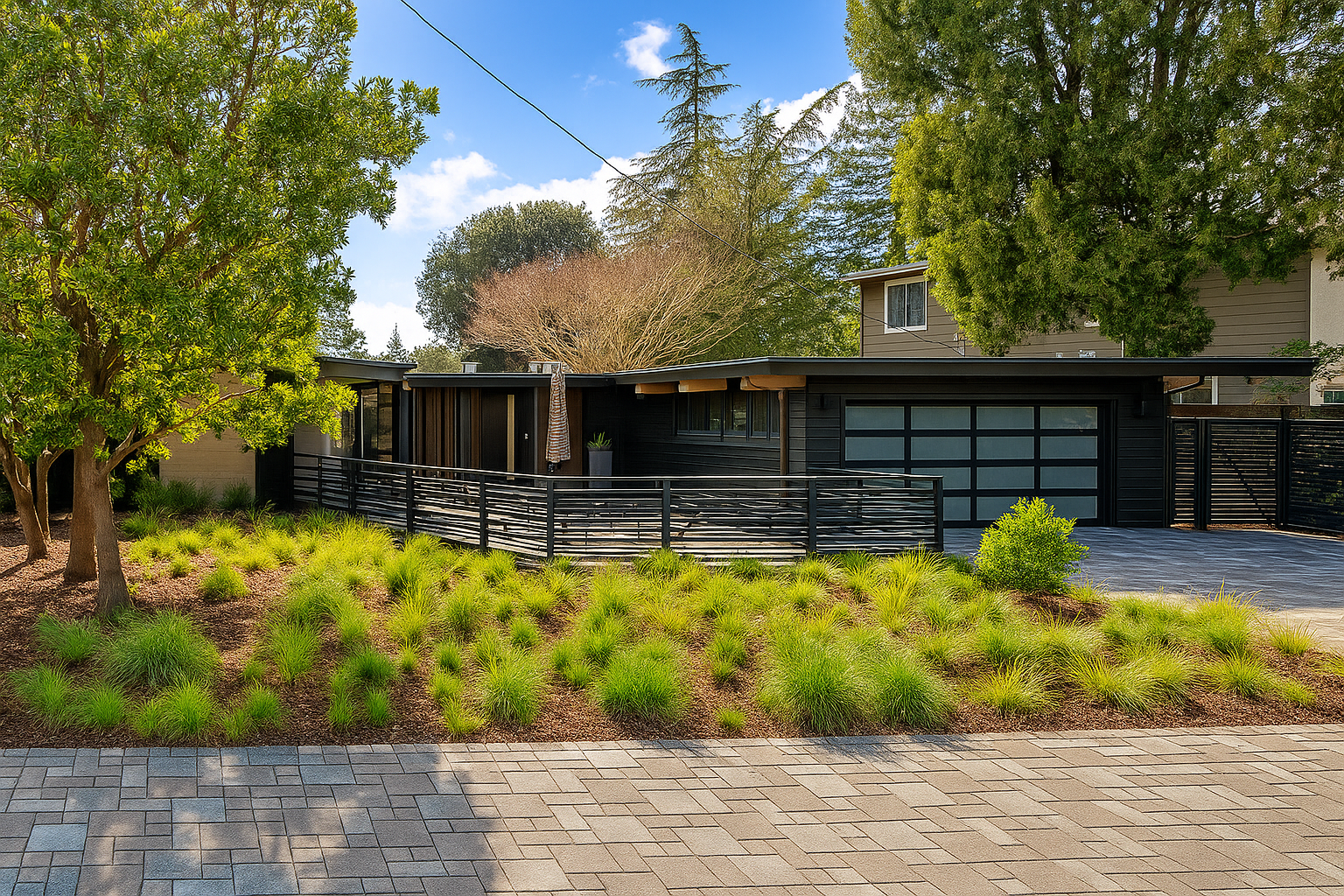
A classic Eichler home in Palo Alto’s Greenmeadow neighborhood, showcasing the low-profile mid-century facade with clerestory windows and carport. Behind the street-facing privacy, floor-to-ceiling glass opens to an interior atrium and backyard, reflecting Eichler’s design balance of privacy and openness.
In sum, Eichler’s architecture deliberately nurtured social interaction: Homes face the community center, not just the street; interiors are transparent and communal; and the tract layout privileges walkers and kids at play over cars. These physical features set the stage for strong social networks – but it’s the residents who truly activate the design.
Life in an Eichler Neighborhood: High Social Capital and Traditions
Walk through an Eichler enclave and you’ll often sense an “old neighborhood” vibe that modern suburbs struggle to replicate. Because of their design and the type of resident they attract, Eichler neighborhoods tend to develop tight-knit, active communities. Neighbors not only know each other – they celebrate together, help each other, and even self-organize to improve their area. This organic social fabric is what sociologists refer to as high social-network density or social capital, and Eichler enclaves have it in spades. Some real-world examples:
Decades-Long Traditions: Many Eichler tracts carry on communal traditions started in the 1950s and ’60s. For instance, Palo Alto’s Greenmeadow has held an annual July 4th parade and picnic since 1958, complete with kids’ footraces, homemade floats, water-balloon tosses, and block-party barbeques. Neighbors of all generations turn out – long-timers recall appearing in parade photos as children, and now watch their kids (or grandkids) do the same. After the main festivities at the park, each of Greenmeadow’s 22 blocks breaks into its own block potluck, a “wonderful way for the neighborhoods within the neighborhood to stay in touch”. The result is an extraordinary continuity: residents truly know each other, often for decades, and newcomers are swiftly woven into the social fabric. It’s not uncommon in an Eichler tract to find multi-generation households or neighbors who’ve lived side by side for 30+ years, forging friendships that turn into quasi-family.
Neighbors young and old participate in a water-balloon toss at Greenmeadow’s annual July 4th celebration – a beloved tradition since the late 1950s. Events like these exemplify the “small-town” community activities that Eichler neighborhoods foster, bringing residents together year after year.
Everyday Social Hubs: Beyond big annual events, Eichler communities encourage daily interaction. Greenmeadow’s community pool and center is one such hub – “We are at the pool all the time,” says one resident, noting it’s a go-to spot for playdates and parties. The pool isn’t just recreation; it’s a project owned by the neighbors since the 1950s, when residents banded together to purchase it and form a co-op association. Working side by side to maintain and improve shared facilities has further bonded the community over time. Similarly, in Eichler tracts like Lucas Valley in Marin County, a community center and even a resident-led orchestra give neighbors structured ways to meet on their own terms. These spaces and activities function as the neighborhood’s “third places” – informal gathering spots outside of home and work – which are crucial for building social capital.
Neighborly Support Networks: High social-network density means neighbors look out for each other. In Castro Valley’s Greenridge Eichler community, for example, residents leverage both high-tech and low-tech means to stay connected. A private neighborhood Facebook group (280 members strong) lets Eichler owners swap recommendations, organize clubs, and alert each other to issues. When a storm blew a tree down across the road, “residents were out with chainsaws before the county got there,” thanks to a neighbor’s quick post. They’ve formed a garden produce co-op, a babysitting network, a book club, even impromptu cocktail hours – all coordinated organically online and cemented by in-person trust. For those not on social media, a physical bulletin board (shaped like an Eichler house, of course) shares news so no one is left out. The effect is a resilient web of ties: people offer tools, exchange produce, lend a hand at a moment’s notice. One neighbor needed a Rosie the Riveter costume for a charity event – within hours, multiple people had dropped off denim shirts and props at her house . This level of day-to-day reciprocity and trust is the hallmark of a strong community.
Collective Community Projects: Eichler homeowners also collaborate to preserve their neighborhood’s character and resources. Many areas organize volunteer “work days” for sprucing up common spaces. In San Jose’s Evergreen Commons (an Eichler-like tract), residents “sacrifice one day of the year” to jointly maintain their shared park, playground and even a picnic area. By pruning trees, mending equipment, and sharing a barbecue lunch, neighbors keep maintenance costs low and morale high. It’s a fun, unconventional tradition that builds a sense of ownership and pride in the community. Other Eichler neighborhoods have started their own annual car shows or music concerts (sometimes literally in a cul-de-sac or someone’s carport!) – not so much because everyone loves cars or Mozart, but because it’s an excuse to come together and share passions. As one resident quipped about their neighborhood orchestra nights: “It’s not about the music, it’s about the community getting closer and sharing common beliefs.”
All these examples underscore a key point: Eichler neighborhoods function as real communities, not just collections of houses. Home design plays an enabling role, but residents’ shared activities and dense social ties give these places their unusually strong “social cohesion.” Sociologists note that such cohesion has tangible benefits. Neighbors with high trust and interaction tend to have informal systems of mutual aid – from watching each other’s kids to checking on elderly residents during a crisis. In fact, a famous study of the 1995 Chicago heat wave found that two demographically similar neighborhoods had drastically different outcomes based on social connectedness. In one, an isolated, high-crime area (Englewood), 33 per 100,000 residents died in the heat; in the adjacent Auburn Gresham, which had a “viable social infrastructure” of friendly shops, churches, and watchful neighbors, the death rate was only 3 per 100,000. Researchers concluded that “social connections can save lives,” acting as a protective layer in emergencies just as important as physical infrastructure. Eichler neighborhoods – with their block parties, Facebook groups, and deep well of neighborly goodwill – exemplify this principle. Residents there often describe a comforting feeling that someone nearby has your back. For families relocating in search of meaningful community, that sense of security and belonging can be just as critical as the home’s architecture.
No-HOA Neighborhoods: Trust, Autonomy, and Informal Governance
Interestingly, one reason Eichler communities flourish socially is what they lack: the typical modern homeowners’ association. Most Eichler tracts were developed without HOAs (or with only light-touch associations), relying instead on informal norms, original covenants, and resident-led initiatives to guide the neighborhood. This absence of a heavy-handed HOA has preserved a spirit of autonomy and trust:
Voluntary Associations vs. Mandatory HOAs: Rather than mandatory dues and enforcers, Eichler neighborhoods often have voluntary community associations. Greenmeadow’s famed association, for example, was formed in the 1950s when neighbors voluntarily pooled funds to buy their promised park and pool from Joe Eichler himsel. To this day, it remains a unique hybrid: it runs the pool/center and an architectural review committee, but membership is optional and open even to outsiders who want to join the swim club. There’s no HOA telling every homeowner what to do; only those who choose to join pay dues, and the “power” of the group comes from neighbor consensus and shared goals. Most families do join (who wouldn’t want access to the pool and kids’ swim team?), but the dynamic is one of community trust rather than top-down control. Neighbors collectively agree on guidelines to preserve their mid-century homes, and social pressure (plus pride in the historic character) encourages compliance more than any threat of fines. As one Eichler resident put it, “We’re all motivated to keep the neighborhood looking great because we love it – no one needs to get a nastygram on their door.” In fact, cities like Palo Alto have Eichler design guidelines that are “currently voluntary but strongly encouraged” – a collaborative effort with residents to maintain the Eichler look without rigid enforcement eichlerhomesforsale.com. This voluntary approach shows faith in homeowners’ autonomy and shared responsibility.
Fostering Trust and Informal Rules: Without an external HOA policing every paint color or lawn height, Eichler neighbors often resolve issues through direct communication and informal norms. This can build trust and neighborly respect. If someone wants to remodel, they might discuss plans with adjacent neighbors out of courtesy, rather than just battling an HOA committee. In Eichler communities, original Covenants, Conditions & Restrictions (CC&Rs) did impose some basic uniformity (often no second-story additions, etc.), but over time enforcement fell to residents themselves lobbying the city for protective zoning overlays or voluntarily adhering to period-appropriate styles eichlerhomesforsale.com. The process of coming together to, say, petition for a single-story overlay (which in Palo Alto requires a supermajority vote of neighbors eichlerhomesforsale.com) is itself community-building. It requires communication, compromise, and collective trust that everyone is acting in the neighborhood’s best interest – very different from an outside developer or management company dictating rules. Neighbors become, in effect, stewards of their community’s character, which deepens their commitment to each other.
Personal Freedom and Creativity: The lack of stringent HOA rules also leaves more room for personal expression and creative use of one’s property, which can increase homeowner satisfaction. While Eichler communities value their cohesive aesthetic, within that modernist palette residents often get creative – whether it’s a bold accent color on an atrium wall or an eclectic backyard design. Because Eichler owners tend to love design (many are architects, engineers, artists, etc.), they bond over keeping the neighborhood authentic yet unique. In contrast, a strict HOA subdivision might ban, for example, hanging string lights in your yard or painting your door an unapproved color. Even HOA industry advisers acknowledge that “homeowners need the freedom to personalize their homes and lifestyles” and that “too many restrictions can lead to frustration”. Eichler neighborhoods, by being more permissive (within a reasonable mid-century design framework), often avoid that resentment. Residents feel a sense of autonomy – their home is truly theirs – which can translate into greater happiness and neighborly goodwill. After all, if your community trusts you to do the right thing, you’re more likely to extend trust and kindness to your neighbors.
Communities Navigating Change Together: When conflicts or changes do arise, Eichler neighbors handle them in a more collegial way than many HOAs. For example, when some Eichler owners wanted to build second-story additions (a contentious issue since it could impinge on the iconic low-roof aesthetic and neighbors’ privacy), many Eichler tracts held discussions and votes, resulting in voluntary agreements or city-backed height limits eichlerhomesforsale.com. This democratic, grassroots approach can be messy, but it often leads to outcomes that most residents accept – precisely because they had a voice. Contrast that with the horror stories of HOAs where one can be fined for a mailbox that’s 2 inches too tall or be taken to a tribunal over a minor fence dispute. By not externalizing these issues to a rulebook, Eichler communities encourage neighbor-to-neighbor dialogue, which in turn strengthens social ties (or at least keeps them civil). In Greenmeadow’s history, when financial or architectural challenges hit, neighbors “banded together” to solve them, keeping the community intact and friendly. This reinforces a culture of “we’re all in this together.”
None of this is to say Eichler neighborhoods are anarchic or conflict-free. They simply operate more on social norms and mutual trust than formal governance. And for many residents, that’s a feature, not a bug. It empowers the community to shape its own identity and reduces the adversarial dynamic that can arise between homeowners and an overzealous HOA board.
Walkability, “Eyes on the Street,” and Social Cohesion
Urban planners and researchers have long noted that neighborhood design affects social cohesion. Eichler neighborhoods, though suburban in setting, incorporate many design elements that contemporary urban theory lauds for building community strength – features often lacking in newer HOA subdivisions.
One major factor is walkability and street life. Eichler tracts were built in an era when kids walked or biked to school and adults strolled the block in the evening. They typically include sidewalks, short blocks, and destinations (like parks or nearby schools) within walking distance. Greenmeadow, for instance, was planned with an internal greenbelt and paths connecting homes to the community center and park. Families walk to the pool or bike to the nearby community center, naturally bumping into neighbors along the way. This everyday visibility underpins what urbanist Jane Jacobs famously called “eyes on the street” – the idea that having residents out walking, playing, and watching the goings-on makes a neighborhood safer and friendlier. A street where people linger is self-policing and invites casual hellos; a street where everyone stays inside or only drives by can feel empty and unwelcoming. Jacobs observed that city blocks with active sidewalks and engaged residents had lower crime and stronger community trust, whereas deserted blocks bred alienation. Eichler neighborhoods create their own version of “eyes on the street.” For example, Greenmeadow’s streets curve around central commons, so people walking dogs or kids playing ball in a cul-de-sac are in easy view of several houses (even if those houses have mostly clerestory windows facing out). With slow traffic and many young families, neighbors tend to be outside more – watching children play, chatting in front yards, or working on projects in open carports – providing a friendly presence that newcomers immediately notice. It’s no coincidence that walkability is frequently cited as a perk of Eichler tracts: one guide notes Greenmeadow’s “walkable streets” and peaceful vibe make it pleasant to stroll, and suggests visitors explore by foot or bicycle to appreciate the community atmosphere.
Empirical research backs up the importance of such design. A landmark study in the American Journal of Public Health found that people living in walkable neighborhoods (with sidewalks, nearby amenities, and social spaces) are significantly more likely to know their neighbors, participate in community activities, trust others, and be socially engaged compared to those in car-dependent sprawl. In fact, the study’s author, Kevin Leyden, concluded: “Residents living in walkable, mixed-use neighborhoods are more likely to know their neighbors, to participate politically, to trust others, and to be involved socially.” Walkability, it turns out, was the strongest predictor of local social capital – more than age, income, or any other factor. The reason is intuitive: when daily life happens in public (walking to a park, chatting on the sidewalk, running into a neighbor at a local café), people build the micro-interactions that form community. In Eichler neighborhoods, while they are not mixed-use urban blocks, the presence of communal recreational facilities and the design encouraging outdoor living yields a similar effect. Children walk or bike to friends’ houses without fear of speeding traffic (Greenmeadow even closes its entrances to cars during the July 4th parade, turning the streets into a pedestrian zone). Original residents recall the freedom of being able to walk to the pool on their own as kids – one Greenmeadow neighbor reminisced that at age 4 he could toddle to the community pool with mom watching from afar, and older kids would roam the tract safely on foot or bicycle. Such an environment is tailor-made for forging neighborly trust – parents trust the community enough to give kids independence, and neighbors collectively keep an eye out.
By contrast, many modern HOA-driven subdivisions are built with a “privacy-first” or car-first mentality that can inadvertently undermine walkability and social cohesion. Let’s explore that side of the coin next.
The HOA Subdivision: Gated Privacy, Uniformity, and the Community Trade-Off
Typical post-1980s suburban developments – especially those governed by homeowners associations – often prioritize a different set of values: privacy, security, and aesthetic uniformity. While these can be attractive features for many buyers (who wouldn’t want a quiet, safe street and a well-kept neighborhood?), they sometimes come at the expense of spontaneous social interaction and community-building. Here’s how HOA-style design and governance tend to differ from the Eichler ethos:
Gated and Walled Communities: A hallmark of many HOA developments is the gated entrance or walled periphery. By restricting access to residents and guests only, gates aim to provide security and exclusivity. However, urban observers note that gating “privatizes” public space – streets that would normally be shared by the broader community become semi-private enclaves. This can create a subtle sense of segregation. Neighbors inside the gates may bond with each other, but the neighborhood is physically and psychologically cut off from surrounding areas. You won’t see kids from the next block biking through, or local pedestrians strolling by on a whim – it’s all enclosed. Sociologists like Sonia Roitman argue that gated communities “hinder the city and society in general because they [create] obstacles in the urban fabric”, reinforcing social exclusion and an “us vs. them” mindset. In everyday terms, a gated subdivision might feel secure, but it also means fewer casual encounters with anyone not in your bubble. By contrast, Eichler tracts like those in Palo Alto are open and integrated into the city street grid (albeit with design features to slow traffic). Anyone can wander through to admire the architecture or play at the park, and residents often welcome this openness – it contributes to a broader sense of community beyond just one tract.
Auto-Oriented Layouts: Many newer suburbs lack sidewalks and have longer blocks or cul-de-sacs that empty onto arterial roads far from shops or schools, making walking impractical. HOAs sometimes even discourage on-street parking or daytime street play for aesthetics and safety reasons. The result can be eerily empty streets. One observer comparing affluent Atlanta neighborhoods noted that in areas with no sidewalks and long driveways, “hardly anyone walks”, whereas a similarly wealthy area with more walkable design had residents out and about providing those crucial “eyes on the street”. Unfortunately, “most contemporary suburban subdivisions do little to enable social interaction,” as Leyden writes – life often takes place “within the home or in the backyard”, with residents driving elsewhere for recreation. Picture a modern subdivision evening: a resident drives home, pulls into an attached garage, the door closes, and they may not emerge to the front yard at all. Compare that to an Eichler cul-de-sac where a carport or open garage might double as a workshop or ping-pong area, drawing in neighbors or curious kids. It’s a stark difference in street culture. Simply put, when a neighborhood’s design prioritizes privacy and cars over walkability and shared spaces, there are fewer chances for serendipitous social contact.
“Privacy-First” House Design: In HOA communities, individual homes often reinforce the private, inward focus. Houses may have large fenced backyards and high privacy fences, with front elevations dominated by garage doors or a grand entry set back from the sidewalk. While this yields personal seclusion, it removes the friendly signals that someone is home and engaged with the neighborhood. Traditional homes of early 20th-century towns had front porches and low fences – inviting neighbors to stop by for a chat. Eichler homes, as we discussed, innovated a different approach: a mostly closed front for privacy combined with transparent inner courtyards and lots of communal space in the tract plan. Many modern tract homes, however, lack either feature – they simply orient everything to internal family life or the back patio. A mid-century critic once described suburban houses as “comfortable concentration camps” for isolated families. That may be extreme, but there’s some truth that a street of tall fences and blank garage fronts can feel isolating. Interestingly, even within Eichler’s own designs, some critics (including feminists like Betty Friedan) worried that the suburban model “trapped” women at home. An analysis by architectural historian Annmarie Adams found that Eichler’s “back-to-front” planning – directing family life to the rear yard, away from the street – while great for privacy, “hindered social relations between [neighbor] women” in some cases. In other words, moms at home couldn’t casually wave to each other through a picket fence as in older neighborhoods, because Eichler’s designs shielded them. The saving grace was the cul-de-sac culture and community amenities that drew people out of those private realms when they wished. In many newer subdivisions, you get the isolation without the antidote: plenty of private space, no inherent community space. It then falls on the HOA to manufacture community through planned events (a seasonal picnic or holiday lights contest), which may or may not be effective in generating authentic neighborly camaraderie.
Strict Aesthetic Controls: Homeowners associations typically enforce detailed CC&Rs and rules to maintain a cohesive look – think pre-approved paint palettes, limits on landscaping, even rules about how long your garage can be open. The upside is curb appeal and property value protection; the downside can be a sense of conformity and reduced personal expression. In some HOA communities, wanting to do something as innocuous as plant a vegetable garden in the front yard or put up a unique holiday display can turn into a bureaucratic battle. This emphasis on uniformity contrasts with the Eichler community ethos, where the shared modernist aesthetic comes more from collective appreciation than fear of sanctions. In fact, Eichler neighborhoods have shown that pride and peer influence can be as effective as HOA rules in preservation – Palo Alto’s Eichler tracts still “look much as they did when first built” in part because neighbors voluntarily uphold the style. There is an informal social contract. In HOAs, by comparison, the contract is formal – and stepping outside the lines can lead to neighbor conflict via compliance notices. Sociologically, this can erode community spirit: if your interaction with neighbors is mainly them reporting you for a minor infraction, trust and friendship don’t exactly flourish. On the flip side, some HOA neighborhoods do foster community through shared amenities (clubhouses, pools, golf courses) and active committees. But again, these are typically top-down organized and can feel obligatory. The key difference is spontaneity and ownership: an HOA board may organize a block party as a calendared event, whereas Eichler neighbors throw a block potluck because it’s a beloved tradition they themselves started. The latter arguably builds stronger bonds.
It’s worth noting that not all HOAs are “bad” for community – some newer developments, inspired by New Urbanism, incorporate porches, parks, and walking trails to encourage interaction (and the HOA’s role is mainly maintenance). However, the prevailing suburban model in much of America still skews toward the private realm. And surveys show a telling trend: Americans today report knowing fewer of their neighbors and trusting them less than in decades past. For instance, as of 2018 only 31% of Americans said they know all or most of their neighbors, and less than half say they trust them deeply. Many factors contribute to that, but the design of sprawling, car-centric subdivisions – often with HOAs – is believed to be one reason. It’s harder to build neighborly trust when you rarely see your neighbors except behind a steering wheel.
In summary, HOA-driven suburban developments tend to emphasize order and exclusivity – which can certainly produce beautiful, safe streets – but they risk trading away the informal social glue that turns a neighborhood into a supportive community. A gated enclave may feel private and secure, yet it might lack the warm reciprocity of an open, engaged neighborhood. Families seeking a home might consider this trade-off: Do you value the controlled predictability of an HOA, or the organic, sometimes imperfect, but ultimately rich social tapestry of a place like an Eichler tract?
Community Strength: Why Design and Social Networks Matter for Families
For family buyers and relocating professionals who long for not just a house but a hometown, the lessons from Eichler vs. HOA neighborhoods are clear. Urban design and social-network density directly impact the strength of community life. An open-layout, people-friendly neighborhood can nurture friendships and support networks that enrich your daily life (and even help in a crisis), whereas a fortress of cul-de-sacs and strict rules might leave you more isolated than expected.
Research in public health and urban planning reinforces that finding your “community fit” matters for well-being. Neighborhoods with high social capital have been linked to lower crime, better health outcomes, and even improved democratic participation. When you know your neighbors, you’re more likely to vote, volunteer, and feel safer and happier in your environment. We’ve seen this in the Eichler realms: residents come together to solve problems – whether it’s preventing teardown McMansions from spoiling the character, or rallying around a neighbor in need – because they have the cohesion to do so. They’ve built that “bank account” of goodwill over years of barbecues, holiday parties, and helping each other out.
Of course, not every Eichler tract is a utopia, nor every HOA subdivision a sterile wasteland. There are friendly cul-de-sacs in HOA communities and some less-active Eichler blocks. But the overall pattern is that Eichler’s approach to design and community engenders a family-oriented lifestyle that many find deeply meaningful. Residents often cite the mix of mid-century architectural charm and genuine neighborly connection as the reason they “never want to leave”eichlerhomesforsale.com. As one blogger wrote, Eichler subdivisions became “beloved places that people don’t want to leave, even decades later” – not due to prestige or property values, but because of the community experienceeichlerhomesforsale.com.
For those relocating to Silicon Valley or California in search of that elusive “neighborly feel” reminiscent of simpler times – where kids can roam safely, where you borrow cups of sugar next door, where block parties happen spontaneously – an Eichler neighborhood can be a revelation. You get to live amid iconic mid-century modern style and have the benefit of a socially rich environment. It’s mid-century architecture aligned with lifestyle: open, unpretentious, and community-minded. By contrast, in a meticulously managed HOA enclave, you might enjoy immaculate lawns and uniform rooflines, but you may have to work a bit harder to create opportunities for interaction (perhaps via school events, or the HOA’s sanctioned gatherings).
Bottom line: Urban design isn’t just about aesthetics – it sets the stage for how we interact. Eichler neighborhoods, with their glass walls and atriums, invite connection (even if just by providing something to chat about – “Love those original mahogany ceilings, mind if I take a look?”). Their lack of rigid governance entrusts residents to form their own bonds and traditions. In turn, those dense social networks make the community resilient, welcoming, and lively. Traditional HOA suburbs offer a different promise: consistency, privacy, and control – attractive qualities, yet ones that can inadvertently dilute everyday social contact and trust.
For a family weighing these choices, consider what kind of childhood and daily life you envision. If kicking a soccer ball in the street while neighbors cheer, or an impromptu wine hour in an atrium-turned-lounge appeals to you, you might find your tribe in an Eichler tract or similar non-HOA community. If, on the other hand, a quiet retreat with formal structure is more your style, a well-kept HOA neighborhood might suit you – just know that you may need to take extra steps to build the village around you.
In the end, “community” is something we create together. Joseph Eichler believed good design could facilitate that – giving people beautiful spaces that naturally bring them together. The enduring strength of Eichler neighborhoods’ social life suggests he was on to something. As we plan the future of suburbs or choose where to raise our families, we can learn from these mid-century modern gems: when architecture and planning put people first, community will flourish.