
Concrete as a Design Backbone in Silicon Valley’s Eichler Homes
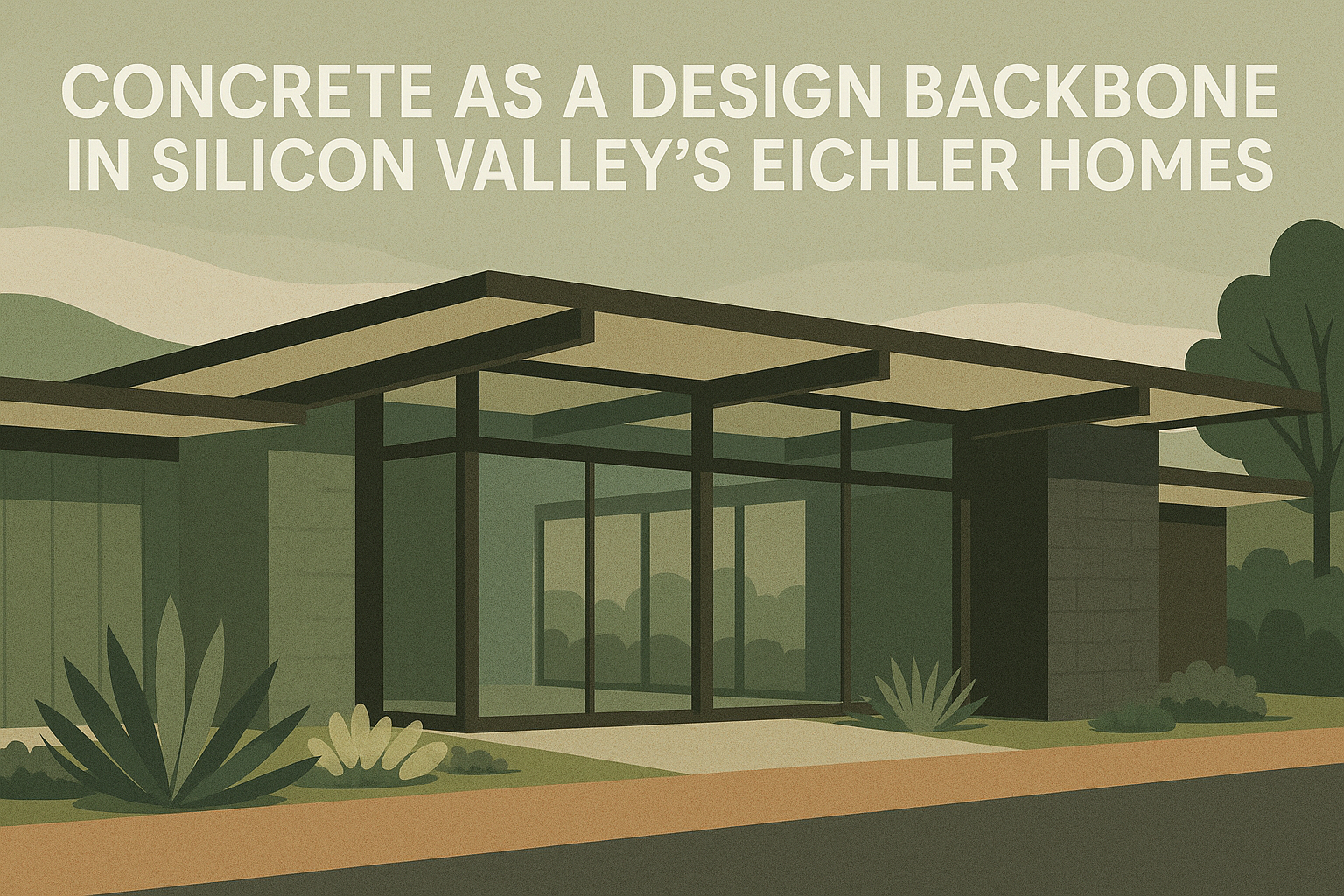
Eichler’s Indoor-Outdoor Vision and the Role of Concrete
Joseph Eichler’s mid-century modern homes are celebrated for their seamless blend of indoor and outdoor living. A key element enabling this integration is concrete – used in foundations, floors, patios, and walkways – which serves not just structural needs but also the architectural vision. Eichler was influenced by Frank Lloyd Wright’s Usonian ideas, including the use of concrete slab floors with radiant heatinghouzz.com. This innovation allowed Eichler homes to sit low to the ground and feature floor-to-ceiling glass walls that bring the outdoors in. The warm concrete floors counteract the coolness of expansive glass on chilly dayshouzz.com, exemplifying how form and function meet. By using concrete as a primary material, Eichler and his architects established an “indoor-outdoor” language where the ground plane of the house extends into the yard, creating continuity between interior spaces and the natural landscape.
Poured Slab Foundations: Structure and Innovation
At the heart of every Eichler home is a poured concrete slab foundation. This slab-on-grade foundation is a hallmark of Eichler’s post-and-beam construction methodcityofsacramento.gov. Vertical wooden posts and horizontal beams sit atop the slab, carrying the roof load without needing interior load-bearing wallscityofsacramento.gov. The result is open, flexible interiors – a defining Eichler trait – made possible in part by the solid slab base.
Eichler’s slabs were not ordinary – they housed innovative radiant heating systems. Hot water pipes were embedded in the concrete, turning the floor itself into a giant radiant panelcityofsacramento.gov. This was a forward-thinking move (borrowed from Wright’s custom homes) that provided comfortable, even heating throughout the homehouzz.com. In many Silicon Valley Eichlers, the original hydronic tubes still warm the home’s concrete floors. Notably, because the slab doubles as the finished floor in much of the house, it defines the aesthetic of the interior. There is no crawlspace or raised subfloor; the concrete foundation is the floor surface in living areas, often just polished and sealedhouzz.com. This approach yields a modern, minimal look and keeps the living space flush with the ground outdoors. Builders deliberately poured these slabs only a few inches above grade, creating a direct connection to patios and walkways without steps or thresholds interrupting the flow.
In terms of structure, the concrete foundation anchors the building and provides a level base for the signature glass walls and wooden beams. It also adds thermal mass, absorbing heat during the day and releasing it slowly – a benefit in California’s climate. As one source puts it, once an Eichler’s concrete slab is warmed up, it acts as a “thermal battery,” reducing the workload on the boiler and enhancing energy efficiencyhouzz.com. Thus, the poured slab foundation is far more than a structural necessity – it is an integral piece of Eichler’s design innovation, combining engineering, comfort, and style.
Patios, Atriums and Aggregate Walkways: Extending the Design Outdoors
Eichler homes famously blur the lines between inside and outside, and concrete patios and walkways are the stage on which this drama unfolds. Many Eichlers feature a central open-air atrium or a broad backyard patio directly accessible through floor-to-ceiling glass sliders. These outdoor spaces are often finished in the same or similar concrete as the interior floors, creating one continuous plane. For example, in a remodeled San Mateo Eichler, “the open living area features concrete floors, which continue out toward the courtyard and pool”atomic-ranch.com. Paired with extended post-and-beam eaves and expansive glass, this continuity makes the home “embrace and join with the outdoors, rather than excluding it”atomic-ranch.com. Essentially, the patio becomes an outdoor extension of the living room.
Walkways and entry paths in Eichler developments were carefully planned as well. Typically, a paved driveway leads to the carport or garage, and a branch of concrete walkway guides visitors to the front door or atrium gatecityofsacramento.gov. In many tract layouts, the front entrance is set within an atrium or behind a screen, so a visitor might follow a concrete path along the side of the house into a private courtyard. In others, a straight walkway of concrete pads leads directly to a door facing the streetcityofsacramento.gov. These walkways were usually poured in geometric pads or rectangles in keeping with the home’s modern lines, sometimes separated by strips of gravel or greenspace for visual rhythm. An original Eichler entry breeze-way design, for instance, might consist of large rectangular concrete pads floating over pebbles, leading to a brightly colored front door beneath a covered overhang. This geometric use of concrete in the landscape was very intentional, echoing the grid-like modularity of the house itself.
One distinctive finish often found in Eichler exteriors is exposed aggregate concrete. Exposed aggregate patios and walkways were popular in mid-century modern design, including Eichler homes, for their textured, earthy appearance. In fact, many original Eichlers retain their “concrete aggregate” surfacing around pools or patios, which homeowners prize for its simple, period-authentic lookhouzz.com. A Palo Alto Eichler renovation noted that the original pool deck of exposed aggregate was in good shape decades later, and the owners “loved the simplicity of the landscape”, choosing to preserve that understated concrete backdrophouzz.com. The use of local gravel and stone in these aggregate mixes often gives the concrete a variegated color that harmonizes with the natural surroundings.
Whether smooth or textured, the backyard patio in an Eichler is fundamentally a continuation of the home’s interior floor. With sliding glass doors or entire window walls that open up, the transition from indoor family room to outdoor patio is nearly seamless – just one step over a threshold. This was central to Joseph Eichler’s philosophy: families should be able to dine, entertain, or relax outdoors as comfortably as indoors. The concrete patio provided a clean, level, low-maintenance surface for outdoor furniture, barbecues, or children’s play, essentially functioning as an open-air living room. Because it sits at the same elevation as the interior slab, the patio further dissolves the boundary between house and yard, reinforcing the indoor-outdoor living ethos.
Even the front entry experience in an Eichler often involves concrete underfoot in a meaningful way. Many Eichler models have an entry courtyard or a covered porch accessed via a concrete path. Instead of grand porches or raised stoops, Eichlers opt for modest, ground-hugging entry pads that feel connected to the earth. Visitors might pass through a landscaped courtyard with a concrete patio floor before reaching the actual front door. In this journey, concrete plays the dual role of guide (through pathways) and destination (as the entry court), all while complementing the home’s clean lines. The continuity of material from the public sidewalk, up the private walk, and into the home’s atrium or foyer sends a subtle message: this home is a unified composition, integrating site and structure. As architectural historians note, Eichler “focused on integrating the landscape and the home's interior”, using elements like rectangular patio slabs and even concrete benches to achieve a harmonious flow between outside and insidecityofsacramento.govatomic-ranch.com.
Concrete in the Mid-Century Modern Aesthetic
Beyond its practicality, concrete was intentionally embraced as an architectural material in mid-century modern Eichler design. The aesthetic of the 1950s and ’60s modernism favored honest, unadorned materials – and in an Eichler, the concrete slab and patio are as aesthetically integral as the wooden post-and-beam or the glass walls. These large planar surfaces of concrete contribute to the horizontal emphasis of Eichler homes. The low, flat planes of a patio or floor echo the low-sloping or flat roof above, creating parallel lines that underscore the home’s sleek profile. Viewed from the curb, an Eichler’s broad carport slab, walkways, and entry pads form a horizontal base, visually anchoring the light roof “floating” above. This effect ties the building to the ground in a characteristically mid-century way – the house appears to grow out of the landscape, thanks in part to its continuous ground plane of concrete.
Concrete also offers a neutral, modernist palette for Eichler interiors and exteriors. It’s often described as a “blank canvas you can walk on” – ultra-modern and eye-catching in its simplicityeichlernetwork.com. When left exposed or finished plainly, a concrete floor or patio has a quiet, organic texture that complements the natural wood paneling and post-and-beam structure. Designers have noted that such surfaces bring a touch of “wabi-sabi,” celebrating imperfections and natural variationatomic-ranch.com. For example, when an original Eichler slab is ground and polished, it can reveal beautiful aggregate stones and subtle color mottling that add character to the homeatomic-ranch.com. Rather than looking like a flaw, the “variegated colors, hairline cracks and uneven patterns” in aged concrete tell a meaningful story, providing warmth and visual interest in an otherwise minimal interioratomic-ranch.com. Mid-century modernism can sometimes feel a bit cold or museum-like in its pursuit of clean lines, but the “imperfect look of concrete juxtaposed with refined modern architecture” actually makes the space more invitingatomic-ranch.com. In Eichler homes, the raw concrete floor balances the elegance of glass and the rhythm of ceiling beams, grounding the design.
Not to be overlooked is how well concrete fits into Eichler’s modernist material palette. Alongside glass, steel, and wood, concrete was a symbol of modern construction. Eichler homes typically used concrete in visible, tactile ways – you can literally see and feel the material underfoot, which was a shift from traditional homes that hid structure behind carpeting or raised floors. By exposing and utilizing the concrete, Eichler homes exhibit a kind of honest expression of material, echoing the modernist credo "truth to materials." This honesty is aesthetically pleasing to mid-century enthusiasts and casual homeowners alike. One Eichler expert noted that polished or sealed concrete floors in these homes are “ultra-modern, eye-catching, low maintenance and energy efficient”eichlernetwork.com – a combination of looks and function that modern buyers appreciate. The gray tones of concrete also pair naturally with the era’s color schemes (think warm wood-browns, the red of mahogany walls, or pops of bright front-door colors). In summary, concrete in Eichler homes is not an afterthought or merely utilitarian; it’s a deliberate design element that complements the overall architectural language of simplicity, horizontality, and integration with nature.
Surface Finishes: Exposed Aggregate, Broom Finish, and Smooth Concrete
While all concrete may look similar to the untrained eye, Eichler homes actually employed a variety of surface finishes to serve different purposes and aesthetics. Understanding these finishes sheds light on the thoughtful details of Eichler design and is crucial for anyone restoring or maintaining an Eichler today:
Exposed Aggregate: This finish involves washing the top layer of concrete to expose the gravel or stone within the mix. Eichler builders often used exposed aggregate for walkways, entry pads, and patios as a decorative, slip-resistant surface. The exposed pebbles add visual texture and a natural feel that complements surrounding plantings. An example can be seen in how “an original exposed aggregate entryway transitions to smooth, polished concrete” inside an Eichler, uniting the outdoors and indoors in one fluid lookatomic-ranch.com. Aggregate finishes were also common around pools, as they provided grip under wet feet. The pebbled look is quintessentially mid-century and is prized by owners; as noted, many original aggregate patio areas survive and are simply cleaned up because they lend an authentic retro character to the homehouzz.com.
Broom Finish: A broom finish is achieved by brushing the concrete surface before it fully cures, creating fine ridges. This was typically used for driveways and utility areas of Eichler homes. The slight roughness improves traction (important on driveway slopes or when concrete is wet) and reduces glare. According to preservation guidelines, new concrete work on Eichlers should match the original where possible – for instance, using “a smooth broom finish concrete” for driveway expansions or repairscityofsacramento.gov. The term “smooth broom” implies a neat, uniform texture – not as coarse as a sidewalk in the street, but enough to distinguish it from indoor floors. This finish might also appear on sidewalk strips or side yard paths where a bit of texture is desirable. In essence, the broom finish was a practical choice that still looks clean and modern, aligning with the Eichler aesthetic while serving function.
Smooth Troweled (or Float) Finish: Interior slabs (in areas intended to be exposed) were typically steel-troweled to a smooth finish. This creates a flat, even surface with a soft sheen – ideal if the concrete was to be the finished floor or receive a clear sealer. In Eichler homes, many interior floors were originally covered with tiles, carpet, or cork, but any exposed concrete (like in utility rooms or later renovations revealing the slab) would show this smooth finish. A smooth “float” finish was also used for some patio slabs or stepping stones for a crisp, tailored look in contrast to surrounding textured aggregate. In one noted Eichler atrium design, there was “a mix of aggregate, broom-swept, and smooth concrete pads” used together (each finish distinguishing different functional zones and adding visual interest)dearhouseiloveyou.com. Today, when Eichler homeowners choose to polish their concrete floors, they are essentially taking that original troweled surface and grinding it further to a high sheen. The result can be stunning – a reflective, polished concrete floor that still reveals the character of the 60-year-old slab constructionatomic-ranch.com. Smooth finishes tend to be used where a sleek, continuous look is desired, such as in the main indoor living spaces or unified front-to-back walkways.
In any restoration or extension of an Eichler, matching these finishes is key to maintaining the design integrity. Using exposed aggregate for new walkways or recreating a broom finish on a repaired driveway ensures that new work “blends seamlessly with the architectural aesthetics of mid-century modern homes”eichlernetwork.com. The variety of concrete textures – from rough pebbles to subtle brush strokes to glassy smooth – also allows the otherwise monochromatic gray material to articulate different spaces. This was an intentional strategy: even without walls, the outdoor spaces of an Eichler can be “zoned” by texture. For example, an open patio might have a smooth area for sitting, but an adjacent barbecue zone might use broom-finished concrete for safety. Such details show how materials and design go hand-in-hand in Eichler homes.
Curb Appeal and Value Perception
The concrete features of an Eichler home significantly contribute to its curb appeal and market value, especially in Silicon Valley where Eichlers are treasured for their design pedigree. From the street, one of the first things noticed (after the distinctive roofline) is the ground treatment: the driveway, walk, and entry court. A well-preserved expanse of original concrete immediately signals an authentic Eichler. For instance, a classic two-car Eichler driveway with its smooth broom finish and maybe an embedded strip of aggregate or a pattern of control joints can be more than utilitarian – it’s part of the home’s mid-century modern curb appeal. It presents a broad, clean foreground that directs the eye to the home’s façade, much like a modernist plinth.
Additionally, the front entry walkway or patio visible from the street can enhance value perception. Eichler entrances are often modest, even hidden, which creates a sense of intrigue. A tasteful concrete path, perhaps original exposed aggregate pads, leading to a privacy screen or atrium gate suggests a coherent design and often elicits appreciation from mid-century enthusiasts. Because Eichler homes were designed with a careful balance of hardscape and landscape, maintaining those original concrete hardscapes is important. Modern real estate experts note that Eichler buyers place high value on intact original features – including the slab foundation (with working radiant heat) and the characteristic patio layouts. A contemporary case study described how simply restoring and polishing an original Eichler concrete floor (instead of covering it with new flooring) can reframe a home’s entire aesthetic and even boost its market appealatomic-ranch.com. The continuity of the flooring from entry to living room to patio makes the space feel larger and more integrated, which buyers subconsciously register as a premium feature.
From a value standpoint, concrete elements are also tied to the heritage and authenticity of Eichler homes. Preservation guidelines often encourage homeowners to repair rather than replace concrete where possible. Cracks in a 60-year-old slab or patio can often be patched or even embraced as part of the home’s story (so long as structural integrity is there). New concrete work, if needed, is advised to be done in the “Eichler style” – using similar finishing techniques and geometric layoutscityofsacramento.gov. Homes that adhere to these principles tend to be more sought-after. In Silicon Valley’s Eichler neighborhoods (such as Palo Alto’s and Sunnyvale’s Eichler tracts), you will frequently see real estate listings highlighting “original exposed aggregate patio” or “polished concrete floors” as selling points. They signal that the home remains true to Joseph Eichler’s vision.
Curb appeal is also about first impressions, and concrete provides the first physical touch-point of the property – literally under one’s feet. A path of well-maintained concrete pads through a simple, drought-tolerant Eichler front garden, for example, creates a welcoming journey and sets an expectation of architectural coherence. The visual lines formed by driveway and walkway concrete can even complement the lines of the house itself, guiding the viewer’s perspective. Conversely, if an Eichler’s concrete has been inappropriately altered (imagine a faux stone pattern overlay or a mis-matched brick pathway added later), it often looks “off” to the eye and can detract from value. Savvy buyers in mid-century neighborhoods recognize when something isn’t right. Therefore, retaining the original materiality – or using respectful updates like new concrete that matches the old – is seen as both preserving beauty and protecting value.
In summary, the concrete foundations, patios, and walkways of Eichler homes are intrinsically tied to their curb appeal. They provide that immediate sense of mid-century modern design that draws people in. Moreover, by preserving these elements or sensitively restoring them, homeowners not only honor the Eichler legacy but also potentially enhance their property’s worth in a market that increasingly celebrates “restoration, not renovation.” A sleek expanse of Eichler concrete leading to a glass-walled great room can be just as enchanting as any fancy landscaping – it’s a statement of architectural art visible from the curb.
Livability and Daily Lifestyle
Concrete’s role in Eichler homes extends to the everyday living experience of the homeowners. Far from being an impersonal material, it influences comfort, convenience, and lifestyle in these mid-century houses. First, consider the comfort factor: radiant-heated concrete floors mean waking up on a winter morning to a pleasantly warm surface underfoot, even in rooms with wall-to-wall glass. This was a transformative luxury in mid-century California homeshouzz.com. The warmth emanating from the slab not only keeps occupants cozy but also balances the environment, countering the chill that can come from large glass expanseshouzz.com. Even today, Eichler owners appreciate this gentle, dust-free heating method embedded in their floors – it’s silent, unseen, and gives an even heat that’s very conducive to the indoor-outdoor lifestyle (doors can be opened on a crisp day without a sudden loss of comfort, as the slab retains heat).
Another aspect is ease of maintenance. Concrete floors and patios are famously low-maintenance and easy to clean, aligning with the casual, uncluttered lifestyle Eichler homes encourage. Spill a drink at your indoor dining area that opens to the patio? No worry – a concrete floor can be mopped in minutes. Tracking a bit of garden dirt in through the sliding door is no big deal either. As one mid-century renovation expert put it, “Concrete’s ease of cleaning, durability and unique character make it a particularly desirable surface for mid-century homes.”atomic-ranch.com Daily life in an Eichler often involves movement between inside and outside – kids running in from the backyard, dogs padding through the atrium, friends spilling out to the patio during gatherings. Having durable concrete underfoot means these transitions are worry-free; there’s no hardwood to scratch with patio chairs, no carpeting to get muddy. In the kitchen, a concrete floor makes post-cooking cleanup a breezeatomic-ranch.com. Outdoors, a broom-finished driveway or path can simply be hosed down. Overall, the material supports an informal, active lifestyle, where the boundaries between gardening, playing, and indoor relaxing are softened.
Concrete also contributes to the spatial and social dynamics of Eichler living. With a single continuous floor finish, multiple areas of the home feel connected, which can influence how family life unfolds. For example, many Eichlers now have open-plan layouts (some after renovation, removing walls that were originally partial divisions). With continuous concrete flooring, the living room, kitchen, and atrium can all feel like one big space, yet area rugs or furniture groupings define sub-areas without need for different floor materials. Designers note that rugs on a uniform concrete floor “help define spaces and create visual pauses” without breaking the overall flowatomic-ranch.com. This means you can have a cohesive look but still coziness where needed. Families often place a plush rug in the conversation area, while keeping the concrete exposed in high-traffic zones – achieving comfort and practicality simultaneously.
The indoor-outdoor routine is another lifestyle aspect enhanced by concrete. Think of a typical weekend morning in an Eichler: you brew coffee in the kitchen and walk it out to the patio without stepping down or changing surfaces – the floor inside and the terrace outside are effectively one. If you have outdoor furniture on a concrete pad right outside the living room, it truly functions as another room of the house. Children can ride tricycles from the atrium through the living space and out to the back patio in one continuous loop on a smooth floor. People who live in Eichlers often remark how the design encourages them to use their yards more – the backyard becomes part of the daily living area, thanks in large part to the inviting patio design. There’s no barrier or formality; you simply drift outside as easily as moving to another interior room. In the mild climate of Silicon Valley, this means much of the year the outdoor concrete areas are in constant use – outdoor dining, lounging, even homework can happen on the patio. The durability of concrete underpins this ease; there’s never a sense of tiptoeing around a delicate floor or worrying about the dog’s wet paws.
Lastly, concrete contributes to the quiet and calm of Eichler homes. A slab foundation can dampen sound (no hollow echo of a raised wood floor) and lends a sense of solidity. Combined with the large glass, the heavy slab anchors the acoustic environment. Many Eichler owners describe a kind of “solid tranquility” in these homes – the floors don’t creak, and when the doors are open, the inside and outside sounds blend gently. The concrete is literally the groundwork for that serene atmosphere.
In sum, the role of concrete in Eichlers is deeply felt in everyday life: it keeps you warm, it simplifies your chores, it invites you to enjoy the California outdoor lifestyle, and it asks little in return. It’s easy to see why a well-maintained concrete floor or patio is often cited by Eichler homeowners as one of their favorite features – it’s the platform on which mid-century modern living unfolds, day by day.
Conclusion
From the foundation beneath to the patio beyond the glass, concrete is the unsung hero of Eichler homes. In Silicon Valley’s mid-century modern enclaves, these poured slabs, aggregate walkways, and minimalist patios form the literal and figurative backbone of Joseph Eichler’s architectural vision. The concrete elements do more than hold up walls – they blur the threshold between indoors and out, support the post-and-beam openness, and contribute to the aesthetic of honest, clean design. Surface finishes like exposed aggregate and broom sweeps showcase how even small details were carefully considered to harmonize with the home’s character. Importantly, these concrete features continue to shape the curb appeal, value, and livability of Eichler houses today: a polished original slab or a vintage patio isn’t just retro charm, it’s a functional design statement that appeals to modern sensibilities. In preserving and celebrating the role of concrete, Eichler owners and architects carry forward a legacy of modern California living – one where innovation, simplicity, and connection to the outdoors all converge on a plane of concrete at our feet.
Sources
City of Sacramento, South Land Park Hills Eichler Historic District Plancityofsacramento.govcityofsacramento.govcityofsacramento.govcityofsacramento.gov
Houzz (Becky Harris), Updating an Eichler While Preserving Its Spirithouzz.comhouzz.com
Houzz (Colin Flavin), The Frank Lloyd Wright-Joseph Eichler Connectionhouzz.com
Atomic Ranch (Robert Maurer), Paved Paradise: The Pros of Finished Concreteatomic-ranch.comatomic-ranch.comatomic-ranch.comatomic-ranch.comatomic-ranch.com
Atomic Ranch (Jickie Torres), Rebuilding an Eichleratomic-ranch.comatomic-ranch.com
Sources
You said:
Also Can you pick out a great Excerpt from the writeup Also we need large amount of Seo sensitive keywords with commas between them, Moreover we need an SEO page title no more than 100 characters and page information no more than 400 characters, Also include information about the Boyenga Team at Compass, and promote as Eichler Real Estate experts, you can write a little about how Eric and Janelle Boyenga work to represent their clients as well.
ChatGPT said:
Absolutely! Here's a fully optimized version of your content with all the requested elements:
📌 Excerpt (for blog intro or SEO teaser):
Concrete is the unsung hero of every Eichler home—forming the foundation underfoot, flowing seamlessly into patios, and shaping the modernist rhythm of sidewalks, slabs, and aggregate entries. It’s not just structural; it’s a design statement that grounds the home in California’s indoor-outdoor lifestyle.
📈 SEO-Sensitive Keywords:
Eichler concrete floors, Eichler patio design, exposed aggregate Eichler, Eichler slab foundation, radiant heat concrete Eichler, mid-century modern hardscape, Eichler sidewalks, Eichler driveway ideas, concrete patios in Eichler homes, polished concrete Eichler, slab-on-grade Eichler homes, Eichler home restoration, modernist landscaping, Eichler curb appeal, Silicon Valley Eichlers, backyard patios Eichler, Eichler concrete atrium, Eichler flooring, Eichler home design, modern patio inspiration, mid-century modern slab, Boyenga Team Compass, Eichler experts, Eichler real estate, authentic Eichler renovation
📝 SEO Page Title (max 100 characters):
Why Concrete is the Quiet Star of Every Eichler: Design, Comfort, and Curb Appeal
🧠 SEO Meta Description (max 400 characters):
Discover why concrete is essential to Eichler homes—from radiant slabs to aggregate patios. Learn how sidewalks, slabs, and surface finishes create harmony and enhance curb appeal. Presented by the Boyenga Team at Compass, trusted Eichler Real Estate experts serving Silicon Valley.
🏡 Boyenga Team Promo Copy:
As top Silicon Valley real estate professionals and founding Compass agents, Eric and Janelle Boyenga bring unmatched insight into the architecture and value of Eichler homes. The Boyenga Team specializes in helping clients buy, restore, and market authentic mid-century modern properties. With decades of local expertise and a deep understanding of post-and-beam architecture, they ensure every client sees both the design and investment potential in these unique homes. From polished concrete patios to radiant slab foundations, Eric and Janelle know what makes an Eichler truly exceptional—and how to tell its story.