
Courtyard Kingdoms: A Complete History of the Eichler Atrium
The concept of a sunlit courtyard or atrium has ancient roots. In Roman domus (townhouses), an open central hall – the atrium – was the focal point of family life wikidwelling.fandom.com britannica.com. Romans collected rainwater in an impluvium and gathered around it for light and air wikidwelling.fandom.com. Over the centuries, many cultures refined the courtyard idea (for example, Moorish riads in Spain and Islamic patio homes often featured inward-facing gardens). Courtyard design remained valued for bringing light, ventilation, and privacy into a home wikidwelling.fandom.comwikidwelling.fandom.com. In fact, a modern summary notes courtyards provide “air, light, privacy, security, and tranquility” wikidwelling.fandom.com – comforts that Joseph Eichler’s mid-century modern houses would revive for suburban California.
Eichler’s Modern Atriums and Courtyards
Joseph Eichler was a visionary builder in postwar California who famously aimed to “bring the outdoors in” with glass walls, radiant floors and open plans en.wikipedia.org heritageparkmuseum.org. From his very first tract in Sunnyvale (1950) through the 1960s, Eichler homes often wrapped living rooms around an open-air court. Architects Robert Anshen and Sidney Allen introduced early courtyard-style layouts (U- and L-shaped plans with fenced patios) eichlerhomesforsale.com. In fact, Anshen’s E-111 model (built ca. 1950 in Sunnyvale) already featured a central open atrium atomic-ranch.com. By the mid-1950s, Anshen proposed fully open-air atrium courts, laying the groundwork for the iconic atrium models that followed eichlerhomesforsale.com, Eichler himself was initially cautious about a house that “looked like a blank wall to the street” without a conventional facade eichlerhomesforsale.com, but soon atrium houses proved enormously popular. In 1958 designer A. Quincy Jones and Frederick Emmons fully embraced the atrium; their 1958 Atrium Model had a wide-open courtyard entry surrounded by living spaces on all sides eichlerhomesforsale.com.
Eichler homes often featured horizontal lines, flat/low-pitched roofs and large overhangs. Here a San Jose Eichler (1959–61) shows a wide carport and enclosed entry – a typical street facade that masks a light-filled atrium inside en.wikipedia.orgeichlerhomesforsale.com.
By the 1960s even more adventurous roof forms appeared (steep gables or A-frames to admit light at clerestories) eichlerhomesforsale.com. One Eichler listing notes a classic atrium model with “globe lighting, tongue-and-groove open beam ceilings, floor-to-ceiling panels of glass” and even an indoor brick barbecue. In many Eichler tracts of Silicon Valley and the Bay Area, the atrium became the signature “heart of the home”. Palo Alto’s Los Arboles neighborhood and Sunnyvale’s original Sunnymount Manor tract included numerous “atrium model” Eichlers from 1958–1960 heritageparkmuseum.org. (Los Arboles even has an Eichler called the “Atrium Model” built in 1960 .) Further south, Redwood City’s Atherwood development (1950s) and Mountain View’s Monta Loma (1954) introduced Eichler’s indoor-outdoor homes to Santa Clara County. In nearby Fairglen (Willow Glen, San Jose), builder Greghenderson documented dozens of Eichlers with central courts. Around the Bay, tracts like Castro Valley’s Greenridge (early ’60s, designed by Claude Oakland and Jones & Emmons) have “nearly all” homes with the signature atrium courtyard and floor-to-ceiling glass en.wikipedia.org.
Evolution of the Atrium Design
Eichler atriums came in several “flavors” over the years. Early Anshen & Allen homes often had a small entry patio or side court (a precursor to a full atrium) eichlerhomesforsale.com. Starting in 1958, Jones & Emmons standardized the fully enclosed, open-roof atrium at the front of the house eichlerhomesforsale.com. Many later homes simply walk through the atrium to reach the front door. Claude Oakland and others continued tweaking the idea: some late-’60s models even had two-story entry courts or split-level atriums for townhouse clusters. Roofs varied from flat to shallow gable, but all Eichlers had wide eaves and no attics eichlerhomesforsale.com, keeping the atrium’s views open. In short, the atrium concept – a private courtyard inside the house envelope – went from experimental seed to Eichler’s hallmark eichlerhomesforsale.comeichlerhomesforsale.com.
Later Eichlers played with bolder profiles. This Sunnyvale-area atrium model (1960) combines a broad flat roof with a central gabled skylight. Two-car garage bays flank the orange entry door – a very mid-century composition eichlerhomesforsale.com.
Silicon Valley Eichler Atrium Neighborhoods
In Silicon Valley and the Peninsula, Eichler communities remain beloved for these airy atriums. Palo Alto (more Eichlers than any city en.wikipedia.org) includes the famed Greenmeadow tract and Los Arboles, both laden with atrium models. Mountain View’s 200-home Monta Loma (1950s) and Sunnyvale’s 1100-home holdings showcased both courtyard and atrium types heritageparkmuseum.org. In San Jose, neighborhoods like Fairglen and North Fairbrae feature many single- and two-story atrium houses. The key shared element is the indoor-outdoor connection: atriums allow living rooms and even kitchens to open onto a private garden central to the plan en.wikipedia.orgheritageparkmuseum.org. (As one Eichler designer put it, the atrium “created a private outdoor room that not only brought light and nature into the center of the home, but also improved the entry sequence – a visitor passes through a garden before even reaching the front door” eichlerhomesforsale.com.) Silicon Valley homeowners prize their atriums so much that modern Eichler real estate listings often advertise the “atrium model” as a premium feature.
Living with an Atrium: Benefits and Lifestyle
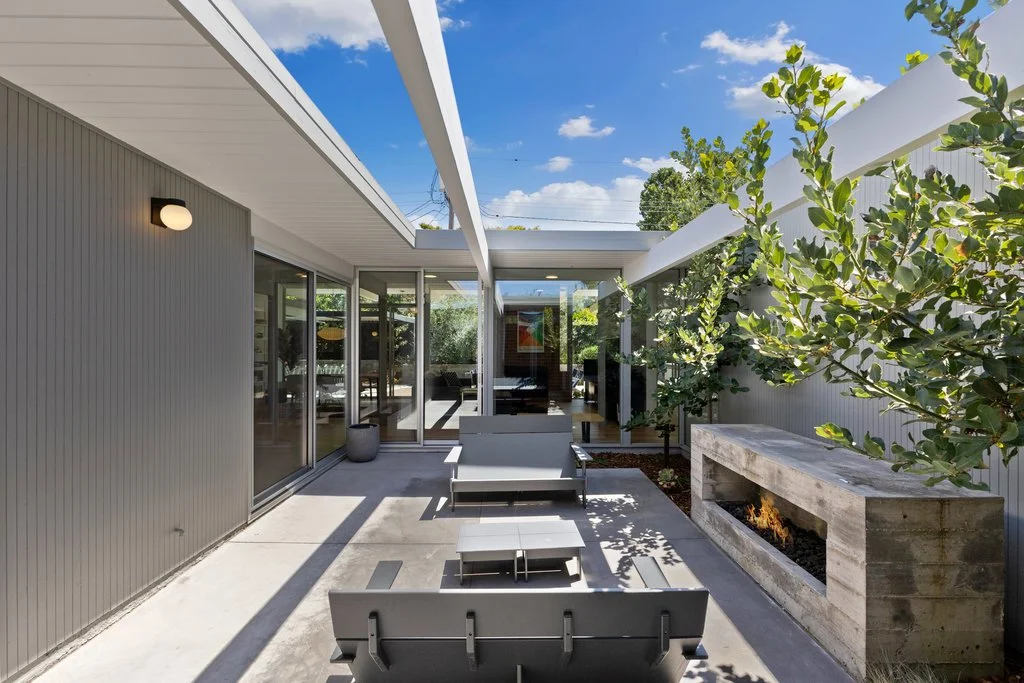
Interiors like this Burlingame Eichler open directly onto the covered courtyard. Sliding glass walls flood the atrium with sun, and owners often arrange chairs or plants inside to make it feel like an extra living room eichlerhomesforsale.com onekindesign.com.
Eichler atriums dramatically “blur the lines” between indoors and out. Floor-to-ceiling glass walls and clerestory windows face the atrium, so even interior rooms have garden views en.wikipedia.org eichlerhomesforsale.com. The result is bright, airy spaces and a feeling of tranquility. Many owners use the atrium as a second living room: furnished with lounge chairs or a dining set, it becomes a social hub under the sky eichlerhomesforsale.com. In cooler months, that protected courtyard can keep potted plants alive (Eichlerbooks advise moving tender plants inside the atrium for winter warmth). In one Eichler remodel, the owners preserved original sliding shōji-style panels on the atrium doors to give privacy and shade on bright days onekindesign.com.
Among other lifestyle perks: the courtyard naturally ventilates the house on warm nights. In California’s dry summers, an open atrium (sometimes called an “indoor courtyard”) lets air flow through without exposing the inhabitants to full sun. As one Californian homeowner noted of a mid-century home, “The atrium is built for the valley, as it gets us that indoor-outdoor feel without scorching us with the heat.” atomic-ranch.com. And because many Eichlers front the street with solid walls or minimal windows, the atrium gives privacy – the family sees the sky, not the neighbors eichlerhomesforsale.com heritageparkmuseum.org.
Atrium Hacks: DIY Ideas and Staging Tips
Plant Paradise: Use the atrium as a mini-garden. Low-water succulents, cacti and Mediterranean shrubs thrive here atomic-ranch.com. One MCM homeowner turned a concrete courtyard into a “dry garden” of euphorbia and succulents atomic-ranch.com, echoing California’s climate. (Use sturdy planters or raised beds; consider a rain-drainage grate if the atrium gets wet.)
Outdoor “Living Room”: Furnish it as extra living space eichlerhomesforsale.com. A wooden bench, wicker lounge chairs or a small dining set can transform the atrium into a family hangout. Eichler enthusiasts note that many owners describe their atrium as “the heart of the home”, often setting out patio furniture and potted palms eichlerhomesforsale.com. For staging, keep furniture minimal and mid-century in style (think simple teak or white-frame pieces) so as not to clutter the space.
Ambient Lighting: Install period-appropriate fixtures. For example, globe pendant lights or recessed uplights accentuate Eichler lines. (A Palo Alto Eichler was noted for its “globe lighting” in the atrium.) Even string lights or lanterns can add warmth for evening gatherings. Highlight one wall of glass or a plant with subtle LED strips for architectural effect.
Shade & Privacy: Manage sun and views with screens. Folding or sliding panel screens (like shōji screens) can filter harsh light and give privacy where needed. One Eichler remodel kept sliding shōji panels on all atrium doorways to control sun and privacy onekindesign.com. Retractable shades, bamboo blinds or vines on a trellis are other options.
Seasonal Move: In autumn/winter, consider treating the atrium like a sunroom. Move in potted tropicals or use portable planter stands to bring green indoors. Some designers suggest simply shifting hardy outdoor furniture and plants under cover to protect them from rain. (Eichler network columns note that colder seasons “don’t mean an end to gardening” – just move pots into the enclosed atrium.)
Staging for Sale: When showing an atrium home, keep it tidy and styled. Trim overgrown plants and remove yard tools. A single feature plant or a sculptural agave in a geometric pot can be striking. A small tabletop or a simple bench hints at the space’s potential without cluttering it. Aim for an open vista through the atrium into the home beyond, highlighting the seamless indoor-outdoor flow eichlerhomesforsale.com.
Across Silicon Valley and the Bay Area, Eichler atriums remain cherished for their blend of openness and privacy. From ancient Roman antecedents to Eichler’s mid-century modern take, the interior courtyard endures as an elegant solution for light, ventilation and family gathering. With thoughtful design and a few DIY touches, today’s homeowners continue to turn these “courtyard kingdoms” into verdant, livable retreats in the heart of a busy city.
Sources: Modern architectural histories of Eichler homes and ancient courtyard architecture wikidwelling.fandom.com britannica.com en.wikipedia.org eichlerhomesforsale.com; local Bay Area Eichler archives and listingsheritageparkmuseum.org contemporary design articles (Atomic Ranch, One Kindesign) on mid-century atriums atomic-ranch.com, monekindesign.com.