
Designing Decks and Patio Covers for Eichler Homes
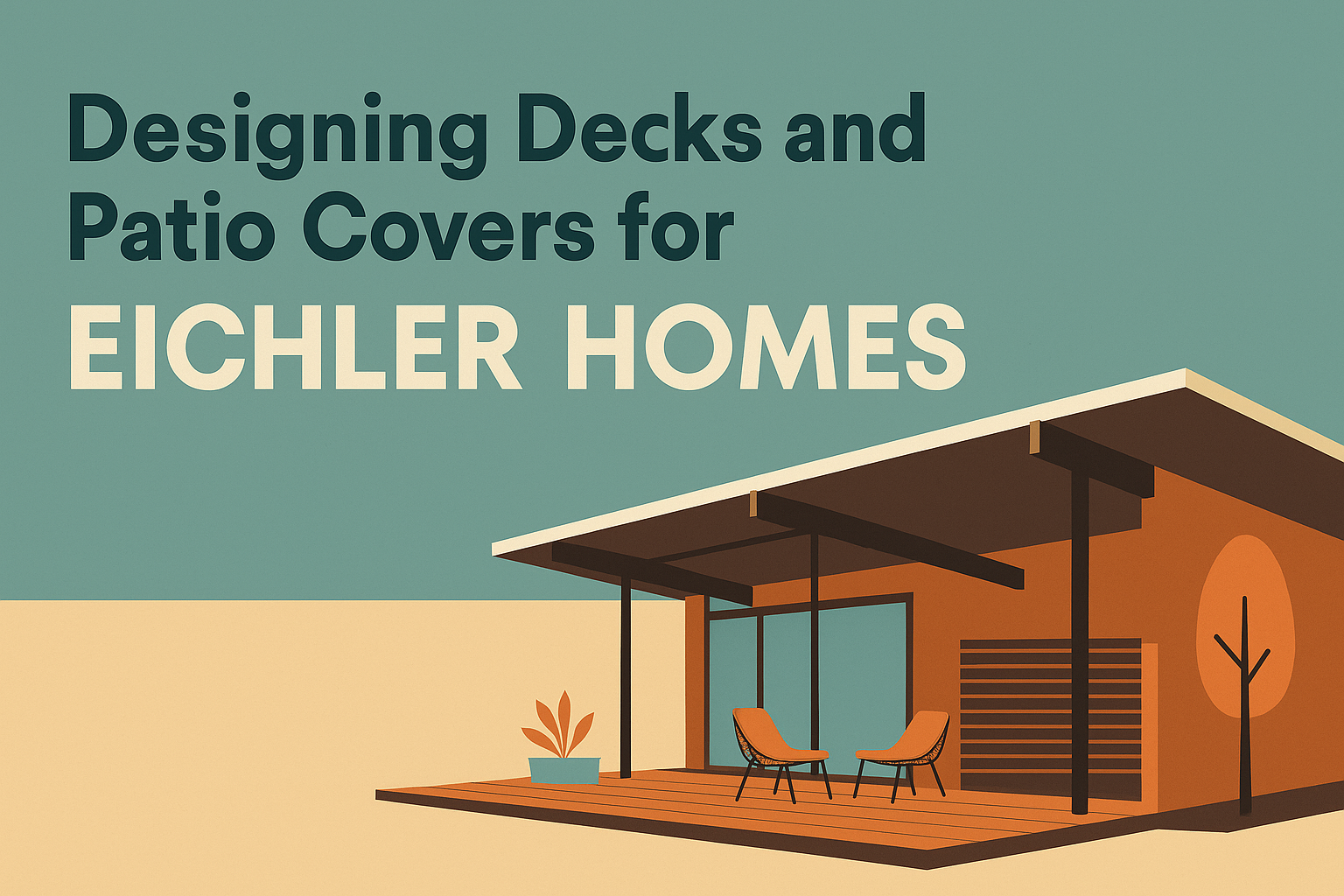
Eichler Decks and Patio Covers: Style Guidelines and Design Integrity
Joseph Eichler’s mid-century homes were conceived with a seamless indoor-outdoor connection at their core. Hallmarks of Eichler design include walls of glass, open floor plans, open-sky atriums and deep connections to the outdoors houzz.com. Large floor-to-ceiling glass panels along the rear of the house literally dissolve the boundary between inside and outside eichlerhomesforsale.com, inviting the landscape in. Many Eichlers feature a central atrium open to the sky – an outdoor room in the heart of the home – bringing light, air and nature directly into the living space eichlerhomesforsale.com. This open-air atrium (when present) was always left uncovered by Eichler’s intent. “The hallmark of a true Eichler atrium is that it’s open to the sky… perhaps with an open-beam trellis or sunshade slats above, but no solid roof,” notes one expert eichlerhomesforsale.com. Any attempt to permanently roof over these spaces fundamentally alters the sunlit, open-air ethos Eichler envisioned.
Eichler homes also emphasize horizontal lines and low-slung forms that blend into the landscape. Typical models have flat or nearly-flat roofs with broad, boxy eaves, accentuating a long, horizontal profile eichlerhomesforsale.com. This means any addition – whether a deck or cover – should respect the low, horizontal roofline rather than introducing tall or steep elements. Eichler’s architects often carried the same materials from inside to outside, enhancing continuity. For example, many original homes had exposed aggregate concrete patios or simple brushed concrete that flows right from the interior floor level out to the yard – a seamless, no-step transition eichlerhomesforsale.com. This flush indoor-outdoor flooring eliminated thresholds and encouraged residents to wander outside as part of everyday living eichlerhomesforsale.com. In essence, Eichler’s intent was to make the outdoor spaces an extension of the home’s living areas, using matching materials, consistent roof planes, and open skies to blur the line between indoors and out.
Decks That Harmonize with Eichler Design
An Eichler backyard with a ground-level patio and built-in bench, maintaining the home’s flat roof lines and open glass walls. The low, understated hardscape extends indoor living space outdoors in a manner true to the home’s mid-century roots.
When adding or updating a deck or patio on an Eichler home, the goal should be to complement the home’s existing geometry and materials so that the outdoor platform feels like a natural continuation of the house. One key principle is to keep decks low and ground-hugging. Most Eichlers sit on a concrete slab foundation only inches above grade, so an outdoor deck should likewise sit close to ground level. Ideally, the deck surface is at the same elevation as the interior floor (or within an inch or two), creating a flush transition out the slider doors waterandearthld.com. This avoids the need for multiple steps or railings at the threshold. In fact, original Eichler patios were often just an extension of the slab – a no-step expanse of concrete pavers or aggregate that flowed directly from inside to outside eichlerhomesforsale.com. Modern Eichler remodels emulate this by using continuous flooring materials: for example, one Eichler renovation by Klopf Architecture extended the same floor tile from the kitchen out to the patio, “further fading the boundary between [the] interior and exterior.” klopfarchitecture.com A deck that sits low and level with the interior reinforces the Eichler ideal of indoor and outdoor rooms merging into one.
Materials for decks should likewise echo the mid-century palette of the home. Natural wood is a popular choice – many owners opt for Redwood or Ipe for its warmth and period-appropriate look – but any decking should be simple in finish and color. Unpainted or dark-stained wood compliments Eichler post-and-beam ceilings and siding. Composite materials can work if they have a clean, matte appearance, but highly textured or rustic decking would feel out of place. In many cases, concrete or stone patios are equally appropriate (Eichler’s own homes often featured concrete pads). Exposed aggregate, smooth concrete, or rectangular paving stones laid in geometric grids all blend well with Eichler architecture. The key is to use honest, simple materials that harmonize with the home’s original elements. For instance, a yard design in San Mateo kept a large concrete patio adjacent to the house for play and entertaining, then introduced an accent ipe wood deck surrounding a spa, complete with a built-in ipe planter boxgrowsgreen.com. The wood tones echoed the home’s internal wood accents, and the integrated planter tied the deck into the landscape – all fitting “the beautiful Eichler aesthetic.”growsgreen.com
Layout and elevation of an Eichler-compatible deck should remain modest and rectilinear. Decks or terraces work best when they align with the home’s architectural lines – often running parallel to the house and at a similar height as the interior floor. Ground-level platforms that stretch from the back wall of the house outward create a continuous plane extending the living space. It’s common to see Eichler decks that form an outdoor living area directly off the living room or kitchen, sometimes wrapping a pool or hugging the side of the house. These platforms are usually unencumbered by railings or complex level changes. Avoiding tall, multi-tiered decks is wise not only for simplicity but also because Eichler lots were typically graded flat; a multi-level deck can look forced and break the clean lines. If the yard has a gentle slope, a very slight elevation or a step down can be used, but the upper portion nearest the house should remain as low-profile as possible. In one design concept for a Sunnyvale Eichler, designers created a wood deck that was “raised an inch or two to meet the home’s elevation,” then met the lower yard with a step into pavers waterandearthld.com. This kept the deck feeling like an extension of the interior slab while gracefully addressing the grade change.
Incorporating built-in planters and benches into a deck is an excellent way to complement Eichler style. Mid-century modern design often blurred the line between furniture, architecture, and landscape – and Eichler backyards were no exception. Many original Eichler patios featured planter boxes and low bench seating walls built of brick or concrete, which provided greenery and seating without cluttering the space with standalone furniture. Homeowners today can take a cue from that: integrating a planter along the edge of a deck or a wrap-around bench can enhance the “indoor-outdoor” feel. As one retrospective noted, owners would often add “built-in brick or stone planters and low benches” to patio areas, further blurring the lines between furniture and garden eichlerhomesforsale.com. For example, a modern Eichler garden design combined a wooden deck around a hot tub with a raised ipe planter full of succulents, and added minimalist concrete bench walls adjacent to the patiogrowsgreen.com. These elements serve multiple purposes – defining space, adding comfort, introducing nature – all while echoing the home’s architecture. The built-ins are typically low and linear, mirroring the home’s horizontal emphasis. Likewise, any guardrail or barrier that is necessary (for instance, around a sunken patio or along a raised edge) should be kept as open and simple as safety allows – tempered glass or thin horizontal cable rails are far preferable to ornate wrought iron in this context.
Patio Covers that Complement Eichler Architecture
While Eichler’s original designs favored open-sky atriums and patios, many homeowners today desire some shading or rain cover over their outdoor spaces. The challenge is to add a patio cover that provides comfort without violating the home’s design harmony. The guiding principle for Eichler-compatible patio covers is to respect the home’s existing roof form and construction. Eichler roofs are typically flat or very low-pitched and feature an exposed post-and-beam structure; an ideal patio cover will look like a natural extension of that system.
One approach is to build a post-and-beam overhang extension that feels like an extension of the original roof. This can be accomplished by continuing the roofline out over the patio using similar materials and geometry. For instance, some Eichler owners have added a flat roof extension in the back, supported by slim posts at the perimeter, effectively creating a covered patio that appears as if it was always part of the house. The City of Sunnyvale’s Eichler design guidelines encourage this method, recommending that larger covers utilize “post and beam construction” consistent with the Eichler house, and maintain “large areas of glazing” or open space, rather than solid walls scribd.comscribd.com. In practice, this means a patio cover should have a thin, flat roof plane (often only a few inches thick at the eaves, similar to Eichler’s tongue-and-groove roof decking with thin fascia) and be held up by exposed beams or joists that match the house’s structure. Using laminated beam lumber or even insulated aluminum panels can achieve a slender profile. Importantly, the cover’s height and pitch must be kept low. A cover should tie in below the edge of the main roof or just under the fascia, so that it doesn’t stick up above the original roofline or obscure any clerestory windows. The goal is a lightweight, low-profile canopy that reads as part of the house. Overbuilt covers with thick support walls or a tall roof form will dominate the original structure – a misstep Eichler purists caution against. In fact, the Eichler guidelines explicitly warn that heavy, bulky covers overwhelm the original house scribd.com, and advise “use low profile covers with flat or shallow-pitched roofs” to minimize visual impact scribd.com. A flat-roof patio cover that mirrors the home’s roof slope (or lack thereof) will typically look the most integrated.
Another Eichler-friendly option is to install an open trellis or pergola structure instead of a solid roof. Many Eichler models originally included open trellises – for example, over an entryway or side patio – consisting of slatted wood members that provide partial shade while maintaining views of the sky. Extending a similar trellis over a back patio can pay homage to those mid-century details. An open-beam pergola can be built with the same module and spacing as the home’s structural bays (often aligning new beams with existing ceiling beams or window mullions for a unified look). Slender wooden slats or louvers cast light patterns without creating a dark cave, preserving that bright, airy feel Eichlers are known for. In warm climates, a trellis can cut harsh sun and make outdoor dining more pleasant, all while keeping the space technically “outdoors” and in tune with Eichler’s open-air philosophy. As noted earlier, an “original open-beam trellis or sunshade slats” was often used by Eichler instead of any solid atrium cover eichlerhomesforsale.com – new pergolas can replicate this approach. For instance, a custom patio pergola built for a 1960s Eichler in San Jose features a flat lattice of beams painted in the house’s trim color, extending from the eaves over the terrace. This kind of design provides dappled shade but still lets you see the sky and feel the elements, preserving the outdoor ambience.
Modern materials can also be used to achieve Eichler-esque covers. Many homeowners opt for aluminum or steel-framed patio covers that are designed to look like wood but require less maintenance. Products like Alumawood (an aluminum system with wood-like finish) can be configured as either solid panels or lattice pergolas. The advantage of aluminum is that it can span further with a thinner profile, and it won’t rot or need repainting as often. If using a pre-fab aluminum cover, choose one with a flat roof profile (some have a slight pitch for drainage but still appear flat from below) and simple posts. Stick to neutral colors – a local Eichler contractor might recommend white or beige for the underside of a cover to reflect light and blend with Eichler ceilings, which were often painted white eichlernetwork.com. Avoid ornate column/post styles or anything that appears too shiny. The finish should be matte and the connections simple, so the cover doesn’t draw attention to itself. Another high-tech option some Eichler owners have embraced is the motorized louvered roof – for example, the Eclipse Opening Roof system features rows of aluminum louvers that can tilt open or closed. These systems, when done in a minimal style, offer great flexibility (full sun when open, rain protection when closed) and can be integrated into a flat frame that suits mid-century homes. Eichler specialists note that such louver roofs can work well as long as they are kept visually light and in harmony with the post-and-beam aesthetic (often painting them in unobtrusive tones) eichlernetwork.com.
Regardless of the type of patio cover – whether solid roof extension or open slat pergola – proportion and placement are critical. The cover should never overwhelm the house. Keep it smaller than the main roof and set back so that the original lines of the house remain prominent. A common strategy is to limit the cover to the area immediately outside the back door or living room, rather than spanning the entire yard. This creates a covered patio zone for sitting or dining, while leaving some portion of the patio open to the sky to preserve that indoor-outdoor balance. The cover’s supports should also align or relate to the house’s vertical elements (for instance, positioning the cover’s support posts directly in front of existing structural posts or between window bays) so that new posts don’t awkwardly block views or stick out. Using transparent materials for portions of the cover can help maintain openness too. Some owners install skylight panels or translucent fiberglass insets in a patio roof to let in more light. So long as the frame is flat and thin, even a mostly transparent cover (like a tempered glass roof over an atrium) can meet the goal of shelter without heavy enclosure. As one guideline puts it, the aim is to “ensure covers are visually integrated into the design of the Eichler home”scribd.com – it should feel like a natural shadow cast by the house, not a separate, competing roof.
Common Missteps to Avoid
Even well-intentioned improvements can clash with Eichler architecture if not done carefully. Here are some common mistakes with decks and patio covers – and why they undermine Eichler design language:
Adding a steep or gabled patio roof: A-frame or pitched pergolas are a jarring contrast to Eichler’s flat rooflines. A high-angled cover draws the eye upward (away from the horizontal rhythm of the home) and can even obscure the clerestory windows or detract from the roof geometry. Eichler experts strongly discourage any cover with a roof form that Eichler himself didn’t use. Instead, stick to flat or very low-slope covers in keeping with the original style scribd.com. A steep patio roof attached to an Eichler often ends up looking like a tacked-on shed or carport from a different house, breaking the seamless indoor-outdoor flow.
Overbuilding or fully enclosing the patio: Turning your back patio into an enclosed sunroom or “backyard room” can significantly alter the home’s character. Massive patio enclosures with solid walls, residential doors, and traditional construction will usually overwhelm the light, open feel of an Eichler. The scale is critical – Eichler homes are single-story and human-scaled; a bulky addition can loom over the original structure. Moreover, enclosing what was meant to be open defeats the purpose of Eichler’s design (which was to live with the outdoors, not apart from it). For example, extending a conventional family-room addition into the yard or roofing the entire atrium turns a breezy courtyard into an indoor space and “fundamentally changes the Eichler experience.” eichlerhomesforsale.com It’s better to keep outdoor spaces at least partially open, or use large glass panels if you need enclosure, so that the visual connection remains. The Sunnyvale Eichler guidelines caution that “very large covers that overwhelm the scale of the house” or heavy enclosures that don’t match the post-and-beam system are common missteps scribd.com.
Using ornate or non-modern details: Ornate railings, columns, or trim can look out of place on an Eichler. For instance, adding a turned wrought-iron railing around a deck, or installing decorative corbels on a patio cover, introduces a style conflict with the Eichler’s clean lines. Mid-century modern design favors simplicity and absence of extraneous ornamentation. The use of unadorned geometric forms is key. City guidelines for Eichlers explicitly discourage “highly detailed or elaborately shaped” elements on exteriors scribd.com – a principle that applies to deck detailing as well. A good rule of thumb is to avoid anything you wouldn’t see in a 1960s modern home. That means no Victorian scrollwork, no Tuscan columns, no overly fussy light fixtures on the posts, etc. If a railing is required (say, for safety on an elevated deck), choose a simple style: horizontal cables or a plain metal rail that fades from view. Keep textures minimal too – for example, stuccoed support columns for a patio cover would clash with the Eichler wood and glass aesthetic, and heavy stone cladding would be similarly out of place. The Eichler material palette is typically wood, steel, glass, and occasionally brick or concrete in simple finishes – stick to those for any additions.
Mismatched materials or colors: A common mistake is not matching the color and material scheme of the Eichler when building outdoor structures. A bright redwood deck left to weather to natural gray can look beautiful next to an Eichler, but painting that same deck barnyard red or adding a glossy polyurethane sheen would draw attention the wrong way. Similarly, if the house features muted earth tones and natural wood, a vinyl patio cover in a flashy color will look jarring. Eichler design tends toward a modern, neutral palette: Think deep browns, blacks, grays, and white for structural elements, with perhaps a bold accent door or accessory. One Eichler homeowner who refreshed their patio noted the importance of a “natural, simple color palette of white, wood and black” to accentuate the home’s architecture thevedahouse.com. It’s wise to borrow from that palette. Use the home’s existing trim or beam color for any new posts or pergola members. If your Eichler has dark brown beams with white underside ceilings, for example, you might paint a new trellis dark brown to match and keep its overhead slats white. Avoid off-the-shelf patio structures that come in odd colors or obvious fake-wood plastic looks.
Ignoring scale and proportion: Even a well-intentioned deck or cover can fail if its proportions are off. A deck that is too tall (for instance, built atop a high platform) introduces a crawl space or visible supports that were never part of the original design – suddenly the home looks like it’s perched on a deck, rather than the deck being part of the ground plane. Likewise, posts that are too chunky or too skinny can look wrong: Eichler posts are often 4x4 or 6x6 wood, or slender steel – anything hugely thicker may appear overbearing, while something too spindly might feel incongruous against the heft of the existing beams. Pay attention to alignment: a frequent mistake is placing a new patio post in front of a large glass window or door, interrupting the view. Always line up new structural elements with the rhythm of the house (edges of walls, mullions, etc.) so they feel intentional. And be cautious about the size of the deck relative to the yard – Eichler lots aren’t enormous, so a deck that consumes the entire backyard leaves no breathing room. Remember that Eichler’s concept was to integrate garden space with living space; preserving some open yard, whether planting or lawn or gravel, around your deck or patio cover will keep the outdoor area feeling balanced, not overbuilt.
Guidelines for Preserving Eichler Harmony in Outdoor Additions
To ensure your outdoor improvements respect the Eichler spirit, keep these expert guidelines in mind:
Maintain Low Profiles: Align any new deck or cover with the home’s horizontal, low-slung profile. Decks should sit at or near grade level, and patio covers should hug the roofline with flat or very low-pitch designs scribd.com. Avoid tall structures that stick up above the house or introduce new roof shapes.
Use Authentic Materials: Opt for materials that either match or complement the original house. Natural wood (redwood, cedar, teak, ipe), exposed structural steel, concrete, brick, and glass are all compatible with mid-century modern aesthetics. If the Eichler has tongue-and-groove redwood ceilings and vertical grooved siding, try to incorporate similar woods in your deck or cover. The City of Palo Alto Eichler guidelines advise using exterior materials “identical to or closely resemble the original materials” on any additions scribd.com. In practice, this means sourcing matching lumber dimensions for beams/trellises, and using similar finishes (for example, if your Eichler’s beams are painted dark, paint new pergola beams the same color). Steer clear of cheap vinyls or faux-stone composites that weren’t around in the 1960s – they will likely clash.
Echo the Structural Rhythm: Let the design of your deck or cover echo the existing structural rhythm of the house without outright copying it in a false way. This might mean spacing pergola rafters to align with the house’s beams or continuing an existing fence or siding pattern into a new screen or planter. However, avoid “tacked-on” imitations like fake beam-ends or decorative brackets trying to mimic Eichler construction – such gimmicks can look obvious and inauthentic scribd.com. Instead, use the real post-and-beam logic of the house as a guide: if your cover extends from the house, actually carry the real beams outward; if your deck has built-in seating, maybe use the same bench design as Eichler’s original atrium benches. Repetition of architectural motifs (like the module of posts, the grid of pavers, or the simple geometric forms) will make new elements feel cohesive.
Prioritize Openness and Light: Keep outdoor additions as open and transparent as possible. The success of Eichler’s indoor-outdoor living comes from the free flow of light and views. So, for patio covers, consider integrating skylights or leaving portions uncovered. For decks, don’t box the space in with tall railings or privacy walls (unless required, and even then find creative alternatives like foliage or low partitions). An Eichler yard should still allow you to appreciate the open sky above and greenery around. As Eichler himself believed, “bringing the outside in” was paramount eichlerhomesforsale.com – any addition should likewise bring the inside out without barriers. If you need shade, think slats not solid drywall; if you need privacy, use a slatted screen or frosted glass panel that still reads modern.
Choose Subtle, Harmonious Colors: Eichler homes typically feature a modernist color scheme – often a neutral field color (gray, beige, muted green, etc.), with dark trim or natural wood, white ceilings, and the occasional pop of bold color on a front door or accent wall. Your deck and cover should fall into this scheme. Popular approaches include staining wood to a natural tone, using black or charcoal metal accents (which echo the black anodized window frames many Eichlers have), or painting structural elements to match the house’s trim. A palette of “white, wood and black” or other simple combinations will almost always look timeless next to an Eichler thevedahouse.com. Reserve bright colors only for small accents (like seat cushions or plant pots) unless your particular Eichler model originally had a colored feature you want to echo. Also consider the environment – using a slightly lighter shade on an overhead cover’s underside can help reflect light into the home, keeping that Eichler interior bright (many owners paint pergola slats white or light gray for this reason).
Mind the Details – Less is More: In all aspects of design, simplicity is key. Use clean, straight lines and avoid unnecessary frills. For hardware and connections, choose minimalist options (hidden fasteners or stainless steel brackets that are as discreet as possible). Lighting for decks and patio covers should be understated – for example, slim LED downlights tucked into a cover, or simple globe pendant lights that match Eichler originals. Remember that every addition becomes part of the composition of the house. If it draws too much attention to itself, it’s likely deviating from Eichler’s ethos. A good test is to ask: “Does this new element look like it could have been here in 1965?” If yes, you’re on the right track; if no, consider dialing it back. Consult photos of other Eichler remodels or original brochures for inspiration on proportions and details that feel appropriate.
Consult Eichler-Savvy Professionals: Finally, leverage expert help when needed. Eichler homes have unique quirks and a devoted community of architects and contractors who specialize in them. These pros understand how to engineer a floating deck over a slab without damage, or how to attach a ledger to post-and-beam construction safely. Engaging someone with Eichler experience can ensure your deck or cover is not only beautiful but also structurally sound and code-compliant (especially since some Eichler neighborhoods have review boards). Resources like the Eichler Network or local Eichler owners’ groups can provide recommendations. As one city report noted, using designers and builders “experienced with Eichler home design and construction is strongly encouraged,” and the Eichler Network site hosts links to specialists and examplesscribd.com. A skilled designer will help you echo Eichler architecture without mere imitation – meaning your new addition will feel unified with the home yet appropriately modern and personal for you.
By following these guidelines and learning from real-world successes (and missteps), you can create outdoor decks and patio covers that enhance your Eichler’s original vision. The end result should feel as if Joseph Eichler’s team of architects had conceived it themselves: an outdoor living space that is modern, minimalist, and in harmony with the house, where the lines between indoors and out melt away and the design legacy of mid-century California modernism lives on in your own backyard.
Sources: Architectural guidelines and expert insights on Eichler design scribd.com eichlerhomesforsale.comgrowsgreen.com thevedahouse.com, Eichler Network and Eichler-focused publications eichlerhomesforsale.com houzz.com, and case studies from Eichler renovation specialistsklopfarchitecture.com waterandearthld.com.
✅ Excerpt (for SEO, featured snippet, or meta use):
When done right, Eichler decks and patio covers blur the line between indoor and outdoor living. From flush, ground-hugging platforms to low-profile post-and-beam patio covers that echo the original roofline, the best additions honor the architectural rhythm and open-air ethos of Eichler homes—while the wrong ones compromise design harmony entirely.
✅ SEO-Sensitive Keywords (long-tail & short-tail):
Eichler patio cover design, Eichler deck ideas, Eichler home outdoor design, mid-century modern patio, Eichler-style pergola, flat roof patio cover, Eichler-compatible deck, post-and-beam patio, modernist outdoor structures, low-profile patio cover, Eichler-friendly deck design, Eichler architecture, Eichler backyard renovation, Eichler atrium rules, Sunnyvale Eichler guidelines, Eichler renovation tips, Eichler home improvements, flush decks for Eichlers, outdoor Eichler living, open trellis Eichler, flat roof extension, Eichler curb appeal, authentic Eichler upgrades, modern Eichler patios, backyard design for mid-century homes, Boyenga Team Compass, Compass Eichler experts, Eric and Janelle Boyenga realtors, top Eichler real estate agents, selling Eichler homes, Eichler design consultants, Silicon Valley mid-century homes
✅ SEO Page Title (max 100 characters):
Eichler Deck & Patio Cover Design: What Works—and What Breaks Style | Boyenga Eichler Experts
✅ SEO Page Description (max 400 characters):
Explore how to add Eichler-appropriate decks and patio covers that preserve mid-century design integrity. Discover what works, what ruins architectural balance, and how Eric and Janelle Boyenga—Compass agents and trusted Eichler experts—guide clients in maximizing home value while staying true to iconic California modernism.