
Eichler 2.0: Mid-Century Modernism Reimagined for Silicon Valley’s Sustainable Luxury Homes
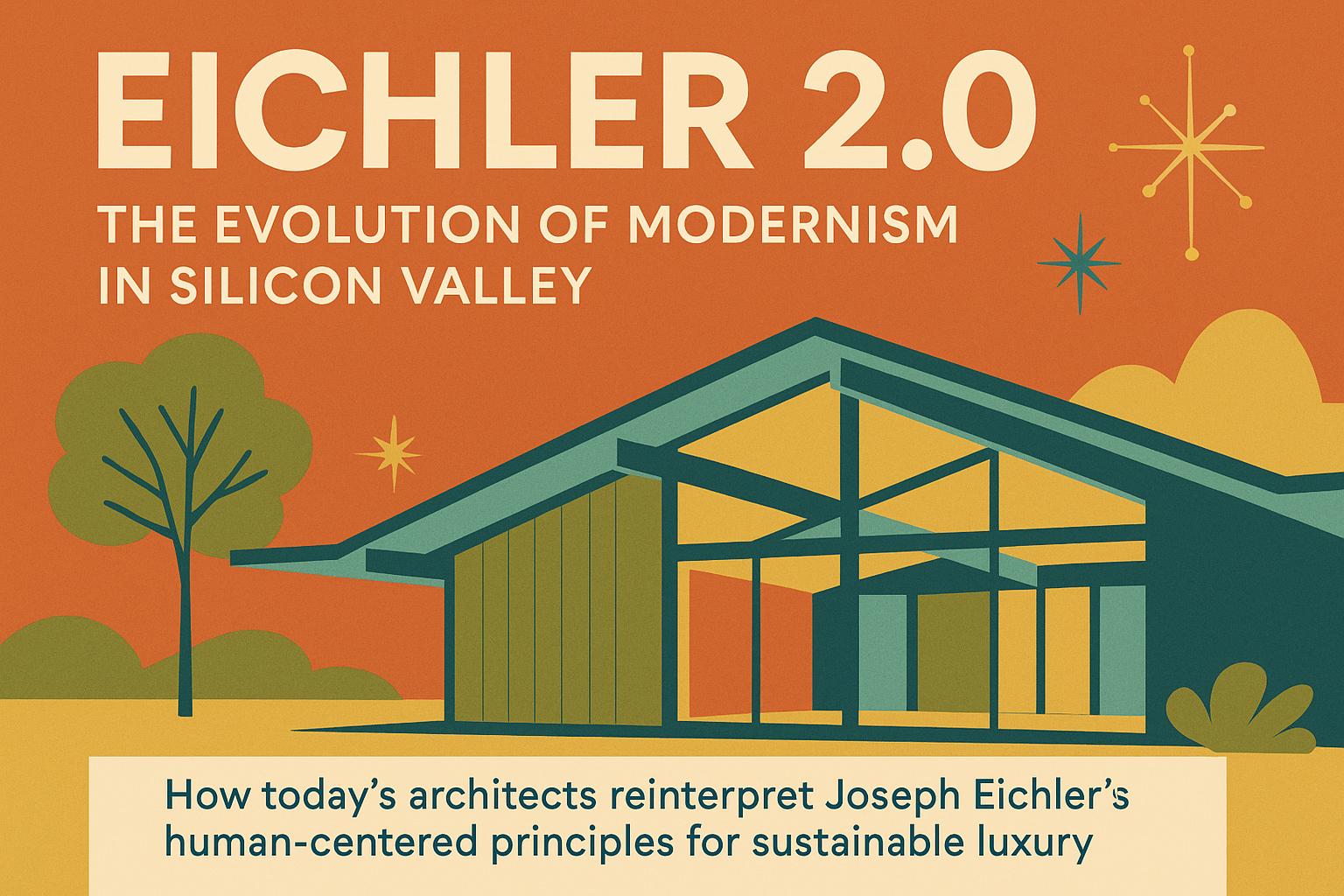
Joseph Eichler’s mid-century modern homes left an indelible mark on Silicon Valley neighborhoods. Hallmarks like indoor-outdoor flow, open-plan living, post-and-beam construction, and a focus on community defined the “California Modern” lifestyle Eichler offered to postwar middle-class families. Eichler’s visionary developments – characterized by glass-walled rooms opening to patios and atriums, simple clean lines, and inclusive, human-centered neighborhoods – were revolutionary in their day\. Today, a new generation of architects is translating these core ideals into a 21st-century context. They are creating an “Eichler 2.0” – homes that capture the spirit of Eichler’s originals but integrate sustainability, smart technology, and contemporary luxury eichlerhomesforsale.com. This report explores how Silicon Valley architects reinterpret Eichler’s design principles for modern sustainable luxury homes, examining the evolution of Eichler’s ideals, the infusion of green technologies, notable firms and projects leading this movement, and the materials and methods marrying mid-century ethos with modern expectations.
Indoor-Outdoor Flow: Blurring Boundaries with Nature
One of Eichler’s most cherished principles was “bringing the outside in.” Mid-century Eichler houses famously featured floor-to-ceiling glass walls, central courtyards (atriums), and wide sliding doors that dissolved the boundary between indoors and outdoors eichlerhomesforsale.com. This indoor-outdoor flow is even more pronounced in modern reinterpretations. Contemporary Silicon Valley homes inspired by Eichler use expansive high-performance glazing – often double or triple-pane glass with low-e coatings – to achieve the same transparency with far better energy efficiency eichlerhomesforsale.com. Entire walls of glass now vanish thanks to technologies like folding NanaWall systems, allowing a living room to open completely to a backyard or patio, effectively turning the home into an open-air pavilion when weather permits eichlerhomesforsale.com.
Modern architects also embrace the atrium concept, sometimes in creative new forms. Eichler’s open-air atriums remain a beloved feature and are often preserved or reintroduced in remodels and new designs. For example, architect Ryan Leidner’s renovation of a 1962 Eichler in Sunnyvale retained the home’s lush central atrium – complete with a mature crape myrtle tree from the original construction – as the focal point visible from almost every room. By stripping away later additions and adding new sliding glass doors, the design refocused attention on the atrium and backyard, seamlessly connecting interior and exterior spaces design-milk.com. In this way, Eichler’s idea of a home that breathes with the outdoors has evolved with modern engineering: atriums might now feature drought-tolerant landscaping or even retractable glass roofs for year-round use, blending nature with high-tech climate control eichlerhomesforsale.com.
Deep roof overhangs – another Eichler signature – continue to be used to mediate the indoor-outdoor relationship. These extended eaves provide shade to glass walls in hot sun and shelter transitioning spaces. Architects today often tailor overhangs to the site’s climate, echoing Eichler’s practice of regional practicality eichlerhomesforsale.com. The goal remains what it was in 1955: enable daily life to flow onto patios and gardens, giving residents “a daily dose of sky, sun, and breeze” in a manner that feels effortless eichlerhomesforsale.com. The difference is that today’s glass walls and doors come with virtually invisible thermal coatings, insulated frames, and motorized screens or shades that automatically deploy for comfort – technology that enhances the experience without detracting from Eichler’s fundamental vision of openness eichlerhomesforsale.com.
Open-Plan Living: Mid-Century Layouts for Modern Lifestyles
Eichler homes were pioneers of open-plan living in their time, eliminating formal dining and parlor rooms in favor of one fluid space containing kitchen, dining, and living areas oriented toward the backyard or atrium eichlerhomesforsale.com. This concept – radical for the 1950s – is now a baseline for contemporary luxury homes, and Eichler’s influence is evident. Modern Silicon Valley architects typically further expand on the open-plan idea, creating even larger “great rooms” and sightlines that extend through the house to the outdoors. They remove many of the smaller partition walls that may have existed and use open layouts to accommodate today’s casual, multitasking lifestyles design-milk.com. In a remodeled 1965 Eichler in San Mateo, for instance, an interior wall separating the kitchen and living room was knocked down to form one big continuous space, vastly improving natural light and flow dwell.com. The updated layout supports contemporary living by allowing family and guests to congregate in one connected area, rather than being isolated in separate rooms.
While Eichler’s original open plans were primarily about family togetherness, today’s designs add flexibility and multi-functionality to these open spaces. With remote work and modern entertainment needs, architects often incorporate flex rooms or adaptable nooks that expand the great room or close off as needed. A modern Eichler-inspired home might include a corner of the open living area that can serve as a home office or a playroom, separated by a sliding partition or cabinetry when privacy is needed eichlerhomesforsale.com. Despite these adaptations, the overall ethos remains: communal spaces are the heart of the home, visually and spatially connected to the kitchen (now often a sleek centerpiece with an island) and to the outdoors. High ceilings and clerestory windows – elements Eichler used to enhance light and spaciousness – are also used liberally today, sometimes updated with automated skylights that open for ventilation or tint to control glare eichlerhomesforsale.com. The result is an open-plan layout bathed in daylight, where interior design and furnishings (like low-profile modern sofas or iconic mid-century pieces) can define sub-areas without needing walls. This free-flowing arrangement not only feels luxurious and expansive, but it remains true to Eichler’s democratic idea that the kitchen, dining, and living functions should share one harmonious space accessible to all.
Modern renovations of Eichler homes illustrate this balance between old and new. Architect Mona Ying Reeves’s work on a 1959 Eichler, for example, transformed a once tight, compartmentalized kitchen into a bright, open cooking and dining area. She introduced a large quartzite island to open the kitchen to the dining space and added a glass wall looking out to the backyard, so the expanded interior feels both connected and filled with light. Such changes reflect contemporary preferences for airy, sociable kitchens and indoor-outdoor entertaining, yet they honor Eichler’s original open-plan intent. Even the furniture choices in these spaces (built-in banquet seating or modular sectionals) often echo mid-century modern aesthetics, reinforcing continuity with Eichler’s design language while providing 21st-century comfort.
Post-and-Beam Construction: New Materials, Same Ethos
The post-and-beam structure was the skeletal framework that made Eichler’s wide-open designs possible. By using a grid of load-bearing posts and horizontal beams (instead of interior bearing walls), Eichler homes achieved their iconic open interiors, glass expanses, and “floating” rooflines eichlerhomesforsale.com. Contemporary architects in Silicon Valley have embraced this structural ethos, often leaving beams exposed as a proud architectural feature, just as Eichler did. However, they now employ advanced materials and engineering to push the concept further. Rather than relying on old-growth redwood beams as Eichler did in the 1950s, modern designs might use engineered timber like glulam or cross-laminated timber, which offer superior strength, longer spans, and sustainable sourcing eichlerhomesforsale.com. In some cases, steel beams or hybrid steel-timber systems are used to achieve ultra-thin profiles and expansive openings that would have astonished mid-century builders eichlerhomesforsale.com. The aesthetic effect remains the same – exposed posts and rafters, tongue-and-groove wood ceilings, and open interiors – but now with the possibility of even taller ceilings or larger room volumes without visible bracing.
Crucially, architects update post-and-beam construction to meet today’s safety and performance standards. Eichler homes were built in an era with less stringent structural codes; modern post-and-beam designs leverage computer modeling and advanced connectors to ensure seismic resilience for California’s earthquake conditions eichlerhomesforsale.com. Fire resistance is another consideration: where Eichler might have had untreated wood members, current practice often includes fire-resistant treatments or the use of laminated beams that char slowly, providing better fire performance eichlerhomesforsale.com. Even with these enhancements, the visual language is consistent with Eichler’s legacy – structural honesty and rhythm expressed in every view. A visitor today might still look up and see a ceiling of exposed beam bays and feel that familiar mid-century warmth, yet those beams could be high-tech laminated lumber manufactured with CNC precision.
Upgrading an Eichler’s structure for modern living can also involve creative solutions to integrate new systems without disturbing the clean lines. Original Eichlers infamously had no attic and minimal crawlspace, making it challenging to add ducts or wiring eichlerhomesforsale.com. In renovations, architects find ways to conceal new infrastructure: for instance, slim HVAC ducts are threaded through cabinet bulkheads, or radiant heating tubes are embedded in a new concrete floor slab so that no bulky furnace is needed. One recent Eichler expansion in San Mateo by Klopf Architecture showcases this approach. The design included installing a new radiant floor heating system beneath both the existing and added concrete slab sections, providing invisible comfort throughout the home contemporist.com. This allowed the architects to maintain the unbroken plane of the wood ceiling (a classic Eichler feature) without compromising on modern comfort. The structural addition itself was executed with restraint: a single-story office/guest suite was added, carefully proportioned so as not to overwhelm the original post-and-beam profile of the house contemporist.com. Large windows in the addition echo the Eichler aesthetic and ensure the new space feels light and connected to the yard, preserving the sense of openness. This kind of sensitive structural evolution – expanding square footage while maintaining the post-and-beam character – exemplifies how architects today honor Eichler’s construction principles even as they adapt homes for larger size and contemporary use.
Community Orientation: Designing for Neighborhood and Lifestyle
Beyond physical design, Joseph Eichler was notable for his community-oriented philosophy. He built entire neighborhoods of modern homes, often including shared amenities like parks or community swimming pools, and he was a social progressive who insisted on selling homes to anyone regardless of race or religion eichlerhomesforsale.com. Today’s Silicon Valley architects and developers draw inspiration from this ethos in several ways. First, there is an emphasis on contextual design – making sure new or remodeled homes respect the scale and harmony of their neighborhoods. Rather than erecting conspicuous mansions, architects often aim for designs that “fit and not stand out too much” among neighboring homes architecturaldigest.com. This sensibility can be seen in projects like the Olson Kundig-designed net-zero home in Mountain View, which was deliberately kept modern yet understated so it would blend into a typical Northern California street architecturaldigest.com. In Eichler tracts today, where homeowners seek to enlarge original homes, architects frequently step roofs back or use tasteful single-story additions to maintain the low-slung neighborhood profile that Eichler established. By preserving sight lines and not dwarfing adjacent Eichlers, these renovations honor the communal coherence of Eichler’s planned developments.
Another aspect of community orientation is designing spaces that encourage social interaction and multi-generational living. Modern reinterpretations sometimes include shared outdoor courts or front yard patios that foster neighborly encounters, much as Eichler’s open front atriums and carport areas informally did. In new small-scale developments, architects may incorporate a common green space or communal facility in the spirit of Eichler’s community clubhouses. While Silicon Valley’s high land values make wholly new Eichler-style subdivisions rare, the concept lives on in pocket neighborhoods and co-housing projects. For example, some designers speculate about “modern pocket neighborhoods” of Eichler 2.0 homes that include community gardens or co-working spaces as updated amenities eichlerhomesforsale.com. An echo of this idea is found in the microgrid solar sharing concept: as sustainability becomes a community concern, architects imagine clusters of homes sharing battery storage and EV charging infrastructure, reinforcing a sense of neighborhood interdependence much like Eichler’s original communities did eichlerhomesforsale.com.
Family and community often overlap in design. Many Silicon Valley luxury homeowners want spaces that accommodate multiple generations or visitors – effectively small communities under one roof. Here we see Eichler’s influence in the design of in-law units and courtyards that allow privacy yet keep relatives close. A notable example is the Glass Wall House in San Mateo, where an original Eichler destroyed by fire was reimagined by Klopf Architecture as a larger multi-generational home. The new design incorporates a breezeway connecting the main house to an in-law unit, with both structures opening onto a shared courtyard and pool klopfarchitecture.com. This layout harks back to Eichler’s tract homes that often had breezeways or atriums, but expands the concept to support extended family living — a practical need in today’s housing market. It creates a mini-community within the property, demonstrating how architects marry Eichler’s communal sensibilities with modern family dynamics. Even within an individual home, touches like built-in breakfast nooks, large kitchen islands with seating, and indoor/outdoor dining areas all encourage people to gather and commune, reflecting the belief that architecture should bring people together. In sum, contemporary Eichler-inspired design in Silicon Valley isn’t just about the house in isolation; it’s about the neighborhood and the people. By respecting context, promoting inclusivity (for instance, designing accessible, single-level layouts that allow aging in place), and creating shared spaces, architects keep Eichler’s community-oriented spirit alive in a modern key eichlerhomesforsale.com.
Integrating Sustainability and Smart Technology
Perhaps the biggest evolution from Eichler’s era to today is the imperative of sustainability. If Joseph Eichler were building now, “sustainability would be a major priority,” and indeed many architects treating his legacy are aggressively pursuing net-zero energy performance in their designs eichlerhomesforsale.com. This means homes that produce as much energy as they consume – a concept only a dream in mid-century, but increasingly attainable with modern technology. Silicon Valley’s sun-soaked climate is ideal for solar energy, and many Eichler remodels and neo-Eichlers integrate solar panels as a standard feature. The flat or gently sloped roofs characteristic of Eichler designs turn out to be perfect for photovoltaic arrays eichlerhomesforsale.com. Architects take care to incorporate these sustainably: we often see solar panels flush-mounted or even designed as solar shingles to maintain clean rooflines. In some cases, a glass solar canopy over an atrium or patio can generate power while providing shade – a dual function Eichler would likely applaud eichlerhomesforsale.com. Forward-looking developments are even networking homes together with community battery systems, so that excess solar power from one Eichler-style home can help power a neighbor, reflecting Eichler’s community-minded approach in an eco-tech context eichlerhomesforsale.com.
Energy efficiency upgrades go far beyond solar panels. Eichler’s original homes had elements of passive design (like roof overhangs for shade and concrete slabs for thermal mass), but they were also notoriously poorly insulated by today’s standards. Now, any Eichler renovation or Eichler-inspired new build dramatically improves the building envelope. Designers add high-R insulation in walls and roofs (often using structural insulated panels or double-stud wall construction that can hide thick insulation while still showcasing post-and-beam geometry) eichlerhomesforsale.com. Leaky single-pane glass is replaced with double or triple-glazed windows in thermally broken frames, preserving the trademark floor-to-ceiling glass aesthetic but eliminating drafts and heat loss eichlerhomesforsale.com. Many homeowners also choose to install new foam roofing with excellent insulation over Eichler’s exposed-beam ceilings, sometimes even raising the roof line slightly at the edges to accommodate insulation in a way that’s invisible from below houzz.com. The result of these measures is that a classic glass-walled Eichler can be transformed into an airtight, highly insulated envelope that stays cool in summer and warm in winter with a fraction of the energy use eichlerhomesforsale.com. In fact, architects report that with enough insulation and efficient systems, even expansive glass “walls” can meet California’s strict energy codes without sacrificing the mid-century look.
Inside these upgraded homes, energy-efficient systems take center stage. Eichler’s radiant floor heating (which was innovative in the 1950s) makes a comeback, now updated with modern materials and controls. For example, a renovated Eichler might feature a solar-powered electric heat pump that heats water for in-floor radiant tubes, eliminating the old gas boiler and avoiding the air quality issues of the past eichlerhomesforsale.com. Heat pumps can double for cooling as well, and when paired with a tight envelope and possibly a bit of thermal mass (polished concrete floors are popular), the home maintains stable, comfortable temperatures year-round on very low energy eichlerhomesforsale.com. Traditional air conditioners are often replaced with small, quiet heat pump HVAC units or mini-splits, and you’ll find ERVs (energy recovery ventilators) bringing fresh air in efficiently – all hidden out of sight to keep the design uncluttered. Water efficiency and other green features also come into play: low-flow fixtures, rainwater catchment integrated into landscaping, and drought-tolerant gardens honor California’s climate constraints.
Smart home technology is another layer that distinguishes the Eichler 2.0 home. While mid-century homes were purely analog, today’s sustainable luxury houses are often “smart” in an invisible way. Architects and custom builders incorporate centralized control systems that manage lighting, climate, security, and even the position of those huge glass walls and shades eichlerhomesforsale.com. Importantly, these technologies are deployed in a minimalist, non-intrusive fashion, aligning with Eichler’s clean design. You might walk into a remodeled Eichler and not immediately see the tech – but behind the scenes, sensors are adjusting LED lighting to mimic circadian rhythms, motorized clerestory windows are opening automatically in the evening to flush out hot air, and a smartphone app allows the owner to pre-heat the home’s radiant floors before a chilly morning. Security systems with discreet cameras and smart locks provide peace of mind without bars or clutter, preserving the open feel.
A key focus of smart integration is enhancing the indoor-outdoor lifestyle. For instance, weather sensors can detect a surprise rain and signal those wide-open skylights or sliding glass panels to close, protecting the home even when the owner is away eichlerhomesforsale.com. Smart irrigation controllers adjust the watering of the Eichler-esque courtyard garden, and landscape lighting tied to solar sensors glows softly at dusk to frame that indoor-outdoor view. Energy monitoring dashboards give homeowners real-time feedback on their solar production and consumption, turning sustainability into an engaging, game-like part of home ownership eichlerhomesforsale.com. This modern tech aligns well with Eichler’s original forward-thinking; after all, Eichler homes were mid-century testbeds for innovations like radiant heat and new materials. In 2025, an Eichler-inspired home might be a testbed for the latest home AI or energy-sharing platform – all deployed in service of comfort, efficiency, and a harmonious lifestyle. Importantly, architects emphasize that the technology should serve the living experience, not dominate it eichlerhomesforsale.com. The interface of a truly modern Eichler-style home is still the view of the trees and sky, not a bank of blinking gadgets. In this way, sustainability and smart tech are integrated as a natural extension of Eichler’s people-centric design: they enhance comfort, reduce waste, and support community interaction, all while remaining elegantly behind the scenes.
Materials and Design Philosophies: Merging Eichler’s Ethos with Luxury
While Eichler’s original homes were built with modest materials to keep costs affordable (concrete slabs, plywood paneling, inexpensive mahogany veneer, etc.), today’s luxury reinterpretations elevate the material palette without losing the mid-century vibe. Architects in Silicon Valley are careful to choose materials that convey the warmth and simplicity Eichler homes are known for, but with modern quality, sustainability, and luxury in mind. A prime example is the extensive use of wood – Eichler loved exposed wood ceilings and siding, and modern homes continue this tradition, often using clear cedar, redwood, or sustainable hardwoods for siding and soffits to echo the linear tongue-and-groove look. However, recognizing issues like durability and fire risk, many architects opt for engineered or treated wood products. Recycled or composite wood siding can mimic the appearance of Eichler’s original vertical groove siding while being far more resistant to rot and fire. In some cases, non-wood alternatives such as fiber-cement panels or recycled steel cladding are used to achieve a similar sleek, horizontal aesthetic – these materials offer longevity and low maintenance, aligning with sustainability goals. Inside the home, original Eichlers featured Lauan mahogany wall panels; today, one might see bamboo plywood or other rapidly renewable veneers providing that same warm, mid-century panelled look in a greener way eichlerhomesforsale.com. Such details maintain continuity with the past (the rich wood tones beloved by mid-century design) while meeting present-day standards for environmental responsibility.
Luxury also comes from craftsmanship and finishes that were not available in Eichler’s tract homes. Floors, for instance, might be upgraded from basic linoleum tiles to polished concrete or terrazzo, which not only evoke mid-century modernism but also serve as thermal mass for passive heating/cooling eichlerhomesforsale.com. In bedrooms and living areas, sustainably harvested hardwood or cork flooring provides comfort underfoot with a nod to mid-century style. Countertops in kitchens and baths, once simple laminate in Eichlers, are now often high-end quartz or Caesarstone with clean lines – durable, low-maintenance, yet visually in tune with the minimalist aesthetic. Eichler’s designs emphasized honest materials, and that philosophy persists: natural stone, wood, and glass predominate, while overly ostentatious ornamentation is avoided. Instead of gilt or heavy adornments, luxury is expressed through precision joinery, flush surfaces, and bespoke details that complement the home’s architecture. For example, a custom built-in sideboard might stretch along an open living/dining space, echoing mid-century furniture designs but executed with hidden soft-close hardware and book-matched wood grain, marrying old-school style with new-school quality.
In terms of construction methods, prefabrication and high-precision building techniques are increasingly employed to deliver luxury quality with Eichler-like efficiency. Eichler homes were originally built quickly using standardized parts; similarly, some modern ventures (like Aro Homes in Mountain View) are exploring factory-fabricated components to achieve high quality control and sustainability. The difference is that today’s prefabrication can yield much finer tolerances and integrate luxury finishes from the start. Walls can arrive on site with insulation, windows, and wiring already in place, speeding up construction and ensuring that every joint is tight (critical for energy efficiency). This approach echoes Eichler’s innovative spirit – he was open to new methods if they improved homes – but applies it to meet premium expectations of the Silicon Valley market, where clients want custom-caliber homes delivered faster. Olson Kundig’s work with Aro Homes demonstrates this: they designed a high-end net-zero home module that can be replicated, aiming to cut build time in half while using top-tier materials like acetylated cypress wood siding and standing-seam metal roofing for longevity architecturaldigest.com. These materials are both upscale and durable, fulfilling the luxury market’s desire for quality and the sustainability goal of long life cycles architecturaldigest.com.
The design philosophy guiding Eichler-inspired luxury homes is often one of “timeless modernism”. Architects intentionally avoid trendy excess in favor of refined interpretations of mid-century principles – a strategy that keeps these homes feeling sophisticated rather than dated. “Selecting materials that will age well and last” is a core idea, as noted by architect Tom Kundig, who emphasizes using rational, practical design so a building can evolve over time without losing integrity architecturaldigest.com. This could mean choosing a natural cedar that weathers into a beautiful patina or installing terrazzo floors that will last generations. The palette tends toward neutral and nature-inspired tones (earthy browns, slate grays, white oak, etc.), which not only pays homage to Eichler’s integration with nature but also meets contemporary tastes for calming, resort-like environments. When bolder colors are used (for instance, a brightly colored front door – Eichler often painted front doors orange or blue), it’s done as a deliberate accent that celebrates mid-century pop without overwhelming the serenity of the space contemporist.com. In a recent San Mateo Eichler update, the architects chose a cheerful bright blue for the classic Eichler entry door, a playful mid-century nod, while keeping surrounding materials like wood and concrete in gentle balance contemporist.com.
Finally, luxury in these homes is about comfort and wellness, not just looks. Architects incorporate biophilic design elements – plenty of daylight, views of greenery from each room, good airflow – which were intuitively part of Eichler’s approach and now are recognized as contributors to well-being. High-end Eichler reboots might include spa-like bathrooms that open to private garden courtyards or outdoor showers, allowing residents to literally bathe in nature. They often feature state-of-the-art kitchens that remain visually minimalist but have gourmet appliances concealed within. Even technological luxuries like smart glass (glass that can tint for privacy or sun control) or in-floor LED lighting strips are applied subtly, enhancing the user experience without disrupting the minimalist aesthetic. In sum, materials and methods in Eichler 2.0 homes represent a fusion of authentic mid-century modern character with contemporary luxury values: sustainability, durability, comfort, and bespoke quality. Every beam, brick, and board is chosen to resonate with Eichler’s ethos of honest, human-centered design – now elevated to meet the demands of an era where luxury and sustainability must go hand in hand eichlerhomesforsale.com.
Silicon Valley Architects Reviving Eichler’s Legacy
A number of prominent architects and designers in Silicon Valley have built reputations on embracing and reinterpreting Eichler’s legacy. These professionals are intimately familiar with mid-century modern principles and have proven adept at updating Eichler homes or creating new Eichler-inspired designs for 21st-century clients. Below are a few key figures and firms leading the “Eichler revival” in the Bay Area, along with highlights of their approaches:
Klopf Architecture – Based in San Francisco, Klopf Architecture is synonymous with Eichler updates. The firm has worked on dozens of Eichler remodels and expansions, always with a “refine, not reinvent” philosophy. As seen in their San Mateo Highlands renovation, John Klopf and his team aim to maintain the iconic Eichler look while subtly integrating higher-quality modern materials and systems. They carefully preserve defining features like open beams and central courtyards, and when adding space, they do so modestly and seamlessly contemporist.com. Klopf Architecture is also known for sustainable upgrades in these homes – for instance, adding insulation and efficient heating (they often install new radiant floors) to drastically improve comfort while keeping the design clean. The end results feel like Eichler homes that have organically evolved rather than been dramatically altered: “nothing feels out of place or forced” in their projects contemporist.com. Klopf’s work has been featured in publications like Dwell, Inhabitat, and Contemporist, solidifying them as go-to Eichler experts. (Notable project: the “Glass Wall House” replacement of a burnt-down Eichler with a new indoor-outdoor home, preserving Eichler elements like a breezeway and open courtyard in a completely new build klopfarchitecture.com.)*
Ryan Leidner Architecture – Ryan Leidner is a Bay Area architect who has garnered attention for elegant renovations of mid-century homes, including Eichlers. In the “Twin Gable House” project in Sunnyvale (an Eichler originally designed by A. Quincy Jones), Leidner’s team demonstrated how to honor mid-century design while updating functionality. They focused on bringing the home back to its logical roots: removing disjointed additions, restoring the open-air atrium, and introducing new features for efficiency and flow. Leidner added sliding glass doors along the rear façade to seamlessly connect the interior to a new backyard swimming pool, exemplifying indoor-outdoor living. At the same time, they improved energy performance with measures like better glazing and a lighter color palette that maximizes natural light. The result was a bright, open Eichler home that feels entirely contemporary yet retains its 1962 soul. Ryan Leidner Architecture’s work appeals to tech-savvy Silicon Valley clients who want minimalist, energy-efficient homes that still exude mid-century cool. The Twin Gable House has been featured in design outlets (e.g. Design Milk), making Leidner another recognized name in the Eichler renaissance.
Maydan Architects – A Palo Alto-based firm, Maydan Architects has tackled several Eichler remodels and mid-century inspired projects with a more transformative bent. They are known for modernizing Eichlers for upscale lifestyles, sometimes pushing the envelope of the original layouts. One Eichler in Silicon Valley updated by Maydan became a “cheery hub where dozens can gather,” featuring a dramatically enlarged living area under a massive skylight dwell.com. By removing walls and opening up the roof, Maydan Architects created a space that can comfortably host 100 guests – a level of entertaining capacity not imagined in the 1960s, but achieved while staying true to the Eichler vision of openness dwell.com. Maydan’s designs often include bold modern elements (like expansive glass skylights or high-end interior decor) that elevate the mid-century home to a contemporary luxury showpiece. They strike a balance between preservation and innovation: original post-and-beam ceilings or atriums might be restored, even as the kitchen is entirely refitted with state-of-the-art appliances and a sleek, open layout for modern gourmet cooking. The firm’s ability to infuse mid-century structures with new life and glamor has made them sought after, particularly as Eichlers in prime Silicon Valley locations (Palo Alto, Los Altos, etc.) become luxury properties.
Mona Ying Reeves (Re:modern) – An architect and designer who has specialized in updating mid-century homes, Mona Ying Reeves is known for thoughtfully reconfiguring Eichlers to improve functionality while preserving their spirit. In one project, Reeves took a 1950s Eichler with a “once-choppy” layout and introduced a more connected flow, especially in the kitchen and living areas. She incorporated contemporary design touches – such as a quartzite kitchen island and vibrant tile and cabinet finishes – that add personality and luxury, yet these elements are set within the clean lines and open volumes of the original Eichler architecture dwell.com. Reeves often emphasizes original Eichler elements as focal points (for example, showcasing an exposed brick fireplace or keeping the tongue-and-groove ceiling unpainted) and then builds her modern interventions around them. Her firm, Re:modern, also advocates for sustainable building practices. In Eichler renovations, Reeves may specify eco-friendly materials and smart home features, aligning with the Bay Area ethos of green design. Her projects have been published and admired for hitting that sweet spot: they feel authentically mid-century in ambiance but serve the needs and tastes of a 21st-century family.
These are just a few of the key players; many other architects, interior designers, and builders in the Bay Area contribute to the Eichler revival. Firms like Ana Williamson Architect, John Lum Architecture, and Feldman Architecture, among others, have also worked on mid-century modern remodels or Eichler-inspired custom homes, each bringing their own twist while respecting the tenets Eichler held dear. The common thread is a deep appreciation for the mid-century modernist legacy coupled with a forward-looking creativity. Whether it’s a meticulous restoration or a bold “Eichler 2.0” new construction, Silicon Valley’s architects are ensuring that Eichler’s human-centered, design-forward philosophy not only remains alive, but continues to evolve with contemporary sustainable luxury eichlerhomesforsale.com.
Notable “Eichler 2.0” Homes and Developments in Silicon Valley
An updated Eichler home in San Mateo, renovated by Klopf Architecture, showcases classic mid-century post-and-beam lines, broad eaves, and floor-to-ceiling glass – now executed with sustainable materials and modern precision. The low-slung pavilion-like form blends indoor and outdoor spaces, illustrating how Eichler’s timeless design language is being adapted for contemporary living.
Several standout projects in Silicon Valley exemplify the fusion of Eichler’s mid-century modern principles with today’s emphasis on sustainability and luxury. These “Eichler 2.0” homes serve as inspiring case studies:
San Mateo Highlands Eichler Expansion (Klopf Architecture) – In the heart of an Eichler tract in San Mateo Highlands, Klopf Architecture undertook a tasteful expansion and renovation of a classic Eichler home contemporist.com. The owners, a growing family, wanted to update the 1960s house for 21st-century comfort while preserving its mid-century soul. Klopf’s team added a single-story extension for a home office and guest suite, designed so gently that one hardly realizes it wasn’t original – the addition’s glass walls, post-and-beam construction, and roofline align perfectly with Eichler’s aesthetic. Inside, modern amenities were woven in: a new hydronic radiant floor heating system was installed throughout, hidden beneath a polished concrete floor that extends to the new addition. This upgrade dramatically improved the home’s energy efficiency and comfort (no more cold spots on those famous concrete slabs) while keeping the heating invisible and silent. The renovation also revived original materials – for example, the team painstakingly restored and re-stained the home’s original Philippine mahogany paneling, rejuvenating its warm glow in the living room. Where new wood was needed, they matched it to the old, blending past and present. Perhaps the most striking gesture is how the design reinforces indoor-outdoor connections: in the primary bedroom, Klopf Architecture extended the white tongue-and-groove ceiling straight through the glass to the outside eave, creating a continuous canopy that visually links the bedroom to a private outdoor patio. Floor-to-ceiling sliding glass doors open that bedroom to the patio, making a small personal retreat that epitomizes Eichler’s idea of bringing nature into daily life. Throughout the house, original clerestory windows and new skylights work in concert to flood the interior with daylight. And yet, for all these modern touches, a visitor would instantly recognize this home as an “Eichler” – a testament to the skill with which it was updated. The project has been described as “a living tribute to Eichler’s vision, ready to serve another generation”, as every detail from the matching bronze window frames to the preserved mahogany siding respects the home’s origins contemporist.com. This home demonstrates that with careful design, an Eichler can gain space, efficiency, and luxury finishes without losing its mid-century character. It’s a blueprint for how to carry a beloved 60-year-old design gracefully into the future.
“Twin Gable” Atrium House in Sunnyvale (Ryan Leidner Architecture) – Nicknamed for its distinctive double-gable roof, this Eichler home (originally by architects Jones & Emmons in 1962) was reborn through a renovation by Ryan Leidner Architecture. The centerpiece of the home is a large open-air central atrium, a classic Eichler feature that had been partially obscured by previous remodels. Leidner’s team stripped away those alterations to reveal and celebrate the atrium as the heart of the house design-milk.com. They retained mature trees in the atrium – including a crape myrtle dating back to the home’s construction – and added new greenery, effectively creating an indoor-outdoor garden visible from every interior room. To integrate the atrium with modern living, the designers used a continuous flooring material: they laid down large-format porcelain tile that runs from the interior rooms out into the atrium and even to the backyard patio, creating one unbroken visual plane design-milk.com. This blurs the line between indoor and outdoor space, making the home feel larger and more unified. In addition to the atrium revival, energy efficiency was a key goal – the owners wanted a “more modern feel” and better performance design-milk.com. The renovation therefore included high-spec insulated glazing in all the new sliding doors and windows, plus upgraded roof insulation and efficient lighting, dramatically improving the home’s thermal comfort. The layout was gently reconfigured: a few walls were removed to open up sight lines, especially connecting the kitchen to the living and dining areas design-milk.com. Now, one can stand in the kitchen and see straight through the house, across the atrium, to the backyard and new swimming pool beyond – a stunning vista of mid-century openness enhanced by contemporary minimalism. The material palette is restrained and bright: white walls and ceilings (where Eichler’s were once darker paneled) help bounce light around, and mid-century-inspired furnishings in the atrium (like sculptural chairs and planters) pay homage to the era. The Twin Gable House exemplifies how a well-executed remodel can amplify Eichler’s original strengths (atrium, glass, simplicity) while adding modern luxuries. It’s now both a nostalgic time capsule and a cutting-edge sustainable home, having been featured in design publications as a model for balancing preservation with progress.
Mountain View Net-Zero Prefab Home (Aro Homes & Olson Kundig) – While not a remodel of an original Eichler, this project in Mountain View captures the spirit of Eichler 2.0 in new construction. A collaboration between Seattle-based architecture firm Olson Kundig and Silicon Valley startup Aro Homes, the house is a 3,000 sq ft net-zero energy home built as a prototype for scalable, eco-friendly luxury development architecturaldigest.com. In designing this home, the team didn’t explicitly copy Eichler details, but they arrived at many similar solutions by prioritizing indoor-outdoor living and efficient, straightforward design. The house features a single-story, low-profile form that would not look out of place in an Eichler neighborhood – in fact, the intent was to create a design that “fits and not stand out” in a NorCal suburban context. It has a gently sloping butterfly roof (a modern twist that also facilitates solar panel orientation) and generous roof overhangs. Clad in acetylated cypress wood siding and floor-to-ceiling windows, the home uses natural materials that weather well, embracing Eichler’s philosophy of honest material expression with a contemporary sustainable material architecturaldigest.com. An ipe wood deck wraps from the front to the back, literally connecting the interior to exterior in both directions – a nod to Eichler’s trademark of front and rear courtyards, here reinterpreted as continuous outdoor living spaces on a corner lot architecturaldigest.com. The interior boasts an open plan and immersive natural light, thanks to thoughtfully placed floor-to-ceiling glazing that illuminates the space while maintaining privacy (achieved with strategic fencing and landscaping). In terms of sustainability and tech, this house is state-of-the-art: comprehensive Passive House strategies were implemented (airtight construction, heat recovery ventilation, super-insulated walls) which allow it to exceed California’s energy code by a wide margin and hit net-zero targets. It comes equipped with greywater recycling, a high-efficiency heat pump for HVAC and hot water, and a smart electrical panel (by Span) to optimize energy usage architecturaldigest.com. What makes this project emblematic of an Eichler-for-today is its philosophy: it treats a home as a product that can be continually improved and potentially mass-produced, much like Eichler’s tract homes, but uses cutting-edge design and construction to achieve sustainability and luxury at scale architecturaldigest.com. While still in its pilot phase, the Mountain View home suggests a future where entire communities of net-zero, indoor-outdoor modern homes could be developed in Silicon Valley – essentially, Eichler tracts rebuilt for the climate-conscious era. It stands as a bridge between Eichler’s legacy of accessible modernism and the tech-driven, green housing innovations that define Silicon Valley’s latest contributions to residential architecture.
Other Noteworthy Examples – Beyond these, many individual homes throughout Silicon Valley carry the Eichler DNA forward. In Palo Alto and Cupertino, some homeowners have built new custom houses influenced by Eichler’s style – single-level modern pavilions with atriums and walls of glass – but with luxurious touches like home automation, gourmet kitchens, and spa-like bathrooms. Even in developments where original Eichlers exist, there’s a trend of upgrading for “modern retro” appeal: for instance, adding Tesla Powerwalls and solar roofs to 1960s Eichlers, or remodeling entire Eichler interiors with high-end finishes (Carrara marble, custom teak cabinetry) while keeping the iconic post-and-beam bones. The real estate market reflects this too: Eichler homes, once “affordable tract houses,” are now highly coveted gems often marketed as mid-century modern luxury – a recent five-bedroom Eichler in Los Altos sold for over $3.5 million after an expansion and eco-friendly retrofit, underscoring how Eichler’s architecture has transitioned into the luxury segment in practice. This “Eichler 2.0” movement in Silicon Valley isn’t limited to architects alone; it’s supported by passionate homeowners, specialized contractors, and even materials suppliers who understand the nuances of mid-century design. Together, they are proving that Eichler’s core ideas – openness, simplicity, integration with nature, and community – are not only relevant today but provide an inspiring foundation for building the sustainable, high-comfort homes that modern life demands.
Joseph Eichler’s Core Principles
From sun-drenched atriums and glass-walled living rooms to innovative sustainable technologies and bespoke finishes, the resurgence of Eichler-inspired design in Silicon Valley shows how a timeless architectural ethos can evolve for a new age. Joseph Eichler’s core principles – embracing the landscape, championing open and inclusive design, expressing structure and materials honestly, and fostering a sense of community – continue to guide architects as they create the next generation of modern homes eichlerhomesforsale.com. The examples and practices highlighted in this report demonstrate a clear through-line: today’s “Eichler 2.0” homes look in many ways like Eichler’s originals at first glance – featuring the clean lines, post-and-beam rhythms, walls of glass, and indoor gardens that have become iconic eichlerhomesforsale.com. But underneath the familiar mid-century appearance, they are marvels of 21st-century design: net-zero energy performers, brimming with smart tech, built of sustainable, resilient materials, and tailored to contemporary lifestyles of luxury and innovation eichlerhomesforsale.com.
In reinterpreting Eichler for the sustainable luxury market, Silicon Valley architects are not simply replicating a style – they are channeling a philosophy of living. It’s a philosophy that asserts that high design can be democratic and human-centered, that homes should connect people to nature and to each other, and that progress and idealism can co-exist in our dwellings. As we’ve seen, this has meant augmenting Eichler’s designs with solar panels and home batteries, with heat pumps and smart sensors, with bamboo cabinets and low-VOC paints – all in pursuit of homes that tread lighter on the earth and offer greater comfort to their occupants. Yet, walking through a modern Eichler-inspired home, one might still feel the optimism and clarity of mid-century modernism shining through. In these spaces, the past and future of California modern architecture truly meet. The legacy of Joseph Eichler is thus not preserved in amber, but alive and dynamic, informing how we can build homes that are beautifully of their time and yet timeless. Silicon Valley’s Eichler-influenced sustainable homes stand as exemplars of how honoring heritage can go hand in hand with innovation, yielding residences that are, in every sense, “embodiments of innovation, inclusivity, and inspiration” for how we can live harmoniously in the modern world eichlerhomesforsale.com.
Sources
Eichler’s design philosophy and mid-century features eichlerhomesforsale.com
Indoor-outdoor flow in Eichler homes then and now eichlerhomesforsale.com]
Post-and-beam construction and modern material advances eichlerhomesforsale.com
Open-plan living origins and contemporary adaptations eichlerhomesforsale.com
Eichler’s inclusive community ethos eichlerhomesforsale.com
Sustainability and net-zero energy integration eichlerhomesforsale.com
Smart home technology in modern Eichler-style houses eichlerhomesforsale.com
Use of sustainable, fire-resistant materials eichlerhomesforsale.com
Klopf Architecture’s approach to Eichler renovations contemporist.com
Ryan Leidner’s atrium-centered Eichler remodel design-milk.com dwell.com
Maydan Architects’ expansive Eichler update dwell.com
Mona Reeves’ Eichler reconfiguration dwell.com
Example: San Mateo Eichler expansion by Klopf contemporist.com
Example: Sunnyvale “Twin Gable House” remodel design-milk.com
Example: Olson Kundig/Aro net-zero home materials and design architecturaldigest.com
Eichler’s enduring influence and modern relevance eichlerhomesforsale.com