
Eichler Facade Formula: 40% Glass, 60% Groove, 100% Harmony in Silicon Valley
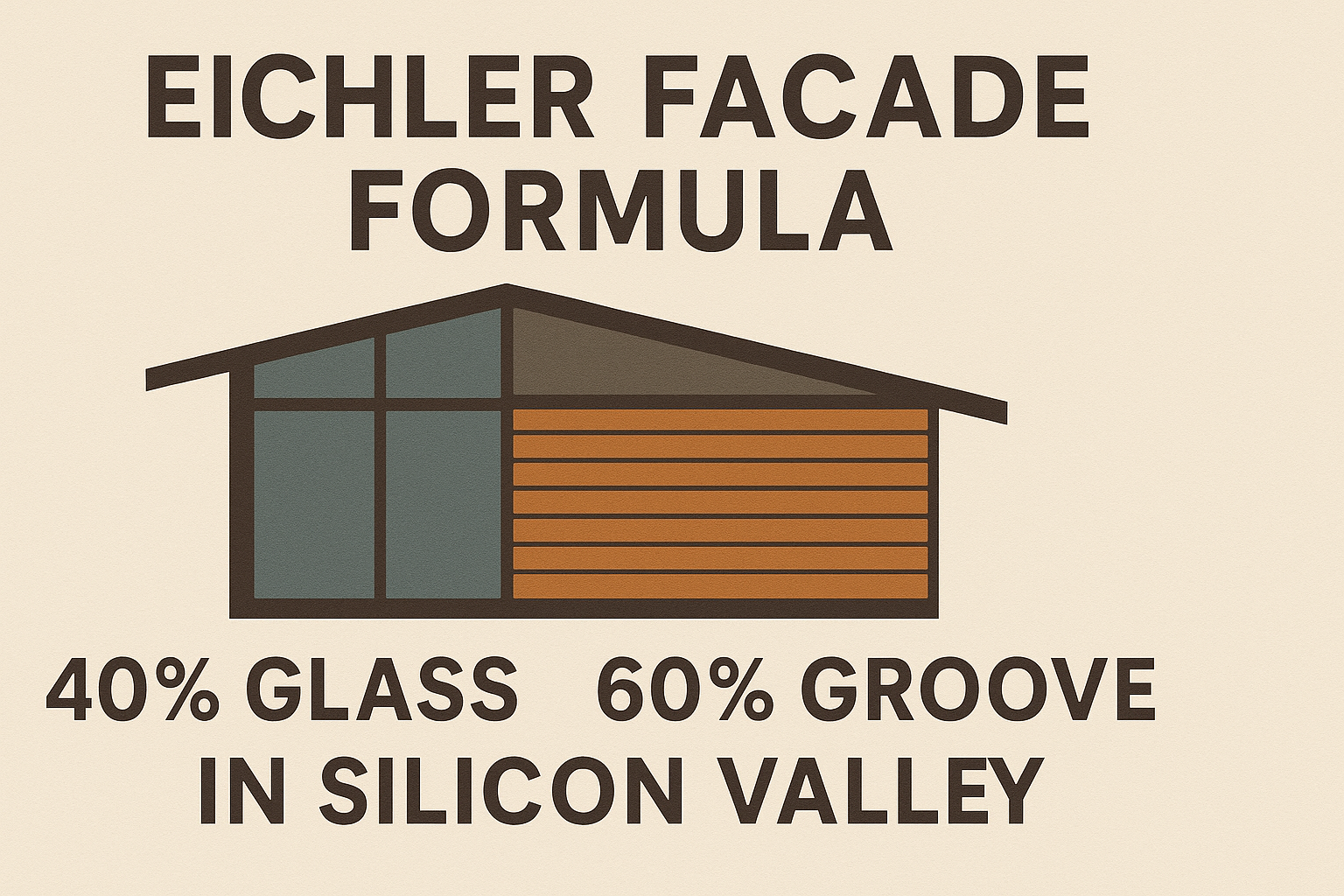
Eichler Exterior Formula and Curb Appeal in Silicon Valley
Joseph Eichler’s mid-century modern homes are instantly recognizable in Silicon Valley neighborhoods for their wood-and-glass exteriors and low-slung profiles sunset.com. The phrase “40% glass, 60% groove, 100% harmony” neatly captures the balance of materials on a typical Eichler facade: roughly forty percent transparent glass walls and windows, sixty percent solid wall clad in grooved wood siding, combining in perfect visual harmony. These modest one-story post-and-beam houses may appear crisp, angular, and unadorned from the street kqed.org, but their design was revolutionary – blurring indoor and outdoor spaces with walls of glass while maintaining privacy with stretches of elegant wooden siding. Over 2,700 Eichlers were built in Palo Alto alone (more than any other city) kqed.org, and today entire Eichler tracts in the Valley are recognized for their architectural significance and protected by design guidelines to preserve that original facade math and character. Enthusiasts line up for Eichler home tours and bid competitively for these homes, which stand apart in style and curb appeal even 60+ years after they were built archive.curbed.com. In the sections below, we analyze how the specific exterior elements – grooved plywood siding, expansive glazing, and carefully proportioned trim – work together to create the iconic Eichler look that remains highly desirable to luxury and design-savvy buyers.
60% Groove: Vertical Grooved Siding and Visual Texture
An Eichler street facade in Palo Alto with its characteristic grooved vertical wood siding and minimal ornamentation. The garage and front wall form a private street face, while expanses of glass open to the interior atrium or rear yard.
A defining feature of Eichler exteriors is the vertical grooved plywood siding that covers most exterior walls (often nicknamed “Eichler siding” or T1-11 panels). Eichler’s original developments uniformly used this smooth plywood with evenly spaced vertical grooves – usually 1/4-inch grooves at 2-inch intervals – typically made of redwood or fir veneers cityofsacramento.gov. This gave the homes a clean yet textured appearance, avoiding the ornamentation of brick or stone in favor of a simple rhythm of lines in the wood itself cityofsacramento.gov. Several groove patterns were used (such as “Wideline” and “Thinline” plywood panels), but all shared the effect of narrow vertical striations that add subtle shadow and interest to the facade while unifying it in one material palette houzz.com. In Eichler’s day, brick, stucco or shingles were never applied – just continuous vertical wood panels wrapping the house cityofsacramento.gov – reinforcing the modernist idea of honesty in materials and a seamless indoor-outdoor flow (often the same paneling appears on interior walls or fences for continuity).
The grooved siding provides the “60% groove” backdrop of the facade, acting as a visual counterpoint to the glass. Its strong vertical lines and natural wood warmth balance the horizontal roof planes and the transparency of the windows. As one preservation guide notes, this vertical groove cladding was the most common exterior material on Eichlers and became a hallmark of their design cityofsacramento.gov. Beyond aesthetics, using one siding material across the facade creates a sense of harmony and simplicity. Even the garage doors on many Eichlers were originally clad in the same grooved panels so that they blend seamlessly into the front elevation cityofsacramento.gov. This unified wood skin ties the various parts of the house together – garage, entry, and walls read as one continuous plane, which makes the structure look longer and lower. The vertical grooves also catch the sunlight and create shadow lines that give the flat walls a subtle pattern rather than a blank monotony. In short, Eichler’s grooved plywood siding brings texture and warmth to the design, “adding interest to the exteriors while unifying the overall exterior” houzz.com. It’s a perfect 60% partner to the glass, ensuring that the home doesn’t feel like a cold glass box, but rather a grounded modern ranch with organic wood character.
40% Glass: Floor-to-Ceiling Windows and Indoor/Outdoor Flow
The other roughly forty percent of an Eichler’s exterior is composed of glass – large panes and sliding doors that open the house to light and nature. Eichler homes were revolutionary for bringing expanses of glass into middle-class tract housing; “no one else was giving buyers a wall of glass” in the 1950s suburban marke teichlerhomesforsale.com. Thanks to the post-and-beam structure (with sturdy perimeter posts and no need for interior load-bearing walls), Eichler architects could insert entire walls of glass between the structural supports eichlerhomesforsale.com. The result was iconic: floor-to-ceiling plate glass windows and sliding glass doors that invite the outdoors in and make modest rooms feel bright and spacious cityofsacramento.go virvinehousingblog.com. In Silicon Valley’s mild climate, this design offered an idyllic “indoor/outdoor living” experience kqed.org – you can be standing in the living room yet see straight out to your private patio, garden, or atrium as if it’s an extension of the house. Eichler residents often describe the feeling as “calm and serene” because of how intimately connected to nature each room becomes midcenturyhome.com.
Key features of Eichler’s glass usage include:
Full-height fixed windows: Many Eichlers feature full-length panes with no dividers (mullions), sometimes stretching from floor to ceiling in the living areas irvinehousingblog.com. This uninterrupted glass maximizes views and light. Eichler design guidelines today insist that “full-pane glass is most appropriate” – small divided lites or grids would break the modernist look cityofpaloalto.org. In fact, original Eichlers often eliminated heavy window frames altogether; glass was set directly into the walls or even into masonry with hidden glazing slots for a flush, clean appearance archive.curbed.com.
Sliding glass doors: Almost every Eichler has sliding glass door panels (originally anodized aluminum frames) opening to rear yards or atriums cityofsacramento.gov. These effectively turn entire portions of the facade into movable glass walls, further blending indoors and outdoors. Modern renovations often replace these with high-end NanaWall or similar systems to create an even more seamless opening builderonline.com – a testament to how integral the glass wall concept is to Eichler design.
Clerestory and privacy-conscious placement: While Eichlers boast huge glass areas, the placement is strategic. On the public street-facing side, there are typically very limited window openings – often just narrow clerestory windows set high near the eaves or small frosted panes by the entry irvinehousingblog.com. This preserves privacy from the street and creates an enigmatic facade (as seen in the image above, which has a blank garage and front wall). The large windows are reserved for the private sides of the home – the back yard, interior courtyards, and side gardens invisible from the street cityofsacramento.gov. This way, Eichler homes feel like private sanctuaries from the front, yet open up with expansive transparency where it counts. As architect Paul Adamson noted, Eichler’s designs “challenged what houses could be” – from the street they looked modest, but inside they astonished with “low lines, all that glass…a California look” that wowed postwar buyers archive.curbed.com.
The glass elements not only flood the homes with natural light, but also serve an aesthetic purpose on the exterior: they break up the solidity of the wood siding and create a balanced “surface-to-void” ratio (solid wall vs. open window) that is visually pleasing. Eichler facades often carry a horizontal emphasis – the low roofline and often a band of clerestory glass under the eaves – which complements the vertical lines of the siding. The transparency of the glass areas is offset by the opacity of the paneled walls, achieving a Yin-Yang of sorts in materials. In essence, the crisp glass panels and the grooved wood panels interplay to avoid either heaviness or fragility: the house doesn’t feel like a primitive log cabin nor like a fragile greenhouse, but strikes a just-right balance. This is the “100% harmony” that Eichler enthusiasts refer to – a carefully modulated equilibrium of light vs. solid, modern vs. natural that gives the home its enduring visual appeal.
Trim and Proportion: Subtle Details That Enhance Harmony
While glass and siding are the stars of the Eichler formula, the supporting actors are the trim elements and proportions that ensure these materials form a cohesive composition. Eichler homes famously embraced a philosophy of “unify and simplify” in their exterior detailinghouzz.com. For example, window and door trim is minimal or even invisible. Many original Eichlers used true flush glazing where large panes were set directly in the wood framing with only a slim wood stop – no chunky window frames or decorative trim casings. This makes the glass and siding meet cleanly, reinforcing the seamless look. Where trim does exist (around doors, eaves, etc.), it’s often flat boards painted in neutral or contrasting colors to accentuate the home’s geometry without ornateness. Eichler’s architects also extended structural elements into design features: exposed rafters and beams at the eaves double as a visual trim line, creating a shadow detail and emphasizing the home’s horizontal roof plane cityofsacramento.gov. The roof fascia (edge) on Eichlers can be quite pronounced – a flat, thick band that caps the vertical siding and frames the facade like a picture. This fascia board, often painted white or a bold color, gives a strong horizontal datum that anchors the design against the vertical grooves of the siding.
Proportion was carefully considered in aligning elements. The Module of the posts and panels often governs the window and siding layout. For instance, the vertical grooves in the plywood often align with structural post positions or window mullions, creating a consistent cadence across the facade. If an Eichler wall has a series of floor-to-ceiling window panels, they will typically be spaced evenly and often balanced symmetrically around the center of the room or around an atrium. Likewise, solid wall sections are arranged to complement the glass sections – not too large to feel ponderous, and not too narrow to lose their visual calm. Clerestory windows tucked under the eaves frequently run as an uninterrupted strip, acting as a light-filled clerestory band that complements the solid panels below. All these subtle proportional choices give the facade a sense of order and calm. One Eichler renovation advisor put it succinctly: “Your goal should be simple: unify, simplify and create an overall harmonious exterior” houzz.com – advice Eichler’s team implicitly followed in the original designs.
Even color and material transitions were handled with restraint. Eichler exteriors typically feature a limited palette (natural wood tones or muted paint on siding, with a pop of color often reserved for the front door or a fascia strip) so as not to distract from the form. The result is that nothing feels superfluous on the facade; every element – be it the groove pattern, a window, or a beam – falls into a deliberate, almost grid-like composition that is quietly elegant. This is the “100% harmony” in action: materials and proportions working in concert, with trim details so refined that the average passerby might not even realize why the house looks so “right” until they study it closely.
Iconic Identity and Curb Appeal in Today’s Market
Eichler’s exterior formula has proven timeless. What was once an affordable tract house in the 1950s is now a coveted architectural gem in Silicon Valley’s luxury market. The same elements that defined the Eichler look then are what attract design-savvy buyers today. In contrast to larger pseudo-Mediterranean mansions or generic suburban homes, an Eichler’s unmistakable modernist facade signals taste and history. “Their design is so distinctive... The Eichlers stand apart,” says architect Paul Adamson; new generations of buyers who value design are actively “seeking them out.” archive.curbed.com Tech industry professionals, architects, and mid-century enthusiasts are often willing to pay a premium for these homes because of the lifestyle and aesthetic they offer archive.curbed.com. The curb appeal of an Eichler is subtle but striking: the house sits low and unpretentious behind a simple front landscape, yet the eye is drawn to its clean lines, the interplay of materials, and the hint of glass atrium just behind the fence. In real estate listings and preservation circles, you’ll frequently hear about Eichler’s “indoor-outdoor harmony” and design integrity – selling points directly tied to the exterior formula we’ve discussed. Buyers know that with an Eichler, they’re getting “wood, glass, and geometric simplicity” instead of stucco walls and fake shutters houzz.com.
Moreover, original Eichlers in good condition or tastefully restored tend to appreciate strongly, as scarcity and appreciation for mid-century design grow. Neighborhoods of Eichler homes in Palo Alto, Sunnyvale, and San Jose have even enacted Eichler-specific design guidelines and historic districts to protect that signature look kqed.org. This means that owners and remodelers are encouraged (or required) to maintain the 40/60 balance – for instance, preserving the grooved siding and expansive windows rather than replacing them with mis-matched materials. Such efforts have reinforced the brand identity of Eichler neighborhoods, making them highly desirable enclaves for those who want authentic mid-century modern style. As Curbed reported, mid-century aficionados line up for a chance to buy an Eichler, and some developers have even tried building new Eichler-inspired homes to meet the demand archive.curbed.com. There is a palpable nostalgia and respect for the “California modern” look that Eichler homes embody – a look of “low lines, all that glass” that still feels “surprisingly aligned” with contemporary tastes archive.curbed.com eichlerhomesforsale.com.
In today’s luxury market, owning an Eichler confers a certain prestige beyond just zip code – it says the owner values architectural design and quality of life over ostentation. The curb appeal of an Eichler thus operates on multiple levels: it’s aesthetically pleasing to anyone (for its neat, proportional facade and friendly integration with the landscape), and it’s especially magnetic to in-the-know buyers who recognize the genius of the 40%/60% formula. These homes photograph beautifully for listings – the vertical lines of the siding, the pop of a brightly colored door or beam, and the glow of light through the glass atrium at dusk all combine to create an inviting image. As one mid-century design publication noted, Eichlers feel “beautiful and timeless… they make you feel calm and serene in a way that a painting or sculpture can”midcenturyhome.com. That emotional resonance is a big part of their enduring appeal. In essence, Eichler’s exterior design formula continues to cast a spell on buyers: it promises a home that is architecturally harmonious, connected to nature, and emblematic of California modernism – a far cry from cookie-cutter tract houses.
Conclusion
The Eichler exterior formula of “40% glass, 60% groove, 100% harmony” is more than just a catchy ratio – it’s a summary of an architectural vision that has proven its longevity. In Silicon Valley, where these homes originated, the formula still defines what many consider the ideal modern home: walls of glass embracing the environment, warm wooden siding providing structure and privacy, and a design ethos that every element should work together in balance. Joseph Eichler and his team of architects achieved a facade composition that feels at once bold in its simplicity and soothing in its proportions. The vertical grooves, the horizontal roofline, the transparent corners and courtyards – all these pieces create an architectural identity so strong that “Eichler” is practically a style category of its own. And that identity resonates powerfully today: from preservation societies celebrating Eichler’s legacy, to high-end buyers snapping up Eichlers as art pieces to live in, the facade math continues to add up. Ultimately, the Eichler exterior is a study in balance – a masterclass in how glass and wood can be balanced to achieve an effect far greater than the sum of their parts. The 100% harmony of Eichler’s design formula not only defined an era of modernist tract homes, but it also continues to influence contemporary design and captivate those who experience its curb appeal firsthandarchive.curbed.com. In the realm of mid-century architecture, Eichler homes demonstrate that when you get the proportions and materials just right, the result is timeless “curb appeal” with genuine architectural substance.
Sources:
City of Sacramento, South Land Park Hills Eichler Historic District – Character-defining features of Eichler exteriorscityofsacramento.gov
Irvine Housing Blog – “Eichler in Orange” (features of Eichler homes)irvinehousingblog.com
Sunset Magazine – “Elements of Eichler style” (overview of Eichler design)sunset.com
R. Myrow, KQED News – “How Joseph Eichler Introduced Stylish Housing for the Masses”kqed.org
L. Tanjuatco, Curbed – “They Like Eich” (Eichler’s comeback and buyer interest)archive.curbed.com
Eichler Network – Guidelines and forums on maintaining Eichler siding and stylehouzz.com
Mid Century Home – Interview on why Eichlers attract today’s owners midcenturyhome.com
Builder Magazine – “Eichler Update Facilitates Outdoor Living” (Klopf Architecture remodel)builderonline.com