
Eichler-Inspired Mid-Century Modern Homebuilders in Silicon Valley

Modernist Builders Who Emulated Eichler in Silicon Valley
Mid-century modern housing flourished in Silicon Valley during the postwar boom, with developer Joseph Eichler setting the gold standard for California Modern tract homes eichlerhomesforsale.com. Eichler’s houses (built 1949–1974) introduced single-story post-and-beam construction, open floor plans, floor-to-ceiling glass walls, and even open-air atriums that brought the outdoors in eichlerhomesforsale.com. His designs featured flat or low-pitched roofs, radiant-heated concrete slab floors, and minimalist facades with vertical wood siding eichlerhomesforsale.com. Eichler’s success inspired a wave of Eichler emulators – other builders who adopted similar modernist principles in their own tract developments. This report focuses on five notable Eichler-influenced homebuilders in (and around) Silicon Valley: Mackay Homes, Alliance Homes, Gavello Homes, Stern & Price, and Bahl Homes. For each, we examine their architectural influences, how closely their homes resemble Eichlers, key distinguishing features, successes or stumbles, current reputation among buyers/collectors, and where their homes are found. A comparison table and final verdict on which homes are most desirable today are also included.
Mackay Homes (John Mackay)
Background & Eichler Influence: In the 1950s, developer John C. Mackay (Mackay Homes) emerged as Eichler’s friendly rival, building affordable modern tract homes that closely emulated Eichler’s style eichlerhomesforsale.com. In fact, Mackay even hired Eichler’s early architects (Anshen & Allen), so it’s no surprise many Mackay homes look like Eichlers at first glance eichlerhomesforsale.com. They feature post-and-beam construction with exposed beams, open layouts, and ample glass walls to blur indoor and outdoor spaces eichlerhomesforsale.com. Mackay marketed many models as “California patio homes,” capturing the same indoor-outdoor vibe Eichler pioneered eichlerhomesforsale.com. This architectural pedigree gave Mackay’s mid-century tracts an authentic modernist character.
Distinctive Features vs. Eichler: Despite the similarities, Mackay Homes can be identified by a few key differences:
Foundation & Heating: Most Mackays were built on raised perimeter foundations (crawl spaces) with conventional forced-air heating or wall furnaces, whereas Eichlers sat on concrete slabs with in-floor radiant heat eichlerhomesforsale.com. As a result, Mackay houses typically have floor vents or a furnace closet (features absent in Eichlers) eichlerhomesforsale.com. The raised foundation makes it easier to access plumbing or add ducts/AC later eichlerhomesforsale.com, whereas Eichler’s radiant slabs are silent but can be harder to retrofit (and prone to pipe leaks over decades) boyengateam.com boyengateam.com. A few early Mackays did use slab-on-grade, but most have that small step up at the entry due to the crawlspaceboyengateam.com.
Roof Profile: Eichler designs often sport flat or nearly-flat roofs. Mackay homes, by contrast, sometimes introduced gentle gable or even butterfly roof forms that create a taller facade silhouetteeichlerhomesforsale.com. These low-sloped A-frame or twin-peak roofs still have wide eaves and exposed beams, but the peek of a gable from the street can hint that it’s a Mackay, since Joseph Eichler didn’t use pronounced gables until later yearseichlerhomesforsale.com.
Ceilings & Materials: Look up inside – Eichler interiors have natural wood tongue-and-groove plank ceilings between exposed beams. Mackay homes often used painted Celotex fiberboard panels between beams insteadeichlerhomesforsale.com. Their ceiling beams might be painted over or even boxed in, whereas Eichler beams are usually left exposed and stained darkeichlerhomesforsale.comeichlerhomesforsale.com. Mackays also favored standard drywall for interior walls, instead of Eichler’s lauan mahogany panelingeichlerhomesforsale.com. These cost-saving measures made Mackays a bit less luxurious in finish, but more mainstream for the 1950s buyerboyengateam.com.
Layout Tweaks: Mackay floor plans tend to be slightly more traditional. Many have a defined entry foyer or a hallway by the kitchen, whereas Eichlers often drop you directly into an open great room or atrium without a formal foyereichlerhomesforsale.com. Mackays generally did not include the large open atriums that became an Eichler signature in the 1960seichlerhomesforsale.com. Some models have a small enclosed front patio or side courtyard, but not the expansive center atrium of later Eichlerseichlerhomesforsale.com. Overall room sizes and square footage were quite similar to Eichlers (e.g. a typical Mackay is a 3BR/2BA ~1,200–1,400 sq ft, comparable to Eichler’s mid-50s models)eichlerhomesforsale.com.
Exterior Clues: From the curb, Mackays and Eichlers are close cousins – single-story, low-slung, with vertical wood or grooved plywood siding and big glass sliders opening to the back yardeichlerhomesforsale.com. One giveaway is the garage: Eichler’s early tracts favored open carports, whereas Mackay Homes more often included an attached one- or two-car garage with a dooreichlerhomesforsale.com. For example, Mountain View’s Monta Loma neighborhood has Eichler houses with open carports on one street and very similar-looking Mackay houses with enclosed garages on the nexteichlerhomesforsale.comeichlerhomesforsale.com. Also, if you spot original hardwood flooring, it’s likely a Mackay – Mackay’s raised foundations sometimes came with hardwood floors, while Eichler’s slab homes originally had tile or linoleum (hardwood wasn’t laid on concrete slabs)eichlerhomesforsale.com.
Neighborhoods & Legacy: Mackay Homes popped up in several Silicon Valley communities. Notable concentrations include Mountain View’s Monta Loma (portions of that tract built 1955–56 by Mackay), Santa Clara’s Maywood and Fairmede tracts (Mackay built hundreds of homes there alongside adjacent Eichler tracts)eichlerhomesforsale.com, parts of Palo Alto and Cupertino, and even a few in Redwood Cityeichlerhomesforsale.com. A fun fact: the house Steve Jobs grew up in (Los Altos) was actually a Mackay home often mistaken for an Eichlereichlerhomesforsale.com. Mackay’s close emulation of Eichler paid off – his projects won architectural awards (the Sunshine Meadows and Sunshine Glen Mackay tracts each earned an AIA Merit Award in 1954)boyengateam.com, and today these homes are highly sought-after. Mid-century enthusiasts have “discovered that Mackay-built houses offer a comparable style and vibe” to Eichlersboyengateam.com. As a result, Mackays in Palo Alto, Mountain View, Santa Clara and beyond command strong prices and see healthy demandboyengateam.com. Many real estate listings now highlight the Eichler-like design pedigree – one Santa Clara Mackay was even advertised, “If you appreciate Eichler style homes… you will truly love this home”boyengateam.com. In short, Mackay nailed it: he successfully delivered Eichler-esque modernism to the masses, and decades later these homes are nearly as prized as true Eichlers.
A Mackay mid-century modern home in Santa Clara. From the street it resembles an Eichler, but note the attached two-car garage (Eichlers of this era often had open carports)eichlerhomesforsale.com. Mackay homes share Eichler’s post-and-beam lines and glass, yet typically have raised foundations and subtle design tweaks.
Gavello Homes (Elmer Gavello)
Background & Eichler Influence: Elmer and Leon Gavello, a pair of developer brothers, built a small number of mid-century modern homes in Sunnyvale in the mid-1950s. Gavello Homes were also designed by Anshen & Allen (the same architects behind Eichler’s early models), so at first glance people often mistake Gavellos for Eichlerseichlerhomesforsale.comeichlerhomesforsale.com. These homes feature hallmark mid-century elements: post-and-beam construction, open beam ceilings, floor-to-ceiling glass, and clerestory windows under the eaves to bring in lighteichlerhomesforsale.comeichlerhomesforsale.com. The intent was clearly to offer Eichler-style modern living. However, the Gavellos built on a much smaller scale – their main tract, Gavello Glen in Sunnyvale (near Ponderosa Park), comprised only a few dozen houseseichlerhomesforsale.comeichlerhomesforsale.com. This scarcity makes Gavello Homes little “hidden gems” for enthusiasts today.
Distinctive Features vs. Eichler: Despite the shared architects and overall look, Gavello Homes have some distinguishing attributes:
Larger Lots & Layout: One big difference is lot size. Gavello built on spacious suburban lots (often around 10,000 sq. ft., roughly a quarter-acre) – larger than the typical Eichler loteichlerhomesforsale.com. Their homes often have L-shaped or U-shaped layouts that wrap around a patio and open to a generous backyardeichlerhomesforsale.com. Instead of a center atrium, Gavello designs integrate an outdoor patio off the living/dining area (sometimes covered by the roof overhang) as the primary indoor-outdoor spaceeichlerhomesforsale.comeichlerhomesforsale.com. The result is a private outdoor living area at the side or rear, rather than an open atrium in the middle of the floorplan. The larger yards and setbacks also give Gavello neighborhoods a more spread-out, ranch-like feel – with lawns and driveways – whereas Eichler tracts tend to feel more compacteichlerhomesforsale.com.
Foundation & Heating: Documentation is sparse, but evidence suggests most Gavello Homes used raised foundations and forced-air heating (much like Mackay’s approach)eichlerhomesforsale.com. Some owners have reported radiant heat in their Gavellos, but if so it’s uncommon – radiant floor heating was not a standard feature for Gavello builds and would have been an innovation for a small builder in that eraeichlerhomesforsale.com. In general, expect a Gavello to have a furnace or floor vents rather than the in-slab radiant heat Eichlers are known foreichlerhomesforsale.com. The pitched roofs also imply there may be a bit of attic space for insulation and ductwork, which Eichler’s flat-roofed homes lackeichlerhomesforsale.com.
Architectural Style: Gavello Homes blend true modernism with a few ranch-style touches. Exteriors feature vertical wood siding similar to Eichler, but often combined with brick or stone accents that add a dash of traditional textureeichlerhomesforsale.com. For example, a Gavello’s entry might have a brick planter box or a partial stone wall, adding visual warmth that pure Eichlers usually don’t haveeichlerhomesforsale.com. Many Gavellos have broad low-gabled roofs (A-frame ranch profile) with wide eaves, giving a classic mid-century outlineeichlerhomesforsale.com. They nearly always include a full two-car garage facing the street (whereas Eichlers of the mid-’50s might have had carports)eichlerhomesforsale.com. Some Gavello models even have a front-facing picture window or an asymmetric facade pop-out – elements that add curb appeal in a conventional sense, even as the overall look remains MCM (mid-century modern)eichlerhomesforsale.com. In short, Gavellos “hit all the notes” of 1950s California modernism but with a slightly less spartan face to the street.
Unique Models: Because so few were built, Gavello models didn’t get flashy marketing names, but there are distinctive designs. One noted model is a U-shaped home with an entry courtyard and an asymmetric A-frame roof – a dramatic look that Eichler himself didn’t replicate in Sunnyvaleeichlerhomesforsale.com. Enthusiasts sometimes dub these houses “Gavello ranches” since they offer Eichler-like design on sprawling ranch-sized lotseichlerhomesforsale.com.
Neighborhoods & Legacy: The core Gavello Glen tract is in Sunnyvale, in the Ponderosa Park area (around Quail Ave, Ponderosa Ave, Snapdragon Ct, etc.)eichlerhomesforsale.com. Notably, this pocket is not an Eichler tract – so if you find a mid-century modern home in that area that isn’t documented as an Eichler, it’s likely a Gavelloeichlerhomesforsale.com. In fact, Sunnyvale’s Gavello Glen also has a few homes by Stern & Price and some ordinary ranchers mixed ineichlerhomesforsale.com, so local knowledge or permit records help confirm which are Gavello-built. Some Gavello homes (very few) are reported in Santa Clara and Mountain View as welleichlerhomesforsale.com, but Sunnyvale was the primary locale. Identification tip: Original Sunnyvale building permits from 1956 for streets in Gavello Glen list Anshen & Allen as the architects – a big clue, since A&A only partnered with Eichler, Mackay, and Gavello during that eraeichlerhomesforsale.com. The tract name itself, “Gavello Glen,” is a giveaway too, as Eichler built no tract by that nameeichlerhomesforsale.com.
In terms of success, Gavello Homes were few but are fondly regarded. They essentially delivered Eichler style on larger properties. Because they’re under-the-radar, they often sell for a bit less per square foot than Eichlers in the same region – making them a “sweet find” for mid-century lovers who recognize themeichlerhomesforsale.comeichlerhomesforsale.com. That said, their larger lot sizes and ~1,800–2,000 sq ft house size mean total prices can still be high. (In fact, a well-kept Gavello in Sunnyvale can fetch $2M+ given the lot valueboyengateam.com.) Overall, Gavello’s small scale means they didn’t achieve Eichler-level fame, but among aficionados these homes are considered a success – rare mid-century gems that “hit the notes” of design and are eagerly snapped up when availableeichlerhomesforsale.com.
Alliance Homes (Terra Linda Alliance)
Background & Eichler Influence: Alliance Homes were built by the Alliance Construction Co. in 1954, not in Silicon Valley but in the Terra Linda area of San Rafael (Marin County). They’re included here because of their historical significance as Eichler contemporarieseichlerhomesforsale.com. In fact, Alliance Homes are often jokingly called “Lik-Eichlers” (like-Eichlers) by locals, since at a glance they strongly resemble Eichler-built houseseichlerhomesforsale.com. The Alliance tract actually predated Eichler’s own Terra Linda developments, sharing Eichler’s goal of bringing modern architecture to middle-class familieseichlerhomesforsale.com. These homes feature the classic mid-century ingredients: post-and-beam construction, open plan layouts, globe pendant lights, sliding glass doors, and exposed wood elements – essentially mimicking Eichler’s style detail for detaileichlerhomesforsale.com. About 200 Alliance houses were built as a cohesive modern tract, making it one of the earliest large-scale Eichler lookalike projectseichlerhomesforsale.com.
Distinctive Features vs. Eichler: Alliance Homes copied much of Eichler’s formula, but they did have their own twists and practical differences:
Atrium & Layout: Alliance models did not include Eichler’s signature atrium (which Eichler himself didn’t introduce until a few years later in the late ’50s). Instead, most Alliance homes have an L-shaped floor plan, with living and bedroom wings forming an L around a rear patioeichlerhomesforsale.com. All courtyards are on the exterior; there is no open-air atrium in the center of the houseeichlerhomesforsale.com. A unique selling feature was a “children’s play patio” – some Alliance designs include a small covered patio off a bedroom, intended as a play area where kids could be outside yet contained (and even clean up before coming indoors)eichlerhomesforsale.com. This is a quirky feature Eichlers didn’t have. If you see a mid-century home with a tiny patio off a back bedroom (and no central atrium), it could very well be an Allianceeichlerhomesforsale.com.
Roof Design: Alliance homes have gently pitched roofs, slightly steeper than Eichler’s typically flat or 1:12 pitch roofseichlerhomesforsale.com. From the street you might notice a low gable or just a hint of slope on an Allianceeichlerhomesforsale.com. This design choice actually gave Alliance an advantage in rainy Marin – better roof drainage and fewer leaks compared to flat-roof Eichlerseichlerhomesforsale.com. Eichler’s Terra Linda models often had flat tar-and-gravel roofs that need vigilant maintenance, whereas Alliance used a low-slope roof with shingles or rolled roofing that held up better over time in wet weathereichlerhomesforsale.com.
Radiant Heating: Impressively, Alliance Homes did feature radiant floor heating like Eichlers – but with a crucial improvement. They ran the radiant pipes in copper instead of steeleichlerhomesforsale.com. Early Eichler slabs used steel pipes which eventually rusted out; Alliance’s copper tubing resisted corrosion, so many original radiant systems lasted much longer without leakseichlerhomesforsale.com. In essence, Alliance embraced Eichler’s innovative heating concept but executed it with more durable materials. If you tour an Alliance home today, there’s a good chance it still has its original (or long-lived) radiant heat working, or at least intact copper manifolds in the utility areaeichlerhomesforsale.com. That’s a subtle distinction you wouldn’t see without inspecting the mechanicals.
Size & Rooms: Alliance houses were generally a bit smaller than Eichlers of the same mid-50s era – roughly 1,200–1,500 sq ft for 3-4 bedrooms, whereas Eichler’s Terra Linda models averaged more like 1,500–1,800 sq fteichlerhomesforsale.comeichlerhomesforsale.com. This means Alliance bedrooms and living areas can feel slightly more compact or tightly designed. They stuck to single-story layouts and efficient use of space, without the larger atrium models or four-bedroom expanses that Eichler introduced in the 1960seichlerhomesforsale.com. In short, Alliance offered a no-frills version of Eichler’s aesthetic – modest-sized homes that delivered the essentials of MCM design.
Exterior Clues: From the outside, Alliance homes are extremely Eichler-like: low profiles, broad eaves, vertical wood siding, big glass windows to the rear – all the trademarks are thereeichlerhomesforsale.com. One subtle clue is the roof pitch: because many Alliance models are L-shaped, you might see two modest gable ends from certain angles (due to the two wings of the house), whereas Eichler atrium models show one larger roof spaneichlerhomesforsale.com. But the biggest giveaway is location – all Alliance homes are in the Terra Linda section of San Rafael, and Eichler did not build in that exact tract in 1954eichlerhomesforsale.comeichlerhomesforsale.com. If you’re looking at a mid-century modern home on streets like Wakerobin, Briarwood, Las Pavadas, or Golden Hinde in Terra Linda, and it doesn’t match the known Eichler tract maps, it’s probably an Allianceeichlerhomesforsale.comeichlerhomesforsale.com. Contemporary records (sales brochures, tract maps) explicitly mention “Alliance” as the developer, which further helps identificationeichlerhomesforsale.com.
Neighborhoods & Legacy: All Alliance Homes are located in the Terra Linda neighborhood of San Rafael (Marin County)eichlerhomesforsale.com. None were built in the South Bay, so Silicon Valley house-hunters won’t encounter them locally (they’re included here for comparison, as they’re a classic example of Eichler emulation)eichlerhomesforsale.com. In Terra Linda, the Alliance tract sits in the valley floor area, whereas Eichler’s later Terra Linda tracts were built on nearby hills and other sections – so Terra Linda actually has four MCM tracts: one Alliance and three Eichler tracts interspersedeichlerhomesforsale.com. For years, the Alliance tract was somewhat overlooked in favor of Eichler’s better-known Terra Linda homes, but mid-century fans have started to take noteeichlerhomesforsale.com. Alliance houses offer a very similar vibe and look to Eichlers, often at a slightly more affordable price in that marketeichlerhomesforsale.comeichlerhomesforsale.com. In Marin, Eichlers have a strong following, and now savvy buyers realize the Alliance “Lik-Eichlers” are essentially an insider’s bargain – you get the Eichler aesthetic and even radiant heat, but might pay a bit less due to the name differenceeichlerhomesforsale.com. In terms of success, Alliance succeeded in beating Eichler to the punch in Terra Linda and delivering quality modern homes (their use of copper radiant tubing was ahead of its time). However, being geographically isolated from Silicon Valley’s core and limited to one tract, Alliance Homes remain more of a historical footnote – a fascinating parallel effort that “nailed” the Eichler look, yet ultimately a cautionary tale that even a great Eichler clone can be overshadowed by the real thing when it comes to lasting fame.
Bahl Homes (George Bahl)
Background & Eichler Influence: In the late 1960s, developer George Bahl added a unique chapter to Silicon Valley’s mid-century modern storyeichlerhomesforsale.com. Bahl built a series of small enclaves – often tiny cul-de-sacs of 10–20 houses – in Sunnyvale, Cupertino, and West San Jose, roughly between 1962 and 1970eichlerhomesforsale.comeichlerhomesforsale.com. These are often called “Bahl Patio Homes”, named for their signature design element: each home is centered around a private enclosed patioeichlerhomesforsale.comeichlerhomesforsale.com. Bahl took Eichler’s indoor-outdoor concept and, if anything, intensified it – maximizing privacy and space efficiency on small lots by literally building the house around a courtyard. Bahl Homes were clearly inspired by Eichler’s atrium models, but they represent an even more radical experiment in blending modern architecture with California suburban living.
Distinctive Features: Bahl Patio Homes are distinct from Eichlers and others in several ways:
Central Courtyard (Atrium-like): Every Bahl home is essentially wrapped around an interior walled patio, which functions like an atrium – the patio is open to the sky, and multiple rooms (living areas, bedrooms) have sliding glass doors opening onto this patioeichlerhomesforsale.comeichlerhomesforsale.com. However, unlike Eichler’s atrium (which usually serves as the entry foyer and is visible from the street through the glass front door), Bahl’s courtyard is hidden deeper in the planeichlerhomesforsale.com. You typically enter a Bahl house from the street into an indoor foyer or hall, and only then do you access the private patio from insideeichlerhomesforsale.com. This creates a secluded “oasis” effect – the street side of the home is almost fortress-like, with a blank facade, but the interior side is all glass facing the private patio and backyardeichlerhomesforsale.com. It’s a clever twist that yields even more privacy than an Eichler atrium, at the expense of a more closed-off public face.
Extreme Privacy (Blank Facade): Bahl Homes are known for their nearly opaque street facades. Often the front features a tall blank privacy wall or the side of the garage, with maybe a thin clerestory window strip, but no big windows facing the streeteichlerhomesforsale.com. Many Bahl courts present a continuous street wall with hidden entrances – even the front doors are tucked in alcoves or behind screen wallseichlerhomesforsale.com. This inward orientation goes beyond Eichler’s designs; while Eichlers minimized street windows, Bahl virtually eliminated them for maximum seclusioneichlerhomesforsale.com. For example, in Sunnyvale’s Bahl cul-de-sacs, you might drive by a row of flat-roofed homes and see little more than blank fences or walls – all the action is facing the interior patios. This design was deliberate, to guard the homeowners’ private outdoor space from public vieweichlerhomesforsale.com. In contrast, Eichler atrium models typically have a glazed wall at the entry where you can glimpse the atrium; Bahl’s approach was to hide the courtyard entirely behind solid wallseichlerhomesforsale.com. Exterior materials on Bahl homes were simple and unadorned – e.g. plain plywood or board-and-batten siding, sometimes concrete block walls or slatted wood screens – emphasizing privacy and modern minimalismeichlerhomesforsale.com.
Post-and-Beam Construction: Despite some unconventional layout ideas, Bahl Homes were built with classic mid-century post-and-beam engineering. They have exposed beam ceilings with tongue-and-groove wood decking, open spans, and very few interior load-bearing wallseichlerhomesforsale.com. The aesthetic of natural wood, simple clean lines, and “honest” materials is very much in keeping with Eichler’s philosophieseichlerhomesforsale.comeichlerhomesforsale.com. Essentially, Bahl took the Eichler bones (post-and-beam structure, open plan, indoor-outdoor flow) and repackaged them in a new configuration.
Roof and Scale: Bahl Homes typically have flat or nearly-flat roofs with broad overhangs, giving them a distinctly modern profile (often one-story with a high fascia or parapet)eichlerhomesforsale.comeichlerhomesforsale.com. From the street they appear as flat-roofed MCM boxes, very uniform in height – if you drive into a Bahl court, the unbroken flat rooflines immediately signal “mid-century modern” rather than typical gabled rancherseichlerhomesforsale.com. They were modest in size, often 3-bedroom, 2-bath homes of ~1,200–1,600 sq fteichlerhomesforsale.com. However, owners frequently remark that the clever layouts feel larger, because almost every room opens onto a patio or yard, giving a sense of expanded space and lighteichlerhomesforsale.com. The floor plans are highly efficient – minimal hallways, combined living/dining great rooms – so they achieve a feeling of openness and functionality despite the small footprintseichlerhomesforsale.com. Bahl essentially distilled the mid-century modern home to a compact essence, with “less is more” designeichlerhomesforsale.com.
No Radiant Slabs: By the late ’60s, builders had largely moved away from in-slab radiant heating (due to the maintenance issues seen in earlier Eichlers). Bahl Homes were constructed on raised perimeter foundations (again, likely a zero-lot-line footing on one side) and did not use radiant heat, instead opting for conventional forced-air heatingeichlerhomesforsale.com. This makes them easier to update with modern HVAC, and indeed many have been retrofitted with new furnaces or even air conditioning over timeeichlerhomesforsale.com. So, like Mackays, Bahl Homes usually have crawlspaces and no in-floor pipes – another clue if you suspect a mid-century house might be a Bahl or Mackay rather than an Eichlereichlerhomesforsale.com.
Neighborhoods & Legacy: Bahl’s developments were boutique in scale. Look for Bahl Patio Homes in Sunnyvale (e.g. a couple of short cul-de-sacs off Mary Ave and Fremont Ave), in Cupertino’s Monta Vista area (the “Rancho del Patio” court in the Rancho Rinconada neighborhood), and a cluster in West San Jose near Lawrence Expressway at the Cupertino bordereichlerhomesforsale.com. These enclaves are so small that many don’t have widely known tract names – often the street name + “court” is the only identifiereichlerhomesforsale.com. Because of their scarcity, Bahl Homes have become cult favorites among mid-century modern aficionadoseichlerhomesforsale.com. They rarely come up for sale, but when they do, they can fetch prices per square foot on par with Eichlers – buyers recognize the uniqueness and are willing to pay a premiumeichlerhomesforsale.com. In fact, some Bahl Patio Homes have sold as high as Eichler homes in the same area, despite their small size, due to intense demand from enthusiastseichlerhomesforsale.com. Real estate listings now explicitly advertise them as “Bahl Patio Homes” as a selling pointeichlerhomesforsale.com. Owning one is like having a hidden time capsule of 1960s design. Bahl’s experiment was quite successful in design terms – he pushed the atrium idea to the extreme of privacy and efficiency, creating mini-neighborhoods that still feel modern and desirable today. In the long run, Bahl Homes are success stories: though not widely known to the general public, they’re revered by the MCM community, and their values reflect that niche demand. Finding one is challenging, but as one source put it, “finding one is like discovering a hidden time capsule”eichlerhomesforsale.com – an apt description of their appeal.
Stern & Price Homes
Background & Eichler Influence: Stern & Price was a partnership of developers active in the late 1950s through the 1960s. Unlike Eichler, Mackay, or even Gavello, Stern & Price did not build large unified tracts; instead, they often built one-off custom modern homes or small clusters within existing neighborhoods across Santa Clara Valleyeichlerhomesforsale.comeichlerhomesforsale.com. You’ll find Stern & Price homes “sprinkled” in cities like Sunnyvale, Santa Clara, West San Jose (near Campbell), and Campbell itselfeichlerhomesforsale.com. Their approach could be seen as blending true mid-century modern ideals with a bit more mainstream appeal – essentially aiming for Eichler-esque design but with some conventional comforts to attract a broader range of buyerseichlerhomesforsale.comeichlerhomesforsale.com. In concept, Stern & Price homes sit at the intersection of California modern and the California ranch.
Design Characteristics: Key points that define Stern & Price homes include:
Hybrid MCM Style: A Stern & Price house exhibits a mix of mid-century modern principles and postwar practicalityeichlerhomesforsale.com. On the modern side, they feature the familiar low-slung rooflines, expansive panes of glass, open beam elements, redwood tongue-and-groove siding, and open floor planseichlerhomesforsale.com. Yet they also weren’t as strictly minimal as Eichlers – you might see a bit more ornamentation, varied facade materials, or slightly larger room sizes and closets (a nod to traditional buyer preferences)eichlerhomesforsale.com. In essence, from the street they look modern – with broad eaves and clean lines – but they may have touches of “cozy ranch” that pure Eichlers omittedeichlerhomesforsale.comeichlerhomesforsale.com. For example, one home might have an extra decorative trim, another might have a more pronounced entry porch or a bay window in a bedroom; each Stern & Price was somewhat unique.
Courtyards & Indoor-Outdoor Flow: Many Stern & Price designs include courtyards or private patios, continuing the Eichler-like emphasis on indoor/outdoor livingeichlerhomesforsale.com. Not every S&P home has a central atrium, but U-shaped layouts around a landscaped courtyard were common in their repertoireeichlerhomesforsale.com. Even in those without a formal atrium, you’ll virtually always find large glass sliders to the back yard and clerestory windows up top – they definitely embraced the concept of bringing the outdoors ineichlerhomesforsale.com. Some homes have central open-air atriums or entry courtyards reminiscent of Eichler’s, but often executed in a more California ranch style (e.g. open to a garden or lawn rather than a stark atrium)eichlerhomesforsale.comeichlerhomesforsale.com.
Construction & Insulation: Stern & Price homes are generally post-and-beam construction as well, but the builders were pragmatic about mixing techniqueseichlerhomesforsale.com. In some cases they incorporated sections of conventional framing (with attics) to allow for more insulation in ceilings or walls – something Eichler eschewed in favor of architectural purityeichlerhomesforsale.comeichlerhomesforsale.com. For instance, a Stern & Price might have a slightly thicker roof profile because it’s insulated and has a shallow attic space, whereas Eichler roofs are typically thin and uninsulated with exposed beams beneatheichlerhomesforsale.com. Many Stern & Price houses have deep roof overhangs, even larger than Eichler’s, as a stylistic and practical choice for shadeeichlerhomesforsale.com. They also tended to use standard forced-air heating (often with crawlspaces or attics to run ductwork), instead of Eichler’s radiant slabseichlerhomesforsale.com. This means no telltale radiant heat pipes, and sometimes flat drywall ceilings in parts of the house (with beams hidden above the ceiling line) – again, a compromise to improve comfort and insulationeichlerhomesforsale.com.
Roof Styles: Stern & Price generally avoided flat roofs, favoring low-pitched hip or gable roofs (often with a wide fascia)eichlerhomesforsale.com. You’ll see the familiar tongue-and-groove soffits and exposed beam tails under the eaves, but the overall roof form might be a broad hip roof or a gentle gable rather than a flat deckeichlerhomesforsale.com. The roofs have held up well over time – a testament to good construction – and many S&P homes still have straight rooflines and solid framing decades latereichlerhomesforsale.comeichlerhomesforsale.com. The slight increase in roof pitch also positions Stern & Price homes somewhere between the ultra-modern flat-top Eichler look and a more typical ranch profile.
Materials & Detailing: Exterior materials often included redwood siding, which was sometimes left unpainted or stained for a natural look (similar to Eichler)eichlerhomesforsale.com. However, Stern & Price had a penchant for adding textured accents that Eichlers lacked – for example, they might incorporate aggregate stone or brickwork in entryway facades or chimneyseichlerhomesforsale.com. A stone veneer on a fireplace or a brick planter by the front door adds a rustic counterpoint to the otherwise clean modern lineseichlerhomesforsale.com. They also might use decorative breeze blocks, varied front door designs, or other mid-century flourishes to give each home a bit of individualityeichlerhomesforsale.com. Eichlers tended to have a very uniform, almost spartan exterior; Stern & Price allowed for a touch more personalized style on each houseeichlerhomesforsale.comeichlerhomesforsale.com.
Layout & Amenities: Catering to slightly more conventional buyers meant S&P layouts often include things like a small foyer, a separate family room, or extra closet/storage space – conveniences that Eichler sometimes sacrificedeichlerhomesforsale.com. They kept the idea of open living-dining areas, but you might find a partial height divider or built-in bookshelf partitioning a space (where Eichler would have left it completely open)eichlerhomesforsale.comeichlerhomesforsale.com. Bedrooms and baths might be a tad larger or more plentiful. In some designs, living rooms feature vaulted ceilings for drama, while bedrooms have standard ceilings for cozinesseichlerhomesforsale.comeichlerhomesforsale.com. This flexibility was a selling point: essentially Stern & Price offered MCM style without some of Eichler’s quirks, appealing to those who wanted modern design but weren’t ready for an all-glass atrium or a house with no attic at alleichlerhomesforsale.comeichlerhomesforsale.com.
Neighborhoods & Legacy: Since Stern & Price did infill and custom groups rather than large tracts, their homes are a bit harder to find without local knowledge. Known pockets include Sunnyvale’s Ponderosa Park area, where Stern & Price homes sit alongside Gavello houses and conventional ranchers (for example, a number of S&P homes are on Quail Ave and Daffodil Way in Sunnyvale)eichlerhomesforsale.comeichlerhomesforsale.com. In Santa Clara, several S&P homes were built near the Homestead Rd/Lawrence Expwy corridor – e.g. on streets like Woodhams and Mauricia – as individual modern houses amidst older ranch homeseichlerhomesforsale.comeichlerhomesforsale.com. In West San Jose, there’s a small enclave east of Calabazas Creek with a cluster of Stern & Price homeseichlerhomesforsale.com. And in Campbell, the Hacienda Gardens area saw some Stern & Price builds in the late ’60seichlerhomesforsale.com. Because these homes weren’t part of big branded tracts, they “don’t announce themselves” – one may need real estate records or an agent’s insight to pinpoint themeichlerhomesforsale.com. Original permits might list architects like Stewart Willey (who designed some S&P homes) or note Stern & Price as the buildereichlerhomesforsale.com, but often public records don’t explicitly flag the developer. Visually, if you suspect a certain house might be Stern & Price versus an Eichler, ask: Is it on a known Eichler street or not? Does it have a front-facing garage (most Stern & Price do, whereas many Eichlers have carports or atrium entrances)? Is the roof pitch a bit higher? Are there mixed materials (stone, brick) on the facade? Those clues tend to point to Stern & Priceeichlerhomesforsale.com. Another difference: Stern & Price often chose bigger lots when available – so their homes sometimes sit on wider parcels than Eichlers, giving more breathing room between houseseichlerhomesforsale.comeichlerhomesforsale.com. Many S&P owners cite the larger yards as a major perk compared to Eichler tractseichlerhomesforsale.comeichlerhomesforsale.com.
In evaluating success, Stern & Price might be considered a hybrid case. They certainly succeeded in building attractive mid-century modern homes – the quality of construction is evidenced by how well many have aged (straight rooflines, solid structure)eichlerhomesforsale.comeichlerhomesforsale.com. They also achieved a balance between Eichler’s avant-garde features and mainstream comfort that likely pleased their original buyers. On the other hand, because their work was scattered and not branded, they never achieved the iconic status of Eichler or even Mackay. Few homebuyers today actively seek out “Stern & Price” the way they do Eichlers. These houses often get lumped under the general “mid-century modern” category when sold, without recognizing the builder, unless a savvy agent points it out. In terms of market value, a Stern & Price home in a good neighborhood will sell for a premium over average ranch houses due to its architecture, but perhaps slightly less than a similar Eichler simply because it lacks the name recognition and cohesive community aspect. Nonetheless, those who own them love them – the homes offer much of the Eichler magic (light, openness, style) with fewer quirks, and the larger lot sizes and extra insulation are practical bonuseseichlerhomesforsale.com. Stern & Price homes thus stand as underappreciated gems: not cautionary tales of failure, but quiet contributors to Silicon Valley’s modernist landscape that only recently are being fully appreciated by mid-century connoisseurs.
Comparison of Key Features and Distinctions
To summarize the similarities and differences of these Eichler-inspired builders, the table below highlights key attributes for each:
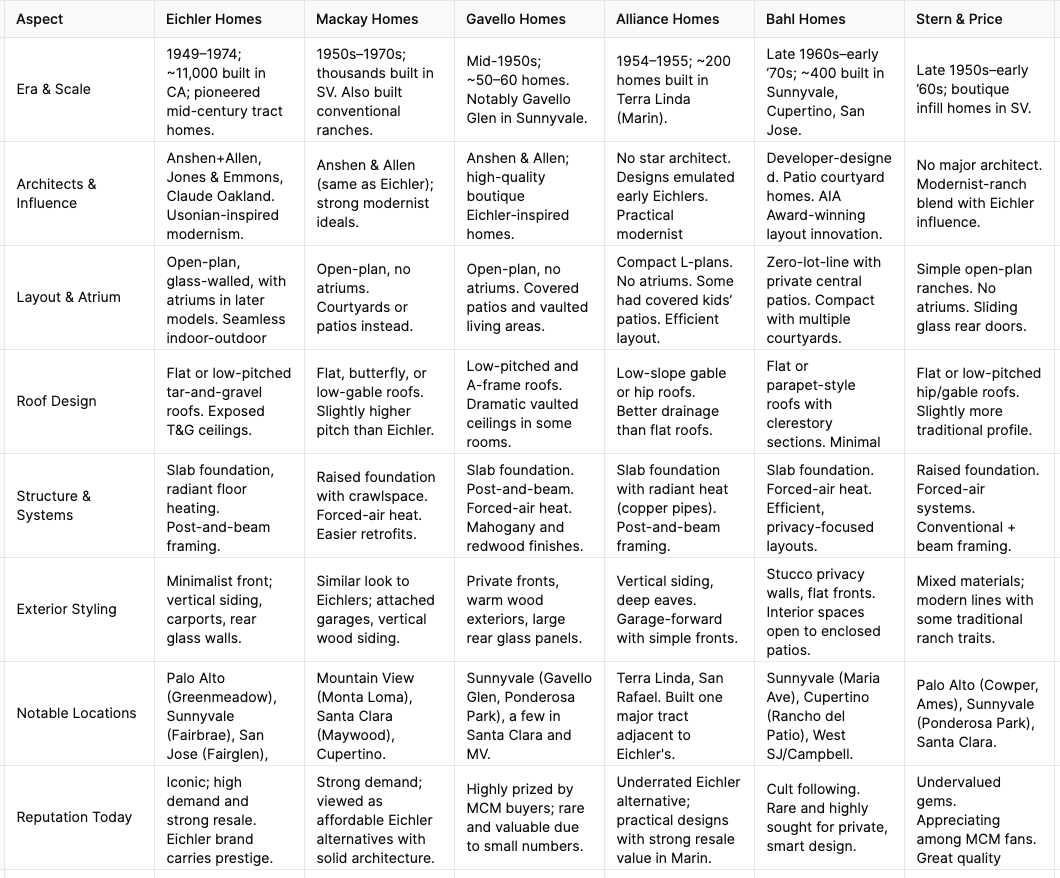
Key: MCM = Mid-Century Modern; SV = Silicon Valley.
Conclusion: Best Mid-Century Modern Homes to Buy Today
All of these Eichler-inspired homes offer attractive mid-century modern design, but some stand out in today’s market for architectural appeal, investment potential, and buyer demand:
Eichler Homes – The Benchmark: It goes without saying that authentic Eichlers remain highly sought-after and command top dollar. They have the strongest collector appeal and dedicated communities, which helps them hold and increase value. However, Eichlers come with quirks (flat roofs, older radiant systems) and a premium price for the name. Among the “Eichler cousins,” savvy buyers are finding comparable appeal.
Mackay Homes – Top Alternative: Mackay Homes are arguably the most worth buying among the Eichler emulators. They deliver nearly the same look and lifestyle as an Eichler – often literally sharing architects and floor plans – and have fully gained recognition and demand in recent yearsboyengateam.com. Mackays trade in the same price range as Eichlers and attract similar passionate buyers. From an investment standpoint, a Mackay in a good neighborhood should appreciate on par with Eichlers, especially as mid-century design remains in vogue. For buyers, Mackays offer a bonus: their conventional foundations and heating make renovations or upgrades a bit easier (no rusty in-slab pipes to worry about)eichlerhomesforsale.comboyengateam.com. In short, Mackays “nailed it” – they captured Eichler’s magic and are accordingly desirable today.
Bahl Patio Homes – Cult Classics with Upside: Bahl Homes may be few, but they pack a punch in terms of design uniqueness and appreciation potential. Their secret-courtyard architecture is highly distinctive, even compared to Eichlers, and mid-century aficionados pay a premium for this rarityeichlerhomesforsale.com. Bahl homes often fetch Eichler-level prices per square foot, and as awareness grows, they are likely to continue appreciating (their scarcity alone ensures demand will outstrip supply)eichlerhomesforsale.com. For buyers who value privacy and efficient design, a Bahl is a dream home. The only challenge is finding one – but if you do, it’s absolutely worth considering as both a livable work of art and a solid investment.
Gavello Homes – Hidden Value: Gavello Homes are a fantastic under-the-radar opportunity. With only a few dozen built, they’re rarer than Eichlers, yet they haven’t achieved the same fame. For buyers, this means you might get a larger house and lot with Eichler-esque style for slightly less cost than an equivalent Eichlereichlerhomesforsale.com. Recent sales in Sunnyvale’s Gavello Glen indicate strong overall prices (often $2M+ thanks to large lots), but the price per square foot is often a bit lower than Eichlers, suggesting upside potentialeichlerhomesforsale.com. Architecturally, they hit all the right notes and even exceed Eichlers in some practical aspects (bigger yards, fewer roof issues). If you can snag a Gavello, you’re getting a mid-century gem that will only become more coveted as more people “discover” them.
Alliance Homes – Eichlers in All But Name: If your home search extends to the North Bay (Marin), Alliance Homes in Terra Linda offer an Eichler experience often at a slight discount versus true Eichlerseichlerhomesforsale.com. They were well-built (copper radiant heat that still works!) and have nearly identical aesthetics to 1950s Eichlerseichlerhomesforsale.comeichlerhomesforsale.com. Their relative obscurity means they don’t carry the Eichler price premium, so for a buyer, that’s an opportunity. They have decent appreciation potential as part of the general rise in mid-century home values, though being in Marin they’re a bit outside Silicon Valley’s hot zone. Overall, if you love Eichler style and find an Alliance for sale, it’s a smart buy – you get the design without the top-tier price, and future buyers will likely value it similarly as Eichler cachet rubs off on these “Lik-Eichlers.”
Stern & Price Homes – Sleeper Picks: Stern & Price homes are the sleepers of the bunch – they don’t have the name recognition, but they often have great bones and features that today’s buyers want (open layouts, big windows, plus larger yards and better insulation). They tend to be situated in good neighborhoods (Sunnyvale, Santa Clara, etc.) albeit intermingled with conventional houses, so they don’t form an obvious “tract” to market. Because of this, they’re sometimes underpriced relative to their architectural merit. A savvy buyer who values mid-century design could buy a Stern & Price at a “regular house” price and end up with a high-quality MCM home. Over time, as mid-century demand persists, these one-off homes should appreciate nicely – possibly even more so if sellers and agents start highlighting the builder’s legacy. For now, they remain a bit of a bargain: you get Eichler-like style without Eichler-level competition. If you’re less concerned with owning a famous name and more with getting space and style, a Stern & Price could be a wise choice with plenty of long-term upside.
Bottom Line: Eichler’s mid-century modern vision extended well beyond his own tracts, and today many of these Eichler-inspired homes are star performers in the real estate market. Mackay Homes offer nearly one-to-one Eichler style and are already prized by buyers. Bahl Patio Homes provide a uniquely private spin on Eichler’s ideas and have a “cult” premium that’s likely to grow. Gavello Homes and Stern & Price houses are comparative sleepers – each with excellent design pedigree and room to appreciate as more people seek out mid-century modern living. And for those open to Marin, Alliance Homes are essentially vintage Eichlers by another name, often a value play. In terms of architectural appeal, all these homes embody the indoor-outdoor California modernism that buyers adore, with each builder adding their own twist – from Mackay’s friendly copies to Bahl’s patio-centric innovations. In today’s market, the most coveted would be the ones combining rarity and recognized design – a mint-condition Eichler, a Bahl Patio Home on the market after years, or a prime Mackay in an Eichler-heavy neighborhood. But one could argue the best buys are the underappreciated gems like Gavellos or Stern & Price customs, where you might still get a relative bargain and watch it appreciate as the mid-century craze continues. Regardless, any well-preserved mid-century modern home in Silicon Valley – Eichler or Eichler clone – is a sound investment in both lifestyle and value, as these architectural icons continue to fascinate new generations of homebuyers boyengateam.com eichlerhomesforsale.com.
Eric and Janelle Boyenga—founders of the Boyenga Team at Compass—are Silicon Valley’s leading experts on Eichler and mid-century modern homes. With decades of experience and a deep understanding of California Modern architecture, they guide clients through buying, selling, and restoring iconic properties with unmatched market knowledge and design fluency. Whether it’s a classic Eichler or a hidden Bahl gem, the Boyenga Team ensures every detail aligns with your vision—and with the value that today’s savvy MCM buyers expect.