
Eichler vs. Other Mid-Century Modern Homes in Silicon Valley
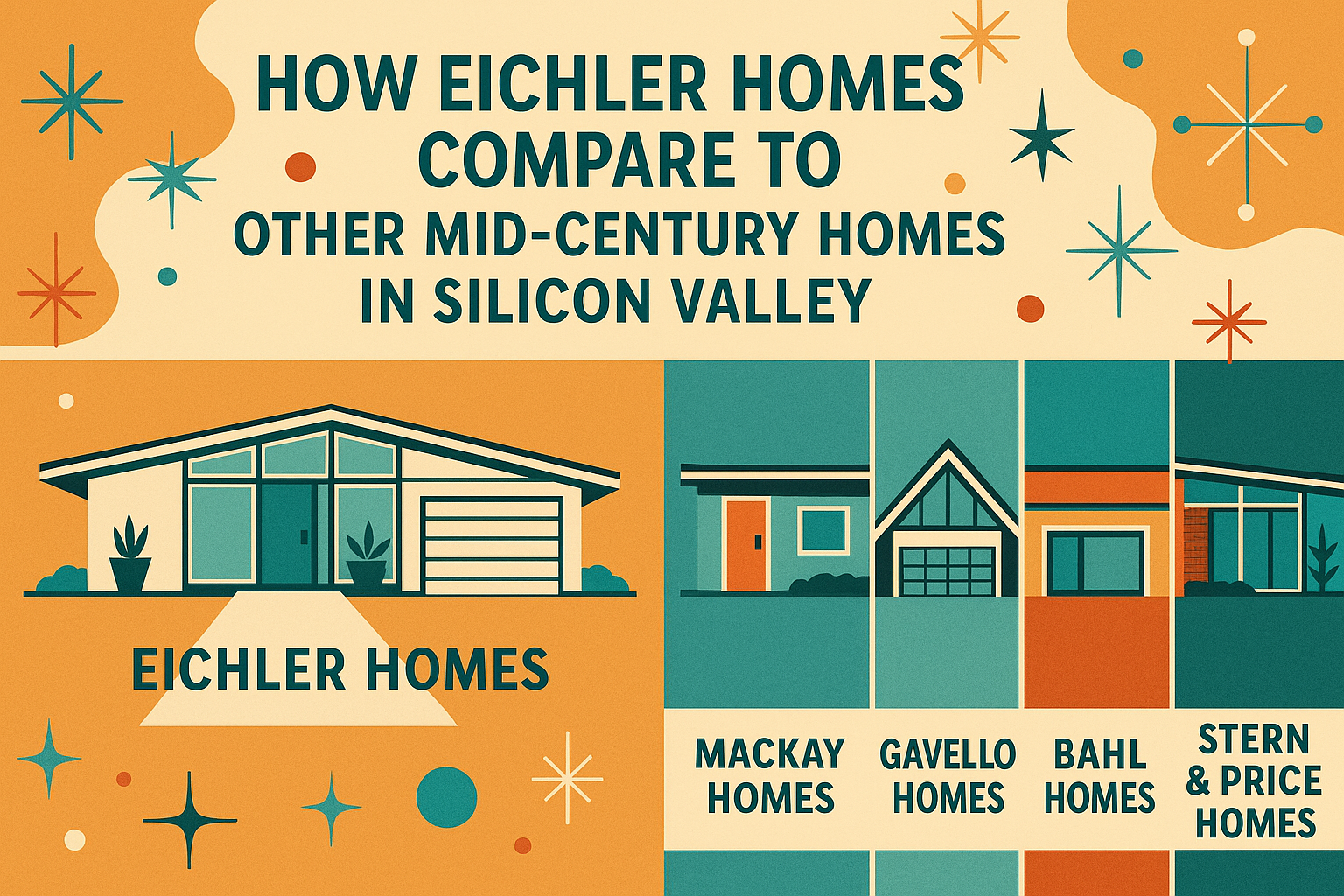
Silicon Valley’s mid-century modern housing is often synonymous with Joseph Eichler’s iconic homes, but Eichler was not the only developer of “California Modern” neighborhoods. In the 1950s–70s, several builders crafted Eichler-like homes in the Valley – notably John Mackay, Elmer Gavello, George Bahl, and the partnership of Stern & Price – each putting their own twist on the style. This comprehensive comparison will examine how Eichler homes differ from other mid-century modern (MCM) homes like Mackay, Gavello, Bahl, and Stern & Price houses, across key dimensions: architectural/design features, living experience (pros/cons), community and neighborhoods, pricing trends, current market values, maintenance needs, and lifestyle fit. We’ll also highlight the role of the Boyenga Team at Compass – local Eichler/MCM real estate experts – in preserving and marketing these unique homes.
A visual field guide highlighting differences in floorplans, roofs, and siding between Eichler and other mid-century builders (Mackay, Gavello, Alliance, Bahl). Each builder emulated Eichler’s style with slight variations in layout and construction.
Architectural and Design Features
Eichler Homes (Joseph Eichler): Eichler homes (built 1949–1974) established the quintessential “California Modern” look. They are single-story, post-and-beam structures with open, exposed beam ceilings and floor-to-ceiling glass walls that blur the line between indoors and outdoorseichlerhomesforsale.com. Many Eichlers feature an open-air atrium at the center – essentially an open-sky courtyard at the entry, surrounded by glass – which creates a dramatic indoor/outdoor focal pointeichlerhomesforsale.comeichlerhomesforsale.com. Homes sit on slab foundations with hot-water radiant heating pipes embedded in the concrete floors (an innovative idea, though the steel pipes proved maintenance-prone over decades)eichlerhomesforsale.com. Eichler rooflines are typically flat or very low-pitched with broad eaves and no attic; the roof support comes from the post-and-beam framework. Exterior design is minimalist: clean vertical wood siding (often grooved plywood or board-and-batten), and almost blank street facades – limited windows on the front for privacy, with the big glass panes facing the atrium and backyardeichlerhomesforsale.com. Early Eichlers even had open carports instead of garages, reinforcing the simple, horizontal look, though later models added garage doors as families’ preferences evolvedeichlerhomesforsale.com. In short, Eichler’s signature style is “bringing the outside in” with walls of glass and courtyards, all in a modest suburban package that was revolutionary for its time.
Mackay Homes (John Mackay): Mackay homes were Eichler’s friendly rival in the 1950s – so similar in appearance that they’re often mistaken for Eichlers at first glanceeichlerhomesforsale.comeichlerhomesforsale.com. In fact, John Mackay even hired Eichler’s architects (Anshen & Allen) to design many of his homes, and he marketed them as “modern patio homes.” Mackays feature open-beam construction, post-and-beam layouts, and large glass sliders like Eichler’s designseichlerhomesforsale.com. However, Mackay made a few conventional adjustments: most Mackay houses have raised perimeter foundations (crawl spaces) rather than slabs, and they used forced-air heating (furnaces with ducts) or wall furnaces instead of in-floor radiant heateichlerhomesforsale.comeichlerhomesforsale.com. This means a Mackay will usually have floor vents or a furnace closet (which Eichlers lack) and often an attic or crawlspace for utilities – making them easier to remodel since plumbing and wiring are accessibleeichlerhomesforsale.com. Architecturally, Mackay roofs tend to be low-gabled or modest-pitch (some even had distinctive peaked or butterfly roofs for flair) rather than completely flateichlerhomesforsale.com. Inside, the layout is still mid-century open, but Mackays sometimes include a defined entry foyer or hallway – a small nod to traditional layouts that Eichler homes usually omittedeichlerhomesforsale.com. From the street, Mackay exteriors use wood siding very much like Eichler, and feature similar wide eaves and floor-to-ceiling windows to the rear. One giveaway is the garage: many 1950s Eichlers have open carports or a carport/garage combo, whereas Mackay homes commonly have an attached one- or two-car garage fully enclosed, signaling a slightly more conventional approacheichlerhomesforsale.com. Also, while Eichlers often showcase natural wood T&G ceilings inside, Mackays often used Celotex or fiberboard ceiling panels between the beams (usually painted white)eichlerhomesforsale.com – an interior clue to distinguish them. In essence, Mackay homes copied the Eichler aesthetic nearly wholesale, but with fewer “experimental” features, aiming for broad appeal and easier maintenance.
Gavello Homes (Elmer Gavello): Gavello homes are mid-1950s MCM gems mostly found in Sunnyvale. Developed by Elmer (and Leon) Gavello, these houses also partnered with Anshen & Allen for design, so they strongly echo Eichler’s hallmarks: post-and-beam structure, open beam ceilings, and expansive glasseichlerhomesforsale.comeichlerhomesforsale.com. At first glance people often assume a Gavello home is an Eichlereichlerhomesforsale.com. There were only a few dozen built – notably in “Gavello Glen,” Sunnyvale – making them a rare treat todayeichlerhomesforsale.comeichlerhomesforsale.com. Distinguishing features: Gavello homes usually have low-pitched gable roofs with wide eaves, giving that classic mid-century profileeichlerhomesforsale.com. Some even have bold A-frame gable forms in front. Like Eichlers, they boast floor-to-ceiling windows and clerestory windows under the eaves, plus open interiors with vaulted ceilings and exposed beamseichlerhomesforsale.com. One key difference is lot size and layout: Gavello built on larger lots (often ~10,000 sq ft) – bigger than most Eichler tracts – so the homes are more spread outeichlerhomesforsale.com. The floor plans are often L-shaped or U-shaped, wrapping around a side or rear patio, rather than centered on an atriumeichlerhomesforsale.comeichlerhomesforsale.com. Many Gavello designs integrate a covered outdoor patio off the living area (under an extended roofline) as a private outdoor living space, instead of a central atriumeichlerhomesforsale.com. The result is a more expansive backyard and a more open street setback – Gavello neighborhoods feel a bit more traditional suburban (lawns, driveways) compared to the compact Eichler tractseichlerhomesforsale.com. Construction-wise, Gavello foundations vary; evidence suggests most used raised foundations with conventional heating (forced-air) – similar to Mackay’s approach – since by the mid-50s many builders avoided complex radiant heat systemseichlerhomesforsale.comeichlerhomesforsale.com. (Some Gavello owners mention original radiant heat, but if so it was likely experimental and not common.) Externally, Gavellos blended modern and ranch styling: they feature redwood or cedar vertical siding like Eichlers, but often with brick or stone accents on the façade – for example, a brick planter or partial brick wall near the entry, adding a touch of traditional warmth Eichlers usually don’t haveeichlerhomesforsale.com. They also almost always have a full two-car garage visible in front (versus Eichler’s frequent carports)eichlerhomesforsale.com. Additionally, while Eichler fronts can be plain, a Gavello might have a picture window or pop-out on the front façade (for a bedroom or kitchen) – again a slightly more open, decorative street presenceeichlerhomesforsale.com. Summed up, Gavello homes hit all the notes of mid-century modernism (post-and-beam, glass, indoor-outdoor flow) but on a bigger canvas – bigger lots, a bit more facade detail, and a less inward-facing design overalleichlerhomesforsale.comeichlerhomesforsale.com.
Bahl Homes (George Bahl): Bahl homes (built in the 1960s–early ’70s) represent a “quieter chapter” in Silicon Valley’s MCM storyeichlerhomesforsale.com. Developer George Bahl built only small clusters (often cul-de-sacs of ~10–20 houses) in Sunnyvale, Cupertino, and a few in West San Joseeichlerhomesforsale.comeichlerhomesforsale.com. They are often called “Bahl Patio Homes” for their signature design: each home centers around a private enclosed courtyardeichlerhomesforsale.com. In some ways, Bahl took Eichler’s indoor-outdoor atrium concept even further – maximizing privacy and efficient use of small lotseichlerhomesforsale.com. Every Bahl home is built around an interior walled patio – essentially an atrium, but usually not at the front entrance. Instead of walking through an open atrium to enter, you enter a Bahl house from the street into an interior hallway or living space, and from inside the home multiple rooms open onto the hidden central patio via sliding glass doorseichlerhomesforsale.comeichlerhomesforsale.com. This design creates a secluded oasis: the street side of the house is almost fortress-like (blank walls), while the inside is all glass facing the patio and backyardeichlerhomesforsale.com. Bahl homes deliberately orient inward to guard privacy – you often cannot see the front door or any large windows from the street, as the entry is tucked behind a tall privacy wall or in a covered breezewayeichlerhomesforsale.comeichlerhomesforsale.com. Architecturally, Bahl homes use classic post-and-beam construction just like Eichlers – exposed beams, tongue-and-groove wood plank ceilings, open spans with few interior wallseichlerhomesforsale.com. They embraced the mid-century “honest materials” aesthetic: natural wood, simple geometric lines, minimal ornamentationeichlerhomesforsale.comeichlerhomesforsale.com. Rooflines on Bahl homes are typically flat or very low-pitched, with large overhangs (broad eaves) shading the windowseichlerhomesforsale.com. From the street many Bahl roofs look flat (they may have a slight slope for drainage, often hidden by a parapet or fascia)eichlerhomesforsale.com. A row of Bahl houses on a court presents a striking scene of unbroken flat rooflines and uniform single-story profiles – immediately signaling mid-century modern, not rancheichlerhomesforsale.comeichlerhomesforsale.com. Because of the inward focus, Bahl facades are nearly blank: often just textured plywood or concrete block siding and maybe a clerestory strip, with the garage or a tall wall dominating the fronteichlerhomesforsale.comeichlerhomesforsale.com. Decorative elements are subtle – sometimes a breeze-block screen or slatted wood detail near the entry – but far less glass on the front than any Eichlereichlerhomesforsale.comeichlerhomesforsale.com. In terms of size, Bahl homes were generally modest (about 3BR/2BA, 1,300–1,600 sq ft), but owners report they feel larger because almost every room opens to the patio, creating a sense of expanded spaceeichlerhomesforsale.comeichlerhomesforsale.com. Floor plans waste little space (minimal hallways, a great-room style living/dining area) by clustering around the patio. Bahl also kept things practical: by the late ’60s radiant heating had fallen out of favor, so Bahl homes were built on crawl-space foundations with conventional forced-air heating – no radiant slabseichlerhomesforsale.com. This makes them structurally more conventional under the skin (easier to update wiring, ducts, etc.), even though their look – flat roof, atrium, post-and-beam – is pure Eichler-esque mid-centuryeichlerhomesforsale.comeichlerhomesforsale.com. In summary, Bahl Homes are like a * distillation of the Eichler concept*: very private, efficient, “less is more” designs that turn the home’s heart inward to a garden courtyardeichlerhomesforsale.comeichlerhomesforsale.com.
Stern & Price Homes: Stern & Price was a development duo active from the late 1950s into the 1970s, who built mid-century homes as “boutique” infill projects rather than mass tractseichlerhomesforsale.com. Their homes are a hybrid of true MCM and California ranch style, aiming for modernist design with mainstream family appealeichlerhomesforsale.comeichlerhomesforsale.com. Common traits include: low-slung rooflines (often low-gable or hipped) with wide eaves, expansive glass (big sliding doors and clerestories), natural wood siding (often redwood, sometimes left unpainted originally), and L- or U-shaped layouts that often incorporate a central courtyard or private rear patioeichlerhomesforsale.comeichlerhomesforsale.com. Unlike Eichler’s “cookie-cutter” tract models, each Stern & Price home was somewhat customized to its lot; there’s more variation in facade design and materials from one S&P home to the nexteichlerhomesforsale.com. For example, many feature aggregate stone or brick accents (such as a stone chimney or brick planter) mixed with wood siding – touches of texture that pure Eichlers usually don’t haveeichlerhomesforsale.comeichlerhomesforsale.com. Inside, S&P floor plans keep the open-plan ethos (seamless flow between kitchen, dining, living areas) and indoor-outdoor integration (virtually all have large glass sliders to the yard and ample windows)eichlerhomesforsale.com. However, they often included a bit more traditional functionality: you might find a formal entry foyer, a separate family room, or slightly larger bedrooms and more closet space than comparable Eichlerseichlerhomesforsale.com. They sometimes used partial room dividers or planters to define spaces rather than Eichler’s completely open great roomseichlerhomesforsale.com – catering to buyers who wanted a modern feel with a touch of familiarity. Construction-wise, Stern & Price homes are post-and-beam like the others, but S&P didn’t shy away from mixing techniques. Many have portions of conventional framing hidden above the ceiling (allowing for insulation or a small attic) which Eichlers lackeichlerhomesforsale.com. They generally avoided flat roofs – an S&P roof is usually a low-pitched hip or gable with a thicker roof profile (often to accommodate insulation)eichlerhomesforsale.comeichlerhomesforsale.com. They also built in more durability: deeper roof overhangs for shade, sturdier roof support, and better insulation meant that “their rooflines remain straight and framing remains solid” even decades latereichlerhomesforsale.com. From the street, an S&P home still looks decidedly mid-century (broad eaves, clean lines, large panes of glass), but you might notice more ornamentation or variation than an Eichler tract house – perhaps an ornamental front door, a mix of horizontal and vertical siding, or a decorative breeze-block element, depending on the houseeichlerhomesforsale.comeichlerhomesforsale.com. Also, attached front-facing garages are typical on Stern & Price homes (since they built for conventional suburban buyers), whereas Eichler fronts often hide the garage or use carportseichlerhomesforsale.com. Overall, Stern & Price homes blend MCM principles with postwar practicalityeichlerhomesforsale.com – they are less extreme than Eichlers (no risky radiant heat or flat roofs) but still capture the mid-century spirit through open layouts, indoor-outdoor flow, and minimalist forms. This made them appealing to buyers who liked modern design but maybe wanted a “cozier” or more flexible home than Eichler’s sometimes uncompromising designseichlerhomesforsale.com.
Pros and Cons of Living in Each Home Type
Each of these home types offers a unique living experience. Here’s a rundown of pros and cons for Eichler, Mackay, Gavello, Bahl, and Stern & Price homes:
Eichler Homes – Pros: Renowned for their timeless modern aesthetics – living in an Eichler means enjoying light-filled spaces, walls of glass opening to patios, and that iconic atrium (in many models) bringing nature into your home. The open floor plans and post-and-beam construction create an airy, free-flowing interior that feels larger than the square footage. Eichler communities also tend to have a strong sense of community and architectural identity – owners often band together to celebrate and preserve the Eichler style, hosting home tours and neighborhood events. Another pro is historical cachet: Eichlers are “design purist” homes beloved by architects and enthusiasts, so owning one carries a bit of prestige for those in the know. Cons: Eichlers do come with quirks. The maintenance can be challenging – for example, the original radiant heating systems (embedded steel pipes in the slab) have often failed after 50-60 years, leading to leaks and costly repairseichlerhomesforsale.com. Many Eichler owners end up installing new heating/cooling systems if the radiant can’t be restored. Insulation is another issue: Eichlers were built in an era of cheap energy, with little wall insulation and huge single-pane glass expanses – meaning they can be cold in winter and hot in summer unless upgraded. The trademark flat or low-pitch roofs can be prone to leaks if not diligently maintained (many owners convert to foam roofs to solve this). Also, Eichler’s minimalist street facade (limited front windows, etc.) means some models have relatively dark entries or less street “curb appeal,” which not everyone loves (the drama is inside, not from the curb). And while the open atrium is beautiful, it does mean an extra roof to maintain and leaves less interior secure space. In short, Eichlers require care and upkeep – they are not “lock it and leave it” homes – but for many the design payoff is worth it.
Mackay Homes – Pros: Mackay homes offer Eichler style with a bit more practicality. They have the same mid-century modern feel – open beams, glass, and integration with the outdoors – but their raised foundations and attics make it easier to update plumbing, electrical, or add insulation and air conditioning compared to Eichlerseichlerhomesforsale.com. No slab means no radiant pipe worries; you typically have a furnace and ducts which are easier to service or replace. The layouts, while still open, include small conventional touches (like a foyer or hallway) that make furnishing and day-to-day living slightly more straightforward than walking straight into a great room. Many families appreciate that Mackays have enclosed garages and a bit more storage (a concession to practicality Eichler eventually made in later models)eichlerhomesforsale.com. In essence, Mackays can be seen as “Eichlers for the average homebuyer” – modern but not too radical, which was exactly John Mackay’s intent. Cons: On the downside, Mackay homes lack the name recognition of Eichler, so die-hard mid-mod purists might not value them quite as highly (though that gap is closing as people realize Anshen & Allen designed them too). Some original interior finishes in Mackays were a notch more modest – e.g. many had fiberboard (Celotex) ceiling tiles instead of Eichler’s wood plankseichlerhomesforsale.com – which can look a bit drab; however, owners often remedy that by painting or restoring exposed wood. The slightly more traditional layout (with defined entries, etc.) means Mackays don’t always feel as utterly open as an Eichler – for instance, a Mackay kitchen might be more separated. Whether that’s a con is personal preference. Finally, like any 60+ year-old home, Mackays may still need significant upgrades (electrical capacity, old galvanized plumbing, etc.), so buyers should expect some renovation costs – but that’s true for all these mid-century homes, not just Mackay.
Gavello Homes – Pros: Gavello homes are mid-century “unicorns” – rare and full of character. A huge pro is their large lot size and more expansive feeling neighborhood. Owners get bigger yards and often more square footage than a typical Eichler, so there’s space to garden, add an ADU, or simply enjoy a roomy backyard for family gatherings. The architecture hits all the high notes – open beam vaulted ceilings, big glass walls, and cool A-frame or broad gable rooflines that scream 1950s California moderneichlerhomesforsale.comeichlerhomesforsale.com. Many Gavello models feature covered patio areas off the living room, which function like outdoor extensions of the home – great for entertaining. Unlike Eichlers, which can be very inward-focused, Gavello homes have a bit more street-facing openness (e.g. a picture window or two in front, and a more noticeable entry)eichlerhomesforsale.com. This can translate to better curb appeal and more natural light in front rooms. Another pro: since Gavellos are often slightly less famous than Eichlers, they have sometimes sold for a “value” price per square foot relative to Eichlers in the same cityeichlerhomesforsale.com – although that gap is narrowing as mid-century fans discover Gavellos’ pedigree. Cons: The biggest con is scarcity – with only ~50–60 built, it’s hard to even find a Gavello home to buyeichlerhomesforsale.comeichlerhomesforsale.com. They tend to get snapped up fast (and often by well-informed buyers willing to pay a premium). The small original tract means there isn’t a large, unified Gavello community; their neighborhoods are mixed with other builder homes. On the house itself, one could cite that Gavellos lack the central atrium of Eichlers – their outdoor living is more patio-based, which some atrium-lovers may miss. And as 1950s homes, they too likely need upgrades – original single-pane glass, 60-year-old wiring, etc. – similar upkeep issues to Eichlers and Mackays. Some Gavellos had forced-air heat (no radiant), which is a pro for maintenance but also means they have wall registers and maybe less even heating compared to Eichler’s silent floors (when that worked). Overall, though, cons are minor – these homes are well-built and lovingly designed; the main “con” is finding one.
Bahl Homes – Pros: Bahl patio homes offer something truly special: privacy and tranquility in the middle of suburbia. For people who love the idea of an enclosed garden retreat, a Bahl is perfect – you can lounge in your central patio in total seclusion (often surrounded by your own walls and glass sliders), almost like having an extra outdoor living room that’s shielded from neighbors’ eyeseichlerhomesforsale.comeichlerhomesforsale.com. This design is great for indoor-outdoor living with maximum privacy (even more private than an Eichler atrium, which is usually partially visible from the front door). The layouts are extremely efficient – Bahl homes were modest in size but feel very functional, with almost no wasted space and a single-story layout that is easy to navigateeichlerhomesforsale.com. They are ideal for small families, couples, or downsizers who want a stylish home without excess square footage. Maintenance-wise, Bahl homes avoided some Eichler issues: no aging radiant heat pipes (they used conventional heating) and no expansive flat roof sections over open atriums to worry abouteichlerhomesforsale.com. The raised foundation and attic space mean it’s simpler to upgrade infrastructure (adding AC, running new cables, etc.)eichlerhomesforsale.com. Despite being little-known for years, Bahl homes now have a “cult favorite” status, so they hold value well and often sell for prices comparable (per square foot) to Eichlerseichlerhomesforsale.com. Cons: The flip side of privacy is that from the street Bahl homes can appear a bit forbidding or plain – some describe the front facade as “fortress-like”eichlerhomesforsale.com. If you love waving to neighbors from a big picture window, a Bahl won’t give you that – the front is usually a blank wall or garage door. Also, Bahl enclaves are tiny; you won’t find an expansive community of 100 Bahl homeowners – it might just be 10 houses on a court. So the sense of neighborhood identity is more limited (though mid-century aficionados definitely know about them). Space can be a con for larger families: ~1,500 sq ft and 3 bedrooms was typicaleichlerhomesforsale.com. Lot sizes, while sufficient, are not huge (these were often on small tracts carved out of other subdivisions), so you may not have as much yard beyond the patio. Finally, because they’re so rare, it can be hard to find contractors or even comps that understand Bahl quirks – though working with experts (like architects or Realtors who know MCM) mitigates this. In sum, Bahl homes are intimate, low-maintenance mid-century havens, but they aren’t the best choice if you crave a big public-facing house or a large community around you.
Stern & Price Homes – Pros: Stern & Price homes strike an appealing balance between mid-century flair and conventional comfort. For buyers who want “Eichler-like” design without some of Eichler’s drawbacks, these homes deliver. They feature the desirable MCM elements – open layouts, big glass windows, cool vintage style – but with better original infrastructure: e.g. insulation in walls/roofs, and standard heating systems (no tricky radiant heat to repair)eichlerhomesforsale.comeichlerhomesforsale.com. This makes them generally more comfortable year-round and easier to adapt to modern needs (many have no issue adding air conditioning, for instance, since ducts or crawlspaces exist)eichlerhomesforsale.com. S&P homes also tend to have larger lots and a bit more interior space on average than tract Eichlers – they were often built as higher-end infill, so the yards are roomy and the houses might include extra features like a family room or fourth bedroom that Eichler’s standard models didn’t always haveeichlerhomesforsale.comeichlerhomesforsale.com. Quality of construction is a noted plus: these homes were built with care and often custom touches, and many have aged well structurally (it’s said that their rooflines and framing have held up very straight over the decades)eichlerhomesforsale.com. From a lifestyle perspective, owners get a unique home that still “fits” in a normal neighborhood – the best of both worlds. Cons: For a long time, Stern & Price homes flew under the radar – lacking the Eichler name meant they didn’t have a ready fan-base or dedicated preservation like Eichler tracts did. As a result, some S&P homes were remodeled insensitively (by owners who didn’t realize what they had), or they might not have the same protected status in neighborhoods. In terms of architecture, while beautiful, they are less instantly recognizable; if part of your joy is owning a famous Eichler, S&P is more of a connoisseur’s find. Design-wise, S&P homes incorporate a few more traditional elements – e.g. front-facing garages are common (so your curb view is a garage door, which in Eichler communities is often deemphasized)eichlerhomesforsale.comeichlerhomesforsale.com. Some models have higher-pitched roofs or mix materials (stone, brick) that purists might consider compromises (though others see it as character). And because each S&P home is somewhat unique, you don’t get that uniform mid-century tract feel; depending on your taste, that could be a con or a pro. Finally, like all these homes, S&P houses are many decades old – so expect to address old electrical panels, possibly single-pane windows, etc. The difference is many S&P owners already updated those things given the homes were comfortable to live in long-term; you might inherit a home that’s been continuously lived-in (good) but also might have assorted changes over time (some not period-correct). In summary, Stern & Price homes offer a “lifestyle compromise” that actually suits a lot of people: you enjoy mid-century living without some of the mid-century headaches – but you won’t have the instant name recognition or consistent aesthetics of an Eichler tract.
Neighborhood and Community Characteristics
One cannot overlook the importance of neighborhood context for these homes. Many mid-century modern owners feel a strong sense of community and take pride in their tract’s history. Here’s where you’ll typically find Eichler, Mackay, Gavello, Bahl, and Stern & Price homes in Silicon Valley, and what those communities are like:
A pair of mid-century modern homes in Sunnyvale’s Gavello Glen tract, originally built by Elmer Gavello. These homes show the blend of California ranch and Eichler-like modernism – note the low gable roof, broad eaves, and mix of clerestory and picture windows facing the street.
Eichler Neighborhoods: Eichler built numerous large tracts across Silicon Valley, many of which are now highly desirable neighborhoods. In Palo Alto, Eichler subdivisions like Green Gables, Greenmeadow, Fairmeadow, and Palo Verde date from the 1950s and ’60s – these areas are known for their concentrations of Eichler homes (often 100+ in a cluster). Palo Alto Eichler neighborhoods often have active homeowners’ associations – for example, Greenmeadow has a community center and pool and holds annual events, fostering a tight-knit community of Eichler enthusiasts. Sunnyvale is sometimes called “the home of the Eichlers” as well, with large Eichler tracts in areas like Fairbrae (around Sherwood Drive) and Birdland (near Ortega Park) among others. Eichler’s presence in Sunnyvale was significant; between 1959 and 1962 Eichler built hundreds of homes thereeichlerhomesforsale.com, making it one of the largest Eichler concentrations. Mountain View also has Eichlers, notably in the Monta Loma area (the “Fairview” tract, 1954) and Grant Park area. San Jose contains Eichler pockets in neighborhoods such as Willow Glen (e.g. Fairglen tract) and Cambrian Park – these were built in the late ’50s and early ’60seichlerhomesforsale.com. Eichler neighborhoods have a reputation for community spirit and preservation: in some cities (Palo Alto, Sunnyvale, San Jose) Eichler owners have even pursued single-story overlay zones or historic designations to protect their tract’s character and prevent McMansion teardownsboyengateam.com. It’s common to see neighbors coordinating on period-appropriate renovations, sharing contractor tips, or hosting mid-century home tours. Living in an Eichler tract often means joining a community of like-minded architecture lovers – a major part of the appeal.
Mackay Neighborhoods: Mackay homes are found in a few key areas, often side-by-side with Eichlers. In Mountain View, the Monta Loma neighborhood is a famous case: Eichler built one section (“Fairview”) and John Mackay built the adjacent tract (“Monta Loma”) in 1955–56eichlerhomesforsale.com. To this day, Monta Loma is a mix of Eichler and Mackay homes that flow together, and the community embraces the mid-century heritage of both. Monta Loma has a neighborhood association that includes all residents, and they proudly note the modernist character of the area. A fun historical note: the house where Steve Jobs grew up in Mountain View was actually a Mackay home in Monta Loma – it’s often mistaken for an Eichler because the style is so similareichlerhomesforsale.com. In Palo Alto, Mackay built a tract in the mid-1950s near the intersection of Louis Road and Loma Verde Avenue (around the Charleston Meadows area) – roughly 200 Mackay modern homes are there, blending in with nearby Eichler tractseichlerhomesforsale.com. Cupertino has a smaller number of Mackay homes (Mackay wasn’t as active there, but a few exist off Miller Ave and Bollinger Rd, intermixed with ranchers). In Santa Clara, Mackay built in the Fairmede area – an area where “Fairmede” Eichler tracts also exist, leading to some interminglingeichlerhomesforsale.com. (For example, streets like Donegal Drive in Santa Clara have Eichlers on one end and Mackay homes on the other.) Because Mackay developments were often adjacent to Eichler’s, Mackay owners generally participate in the same community activities – you’ll see Mackay residents at Eichler homeowner picnics, etc. The community vibe is very much shared. These neighborhoods are typically suburban and family-friendly, near parks and schools (e.g. Monta Loma School, Cupertino’s top schools, etc.), which only enhances their desirability. In short, Mackay neighborhoods benefit from the “Eichler effect” – they are part of Silicon Valley’s mid-century enclaves and enjoy the same pride and camaraderie.
Gavello Neighborhoods: The heart of Gavello’s legacy is Gavello Glen in Sunnyvale, a small tract developed in 1956 near today’s Ponderosa Park. Key streets include Gavello Avenue (named after the developer), Quail Drive, Ponderosa Drive, Daffodil Court, and Snapdragon Courteichlerhomesforsale.comeichlerhomesforsale.com. Because it was a limited development (around 60 homes), the Gavello houses in this area are interspersed with other homes – interestingly, Stern & Price built some houses in the same vicinity, and there are also more standard ranch homes. So the Ponderosa Park neighborhood of Sunnyvale is a real mix: Eichler did not build there, but Gavello and Stern & Price did, creating a unique pocket of mid-century modernism within a typical suburbeichlerhomesforsale.com. Residents in Gavello Glen informally recognize their tract’s identity – the name “Gavello Glen” itself is a give-away on deeds and permitseichlerhomesforsale.com. Sunnyvale’s Ponderosa Park nearby provides a community focal point (great for families). There isn’t a formal “Gavello HOA,” but neighbors often know that their home is something special and thus share an affinity. Beyond Sunnyvale, Gavello built a few homes in Santa Clara and Mountain View in the early ’60s, but not enough to form distinct tractseichlerhomesforsale.com. Those tend to be “one-off” mid-century houses in otherwise traditional neighborhoods – hidden gems you might drive by without realizing their pedigree. For example, in Mountain View there are a handful of Gavello-built homes just outside Monta Loma. Those owners might connect more with general MCM enthusiast groups since they’re not in a concentrated tract. Overall, the Gavello community is small but proud: owning one feels like being part of a small club of mid-century enthusiasts. And thanks to resources like Eichler Network and the Boyenga Team’s blog, many Gavello owners now know the history of their homes and connect that back to the larger mid-century modern community in the Valley.
Bahl Neighborhoods: Bahl homes were built in tiny clusters, so their “neighborhoods” are really just short cul-de-sacs often tucked within larger subdivisions. In Sunnyvale, for instance, there are a couple of cul-de-sacs off Mary Avenue (like Terry Way and Sheldon Court near Fremont High School) that contain a handful of Bahl Patio Homeseichlerhomesforsale.com. Blink and you might miss that those courts even exist, but mid-century buffs know them by sight (the flat rooflines give them away). In Cupertino’s Monta Vista area, there’s a cul-de-sac known as Rancho del Patio (near Rancho Rinconada) that Bahl built – again only about a dozen homeseichlerhomesforsale.com. In West San Jose, near the Cupertino border by Lawrence Expressway, there’s another Bahl enclave on a street called Gleneeden Way (and Bahl Avenue) – around 16 homes thereeichlerhomesforsale.com. Because each cluster is so small, the immediate sense of community is intimate: neighbors on the court likely know each other well, since they share the distinction of owning these rare homes. There might not be formal associations due to the small size, but owners sometimes informally coordinate on maintaining the look (e.g. preserving the low fences or original exterior colors). Importantly, Bahl owners also connect with the wider mid-century community in Silicon Valley. These homes are “cult favorites” among architecture fanseichlerhomesforsale.com, so when one comes on the market, often the news spreads among Eichler/Bahl aficionados. Open houses for Bahl homes tend to draw crowds of curious MCM lovers. In terms of broader neighborhood amenities, the Bahl courts fortunately are in established areas – they often enjoy excellent public schools (Cupertino district, etc.) and nearby parks. For example, Rancho del Patio is near Portal Park and has Cupertino’s top schools, which adds to the appeal (and value) of that enclaveboyengateam.com. So while a Bahl enclave itself is a tiny island of modernism, it benefits from being in prime Silicon Valley neighborhoods. Safety and preservation: Because Bahl tracts are not widely known, they haven’t been targets of major redevelopment – but the owners themselves are pretty vigilant about keeping the mid-century spirit. There is anecdotal evidence of Bahl owners collectively resisting incongruous remodels; they understand that the value of their home is tied to its unique style. In summary, Bahl “neighborhoods” are small, but they carry a big sense of pride – owning one is like stewarding a little piece of Silicon Valley’s design history, and neighbors share that responsibility.
Stern & Price Neighborhoods: Stern & Price homes are sprinkled through parts of Sunnyvale, Santa Clara, West San Jose, and Campbell. Rather than entire subdivisions, you’ll find them as groups of a few houses or standalone custom homes. For example, in Sunnyvale, the Ponderosa Park area (overlapping with Gavello Glen) has a number of Stern & Price houses on streets like Quail Ave, Daffodil Way, Heatherstone, and Peacock Aveeichlerhomesforsale.comeichlerhomesforsale.com. These often sit right next to Gavello homes or other 1950s ranchers – creating an eclectic mid-century micro-neighborhood. In Santa Clara, look around the Homestead Road corridor near Lawrence Expressway – streets such as Woodhams Road and Mauricia Avenue have several larger Stern & Price custom builds from the late ’60seichlerhomesforsale.com. These tend to be on generous lots and were built to attract move-up buyers in that era (today, tech professionals love the area for its proximity to Apple and Nvidia campuses)eichlerhomesforsale.comeichlerhomesforsale.com. In West San Jose, just east of Calabazas Creek (near Calabazas Park), there’s a lesser-known enclave of Stern & Price homes on streets like Phoenix Drive and Comanche Driveeichlerhomesforsale.com. Some original owners in that tract have stayed for decades, maintaining a very authentic look and forming a quiet community. Campbell’s Hacienda Gardens district (around Hacienda Ave and Westmont High) saw a few infill Stern & Price projects as welleichlerhomesforsale.com. Those Campbell S&P homes often have larger setbacks and lots, blending mid-century style with a bit of upscale suburbiaeichlerhomesforsale.com. In general, because Stern & Price homes are not concentrated in one tract, the community aspect comes from the broader neighborhood rather than a builder-specific identity. Homeowners might not even know they have a “Stern & Price” unless a realtor or historian pointed it out, since public records might just list a generic builder or architect. However, in recent years, mid-century home experts (like the Boyenga Team) have worked to identify and celebrate these homes, so awareness is growing. Neighbors in places like Ponderosa Park are starting to recognize, “Oh, those few houses with the wide eaves and courtyards were Stern & Price.” In terms of lifestyle, these are all pleasant suburban neighborhoods with parks, good schools, and convenient commutes (part of why Stern & Price built there). For instance, Ponderosa Park area feeds into good Sunnyvale schools (Fremont Union High district)eichlerhomesforsale.comeichlerhomesforsale.com, and the Santa Clara homes are near Sutter Elementary and Homeridge Park. The communities are generally family-friendly, quiet, and have a mix of owners – some original, some younger tech families. Many S&P homeowners have been in the neighborhood a long time, giving a stable, neighborly feel. And because these houses don’t “announce” themselves as Eichlers do, the neighborhoods have a lower profile – they’re sleepy, in a good way. There might not be an official association for Stern & Price owners, but they tap into larger networks like the Eichler Network or local MCM groups when it comes to resources and preservation. As appreciation for mid-century architecture grows, expect these once-under-the-radar S&P pockets to bond more and perhaps pursue measures to keep their aesthetic intact.
Historical Pricing Trends (Original Prices & Appreciation)
One of the most striking things about these mid-century modern homes is how they went from being affordable postwar housing to multi-million-dollar assets over the decades. Let’s look at historical pricing and appreciation for Eichlers and their mid-century counterparts:
Original Prices (1950s–60s): When first built, these homes were aimed at middle-class buyers and priced accordingly. In 1950, the very first Eichler homes (3-bed/1-bath in Palo Alto) sold for around $10,000 eachmedleyhome.com. Even by the mid/late-1950s, Eichler homes in Palo Alto or San Mateo County were often in the $15k–$25k range – still accessible to young families. Joseph Eichler intentionally priced homes for the average American (with a modest profit margin), fulfilling his mission of bringing modern architecture to the masses. A 1960 Eichler in Palo Alto, for instance, might have cost about $30k depending on size/location. Other builders were similar: Mackay Homes in the late ’50s were marketed as affordable modern tract homes (likely in the ~$20k range for a 3-bedroom in Mountain View at the time). Gavello Homes being somewhat “custom tract” were a bit pricier by the late ’50s – perhaps in the $20k–$30k range. By the 1960s, larger models and inflation pushed prices higher; a concrete example: a 4-bedroom Gavello home in Sunnyvale sold for roughly $50,000 in the 1960sboyengateam.com (that was relatively expensive at the time, reflecting its larger size and quarter-acre lot). Bahl Homes in the late ’60s might have been in the $30k–$40k range new (they were more niche, but also smaller in size – and by then Silicon Valley land was getting pricier). Stern & Price homes often were built as custom or semi-custom, so their original prices varied, but as an example, a high-end S&P in 1965 could have been around $40k. To put these in context: median home prices in Santa Clara Valley in 1960 were only around $15k–$20k, so all these mid-century moderns were in reach of an average engineer, teacher, or manager – they were not luxury homes originally, but stylish tract homes.
Appreciation over Decades: Over the last 50+ years, Silicon Valley real estate has exploded, and these homes appreciated dramatically – far outpacing inflation. But it wasn’t a steady upward march; there were periods when mid-century modern homes were undervalued. In the 1970s and 1980s, for example, many people considered Eichlers “dated” or impractical (flat roofs, odd design), and some sold cheaply relative to conventional homes. However, starting in the late 1990s and especially the 2000s, there was a revival of interest in mid-century design. Young tech wealth and design-conscious buyers “rediscovered” Eichlers and their ilk, and values surged. By the mid-2010s, Eichler homes were routinely selling for $1 million+, which was astonishing compared to their original ~$10k price – a testament to both Bay Area housing demand and the iconic status Eichlers acquiredarchitectmagazine.com. Other MCM homes followed suit. In the 2000–2020 period, many Stern & Price, Mackay, and other MCM homes literally doubled or tripled in value as the market caught on to their appealeichlerhomesforsale.com. In fact, data shows many Stern & Price homes doubled in value just since 2010eichlerhomesforsale.com, reflecting a huge spike after the Great Recession due to tech boom and renewed MCM appreciation. To illustrate long-term appreciation: that Sunnyvale Gavello home that might have sold for ~$50k in the ’60s could sell for $2–$3 million todayboyengateam.com – that’s a 50- to 60-fold nominal increase. Even accounting for inflation, it’s a massive real gain. Eichlers that sold for $20k in 1960 in Palo Alto are now often $3M+, easily a 100+ fold increase nominally. Part of this is simply Silicon Valley’s economic growth (jobs, wealth, limited housing supply). But part is also the “Eichler effect” – these homes now command a design premium on top of location value. For instance, in a given Sunnyvale neighborhood, an Eichler or Bahl home might sell for more than a same-size 1970s ranch because buyers covet the mid-century style. There’s evidence that mid-century modern homes now command price premiums and attract bidding warsboyengateam.comboyengateam.com, especially if they are well-preserved or tastefully updated. Another angle: these homes have proven to hold value well. Real estate experts note that Eichler and Bahl homes have a limited supply and a steady pool of passionate buyers, which insulates their market valueboyengateam.com. During market dips, unique homes often retain value better because of their one-of-a-kind appeal. Owning one of these is almost like owning a piece of art – and indeed savvy investors have started to view them as such.
The Pricing Paradox: It’s interesting that what began as mid-market housing now far exceeds the cost of many larger, newer homes. As one architect noted, “original Eichlers cost between $8,000 and $12,000… Now prices routinely top $1.5 million.”architectmagazine.com (And in 2025, $1.5M is actually on the low side for an Eichler in Palo Alto or Sunnyvale!). This reversal in fortune underscores how cultural value can appreciate even faster than economic value. Eichler’s vision of “modern homes for the everyman” ironically resulted in prized collectibles that not everyman can afford in 2025. Nevertheless, relative to overall Silicon Valley housing, Eichlers and their contemporaries remain competitive – you’re buying not just a house, but a living experience. For many, that is worth every penny, and the market trends suggest continued strong appreciation as new generations fall in love with mid-century modern livingboyengateam.comboyengateam.com.
Current Market Values (2024–2025)
As of 2024–2025, Silicon Valley’s real estate market is very strong, and mid-century modern homes are commanding top-tier prices. Here’s a breakdown of current value ranges for each home type, keeping in mind values vary by condition and exact location:
Eichler Homes: Eichlers often command a premium due to their iconic status and demand. In prime locations like Palo Alto, Eichler homes sell for multiple millionsboyengateam.com. For example, a well-preserved 4-bed Eichler in Palo Alto can easily be in the $3–$4 million range (or more if significantly remodeled or larger than typical). Even smaller Eichlers (3BR/2BA) in Palo Alto tend to be $2.5M and up, largely because Palo Alto land values are extremely high. On the Peninsula (Menlo Park, San Mateo Highlands, etc.), Eichlers also often range from $1.8M to $3M+. In the South Bay, Eichler prices are slightly more moderate but still high: in Sunnyvale, the median list price for Eichlers is around $2.7M in recent timesboyengateam.com, with many sales in the $2.3–$3M range depending on size (Sunnyvale Eichlers are typically 1,500–2,100 sq ft). Mountain View Eichlers (like those in Monta Loma or Willow Park) often fall in the $1.8M–$2.4M range, reflecting Mountain View’s strong housing market (proximity to Google, etc.). San Jose Eichler neighborhoods (Willow Glen’s Fairglen, for example) have historically been more affordable – a nicely kept Eichler there might be $1.3M–$1.7M as of 2024 (partly because the lots and houses are a bit smaller and SJ’s pricing is lower than Santa Clara or San Mateo counties). That said, a record-setting Eichler in Willow Glen recently topped $2M – so there’s a wide range. Summary: Eichlers in Silicon Valley generally range from the high $1 millions to around $3 million+, depending on location (with Palo Alto at the high end). The Eichler brand and design are so sought-after that buyers often pay above neighboring market values; multiple offers and bidding wars are common for move-in-ready Eichlers.
Mackay Homes: Mackay homes are highly valued as well, although slightly less “famous” than Eichlers. In Mountain View’s Monta Loma (where Mackay homes sit alongside Eichlers), Mackay homes are very sought-after by tech buyers – a decent Mackay there might sell in the mid to high $2 millions. Price per square foot for Mackays in Monta Loma can be a bit lower than for Eichlers in Palo Alto, but that’s because Palo Alto commands a premium location, not because Mackays are less desirable in designboyengateam.com. To give specifics: a ~1,200 sq ft Mackay in Monta Loma might be $1.8M, whereas a 1,500 sq ft one could be $2.3M+. Monta Loma has become a trendy neighborhood, so the gap between Eichler and Mackay there isn’t huge – many buyers just want a cool mid-century home. In Santa Clara, where Mackay also built, home prices are slightly lower than Mountain View: a Mackay in Santa Clara (say 1,400 sq ft near Maywood Park) might fetch $1.6M–$2.0M, depending on updates. In Cupertino or Palo Alto, only a few Mackays exist, but those that do can reach Eichler-level prices due to the school districts. For instance, a Mackay in Palo Alto’s Charleston Meadows could approach $3M if it’s large and updated. Generally, Mackay homes sell for somewhat less than Eichlers or Bahl homes in the same area, simply because they don’t carry the Eichler name and sometimes have slightly smaller floor plansboyengateam.com. But they have absolutely benefited from the mid-century pricing boom. They are no longer “budget alternatives” – expect to pay well into seven figures. Summary: Mackay homes in 2024 are typically $1.5M–$2.5M in most Silicon Valley neighborhoods, and higher (near $3M) in premium locales like Palo Alto.
Gavello Homes: Given their rarity, Gavello homes often achieve top-of-market prices in Sunnyvale. A Gavello Glen home in Sunnyvale (typically ~1,800–2,000 sq ft on a ~10,000 sq ft lot) in the mid-2020s sells for roughly $2.0–$2.5 millionboyengateam.com. In fact, some Gavello sales have surpassed comparable Eichlers because of the lot size and turn-key condition. Recent listings in Sunnyvale’s Gavello/Ponderosa area have ranged from about $2M on the low end (for a smaller or fixer-upper Gavello) up to $2.8M for a larger, beautifully updated oneboyengateam.com. That upper end – $2.8M – is quite telling, as it’s on par with or even higher than many Sunnyvale Eichlers. The market has realized that a Gavello is “the real deal” mid-century modern (architect-designed by Anshen & Allen, etc.), so buyers are willing to pay Eichler-level prices for themboyengateam.com. Outside Sunnyvale, if a Gavello in Santa Clara or Mountain View comes up, the price will reflect those cities’ values – likely slightly less than Sunnyvale. (E.g., a Gavello in Mountain View might go for ~$2M if in a less central part of town, simply due to location). However, because so few exist, each sale can set a new benchmark. Moreover, Gavello’s larger lots could interest buyers who might even expand the home – adding potential value. Summary: In 2024, Sunnyvale Gavello homes typically sell in the low-to-mid $2 millions, with exceptional ones pushing toward $3Mboyengateam.com. Their per-square-foot prices are comparable to Eichlers in the same area, and their total prices often slightly higher because of bigger lot and house size.
Bahl Homes: Once somewhat underappreciated, Bahl Patio Homes have seen surging demand and prices. In Sunnyvale, where several Bahl courts exist, a 3-bedroom, ~1,540 sq ft Bahl home was recently listed around $2.1 millionboyengateam.com. That is roughly in line with Eichler prices in Sunnyvale (Eichlers there often list $2M–$2.7M depending on size)boyengateam.com. Considering Bahl homes are usually smaller than Eichlers, their per-square-foot price can be quite high – they essentially keep pace with Eichlers on a size-adjusted basisboyengateam.com. It’s not unusual for a nicely updated 1,500 sq ft Bahl to get multiple offers and bid up into the mid-$2 millions, given how infrequently they come to marketboyengateam.com. In Cupertino, Bahl homes might fetch even more – partly due to excellent schools. There have been instances where a Bahl in Cupertino (if one sells) can approach $2.5M or more, despite the small size, simply because it’s a mid-century home in a coveted location. Over the last few years, realtors note that Bahl homes often sell as high as Eichlers on a per sq ft basis and sometimes even set record prices for their neighborhoodseichlerhomesforsale.comboyengateam.com. For example, if the surrounding 60s ranch houses sell at $1.5M, a rare Bahl might go for $1.8M because mid-century enthusiasts will outbid general buyers. This trend reflects their “hidden gem” status becoming more known. Summary: Bahl homes in 2024 are generally trading in the $2M range, often $2.0–$2.4M in Sunnyvale/Cupertino for a typical 3/2, with exact pricing depending on lot size and renovations. They have effectively caught up to Eichlers in market value, despite being lesser-known – a testament to their cult appeal and scarcityboyengateam.comboyengateam.com.
Stern & Price Homes: Stern & Price homes have appreciated steadily and significantly, though their values vary widely because of their scattered locations. Many S&P homes are in slightly less expensive cities (Santa Clara, Campbell, etc.), so their absolute prices can be a bit lower than Eichlers in Palo Alto – but within their locales, they are top-tier. For instance, in Campbell’s Hacienda Gardens area, a larger 4-bed, 2000 sq ft Stern & Price home on a big lot might sell for $2.3–$2.6 million in 2025. In Sunnyvale’s Ponderosa Park, a 3-bed S&P home might be around $1.8M–$2.2M, which is similar to the value for Gavello or other homes there. Santa Clara S&P customs (e.g. 2,000 sq ft near Homestead) could be in the $1.8M–$2.0M+ range, buoyed by their proximity to tech jobs. In West San Jose (Moreland district), S&P homes might run around $1.7M–$2.1M, again depending on size and condition. It’s worth noting that as the market recognizes these houses, their appreciation has been very strong – many have doubled in value since 2010eichlerhomesforsale.com, which outpaces some cookie-cutter homes. Because Stern & Price homes have larger lots on average, there’s added value there (e.g., room for an ADU or expansion, which many buyers consider). Also, an attractively updated mid-century home can draw bidding from both MCM enthusiasts and regular buyers, broadening demand. Summary: Stern & Price homes in 2024 generally sell in the high $1 millions to mid $2 millions, situational on location: lower end for smaller ones in Santa Clara, higher for larger ones in Campbell or Sunnyvale. Their value trajectory is upward, with growing recognition that they offer a great blend of style and practicality for the price. In many cases, they’re relative bargains compared to Eichlers – which is why some luxury buyers priced out of Palo Alto or Los Altos look to S&P homes as a smart alternativeeichlerhomesforsale.com.
Overall, mid-century modern homes have become hot commodities in Silicon Valley’s current market. All these types – Eichler, Mackay, Gavello, Bahl, Stern & Price – benefit from the tech-driven demand and limited housing supply. Importantly, they also benefit from a “design premium”: modernist homes have an emotional appeal that often drives competitive bidding. Realtors from the Boyenga Team note that in the mid-2020s, MCM homes, when updated and marketed well, often fetch multiple offers and top-of-area pricesboyengateam.com. They’re not just houses; they’re seen as collectible pieces of architecture, and buyers are willing to pay accordingly.
Maintenance Considerations and Typical Upgrades
All homes from the mid-20th century will require maintenance and thoughtful upgrades, and these mid-century modern classics are no exception. However, each style has its own maintenance challenges and renovation patterns to be aware of:
Eichler Homes – Maintenance: Eichlers are famous for certain maintenance issues. The radiant floor heating is a big one – Eichlers’ original steel radiant pipes are now 60–70 years old and many have corroded or cloggedeichlerhomesforsale.com. Owners often face the choice of abandoning the system (and installing a new HVAC or mini-split heat pump) or retrofitting new PEX radiant tubing if they want to preserve the silent floor heat. Some Eichler purists do restore radiant heat, but many Eichlers today have a furnace in a closet or added ductwork in a soffit as a workaround. Roofs are another concern: Eichlers typically had tar-and-gravel built-up roofs which over time can leak. The lack of attic means any roof leak can drip right into living spaces. The good news is modern solutions exist – a popular upgrade is a foam roof (sprayed polyurethane) which provides both waterproofing and insulation. It slightly alters the roof profile (a bit more thickness) but keeps the flat look and has no seams, ideal for Eichler roof spans. Eichler owners also often add insulation wherever possible: exterior walls were originally uninsulated, so during remodels, people add batts or rigid insulation (though they must be careful to maintain the post-and-beam aesthetics and not cover up those exposed beams). Many Eichlers have clerestory windows and floor-to-ceiling single pane glass, which are beautiful but not energy-efficient; a common upgrade is installing double-glazed window units that fit into the original framesboyengateam.com. Specialized window manufacturers create dual-pane glass that maintains the thin profile and aluminum look Eichlers had. Other typical Eichler maintenance issues: the siding (often redwood) can suffer dry rot or termites, so sections may need replacement and matching. The tongue-and-groove wood ceiling planks can get dirty or stained over time – some owners sand and refinish them to bring back the warm wood tone. Seismic upgrades are also wise (older Eichlers may benefit from shear wall retrofits in walls and carport areas to meet modern codesarchitectmagazine.comarchitectmagazine.com). Finally, Eichlers often had old electrical panels and limited amperage – many owners upgrade from the original 100-amp fuse box to a 200-amp breaker panel to handle modern appliance loads, electric car chargers, etc. In summary, owning an Eichler usually means investing in roof integrity, climate control improvements, and preserving the wood elements – all doable with experienced contractors, but important to budget for.
Mackay & Gavello Homes – Maintenance: Mackay and Gavello homes, by virtue of their more conventional construction (crawl spaces, attics, forced-air heat), tend to be easier to maintain and upgrade in certain respects. For instance, having a raised foundation means if you need to re-pipe plumbing or run new electrical, you can go under the house – you don’t have to jackhammer a slab as in an Eichler. Similarly, adding insulation is simpler since many Mackays and Gavellos have attics or at least accessible roof joist cavities to put insulation ineichlerhomesforsale.comeichlerhomesforsale.com. That said, roof maintenance remains critical. Mackay homes often have slightly pitched roofs (e.g. modest gables), which generally have fewer leak issues than flat roofs – but by now many will have needed new shingles or tar-and-gravel replacement. Gavello homes with low-pitch gables need careful watch for any gutter backups or leaks at the clerestories. Both Mackay and Gavello houses often used exposed beams and T&G wood ceilings like Eichlers (at least in main living areas), so those need care similar to Eichlers – you wouldn’t want to drywall over them and lose the mid-century look. One known issue: interior ceiling tiles in Mackays (the Celotex panels) – over decades, some sag or get damaged. Owners sometimes choose to remove those and either paint the exposed sheathing or install new panels; a few have even added wood planks to mimic Eichler ceilings (improving aesthetics). Heating/Cooling: originally most Mackays and Gavellos had wall furnaces or forced-air furnaces. If those are original, they’re long past prime – many owners have replaced them with modern furnaces or converted to heat pumps. Since ductwork exists (or can be added in the crawl space), adding A/C is usually straightforward – a plus in today’s warmer climate. It’s not uncommon to see a Mackay with central air, something you rarely see in an untouched Eichler. Windows: like Eichlers, these homes had single-pane aluminum windows originally. Upgrading to dual-pane is common, and because their designs are less extensive glass than Eichlers (Mackays often have more solid wall in front), it’s slightly less costly to replace windows. Exterior siding maintenance (paint, repair) is needed for the redwood or plywood siding – same issues of rot/termites can apply. One thing that helps: Mackays and Gavellos often have slightly more roof overhang protecting the siding, and also many had some brick or stone which is maintenance-free. So, arguably a bit lower maintenance exteriors than a full-wood Eichler facade. Foundation: With age, any house can settle – Mackay crawlspaces should be checked for any needed re-leveling or foundation bolting (Eichlers too should have foundation bolts checked/upgraded). In short, Mackay and Gavello homes tend to require less specialized care – any good contractor can update a furnace or rewire them – but owners should still be mindful to use materials in keeping with the style (e.g., flat roof repairs on Gavello should preserve the look, window replacements should maintain large glass areas). Fortunately, many owners do respect that and keep the mid-century vibe even as they renovate.
Bahl Homes – Maintenance: Bahl homes, being later (1960s) and built with pragmatism in mind, have some advantages. They have no radiant heat to worry about and typically conventional roofs (flat but often with slightly pitched internal drainage). However, their unique design warrants attention in a few areas. Roof and Courtyard Drainage: Bahl roofs are mostly flat – owners must ensure the drainage is functioning (clear downspouts, etc.) to avoid ponding. The central courtyards often have drains too that need to stay clear (since the patio might be surrounded by house on all sides, you don’t want it to flood during heavy rain). Most Bahl owners long ago upgraded the roofing – many choose modern membrane or foam roofs which work well. The sealed atrium walls mean you want those to remain waterproof – any skylights or openable portions must be maintained so the interior patio doesn’t leak into the surrounding rooms. Siding and Structure: as noted, Bahl fronts often feature concrete block or stucco alongside wood sidingeichlerhomesforsale.com. The block/stucco is pretty low maintenance (just paint), but where there is wood, you’ll check for rot as usual. The blank facade means large sections of wall with no windows – this actually helps with efficiency (fewer window leaks or heat loss in front). Beams and ceilings: Bahl homes have exposed beams and wood ceilings similar to Eichlers – these should be periodically checked for any roof leaks or termite damage (termites love older wood; preventative treatment is wise). Mechanical systems: originally Bahl homes had forced-air heating; many now have updated furnaces or added air conditioning, which is relatively easy given they have crawl spaces and atticseichlerhomesforsale.com. As with Mackays, electrical service might need updating (1960s wiring can handle more load than 1950s, but today’s needs are even greater). Owners often also improve lighting – some Bahl homes were built with minimal ceiling lighting (common in mid-century design), so people add recessed lights or track lighting carefully, trying to conceal wiring along beams or in accessible areas. Windows and Doors: Bahl homes have lots of sliders opening to the patio. These sliding glass doors from the 60s are typically single-pane and aluminum. Upgrading them to double-pane while keeping the clean aluminum look is a common project. It makes a big difference in comfort. Front doors on Bahl homes are usually tucked away, but they can be a cool design element – owners often restore original Mid-Century front doors or at least paint them in period-appropriate colors since they’re one of the only street-facing design features. Security and fencing: The “fortress” front means Bahl homes often have gates or courtyard entry doors – maintaining those (both for appearance and function) is important. Fortunately, because the Bahl layout is inward, you can have a very secure home with little glass exposure to the street, which some owners count as a pro. Overall, Bahl maintenance is about preserving that indoor-outdoor relationship – keeping the patio area well-maintained (since it’s the focal point), ensuring all those sliding doors glide properly, and addressing any aging of materials from the 60s. One plus: Bahl’s conventional construction means if you want to, say, remodel the kitchen or knock out a wall, it’s often easier than in an Eichler (where every wall can be structural). Bahl homes have few interior walls anyway, but when modifying, contractors find the crawlspace and attics helpful. In summary, Bahl homes require attentive roof and patio upkeep, but no more so than Eichlers, and many issues are easier to remedy thanks to the thoughtful construction.
Stern & Price Homes – Maintenance: Stern & Price homes generally were built with durability in mind, so many have held up nicely. Still, they are older homes, and maintenance aligns with both mid-century elements and some conventional ones. Roof and Insulation: As noted, S&P often used thicker roofs with insulationeichlerhomesforsale.comeichlerhomesforsale.com. Owners should check that insulation – sometimes it was rockwool or old fiberglass that may have settled; topping it up can improve energy performance. The roofs are typically low-pitch gable or hip with wide eaves. Maintenance involves inspecting the eaves and soffits (which might be tongue-and-groove or slat) for any wood decay, and making sure the shingles or roofing material is in good shape (many probably re-roofed in the last 10-20 years). Because they avoided flat roofs, S&P homes might have fewer leak issues, but if there are any skylights or complex roof junctions (some custom designs have multiple roof planes), those need sealing. Heating/Cooling: S&P houses had forced-air heating and often better insulation, so a lot still have their ductwork in place and simply have upgraded the furnace or added AC over timeeichlerhomesforsale.comeichlerhomesforsale.com. It’s common to see an S&P home with central air conditioning – something relatively rare in Eichlers unless added later. The presence of attics or crawlspaces makes maintenance of plumbing and electrical easier, akin to Mackay/Bahl. Glass and Glazing: Many Stern & Price designs include large glass sliders and big fixed windows, similar to Eichler, plus clerestory windows. Replacing these with modern dual-pane units while keeping the appearance is a recommended upgrade, and many owners have done so. Because Stern & Price homes often had unique window configurations, owners might need custom window solutions (which can be pricy, but worth it). However, an interesting note: some S&P homes already used better glass or thicker panes than Eichler did, since they were later – for example, a late-60s Stern & Price might have had double-glazing in some form or at least higher quality aluminum frames. Regardless, in 2025 most will have been upgraded to dual-pane for energy code if any remodel happened. Exterior materials: S&P facades can include aggregate stone or brick. These are durable, but one should inspect any mortar or stonework for cracks. Redwood siding, if unpainted originally, might be weathered; many owners choose to stain or paint it now to protect it. Aesthetic tip: owners often preserve or replace decorative elements like breeze blocks, original front doors, etc., as those are selling points – maintenance of those might mean repainting the breeze block or refinishing the wood door to keep the mid-century charm. Interior layout flexibility: Many Stern & Price homes were built to allow easy reconfiguration (they often have some beams hidden above ceilings, meaning not every wall is load-bearing)eichlerhomesforsale.com. This means maintenance or remodel can involve taking down a non-structural wall to open a kitchen, for example, without extreme expense – a plus for adapting to modern living. Electrical and plumbing: These houses are newer than Eichlers, so originally they may have had copper plumbing (where Eichlers had galvanized in the ’50s) and a bit better electrical. Still, any original 1960s water pipes could be failing by now, so many have been re-piped in copper or PEX. The electrical panels might have been, say, 125 amps originally – often upgraded now to 200 amps. Essentially, S&P homes are like any quality 1960s home with the same update needs, just wearing a modernist façade. Unique Challenges: Because S&P homes aren’t tract homes, when something needs repair, you might not have a large community knowledge base to draw from (unlike Eichler, where specialized contractors exist). But increasingly, mid-century contractors (roofers, window suppliers, etc.) are familiar with S&P too, especially if working with an agent like Boyenga Team who points out the builder. From an investment perspective, experts note that homes with “sensitive renovations” – meaning they preserved the post-and-beam elements while modernizing kitchens/baths – tend to fetch a premium on resaleeichlerhomesforsale.com. So there’s an incentive for owners to maintain the original design integrity. Many S&P owners keep features like open hearth fireplaces, floating room dividers, etc., and just restore them. The Boyenga Team often guides owners on things like window replacement sensitivity (avoiding disrupting the visual rhythm of the clerestories) and how to enhance floorplan flexibility without losing charactereichlerhomesforsale.comeichlerhomesforsale.com. In sum, caring for a Stern & Price home is about doing standard home maintenance but with an eye toward preserving its hybrid modern character – something a growing number of owners are passionate about.
Summary of Typical Upgrades: Across all these home types, certain upgrades are very common today: installing new roofing (foam or IB membrane on flat sections, or new composite shingles on pitched sections) while keeping the low-profile look; upgrading to double-pane windows and sliders (often custom-made to fit original openings and match the mid-century style)boyengateam.com; modernizing kitchens and bathrooms (many original cabinets were plain mahogany and appliances are long obsolete – owners redo these spaces in a contemporary style that often nods to mid-century, like walnut veneer cabinets or period-inspired tile)boyengateam.com; and adding conveniences like HVAC, insulation, and smart home features (without detracting from design). The goal is usually to increase comfort and efficiency while honoring the home’s design integrity. For example, if adding solar panels, owners will place them flat on the roof so they aren’t visible from the street, or if adding an addition, they’ll often do it in the rear and maintain the original roofline in front.
One advantage today is that an ecosystem of specialists exists – contractors who focus on mid-century modern restoration. The Boyenga Team at Compass often connects their clients with such specialists and advises on upgrades that enhance value rather than diminish itboyengateam.comboyengateam.com. They know, for instance, that preserving features like open beam ceilings, Philippine mahogany paneling, or original globe light fixtures can actually boost appeal to the right buyer, whereas something like replacing an old tar-and-gravel roof with a new foam roof will boost value and not detract if done well. Their guidance helps owners strike that balance between solving the practical issues of an older home and celebrating the mid-century design. As a result, many updated Eichler, Mackay, Gavello, Bahl, and S&P homes today are better than new – with 21st-century performance under the skin and 20th-century style in the visible details.
Lifestyle Fit: Who Each Home Type Appeals To
Each of these mid-century home types has a somewhat different “lifestyle fit,” attracting different kinds of buyers (though of course with overlap, as all appeal to design lovers). Let’s profile who tends to be drawn to each:
Eichler Homes – Design Purists and Community Enthusiasts: Eichlers have a near-legendary status among mid-century modern fans. Thus, they often attract “mid-mod purists” – people who specifically want an Eichler for its authentic design pedigreeboyengateam.com. These buyers might be architecture buffs, designers, or anyone who cherishes the idea of living in an iconic space with an atrium and post-and-beam ethos. Many tech professionals fall into this category too; in Silicon Valley, there’s a trend of tech execs and engineers (from Apple, Google, Nvidia, etc.) seeking out Eichler homeseichlerhomesforsale.com. They appreciate the innovative spirit of Eichler designs and often love the integration of tech-friendly features (open layouts are great for modern smart home tech). Eichler neighborhoods also appeal to young families who enjoy the community aspect – kids can play in cul-de-sacs without busy traffic, neighbors often know each other, and there’s a creative, unpretentious vibe (many Eichler owners are into art, gardening, etc.). On the other hand, some empty nesters/downsizers also seek Eichlers – especially one-story models – because they want a manageable house but with great style. Eichlers tend not to appeal to those who insist on traditional luxury (e.g. someone wanting a formal mansion or a showy two-story might overlook Eichlers due to their modest street presence). They also might not appeal to folks who prioritize turnkey convenience over style – an Eichler almost always comes with projects. But by and large, the Eichler lifestyle – indoor-outdoor living, community swimming pools (in some tracts), block parties, architectural tours – appeals to people who value experience and aesthetics as much as square footage. Investors occasionally buy Eichlers to flip, but they have learned that mid-century buyers are discerning – flips that ruin Eichler character often backfire. Savvy investors instead do “Eichler-sensitive” improvements and profit from selling to eager enthusiasts. Eichlers also see interest from design-minded downsizers (coming from larger, conventional homes, they choose an Eichler for its soul even if it’s smaller).
Mackay Homes – Blended Tastes and Practical Families: A Mackay home buyer is often someone who wants mid-century style but maybe isn’t 100% purist. They value a mix of modern and traditional elementsboyengateam.com. For instance, a young family might love the idea of an open floor plan and big glass doors to the yard (so they can watch the kids play outside), but they also feel more comfortable with a house that has a conventional heating system and a bit more separation of space – a Mackay provides that compromise. Families with children are common Mackay owners; the houses are well-situated in suburbs with good schools (like Mountain View, Sunnyvale, Santa Clara), and their slightly more traditional layout can make childproofing or furnishing a tad easier (some Eichler owners struggle with where to put a TV on all those glass walls – Mackays often have a bit more wall space). Mackays also attract buyers who originally looked at Eichlers but were either priced out or put off by certain quirks. These buyers realize they can get essentially Eichler-like architecture (often designed by the same architects) at a better price or with fewer headaches, so they’re happy to buy a Mackay. Design enthusiasts do appreciate Mackays too – especially knowing Anshen & Allen’s involvement, some see them as “the underappreciated Eichlers” and love restoring them. Investors and flippers occasionally target Mackay homes as well, since they can market them as “Eichler style” and attract interest; however, as with Eichlers, the best outcomes are when they honor the style in renovations. Lifestyle-wise, Mackay owners enjoy many of the same things Eichler owners do: indoor-outdoor living (patios, BBQs in backyards visible through glass walls), community pride (e.g., Monta Loma has neighborhood parties and a newsletter), and a casual, modern vibe. They might be a bit more mainstream in taste – for example, some Mackay owners will happily remodel the interior in contemporary style (white cabinets, recessed lights) without as much worry about mid-century authenticity as an Eichler owner might have. So Mackay appeals to practical modernists – people who say “I love the look, but I also want a home that functions easily,” which Mackays generally provide.
Gavello Homes – Boutique Enthusiasts and Value Hunters: Gavello homes appeal to a small but passionate set of buyers. Because so few come up for sale, typically the buyer is someone who really did their homework or got tipped off by an agent. Often, they are mid-century enthusiasts who might have initially been looking at Eichlers but fell in love with the “Gavello story” – the idea of a one-tract developer partnering with Eichler’s architects to create a unique enclave. Such buyers love the fact that a Gavello is authentic and rare, almost like owning a limited-edition designboyengateam.com. Families also appreciate Gavello homes for their larger yards – if you want mid-century style but also a big grassy yard for kids or gardening, a Gavello is ideal. The suburban setting (Sunnyvale Ponderosa) with tree-lined streets and a park nearby is very attractive to those who want a balance of style and traditional neighborhood feel. Additionally, some buyers see Gavello homes as a smart value: you get the Eichler-like design without the Eichler premium (though as noted, that gap is closing as prices rise). For instance, an engineer couple might say, “We can get a 2,000 sq ft mid-century house on a quarter acre in Sunnyvale for the same price as a 1,600 sq ft Eichler on a 6,000 sq ft lot – let’s do that.” They might slightly sacrifice the cachet of the Eichler name, but they gain space. Design purists are usually happy with Gavellos, because they were architect-designed and have very legit MCM features (open beams, etc.). Some Gavello buyers might be those who love ranch-style practicality with modern style: indeed Gavellos have been described as a cross between Eichler and ranch, so they can attract folks who find Eichlers a bit too out-there and ranches a bit too boring – Gavello is the sweet spot. Downsizers might be less common (these homes are on the larger side and have big yards to upkeep, which downsizers may not want). Investors rarely get a crack at Gavellos because they are scooped by owner-occupants quickly. Lifestyle in a Gavello is similar to Eichler: lots of entertaining on the patio, enjoying the indoor-outdoor flow, perhaps a bit more gardening given the bigger yards. Owners often feel a bit special, owning something most people don’t even know exists; as one might say, discovering a Gavello home is like finding a rare vintage car – it’s stylish and tells a storyboyengateam.com. That appeals to a certain kind of buyer who likes the idea of having something unique.
Bahl Homes – Privacy Seekers and Mid-Century Aficionados: Bahl Patio Homes draw a specific subset of buyers – often people who value privacy, cozy scale, and architectural uniqueness. A typical Bahl buyer could be a couple (young professionals or retirees) that doesn’t need a huge house but wants an inspiring space. They love the idea of a secluded central courtyard where they can dine, garden, or even do yoga in complete privacy, with the house as a wrap-around sanctuary. This appeals a lot to those who might find Eichler atriums too exposed or simply want a more intimate setting. Design aficionados who know about Bahl are extremely enthusiastic – since Bahl homes are so rare, snagging one is like a trophy for a mid-century lover. They’re willing to wait months or years for one to hit the marketboyengateam.com. In practice, many Bahl owners are indeed empty nesters or small families. The 3-bedroom layout works for a couple who needs offices or a guest room, or a family with one or two kids max. Larger families tend not to target Bahl because of the limited interior space and zero second-story option (also you can’t easily expand a Bahl without sacrificing yard or messing up the design). Another group is professional singles or couples (DINKs – dual income, no kids) who want a stylish home to entertain in – Bahl homes are great for entertaining a small group of friends with that indoor-outdoor flow, and being single-story, everything feels accessible and connected. They are also relatively low-maintenance in terms of yard (the courtyard is usually hardscaped or minimally planted, and the backyards are modest), which can attract those who don’t want huge landscaping chores. Investors/flippers very rarely deal in Bahl homes – partly because so few exist, and partly because the buyer pool is niche (flipping a Bahl might be risky if you don’t get the right buyers’ attention). That being said, the Boyenga Team has noted they achieved record prices for Bahl sellers by marketing these homes as the rare collectibles they areboyengateam.comboyengateam.com. Lifestyle for Bahl owners: Many describe it as “my little oasis.” You might have less interaction with neighbors given the closed front (it’s ironically easy to be very private in a Bahl community – you could drive into your carport/garage and enter your house without being seen). But Bahl owners who are mid-mod fans do connect with each other through enthusiast circles. When one Bahl owner hosts a tour or gathering, others often show up. The lifestyle is also somewhat minimalist – you learn to live efficiently in a Bahl, using the indoor-outdoor space to expand living areas. It likely appeals to those who embrace the “less is more” philosophy of mid-century designeichlerhomesforsale.com. Also, given their locations (often near good transit or tech areas), Bahl homes can appeal to tech folks who want a cool home but don’t need a mansion – for example, a Google employee might prefer a 1,400 sq ft architecturally interesting home over a 3,000 sq ft banal one. They get the design satisfaction and since they work long hours, they’re fine with a smaller, efficient home. All told, Bahl homes appeal to those who seek refuge in design – people who want their home to be a calm, private retreat that is also an expression of mid-century creativity.
Stern & Price Homes – Balanced Lifestyle and “Hidden Gem” Seekers: Buyers of Stern & Price homes often appreciate balance. These homes tend to attract people who want architectural character but also need a house that works for a typical family lifestyle. For instance, a family with kids might choose a Stern & Price home in Campbell because it offers a big yard for the kids, a spacious floor plan, and is near good schools – plus it has a cooler design than the average ranch. So one key group is families (including move-up buyers) who might have outgrown a smaller Eichler or condo and want a larger home but don’t want to give up on having something stylish. Stern & Price’s blend of mid-century and ranch means it can satisfy both the husband who wants his classic MCM and the wife (or vice versa) who wants a practical kitchen and plenty of storage (or vice versa!)eichlerhomesforsale.com. Another group is professionals relocating or looking in areas like West San Jose or Santa Clara – these folks might be priced out of Palo Alto or Los Altos, so they come a bit south and are pleasantly surprised to find these “Eichler alternative” homes that offer a unique vibe for less moneyeichlerhomesforsale.com. In that sense, Stern & Price homes appeal to some value-conscious luxury buyers – people with $2M budgets who realize they can get a custom mid-century home with a big lot in Campbell, as opposed to a fixer cottage in Palo Alto. They appreciate the relative value and the fact that S&P homes are understated – you get a nice neighborhood without the flaunt of, say, Atherton. Tech professionals are definitely in the mix too: a number of S&P neighborhoods (e.g., Santa Clara Homestead area) are near Apple’s campus – many Apple employees love mid-century design (Apple Park itself has a very mid-century-inspired ring design). So an Apple engineer might deliberately seek out an S&P home because it’s close to work and has that retro-modern charm. Mid-century enthusiasts also hunt for S&P homes, though since these houses are less documented, it’s often with the guidance of knowledgeable realtors that they find them. These buyers enjoy having a mid-century home that not everyone recognizes – a bit of a “hidden gem” factor – and they often continue to research their home’s background (perhaps even finding original plans or the architect’s name). As a result, we’re seeing Stern & Price owners increasingly become part of the larger mid-century community, sharing tips on preserving these homes. Lifestyle in S&P homes: It’s akin to Eichler/ranch living – lots of indoor-outdoor enjoyment, possibly a pool in the backyard (some S&P homes were built with pools, especially the larger lots in Campbell). The neighborhoods are established and quiet, so residents enjoy block barbecues and the benefits of a settled community. Many S&P owners have long tenure – these aren’t typically flip houses; people buy them to live in and raise families. For those who love to tinker or customize, S&P homes are great because they provide a solid canvas with room to expand or adapt (floorplans were often flexible or had “expansion potential” built in). So an owner might spend years slowly updating: converting a carport to living space (some S&Ps had carports too), or adding an ADU for in-laws – things that Eichler owners also do, but perhaps with fewer constraints here. Importantly, Stern & Price homes attract people who want a unique home that still blends in with a conventional neighborhood. They don’t necessarily want the attention that comes with owning a famous Eichler on a busy street; they want a beautiful, comfortable home with character that might only reveal itself fully once you walk inside. That’s a somewhat understated lifestyle – and it resonates with professionals and families who are drawn to quality and authenticity over showiness.
Finally, a common thread for all these home types is that they increasingly attract buyers who are conscientious stewards of mid-century architecture. As these homes trade hands, we see more new owners who want to preserve and celebrate the design (rather than bulldoze or radically alter it). This is where the Boyenga Team at Compass often comes in. They have branded themselves as Eichler and mid-century specialists, and indeed they often help match these unique properties with the right buyers. They emphasize “design integrity” – helping buyers understand what they’re getting (and how to care for it), and helping sellers market their home’s architectural story to maximize valueboyengateam.comboyengateam.com. The Boyenga Team has been described as “ambassadors for the mid-century modern lifestyle,” not just realtorsboyengateam.comboyengateam.com. For example, they provide guidance on sympathetic renovations (what original elements to keep, like an atrium or a breezeblock screen, and what modern updates will enhance value)boyengateam.comboyengateam.com. They maintain a network of mid-century contractors and even assist with Compass’s Concierge program to fund strategic improvements like period-correct staging or landscape tweaksboyengateam.comboyengateam.com. All this ensures that when a new family or couple steps into an Eichler, Mackay, Gavello, Bahl, or Stern & Price home, they can enjoy the true mid-century experience with modern comfort. With such expert support and a passionate homeowner community, the lifestyle associated with these homes – one of architectural enjoyment, neighborly camaraderie, and pride in a piece of Silicon Valley history – is likely to endure and flourish. As one can see, each home type offers something a little different for everyone: Eichlers for the iconic modernist lifestyle, Mackays for a touch more tradition with your modern, Gavellos for the rare spacious MCM find, Bahls for the private oasis lover, and Stern & Price for the balanced connoisseur. All contribute richly to Silicon Valley’s diverse mid-century tapestry, a legacy the community and experts like the Boyenga Team are committed to preserving for future generationsboyengateam.comboyengateam.com.
Sources: Field Guide to Mid-Century Modern Builders (Boyenga Team/Eichler Homes For Sale blog)eichlerhomesforsale.comeichlerhomesforsale.com; Boyenga Team “Mid-Century Modern Gems” series (Gavello, Bahl)boyengateam.comboyengateam.com; Architect Magazine on Eichler historyarchitectmagazine.com; Medley blog on Eichler historymedleyhome.com; Eichler Network archives; and Boyenga Team insights on market trendsboyengateam.comeichlerhomesforsale.com.
Sources