
Eichlers vs. Apple Park: The Surprising Shared Design DNA
On the surface, the modest mid-century Eichler homes of California and Apple Park’s futuristic “spaceship” campus seem worlds apart. One is a tract home model born in the 1950s suburbs; the other, a 21st-century tech headquarters lauded for its cutting-edge design. Yet a closer look reveals a surprising shared design DNA. Both Joseph Eichler’s iconic houses and Apple’s Cupertino campus (designed by Foster + Partners) champion similar philosophies: expanses of glass that blur indoors and outdoors, a biophilic integration of nature via courtyards and landscaping, and a form of modular design thinking in their layouts. These parallels are no coincidence – they reflect a continuous Silicon Valley ethos bridging mid-century modernism and contemporary tech architecture. In this feature, we’ll explore these design parallels in depth, beginning with a brief history of Eichler homes and Apple Park’s creation, then examining how glass-first philosophy, biophilic logic, and modular thinking manifest in both. Along the way, we’ll hear insights from architects and design experts, and consider the cultural thread connecting Eichler’s mid-century vision to Apple’s modern campus.
Mid-Century Roots: Eichler Homes and Their Influence
In the post-WWII housing boom, Joseph Eichler emerged as a visionary developer bringing modern architecture to mainstream California suburbs. Between 1949 and 1974, Eichler’s company built over 11,000 homes across the state eichlerhomesforsale.com. These weren’t typical cookie-cutter houses – Eichler worked with forward-thinking architects (like Anshen & Allen, Jones & Emmons, and Claude Oakland) to create what he called “California Modern” homes defined by glass walls, clean lines, and unprecedented indoor-outdoor harmony eichlerhomesforsale.com. Inspired by architects such as Frank Lloyd Wright, Eichler democratized modernism by adapting open-plan “bring the outside in” concepts for middle-class tract housing eichlerhomesforsale.com. Hallmarks of Eichler design included post-and-beam construction (eliminating interior load-bearing walls for airy open layouts), floor-to-ceiling glass panels and sliding doors, central open-air atriums, and flat or low-pitched roofs with exposed beams eichlerhomesforsale.com. At a time when most suburban homes were small closed-off boxes, Eichlers broke the mold with transparent walls and integrated courtyards that made nature part of the home experience eichlerhomesforsale.com . This mid-century modern aesthetic – minimalist yet warm, “not overblown with fanciful accoutrements” as one admirer notes eichlerhomesforsale.com – has had lasting influence. Eichler’s ideas of open-plan living, indoor-outdoor flow, and accessible good design seeded a regional design culture in Silicon Valley, where many young tech professionals today prize and preserve these mid-century gems eichlerhomesforsale.com.
Apple Park: A Futuristic Campus with Mid-Century Echoes
Fast-forward to the 2010s, and Apple Inc. set out to build a new headquarters that would embody its design-driven ethos. The result was Apple Park, completed in 2017 in Cupertino – a campus often dubbed the “spaceship” for its striking circular form. Conceived by Steve Jobs and executed by architect Norman Foster’s firm (Foster + Partners) in collaboration with Apple’s design chief Jony Ive, Apple Park is an immense ring 1,600 feet in diameter, enclosing a 2.8 million sq. ft. main building. The design is as much about philosophy as it is about size. Foster’s team aimed to create a “Californian in spirit” workplace – open, fluid, and connected to nature. The main building, called “The Ring,” is a four-story circle that sits low amid the landscape, its perimeter wrapped entirely in glass to allow uninterrupted views and natural light. Inside, the Ring is highly flexible and modular: it’s divided into eight identical segments with broad open-plan workspaces that can be reconfigured as needed. The entire campus was designed as a harmonious “seamless whole” of architecture and landscape – more than 80% of the 175-acre site is green space, restored with over 9,000 trees (including apricot and apple orchards nodding to the area’s agrarian past). A 20-acre central garden with meadows, ponds, and walking trails occupies the heart of the Ring, effectively making Apple Park a modernist version of the classic campus quadrangle. This emphasis on nature, sustainability (the campus is LEED Platinum and powered by 100% renewable energy), and human wellness at Apple Park echoes many principles that mid-century architects championed – albeit executed at an unprecedented scale. As we examine the design parallels below, Apple Park can be seen as a futuristic cousin to the Eichler home: both are products of their eras’ innovation ideals, yet surprisingly aligned in core design DNA.
Glass-First Philosophy: Transparency and Indoor–Outdoor Blur
One of the most obvious parallels between Eichler homes and Apple Park is an almost obsessive “glass-first” design approach. Eichler’s houses famously treat glass as the skin of the building – huge floor-to-ceiling panes and sliding glass doors replace what would traditionally be solid exterior walls eichlerhomesforsale.com. In a classic Eichler living room, an entire wall might be glass opening onto the backyard, and bedrooms often have glass sliders to private patios eichlerhomesforsale.com. These expansive glazed facades flood the interior with natural light and panoramic views, making a modest 1500 sq. ft. home feel boundless and connected to its site eichlerhomesforsale.com. Eichler wasn’t the first to use big glass (custom modernist architects like Mies van der Rohe had pioneered glass houses earlier), but he democratized it in mass-market housing, proving that ordinary families could live in transparent connection with their yard and environment eichlerhomesforsale.com. “Bringing the outside in” was more than a slogan – it was literally built into Eichler’s walls eichlerhomesforsale.com. As one Eichler owner quipped, “You know that phrase ‘indoor/outdoor living’? This is that.” eichlerhomesforsale.com Standing in an Eichler, even with doors closed, the garden becomes “a framed picture that changes with the seasons,” as the view and light are ever-present eichlerhomesforsale.com. This transparency was radical in the 1950s and is a big reason Eichler homes still feel contemporary today.
Apple Park takes the glass-first philosophy to a jaw-dropping extreme. The Ring building is encased by 800 curved glass panels, each 45 feet tall, forming a continuous transparent facade around the circle appleinsider.com. This is one of the most extensive uses of structural glass in the world rdttech.co – a feat of engineering (the largest curved glass sheets ever made were produced for this project). But beyond engineering bravado, Apple’s use of glass is deeply tied to its design ethos of openness. Floor-to-ceiling glazing blurs the boundary between indoors and outdoors, granting nearly every workstation a view of greenery. Employees can gaze out at the park and sky through uninterrupted glass, reinforcing Apple’s culture of transparency and collaboration. In fair weather, giant glass sliding doors (some 50 feet high and 180 feet wide!) can retract to literally open up entire walls of the building, erasing the separation between the interior and the landscape. Foster + Partners describe how the Ring “draws invigorating views and fresh air from the park through its glass facades”, making nature an active part of the workspace environment. Just as Eichler’s glass walls allowed a postwar family to feel connected to their garden, Apple Park’s glass curtain walls connect thousands of tech workers to an encompassing green refuge. Both designs leverage transparency to create a sense of lightness, openness, and unity with the environment – whether in a single-story Eichler living room or a four-story circular mega-structure. (Of course, the glass comes with modern upgrades: unlike Eichler’s single-pane glass that could lose heat, Apple Park’s high-performance glass and extensive canopy overhangs manage solar gain and comfort at scale.)
Biophilic Design: Nature at the Heart of the Space
Another shared design DNA strand is what we today call biophilic design – integrating nature and natural elements into the built environment to enhance wellbeing. Joseph Eichler may not have used that term, but he intuitively grasped the concept. Eichler homes often center around an open-air atrium or courtyard, essentially bringing a piece of the outdoors inside the home’s footprint. Starting in the late 1950s, many Eichler models featured a private atrium foyer: you’d enter the house through a door and find yourself under the open sky, in a small landscaped courtyard enclosed by glass walls eichlerhomesforsale.com. From there, glass surrounds you – every adjacent room (living, kitchen, hallway) looks into this atrium, blurring indoor and outdoor realms eichlerhomesforsale.com. The atrium concept, inspired by ancient Roman and Spanish courtyards, flooded Eichler interiors with natural light and air, creating a tranquil oasis in the center of the home eichlerhomesforsale.com. Even Eichler models without central atriums still emphasized private gardens and patios: the houses typically turned a nearly blank face to the public street, while opening up with glass towards the backyard or an inner court for private communion with nature eichlerhomesforsale.com. This inward orientation meant families could enjoy outdoor splendor in unison with indoor living, shielded from the outside world’s eyes eichlerhomesforsale.com. Natural materials like wood siding and stone, plus features like open-beam ceilings extending outside, further blurred the house-garden boundary. The result is a dwelling where “inside and outside become one”, as Eichler’s team put it – a biophilic logic that many contemporary homes (and tech offices!) strive to emulate.
Apple Park was explicitly designed with nature at its core, following a similar logic on a dramatic scale. The ring-shaped plan inherently creates a central park: a 20-acre landscaped courtyard in the middle of the building, open to sky and full of walking paths, shade trees, and even an orchard of fruit trees. In effect, Apple Park is a massive circular courtyard building – not unlike a gigantic Eichler atrium turned inside-out. “The landscape was one of the things uppermost in Steve Jobs’ mind,” according to Apple Park’s landscape architect, Laurie Olin. Jobs insisted that the campus feel like a lush retreat for employees, invoking the local landscape he remembered (the site was once apricot orchards) and the ambience of Stanford University’s green quadrangles. Accordingly, over 80% of Apple Park’s grounds are green space, a dramatic increase from the sea of asphalt parking lots that previously occupied the site. Over 9,000 trees – indigenous oaks, olives, and many fruit-bearing species – were planted, and most of the car parking was buried underground to eliminate visual clutter. The building itself is set amid rolling berms and meadows, so that from many angles only the tree canopy and the glint of glass is visible. Employees can stroll on 4+ miles of trails or sit by a pond during breaks, rarely feeling like they’re in the middle of a dense suburban office zone. In biophilic design terms, Apple Park is a case study: it uses nature “as a performance asset” – trees to improve microclimate and air quality, orchards and gardens to boost employee wellness. And thanks to all that glass, every person inside has a view of greenery, forging a constant visual and sensory link to the outdoors. This mirrors Eichler’s goal of optimally lit, nature-connected spaces for better living, simply translated to a corporate campus. Culturally, both designs reflect a California ideal: that blending modern life with nature isn’t a luxury but a necessity for quality of life (whether for a family in 1955 or an engineer in 2025). Apple Park just scales that idea to an almost utopian park-like environment – what one commentator calls “a blueprint for people-centric architecture in the digital age”.
Modular Design Principles: From Tract Homes to a “Spaceship”
A less obvious but significant parallel is how both Eichler homes and Apple Park exhibit modular thinking in their design and construction. Eichler homes were pioneering not only for their style but also for how they were built as tracts: essentially neighborhoods of repeating model homes, adapted to each lot. Eichler and his architects developed a limited set of floor plans and components that could be reproduced efficiently, yet with enough variation (through mirrored layouts, different facades, etc.) to avoid monotony. This approach was an early form of mass customization in home building – balancing creativity with repetition. Structurally, Eichlers were built on a post-and-beam grid system, a modular skeleton that could be extended or tweaked easily for different configurations eichlerhomesforsale.com. The standardized 4x8 foot modules of post-and-beam spacing, for example, allowed prefabrication of some elements and quick on-site assembly, much like an architectural kit-of-parts. Walls of glass, panelized walls, and kitchen/bath cores could be arranged within this framework. The consistency of module also gave Eichler homes a harmonious proportion and scale throughout a tract. Developers in the 1950s took note – many “Eichler copycats” (dubbed “Likelers”) emerged, using similar modular modern plans that could be replicated across subdivisions. In short, modularity and repeatability were key to Eichler’s success in delivering modern design at scale. Even the design itself speaks to modular principles: the open-plan interiors were divided into functional zones (living area, sleeping area) often separated by movable panels or cabinetry rather than fixed walls, anticipating today’s flexible spaces.
It’s fascinating, then, that Apple Park – an entirely different kind of project – also embodies modular design thinking. The Ring’s circular form might appear singular and monolithic, but it’s actually composed of eight identical curved segments joined end-to-end. In plan, one can imagine the circle as an 8-piece pie – a modular strategy that likely eased construction and allows parts of the building to function somewhat independently. The structure itself made heavy use of prefabrication: for instance, over 4,000 pre-cast concrete slabs (each up to 48 feet long) were fabricated as “void slab” floor units that slot together to form the building’s floors and ceilings fosterandpartners.com. These units integrate mechanical systems and are repeatable elements, a modern echo of modular post-and-beam components. More visibly, Apple Park’s interior architecture was designed for easy reconfiguration. Jony Ive noted that the building was made “very configurable” so it can evolve with Apple’s needs appleinsider.com. Indeed, the office layout uses open-plan “pods” and movable glass walls/partitions that can be quickly rearranged to expand or contract spaces. Utility systems (power, HVAC, data) are integrated in raised floors and accessible infrastructure grids, so teams can reshape their workspace without major construction. This is essentially modularity in practice – designing spaces as flexible modules that can plug-and-play. In concept, it’s not far from how Eichler homes could be expanded or how rooms could serve multiple purposes (e.g. the famously multi-functional “hobby room” or convertible study/bedroom in some Eichler models). Even the circular form of Apple Park has a modular logic: the symmetrical ring ensures that any point in the building is equidistant from the center, fostering equality and easy circulation, much like the uniform lots and communal parks of an Eichler tract were democratically arranged. Both Eichler and Apple understood that designing for change and flexibility is vital – Eichler in giving mid-century homeowners a modern, modular way of living, and Apple in future-proofing its workplace for generations of products and employees to come.
Visual Parallel: Mid-Century Home vs. Futuristic Campus
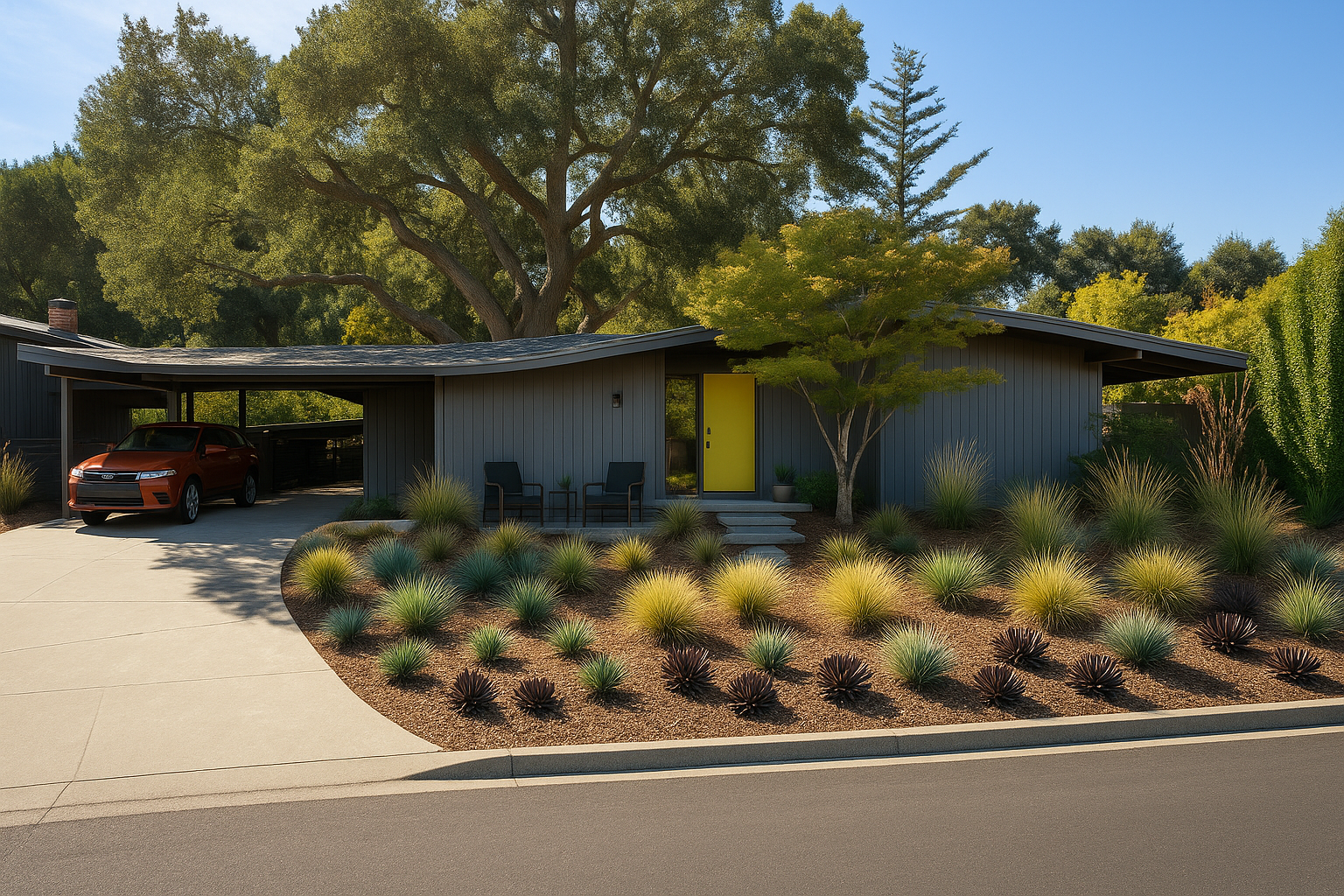
An Eichler home in California, circa 1964, featuring walls of glass and a low-slung post-and-beam roof that seamlessly blend the interior with the lush garden outside. The home’s design turns its focus inward to private courtyards and backyard terraces, exemplifying Eichler’s indoor-outdoor philosophy eichlerhomesforsale.com
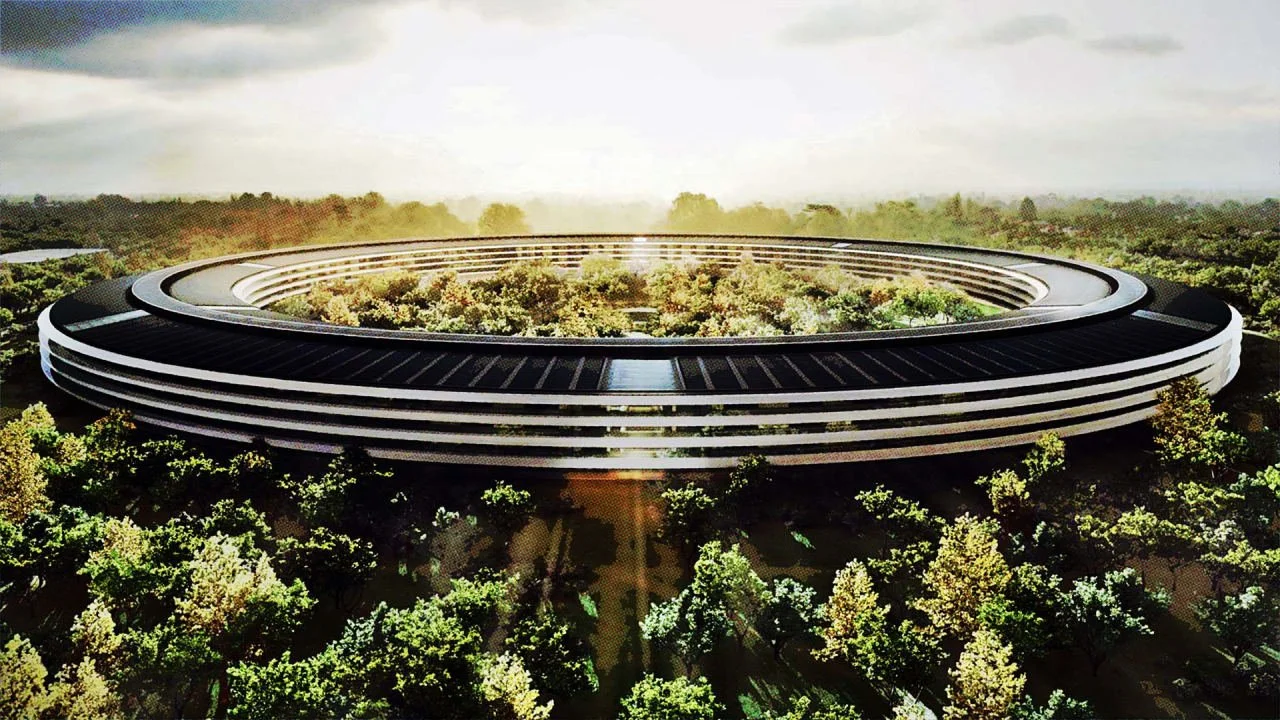
A view of Apple Park’s ring building in Cupertino. The four-story circular structure is encased in continuous glass, reflecting the landscape of trees and sky. Like an Eichler home writ large, the design blurs the line between inside and out – employees move through sunlit spaces with panoramic park views, and can step directly outside as giant glass doors open the façade on nice days rdttech.co. The campus’s low profile, sleek lines, and integration with greenery give it a distinctly mid-century modern spirit, despite its futuristic scale.
To further illustrate the shared DNA, consider the following side-by-side comparison of key design elements in Eichler homes and Apple Park:
Design PrincipleEichler Homes (1950s–60s)Apple Park (2010s)Expansive Glass (“Glass-First”)Floor-to-ceiling glass walls as a defining feature – entire walls of fixed glass and sliding doors open living areas to the outdoors. Eichler houses literally use glass to make the outside a part of the inside, flooding spaces with light eichlerhomesforsale.com. Eichler’s era-defying use of big glass panels created a transparent living environment unprecedented in tract homes.Continuous curved glass façade around a circular building – 800 panels, ~45 ft tall each. This extensive glazing provides unobstructed views for occupants and blurs indoor/outdoor boundaries appleinsider.com. Some panels serve as 50-ft high sliding doors, so whole sections of the building open to nature. It’s one of the largest uses of structural glass ever, embodying Apple’s ethos of openness.Nature Integration (“Biophilic Logic”)Central atriums and private gardens integrated into home layouts. Many Eichlers have an open-air atrium at the heart, surrounded by glass, bringing sky, light, and plants into the middle of daily life eichlerhomesforsale.com. Large windows frame views of greenery, and layouts turn inward toward patios/backyards for a sense of refuge in nature. Indoor materials often extend outside (e.g. ceiling beams, floor materials) to unify house and landscape.Park-like campus with nature at its core. Apple Park is 80% landscaped with ~9,000 treesf osterandpartners.com; the ring building surrounds a 20-acre central garden featuring fields, hundreds of fruit trees, and a pond. Every office area overlooks greenery, and employees can roam miles of trails in what feels like a private nature reserve. The design was guided by principles of wellness and the local ecology, effectively making the campus a biophilic environment on a grand .Modular Design Thinking (“Modularity & Flexibility”)Standardized components and flexible layouts. Eichler homes used a post-and-beam grid allowing for open plans and easy adaptation eichlerhomesforsale.com. A few core models were repeated across developments, tweaking facade and orientation – an efficient modular approach to tract construction re-thinkingthefuture.com. Inside, spaces were multi-purpose (e.g. open plan living/dining, convertible rooms), and non-structural partitions or built-ins could be added, reflecting a mindset of flexible use. Eichler’s process proved that modern design could be replicated at scale without losing its soul. Prefabricated structure with adaptable interiors. Apple Park’s circular building is composed of 8 repeating segments appleinsider.com, built with prefabricated elements like 4,000 pre-cast concrete slabs for floors/ceilings fosterandpartners.com – a modular construction feat for speed and precision. The interior workspace design is highly configurable: movable walls, reconfigurable “pods” of desks, and raised floors with plug-and-play utilities allow teams to reshape areas on demand rdttech.co. The ring’s symmetry also means any point can change function without altering the overall design. This forward-looking modularity ensures the campus can evolve with Apple’s needs, just as Eichler’s designs have proven adaptable for decades.
Silicon Valley Design Ethos: A Continuous Thread
It’s no accident that Eichler homes and Apple Park both flourished in Silicon Valley. Though separated by half a century, they are products of a regional culture that values innovation, openness, and human-centric design. Eichler’s developments housed generations of Bay Area engineers, entrepreneurs, and creatives – indeed, Apple’s co-founder Steve Wozniak grew up in an Eichler in Sunnyvale, and Steve Jobs spent his youth in a modern tract home by an Eichler contemporary (Jobs often admired his friend Woz’s Eichler house) re-thinkingthefuture.com. Those early experiences in light-filled, modern homes left an imprint. “His houses were smart and cheap and good,” Jobs said of Eichler homes, praising how “they brought clean design and simple taste to lower-income people”zeitgeist.jp. It’s not a stretch to see parallels in Apple’s own philosophy of making sophisticated technology accessible and intuitive. The indoor-outdoor California lifestyle that Eichler encapsulated – informal, in touch with nature, optimistic about the future – is the very backdrop against which Silicon Valley’s tech culture developed. Today’s tech campuses often resemble mini-cities with greenways, communal spaces, and architecture that encourages chance encounters, much as Eichler neighborhoods were designed around community parks and open circulation. In fact, many Silicon Valley tech workers seek out Eichler homes to live in, finding that the mid-century design “aligns perfectly with what [they] are looking for” in terms of openness, authenticity, and work-life harmony eichlerhomesforsale.com.
Apple Park can thus be seen as a culmination of the Valley’s design ethos – taking the indoor-outdoor, human-focused principles pioneered by folks like Eichler and scaling them up with 21st-century technology and resources. Norman Foster’s team essentially created a high-tech “Eichler for 12,000 people,” with a vast atrium (the central park) and glass walls everywhere letting nature in. The campus embodies the same belief that environment shapes creativity and well-being. As Jony Ive described the philosophy, the goal was to “get design out of the way” – to create something inevitable and intuitively right appleinsider.com. In both an Eichler house and Apple’s campus, the design doesn’t scream for attention with ornament; instead, it frames experience – of light, space, and community – in a seemingly effortless way. This understated, “inevitable” quality is a hallmark of great design in both eras.
Conclusion
Eichler homes and Apple Park, despite their differences in scale and function, share a remarkable common ground in design DNA. Both embrace glass to dissolve barriers between inside and out, employ nature as an integral design element that nourishes users, and utilize modular thinking to achieve flexibility and efficiency. These parallels highlight a continuity of ideas: the notion that good design should improve quality of life by fostering openness, connection to nature, and adaptability. It’s a thread that runs from the mid-century modern movement straight through to the cutting-edge tech campuses of today. In the context of Silicon Valley’s evolution, Eichler’s tract homes were more than stylish dwellings – they set a precedent for the region’s blend of innovation and livability. Apple Park, in turn, translates those values into a corporate realm, showing that even the most advanced workplace can learn from the past masters of residential design. In an era when tech architecture sometimes leans toward the sterile or overly monumental, Apple Park’s success lies in feeling, at its core, like a place to live and grow, not just work – much like an Eichler house scaled up to neighborhood size. The surprising kinship between Eichlers and Apple’s campus reminds us that design principles fostering transparency, harmony with nature, and human scale are timeless, capable of bridging decades and typologies. As Silicon Valley continues to build its future, it’s fitting that it still finds inspiration in its mid-century modern roots – proving that truly great design, whether a family home or a tech HQ, always puts people first.
As Silicon Valley’s leading Eichler home experts, the Boyenga Team at Compass brings unmatched architectural fluency and market insight to every client. Eric and Janelle Boyenga champion the same values that defined Joseph Eichler—innovation, transparency, and a people-first design philosophy. Whether representing buyers or sellers, they deliver elevated, tech-forward strategies backed by deep mid-century modern expertise. Their understanding of Eichler design, history, and lifestyle positions them as the go-to advisors for modern homes across the Valley.
Sources:
Eichler Homes history and design features eichlerhomesforsale.com
Mid-century indoor-outdoor philosophy and atrium concepts eichlerhomesforsale.com
Eichler homeowner perspectives on indoor/outdoor living eichlerhomesforsale.com
Apple Park design overview – Foster + Partners description fosterandpartners.com, AppleInsider details appleinsider.com
Biophilic and sustainable aspects of Apple Park architectmagazine.com
Modular and flexible design elements at Apple Park rdttech.co
Silicon Valley cultural context and commentary eichlerhomesforsale.com.