
Fairorchard: Silicon Valley History in a Mid-Century Modern Neighborhood
Fairorchard Neighborhood: Eichler Legacy and the Birthplace of Jobs and Wozniak
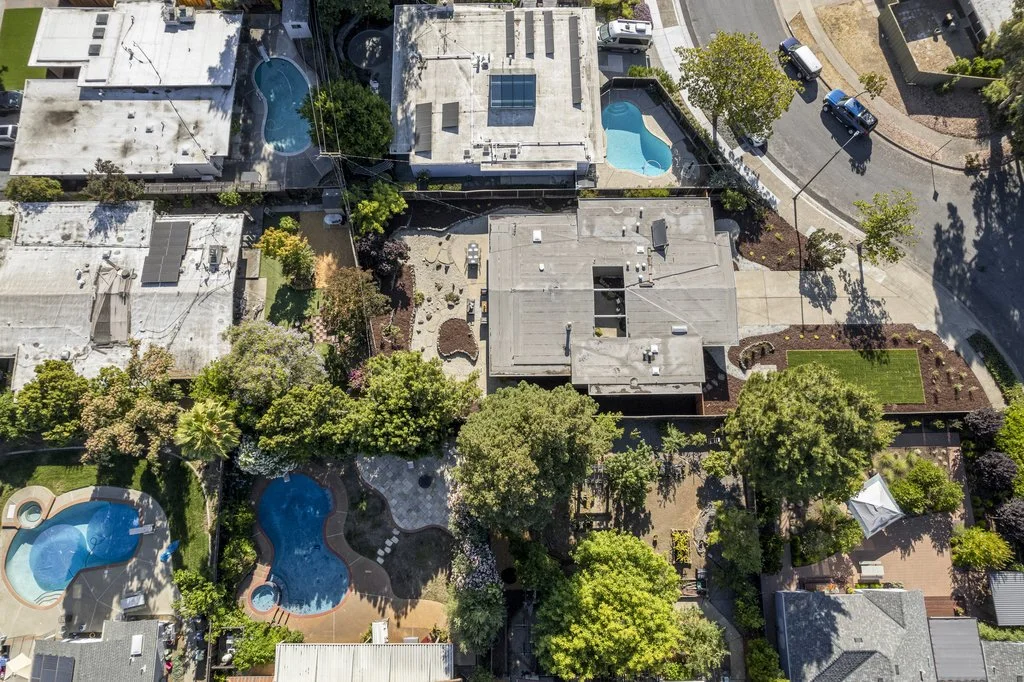
Nestled in the heart of Silicon Valley, the Fairorchard neighborhood of San Jose (in the Sunnyvale area) is more than just another Eichler tract – it’s a living museum of mid-century modern architecture with a dash of tech folklore. In the 1970s, its quiet Eichler-lined streets bore witness to a chance meeting between two young men, Steve Jobs and Steve Wozniak, a friendship that would spark the Apple Computer revolution. Today, Fairorchard remains a distinctive Eichler community celebrated for its architectural integrity, close-knit lifestyle, and the cultural legacy that sets it apart. In this article, we explore Fairorchard’s historical significance, architectural identity, community life, real estate trends, and how it compares to other famed Eichler neighborhoods like Fairglen and Monta Loma.

Historical Significance: Where Woz Met Jobs
Fairorchard holds a legendary place in Silicon Valley lore as the neighborhood where Apple’s co-founders first crossed paths. In the early 1970s, Steve Wozniak was living with his family in an Eichler home on Edmonton Avenue in Fairorchard, a home he later called “my favorite home ever” eichlernetwork.com. A mutual friend (Bill Fernandez) introduced a young Steve Jobs to Wozniak, and it was in this very Eichler that the two Steves first bonded over electronics and prank gadgets like the “blue box” – a humble suburban living room that would incubate ideas for a tech empire. Wozniak recalls Jobs being a frequent visitor to his Fairorchard home, where they spent countless hours tinkering and dreaming eichlernetwork.com. This serendipitous meeting under an Eichler roof not only launched a lifelong partnership, but also endows Fairorchard with a unique cultural importance. Residents take pride that their otherwise tranquil mid-century neighborhood played a supporting role in tech history, proving that innovative minds often find fertile ground in ordinary places.
Beyond the Apple connection, Fairorchard’s history is intertwined with the narrative of California’s post-war boom. Developed in the mid-1950s (circa 1954-1956) as one of Joseph Eichler’s early South Bay projects, Fairorchard was part of the grand experiment to bring modernist design to mainstream California living eichlerhomesforsale.com. By the time Steve Wozniak’s family moved there, the neighborhood was already a well-established enclave of engineers, young families, and forward-thinking homeowners – exactly the kind of environment that fostered Silicon Valley’s spirit of innovation. Homestead High School, just down the road, served both Wozniak and Jobs (who lived nearby in Mountain View), so the area’s excellent schools were another crossroads for future tech pioneers. Today, Fairorchard carries this history with quiet pride. A simple stroll through the neighborhood can feel like walking through a chapter of tech folklore – from the Eichler where Wozniak once soldered circuits to the sidewalks where two teenagers plotted a revolution in computing. This blend of mid-century modern heritage and Silicon Valley genesis makes Fairorchard’s historical significance truly one-of-a-kind.
Eichler Architectural Identity of Fairorchard
A classic mid-century Eichler home with its distinctive low-gabled roof, glass walls, and integrated garage. This example is from San Jose’s Fairglen tract – similar in style and era to the Eichler homes in Fairorchard en.m.wikipedia.org.
Fairorchard is quintessential Eichler territory, embodying the mid-century modern ideals that Joseph Eichler famously brought to California suburbia. The tract was developed around 1954-1956 and consists of 54 single-story Eichler homes situated along Wright Avenue, Edmonton Avenue, La Salle Drive, Helena Drive, and Homestead Road. What makes these homes special is their architectural DNA: they were designed by the renowned modernist firm Anshen & Allen (with input by Jones & Emmons as Eichler’s projects expanded) eichlerhomesforsale.com. In Fairorchard, Eichler and his architects responded to buyer feedback by introducing larger floor plans and new design features, marking an evolution in Eichler design. Homes range from modest 3-bedroom, 2-bath models (~1,370 sq ft) to more spacious 4-bedroom models (~1,800–1,890 sq ft) eichlerhomesforsale.com. Notably, Fairorchard was among the first Eichler tracts to debut the iconic atrium model – a signature open-air atrium at the center of the home that blurs the line between indoors and outdoors eichlerhomesforsale.com. Earlier Eichlers had L-shaped courtyard layouts; by the mid-’50s, the atrium concept was taking center stage, literally bringing “nature into the heart of each home” as a sunlight-filled indoor patio eichlerhomesforsale.com.
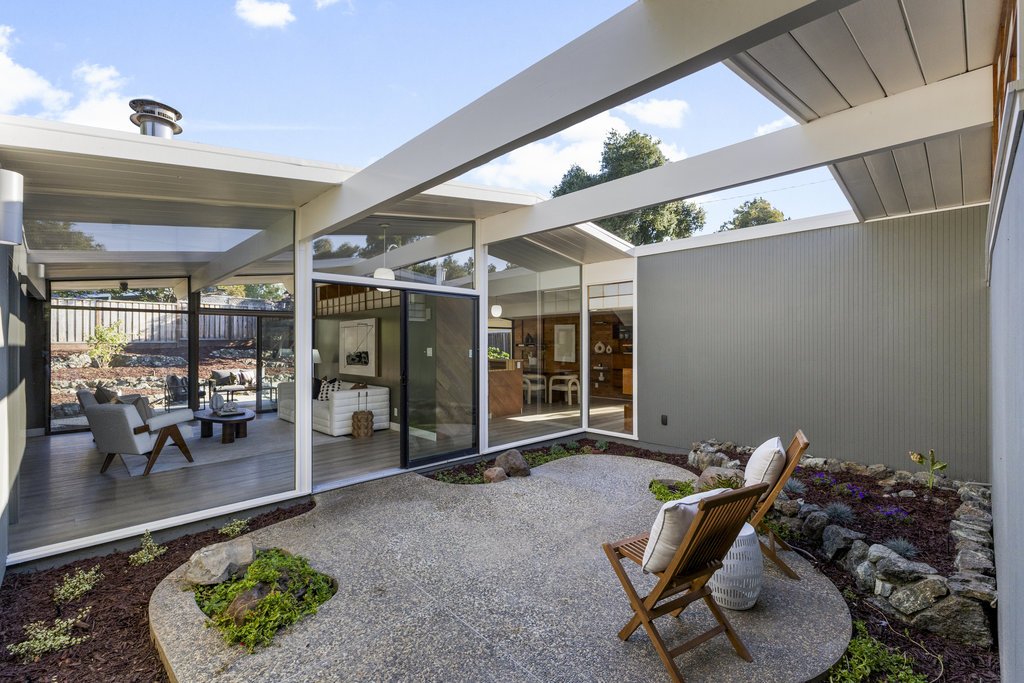
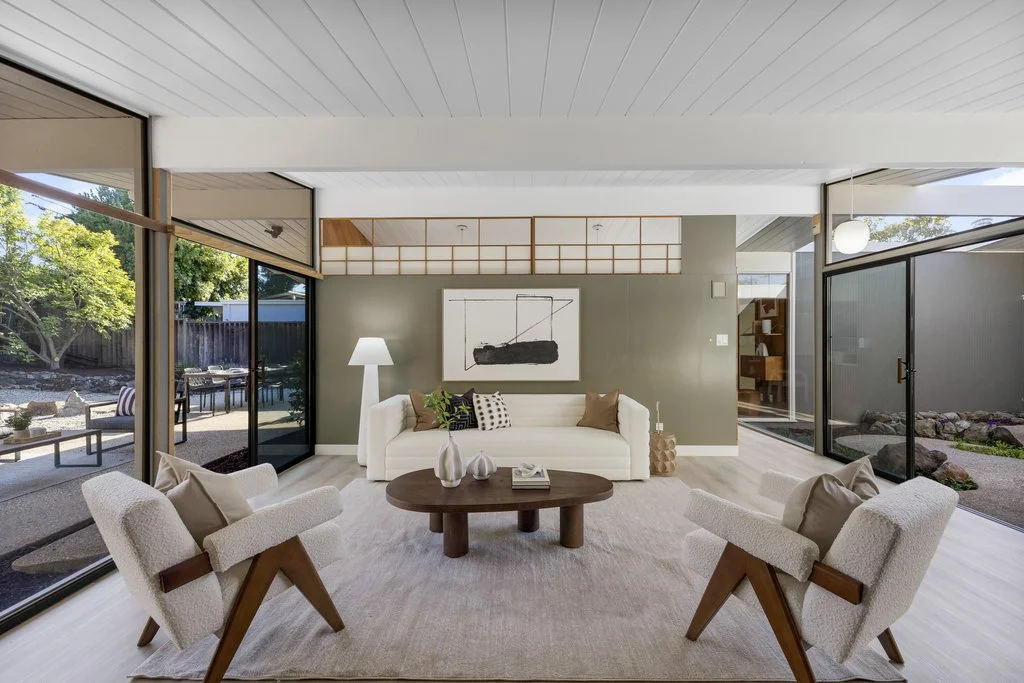
A view of the backyard through the atrium of this Fairorchard Eichler Home.
Characteristic features of Fairorchard’s Eichlers include post-and-beam construction, floor-to-ceiling glass walls facing private gardens, and exposed wood ceilings, all of which foster an open, airy ambiance eichlerhomesforsale.com. The street view is distinctly “California modern” – low-pitched or flat rooflines with extended eaves, clean geometric facades often finished in vertical wood siding, and carports or integrated garages that blend into the design. Many houses retain their original Philippine mahogany wall paneling and polished concrete floors with radiant heating, hallmarks of Eichler interiors in that era en.wikipedia.orgen.wikipedia.org. Although several homes have been updated over the years to suit contemporary tastes (for instance, with updated kitchens or dual-pane windows), there is a strong ethos of preservation. Renovations tend to honor Eichler’s intent: open-plan layouts, unadorned modernist lines, and seamless indoor-outdoor transitions remain intact eichlerhomesforsale.com. Walking through Fairorchard, one might see butterfly chairs on a front porch, a vintage globe pendant light in an atrium, or a freshly painted bright front door – tasteful nods to mid-century style that homeowners proudly maintain.
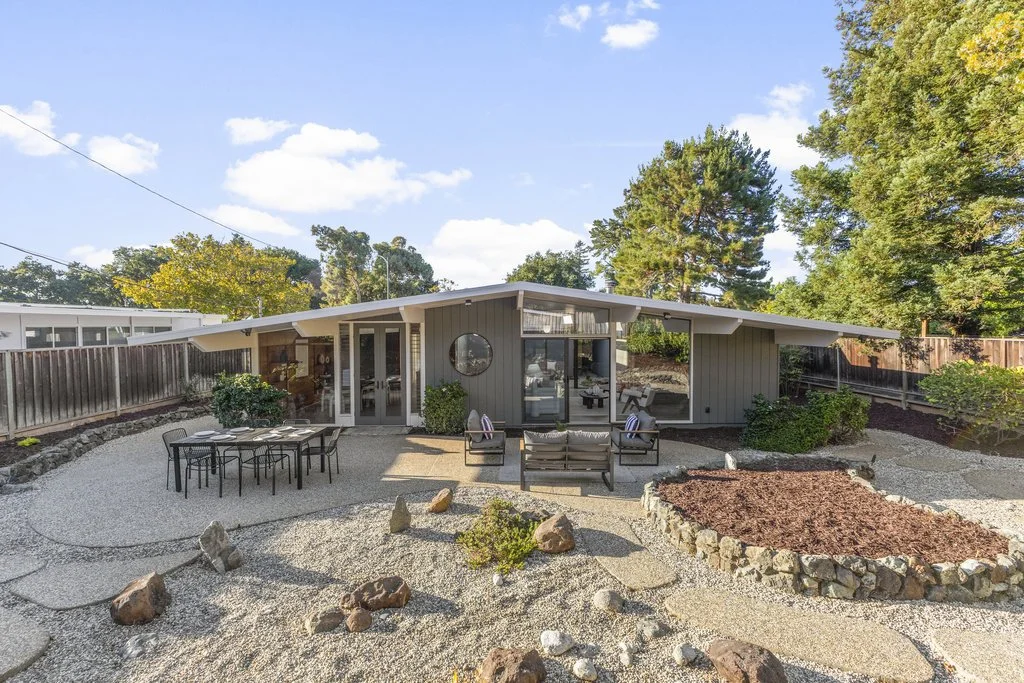
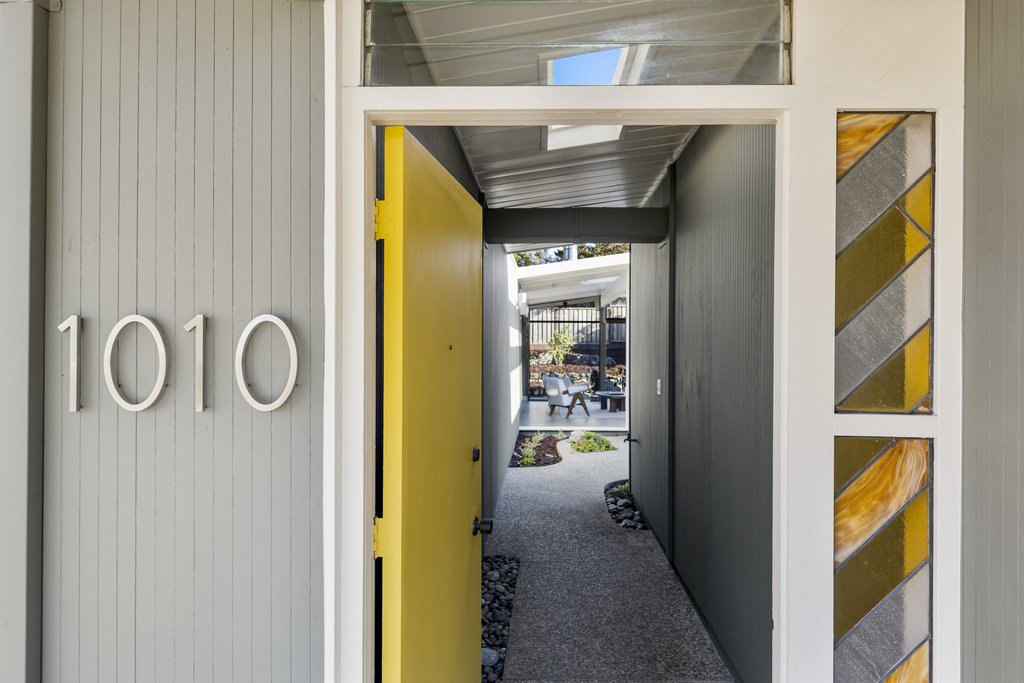
Rear view of the Fairorchard Eichler at 1010 La Salle
In architectural terms, Fairorchard’s Eichlers share a pedigree with those in other Silicon Valley neighborhoods, yet they also have their unique flavor. Compared to Fairglen (Willow Glen, San Jose), which was built a couple of years later (1959–1961) and is a larger tract of 218 Eichlers en.wikipedia.org, Fairorchard’s homes are a bit earlier and slightly smaller on average. Fairglen’s designs (by Anshen & Allen, Jones & Emmons, and Claude Oakland) introduced more variations – 13 distinct floor plans in total – including models with double garages and larger atriums, as well as the iconic A-frame peaks en.wikipedia.org. Fairorchard, being an earlier project, sticks to four fundamental layouts (all by Anshen & Allen) and reflects Eichler’s first foray into “bigger” homes with atriums. The result is a cohesive look: Fairorchard feels unified in style, with every house clearly an Eichler yet not cookie-cutter identical. Meanwhile, in Monta Loma (Mountain View) – another mid-50s neighborhood often mentioned in the same breath – Eichler homes coexist with “Eichler-like” tract homes by Mackay and Mardell. Monta Loma’s Eichler section (called “Fairview” originally) has about 200 Eichlers built 1954–1957 eichlernetwork.com. Those homes are similar in size and design to Fairorchard’s (since they were also Anshen & Allen designs), but Monta Loma as a whole features a mix of builders and slightly different aesthetics (e.g. some Mackay homes have crawl spaces and forced-air heating instead of Eichler’s slab and radiant heat) eichlernetwork.com. In contrast, Fairorchard is a pure Eichler enclave – every home on those few streets carries the Eichler pedigree, creating a more uniform mid-century modern ambiance.
Overall, the architectural identity of Fairorchard is defined by timeless modernism married to California casual living. Large panes of glass frame views of private courtyards filled with succulents and Japanese maples. The combination of honest materials (wood, glass, concrete) and efficient, light-filled spaces gives these 65+ year-old homes an enduring contemporary feel. It’s easy to see why Steve Wozniak held such fond memories of growing up in an Eichler – the design itself encourages creativity and connectivity. In Fairorchard, architecture isn’t just about style; it actively shapes the lifestyle of the community, from kids playing in atriums visible through glass walls to neighbors chatting over back fence planters. Joseph Eichler’s vision of “bringing the outside in” thrives on these streets, much as it does in larger Eichler tracts across the Bay Area en.wikipedia.org. Fairorchard might be smaller in number, but it stands tall as a showcase of mid-century modern ideals, lovingly preserved and appreciated anew by each generation of homeowners.
Community Life in Fairorchard Today
What is it like to live in Fairorchard today? In a word: serene, friendly, and design-savvy. The neighborhood’s mid-century roots have fostered a community that values both innovation and nostalgia – much like Silicon Valley itself. Many residents are professionals in the tech industry (not surprising, given that Apple’s new campus and other tech hubs are a short bike ride away), and they’re drawn not only by the location but by the lifestyle an Eichler neighborhood provides. Fairorchard’s streets form a small grid with limited through-traffic, so there’s a peaceful, almost cul-de-sac vibe even on the main avenue. It’s common to see neighbors out walking dogs, kids riding bicycles, or families hosting impromptu barbecues in their front courtyards on sunny weekends. That original Eichler concept of “community through design” – with open atriums and glass walls subtly connecting each house to the street – does seem to work; residents often remark how the architecture encourages interaction. Many homes have retained their front courtyard fences, which give privacy but also create a transitional space where neighbors wave hello or stop to chat over succulents and lemon trees.
Demographically, Fairorchard is a blend of old and new. Long-time owners (some dating back decades) bring continuity and firsthand stories of the neighborhood’s past. They remember when orchards and open fields were still nearby and when Homestead High’s most famous alum was just a kid who liked electronics. Alongside them are newer homeowners, often young families or couples (frequently in tech) who have an appreciation for mid-century design. These newer residents are breathing fresh energy into the community – organizing block parties, starting a neighborhood WhatsApp or NextDoor group, and undertaking period-sensitive renovations of their Eichlers instead of tearing them down. There’s a shared understanding in Fairorchard that owning an Eichler is owning a piece of architectural heritage. As one local Eichler specialist noted, Eichler owners tend to fall into two camps: purists who preserve original elements, and modernists who carefully update homes for 21st-century living pastheritage.org. In Fairorchard, you’ll find plenty of both, coexisting harmoniously. It’s not unusual for a neighbor to host an “open house tour” after finishing a remodel, inviting others to admire a restored mahogany wall or a new modern kitchen that still “feels Eichler.”
Community events in Fairorchard tend to be organic and modest, given the small size of the tract, but meaningful nonetheless. During the holidays, the mid-century rooflines often sport retro string lights and the occasional aluminum Christmas tree can be spotted through a glass wall – a charming scene that draws evening drive-by visitors from around Sunnyvale. In spring, neighbors might coordinate a neighborhood yard sale or join city-wide events. Fairorchard residents also participate in larger Eichler community gatherings in the region. For example, the annual Silicon Valley Eichler Home Tour (when organized) sees some Fairorchard owners opening their doors to architecture buffs, proudly sharing the story of their homes and the neighborhood’s claim to fame as “the place where Jobs met Woz.” The nearby Fairbrae Swim & Tennis Club (in the adjacent Fairbrae Eichler tract) is another hub of activity – while not within Fairorchard’s boundaries, its pool and summer events are popular with families from all the Eichler tracts in the area.
Another cornerstone of community life is the school scene. Fairorchard is fortunate to be served by top-rated public schools: West Valley Elementary, Cupertino Middle School, and Homestead High School. These schools (part of Cupertino and Fremont Union districts) are not only academically prestigious but also walkable or a short bike ride away. As a result, you’ll often see parents and children walking to school together in the mornings, reinforcing that classic neighborhood feel. The school connection also means Fairorchard sees many families moving in specifically for the education and the environment – people who intend to stay long-term. Neighbors often come together at school functions, sports games, or PTA events, further tightening the knit of the community.
Culturally, Fairorchard and its Eichler brethren in Sunnyvale have a bit of a “cult following.” There’s an underlying camaraderie among Eichler owners – a sense that they’re all caretakers of something special. This is evident in the way neighbors swap contacts for Eichler-experienced contractors, or how they collectively lobby the city for preservation-friendly policies. Sunnyvale in general has embraced its Eichler legacy (the city even officially recognizes the historical value of Eichler neighborhoods pastheritage.org), and Fairorchard residents are proud contributors to that legacy. Living here means enjoying a relaxed, suburban lifestyle with a design-centric twist: your block might host an architectural tour one day, and a casual potluck the next. It’s this blend of California casual living and mid-century modern passion that defines Fairorchard’s community life. As one long-time resident summarized with a smile, “We’re a small neighborhood with a big heart – and some famous history to boot.”Real Estate Trends: Past and Present
Fairorchard’s real estate market reflects the broader trajectory of Silicon Valley – once humble homes for middle-class families, Eichlers have become coveted treasures commanding premium prices. Over the decades, home values here have seen tremendous appreciation, especially as mid-century modern design came back into vogue and tech industry wealth fueled demand. Historically, Eichler homes were quite affordable: original prices in the 1950s ranged from roughly $15,000–$20,000 (a far cry from today’s prices). Even by the early 1990s, a Fairorchard Eichler could be had for a few hundred thousand dollars. (For instance, a 4-bedroom Eichler on Edmonton Ave sold for about $387,000 in 1993 redfin.com.) But as Silicon Valley’s fortunes grew, so did interest in these architectural gems. Wozniak’s parents likely paid under $30k for their Eichler in the 1960s; today that same house is worth millions – an appreciation story as remarkable as any startup’s IPO.
Current Market: In the mid-2020s, Fairorchard homes are firmly in the multi-million-dollar range. Despite their age (65+ years), Eichlers in good condition attract competitive bids thanks to their design pedigree, location, and limited supply. Recent sales and listings illustrate the trend:
Address (Sale Date)Beds/BathsSize (sq ft)Sale Price1661 Edmonton Ave (Aug 2013)redfin.comredfin.com4 / 21,890$1,260,000 redfin.com1624 Edmonton Ave (Jul 2017) redfin.comredfin.com4 / 21,816$1,940,000redfin.com1633 Edmonton Ave (Jun 2020)redfin.comredfin.com4 / 21,890$1,903,000redfin.com1650 Edmonton Ave (Listed 2024)compass.com4 / 21,770$3,369,000 (asking)compass.com
As the table shows, values have roughly doubled in the last 10 years alone. A typical 4-bedroom Eichler in Fairorchard that sold for around $1.2–$1.3M in 2013 was selling in the high $1.9M range by 2017, and around $1.9M–$2.0M by 2020. Despite a brief cooling in the late 2010s, the market surged again post-2020. By 2023-2024, Eichler sales were frequently crossing the $2.5M mark, and some even approaching $3M depending on lot size, condition, and remodel quality. Indeed, one 4-bed, 2-bath Eichler (1,770 sq ft) was listed at $3.37 million in 2024compass.com. While list prices and sale prices can differ, Zillow and Redfin estimates for Fairorchard homes in 2025 hover around $3.0–$3.3 million for a well-maintained 4-bedroom Eichler zillow.comredfin.com. That translates to roughly $1,600–$1,800 per square foot, reflecting the intense demand for these homes and the land they sit on zillow.comredfin.com.
Several factors drive this robust market:
Location & Schools: Fairorchard benefits from proximity to major employers (Apple’s campus is just about a mile away) and inclusion in Cupertino’s top-tier school district. This draws affluent buyers who might otherwise consider new luxury builds, but are instead charmed by Eichler style plus convenience. As Boyenga Real Estate Notes notes, Sunnyvale’s Eichler neighborhoods are among the most popular for tech buyers due to the combination of design and practical location.
Architectural Appeal: There is a passionate subset of buyers specifically seeking authentic mid-century modern homes. For them, an Eichler is the gold standard. Fairorchard, being a small tract, might only see a handful of listings each year (if that), so competition is fierce when one hits the market. These buyers often appreciate the architectural history and are willing to pay a premium for well-preserved original features like open-beam ceilings or Philippine mahogany walls.
Turnover Rates: Turnover in Fairorchard is relatively low. Many owners stay for decades – some original 1950s owners even passed homes to their children. When homes do change hands, it’s often due to life events (estate sales, job relocations, etc.) rather than owners “trading up.” The low inventory pushes prices higher when a desirable listing appears. It’s not uncommon for a Fairorchard Eichler to receive multiple offers, sometimes from buyers who lost out on other Eichlers and have been waiting for an opportunity. In recent years, all-cash offers or no-contingency offers have become more frequent in this market, a testament to buyer eagerness.
Buyer Profiles: Today’s buyers in Fairorchard typically include: Tech professionals (engineers, executives) who appreciate the proximity to work; design enthusiasts/architects who value the Eichler aesthetic; and family buyers drawn by the schools and safe neighborhood who have also come to love the idea of an atrium and open floor plan. A fun anecdote: even Apple’s current employees show up as buyers – coming full circle to Wozniak’s roots, young Apple engineers now covet living in the same Eichler community where the company’s co-founder grew up. There’s a certain cachet to that narrative.
In terms of recent pricing trends, the late 2010s and early 2020s saw record highs, with a slight plateau in 2019 followed by renewed growth in 2021-2022. The broader Bay Area market fluctuations (interest rates, tech stock performance, etc.) do impact Fairorchard, but Eichlers have shown a tendency to outperform average market changes. Their uniqueness insulates them to an extent – for example, during a softening in generic suburban tract home prices, Eichlers often held their value or even continued to appreciate because buyer demand remained strong for this niche. A data point from 2020: while many markets paused during early pandemic months, a Fairorchard Eichler still sold for just under $1.9M in June 2020 redfin.com, basically unchanged from the previous year, and then values climbed sharply in 2021 as remote work increased interest in single-family homes.
Another noteworthy trend is the investment in renovations. Many buyers, upon purchasing a Fairorchard Eichler, put substantial money into upgrades – be it restoring original woodwork, installing new roofs (foam or membrane roofing is common on Eichlers), or modernizing kitchens and baths. These improvements, when done tastefully, further boost the value of the home and by extension, the neighborhood. A fully renovated Eichler with high-end, period-appropriate finishes can set new price records. For example, a beautifully refreshed Eichler on Fairorchard Avenue in San Jose (Willow Glen area) was listed in 2024 for about $2.3M after a complete modern makeover by Klopf Architecture dwell.com – showing how updated mid-century homes attract premium prices. In Fairorchard Sunnyvale, remodeled homes with expansions (e.g. an enclosed atrium or added living space that respects Eichler style) have touched the upper $2 millions. However, even relatively original-condition homes tend to sell high due to scarcity; some buyers prefer a “project” Eichler they can restore to their liking.
In summary, Fairorchard’s real estate can be described as high-value and high-desirability, with a strong upward trajectory over time. While market cycles will come and go, the combination of architectural significance, location advantages, and that special Steve Jobs/Wozniak provenance suggests Fairorchard Eichlers will remain among the most sought-after homes in Silicon Valley. As long-time Eichler realtor Kenny Cardoza quipped, “Sunnyvale is the home of the Eichlers” and each Eichler neighborhood here, including Fairorchard, enjoys a halo effect because of the Eichler brand and the lifestyle it entails. Investing in Fairorchard has not just been about buying a house, but about buying into a piece of mid-century history – and the market reflects just how priceless that combination has become.
Comparative Analysis: Fairorchard vs. Fairglen vs. Monta Loma
How does Fairorchard stack up against other notable Eichler enclaves? While all Eichler neighborhoods share a common ethos, each has its own character, history, and appeal. Let’s compare Fairorchard with two peers: Fairglen in San Jose’s Willow Glen area, and Monta Loma in Mountain View.
Size & Layout: Fairorchard is an intimate tract of 54 homes, essentially one small neighborhood developed all at once. This compact size creates a strong sense of identity – everyone really does know everyone, and there are just a handful of street blocks comprising the whole community. Fairglen Additions, by contrast, is much larger with 218 Eichler homes spread across multiple adjoining streets and cul-de-sacsen.wikipedia.org. Fairglen (Units 1, 2, 3 collectively) feels like a sizable neighborhood with a more complex street pattern – it even has multiple entrances and distinct sub-sections, though all under the “Fairglen” banneren.wikipedia.org. Monta Loma’s Eichler portion (the Fairview tract) is about 200 homes as welleichlernetwork.com, but Monta Loma as a whole includes additional tracts by other builders, making it larger and more varied overalleichlernetwork.com. So, Fairorchard offers coziness and exclusivity, whereas Fairglen and Monta Loma offer scale and diversity. Some buyers prefer Fairorchard’s small-community vibe; others might like that Fairglen or Monta Loma have hundreds of mid-century neighbors and thus more of a “district” feeling.
Era and Design Variations: Fairorchard and Monta Loma’s Eichlers were built in the mid-1950s (pre-1960), whereas Fairglen’s were built 1959–61. This means Fairglen’s homes are slightly newer and reflect late-50s Eichler design evolutions: for instance, Fairglen Additions include models with double garages, larger atriums, and some two-story models (in a related nearby tract)en.wikipedia.orgen.wikipedia.org. Fairglen’s architects list is longer – Anshen & Allen started the project, but Jones & Emmons and Claude Oakland finished it, yielding 13 floor plans and numerous façade variationsen.wikipedia.orgen.wikipedia.org. Walking Fairglen, you’ll see a mix of flat roof and peaked A-frame profiles, and both atrium and courtyard layouts, often in the same block. Fairorchard, being earlier, has a more uniform aesthetic (all houses are one-story, and mostly modest atrium or L-courtyard models of roughly similar footprint). Monta Loma’s Eichlers are contemporaries of Fairorchard’s – many are 3-bed/2-bath in the ~1300–1500 sq ft range or 4-bed in the ~1750 sq ft range, with carports or 1-car garages typical of mid-50s Eichlerseichlernetwork.com. However, Monta Loma’s uniqueness lies in the adjacency of “likeler” homes: Eichler and Mackay homes sit side by side. The Mackay homes were designed by Anshen & Allen too, so they resemble Eichlers but with slight differences (e.g. crawlspace foundations, different heating)eichlernetwork.com. This mix can be charming – Monta Loma streetscapes have Eichler rooflines interspersed with other MCM styles, which some find eclectic and others find less pure. Fairorchard and Fairglen, by contrast, are 100% Eichler – every house is a verified Eichler, creating a consistent mid-century modern environment.
Historical Cachet: All three neighborhoods have notable historical associations, but of different types. Fairorchard’s claim to fame is tech history – the meeting of Jobs and Wozniak and Woz’s upbringing there put Fairorchard on the map for Apple aficionados. This story isn’t as tied to Fairglen or Monta Loma. However, Fairglen has formal historic recognition: in 2019, the Fairglen Additions were listed on the National Register of Historic Places for their architectural significance en.wikipedia.org. It’s one of the few Eichler tracts to achieve national historic district status, which reflects both its well-preserved state and its exemplary mid-century design. Fairglen’s addition to the NRHP means homeowners have a sense of pride (and some guidelines) knowing they live in an officially historic neighborhood. Fairorchard is not (yet) landmarked – it’s smaller and perhaps hasn’t sought that designation – though the Eichler Network and local enthusiasts certainly acknowledge its importance, and Sunnyvale as a city is proud of all its Eichler tracts. Monta Loma’s historical angle is interesting: aside from hosting Steve Jobs’ childhood (in a Mackay-built “likeler”), Monta Loma was built on a former Ohlone native site and even a 1940s airfield, with a street layout originally proposed to have greenbelts between cul-de-sacs eichlernetwork.com. While Monta Loma isn’t on the NRHP, it is considered likely to be eligible in the future as a remarkably intact mid-century neighborhood eichlernetwork.com. In community memory, Monta Loma also has quirky tales (like being a test route for self-driving cars in modern times, because of its quiet streets)eichlernetwork.com. Fairorchard’s lore will always circle back to “this is where Apple was born (unofficially)”, which carries a different kind of weight – more pop culture than architectural, but significant nonetheless.
Community and Culture: Fairglen and Monta Loma both have very active neighborhood communities, arguably more formal than tiny Fairorchard’s just due to size. Monta Loma has a longstanding neighborhood association, a newsletter, and events like annual ice cream socials, block parties, club meet-ups (knitting club, garden club, etc.), and even an annual “star party” for stargazing eichlernetwork.com. Neighbors there are known to celebrate the mid-century heritage; for example, many wear Monta Loma caps and participate in group activities, which fosters a strong inclusive spirit eichlernetwork.com. Fairglen also benefits from being in Willow Glen, which is a community-oriented area of San Jose – it has an active Eichler homeowner group that communicates about preservation and organizes open house tours. Fairglen’s larger population means more Eichler enthusiasts concentrated in one place, so they’ve successfully advocated for things like maintaining the mid-century character (even getting the city to consider design guidelines to prevent unsympathetic remodels). Fairorchard’s community, while tight-knit, is less formal – there’s no specific Fairorchard HOA or annual picnic on the calendar (at least not historically, given only 50-some households). That said, Fairorchard’s residents often join forces with those of nearby Eichler tracts (like Fairbrae or Rancho Verde in Sunnyvale) for joint activities. And because of the schools and shared history, Fairorchard folks might mingle with Eichler owners from adjacent neighborhoods at, say, Homestead High alumni events or Eichler Club meetings. In essence, Fairorchard offers a quieter, more low-key community life, whereas Fairglen and Monta Loma provide a bit more structure and group activity simply by virtue of headcount. Depending on personal preference, some might find Fairorchard’s semi-retired vibe appealing, while others might love Monta Loma’s lively, family-friendly scene or Fairglen’s organized historic community feel.
Desirability & Market Comparison: All three neighborhoods are highly desirable, but nuances apply. Location-wise, Fairorchard (Sunnyvale) and Monta Loma (Mountain View) are in the heart of Silicon Valley jobs and top schools, which often gives them an edge in real estate prices over Fairglen (which, being in San Jose, has great Willow Glen charm but not Cupertino schools). Indeed, recent pricing reflects that: Eichlers in Sunnyvale/Mt. View have sold in the $2–$3M+ range, whereas many in Fairglen (Willow Glen) often trade slightly lower, in the high $1M to low $2M range, for comparable homes (though Fairglen prices have been rising too as its historic status attracts more interest). Architectural purists might rank Fairglen at the top because of its NRHP status and larger, later models; others might prefer Monta Loma for the variety or Fairorchard for exclusivity. It’s a bit like choosing between different vintages of a fine wine – each Eichler neighborhood offers something special:
Fairorchard: prized for its Apple connection, cozy scale, and Cupertino schools. Limited inventory makes it a rare find.
Fairglen: prized for its historic designation, large community of Eichlers, and classic Willow Glen atmosphere (tree-lined streets, nearby downtown Willow Glen charm). It also has the Fairglen Swim Club nearby and larger lot sizes on average (Fairglen lots ~6,000 sq ft) en.wikipedia.org.
Monta Loma: prized for diversity of MCM homes, active community spirit, and proximity to both Mountain View and Palo Alto. Also, it’s the childhood neighborhood of Steve Jobs, which, while he didn’t live in an Eichler, still gives it a tech-historical aura eichlernetwork.com. Some buyers find Monta Loma’s mix of Eichler and Mackay homes appealing because the whole area feels like a mid-century time capsule, not just one builder’s vision.
In terms of style and desirability, all three have that indoor-outdoor California living and mid-century vibe that Eichler fans adore. Fairorchard and Fairglen are stylistically more homogeneous (which some see as a plus for neighborhood character), whereas Monta Loma’s mix can be seen as either a plus (variety) or minus (less uniform). Importantly, none of these neighborhoods feel cookie-cutter like typical suburban tracts – each has an intangible cool factor. Fairorchard might be described as “quietly prestigious” – a little enclave only insiders seem to know, until they learn its history. Fairglen could be “architecturally prestigious” – it has official accolades to prove its worth. And Monta Loma is “socially vibrant” – a mid-century neighborhood that’s very much alive and kicking with community energy.
For an Eichler home seeker, one might choose Fairorchard if they want Sunnyvale convenience and that unique tech heritage story. They might choose Fairglen if they want to be part of a formally recognized historic district with lots of fellow Eichler lovers around. Or they might choose Monta Loma if they value a larger neighborhood with mixed MCM architecture and perhaps a slightly shorter commute north to Google or Stanford. All are desirable; it often comes down to personal priorities. What’s clear is that each of these Eichler neighborhoods – Fairorchard, Fairglen, Monta Loma – shares the fundamental appeal of Eichler design: light-filled rooms, post-and-beam elegance, and a welcoming community vibe. The differences lie in scale, setting, and story, and taken together they paint a picture of the rich tapestry of mid-century modern living in Silicon Valley.
Visual Context: Photos and Maps for Mid-Century Fans
For those who haven’t strolled through Fairorchard (or can’t get enough of Eichler visuals), there are thankfully many ways to see the neighborhood’s charm from afar. A simple look at satellite imagery on Google Maps reveals a telling detail: the roofs. From above, Fairorchard is a neat grid of rectangular and polygonal rooflines with various cut-outs – those cut-outs are the open atriums and courtyards that make Eichler homes so distinctive. The consistency of the roof shapes and their gentle slopes immediately differentiates Fairorchard from surrounding developments. In fact, map enthusiasts often note you can “spot an Eichler tract from the air” by the pattern of its roofs, and Fairorchard is no exception.
On street view (Google Street View or driving in person), you’ll see well-maintained Eichler exteriors: many homes still feature the original mahogany garage doors or period-appropriate replacements, as well as the iconic Eichler entry atriums visible through the double front doors. The setting has mature landscaping – palm trees, pines, Japanese maples, and citrus trees dot the front yards, giving a lush backdrop to the clean lines of the homes. Because Fairorchard’s streets are relatively open (no tall fences facing the street in most cases), one can catch glimpses of classic Eichler elements like globe pendant lights hanging in an atrium or breezeways leading to back yards. Public domain photographs of similar Eichler neighborhoods (like the image above from Fairglen) showcase the typical look: modest front facades with horizontal emphasis, carport or garage to one side, a blank street-facing wall balanced by a glassy entryway tucked behind a screen or fence en.m.wikipedia.org. This design was intentional – Eichlers present a private face to the street and open up entirely in the back.
Photography enthusiasts will find Fairorchard a rewarding subject. While I couldn’t include specific Fairorchard house photos here without permission, there are some real estate photos and articles that offer interior and exterior views. For example, Dwell magazine featured a beautifully renovated Eichler on Fairorchard Avenue (in Willow Glen) – showcasing how these mid-century homes can be updated with crisp white interiors, polished concrete floors, and pops of color like an aqua front door dwell.com. The before-and-after of that project (by Klopf Architecture) highlights the “Eichler bones” that remain: the post-and-beam structure and walls of glass that define the living spaces dwell.com. Many elements shown there are identical to Fairorchard Sunnyvale Eichlers (since the Willow Glen Eichlers were built around the same time by the same builder). High-resolution photos from such features often circulate in Eichler fan communities, serving as inspiration for current owners.
Additionally, Realtor listings are a great resource for visuals. The listing for 1650 Edmonton Ave in 2024, for instance, had dozens of photos (some of which can be found on Zillow or Compass’s websites) showing the home’s open atrium, beamed ceilings, and indoor-outdoor flow compass.comzillow.com. These images give a sense of how bright and airy Fairorchard homes are, with skylights and floor-to-ceiling windows flooding spaces with light. One can often see original features like brick fireplaces centered in glass walls dwell.com, or updated touches like modern kitchens that still respect the open concept dwell.com. Even the backyard shots tell a story: Eichler backyards in Fairorchard aren’t huge, but they are private retreats thanks to high fences and the house wrapping around, often featuring patios perfect for California outdoor living.
For map aficionados, aside from Google, there’s an interesting 1950s tract map of Sunnyvale Eichler developments (available in Eichler historical archives) that pinpoints Fairorchard by name. It’s labeled as “Fairorchard Unit” on some city planning documents from the era, indicating its place among Eichler’s sequence of Sunnyvale projects eichlerhomesforsale.com. Also, Sunnyvale’s Heritage Park Museum has a display about Eichler homes in the city, sometimes including old photographs or brochures from the 1950s showing model Eichler homes and families of that time heritageparkmuseum.org. While not specific to Fairorchard, it’s a window into the period when Fairorchard was new – black-and-white photos of ribbon-cuttings and open houses, where Eichler’s modern tract homes were on the cutting edge of suburban design.
If you’re visiting the area, Fairorchard is easy to find – it’s essentially the pocket of streets east of Cupertino Middle School and north of Homestead Road in Sunnyvale eichlerhomesforsale.com. There are no tract markers or signs saying “Fairorchard” (unlike some named subdivisions), so using a map is key. Look for Edmonton Avenue or Wright Avenue; once you’re on those streets, you’ll instantly recognize the Eichlers. Out of respect for residents, it’s best to drive slowly or park and walk; Eichler owners are generally friendly and used to admirers, but it is a quiet residential zone. Some might even wave and say hi if they see you admiring a butterfly roof or globe lamp – the community’s welcoming nature extends to respectful architecture fans.
In conclusion, visual context enriches the story of Fairorchard. The neighborhood’s appearance has changed remarkably little since the 1950s: the biggest difference is that the once-new tract is now adorned with mature greenery and occasionally solar panels, but the architectural harmony endures. Whether through photos in magazines, real estate galleries, or a virtual stroll on Maps, seeing Fairorchard helps one appreciate why these homes are beloved. The images confirm what words convey: an Eichler isn’t just a house, it’s a lifestyle. Fairorchard, in its look and layout, invites people to live differently – with openness, with style, and in communion with both their neighbors and the environment. It’s a photogenic embodiment of mid-century California living, set in a neighborhood that’s as historically significant as it is beautiful.
Sources: This article draws on information from Eichler historical archives, local real estate resources, and community anecdotes. Key references include the Eichler Network’s coverage of Steve Wozniak’s upbringing in Sunnyvale eichlernetwork.com, the Boyenga Real Estate guide to Sunnyvale Eichler tracts, Wikipedia documentation on the Fairglen Additions historic district en.wikipedia.org, and Redfin/Zillow sales data for Fairorchard homes to illustrate market trends redfin.com. Photos are courtesy of Wikimedia Commons and Dwell (as noted). This blend of architecture, history, and market data aims to provide a comprehensive portrait of Fairorchard – a small neighborhood with a big story, where mid-century modern design and Silicon Valley history uniquely intersect. eichlernetwork.com redfin.com
Sources