
Inside Eichler’s Vision: Why Joseph Eichler’s Philosophy Still Shapes Modern Communities
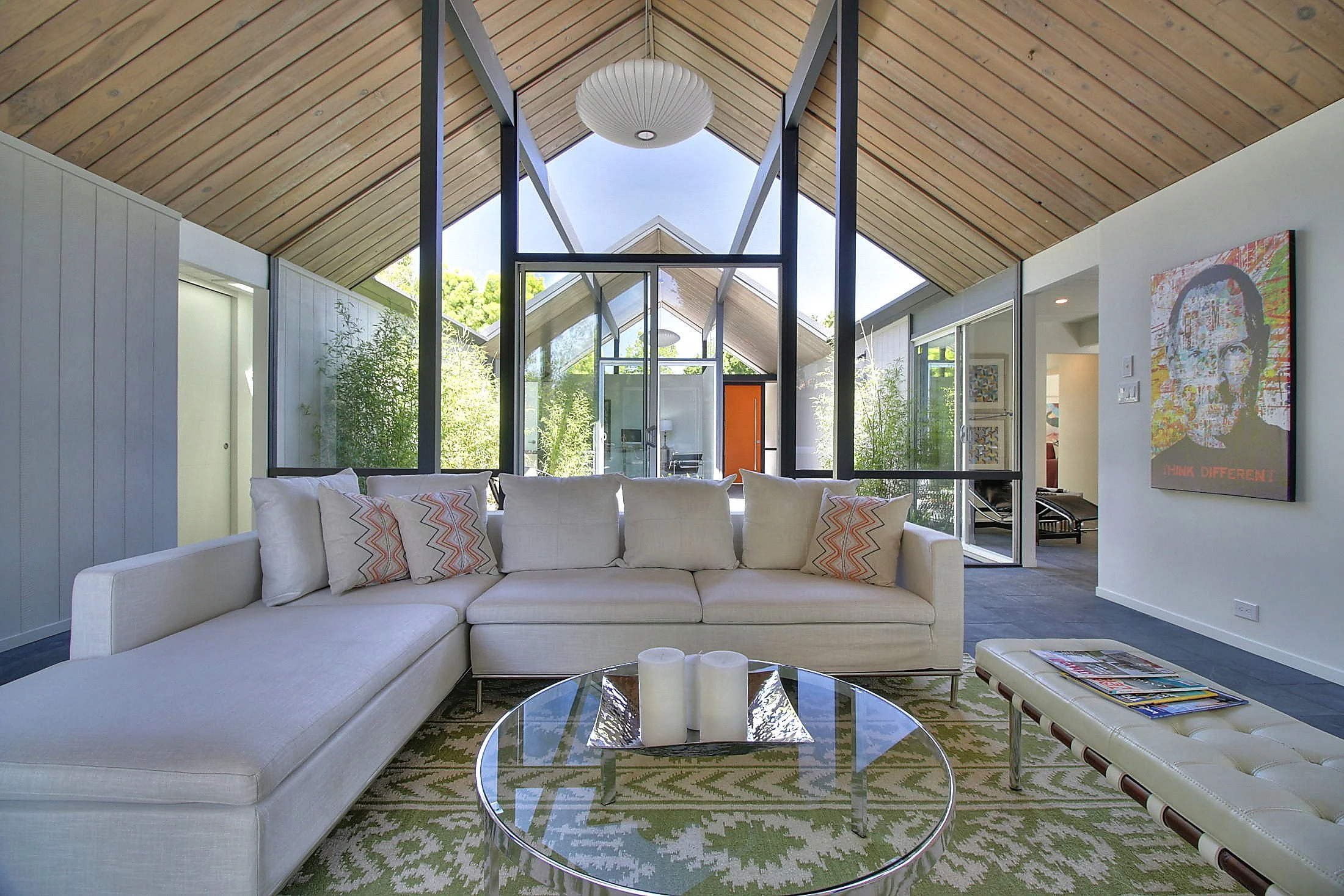
Joseph Eichler (1900–1974) was a visionary California developer whose mission went far beyond selling houses. Raised in a liberal, diverse New York family timesofisrael.com, he believed modern design could uplift ordinary people. After moving his family to California in the 1940s and renting a Frank Lloyd Wright house (“Father was hooked,” Eichler’s son recalled) latimes.com, Eichler launched Eichler Homes. Between 1949 and 1966 he built over 11,000 mid-century modern houses en.wikipedia.orgaamodtplumb.com. But more than design, Eichler’s philosophy was about who could live in those houses. He famously insisted that every Eichler home be sold “to everybody, regardless of race or religion” aamodtplumb.comsah-archipedia.org – a radical stance in segregated postwar America.
Modernist Design Meets Middle‑Class Living
Eichler partnered with progressive architects (Anshen & Allen, A. Quincy Jones, Claude Oakland and others) to bring high-style “California Modern” architecture to ordinary families dwell.com aamodtplumb.com. He favored post‑and‑beam construction, flat or gently sloping roofs, atriums and floor-to-ceiling glass walls that “bring the outdoors inside,” blurring the line between living room and garden aamodtplumb.com. Every Eichler home had an open floor plan and radiant-heated slab floors – luxurious features that were unheard-of in tract housing. As Eichler himself said, his houses “offered new living experiences” that felt revelatoryaamodtplumb.com. He wanted quality materials (redwood paneling, clerestory windows) and amenities (indoor/outdoor spaces, built-in furniture) in every affordable homeaamodtplumb.com. Eichler’s idea was that middle-class families – not just the rich – should enjoy modern design. “Affordable” in Eichler terms meant using small, repeated floor plans so prices could be kept lowsah-archipedia.org. In this way he redefined suburban housing for the postwar boom.
An Eichler home – the Foster Residence in Granada Hills – showing Eichler’s signature geometric roofline and expansive glass facadecommons.wikimedia.org. Eichler’s modernist style (flat planes, clerestories, indoor-outdoor courtyards) was revolutionary in the 1950s.
Building Inclusive Communities
From the start, Eichler’s vision was as much social as architectural. Born to Jewish immigrants, he knew discrimination firsthand timesofisrael.com. His goal was inclusive architecture – subdivisions intentionally designed to welcome diverse residents. In every new tract Eichler incorporated parks, playgrounds and community centers so neighbors could mingle. In fact, Archipedia notes that Eichler’s planned developments “often featured integrated parklands and community centers,” reflecting his holistic approach to neighborhoodssah-archipedia.org. The San Mateo Highlands (Eichler’s largest project, with over 700 homes) is a prime example: built 1956–64 on Pulgas Ridge, it was laid out with terraces, schools and a shopping center to knit the community togethersah-archipedia.org.
Crucially, Eichler codified an open-occupancy policy: any qualified buyer could purchase an Eichler home, regardless of race, creed or religion aamodtplumb.comsah-archipedia.org. This was revolutionary. Early on, Asian American buyers moved into his 1950 Palo Alto tracts sfchronicle.com, and in 1954 the first sale to an African American family occurred. When neighbors complained (notably in Palo Alto’s Greenmeadow tract), Eichler simply bought out the objecting owners and resold their homes sfchronicle.com dwell.com. One San Rafael (Marin) protest group even threatened Eichler staff, yet Eichler met them head‑on. He told them firmly, “If…this will destroy property values, I could lose millions. You should be ashamed of wasting time on such pettiness,” and offered to buy any complaining household sfchronicle.comdwell.com. No one accepted, and the new Black family was able to move in.
Eichler’s non‑discrimination stance went beyond polite tolerance. He built a custom house (on his own lot) in 1951 for NAACP lawyer Franklin Williams, who had worried that integration might jeopardize FHA financing dwell.com. After this firsthand experience, Eichler “began to put [his egalitarian] ideals into practice,” historian Ocean Howell notes dwell.com. Eichler even resigned in 1958 from the National Association of Home Builders, outraged when it publicly defended housing segregation. In a San Francisco meeting he declared: “I wish to state emphatically that Eichler Homes in no way practices any kind of discrimination.” motc.org To Eichler, integration was not only morally right but economically sound.
Fair Housing Advocacy and Key Milestones
Eichler leveraged his clout to influence housing policy. Behind the scenes he lobbied for fair‑housing laws and testified at the federal level. In 1960 he met with the U.S. Civil Rights Commission and federal agencies to “craft and promote antidiscrimination laws.” dwell.com His family helped organize California’s housing conventions and even aided in drafting the state’s Fair Housing Act. Eichler’s son Ned later wryly told legislators that, contrary to cynical adages, “from the time of Moses... you can [change people with a law].” timesofisrael.com
These efforts helped lay groundwork for the national Fair Housing Act of 1968. As one historian observes, Eichler and his family “demonstrated by example that integration would not bring the private housing market crashing down.” dwell.com By quietly showing that integrated neighborhoods could thrive and retain value, Eichler Homes provided proof-of-concept to skeptics. Ironically, many builders adopted Eichler’s approach — his firm sold dozens of tract houses to Black buyers by the mid‑1960s dwell.com — even if they never advertised it. Eichler himself never sought credit as a “civil rights crusader,” yet newspapers and housing papers did note that “Eichler Homes had…sold homes to 12 Negro families…and more than 200 to Orientals” by the 1950s eichlernetwork.com. In short, Joseph Eichler’s fair‑housing philosophy became part of the inclusive architecture history of America.
Eichler Neighborhoods: Real‑World Integration
The best proof of Eichler’s vision was in the neighborhoods themselves. In Palo Alto’s Greenmeadow tract, for example, Eichler homes were among the first to welcome Asian and African American residents. When one white resident objected to a Black family moving in, Eichler bought and resold the complainer’s homedwell.com. In Marin County’s Lucas Valley (Terra Linda), a similar drama unfolded in 1955; Eichler confronted protesters door‑to‑door and offered to repurchase their houses dwell.com. No buyers took him up, and the new families remained. The result in both cases was a mixed neighborhood where children of different races went to the same schools and played in the same parks — exactly the future Eichler had envisioned. San Mateo’s Highlands, his crown-jewel community, was built on hilly, previously empty land. Stretching west of the city, it became Eichler’s largest tract (over 700 homes sah-archipedia.org) with integrated greenbelts and a shopping center. Today it remains a well-loved Mid‑Century enclave. Even in Orange County, Eichler built the Fairhills neighborhood (1960s), where integration policy earned him design awards dwell.com.
A restored Eichler house in Palo Alto’s Greenmeadow (built 1954) exemplifies how Eichler neighborhoods blended indoors and outdoors. In Greenmeadow Eichler sold the first tract home to a Black family, and when a neighbor complained Eichler bought back that home dwell.com. Eichler neighborhoods like these were intentionally diverse.
Throughout the 1950s and ’60s Eichler Homes earned dozens of design awardsaamodtplumb.com, but more importantly they quietly rewrote the social rules of suburbia. Eichler’s “open secret” of selling to any qualified buyer regardless of race became an actual selling point for some: prospective homeowners eventually learned that Eichler tracts were more cosmopolitan than most. Families who chose Eichler homes were drawn not just to the glass-and-wood aesthetics but to the community ideals behind them. As one blogger put it, “for many families, his homes…represented a new way of living” – one that balanced privacy with neighborly openness aamodtplumb.com.
Lasting Legacy: Eichler’s Ideals Today
Decades after Eichler’s death, his influence endures in California and beyond. Eichler homes are still highly coveted by design aficionados dwell.comaamodtplumb.com, and the Eichler Network (a homeowners’ organization) keeps his story alive, emphasizing “modern architecture for everyone.” Preservation groups celebrate Eichler neighborhoods as historic gems of community planning and social progress. Architects today point to Eichler as an early example of sustainable, human‑centric design: his use of passive solar layout, daylighting and radiant floor heating – features noted for their energy efficiency – were ahead of their time.
More broadly, Eichler’s philosophy of inclusive community-building resonates in contemporary planning. Planners now routinely prioritize mixed-income housing, accessible green spaces, and anti-exclusionary zoning – the very goals Eichler championed. In urban design circles Eichler is cited as a precursor to concepts like new urbanism and universal design, because he proved that good design can be social as well as aesthetic. His belief — once radical — that “all families should experience the joys of living in a modern home” aamodtplumb.com is echoed in today’s calls for affordable, high-quality housing for all.
Ultimately, Joseph Eichler’s philosophy was one of equality and innovation. He showed that modern homes and integrated communities could go hand-in-hand. The social impact of Eichler homes in the 20th century was profound: they integrated suburbs and helped change attitudes about race and housingdwell.comtimesofisrael.com. Today, his ideals still shape how we build communities. Eichler’s vision reminds us that architecture can be a tool for justice: well-designed, inclusive neighborhoods aren’t just aesthetically pleasing, they forge stronger, more diverse communities. In the words still posted on his desk long ago, Eichler built with the conviction “this sums up… what I believe in and what I’m working for in life” sfchronicle.com – a legacy that, in both bricks and spirit, lives on in modern housing and urban design.
Sources: Historical and architectural accounts, interviews and archives latimes.com, sfchronicle.com, motc.org, timesofisrael.com, dwell.com sah-archipedia.org, aamodtplumb.com (see annotations). These include Eichler biographical profiles, contemporary news reports, and expert analyses of Eichler homes and communities.
Sources