
Eichler Courtyards vs. Traditional Backyard Retreats
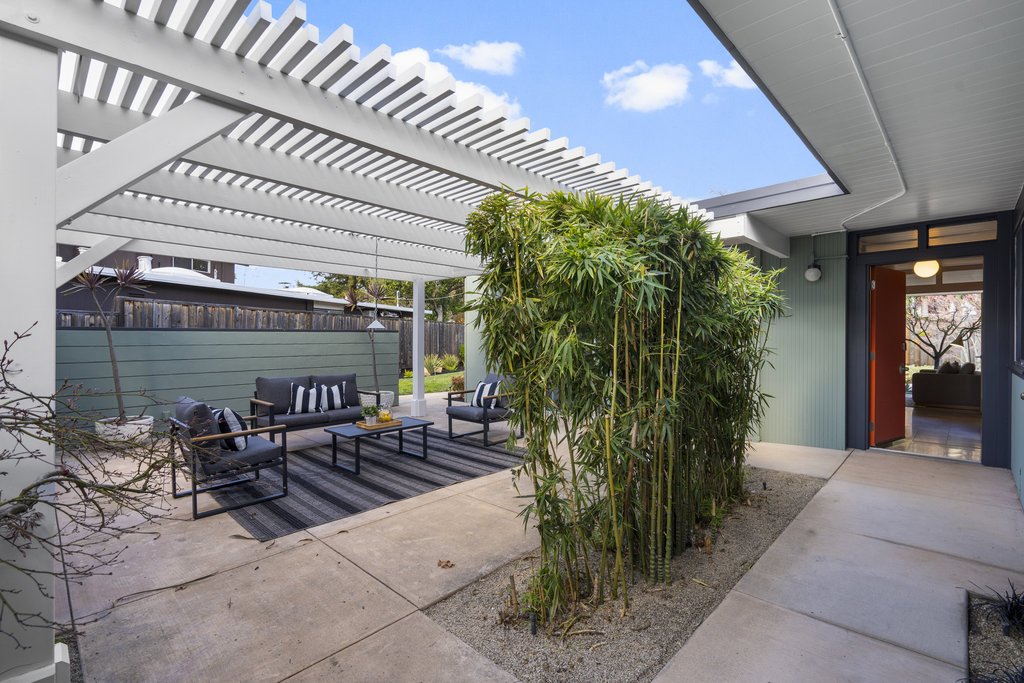
A Tale of Two Patios: Eichler Courtyards vs. Backyard Retreats
Mid-century modern Eichler homes revolutionized suburban design by placing an open-air courtyard at the heart of the house, rather than tucking greenery behind it. This philosophy echoed ancient precedents: Roman domus and Moorish riads long used inward-facing gardens to bring “air, light, privacy, security, and tranquility” into the home eichlerhomesforsale.com. Joseph Eichler embraced this idea in postwar California, determined to “bring the outdoors in” with glass walls and open plans eichlerhomesforsale.com. Early Eichler floor plans looped living areas around a central patio (U- and L-shaped layouts) eichlerhomesforsale.com. By 1958, architects A. Quincy Jones and Frederick Emmons were building fully open-air atrium homes with wide, glass-framed courtyards as the front entry eichlerhomesforsale.com. In short, Eichler’s signature was the indoor-outdoor fusion: homes with “flowing light, glass walls, and an open plan” that literally “brought the outside in” eichlerhomesforsale.com. These atria were often called “the heart of the home” – true outdoor rooms where families gathered in privacy rather than looking into neighbors’ yards eichlerhomesforsale.com.
Indoor-Outdoor Integration in Eichler Homes
An Eichler courtyard blurs interior and exterior. In an Eichler house, living rooms open directly onto the courtyard via floor-to-ceiling glass, creating a seamless indoor-outdoor flow. For example, one Eichler renovation notes how the sheltered courtyard was “redesigned to allow parents to watch the kids while cooking,” making it both a play area and visual extension of the kitchen klopfarchitecture.com. The Klopf Architecture project above shows how the living/dining area (right) and entrance corridor (left) share walls of glass with the courtyard, achieving a truly harmonious indoor-outdoor flow klopfarchitecture.com. In fact, observers describe Eichler houses as offering “seamless living in open and fluid spaces,” with sliding walls that let one “look straight through the home to the backyard and pool” atomic-ranch.com eichlerhomesforsale.com. This transparency is at the core of Eichler courtyard ideas: the courtyard isn’t an afterthought but integrated so that every principal room sees or opens onto the garden.
The Classic Mid-Century Backyard Retreat
By contrast, a traditional mid-century backyard was usually a separate outdoor retreat behind the house. These yards often featured open lawns, concrete patios or decking, and amenities like pools or fire pits. A design guide observes that with planning, “the equivalent of another living room is just outside the back door,” where you can “sip your coffee and watch the sunrise” on a chaise lounge or gather around a fire atomic-ranch.com. However, that “back door” step is typically a distinct transition – you leave the sealed interior and step into the open yard. Classic backyards might be enclosed by fences or hedges (for privacy) but they remain exposed to the sky and weather. In mid-century suburban tract homes, the backyard was mainly a place for grilling, playing, or gardening, not a core element of the living space. Patio furniture, a BBQ, or a built-in pool could make it comfortable, but this space was fundamentally outside the house rather than at its center.
Eichler Courtyard vs. Traditional Backyard: Key Differences
Eichler courtyards and classic backyards serve similar social and aesthetic goals, but their layouts and experiences differ sharply. An Eichler’s courtyard is inward-facing and enclosed by the rooflines on three sides. This gives it a living-room feel and year-round privacy. In California’s dry climate it also functions like an indoor-outdoor room: it provides light and ventilation on summer nights without direct scorching suneichlerhomesforsale.com. The family literally lives around the courtyard – parents can be in the kitchen while watching children play just steps away klopfarchitecture.com. The upside is total privacy and integration, but a downside can be limited sun or sky view (especially in winter) and less space for large gatherings. A traditional backyard, on the other hand, is fully open to the air and often larger. It offers big-sky views and full sun (good for pools, gardens or parties) but with neighbors nearby. Typical backyards are simply bounded by a fence; they require stepping through doors to reach them. Eichler owners often say they prefer seeing sky instead of neighbors eichlerhomesforsale.com, whereas owners of ranch-style homes enjoy sweeping lawns under the sun.
Patio Design Ideas for Mid-Century Modern Homes
A mid-century modern patio should complement the clean lines of the architecture. Popular ideas include:
Seamless flooring: Extend the indoor flooring (terrazzo, tile or concrete) out to the patio to blur boundaries.
Built-in seating: Simple wood or concrete benches (think sculptural teak or molded concrete) echo the era’s minimalist aesthetic. (In fact, Eichler renovations often use built-in benches in the courtyardklopfarchitecture.com.) Modern interpretations even use vintage Eichler-era benches.
Sun shades and structure: Low pergolas or overhangs (often flat or angled to match the roof) provide partial shade and shelter. Thin steel or wood posts echo the post-and-beam construction indoors.
Fire features: A clean-lined fire pit or fireplace (even an indoor-outdoor brick hearth) anchors the space. Early Eichler atriums famously included an indoor brick barbecue eichlerhomesforsale.com. A modern patio might add a sleek fireplace wall or sunken firepit platform.
Mid-century furniture: Retro lounge chairs, poufs, and simple tables in teak, steel or rattan keep the look authentic. One design guide notes that the right patio can feel like “another living room” just outside atomic-ranch.com. Use low-profile seating and avoid clutter to maintain the airy feel.
In all designs, think extension of indoor space. Sliding glass doors or large accordion walls (common in Eichlers) should open fully so the patio truly functions as living space. For example, the outdoor lounge area above is placed under a flat, cantilevered roof connected to the house – a very Eichler-like solution.
Mid-Century Backyard Landscaping Inspiration
Landscaping is key in any outdoor room. Eichler courtyards and mid-century backyards often favor low-maintenance, drought-tolerant plantings. In dry California regions, designers recommend succulent gardens, agaves, palms and gravel beds as shown above. One Eichler owner even turned her concrete courtyard into a “dry garden” of cacti and euphorbias eichlerhomesforsale.com. Such plantings echo the Mid-Century Modern love of simple geometry and local climate. A Houzz showcase of modern courtyards highlights designs “featuring drought-tolerant plants and natural stone accents” that balance “modern minimalism and serene beauty”houzz.com. In lush climates or traditional yards, mid-century landscaping might include manicured lawns, hedges, and tropical houseplants. Common motifs are clustered plantings: around a courtyard fire pit or on the edges of a patio, rather than a wild overgrown garden. Low horizontal shrubs, ornamental grasses, or sculptural trees frame the space. Built-in planters or raised beds can define sections of a courtyard or patio.
Key elements that enhance both styles include water features and lighting. A reflecting pool or fountain (sometimes a raised concrete pond) adds mid-century flair and keeps the atmosphere calm. Understated lighting – globe pendants in an Eichler atrium or simple lanterns and string lights on a backyard porch – allow these outdoor rooms to function at night. Even in a classic backyard, adding period-inspired planters, a pergola vine, or a stylized sculpture can tie the space back to the home’s architecture. As one Eichler design guide notes, well-chosen outdoor benches and seating “foster connection” and real estate value eichlerhomesforsale.com – in other words, the right furniture and planters complete the indoor-outdoor vision.
Pros and Cons for Modern Living
Eichler Courtyard – Advantages: (Private outdoor “room” at the center of the home, ideal for family life.) It maximizes privacy and security – you see sky instead of neighbors eichlerhomesforsale.com – and provides natural light and ventilation to multiple rooms at once. The courtyard’s proximity keeps kids in view and hosts events in a contained, sheltered space klopfarchitecture.com eichlerhomesforsale.com. It also uses less land footprint than a large yard, often making it practical on modest lots. The result is a unique aesthetic statement that blurs indoor-outdoor boundaries, achieving the celebrated mid-century indoor-outdoor flow.
Eichler Courtyard – Drawbacks: Because it is enclosed, an atrium may admit less direct sunlight (especially in winter), and it can feel smaller than a wide-open yard. Very large gatherings can be cramped. Water management can be trickier (open roofs may require drainage planning). Some people miss having a green lawn or direct sun. In home appraisals, the courtyard may not count as square footage. The style is also distinctive – while many buyers love it, others unfamiliar with Eichlers might find an inward-facing facade unconventional.
Traditional Backyard – Advantages: (Expansive outdoor space and full sun exposure.) A classic yard can be much larger, ideal for big lawns, pools, gardens, or sports. It usually gets maximum sunlight, which is great for greenery and poolside fun. It’s straightforward and familiar – guests come through the back door into an open sky yard, often with a deck or patio. Backyards accommodate varied uses (vegetable gardens, playgrounds, large parties) and are easy to divide into zones. In some markets, homebuyers expect a big yard and see it as a valuable amenity.
Traditional Backyard – Drawbacks: These yards offer less privacy. Neighbors may overlook your space, and street traffic is visible. In hot climates the wide-open yard can be unshaded, making it less usable in midday heat. The house may feel more disconnected from the yard – you often step through a doorway and down a few steps instead of seeing the space from multiple rooms. Maintenance can be higher (lawn mowing, weeding). Finally, a typical backyard does not exploit the indoor-outdoor synergy of mid-century design; it remains “out there” rather than integrated, which can make it feel like a separate add-on rather than part of daily living.
Each layout has trade-offs. An Eichler-style courtyard prioritizes privacy and integration – it’s a built-in outdoor oasis that doubles as living space. A classic backyard offers breadth and versatility at the cost of that seamless connection. Modern homeowners renovating mid-century homes can choose features accordingly: bring Eichler courtyard ideas (glass walls, built-in seating, Mediterranean plantings) into an existing yard, or conversely, reintroduce an atrium inside an older ranch house. Both concepts celebrate outdoor living in their own way, and understanding their origins helps tailor the right approach for today’s lifestyle.
Sources: Historical Eichler design principles and renovation examplesklopfarchitecture.com atomic-ranch.comeichlerhomesforsale.com; mid-century patio and landscape advice atomic-ranch.com houzz.com.
Sources