
The Original Open Concept: How Eichler Homes Changed Residential Architecture Forever
Joseph Eichler’s California modern tract homes broke decisively with the boxy, compartmentalized houses of the 1950s. Working with architects like A. Quincy Jones and Claude Oakland, Eichler brought post-and-beam construction, flat roofs and walls of glass into mass-market housing en.wikipedia.org atomic-ranch.com. For example, the Pomeroy Green development in Santa Clara (above) clusters modest Eichler units around shared courtyards and carports – a far cry from the tight rows of ranch houses that typified postwar suburbs. Eichler himself promoted these “winding roads with picturesque landscapes” as backdrops for community life atomic-ranch.com. As one retrospective notes, Eichler’s neighborhoods were set up so “neighbors were able to gather for outdoor events or cookouts… all while ending the day in their marvelous modernist home.” atomic-ranch.com In short, Eichler designs and site plans wove together open indoor spaces and communal outdoor living in ways that earlier tract housing simply did not.
Above: Eichler-style tract housing in the Bay Area’s Pomeroy Green (Santa Clara) showcases the shared-courtyard planning Eichler prized. This layout fosters community gatherings and extends living spaces outdoors atomic-ranch.comacsa-arch.org.
Eichler’s houses themselves exemplified the “California Modern” ideal. They typically featured expansive open floorplans with long, low rooflines and clerestory walls. In the San Mateo Eichler shown below, the flat roof projects over a sheltered carport and entrance. Behind it, broad picture windows and glass doors would open to a central courtyard – literally bringing the outside in. Eichler homes “offer seamless living in open and fluid spaces,” one architectural study observes, emphasizing “flowing light, glass walls, and an open plan”acsa-arch.org. Instead of narrow corridors and closed rooms, most Eichlers had few solid interior walls: living, dining and kitchen areas all blended together. In fact, as Atomic Ranch magazine notes, Eichler’s trademark was “large open spaces, walls of glass… indoor-outdoor living” atomic-ranch.com – a design far removed from the dark, compartmentalized suburban homes of the era.
Above: A classic Bay Area Eichler home (San Mateo Highlands, 1960) with its low-slung roof, clerestory windows, and glass walls. Eichler’s designs used post-and-beam construction and open layouts – “airy and modern” for 1950s suburbs en.wikipedia.orgen.wikipedia.org – to flood interiors with light and blur indoor/outdoor boundaries.
Eichler’s Signature Innovations
Eichler pioneered several key innovations that defined his open-concept homes:
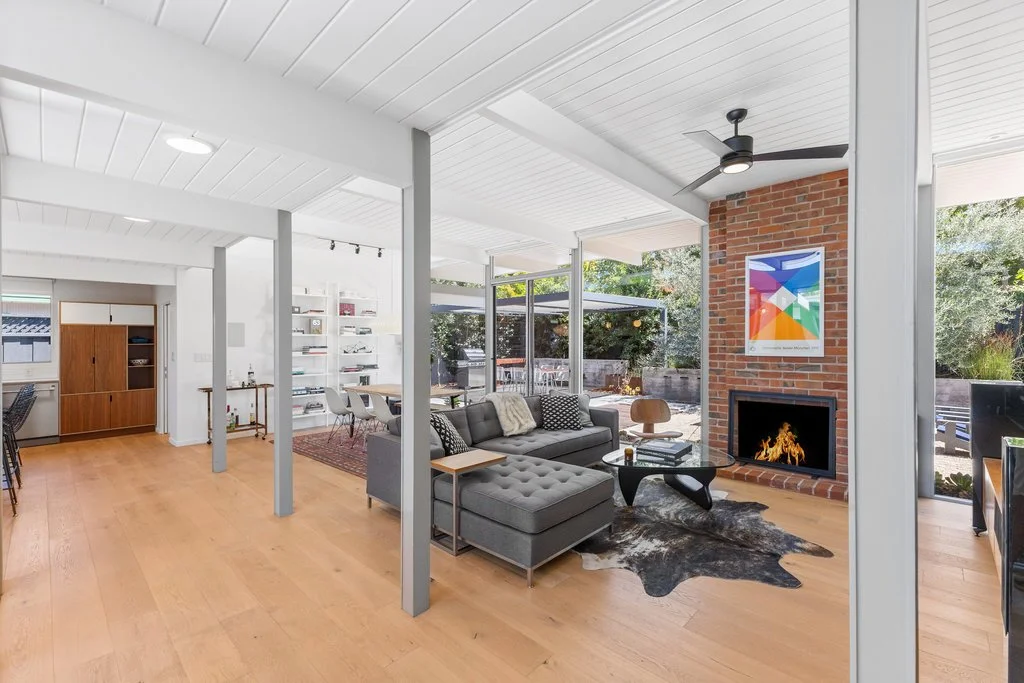
Open-Plan Living: Kitchens, living rooms and dining areas flowed into one another with minimal barriers. Many Eichlers were built with L-shaped or rectangular layouts where the kitchen faced the living area. As a homeowner recalls, “the original open-plan Eichler home… was designed with the kitchen and living room areas central to life in the house; these spaces are large while the bedrooms and bathrooms are relatively tiny.” womensgolfjournal.com By making the hearth of the home wide and communal, Eichler broke from the traditional model of closed-off parlors and tiny galley kitchens.
Atrium Foyers and Courtyards: Beginning in the early 1950s, Eichler incorporated atriums – open-air courtyards often behind the front door – as dramatic focal points. These atriums created a new kind of “room” that let light deep into the house and provided private outdoor space acsa-arch.org. In effect, each atrium became a social axis: sliding walls and windows around it could be opened fully so the courtyard became an extension of the living area. Architects note that Eichler’s atria “added breadth to the other rooms of the house and facilitated new and individual modes of inhabitation” acsa-arch.org.
Seamless Indoor-Outdoor Flow: Floor-to-ceiling windows, glass sliders and clerestories were used wherever possible. Sliding glass doors often spanned entire walls, so a living room could open directly onto a patio or garden. One Eichler-era designer described the aim as literally “bringing the outside in” en.wikipedia.org. These glazed walls, combined with concrete slab floors (often with radiant heating) and exposed wood beams, made interiors feel like light-filled outdoor pavilions. As an Architect Magazine feature on a renovated Eichler put it, the completely operable glass walls “allow the homeowners to truly open up the living space… transforming it into an open air pavilion” that blurs the line between indoors and outdoorsarchitectmagazine.com.
Integrated Family Spaces: Instead of formal parlors or multiple small living rooms, Eichlers typically had a single big room for the family. The kitchen, dining area, and play space might all connect to the living room without hallways. In effect, Eichler promoted casual, communal living: moving meal prep, playtime, and conversation into one shared zone. This mirrored the postwar ideal of togetherness and made home life more flexible. Indeed, one study of Eichler plans notes that combining “the functions of kitchen, dining room and play… was a strategy promoting family togetherness”acsa-arch.org.
These features were radically different from typical 1950s tract houses, which usually had separate small rooms, narrow windows, and no real connection to the yard. Eichler residents would wake each morning under skylights or in sight of their atrium gardens, not behind closed doors. In Eichler’s neighborhoods, the effect was a sense of openness and informality at every scale acsa-arch.org.
Spatial Psychology: Families, Lifestyle and Nature
The physical layout of Eichler homes had profound effects on family life and daily routines. With walls removed or replaced by glass, family members could see and hear each other across the house. Children playing in one area were visible from the kitchen; parents cooking or working could engage with living room activities. As one blogger-builder put it, Eichlers were “designed… for women”, with kitchens positioned so a mother could watch children play while cooking n3a9.github.io womensgolfjournal.com. In short, the open plan made the family’s life “flow from room to room” in a way that encouraged interaction acsa-arch.orgwomensgolfjournal.com.
Architectural researchers have noted the social impact clearly. Eichler’s flowing, transparent spaces “suggest new methods of communication and interaction,” according to one studyacsa-arch.org. By removing interior walls, the house no longer imposed isolation; instead it intensified togetherness. Families could host guests in a continuous great room without shutting off their kitchen work, and indoor parties could spill into an atrium or patio seamlessly. Even the way privacy worked was reimagined: some Eichlers gave bedrooms their own entrance from the atrium, giving teens a sense of independence while still keeping them close to the household’s common core acsa-arch.org.
In practice, families living in Eichlers reported a completely different rhythm. Meal times happened with everyone visible; children often did homework at the kitchen island while parents prepared dinner. The boundary between inside and outside was also psychologically smaller – a sunny day might mean breakfast on the patio, or a living room that literally opens to the garden. All these factors meant Eichler homes supported a more open, communal lifestyle than the closed-off houses around them acsa-arch.orgacsa-arch.org.
Legacy: Eichler’s Blueprint for Today’s Open Homes
Eichler’s innovations laid the groundwork for the open-concept housing that many modern homeowners now crave. Today’s architects and designers regularly point back to Eichler’s blueprint. The nearly universal open-plan living area, the use of glass to merge indoors and outdoors, and the idea of a multipurpose family room all trace to Eichler’s 1950s vision. As one architectural historian observes, Eichler’s tract homes were “a very successful architectural… program,” and unlike contemporaries such as the Levittowns, “they remain popular today.” acsa-arch.org In fact, Eichler communities in California enjoy active preservation and even new infill construction with Eichler-style plans.
Contemporary remodels underscore how fresh Eichler’s ideas still feel. For example, a 2014 renovation of a Palo Alto Eichler features fully collapsible walls of glass that turn the main living space into an open-air pavilion architectmagazine.com. This is exactly the promise Eichler made: to treat a house like a light-filled indoor-outdoor pavilion on any nice day. Many of the “must-have” traits in today’s luxury homes – glass walls, indoor-outdoor flow, flexible great rooms – were standard in Eichlers over half a century ago. In this way Eichler Homes catalyzed the original open-concept ideal. His midcentury neighborhoods proved that modern design could work for ordinary families, and his ideas about free-flowing space have since become the gold standard of suburban living acsa-arch.orgacsa-arch.org.
Key Eichler Takeaways
Eichler popularized open, glass-walled floorplans in mass housing, contrasting sharply with closed 1950s tract homesen.wikipedia.orgacsa-arch.org.
His homes centered on integrated living spaces (living/dining/kitchen) and often included a central atrium or courtyard to bring light and nature inside acsa-arch.orgacsa-arch.org.
The design encouraged family togetherness and an indoor-outdoor lifestyle: residents could socialize across rooms and out into the yard in a way impossible in traditional homes acsa-arch.orgwomensgolfjournal.com.
Eichler’s model proved enduring: his neighborhoods are cherished today, and his open-concept principles remain at the heart of what we now expect from modern homes acsa-arch.orgarchitectmagazine.com.
Sources: Architectural journals and histories of Eichler Homes acsa-arch.orgacsa-arch.org, plus Eichler archives and modern articles atomic-ranch.com architectmagazine.com en.wikipedia.orgwomensgolfjournal.com acsa-arch.org, detail how Joseph Eichler’s Bay Area developments rewrote the suburban housing rulebook.
Sources