
John Brooks Boyd and the Hidden Architecture of Eichler Homes
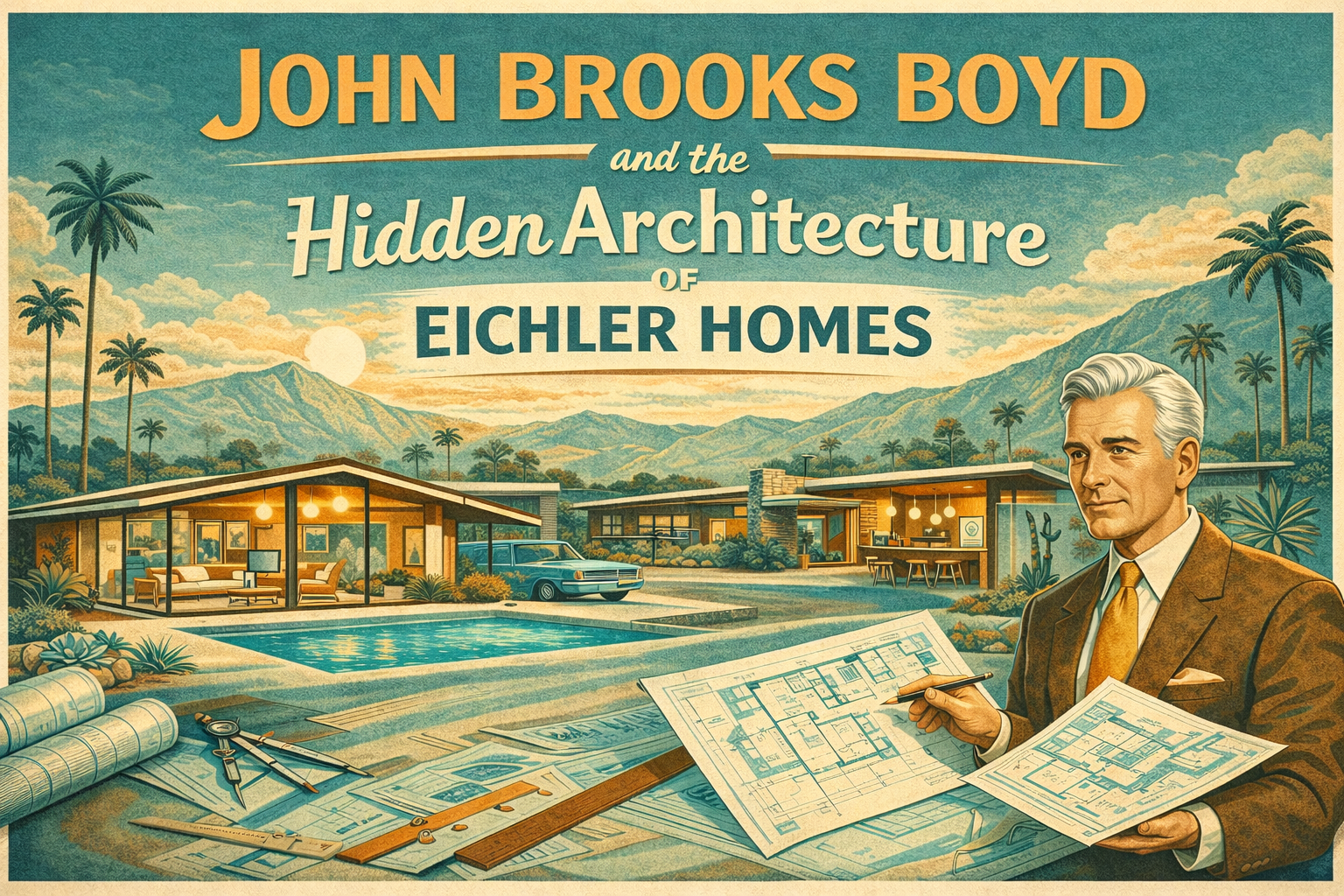
This study examines the architectural role of John Brooks Boyd within the Eichler Homes organization during the late phase of its development, arguing that Boyd functioned as a critical adaptive architect whose work enabled Eichler modernism to survive and operate under increasingly complex geographic, regulatory, and market constraints. While Eichler historiography has traditionally emphasized the visionary contributions of headline architects such as A. Quincy Jones, Frederick Emmons, and Claude Oakland, this paper reframes Boyd as an infrastructural figure—one whose adaptive modernism preserved Eichler’s architectural DNA while allowing for variation, responsiveness, and site-specific problem-solving. Through biographical analysis, theoretical framing, and neighborhood-based case studies, this research establishes Boyd’s work as a distinct and under-recognized sub-class within the Eichler canon, with direct implications for architectural preservation, real estate valuation, and contemporary market interpretation.
Part I: Eichler Homes as a System, Not a Style
Eichler Beyond Aesthetics
Eichler Homes are most often discussed as an aesthetic phenomenon: flat roofs, post-and-beam construction, glass walls, and indoor–outdoor living. Yet this visual shorthand obscures a more important truth. Eichler Homes were not merely stylistic expressions of mid-century modernism; they were a tightly organized architectural system designed to industrialize modernist principles at scale.
Joseph Eichler’s ambition was not to build isolated architectural statements but to normalize modernist living for the American middle and upper-middle class. To accomplish this, Eichler relied on a modular logic: standardized components, repeatable plan types, and disciplined material palettes that could be deployed across varied suburban contexts. Within this system, architects were not interchangeable creatives but specialized contributors, each fulfilling a distinct role.
The Internal Division of Architectural Labor
Within the Eichler ecosystem, architectural labor was stratified. Visionary architects such as A. Quincy Jones articulated the philosophical and spatial ideals that defined the Eichler brand. System architects like Jones & Emmons refined those ideals into reproducible plan sets capable of being built efficiently across multiple tracts. Designers such as Claude Oakland elevated the aesthetic and experiential quality of Eichler homes, particularly as buyer sophistication increased.
What has been largely omitted from popular and academic narratives is the role of the adaptive architect: the figure responsible for modifying, recalibrating, and reconciling Eichler’s idealized plans with real-world conditions. It is within this gap that John Brooks Boyd emerges as indispensable.
Part II: The Problem of the Invisible Architect
Why Boyd Disappeared from the Record
John Brooks Boyd’s relative obscurity is not the result of limited contribution but of structural bias within architectural history. In-house architects, particularly those working within developer-led systems, are rarely credited as authors. Their work is seen as derivative, corrective, or administrative rather than creative. Yet this categorization misunderstands the intellectual rigor required to adapt a closed architectural system without breaking it.
Boyd’s work did not announce itself through radical formal invention. Instead, it manifested in subtle plan mutations, responsive siting strategies, and nuanced courtyard geometries. These interventions preserved Eichler’s identity while allowing it to function in environments for which it was not originally designed.
The Economic Consequences of Misattribution
The absence of Boyd from mainstream Eichler narratives has had measurable consequences. Homes influenced by Boyd’s adaptive approach are frequently mislabeled as anomalies or inferior variants rather than recognized as context-specific evolutions. This misattribution affects renovation decisions, marketing narratives, and ultimately valuation. Understanding Boyd is therefore not merely an academic exercise but a corrective to market inefficiency.
Part III: Boyd’s Formation and Architectural Disposition
Education at Cal Poly San Luis Obispo
Boyd’s architectural education at California Polytechnic State University, San Luis Obispo, emphasized constructability, pragmatism, and material discipline. Unlike more theory-driven programs, Cal Poly trained architects to think simultaneously as designers and builders. This dual orientation would later define Boyd’s professional value within Eichler Homes.
Naval Construction and Constraint-Based Design
Boyd’s service with the U.S. Navy Seabees further reinforced a constraint-oriented mindset. Construction under military conditions demands adaptability, logistical clarity, and rapid problem-solving—skills that translate directly to large-scale residential development operating under regulatory and environmental pressure.
Jones & Emmons: System Discipline
Boyd’s pre-Eichler experience with Jones & Emmons exposed him to the discipline of high modernist systems. Rather than cultivating a signature style, Boyd absorbed a methodology: architecture as an integrated, repeatable logic. This background positioned him uniquely to operate within Eichler’s evolving organizational needs during the 1960s.
Part IV: Adaptive Modernism as Architectural Theory
Defining Adaptive Modernism
Modernist architecture is often discussed through the lens of authorship and purity: the singular vision, the ideal site, the uncompromised form. This framework privileges architects whose work could be executed under optimal conditions and marginalizes those whose primary contribution was adaptation. Adaptive modernism, by contrast, describes an architectural mode in which fidelity to core principles is maintained while formal, spatial, and organizational adjustments are made in response to constraint.
Within the Eichler ecosystem, adaptive modernism became increasingly necessary as the company expanded beyond flat, suburban parcels into more complex physical and political environments. Zoning variability, community resistance, environmental exposure, and parcel irregularity all placed pressure on Eichler’s otherwise disciplined architectural system. The challenge was not whether Eichler modernism could be preserved in these conditions, but how.
John Brooks Boyd’s role was to answer this question repeatedly, without fracturing the system itself.
Adaptation Without Dilution
Boyd’s work demonstrates a consistent architectural ethic: adaptation must not be visible as compromise. Rather than adding stylistic elements or abandoning plan logic, Boyd manipulated proportion, orientation, and circulation to resolve site-specific challenges. Courtyards were reshaped, atrium entry sequences were reoriented, and massing relationships were recalibrated, yet the experiential essence of the Eichler home remained intact.
This approach distinguishes Boyd from architects who responded to constraint by stylistic departure. Boyd’s adaptations operate within the grammar of Eichler modernism, preserving legibility while increasing flexibility. In this sense, his work functions less as invention and more as translation.
Identifying Boyd’s Architectural Fingerprint
Boyd’s influence can often be detected through architectural forensics rather than attribution records. Common indicators include:
Non-orthodox atrium geometries that respond to lot shape or setback requirements
Transitional courtyard spaces that blur the distinction between entry sequence and living space
Subtle shifts in circulation that reduce corridor dominance in favor of diagonal or indirect movement
Massing strategies that protect privacy or mitigate exposure without sacrificing transparency
These features are frequently misinterpreted as deviations or irregularities when evaluated against standard Eichler models. Within an adaptive modernist framework, however, they represent deliberate and highly skilled interventions.
Part V: Foster City — Eichler Modernism Under Constraint
Foster City as an Architectural Outlier
Foster City occupies a singular position within the Eichler portfolio. Unlike most Eichler developments, Foster City was not conceived, controlled, or executed as a unified Eichler tract. Instead, Eichler Homes entered an already-defined master-planned community developed by T. Jack Foster. This inversion of authority fundamentally altered the architectural dynamics.
Street grids, parcel dimensions, setbacks, and environmental exposure were predetermined. Eichler could not impose its typical planning logic; it had to integrate. This condition transformed Foster City into a test case for adaptive modernism at scale.
The Necessity of Boyd in Foster City
Standard Eichler plans were ill-suited to the Foster City context. Lagoon adjacency introduced wind and exposure issues. Parcel variability disrupted standard courtyard placement. The visual openness that defined Eichler homes risked becoming liability rather than asset.
Boyd’s role was to recalibrate Eichler architecture for these realities. Working alongside Claude Oakland, Boyd adapted courtyard and atrium models into the FB-series plans documented in period materials. These plans preserved Eichler principles while introducing greater enclosure, strategic orientation, and nuanced massing relationships.
Architectural Outcomes
The resulting Foster City Eichlers differ subtly but meaningfully from their Palo Alto or Sunnyvale counterparts. They exhibit:
Greater plan diversity within a single neighborhood
Enhanced privacy strategies without visual heaviness
More complex relationships between interior living spaces and outdoor courts
These differences are not stylistic embellishments. They are architectural responses to constraint, executed without compromising modernist clarity.
Market Implications of Foster City Eichlers
From a real estate perspective, Foster City Eichlers behave differently than those in more uniform tracts. Plan variation complicates direct comparison. Buyer profiles skew toward individuals with higher architectural literacy. Renovation risk is elevated due to non-standard geometries and circulation patterns.
Without architectural context, these homes are often mispriced or misunderstood. Within a Boyd-informed framework, however, they can be properly interpreted as a distinct and valuable sub-class of Eichler modernism.
The lessons of Foster City reveal Boyd’s essential function: preserving Eichler modernism under non-ideal conditions. This role becomes even more pronounced when examining Boyd’s work in Marin County, where topography, preservation culture, and client expectations introduced an entirely different set of constraints.
The next section examines Boyd’s contribution to one-off and limited Eichler projects outside the tract environment, where adaptive modernism approached custom residential design.
Part VI: Marin County and the Limits of the Eichler System
Why Marin Required a Different Architect
Marin County represented the outer boundary of Eichler’s tract-based modernist system. Unlike the flat, subdividable landscapes of the Peninsula and South Bay, Marin introduced a set of constraints that challenged Eichler’s core assumptions: sloping topography, heavily wooded parcels, view corridors, and a politically active preservation culture. These conditions did not merely complicate construction; they altered the social and aesthetic expectations of buyers.
In Marin, Eichler buyers were less interested in modernism as a democratic ideal and more interested in it as a bespoke architectural expression. This shift placed pressure on Eichler’s standardized plans and made the role of an adaptive architect essential rather than supplementary.
Boyd’s Mill Valley Work: Eichler at the Edge of Custom Design
Documentation and secondary accounts link John Brooks Boyd to at least one Eichler home in Mill Valley, near the Harbor Point area. While limited in number, this project is architecturally significant because it illustrates how Boyd translated Eichler principles into a context where tract logic no longer applied.
Rather than imposing a flat-land courtyard model onto a sloped or wooded site, Boyd adjusted massing and orientation to preserve privacy, maintain transparency, and engage with terrain. The resulting home retained Eichler’s post-and-beam clarity and indoor–outdoor sequencing, yet felt closer to a custom modernist residence than a production house.
This project demonstrates Boyd’s capacity to operate at the threshold between system architecture and individualized design. It also reveals why his contributions are difficult to categorize: they resist repetition and therefore resist easy attribution.
One-Off Eichlers and the Problem of Classification
Boyd’s Marin work highlights a broader issue within Eichler historiography: the difficulty of classifying homes that fall outside recognizable plan families. These one-off or semi-custom Eichlers are often excluded from scholarly discussion because they do not scale. Yet from an architectural perspective, they are among the most revealing.
They show how Eichler modernism behaves when stripped of repetition. They expose which elements are essential and which are contingent. Boyd’s ability to preserve architectural coherence under these conditions underscores his importance not as a peripheral figure, but as a stress-test architect whose work reveals the true flexibility of the Eichler system.
Beyond Eichler: Continuity of Principles
Boyd’s independent work outside the Eichler organization, though sparsely documented, appears to maintain the same core principles evident in his adaptive Eichler projects: structural honesty, spatial clarity, and a preference for livability over monumentality. This continuity suggests that Boyd was not merely executing Eichler’s vision, but operating from a consistent architectural ethic of his own.
Understanding Boyd’s non-Eichler work is therefore not a departure from the Eichler narrative, but a confirmation of it. The same adaptive logic that allowed Eichler modernism to survive in difficult contexts also defined Boyd’s broader architectural practice.
Part V: Foster City — Eichler Modernism Under Constraint
Foster City as an Architectural Outlier
Foster City occupies a singular position within the Eichler portfolio. Unlike most Eichler developments, Foster City was not conceived, controlled, or executed as a unified Eichler tract. Instead, Eichler Homes entered an already-defined master-planned community developed by T. Jack Foster. This inversion of authority fundamentally altered the architectural dynamics.
Street grids, parcel dimensions, setbacks, and environmental exposure were predetermined. Eichler could not impose its typical planning logic; it had to integrate. This condition transformed Foster City into a test case for adaptive modernism at scale.
The Necessity of Boyd in Foster City
Standard Eichler plans were ill-suited to the Foster City context. Lagoon adjacency introduced wind and exposure issues. Parcel variability disrupted standard courtyard placement. The visual openness that defined Eichler homes risked becoming liability rather than asset.
Boyd’s role was to recalibrate Eichler architecture for these realities. Working alongside Claude Oakland, Boyd adapted courtyard and atrium models into the FB-series plans documented in period materials. These plans preserved Eichler principles while introducing greater enclosure, strategic orientation, and nuanced massing relationships.
Architectural Outcomes
The resulting Foster City Eichlers differ subtly but meaningfully from their Palo Alto or Sunnyvale counterparts. They exhibit:
Greater plan diversity within a single neighborhood
Enhanced privacy strategies without visual heaviness
More complex relationships between interior living spaces and outdoor courts
These differences are not stylistic embellishments. They are architectural responses to constraint, executed without compromising modernist clarity.
Market Implications of Foster City Eichlers
From a real estate perspective, Foster City Eichlers behave differently than those in more uniform tracts. Plan variation complicates direct comparison. Buyer profiles skew toward individuals with higher architectural literacy. Renovation risk is elevated due to non-standard geometries and circulation patterns.
Without architectural context, these homes are often mispriced or misunderstood. Within a Boyd-informed framework, however, they can be properly interpreted as a distinct and valuable sub-class of Eichler modernism.
Part VII: Boyd and His Contemporaries — Function, Not Fame
Rethinking Comparison in Eichler Historiography
Comparisons among Eichler architects have traditionally been framed around authorship, visibility, and stylistic signature. This approach privileges architects whose work produced easily recognizable forms and repeatable plan families. Such a framework, however, is ill-suited to understanding architects whose primary contribution was functional rather than formal.
John Brooks Boyd does not fit neatly into a hierarchy of fame. His role within Eichler Homes was fundamentally different from that of A. Quincy Jones, Jones & Emmons, or Claude Oakland. Rather than competing for authorship, Boyd occupied a complementary position: he ensured continuity when conditions threatened to fracture the system.
A Functional Matrix of Eichler Architects
To clarify Boyd’s position, it is useful to analyze Eichler architects by function rather than reputation:
A. Quincy Jones articulated the philosophical and spatial ideals that defined the Eichler vision. His work established the grammar of post-and-beam living, atrium-centered plans, and the ethical ambition of modernism as a social project.
Jones & Emmons translated that vision into a scalable system. Their contribution lay in repetition, discipline, and the refinement of plans capable of being built hundreds of times without erosion of intent.
Claude Oakland introduced refinement and elegance at a moment when Eichler buyers became more design-literate and affluent. Oakland’s work elevated material sensitivity and experiential quality while remaining legible within the Eichler system.
John Brooks Boyd, by contrast, functioned as the system’s adaptive regulator. His work ensured that Eichler modernism could survive deviations in parcel geometry, environmental exposure, and political constraint without collapsing into incoherence.
Seen through this lens, Boyd’s relative invisibility becomes understandable. Adaptive work resists repetition, and historiography favors repetition. Yet from a systems perspective, Boyd’s role was indispensable.
Why Boyd Matters More Now Than Then
During Eichler’s operational years, Boyd’s adaptations were largely invisible to buyers. The homes worked; the system held. In today’s market, however, the conditions have reversed. Scarcity, architectural literacy, and customization premiums have elevated the value of variation.
Boyd-influenced Eichlers now present characteristics that contemporary buyers prize: plan uniqueness, site responsiveness, and a sense of intentionality that transcends tract logic. Ironically, the very qualities that made Boyd’s work difficult to categorize in the 1960s now position it as especially desirable.
Misinterpretation and Risk
Without an interpretive framework, Boyd homes are frequently misunderstood. Their deviations from standard plans are mistaken for errors rather than solutions. Renovations that seek to “correct” these differences often destroy the logic that justified them in the first place.
This risk underscores the necessity of architectural literacy in both preservation and transaction strategy. Understanding Boyd is not about hero worship; it is about recognizing function and intent within a complex architectural system.
Part VIII: Architectural Intelligence as Market Strategy
Eichler Homes as an Architectural Asset Class
In contemporary Silicon Valley real estate, Eichler homes function less as conventional housing stock and more as a specialized architectural asset class. Their value is not derived solely from square footage, location, or condition, but from a layered combination of design authenticity, architectural attribution, plan integrity, and historical coherence. These variables behave differently than standard residential metrics and require a correspondingly sophisticated interpretive framework.
Within this context, Boyd-influenced Eichlers occupy a distinct position. Their value is often obscured by non-standard geometry, atypical circulation, or deviations from well-known plan families. Yet these same characteristics, when properly understood, signal scarcity rather than deficiency. Architectural variation, once a liability in tract housing, has become a premium attribute in a market that increasingly rewards differentiation.
Attribution Risk and Valuation Distortion
One of the most significant risks in the Eichler market is attribution blindness: the failure to recognize when architectural deviation represents intentional adaptation rather than error or alteration. Boyd’s work is particularly vulnerable to this misinterpretation because it resists easy categorization.
Misattribution leads to predictable market distortions. Homes are renovated toward incorrect ideals, marketed with incomplete narratives, or priced against inappropriate comparables. In each case, value is either suppressed or destroyed. Correct attribution does not merely protect architectural integrity; it preserves economic potential.
Renovation as Capital Allocation
Renovating an Eichler home is not a neutral act. Each intervention reallocates architectural capital, either reinforcing or eroding the logic that underpins value. Boyd-influenced homes demand a higher level of discipline in this regard. Because their adaptations were precise responses to constraint, casual modification can unravel the balance they achieved.
Effective renovation strategy therefore begins with architectural diagnosis. Which elements are essential to the home’s adaptive logic? Which are contingent? Without these distinctions, even well-funded projects risk diminishing long-term value.
Real Estate as Interpretive Practice
The Boyd case illustrates a broader principle: in architecturally significant markets, real estate practice becomes an interpretive discipline. Agents are not merely intermediaries of price but translators of meaning. They must be capable of explaining why a home is the way it is, how it differs from its peers, and what those differences imply for use, preservation, and value.
This interpretive role cannot be improvised. It requires sustained engagement with architectural history, neighborhood-specific knowledge, and an understanding of how design intelligence interacts with market behavior.
Applied Expertise and the Role of the Specialist
Within the Eichler ecosystem, specialists function as applied architectural analysts. Their expertise lies not in branding but in diagnosis: identifying architectural intent, articulating differentiation, and aligning buyers and sellers around a shared understanding of value.
The Boyenga Team operates within this model. Their work treats Eichler homes not as aesthetic curiosities but as complex assets whose value emerges from the intersection of design, history, and market literacy. In cases involving Boyd-influenced homes, this expertise becomes particularly consequential, as subtle architectural distinctions carry outsized economic implications.
Reframing Boyd’s Legacy
John Brooks Boyd’s legacy is not one of authorship but of continuity. His work reveals how modernist systems survive when ideal conditions disappear. By preserving Eichler’s architectural logic under constraint, Boyd ensured that modernism remained livable, adaptable, and relevant.
Understanding Boyd corrects a historical omission, but it also offers a contemporary lesson. In markets shaped by scarcity and design literacy, value follows understanding. Architectural intelligence is no longer optional; it is foundational.
This study reframes Boyd not as a footnote, but as a structural necessity within the Eichler canon—and affirms the importance of interpretive expertise in preserving both architectural meaning and economic value.
When people talk about Eichler architects, the same names usually surface: A. Quincy Jones, Frederick Emmons, Claude Oakland. But Eichler’s real genius wasn’t just visionary designers — it was also the problem-solvers, the architects who quietly adapted modernism to land, politics, clients, and budgets.
One of the most elusive — and most misunderstood — of those architects was John Brooks Boyd.
Boyd wasn’t flashy. He didn’t brand himself. He didn’t publish manifestos.
But without architects like Boyd, Eichler Homes would not have scaled, adapted, or survived into the late 1960s.
This is the Boyd story — and why knowing it matters if you’re buying or selling an Eichler today.
About the Boyenga Team | Eichler Real Estate Experts at Compass
The Boyenga Team at Compass is nationally recognized for its expertise in Eichler homes and mid-century modern real estate throughout Silicon Valley. Led by Eric and Janelle Boyenga, the team approaches Eichler properties not as stylistic novelties, but as architectural assets whose value is shaped by design integrity, attribution, neighborhood context, and thoughtful preservation.
Eric and Janelle Boyenga are known for representing their clients with a rare blend of architectural literacy, market intelligence, and fiduciary rigor. Their work goes beyond transactional real estate, focusing instead on interpretation—helping buyers understand what makes a home architecturally significant, and helping sellers articulate that significance clearly to the right audience.
In cases involving rare or adaptive Eichlers—such as homes influenced by John Brooks Boyd—the Boyenga Team’s depth of knowledge becomes especially critical. By understanding how architects like Boyd adapted Eichler modernism to complex sites and conditions, the team is able to guide renovation decisions, pricing strategy, and marketing narratives that protect both architectural meaning and long-term value.
For clients who care about design, authenticity, and legacy, the Boyenga Team offers something increasingly rare in real estate: true Eichler expertise, grounded in architecture, not just aesthetics.
Boyd’s Background: A Builder of Systems, Not Ego
John Brooks Boyd came to Eichler through a path that explains everything about his role.
Education: Cal Poly San Luis Obispo — a school known for hands-on, buildable modernism
Early experience: U.S. Navy Seabees (construction under real-world constraints)
Pre-Eichler work: Jones & Emmons — one of California’s most respected modernist firms
That resume didn’t produce “signature architects.”
It produced architectural engineers of livability.
Boyd was brought into Eichler not to redefine the brand — but to make it work in places where idealized tract models broke down.
Boyd’s Role at Eichler: The In-House Modernist
This is critical for Property Nerds to understand:
Boyd was not a volume tract architect. He was an adaptive architect.
While Jones, Emmons, and Oakland produced repeatable, brand-defining plans, Boyd’s role was to:
Modify plans for irregular parcels
Adapt Eichlers to master-planned communities
Resolve conflicts between design purity and municipal reality
Design one-off and semi-custom Eichlers where standard models didn’t fit
That’s why Boyd’s fingerprints are rarer — and why his homes are often misattributed or overlooked.
The Foster City Eichlers: Boyd’s Most Important Legacy
If you want to understand Boyd, you start with Foster City.
Why Foster City Was Different
Eichler was not the master developer
Homes had to integrate into T. Jack Foster’s larger vision
Streets, setbacks, and parcels didn’t match Eichler’s usual formula
Buyers skewed more affluent and design-aware
This required architectural diplomacy — and that’s where Boyd thrived.
Boyd-Associated Contributions in Foster City
Adapted courtyard and atrium plans to tighter, varied lots
Worked on Plan FB-series models (including documented FB-4 materials)
Balanced Eichler openness with wind, exposure, and privacy constraints unique to lagoon-based development
The result?
Foster City Eichlers feel more tailored, less repetitive, and unusually refined for tract modernism.
Property Nerd insight:
Foster City Eichlers often trade at a different valuation curve than Palo Alto or Sunnyvale Eichlers — and Boyd’s plan diversity is a major reason.
Mill Valley & Marin: Boyd’s One-Off Modernism
Boyd is also linked to at least one Eichler home in Mill Valley, near the Harbor Point area — a location that immediately tells you why Boyd was involved.
Marin parcels introduced:
Slopes
Trees
View corridors
Stronger preservation sentiment
These were not cookie-cutter conditions.
Boyd’s Mill Valley work shows:
Greater sensitivity to site lines and terrain
More nuanced indoor-outdoor transitions
Subtle departures from Eichler’s flat-land suburban grammar
These homes feel closer to custom modernist residences than tract housing — and they trade accordingly when marketed correctly.
Beyond Eichler: Boyd Outside the Brand
Boyd did design non-Eichler homes, though documentation is sparse — another reason he’s hard to pin down.
What we do know:
His independent work maintained post-and-beam logic
He favored clarity over ornament
He leaned toward livability, not monumentality
This consistency reinforces the idea that Boyd wasn’t “doing Eichler” — Eichler was doing Boyd, at least in its adaptive phase.
Boyd vs. the Big Names: A Property Nerd Comparison
Boyd vs. the Big Names: A Property Nerd Comparison
A. Quincy Jones
Primary role: Brand visionary
Legacy: Iconic Eichler DNA — the look, the vibe, the repeatable magic that defined the movement
Jones & Emmons
Primary role: Systematizers
Legacy: Scalable modernism — turning great design into a buildable, repeatable system
Claude Oakland
Primary role: Refinement + elegance
Legacy: Premium Eichler feel — where modernism meets polish and restraint
John Brooks Boyd
Primary role: Adapter & problem-solver
Legacy: Site-specific modernism — bending the Eichler playbook to fit real lots, real constraints, real life
Why This Matters in Real Estate (This Is Where the Boyenga Team Comes In)
Most agents sell Eichlers as a style.
The Boyenga Team sells them as an architectural asset class.
Here’s why Boyd knowledge matters:
1. Attribution = Value
Boyd-linked homes often:
Don’t match standard Eichler plans
Have unusual courtyard geometry
Sit on atypical parcels
Uninformed agents call these “odd.”
Experts recognize them as adaptive modernist rarities.
2. Renovation Strategy
Boyd homes demand restraint:
Over-modernizing destroys their logic
Over-preserving can ignore performance upgrades
The Boyenga Team understands where Boyd homes want to evolve — and where they shouldn’t.
3. Buyer Matching
Boyd Eichlers attract:
Design-literate buyers
Architects, creatives, engineers
Buyers willing to pay for thoughtful difference
These buyers don’t respond to generic marketing.
They respond to architectural storytelling.
The Boyenga Team: Eichler Expertise at the Architectural Level
The Boyenga Team doesn’t just know Eichlers — they know which Eichlers matter, and why.
Deep knowledge of architect attribution
Neighborhood-by-neighborhood Eichler analysis
Proven experience marketing non-standard, high-IQ modernist homes
A Property Nerd approach that turns obscurity into leverage
When you’re dealing with an architect like John Brooks Boyd, surface-level knowledge leaves money on the table.
Final Thought: Boyd’s Quiet Power
John Brooks Boyd reminds us that the strength of mid-century modernism wasn’t just vision — it was adaptability.
He didn’t seek credit.
He solved problems.
And today, his homes quietly reward the buyers and sellers who understand them.
If you own — or are searching for — a Boyd-influenced Eichler, this is not a job for a generalist.
It’s a job for Property Nerds.
It’s a job for the Boyenga Team.