
Preparing a Joseph Eichler Home for Sale: The Boyenga Team’s Approach
Architectural & Historical Considerations of Eichler Homes
An iconic Eichler exterior in Silicon Valley, showcasing the low-slung post-and-beam roof, expansive glass walls, and minimalist landscaping that define mid-century modern curb appeal.
Eichler homes are mid-century modern icons – not just houses, but architectural treasures with a cult following. Developed by visionary builder Joseph Eichler in the 1950s–60s, these homes epitomize modernist principles: clean post-and-beam construction, open floor plans, floor-to-ceiling glass walls, and seamless indoor/outdoor integration. Many Eichlers feature a central atrium (an open-air courtyard in the heart of the home) that blurs the boundary between inside and nature. Signature elements like flat or low-pitched roofs with broad eaves, exposed wood ceilings, and in-floor radiant heating in the concrete slab were innovative for their time. The Boyenga Team understands that these historical design hallmarks are key to an Eichler’s appeal – every preparation effort starts with honoring the “Eichler DNA” of the home’s architecture and history.
Preserving Original Mid-Century Design vs. Modern Updates
A critical step in preparing an Eichler for market is balancing authenticity with tasteful updates. The Boyenga Team emphasizes preserving original mid-century features whenever possible. Elements like Philippine mahogany wall paneling, open-beam ceilings, and globe pendant lights are highly valued by Eichler enthusiasts, so they are cleaned up and restored rather than replaced. For example, if original paneling is unpainted and intact, they might gently refinish it to bring out the grain, rather than paint over it – since painting original wood or brick can undermine the home’s character. The guiding philosophy is to “edit out” any later additions that conflict with the mid-century aesthetic (such as ornate moldings or generic light fixtures) and let Eichler’s minimalist design shine through.
At the same time, the Boyenga Team will recommend sensitive modern upgrades to meet today’s buyer expectations without erasing the Eichler soul. This often means refurbishing kitchens and bathrooms in a period-appropriate way: preserving the simple cabinetry lines but perhaps updating appliances, countertops, or fixtures with sleek, unobtrusive replacements. Outdated kitchen or bath elements can be deal-breakers, so even modest improvements like fresh paint, new cabinet hardware, updated backsplashes or faucets can create a huge return on investment while still feeling “timeless”. Any necessary updates – whether it’s installing a modern appliance or upgrading a bathroom vanity – are chosen to complement the mid-century modern design, not compete with it. The result is a home that feels authentically Eichler, yet comfortable for 21st-century living.
Pre-Listing Preparation Strategies
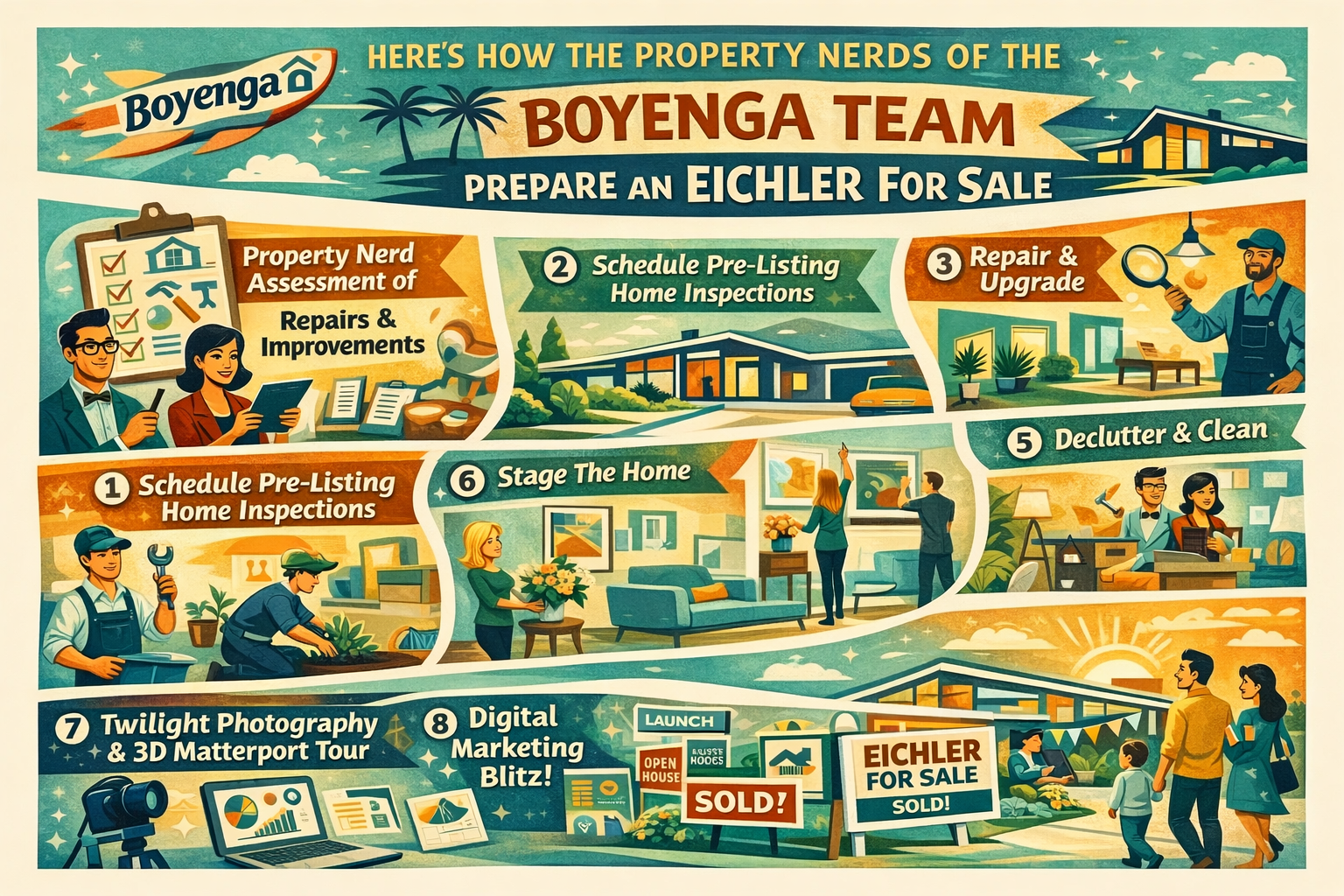
Preparing a vintage Eichler home for sale goes beyond decluttering and curb appeal – it requires proactive maintenance and expert planning before the sign ever goes up. The Boyenga Team (dubbed “the Property Nerds” for their detail-oriented approach) follows a comprehensive checklist in the pre-listing phase.
Maintenance and Inspections: Eichler Home Systems
Because most Eichlers are 60+ years old, early inspections and maintenance are crucial. The Boyenga Team coordinates a pre-listing inspection with professionals who understand Eichler construction, aiming to surface any potential red flags (and address them) before buyers arrive. Key areas of focus include:
Roof & Drainage: Eichler roofs are flat or gently sloped and must be absolutely watertight. Any leaks are repaired and the condition of the roof coating or foam is verified to be in good shape. They ensure the home’s characteristic exposed eaves and fascia remain intact during any roofing work (preserving the original profile), and that gutters and downspouts direct water away from the slab foundation to protect the concrete slab’s integrity.
Radiant Heating: Most Eichlers were built with in-floor radiant heat – a beloved feature when functioning, but a potential Achilles’ heel if leaking. The Boyenga Team brings in a radiant heat specialist to test the system for leaks or failed sections. Original steel or copper radiant pipes can corrode after decades, so if the system is non-operational, they’ll arrange for repairs or discuss installing an alternative heating solution before listing. Ensuring the home has reliable heat (ideally the original radiant system, if salvageable) gives buyers peace of mind that this classic feature won’t become an expensive headache.
Electrical System: Eichler’s original 1950s electrical panels (often 100-amp fuse boxes) are usually insufficient for modern needs. The Boyenga Team checks if the panel has been upgraded; if not, they often recommend installing a new 200-amp breaker panel prior to sale. This not only addresses a safety and capacity issue (many Eichlers lack grounded outlets, which are upgraded to GFCIs as needed), but it becomes a selling point that the home’s electrical infrastructure meets modern codes. Replacing an old panel or ungrounded outlets is a relatively small investment that removes a common buyer concern and signals that the home has been conscientiously updated for today.
Plumbing & Sewer: The team also advises a sewer lateral inspection and plumbing check, given the age of the pipes. It’s common for mid-century sewer lines to suffer root intrusion or cracks. Identifying any issues means they can proactively fix them (for example, using a trenchless sewer liner if roots are found). Being able to advertise a “new sewer line” or leak-free plumbing is a huge plus for buyers of an older home. All faucets, fixtures, and water heaters are checked and serviced so that the plumbing appears worry-free during showings. The goal is a turn-key Eichler, where the vintage charm is backed by solid, updated fundamentals.
By tackling these core systems upfront, the Boyenga Team eliminates potential deal-killers before the home hits the market. Addressing big-ticket maintenance (roof, heat, electrical, plumbing) ensures that inspections during escrow won’t derail the sale, and it gives buyers confidence that this Eichler’s beauty is more than skin-deep. In short, an Eichler listed by the Boyenga Team comes with no unwelcome surprises – only the expected mid-century delights.
Cosmetic Upgrades and Repairs
Beyond the fundamental systems, the Boyenga Team will often coordinate a series of light cosmetic upgrades to make the Eichler shine while respecting its era. Every home is different, but common pre-sale improvements include refinishing the original concrete floors or hardwood, touch-up painting (using colors that complement mid-century style), and refreshing any worn surfaces. Importantly, they choose materials and colors in keeping with Eichler’s mid-century palette – e.g. restoring mahogany wood panels rather than drywalling over them, or painting accent walls in retro hues like orange or teal for a pop of authenticity.
In the kitchen and bathrooms, where buyers expect more modernization, the team focuses on cost-effective makeovers: resurfacing or painting the flat-panel cabinet fronts (instead of ripping them out), updating cabinet pulls to a sleek vintage-inspired design, installing a new faucet or light fixture with a mid-century modern look. These small changes can make dated spaces feel fresh yet period-correct. For instance, simply swapping in a sputnik-style pendant lamp over the dining area or vanity globe lights in a bathroom can transform the ambiance and nod to the home’s 1960s roots. Fresh, neutral paint on interior walls (often white or soft gray) brightens the home and lets the beams and trim stand out. The Boyenga Team has a keen eye for what to update versus what to preserve – their mantra is “improve the functionality and cleanliness, but don’t over-modernize.” Every cosmetic project is vetted to ensure it adds value without erasing character.
Notably, the Boyenga Team has access to the Compass Concierge program, which can front the costs of these improvements (from staging to minor renovations) with no upfront cost to the seller. This means an Eichler homeowner can, for example, confidently proceed with that much-needed exterior paint job or bathroom refresh recommended by Boyenga, knowing they don’t pay for it until the home sells. It’s a strategic advantage that allows the team to polish the home to its fullest potential – the house looks magazine-ready on day one, which ultimately attracts higher offers, more quickly.
Eichler-Experienced Vendors & Contractors
One of the Boyenga Team’s strengths is their network of Eichler-savvy professionals. Not every contractor or inspector understands the nuances of these unique homes – but over decades of Eichler transactions, Boyenga has built a roster of experts who do. They will connect the seller with the right people: a roofer experienced in foam-flatroofs, an electrician who’s familiar with Eichler wiring quirks, or a radiant heating guru who has literally crawled under dozens of Eichler slabs. By “speaking the language” of Eichler construction, the Boyenga Team and their vendors can devise solutions that respect the home’s design (for example, finding a leak in a radiant system without unnecessarily jackhammering the entire floor).
This vendor coordination extends to staging and inspections as well. The Boyenga Team partners with home stagers who specialize in mid-century modern decor and understand that less is more (more on staging below). They also know the local inspectors who “get” Eichlers – in terms of recognizing the difference between a cosmetic concrete slab crack versus a serious foundation issue, or understanding how to pressurize a radiant system for testing. By having the right experts on the job, potential problems are addressed in an Eichler-appropriate way, and there’s no trial-and-error with folks who might inadvertently damage the home’s features. This level of care in choosing vendors ensures that any pre-sale work enhances the Eichler’s value and that the home is presented to buyers in top form, with authentic materials and craftsmanship.
In summary, meticulous preparation is the foundation of the Boyenga Team’s Eichler selling strategy. Original features are preserved or repaired, necessary fixes are made by Eichler experts, and strategic upgrades are implemented – often financed through Compass Concierge – to maximize appeal. By the time they finish pre-listing prep, the Eichler is not only true to its mid-century soul, but also market-ready: clean, functional, and poised to wow even the most discerning buyers.
Eichler-Specific Staging Approaches
Staging emphasizes the Eichler indoor-outdoor lifestyle: here, a 1960s Eichler’s atrium and living room flow seamlessly, furnished with period-appropriate pieces. Clean lines, iconic lighting (note the globe pendant), and natural touches create an inviting mid-century modern ambiance.
Staging an Eichler home is all about showcasing its mid-century modern vibe and unique architectural features in their best light. The Boyenga Team often says that in an Eichler, the architecture is the star – so the staging’s job is to frame that star perfectly. Practically, this starts with subtractive staging: decluttering and simplifying the spaces so that the eye is drawn to the home’s design elements (not the furniture). They have the seller remove excessive or oversized furniture, personal photos, and any decor that conflicts with the mid-century style. By paring down, the post-and-beam construction and open layout take center stage. For example, the natural wood beams in the ceiling are left exposed and clean, not visually chopped up by tall armoires or busy artwork. Floor-to-ceiling glass walls are cleared of heavy drapes or blinds – if any window coverings are needed, they’re minimal and translucent to let the light pour in. This approach creates a bright, open canvas that highlights signature Eichler traits: exposed wood ceilings, expanses of glass, and indoor-outdoor sightlines.
Next comes furnishing and decor with a purpose: to complement the architecture and evoke the mid-century era, while still feeling welcoming. The Boyenga Team brings in (or works with staging companies to source) mid-century modern style furniture that looks like it belongs in a 1955 Eichler, not a 2020 suburban tract home. Think low-slung sofas with clean lines, iconic pieces like Eames lounge chairs or Nelson benches, a Tulip dining table, and geometric area rugs with pops of retro color. They often use authentic vintage items or high-quality reproductions – for instance, a classic surfboard-style coffee table or a starburst clock on the wall – to instantly telegraph that cool “Mad Men” aesthetic. Importantly, comfort isn’t sacrificed: they blend in some contemporary touches like a plush throw or subtle modern sectional to ensure the home feels livable, not like a museum. The color palette for staging an Eichler tends to be neutral base tones (whites, grays, natural wood) punctuated by bold mid-century accent colors – perhaps teal or orange throw pillows, or an accent chair in mustard yellow – echoing the era’s design sensibilities.
Staging also extends to highlighting the indoor-outdoor flow that Eichlers are famous for. The Boyenga Team makes a point to stage not just the interior rooms, but also the atrium and backyard/patio areas as true living spaces. For example, the central atrium (often the first space a buyer walks into) might be styled as a Zen garden with minimalist landscaping and a couple of sculptural lounge chairs for morning coffee. Alternatively, if targeting young families, they might stage the atrium with a few kid-friendly touches or as an outdoor dining nook – painting a picture of the versatile lifestyle the space allows. Outdoor furniture is chosen to complement the interior: sleek, weatherproof versions of mid-century designs, arranged on the patio to suggest an “outdoor living room.” This way, when buyers tour the home, every glass wall they look through presents another inviting vignette – a reading chair by the floor-to-ceiling window, or a pair of butterfly chairs on the lawn facing the sunset.
Lighting is another subtle but important aspect of staging. Eichlers were built to maximize natural light, so daytime showings are bright and airy by design. The Boyenga Team ensures all windows are spotless and unobstructed, and they might place a mirror strategically to amplify the light further. For evening viewings, they bring in additional floor and table lamps (since many Eichlers lack overhead lights) with a mid-century flair – for example, a tripod floor lamp or an arc lamp in a corner. Original globe pendant lights are a huge asset; if the home still has them, they make sure to feature those prominently (sometimes even using them as a motif in marketing). Good lighting levels make the home feel warm and inviting, especially highlighting textured walls or art in the evenings.
Overall, the Boyenga Team’s Eichler staging philosophy is “let the house speak.” By removing distractions, using period-correct furnishings, and drawing attention to the architectural drama (be it a vaulted ceiling or an atrium view), they enable buyers to emotionally connect with the home. In fact, well-staged Eichlers often elicit a visceral response – buyers walk in and immediately “get” the lifestyle on offer. Eric and Janelle Boyenga have partnered with some of the best Eichler stagers in the Bay Area, and their staged homes frequently end up looking like spreads from Dwell magazine. This careful staging not only helps the home look its best, but also helps buyers imagine themselves living the mid-century modern dream. That emotional vision can translate into higher offers and even bidding wars, as the Boyenga Team has seen time and again (with Eichler listings selling hundreds of thousands over asking after staging and prep).
Visual Marketing Strategies: Photography, Video & Beyond
Marketing an Eichler home requires visual storytelling that captures its architectural magic. The Boyenga Team invests heavily in professional photography and other media to ensure that the first impression online is as stunning as the home itself. Unlike a generic tract home that might get by with standard photos, an Eichler demands an architectural photography approach. The team hires photographers experienced in mid-century modern homes, instructing them on key shots to get: the expansive open-plan interior that shows the flow from living room to atrium to yard, the classic post-and-beam ceiling shot (often taken from a low angle to include both ceiling and floor-to-ceiling glass in frame), and the indoor-outdoor vignettes that define Eichler living. Typically a mix of wide-angle shots – to capture how spaces connect – and closer detail shots – like a cozy conversation corner or the play of sunlight across the mahogany wall – are used, so buyers appreciate both the scale and the intimate details of the design.
One signature Boyenga strategy is incorporating twilight and nighttime photography into the marketing portfolio. Eichler homes are absolutely enchanting at dusk: as interior lights glow through the glass walls and the sky darkens to deep blue, the home takes on a dramatic, almost lantern-like aura. The Boyenga Team often literally waits for the “magic hour” to capture the atrium lit up from within and the roofline against the evening sky. These twilight images are used prominently in ads and brochures because they tug at buyers’ heartstrings, selling not just the architecture but the mood of mid-century modern living. In fact, they’ve found that a well-done twilight photo – the atrium glowing warmly, the iconic globe lights shining – can stop scrolling buyers in their tracks and even encourage late-day open house events to show off that ambiance. Along with still photos, aerial drone shots are frequently employed to show the Eichler in context: an overhead view highlighting the geometric roof pattern and how the property sits in the neighborhood (especially effective if it’s in an enclave of other Eichlers or has a large yard). Drone photos at twilight, capturing the whole street as porch lights come on, have become a Boyenga hallmark – creating a “wow” image that conveys community and context in one frame.
Video marketing is another area where the Boyenga Team leverages technology. They produce high-definition video tours that might include a walkthrough set to music, highlighting how one can move from the front door, through the atrium, into the living areas and out to the yard in one continuous flow. These videos often mix in some lifestyle shots (a family enjoying the space, or close-ups of architectural details like the Eichler front door with its circle cut-outs). Additionally, they provide 360° virtual tours (Matterport or similar) so that out-of-town or busy buyers can “walk through” the home online. Given Eichler homes attract enthusiasts from all over, not just locals, this is important – an architect in New York or a mid-century fan in L.A. can explore the property remotely. Virtual tours are especially useful for conveying layout in an open-concept home, as users can pan around the atrium and see how rooms connect. The Boyenga Team also uses these digital assets in their Compass Coming Soon campaigns – releasing a teaser video or a spectacular photo on social media before the listing officially hits the market, to build buzz and anticipation.
On top of photos and videos, the print materials and website presentation are carefully crafted. They produce glossy brochures for each Eichler listing that read almost like an architecture magazine feature: professional photos arranged alongside descriptions of the home’s design story, maybe a quote about Joseph Eichler’s philosophy, and callouts of special features (“Original 1959 Eichler built by Jones & Emmons, lovingly maintained!”). The Boyenga Team understands that Eichler buyers are design-savvy, so everything from the font to the layout of these brochures is chosen to feel mid-century modern and sophisticated. They may even incorporate floor plans or vintage Eichler marketing materials in the presentation for that extra credibility with enthusiasts.
In summary, visual marketing is where the Boyenga Team truly “engineers happiness” for Eichler listings. High-quality imagery not only attracts more eyeballs online (leading to more showing appointments), but also primes buyers to fall in love before they ever set foot inside. By showcasing the home’s architecture under the best conditions – bright daytime interiors, dreamy twilight exteriors, sweeping drone perspectives – they sell not just a house, but the lifestyle and emotion that comes with owning an Eichler. It’s a strategy that consistently results in packed open houses and, often, multiple offers from captivated buyers.
Buyer Targeting and Outreach
Finding the right buyer for an Eichler is as important as prepping the house itself. Fortunately, Eichlers come with a built-in target market: design enthusiasts, mid-century modern aficionados, and Silicon Valley professionals who appreciate style and history. The Boyenga Team has made a science of reaching these buyers where they are looking.
Firstly, they’ve developed a specialized online presence for Eichler and mid-century listings. Generic real estate marketing can fall flat for this niche, so Boyenga created Eichler-specific websites (like EichlerHomesForSale.com) rich with content about Eichler neighborhoods, history, and architecture – all packed with the keywords Eichler lovers might search. If someone Googles “Eichler home for sale Palo Alto” or “mid-century modern Silicon Valley,” chances are they’ll land on a Boyenga page featuring just the kind of property they want. This tailored SEO strategy means their Eichler listings attract organic traffic from exactly the demographic we want: people actively hunting for mid-century modern homes. In fact, the Boyenga Team’s web presence is widely regarded as the best mid-century modern real estate resource in the area, precisely because it speaks to that passion and “Eichler fever” that exists in the community.
Beyond search engines, the Boyenga Team uses targeted digital marketing campaigns to reach out to likely Eichler buyers. They identify buyer personas – for example, the tech executive who admires architectural homes, or the empty-nester designer who’s always wanted an Eichler – and craft their messaging to resonate with those groups. Social media is a big part of this: they run Instagram and Facebook ads not just with generic home photos, but with striking Eichler images and captions that highlight architectural features (“Open-air atrium atrium ✨, post-and-beam elegance🏡 – Eichler open house this Sunday!”). These posts often include tidbits about Eichler homes (like an interesting fact about the architect or the year built) to catch the eye of mid-century design fans scrolling by. The Boyenga Team’s social accounts and e-mail newsletters essentially function as mid-century modern channels, sharing Eichler renovation tips, local MCM events, and new listings in a way that builds a following of engaged enthusiasts. When a new Eichler listing comes up, they’ll blast it out to this cultivated audience who already loves the style. They also maintain relationships with the Eichler Network and other local MCM groups, ensuring that word-of-mouth in the tight-knit Eichler fan community augments their outreach.
Crucially, Boyenga doesn’t rely solely on the MLS to syndicate listings. They make sure Eichler homes get featured on niche and high-profile architecture platforms. This can include listing the property on sites like Dwell, Curbed, or other design blogs that have real estate sections. They might reach out to editors if the home has a particularly interesting story (e.g., “first time on market in 50 years, untouched original Eichler”) to see if it can get an editorial mention. In print, they consider advertising in architectural magazines or local design-oriented publications, knowing that Eichler buyers often read those. Even the open houses are approached creatively: the Boyenga Team has been known to host themed open house events for Eichlers. For example, an afternoon open house might feature 1950s jazz music, retro cocktails, and Eichler historical displays, transforming a showing into a mid-century social event. This not only draws big crowds (including media attention sometimes), but also helps the right buyers emotionally connect — they’re not just viewing a home, they’re experiencing the Eichler lifestyle for an afternoon.
Another modern tool in their arsenal is the Compass platform’s buyer analytics. The Boyenga Team can leverage data on who is searching for what. If their Compass website shows many users “favoriting” Eichler listings or searching in certain Eichler neighborhoods, they can target those specific users with notifications or new listings (with their permission). They also utilize Compass Collections, a feature where agents can create curated boards of listings for their clients. Many mid-century-minded buyers will have a “My Eichler Wishlist” collection. By listing an Eichler with Boyenga/Compass, the home can be directly shared into those collections that agents or buyers have set up for Eichlers, immediately getting in front of an audience that’s already expressed interest in this type of home. It’s a high-tech way of tapping an existing pool of enthusiasts.
Overall, the Boyenga Team’s outreach is laser-focused on Eichler and MCM enthusiasts. They know that the likely buyer is not the average person looking for a house – it’s someone with a bit of “Eichler fever.” So every marketing channel, from web searches to social media to open houses, is calibrated to speak that buyer’s language (literally using terms like “atrium,” “modernist gem,” “indoor-outdoor living” in the ads). This precision means their Eichler listings don’t languish waiting for the right buyer to stumble along – they actively find and excite those buyers, often driving demand up through the sense of community and exclusivity they create around these homes.
Storytelling & Educational Marketing for Eichler Heritage
Selling an Eichler isn’t just a transaction for the Boyenga Team – it’s an opportunity to tell a story about architectural heritage and lifestyle. They firmly believe that educated buyers will value the home more, so they make a point to weave Eichler’s story and unique qualities into the marketing. One way they do this is through rich listing descriptions and collateral that go beyond “3 bed, 2 bath.” A Boyenga Eichler listing will typically mention Joseph Eichler by name, note the architect if known (many Eichlers were designed by notable architects like Anshen+Allen or Jones & Emmons), and highlight features in narrative form – e.g. “Experience life under the exposed beams of this Claude Oakland-designed Eichler, where sunlight dances across Philippine mahogany walls and every room opens to your private atrium.” This kind of language educates buyers on what is special before they even set foot in the door. It frames the home as art as much as real estate. The Boyenga Team’s marketing copy consistently uses the correct mid-century terminology – they’ll talk about the tongue-and-groove ceiling, the carport, the radiant floor heating, etc., which both signals to aficionados that “these agents know their stuff” and helps newcomers learn why these elements matter.
In their open houses and private showings, the Boyenga agents and team members almost take on the role of docents in a museum. They’ll share anecdotes about the Eichler development history, point out original features (“This pendant light is original – Eichler homes often came with these dome lights, which are now very collectible”), and even have display boards or handouts that outline Eichler’s background. It’s not unusual for them to have a coffee table booklet at the open house with vintage Eichler brochure images, floor plans, and a write-up about Joseph Eichler’s philosophy of “bringing modern architecture to the masses.” By giving visitors this context, they aren’t just seeing a cool house – they’re learning that they could own a piece of California modernism history. This kind of storytelling creates an emotional connection; buyers start to see themselves as custodians of something significant, not just purchasers of a property.
The Boyenga Team also creates content specifically to educate and engage the Eichler community. Their Eichler Blog (on EichlerHomesForSale.com) features articles on topics like Eichler renovation guidelines, the importance of preserving original materials, Eichler vs. contemporary home comparisons, and so on. These posts serve a dual purpose: they attract traffic (good for SEO) and they establish Boyenga as knowledgeable experts (good for credibility). For example, they have blogged about why Eichlers are “magical at night” with tips on lighting (which subtly encourages sellers to do twilight photography and buyers to appreciate it). They’ve written about the top Eichler neighborhoods, profiling each tract’s history and community vibe. All of this content is shared freely, often through their newsletter and social media, effectively educating potential buyers even before they have a specific listing in mind. By the time someone comes to one of their Eichler listings, they might have already read a Boyenga article about radiant heating or seen a post about mid-century landscaping tips. This pre-education means buyers are more primed to value what they see (for example, understanding why that unpainted wood paneling is a gem, not an eyesore).
A particularly innovative storytelling tool the Boyenga Team uses is Compass Collections, mentioned earlier. When representing an Eichler, they can create a curated online collection for that listing – not just including the home’s photos, but also supplementary content: maybe a scan of the original 1960s Eichler brochure for that model, a couple of photos of other Eichlers of the same design for reference, or even design idea images showing how an atrium could be furnished. They might title the collection something like “Eichler Living in Greenmeadow – Story and Inspiration.” Buyers (and their agents) who view this collection get a richer narrative around the home, and Boyenga agents can update it in real time with new info or answers to questions. It essentially creates a micro-site for the home that tells a story and educates – a far cry from a basic MLS listing. According to Compass, this kind of approach helps buyers feel more informed and in control. The more a buyer knows about the value of what they’re buying (architecturally and historically), the more confident they often feel in making a strong offer.
Finally, the Boyenga Team leverages the power of testimonials and success stories as part of their storytelling. They often share case studies (in person or in marketing) of past Eichler sales: for instance, how staging and a few restorations turned a Cupertino Eichler into a record sale with multiple offers. Or how one Eichler’s sellers used Compass Concierge to refinish their original tongue-and-groove ceiling and were rewarded with buyers who fell in love with it. These narratives do two things: they educate sellers (showing Boyenga’s expertise and the reasoning behind their methods) and educate buyers (illustrating the passion others have for these homes, which can be contagious). Often, a buyer will hear how a previous Eichler sold in a weekend with 10 offers and think, “Wow, I’d better come in strong on this one.” It builds a sense of community and excitement around Eichler transactions that is truly unique.
In essence, storytelling is woven into every step of the Boyenga Team’s Eichler marketing. They aren’t just selling square footage – they are selling the Eichler legacy. By teaching the uninitiated and connecting with the devoted, they create a narrative around each home that elevates it from a listing to a chapter in the Eichler story. And buyers, especially the enthusiasts, respond to that on a deeply emotional level, which often translates into a willingness to pay a premium for the honor of becoming the next owner in that story.
Tech Tools & Next-Gen Marketing Platforms
It’s no accident that Eric and Janelle Boyenga are known as the “Property Nerds.” Their team embraces cutting-edge technology from the Compass brokerage to give Eichler sellers a modern advantage. This tech-driven approach operates behind the scenes to complement the traditional prep, staging, and marketing. Some of the key next-gen tools include:
AI-Powered Pricing Intelligence: Eichlers don’t fit the mold of a cookie-cutter CMA (Comparative Market Analysis), so Boyenga leverages Compass’s artificial intelligence pricing platform to analyze massive datasets and pinpoint the optimal price range for a unique home. The AI CMA tool can identify relevant comps beyond just the immediate neighborhood – for example, pulling in other mid-century or architectural home sales across the Bay Area that a human agent might overlook. It even makes nuanced adjustments (e.g., recognizing that a mostly original Eichler in great shape can command a premium over one with altered features) and presents the data in smart charts. By blending this data intelligence with their own Eichler market expertise, the Boyenga Team sets pricing strategies that are aggressive yet justified. This means sellers don’t leave money on the table, and buyers see the rationale (often through data visualizations) for the home’s value.
Compass Concierge Program: Preparing an Eichler often involves tackling a list of repairs and upgrades – and not every seller has the cash upfront. The Compass Concierge program is a game-changer, essentially a zero-interest, no-fee loan that front-funds home improvement costs so sellers can maximize their sale price without financial strain. The Boyenga Team helps Eichler sellers identify which improvements will add the most value (from critical fixes like a new foam roof to aesthetic boosts like refinishing the concrete floors or staging with high-end furniture), and then Compass covers those costs upfront. For example, if an Eichler needs $30k of work – a kitchen facelift, new landscaping, and staging – Compass Concierge will pay those bills, and the seller simply pays back that $30k at closing (with no added fee or interest charged). This tool removes the biggest hurdle to doing what’s right for the home. Boyenga frequently cites cases where Concierge investment yielded huge returns – such as an Palo Alto Eichler where ~$50k in Concierge-funded updates (exterior paint, restoring an atrium garden, updating the electrical panel) led to multiple offers and several hundred thousand over asking in the final sale. In short, Concierge lets the Boyenga Team “flip the house” in the market’s eyes without asking the seller to front the cash, ensuring every Eichler is showcased at its best and addressing any buyer objections before they arise.
Compass Collections & Digital Reach: As discussed, Compass Collections is a high-tech platform that acts like a Pinterest for home buyers – and Boyenga exploits it fully for Eichlers. By curating a Collection for the listing, they get the home in front of Compass’s nationwide network of agents and buyers who have shown interest in similar homes. Moreover, the Boyenga Team can monitor anonymous feedback from these collections: if multiple buyers “favorite” the listing or comment on loving the open atrium, that’s valuable intel they can use in negotiations or marketing. Beyond Collections, Boyenga utilizes Compass’s broader digital marketing suite – this includes hyper-targeted Facebook/Instagram campaigns managed through Compass (hitting users who have, say, frequented design websites or searched for home renovation content), as well as email blasts to Compass’s internal agent network which often contain buyer wants (“ISO Eichler in Mountain View”) that the AI matches with their listing. They also take advantage of Compass’s Coming Soon feature: this allows them to post the Eichler as “coming soon” on Compass.com and affiliated sites before it’s on the open MLS, building pre-market buzz and often yielding private showings or even early offers from Compass-connected buyers who get the sneak peek. All of these tools embody the Boyenga ethos of using data and technology to amplify the marketing – they’re not just putting a sign in the yard and praying; they’re actively engineering a successful sale using every modern platform available.
In-House Marketing Analytics: The “Property Nerds” nickname also comes from Boyenga’s penchant for analytics. They track everything – online page views, click-through rates on the Eichler listing photos, engagement time on their virtual tours, etc. If the data shows, for example, that the twilight photo is getting far more clicks, they might boost that image in advertising. If their EichlerHomesForSale site analytics show heavy traffic from a particular city (say, lots of views from San Francisco or LA), they might decide to do a targeted campaign in that area, knowing there’s interest from those buyers. This iterative, analytical approach is something traditional agents may not do, but Boyenga’s team embraces it to continuously fine-tune their marketing while the property is listed.
Ultimately, these tech tools allow the Boyenga Team to market Eichler homes smarter and faster. Sellers benefit from precise pricing, stress-free home improvement, and maximum exposure; buyers often find the process smoother too, with access to more information and the feeling that the listing was practically made for them. It’s a blending of high-tech innovation with high-touch service – the Boyengas still do the personal work of telling the Eichler’s story and guiding clients, but they’re supported by some of the most advanced real estate tech in the industry. This combination is one reason the Boyenga Team’s Eichler listings consistently stand out and achieve top dollar (and why they’re in the Top 100 Real Estate Teams in the U.S.). It’s not just about selling a house – it’s about engineering a superior selling experience for a very special kind of home.
The Boyenga Team at Compass are widely recognized as Silicon Valley’s premier Eichler and mid-century modern real estate experts. Known as The Property Nerds, the team blends architectural fluency, data-driven strategy, and next-generation marketing to represent some of the most design-significant homes in the Bay Area.
Led by Eric Boyenga and Janelle Boyenga, the team approaches Eichler homes differently than traditional agents. Rather than “updating away” what makes an Eichler special, they focus on preserving architectural integrity while solving the real issues buyers care about — radiant heat, roofs, electrical capacity, indoor-outdoor flow, and authenticity.
Eric and Janelle work hands-on with their clients, coordinating Eichler-experienced inspectors, contractors, designers, and stagers, while leveraging Compass tools like Concierge, Collections, and advanced pricing analytics to position each home precisely in the market. Their process is collaborative, transparent, and deeply strategic — designed to protect legacy, reduce risk, and maximize outcome.
From original, largely untouched Eichlers to architect-reimagined modernist renovations, the Boyenga Team has built a reputation for selling Eichler homes correctly — to the right buyers, with the right story, at the right moment.
Sources: The insights and examples above were synthesized from the Boyenga Team’s Eichler-focused resources and real estate guides, including their comprehensive Eichler selling guide, staging and marketing tips from their blog, and Compass platform information. These sources reflect the Boyenga Team’s extensive experience and thought leadership in mid-century modern real estate. By following their approach – preserving Eichler’s mid-century essence while leveraging modern strategy and technology – sellers can feel confident that their Eichler home is in the best possible light when it hits the market.