
Jones & Emmons: Defining Eichler’s Mid-Century Modern Homes
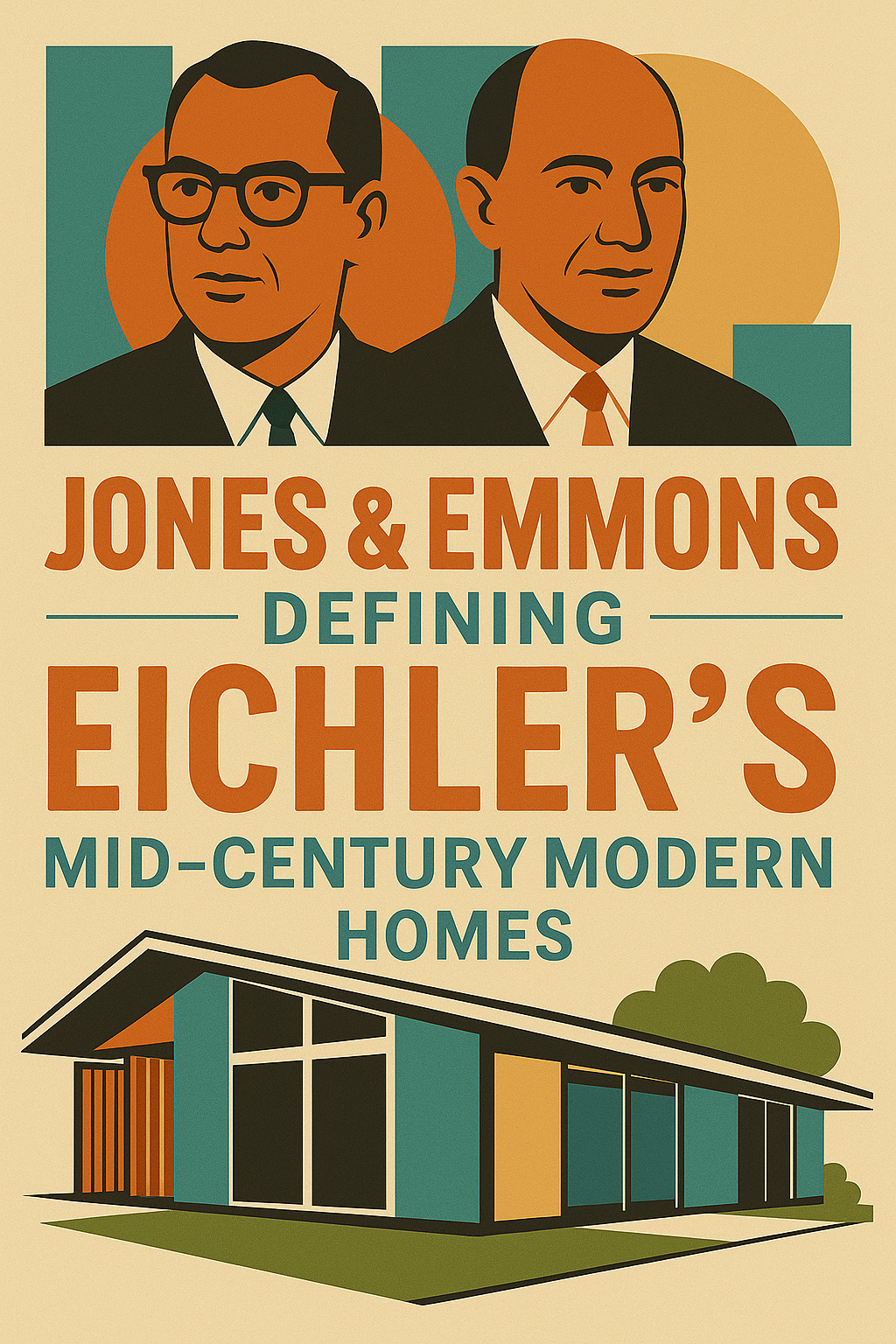
Inside the Jones & Emmons Blueprint: How Their Designs Shaped the Eichler Legacy A classic mid-century Eichler home designed by Jones & Emmons, showcasing the low-pitched roof, broad eaves, and minimalist façade typical of the Eichler style. This 1950s Palo Alto house features vertical wood siding, a simple geometric facade, and a carport—hallmarks of the California Modern look almanacnews.comirvinehousingblog.com.
Background: A. Quincy Jones and Frederick Emmons
A. Quincy Jones and Frederick E. Emmons were the dynamic architectural duo behind thousands of Joseph Eichler’s celebrated mid-century modern homes. Jones (born 1913) earned his architecture degree at the University of Washington in 1936 en.wikipedia.org. He cut his teeth working for modernist architects in Los Angeles (including Douglas Honnold, Burton Schutt, and Paul Williams) before World War II usmodernist.orgen.wikipedia.org. Emmons (born 1907) graduated from Cornell University’s architecture program in 1929 and also gained experience with top firms like McKim, Mead & White and William Wurster before moving west latimes.com. The two met working in LA’s Allied Engineers office around 1940 usmodernist.org, where they discovered a shared vision for forward-looking design. After wartime Navy service, Jones opened his own practice and soon reconnected with Emmons to form the partnership of Jones & Emmons in 1950 latimes.com.
Despite their different personalities – Jones was the imaginative designer, Emmons the practical, even-keeled partner – they complemented each other perfectlylatimes.com. Jones became a respected professor (and later dean) at USC’s School of Architecture, influencing a generation of architects, while Emmons deftly handled clients and project managementlatimes.comlatimes.com. Both men were deeply inspired by the Modernist ideals of light-filled spaces, honest materials, and functional design for everyday living. Jones in particular had been influenced by Frank Lloyd Wright’s Usonian principles – he even worked on a case study program house and partnered with Wright’s apprentice Anshen & Allen on early projects eichlerhomesforsale.com rostarchitects.com. This philosophy aligned perfectly with developer Joseph Eichler’s goal of bringing high-quality modern architecture to middle-class California homes. Eichler insisted on “bringing the outdoors in” with open plans and walls of glass eichlerhomesforsale.com irvinehousingblog.com, a concept Jones & Emmons would embrace wholeheartedly. In short, both architects believed good design should be accessible and improve the way people live – a conviction that would drive their work with Eichler.
Partnering with Eichler: Origins of a Visionary Collaboration
The partnership between Jones & Emmons and Joseph Eichler began serendipitously in 1950 and would prove enormously influential. That year, Architectural Forum magazine honored a custom home designed by Jones as “Builder’s House of the Year,” and simultaneously named Eichler’s fledgling Palo Alto subdivision “Subdivision of the Year” usmodernist.orgmoderndesign.org. Impressed, Eichler personally invited Jones to tour his Palo Alto tract, proposing that the “Architect of the Year” team up with the “Builder of the Year.” A simple handshake sealed the deal, forging a creative alliance that lasted until Eichler’s death in 1974 moderndesign.org. Jones quickly brought Emmons on board in 1951 to help execute the large volume of work Eichler’s developments would require usmodernist.orglatimes.com.
From the beginning, Eichler and his new architects found common ground in their progressive vision. Eichler was not a typical tract developer – he had lived in a Frank Lloyd Wright home during the 1940s and became determined to “democratize” modern architecture for average families rostarchitects.com npr.org. He sought architects who could design open, sunny homes that were aesthetically modern yet practical and affordable. Jones & Emmons fit the bill perfectly. As historian Dave Cornoyer notes, they “made a successful name for themselves in the midcentury era as the preferred architects for prolific developer Joseph Eichler” docomomo-us.org. Between 1951 and 1969, the firm designed roughly 5,000 Eichler houses by Emmons’ own estimate en.wikipedia.org – an extraordinary output that speaks to the efficiency and consistency of their design system. They were even recognized with the AIA National Firm of the Year award in 1969 for their contributions usmodernist.org.
Working hand-in-hand with Eichler, Jones & Emmons established many of the standards that defined the “Eichler home.” They introduced thoughtful site planning to the tract format, incorporating parks, greenbelts and community amenities into subdivision layoutsen.wikipedia.orgalmanacnews.com. Eichler gave them freedom to plan whole neighborhoods with shared pools or play areas, realizing Jones’s concept of “park-like common areas” to foster community en.wikipedia.org. Just as importantly, Eichler insisted on fairness and inclusivity in housing – a stance the architects fully supported. Eichler’s non-discrimination policy meant anyone (regardless of race or religion) could buy his homes, which was revolutionary in the 1950s npr.orgmcmdaily.com. One Eichler tract designed by Jones & Emmons in Granada Hills (Balboa Highlands, 1963) became the first in its area to welcome African-American buyers, a point of pride in Eichler’s legacy latimes.com. In short, the partnership was built on a shared idealism: they believed modern design could create not just houses but better communities and lifestyles.
Key milestones of the Jones & Emmons/Eichler collaboration came quickly. In 1954–55 they designed Greenmeadow in Palo Alto, an innovative 270-home tract wrapped around a central community center and pool almanacnews.com. Greenmeadow’s success (it won national awards and remains a preserved historic district) proved that Eichler’s approach to modern living had wide appeal almanacnews.com. In 1956, Jones & Emmons designed Eichler’s experimental “X-100” steel house, a visionary prototype built in the San Mateo Highlands tract that explored new materials and futuristic features midcenturyhome.com. The X-100, a one-of-a-kind all-steel model home with two interior courtyards and space-age amenities, was billed as the “house of tomorrow” and drew national attention eichlerx-100.com bungalowjournal.com. By the late 1950s, the architects were regularly devising new model floorplans each year as Eichler expanded. They introduced features like covered atrium entrances, new roof profiles, and even a rare two-story design, keeping Eichler homes at the cutting edge of modern style to meet evolving buyer tastes. Emmons retired in 1969, and Jones continued with other projects (Eichler Homes itself had slowed by then), but the two decades of Jones & Emmons’s partnership with Eichler left an indelible mark on mid-century housing. Together, they “bridged the gap between custom-built and merchant-built homes, producing dynamic, livable housing for the postwar moderate-income family”moderndesign.org – exactly as Eichler had envisioned.
Iconic Eichler Designs and Innovations
Jones & Emmons were responsible for many of Eichler’s most iconic home designs, floorplans that now epitomize California mid-century modernism. They excelled at creating layouts that felt open, airy, and flexible within the modest footprints of a tract house. A hallmark was the use of post-and-beam construction, which eliminated interior load-bearing walls and allowed for free-flowing living spaces rostarchitects.com. This structural system – essentially a framework of exposed wood beams and posts – could be erected quickly and enabled Eichler homes to have the open-plan living/dining areas and broad glass expanses that set them apart rostarchitects.com. Jones & Emmons paired these modern structures with natural materials to keep the homes warm and inviting. For example, they famously lined interiors with exposed Philippine mahogany paneling, a rich wood veneer on walls and cabinets that gave tract houses a custom, high-quality feel rostarchitects.com. As one architect observed, the beautiful grain of the mahogany panels made each home unique and was easy to install – functional artistry that became an Eichler signature rostarchitects.com.
Perhaps the most celebrated innovation Jones & Emmons brought to Eichler homes was the central atrium layout. Courtyard houses were not new (ancient Roman and Asian homes had them), but Jones & Emmons reimagined the concept for 20th-century California living eichlerhomesforsale.com. In 1958, they unveiled the first true “Atrium Model” Eichler: a home with a wide open-air courtyard at its entrance, surrounded by glass walls of the living spaces on all four sides eichlerhomesforsale.com. This was a bold departure from a conventional foyer – instead of a front porch, one stepped into a private outdoor room open to the sky, often landscaped and furnished for indoor-outdoor living. From the atrium, sliding glass doors led into the living room, kitchen, and bedrooms, blurring the line between indoors and out. This design proved enormously popular with buyers and quickly became Eichler’s trademark by the early 1960 seichlerhomesforsale.com. As architectural writer Paul Adamson noted, starting in 1958 Jones & Emmons “standardized the fully enclosed, open-roof atrium at the front of the house”, such that many later Eichlers require you to walk through a lush atrium to reach the front door eichlerhomesforsale.com. The appeal was obvious – the atrium brought “air, light, privacy, security, and tranquility” into the heart of the home eichlerhomesforsale.com, allowing families to enjoy California’s climate in total seclusion. It also became a social space where children could play safely or adults could entertain under the stars, all within the home’s footprint. This indoor-outdoor flow – literally bringing the outside in – supported Eichler’s casual, family-centric lifestyle and was imitated by many other builders mcmdaily.comnpr.org.
Other design features introduced or popularized by Jones & Emmons greatly supported the “Eichler lifestyle.” They favored horizontal lines and low-profile roofs that hugged the ground in harmony with the landscape eichlerhomesforsale.com. Most Eichler/J&E models were single-story with either flat or very low-pitched roofs and generous eaves, giving a sleek modern look and also shading the expanses of glass from summer sun almanacnews.com irvinehousingblog.com. On some models the architects added shallow A-frame or gabled roof segments, not just for style but to add drama and clerestory windows for more light. By the early ’60s, for instance, they had developed striking “twin gable” designs (often called double A-frames) where an atrium sits between two peaked roof sections – this allowed high clerestory glass in the gable ends, brightening the interiors with sunlight eichlerhomesforsale.com. In all cases, Eichler roofs had no attics and were often open-beam on the interior, exposing the structural wood ceiling with tongue-and-groove planks – a modernist look that also saved cost on finish plaster eichlerhomesforsale.com. Floors were typically concrete slab with hot-water radiant heating pipes embedded, an efficient system that left ceilings free of ductwork and kept interiors uncluttered irvinehousingblog.com.
Jones & Emmons also optimized the layout of rooms to enhance family living. Many of their Eichler plans separated the sleeping areas into distinct wings – for example, a master suite on one side and children’s bedrooms on the other, with living spaces in between – to give privacy and flexibility for growing families npr.org. “You had two wings completely…so that each side is independent,” recalled one Eichler owner about raising kids in a Jones & Emmons home npr.org. They often included a multi-purpose room (sometimes labeled a den or family room) in addition to the main living room, recognizing the need for casual space where kids could play or parents could set up a home office eichlersocal.com. Storage was smartly integrated via built-in cabinetry. In the kitchen, Jones & Emmons introduced the idea of an “open kitchen” with a pass-through or breakfast bar to the dining area, so the act of cooking became part of family life instead of hidden away – yet they ingeniously paired it with a separate “scullery” or utility area for messier tasks out of sighteichlersocal.com. Even minor details showed their understanding of how people used the homes: in one model they added a second bathroom door leading directly outside, so children could come in from the yard and clean up without tracking mud through the house almanacnews.com. Features like skylights, glass clerestories, and floor-to-ceiling windows were liberally used to flood the homes with natural light irvinehousingblog.com mcmdaily.com. And because many models lacked traditional hallways (rooms often opened directly off the atrium or living areas), the designs felt very efficient and “big” for their square footage almanacnews.com. All these innovations – open plans, atriums, post-and-beam construction, integrated kitchens, and walls of glass – worked together to create houses that were “not like living in a normal house at all…there’s nothing conventional about it,” as one Eichler resident enthusiastically described npr.org. Jones & Emmons had effectively defined a new kind of suburban home: bright, informal, and intimately connected to the outdoors and the family’s needs.
An Eichler atrium at the center of the home, exemplifying Jones & Emmons’ indoor-outdoor design. The open-air courtyard (framed by post-and-beam construction) serves as an outdoor living room, blurring boundaries between interior and exterior. Such atriums, introduced in 1958, became the “heart of the home,” bringing light and nature into Eichler’s floorplanseichlerhomesforsale.comrostarchitects.com.
Evolution of Their Design Style Over Time
Over the span of their Eichler work (early 1950s through the mid-1960s), Jones & Emmons continually refined and adapted their architectural style – responding to new materials, client feedback, different climates, and market trends. Early Eichler homes (1950–54), before Jones & Emmons came aboard, had been designed by Robert Anshen and were somewhat experimental in layout – often L- or U-shaped one-story houses with glass facing an internal patio eichlerhomesforsale.com. When Jones & Emmons took over as Eichler’s principal designers, they built on these ideas but brought a new level of consistency and systematization. In the mid-1950s, their Eichler designs still featured flat or gently sloping roofs and open plans, but without full atriums yet – instead, many had fenced side or rear patios as outdoor extensions of the living room eichlerhomesforsale.com. During these years, Jones & Emmons were honing the modular coordination of parts that made rapid tract construction possible. They embraced standardized components (like pre-fabricated roof beams and window units) to streamline building, but arranged them in varied ways so the tracts wouldn’t look cookie-cutter moderndesign.org sah-archipedia.org. By 1954, they were already offering multiple floorplans in a single subdivision. For example, Palo Alto’s Greenmeadow tract included six different layouts, ranging from a basic 3-bedroom plan to a larger 4-bedroom model with a family room and attached double carport – giving buyers some choice while keeping a cohesive look almanacnews.com.
Around 1958, a pivotal evolution occurred with the advent of the atrium model (as discussed above). This innovation not only set a new aesthetic, but also addressed regional and lifestyle considerations. In Northern California’s temperate climate, an open atrium worked wonderfully to bring sunlight into the home’s core. Eichler himself had initially been cautious, worried that a house presenting a blank wall to the street (hiding an atrium within) might deter buyers eichlerhomesforsale.com. But Jones & Emmons’ 1958 atrium design quickly proved a hit, and thereafter most of their Eichler models were designed “atrium-first.” Starting in 1958, virtually every new Eichler development featured some fully enclosed front atrium plans eichlerhomesforsale.com. The architects did still produce a few non-atrium variants in the late ’50s for variety (and to accommodate small or odd-shaped lots). For instance, in the Orange County tracts, they created a rare model that instead of an atrium had a partially covered entry patio open on one side – a compromise to fit a shallower lot while still providing a private outdoor spaceeichlersocal.comeichlersocal.com. But the atrium concept was clearly the flagship and even evolved itself: by the 1960s, Jones & Emmons and their colleagues experimented with “gallery” atriums (covered skylit atrium halls) and in some cases for Eichler’s later townhouses, two-story atriums that formed dramatic entry courtyards eichlerhomesforsale.com. This constant tweaking showed their willingness to adapt the core idea to different contexts (from single-family homes to cluster homes).
The roof designs and exterior styling of Eichler homes also evolved under Jones & Emmons over time. In the early and mid-50s, most Eichlers had either flat or nearly flat roofs with a simple rectangular form. But as the modern style caught on, the architects felt freer to add visual interest. By the early ’60s, they introduced bolder roof profiles like pronounced peaks and steep A-frame entries to create what one writer called “more adventurous roof forms” that distinguished the newer Eichlers eichlerhomesforsale.com. For example, the 1962–64 Eichler models in neighborhoods like Palo Alto’s Los Arboles and Orange’s Fairhills included prominent front gables, giving a striking angular silhouette to the curb view while still retaining wide eaves and vertical wood siding to stay true to Eichler’s look eichlerhomesforsale.com mcmdaily.com. These peaks often had glass triangles or clerestories that not only looked dramatic but pulled extra daylight into the interiors. In parallel, material choices shifted subtly: the tongue-and-groove redwood or cedar siding remained a constant exterior feature (painted in earth tones or occasionally bright accent colors), but inside, the Philippine mahogany paneling of the 50s gave way to other finishes by the mid-60s as mahogany became scarce. Some later Eichlers used luan plywood or even sheetrock with paint, though many homeowners today restore the mahogany look for its warmth. By the 1960s, insulation and climate control were also becoming concerns – especially in the hotter Southern California tracts. Jones & Emmons responded by ensuring their designs could accommodate add-ons like air conditioning. For instance, they planned closet spaces or soffits where ducts could run if AC units were installed, and they positioned more operable clerestory windows for cross-ventilation in warm regions. Eichler homes in Orange and Granada Hills thus featured both the radiant floor heat for winter and options for cooling in summer, addressing critiques that the glass houses could get too hot or cold irvinehousingblog.com.
Another aspect of evolution was adapting to different topographies and markets. Most earlier Eichler subdivisions were on flat land, but in 1956 Eichler began developing the San Mateo Highlands, a large tract on hilly terrain. Jones & Emmons rose to the challenge by devising split-level and even two-story models to handle sloped lots – a notable break from Eichler’s single-story tradition. They created some Highlands homes with daylight basements or raised sections, and a very rare Eichler two-story model (SM-____) appeared in the Highlands around 1961 sah-archipedia.org. These had the same mid-century style (open riser staircases, paneled walls) but allowed the Eichler brand to expand into hillside neighborhoods with views. In the Highlands and another hilly tract (Greenridge in Castro Valley), the architects carefully “terraced” the housing so each roof became a view deck for the home above, and no view was blocked sah-archipedia.orgs. Adaptation was also evident in their later urban projects – Eichler ventured into building a few mid-rise apartments and even a high-rise in San Francisco in the mid-1960s. Jones & Emmons contributed their planning expertise to some of these (like the site plan of Diamond Heights in SF), bringing the Eichler sensibility to multi-family environments. While their core aesthetic remained consistent – honest post-and-beam forms, integration with nature, and lack of ornament – Jones & Emmons were not static designers. They refined details like window frame profiles, experimented with new products (such as insulated fiberglass skylights when they became available), and adjusted their palettes as styles changed (some late Eichlers sported brise-soleil screen blocks or stone accent walls in tune with 1960s trends). Through it all, the emphasis was on livability and innovation within a moderate budget. As one retrospective noted, Jones & Emmons’s practice was “consistent in their implementation of rationalized building systems, sensitive site design, attention to the user, and experimentation with both design and materials” moderndesign.org – a perfect summary of how they evolved Eichler homes to keep them modern, comfortable, and exciting for the homeowners.
Neighborhoods Shaped by Jones & Emmons
Jones & Emmons left their architectural imprint on Eichler neighborhoods across California. From the San Francisco Bay Area to Los Angeles and Orange County, many Eichler tracts owe their distinctive character to Jones & Emmons master plans and model designs. Here are a few notable communities and their key features:
Palo Alto (Greenmeadow and Fairmeadow, 1954–1955): In Eichler’s hometown of Palo Alto, Jones & Emmons designed the award-winning Greenmeadow subdivision, which remains a mid-century modern gem todayalmanacnews.com. Greenmeadow was carefully planned as a cohesive neighborhood of 22 blocks with 243 single-story homes, all arranged around a central park, community center, and swimming pool almanacnews.com. This was an early example of “community building” in a tract – Eichler sold the community facilities to the homeowners’ association at cost, ensuring they would thrive almanacnews.com. The homes themselves shared a consistent vocabulary: low-pitched gable or flat roofs, clerestory windows, vertical redwood siding, and open rear facades of glass almanacnews.com. Yet variation in floorplans (six models total) gave visual interest. For instance, some Greenmeadow models have the front façade dominated by a triangular clerestory gable, while others present a sleek flat roof – but all have the characteristic Eichler carport or garage at front and glass-walled great room at back. One larger model introduced here had a T-shaped layout with a family room off the kitchen, a novel idea in 1954 that soon became standard for family living almanacnews.com. Many Greenmeadow homes also featured built-in modern amenities (for the era), like sliding room dividers, built-in bookcases, and kitchens open to the dining area – selling points that attracted upwardly mobile young families. Thanks to loving maintenance by residents, Greenmeadow today looks nearly as it did in the 1950s, with “pristine Eichlers” that transport visitors to a suburban utopia of glass-walled dwellings and lush gardens almanacnews.com.
San Mateo (The Highlands, 1956–1962): The San Mateo Highlands is a showcase of Jones & Emmons designs on a grand scale. It was the largest contiguous Eichler development, with over 700 homes nestled in the foothills above the San Francisco Bay sah-archipedia.org. Here, the architects had to accommodate winding streets and slopes, resulting in Eichler models with unique adaptations. While many Highlands homes are classic one-story atrium models on level lots, some on steeper lots were split-level, featuring partial second stories or expanded lower levels. This tract also saw the debut of the Eichler X-100 steel house in 1956 en.wikipedia.org – a one-off model home made of an experimental steel frame and decking, complete with futuristic elements like a bomb shelter and rotating appliances midcenturyhome.com. The X-100 still stands as a celebrated landmark in the Highlands, symbolizing Eichler and Jones & Emmons’ willingness to push boundaries. Overall, the Highlands development is known for its picturesque setting and view-oriented designs – large glass walls face out toward the scenery, and many homes have rear decks or balconies to take in vistas. Despite the hilly terrain, the architects maintained a coherent neighborhood feel with consistent rooflines and materials, and by terracing the streets they gave most homes a measure of privacy and panorama simultaneously sah-archipedia.org sah-archipedia.org. Today, the Highlands remains a sought-after neighborhood for Eichler aficionados, blending mid-century architecture with bay-view landscapes.
Orange County (Fairhaven and Fairhills tracts in the City of Orange, 1963–1964): In the early 1960s, Eichler Homes expanded to Southern California, and Jones & Emmons brought their Northern California sensibilities with some regional tweaks. In Orange, two adjacent tracts – Fairhaven and Fairhills – totaling around 350 homes were laid out by Jones & Emmons in the gently rolling terrain near the Santa Ana foothills. These homes, completed by 1964, are among the last built by Eichler and show evolved design features. Nearly all are atrium models with the signature open-air courtyard entry, and they boast some of the largest floorplans Eichler ever offered (including 4-bedroom models over 2,000 sq ft)eichlersocal.com. One particularly impressive Fairhills plan (#OJ-1605) was a sprawling U-shaped layout with a master suite and retreat on one wing and three kids’ bedrooms on the other, wrapped around a central atrium – essentially two houses connected by glass corridorseichlersocal.com. On the exterior, the Orange Eichlers display bold architectural gestures: high open-beam A-frame entrances, decorative concrete block accents, and varying facades to avoid monotony in the cul-de-sac streets. An interesting adaptation to local lot sizes was the rare plan #OJ-04, a design for shallow lots that did not have a fully enclosed atrium; instead it featured a 3-sided patio off the dining and multipurpose rooms, open to the driveway sideeichlersocal.comeichlersocal.com. This shows Jones & Emmons adjusting the beloved atrium concept when needed for site constraints. The Orange tracts also reflected contemporary 1960s tastes: many homes came with swimming pools in back, and Eichler even installed a few with central air conditioning – a nod to the warmer climate. These neighborhoods are distinguished by their broad, curving streets and the way the homes relate to the outdoors; as one Orange Eichler owner put it, “Floor-to-ceiling glass walls...bring the outside in. The atrium is the life center of the house, capturing all the activity from various rooms” irvinehousingblog.com. Even today, driving through Fairhaven or Fairhills, one can spot iconic details like the bright colored entry doors under geometric porticos and the absence of visible front windows (privacy preserved by blank street facades that hide glass-filled courtyards just behind) irvinehousingblog.com. These tracts truly feel like time capsules of optimistic 1960s modernism in the OC.
Los Angeles (Balboa Highlands, Granada Hills, 1963): When Eichler ventured into Los Angeles’s San Fernando Valley, he again relied on Jones & Emmons for the designs. The Balboa Highlands tract in Granada Hills featured about 100 Eichler homes set against the hills. These were Jones & Emmons models similar to those in Orange – spacious 4 and 5-bedroom layouts with atriums – adapted to larger lots. What makes Balboa Highlands notable is its social history: it became a symbol of integrated suburbia, as Eichler openly sold homes here to minority buyers at a time when many developers would not npr.orgmcmdaily.com. In fact, it’s recorded that Eichler’s non-discrimination policy and the welcoming modern atmosphere attracted a diverse group of pioneering homeowners (artists, teachers, etc.), and the tract is now on the Los Angeles historic register as an intact Eichler neighborhood. Architecturally, Balboa Highlands homes stand out for their dramatic folded-plate roof designs (one model has a zig-zag roofline visible from the street) and the way they embrace backyard views of the mountains. Some were oriented with expansive glass living rooms facing the street as well, taking advantage of the wide lots. Preservation efforts spearheaded by owners (like Adriene Biondo, who wrote a guide to LA’s modern tract homes) have kept many of these houses true to their original form npr.orgnpr.org. The community even served as a filming location – a testament to its classic mid-century look, a Balboa Highlands Eichler was featured in a Super Bowl TV commercial, exemplifying “California-modern” cool on screen npr.org.
Of course, Jones & Emmons-designed Eichlers can be found in many other California locales – from Sunnyvale and San Jose (where entire neighborhoods of atrium Eichlers populate the Silicon Valley suburbs) to the East Bay (such as Castro Valley’s Greenridge, where nearly every home has a panoramic atrium view)eichlerhomesforsale.com. In Marin County, Eichler’s Lucas Valley tract featured some Jones & Emmons input alongside architect Claude Oakland’s work, resulting in a scenic enclave of peak-roof Eichlers amid oak-studded hills. Even in southern California beyond Orange, Jones & Emmons designs appeared in Thousand Oaks (Conejo Village) and Fullerton – in Fullerton, they worked on a project known as the “Fullerton Forever Homes,” collaborating with another developer to bring Eichler-like modern designs there in 1958 atomic-ranch.comoc architectureguide.com. Wherever these homes were built, they carried distinguishing architectural features – whether it was a neighborhood community pool, unique lot orientations, or custom model variations – but all unmistakably reflected the Eichler-Jones & Emmons DNA of indoor-outdoor harmony, clean lines, and human-scaled modernism.
Lasting Influence on California Modernism and Today’s Appreciation
The legacy of Jones & Emmons and their Eichler homes looms large in California Modernism – and it continues to resonate in contemporary architecture, real estate, and home renovation culture. Together, Joseph Eichler and architects like Jones & Emmons proved that modern design could be “democratized” and scaled for the mass market without sacrificing quality rostarchitects.com. They essentially created a new genre of tract housing now known as “Eichlers,” which are celebrated as icons of mid-century innovation. California Modernism, as a broader style, owes much to these homes – the post-and-beam open-plan aesthetic, the seamless indoor-outdoor integration, and the use of new materials (like floor-to-ceiling plate glass and plywood paneling) all filtered from high-end custom modernism into everyday homes via Eichler’s developments mcmdaily.com sah-archipedia.org. The influence can be seen in how later builders across the Sunbelt adopted elements like atrium courtyards, exposed beams, and open kitchens in their designs. Even today’s architecture – with its emphasis on sustainability and openness – echoes mid-century modern principles. The idea of a home oriented to a central communal space (now often a great room or courtyard) and large sliding glass doors opening to a backyard is standard in many contemporary California homes, a direct inheritance from the Eichler model.
In real estate, original Eichler houses have become coveted treasures. What were once modest middle-class homes sold for $15,000 in the 1950s npr.org now routinely fetch seven-figure prices. Enthusiasts are drawn to the “Eichler vibe” – the light, the flow, the simplicity. As NPR noted, owners feel “the architecture really does inform the way you live”, attracting people who “love to live in a modern way” npr.org. Eichler neighborhoods often form close-knit communities, bonded by a shared appreciation of their homes’ design. Many have active homeowner organizations and even annual home tour events where the public can experience Eichler living firsthand. Some areas (like Palo Alto’s Greenmeadow or Orange’s Fairhaven) have won historic designation, helping preserve the distinctive mid-century character for future generations. Renovation and preservation of Eichlers has become a cottage industry in itself – specialist contractors and architects now focus on restoring these mid-century homes, updating systems for efficiency while respecting the original design. It’s common to see renovations that polish up the original mahogany walls, replace aging globe lights with period-correct replicas, and reopen atriums that previous owners might have covered. Publications and websites (such as Eichler Network and Atomic Ranch Magazine) share tips on maintaining Eichler’s radiant heating or sourcing era-appropriate materials, which speaks to the deep appreciation people have for the Jones & Emmons design legacy.
The Jones & Emmons influence extends beyond residential tracts as well. A. Quincy Jones’s later career included notable projects like the Sunnylands Annenberg Estate (1963) – a 25,000 sq. ft. modern mansion in Rancho Mirage – where he applied the same principles of indoor-outdoor living and elegant post-and-beam structures on a grand scale rostarchitects.com. He also helped master-plan the new city of Irvine in the 1960s, ensuring greenbelts and human-centered design at an urban scale en.wikipedia.org. These accomplishments show how the skills honed on Eichler homes translated to larger realms of architecture and planning. Moreover, Jones’s role as an educator at USC (where he taught through the 1950s and 60s) means a generation of Southern California architects were directly or indirectly influenced by his Eichler work and philosophy of **“user-centered” modernism moderndesign.org. The open-plan concepts and modular approach championed by Jones & Emmons can thus be seen echoing in later California designs from corporate campuses to school buildings.
Today, the mid-century modern revival is in full swing, and Eichler homes are often at the center of it. There are instances of architects and developers literally resurrecting Jones & Emmons designs for new construction. In Palm Springs, for example, an Eichler model from 1951 was recently rebuilt as a brand-new home (marketed for over $1 million) because the original plans still appealed to 21st-century buyers seeking “California modern” living npr.org. The fact that one of Jones & Emmons’ Eichler designs can be constructed anew, decades later, and still be considered stylish and ahead of its time is perhaps the ultimate tribute to their enduring influence. Architectural historians point out that Eichler/Jones & Emmons tract homes helped define the middle-class home of the midcentury period dwell.com, and they remain touchstones for design excellence. They are studied in architecture schools as exemplars of integrating form and function, and they feature in countless coffee-table books and museum exhibits about the American home. When we talk about “California Modern,” images of Eichler atriums, butterfly rooflines, and sun-dappled living rooms inevitably come up.
In sum, the partnership of Jones & Emmons, under the patronage of Joseph Eichler, created something much larger than a series of tract homes – they created a cultural phenomenon. They proved that progressive design could succeed in the marketplace, that a house could be both affordable and architecturally significant. Their work has left an indelible stamp on California’s suburbs: neighborhoods that feel like harmonious, glass-filled oases amid the sprawl. As Alan Hess, noted architecture writer, observed, Eichler and his architects built homes that were “modern, optimistic about the future” – essentially the physical embodiment of postwar California’s hopeful spirit npr.org. Decades later, that optimism endures every time new owners fall in love with an Eichler or architects channel Jones & Emmons’ ideas in contemporary designs. The legacy of Jones & Emmons is alive in the sunlight on an atrium wall, the linear silhouette of a post-and-beam roof at dusk, and the smiles of families still living the Eichler dream of “the house that brings the outside in.” Their contribution to architecture is not only in the thousands of homes still standing, but in the very definition of California modern living, which they helped write and which continues to inspire to this day mcmdaily.comdwell.com.
Sources: Jones & Emmons archival records, Eichler Network & Docomomo research, Architectural Forum (1950), Los Angeles Times archives, and mid-century modern experts usmodernist.org latimes.com eichlerhomesforsale.com almanacnews.com, among others. Each citation in text corresponds to the sources listed for verification of facts and quotes.
Sources