
Mod Pods: The Return of Eichler’s Backyard Studio Concept
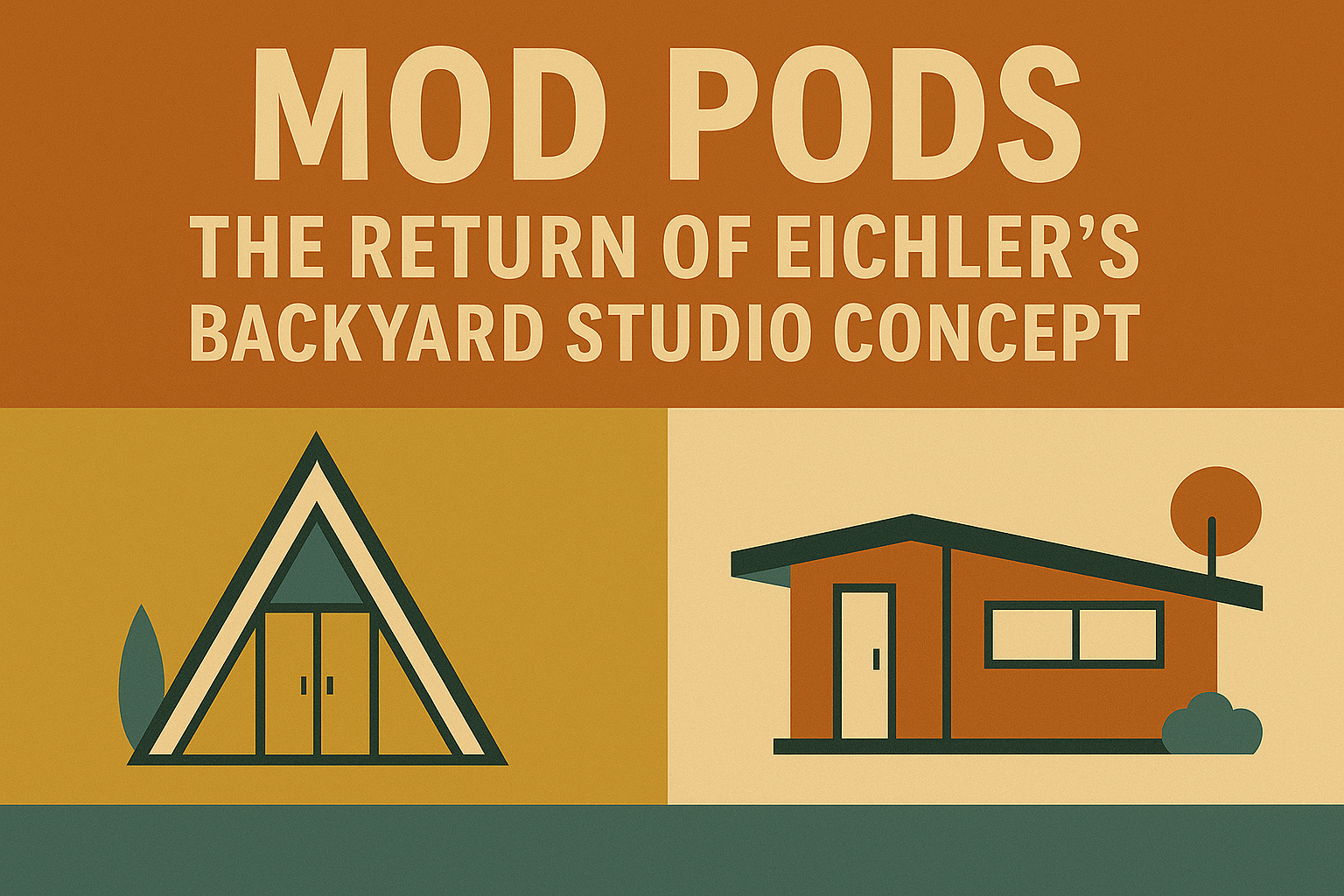
Joseph “Joe” Eichler was a pioneering mid-century developer who collaborated with top architects to bring innovative modern design to the suburbs atomic-ranch.com. Eichler homes, built between the late 1940s and 1960s, were celebrated for open floor plans, floor-to-ceiling glass walls, and a seamless integration with nature coohom.com. Many models featured indoor-outdoor atriums or big sliding glass doors opening to backyards, dissolving the boundary between home and garden. This emphasis on “bringing the outside in” created bright, airy spaces and made modest homes feel larger through extensive use of glass cityofpaloalto.org.
Flexibility was another hallmark of Eichler’s approach. In the mid-1950s, Eichler’s architects Jones & Emmons offered multiple floor plan options that buyers could adjust to suit their needscityofpaloalto.org. The post-and-beam construction and modular layouts made it easier to modify or expand the homes over time. In fact, Eichler designs were innovative and adaptable enough that many owners later added rooms or reconfigured spaces while maintaining the home’s original spirit coohom.com. Eichler’s unwavering commitment to quality modernist design – from flat roofs and open beams to honest materials – resulted in homes that are timeless and highly sought-after today atomic-ranch.com.
It’s no surprise, then, that Eichler homeowners are once again embracing Eichler’s spirit of innovation by adding modern Accessory Dwelling Units (ADUs) and backyard studios. In a way, these contemporary “mod pods” carry forward Eichler’s original vision of flexible living. They provide new space for today’s needs – whether a home office, in-law suite, or rental unit – while echoing the clean lines and indoor-outdoor ethos of the classic Eichler design.
Silicon Valley’s ADU Boom in Eichler Neighborhoods
In recent years, Silicon Valley cities have made it much easier to add ADUs, and Eichler neighborhoods are at the forefront of this trend. California enacted laws that streamline ADU approvals statewide, and cities like Palo Alto, San Jose, Sunnyvale, and Mountain View have embraced these changes. For example, Palo Alto updated its zoning in 2020 to encourage more backyard cottages – the City Council explicitly loosened rules to help homeowners turn portions of their backyards into living spaces n2v.paloaltoonline.com. Palo Alto even adopted Eichler-specific guidelines to ensure ADUs fit the mid-century modern context, including lower height limits for ADUs in designated Eichler tracts cityofpaloalto.org (max. one-story, ~12 feet tall in those areas). This means in Palo Alto’s Eichler enclaves, you can build an ADU, but it must stay low-profile and respect the scale of the iconic post-and-beam homes.
Other cities are equally supportive. San Jose, aiming to combat the housing crunch, launched a pre-approved ADU program in 2019 that fast-tracks permits with vetted designs. The results have been dramatic – as of early 2025, San Jose has issued nearly 2,300 ADU permits and over 1,400 backyard homes have been completed under the program sanjosespotlight.com. The city even amended building codes to remove costly requirements (like heavy solar mandates) for small all-electric ADUs sanjosespotlight.com, further lowering barriers. Sunnyvale and Mountain View likewise updated their ordinances to comply with state law, allowing most single-family lots to add at least one ADU (up to ~800 sq ft by right) with only a 4-foot setback from property lines. All these cities now see ADUs as a key piece of their housing strategy, and homeowners in Eichler neighborhoods are taking note.
Crucially, officials recognize the unique character of Eichler communities. In addition to Palo Alto’s rules, Sunnyvale also has Eichler design guidelines to help maintain the mid-century aesthetic in renovations and additions fr.scribd.com. The goal is to prevent “monster” additions and ensure that new structures – including ADUs – don’t erode the open, modern feel of these neighborhoods. As Eichler Network magazine put it, new ADUs should ideally be a “boon” and not a “bane” for the community, adding gentle density without sacrificing livability. That balancing act is now playing out in real backyards across Silicon Valley’s Eichler tracts.
Designing an Eichler-Friendly ADU or Studio
Adding an ADU or backyard studio to an Eichler property requires a sensitive design approach. Eichler homes have a distinct architectural integrity – a low-slung profile, simple geometric forms, and a profound connection between indoors and outdoors. Any new structure should honor these qualities. Here are key strategies to ensure your “mod pod” complements your mid-century modern home:
Placement and Layout Considerations
Start by choosing the right location for your ADU in the context of the existing house and yard. The priority is to preserve the indoor-outdoor connection that Eichlers are famous for. That means you don’t want to plop a big structure in the middle of the yard that blocks the view from the main house’s window walls. Instead, tuck the ADU to one side or in a far corner of the backyard. Many Eichler lots have underutilized side yards or rear corners – those can be ideal spots where a small unit won’t disrupt sight-lines from the living room or block sunlight to the patio.
If your Eichler has a central atrium or a U-shaped layout around a courtyard, consider positioning the ADU to extend that courtyard concept. For example, an ADU placed at the back corner of the lot can help form a cozy outdoor room between itself and the main house. Landscaping and hardscaping can then tie the two structures together (more on that shortly). In one design for a classic Eichler on a large lot, the homeowners integrated a new ADU in a rear corner among trees, with a private deck and spa next to it, creating a secluded retreat that still connects to the main yard waterandearthld.com. By placing the ADU thoughtfully, they maintained a generous open backyard and gave both the primary house and the ADU their own privacy.
Another big consideration is whether to build a detached unit or convert existing space (an attached ADU or JADU). The easiest and most architecturally compatible way to create an ADU on an Eichler property is often to stay within the home’s existing envelope eichlernetwork.com. Many Eichler owners opt to convert an attached garage or a utility room into a small “junior ADU” because it requires no change to the exterior style. For instance, enclosing an open carport or part of the garage can yield a studio apartment while leaving the iconic facade largely untouched – the roofline, beams, and materials remain original. If you can make do with the space in your existing walls, this approach ensures absolute continuity with Eichler architecture. However, not everyone wants to sacrifice parking or storage, and many Eichlers are modest in size, so a detached backyard unit is a popular alternative.
When designing a detached ADU, keep it single-story and low-slung. A two-story structure is generally discouraged in Eichler neighborhoods (and often prohibited by guidelines) because it would tower over the single-story houses and erode privacy. A well-designed one-story ADU that echoes the horizontal lines of the main house will feel like a natural extension rather than an out-of-place addition. Aim for a similar finished floor height and ceiling height if possible – for example, one Palo Alto Eichler ADU was built with extra high ceilings (~9-10 ft) within a one-story volume, making the compact 275 sq ft space feel open and airy compass.com. By keeping the ADU footprint small but ceilings lofty, it achieved a sense of space with Eichler-like vertical glass and clerestory windows, all while staying well under the roof height of the main house.
Matching Eichler Aesthetics (Materials and Form)
To “honor Eichler aesthetics,” an ADU or studio should borrow cues from the mid-century design vocabulary so that old and new sing in harmony. Roof form is a critical element: most Eichler homes have either flat roofs or very low-pitched gable roofs with wide eaves. Mirroring this is key. Your ADU could have a flat or nearly-flat roof with deep overhangs, echoing the main house, or a modest sloping roof that complements rather than contrasts. Avoid high-pitched roofs or complex shapes – simple rectangles work best. As one Eichler owner-architect put it, mini-Eichlers work well when they keep to the “boxy” modern forms and don’t try to mimic generic cottages. In practice, that means clean rooflines, no ornate trim, and definitely no fake shutters or other adornments that were never on Eichlers.
Use materials that speak the same language as the original house. Eichlers commonly feature vertical wood siding (often grooved panels or tongue-and-groove boards), natural wood soffits, exposed posts or beams, and concrete slab floors. You can source exterior siding that matches your home’s pattern (for example, the same 4-inch grooved plywood panels or similar wood texture) so that the ADU feels like it “belongs.” Many Eichlers also have sections of concrete block or brick, and incorporating a small accent of mid-century masonry or even breeze block screen walls near your ADU can tie it in stylistically. Paint or stain the ADU in a complementary mid-century color palette – warm earth tones, or the classic Eichler deep brown, or a subdued gray that lets the wood and glass be the stars.
Perhaps most importantly, windows and doors of the ADU should emulate the Eichler style. That means large panes of glass and sliding doors whenever possible, especially facing the yard. Eichler homes were designed with limited small windows on the street side but huge expanses of glass on the rear elevation cityofpaloalto.org. You can do the same: keep the ADU’s street-facing side fairly modest and place the big glass towards the interior of the lot (for privacy and to maintain that indoor-outdoor openness). Full-height sliding glass doors or accordion doors that open up onto a deck or patio will instantly give your mini-unit the iconic Eichler vibe. Likewise, using clerestory windows (a row of high windows up near the roof) can echo the look of many Eichlers and also ensure privacy (since they don’t allow direct views in or out at eye-level). Try to avoid overly subdivided window panes – Eichlers typically have uninterrupted expanses of glass or minimal frame divisions cityofpaloalto.org. In short, think transparent, minimal, and functional for fenestration. One successful example is a detached studio in San Rafael designed as a tiny “cabana” – it features a wall of sliding glass and a matching flat roof, so it looks like a mini-Eichler pavilion in the yard dwell.com.
Inside the ADU, continue the mid-century modern feel with open beams or tongue-and-groove ceilings if you can. Several Eichler-inspired prefab units actually offer exposed beam ceilings as a feature. Keep interior finishes simple and warm (think birch or mahogany veneer cabinetry, white walls, maybe some Eichler-esque globe lights) so that the ADU feels like an extension of the main house’s design DNA. Modern comforts can be hidden behind the scenes (efficient insulation, heating/cooling, etc.), but the look should read as clean and timeless. By using warm wood and clean geometry, your ADU can be thoroughly modern yet sympathetic to the 1950s roots.
Landscape Integration and Outdoor Flow
A huge part of making a backyard addition work is integrating it into the landscape design. Eichler homes were originally built with the landscape in mind – often Joseph Eichler hired talented modernist landscape architects (like Thomas Church or Robert Royston) to design patios, planters, and gardens that complemented the houses cityofpaloalto.org. When adding an ADU, you have an opportunity to reshape your outdoor space in a way that benefits both structures and preserves that alfresco living feeling.
One tip is to create a continuous outdoor circulation between the main house and the ADU. This could be as simple as a stepping-stone path or a modern concrete walkway connecting the atrium or back door of the Eichler to the front door of the ADU. By linking them, you encourage interaction and make the ADU feel like part of one cohesive property (as opposed to a random shed in the corner). In design concepts for Eichler yards, we often see paths or L-shaped patio extensions that lead to the new unit, sometimes creating a courtyard effect waterandearthld.com. For example, extending the classic Eichler concrete patio so it runs up to the ADU’s entrance can visually tie the old and new together – you could cover both the original patio and the ADU’s porch with matching quarry tiles or aggregate concrete for continuity.
Plantings and privacy screens are your friends. Use landscaping to soften the presence of the ADU and provide privacy where needed. If you’re worried about the ADU’s occupants looking into the main house (or vice versa), consider a strategic row of tall bamboo, a cluster of ornamental grasses, or a modern fence or screen wall between them. Eichler yards often feature wooden fence panels or natural hedges to define spaces – you can add similar screens that block views without feeling heavy. Some owners install pergolas or trellises that extend from the main house toward the ADU, draped with vines, to create a semi-private walkway and green buffer. Also think about how the ADU’s presence affects your neighbors; a line of trees or a well-placed fence at the rear can prevent any feeling of intrusion, keeping everyone happy.
Don’t forget to give the ADU its own appealing outdoor area, if space allows. A small deck, patio, or seating area in front of the ADU’s entrance can make it feel like a mini Eichler with its own indoor-outdoor lifestyle. One Eichler homeowner added a 120-square-foot studio and included a little deck with mid-century modern outdoor chairs and planters, turning it into a perfect spot for morning coffee. The studio’s occupants (whether family, guests, or tenants) then have their own slice of Eichler-esque outdoor living. If you have a pool, an ADU can double as a pool house or “cabana,” so you might landscape accordingly (e.g. outdoor shower, towel hooks, etc.). Essentially, treat the ADU as an extension of your overall landscape plan. Think about views from each building: perhaps the ADU gets a framed view of a Japanese maple or a sculptural tree that you plant deliberately, while the main house still enjoys a vista of the open lawn or pool.
By mindfully integrating architecture and landscape, your backyard addition won’t feel tacked on – it will feel like it belongs, enhancing the Eichler’s famous indoor-outdoor harmony rather than disrupting it.
Eichler-Sensitive Builders and Prefab “Mod Pods”
Designing and building an Eichler-compatible ADU is a specialized endeavor. Fortunately, a number of architects, builders, and prefab companies in California are experienced in creating modern structures that pair beautifully with mid-century homes. Here are a few notable options and recommendations:
Backyard Eichler – A local design-build firm that specializes in mid-century modern sheds and small ADUs. They explicitly cater to Eichler and modern home owners. Their standard designs include Eichler-esque features like post-and-beam construction, exterior grooved siding, sloping rooflines, and lots of glass. As the company says, “Enhance your backyard and increase your property value with a mid-century modern Backyard Eichler shed.” backyardeichler.com These custom-built studios can serve as home offices or guest suites, and are built on-site to match your home’s style. For Eichler owners who want a tailor-made solution, a specialty builder like this ensures every detail – down to matching paint colors and ceiling beams – is on point.
Avava – Known for their Avava Britespace prefab units, this Bay Area company delivers flat-pack ADUs that unfold into sleek modern spaces. Avava’s designs emphasize sustainability and beautiful modern design cbinsights.com. The units feature flat roofs, clean lines, and large aluminum-framed windows, which can complement Eichler aesthetics nicely. They come in small sizes (like ~150 to 300 sq ft studios) up to larger one-bedroom cottages. An Avava “pod” arrives as a kit of parts and is assembled on your lot, which can be quicker than a full custom build. Eichler owners have shown interest in Avava models because they are unfussy and modern – a good starting point to then customize colors or finishes to echo the main house.
Connect Homes – A Southern California prefab home builder that ships modular units statewide. Connect Homes is famous for their modernist prefab homes that resemble high-end architecture (lots of glass, horizontal lines). They offer smaller models (such as a Connect 2 or Connect 4, referring to module size) that can function as ADUs. These units have a distinctly modern style aligned with mid-century principles – for example, steel frame modules with expansive glass walls and flat roofs. Connect Homes can even match exterior materials (like cement board siding that looks like Eichler wood). If you have the space (their smallest is around 250–320 sq ft), a Connect Homes module could drop into your backyard and look like a mini Eichler pavilion. The advantage is precision: they are built in a factory to exacting standards, then craned into place with minimal on-site construction time.
Studio Shed – A popular option for customizable prefab backyard studios. Studio Shed produces kits for modern-style sheds that homeowners can use as offices, gyms, or ADUs. They typically feature a mix of fiber-cement and wood siding, and many design options include clerestory windows and sliding glass doors. Studio Shed’s aesthetic is clean and contemporary, which can be adapted to complement an Eichler (for instance, choosing their Signature Series with a low gable roof and positioning it to mirror your home). While not Eichler-specific, the flexibility in finishes means you could select a vertical siding and a paint color that matches your Eichler. These are often permit-ready and can be assembled quickly. Plus, Studio Shed’s focus on indoor-outdoor lifestyle (they often highlight how their designs open to the yard) aligns well with Eichler living.
Other Noteworthy Providers: Acton ADU (a design-build firm in the South Bay focusing on ADUs), Abodu (a Silicon Valley startup offering pre-approved 500–650 sq ft ADU units, with a very modern aesthetic), and Modern-Shed (Seattle-based, creator of modular modern sheds). All of these have completed projects in the Bay Area. When selecting a builder or prefab, look for portfolios that include mid-century modern or Eichler projects. Some Eichler owners have even worked with architects like Klopf Architecture or Modern House Architects (Curt Cline), who are Eichler renovation experts, to design custom ADUs that look like mini-Eichler houses. For example, Modern House Architects created a conceptual Eichler ADU rendering showing a main house and a complementary modern mini-house in the rear – demonstrating how careful design can yield an ADU that “perfectly matches the home’s midcentury style.” dwell.com.
In all cases, do your homework and choose a solution that respects the Eichler DNA: simplicity, openness, and warmth. A well-executed “mod pod” by the right team will not only add usable space but can actually enhance the character of your Eichler property. As one ADU builder noted, designing and building an ADU is a complex undertaking requiring a well-researched plan – success comes from greater scrutiny in five key areas: design, engineering, permits, budget, and build quality (according to Curt Cline of Modern House Architects) eichlernetwork.com. Partnering with experienced professionals will help you navigate all of these with an eye toward maintaining architectural integrity.
ADUs in Eichler Neighborhoods: Case Studies and Cautionary Tales
Real-world examples from Eichler communities show how ADUs and studios can be done beautifully – and remind us of pitfalls to avoid. Let’s look at a few:
Marin County “Little Cabana” – In San Rafael’s Lucas Valley Eichler tract, one 1957 Eichler home on Blackberry Lane recently hit the market highlighting its backyard studio as a major asset. The 120-square-foot detached studio, dubbed a “separate cabana,” was designed to match the main house and is fully insulated, wired, and even air-conditioned dwell.com. Clad in wood and sporting a flat roof, this tiny studio echoes the mid-century vibe perfectly – it looks like it could have been built in 1957 alongside the house. Inside, it has wood paneling and a custom built-in desk, making it an ideal office or art space dwell.com. Because it was so well integrated (and presumably permitted), this Eichler’s value was enhanced; buyers saw it as a seamless extension of the property’s functionality. The listing agent noted, “Just think what you could do with a 120-square-foot studio in your backyard.” dwell.com – emphasizing the appeal. The takeaway: scale and style. This studio was kept small (well under the city’s ADU size limits) and crafted in the Eichler style, so it feels like part of the original design. For Eichler owners, it’s proof that even a tiny “mod pod” can make a big impression if done right.
Palo Alto Eichler with Integrated ADU – In Palo Alto’s Los Arboles Eichler neighborhood, a 4-bedroom Eichler home at 796 Gailen Avenue was recently renovated and included a fully functional attached ADU as a selling feature. The ADU was about 275 sq ft, with high ceilings, a full bath, and its own kitchen appliances compass.com. It was seamlessly integrated through a private side entry and a landscaped front patio, maintaining the hallmark 8-foot wide panoramic sliding doors that blend indoor and outdoor spaces compass.com. This ADU didn’t stick out at all; from the street one would hardly know it’s there. Yet for the new owners, it offers tremendous flexibility – guest suite, rental, or extended family quarters – all while respecting the Eichler aesthetic. The primary home’s indoor-outdoor flow was preserved (the main living areas still open to a big backyard), and the ADU even shares the front atrium feel, entering via an enclosed front yard. When this home sold in 2024 for over $3.7M, the ADU was cited as a value booster. Neighbors, too, could appreciate that the ADU was low-profile and Eichler-compatible. Lesson: an ADU can be a selling point and integrate naturally, especially if you cleverly make it an extension of existing structure or an attached wing that uses the same materials and indoor-outdoor design elements. On the flip side, had the owners slapped on a clunky addition that broke the Eichler charm, it might have hurt the value – so design matters immensely for market appeal.
Sunnyvale Eichler ADU – Good Neighbor Example – A homeowner in Sunnyvale’s Fairbrae Eichler tract constructed a detached 1-bedroom ADU at the back of their lot. By following city Eichler guidelines, they kept the ADU set well back from property lines, maintained a low roofline, and used matching tongue-and-groove redwood siding. They also incorporated frosted privacy glass on the side facing the next-door neighbor. As a result, the neighbors had no objections – in fact, some were intrigued and now consider their own – because the ADU is unobtrusive. The owner uses it as a rental unit, generating income, and reports that Eichler enthusiasts rent it partly because they love the design. This case shows that when you respect setbacks and privacy, an ADU can coexist peacefully in a dense neighborhood. California’s law requires only 4-foot rear and side setbacks for ADUs, but in Eichler areas, giving a bit more space (when possible) or adding tall landscaping at the fence can go a long way to keeping the peace. No one wants to feel a looming structure on the fence line.
What to Avoid: “Stucco Box” Syndrome – Not every addition is a good one. Eichler owners cringe at examples where a well-intentioned remodel or ADU turns into a sore thumb. A hypothetical bad example (compiled from various anecdotes) goes like this: An owner builds a large 800 sq ft second unit, but chooses a generic design with a tall peaked roof, small vinyl windows, and stucco walls to save money. The structure dominates the backyard, blocks the view of the sky from the Eichler’s living room, and its style clashes with the main house. Neighbors complain it destroys the mid-century aesthetic of the street. The owner finds that Eichler buyers are actually turned off by the addition when it comes time to sell – it looks more like a 1990s cottage squeezed behind a mid-century gem. This cautionary scenario illustrates why maintaining architectural integrity is so important. An ADU that isn’t sensitive to Eichler design can detract from both your enjoyment of your home and its value. It pays to invest in a thoughtful design (it doesn’t necessarily cost much more to choose Eichler-friendly finishes or rooflines) rather than picking a cheapest-plan option that might work fine elsewhere but not on an Eichler lot. Remember, Eichler communities take pride in their unique look – being a good steward of that legacy includes any new construction on your property.
In summary, the examples show that size, style, and sensitivity are key. Smaller and well-designed often beats bigger but bland. By studying successful Eichler ADUs – like those that match the home’s mid-century style or hide in plain sight as an original feature – you can glean ideas for your own project. Talk to neighbors and see what others have done (some Eichler neighborhoods have online forums or tours showcasing remodels). With good design, your mod pod will be the next success story: adding modern living space and value, while neighbors and Eichler purists nod in approval.
Permits, Setbacks, Privacy, and Value: Expert Guidance
Embarking on adding an ADU to your Eichler involves not just design, but also navigating practical hurdles. Here are some expert tips on the nuts and bolts – permitting, zoning rules, ensuring privacy, and the value implications of your project:
Permits & Approvals: In California, ADUs benefit from streamlined, state-mandated permitting. In most cases, your project can be approved ministerially (no public hearing) if it meets basic criteria. Still, you’ll need building permits and must adhere to building code. Start by reviewing your city’s ADU guidelines and application process. Silicon Valley cities often have user-friendly portals or even dedicated ADU staff. For Eichler properties, check if your neighborhood is in a designated historic or Eichler conservation district – if so, you may have an extra design review step. (For example, Palo Alto requires Eichler ADUs in certain historic tracts to undergo a staff-level design compatibility review cityofpaloalto.org.) Submit complete plans that clearly show how your ADU aligns with development standards. If you’re using a prefab or pre-approved plan, include the standard plans and any site-specific adjustments. It’s wise to mention upfront in your application that you’ve designed the ADU to match the Eichler style; planning staff appreciate attention to context and may expedite approval when they see it’s in harmony with the neighborhood.
Zoning & Setbacks: Know the key development standards for ADUs. State law sets some minimum allowances (cities must allow up to an 800 sq ft ADU, 16 feet tall, with 4-foot side/rear setbacks, even if local zoning is stricter). Many Eichler lots are about 6,000–8,000 sq ft, so size isn’t usually an issue for a modest ADU, but lot coverage rules could come into play if your lot is small – make sure the footprint of the house + ADU doesn’t exceed the percentage allowed (though state law provides some flexibility here too). Pay special attention to height limits. As noted, Palo Alto caps Eichler-area ADUs at ~12 feet cityofpaloalto.org. Other cities might simply use the state’s 16-foot default. Design within those limits to avoid variance requests. Setbacks: 4 feet is the magic number for sides and rear in California now, but if your Eichler has an existing garage at, say, 2 feet from the lot line, converting that garage to an ADU can be exempt from new setbacks (law allows using existing structures’ footprint). Always verify with the city if any easements or special backyard utility lines exist that could affect placement. Finally, parking: State law largely eliminated extra parking requirements for ADUs (especially if you’re near transit), and if you convert a garage to an ADU, the city can’t force you to replace the parking. Still, consider your household’s needs and neighborhood parking dynamics – it may be worth adding a driveway space or carport elsewhere on your lot if you lose a garage, just to keep harmony with neighbors who might worry about street parking.
Privacy & Screening: Privacy is a two-way street – you want both the main house and the ADU to feel private, and you owe the same respect to adjacent properties. Achieving privacy while preserving openness is tricky but doable. Window placement is your first tool: design the ADU’s windows to minimize direct views. For instance, avoid putting a big picture window directly facing your neighbor’s bedroom or backyard sitting area. Instead, orient large windows toward your own main house or toward the open street side, and use high windows or obscure glass on sides that face neighbors at close range (translucent glass can let light in while blurring views cityofpaloalto.org). If your ADU has a patio or deck, think about adding a privacy screen or fence panel around it. A modern slatted wood screen can look great and block sight lines between an ADU tenant enjoying a morning coffee and a neighbor mowing their lawn nearby. Likewise, the main house might need a new fence extension or vegetation to shield its bedroom from the ADU’s front door. Landscaping, as discussed, is a natural privacy enhancer: fast-growing hedges or trees in strategic spots can create visual separation. Another tip: sound privacy – consider solid core doors and good insulation in the ADU so that normal noise (TV, conversations) doesn’t transmit readily to and from the main house. This is more of an issue if you plan to rent it out. Many Eichler owners also add pathway lighting or motion lights for safety, but be sure any exterior lighting is low-key and down-shielded, so it doesn’t glare into either dwelling or the neighbor’s windows at night. By proactively addressing privacy through design, you prevent potential complaints and ensure the ADU is a pleasant addition for all.
Cost & Value Implications: Adding an ADU is an investment – but one that can yield significant returns both financially and in lifestyle flexibility. From a pure real estate perspective, a well-built ADU can increase property value. Buyers typically value the extra space, and in many cases an ADU can add more to resale price than it cost to build (depending on your local market). Studies have indicated homes with ADUs sell at a premium over similar homes without smollenthebuilder.com. You are effectively adding square footage and functionality, which appraisers will count (especially if permitted). Additionally, an ADU that generates rental income can be very attractive; in pricey Silicon Valley, a legal rental unit (even a studio) can command strong monthly rent, which both offsets your costs and appeals to future buyers who like the idea of income or a place for extended family. There are also broader economic benefits: multi-generational living is easier (aging parents or adult children can live independently but close by, saving on other housing or care costs), and you might even see tax benefits if you rent it out (you could potentially deduct expenses, etc., though consult a tax pro). On the flip side, consider ongoing costs: property taxes will likely increase somewhat (in California, new construction is assessed at current value, so the ADU portion adds to your tax basis). However, under Prop 13, your main house assessment remains unchanged, so you’re only taxed on the new addition’s value – a small price for the utility gained. Insurance may need an update to cover the new structure as well. Construction cost for an Eichler-quality ADU can range widely – prefab kits might start around $150K installed for a studio, while custom builds could be $250K and up for larger units with kitchens. Keep an eye on budget, get multiple quotes, and consider that any unique mid-century detailing (exposed beams, custom woodwork) might add cost but also adds value in the eyes of Eichler aficionados.
Permits & Process Tips: One more piece of advice: use your city’s resources. Many cities have ADU checklists and even pre-approved plan libraries (San Jose’s success with pre-approved vendors is a prime example). If you find a pre-approved Eichler-friendly design, it could cut permitting time dramatically. Also, speak with your Eichler neighborhood association if one exists. Some Eichler tracts have informal groups or formal associations that can offer guidance or at least would appreciate being informed of your plans. Given that ADUs are now common, you might even find your city has an ADU ambassador or workshops where homeowners share experiences. By going in well-informed, you can smooth the process and avoid surprises.
In essence, the keys are: plan diligently, follow the rules, and be considerate. With those bases covered, you’ll find that adding an ADU is very feasible – and arguably one of the best upgrades you can make to an Eichler home in today’s market.
Your Eichler Experts – The Boyenga Team at Compass
Building or buying an Eichler with a “mod pod” twist? Lean on the pros who know Eichlers inside and out. The Boyenga Team (husband-and-wife Realtors Eric & Janelle Boyenga) are widely recognized as Silicon Valley’s go-to Eichler home experts. As Compass real estate professionals with decades of experience, they’ve not only sold countless mid-century modern homes, but also actively help clients maximize these properties’ potential through smart, design-sensitive improvements.
Eric and Janelle Boyenga have a deep passion for Eichler architecture – and it shows. They understand the unique value of features like open atriums, post-and-beam construction, and original Philippine mahogany walls. When you work with them, you’re getting advisors who can see beyond the sale, offering guidance on how to preserve and enhance your Eichler’s character. For homeowners considering an ADU or backyard studio, the Boyengas provide unparalleled insight. They maintain a trusted network of Eichler-savvy architects, contractors, and prefab companies, so they can connect you with the right resources to explore an ADU addition that adds value without compromise.
The Boyenga Team stays up-to-date on local ADU regulations and opportunities across Palo Alto, San Jose, Sunnyvale, Mountain View and the greater Bay Area. They can help you navigate from start to finish – from assessing if your lot qualifies for a detached ADU, to recommending Eichler-sensitive builders, to advising on finishes that will appeal to future buyers. If you’re renovating, they’ll counsel you on choices that honor the Eichler aesthetic (they’ve even helped clients restore classic Eichler elements that previous remodels had covered up!). And when it comes time to market your home, Eric and Janelle know how to showcase an ADU or studio as a major asset. Their marketing for Eichler listings highlights the “flexible bonus space” and paints the picture for buyers – whether it’s rental income potential, a private home office, or a creative studio retreat, they make sure your investment in a mod pod pays off.
Beyond ADUs, the Boyengas are champions of creative, value-adding solutions for Eichler owners. Thinking of opening up a wall or modernizing the kitchen in line with mid-century style? They can provide input on what today’s Eichler enthusiasts are looking for. Considering installing floor-to-ceiling glass to restore that indoor-outdoor vibe? They’ve seen it all and can point out the pros and cons. Their goal is to help you steward your Eichler – preserving its soul while adapting it to modern living needs, much as Joseph Eichler himself would have done.
With a client-centric approach and a genuine love for these homes, the Boyenga Team has built a reputation as the “Eichler Home Specialists” of Silicon Valley. They don’t just sell houses; they advocate for the Eichler lifestyle and legacy. If you’re dreaming about adding a stylish backyard studio or wondering how an ADU might increase your home’s value, reach out to Eric and Janelle. Partnering with the Boyenga Team means you have experts who will treat your Eichler with the care and knowledge it deserves – and help you unlock the full potential of Eichler living, from historic charm to future investment.
Sources