
Rare Eichler Homes in Palo Alto’s 94301: Modern Gems Amid Professorville’s Classics
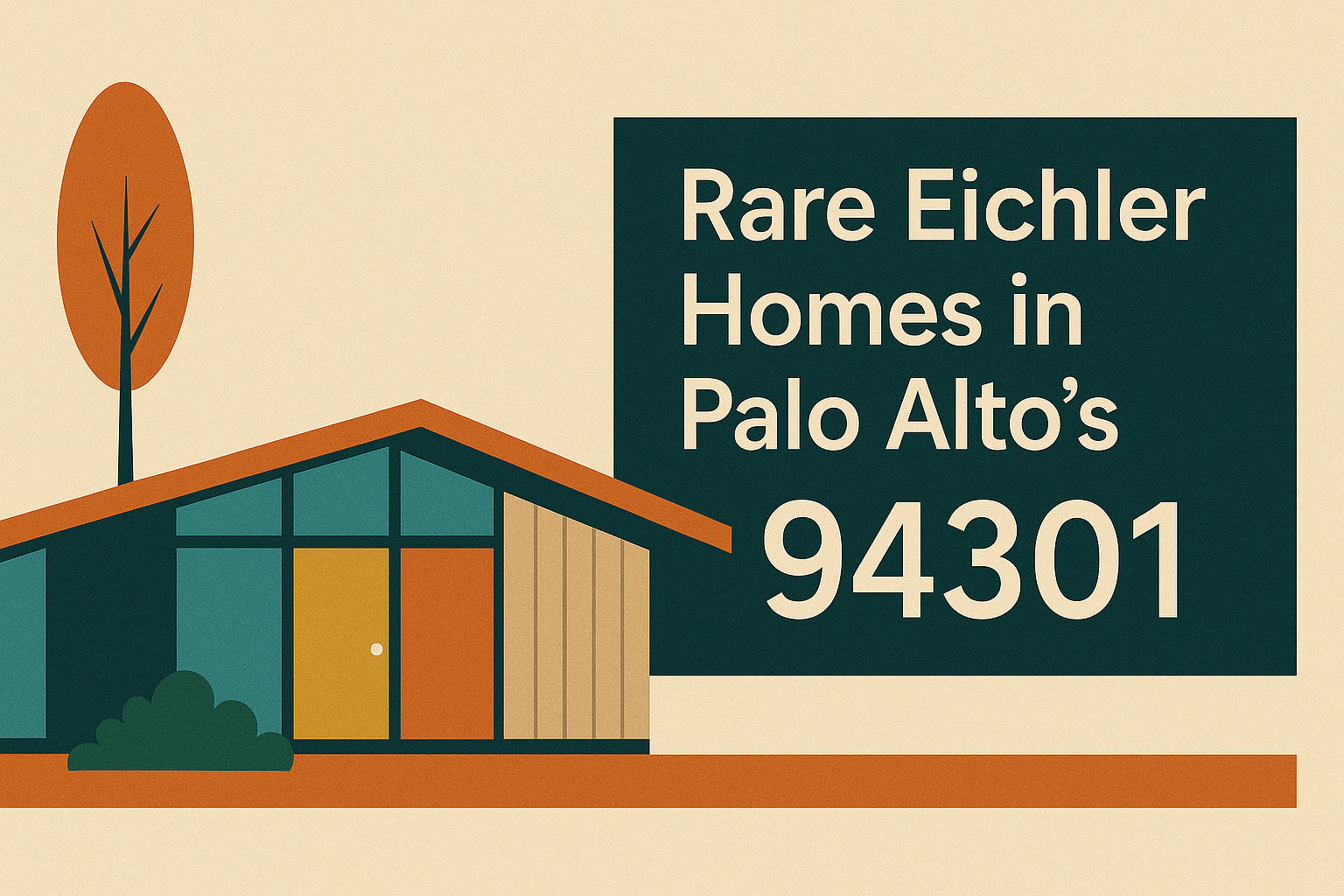
Eichlers in 94301 Palo Alto: Modernism Meets Tradition Near Professorville
The 94301 zip code encompasses Palo Alto’s oldest neighborhoods, including downtown and the famed Professorville historic district. This area dates back to the late 19th century when Stanford University’s early faculty built their residences off campus. In 1889, land in what is now Professorville was subdivided to sell lots to Stanford professors who wanted to own (rather than lease on campus) nps.gov. As a result, Professorville blossomed in the 1890s with eclectic Victorian-era architecture. Many homes were designed in extravagant Queen Anne style, featuring complex rooflines, corner turrets, bay windows, wrap-around porches, and ornate woodwork mv-voice.com. For example, some of Palo Alto’s best Queen Anne homes were built between 1893 and 1898 in Professorville, complete with signature round corner towers and gingerbread detailing mv-voice.com.
Historical Context of Palo Alto 94301 and Professorville’s Heritage
Alongside the Victorians, early 20th-century styles also left their mark. Stately Colonial Revival and Craftsman homes – often clad in brown shingles – dominate many Professorville streets nps.gov. These heritage homes give 94301 a timeless character. The Professorville Historic District (roughly bounded by Addison Ave., Lincoln Ave., Kingsley Ave. and cross-streets like Ramona and Bryant) is listed on the National Register of Historic Places nps.gov. It remains a showcase of turn-of-the-century American architecture, from Dutch Colonial gables to classic Craftsman bungalows, all beneath a mature canopy of oaks and sycamores. In short, 94301’s architectural DNA is firmly rooted in tradition and history.
Eichler’s Presence in Palo Alto and the Hidden 94301 Eichlers
Amid this traditional streetscape, a surprising modernist counterpoint exists: Eichler homes. Joseph Eichler, the visionary developer of mid-century modern homes, built more houses in Palo Alto than in any other Bay Area city. Over 2,700 Eichler houses were originally built in Palo Alto during the 1950s–70s, making the city something of a “Holy Grail” for Eichler aficionados boyengateam.com. However, the vast majority of these Eichlers are located in Palo Alto’s other zip codes (such as 94303 and 94306) in cohesive tract neighborhoods. In the 94301 zip code, Eichler’s work is exceedingly rare – essentially tucked into just a couple of small enclaves.
The first instance of Eichler construction in the 94301 area came in 1959, when Joseph Eichler built two modern homes on Middlefield Road at the edge of old Professorville boyengateam.com. These two houses (built 1959) were not part of a larger tract – in fact, they constituted one of Eichler’s smallest subdivisions ever. They sit side-by-side near the Professorville boundary, juxtaposed against neighboring homes from the 1910s and 20s. One of these Professorville-adjacent Eichlers has even been noted as being in remarkably original condition decades later – a likely candidate for historic designation as a mid-century landmark eichlernetwork.com. The mere existence of these two mid-century modern houses amid Professorville’s Queen Annes and Craftsmans creates a striking architectural contrast.
More Eichler homes would not arrive in 94301 until the early 1970s, near the end of Eichler’s homebuilding era. In 1973, Joseph Eichler acquired the former Miss Harker’s School property in the Community Center neighborhood (just north of Professorville) and developed it into a small tract of Eichler houses. This Community Center Eichler enclave – roughly 30 homes centered around Greenwood Avenue, Harriet Street, and nearby blocks – represents one of Eichler’s last projects and an unusual infill within central Palo Alto. Built in 1973–74, these houses were contemporaries of Eichler’s “last hurrah” tracts (such as Midcourt and Los Arboles Addition in south Palo Alto). They feature later Eichler design elements and even a few two-story models. Today, these 30 or so Eichlers are essentially hidden in plain sight in 94301’s Community Center area – easily overlooked amid the mix of older ranch homes, Craftsman remodels, and new builds. Many long-time Palo Altans are surprised to learn that any Eichler tract exists so close to downtown.
In total, fewer than 35 Eichler homes lie within the 94301 zip code – a tiny fraction (roughly 1%) of Palo Alto’s Eichler housing stock. This extreme scarcity is a product of Palo Alto’s development pattern: by the time Eichler was mass-producing homes in the 1950s, the 94301 neighborhoods were mostly built-out with earlier housing. Thus, Eichlers in 94301 are limited to the rare infill projects described above. For context, Eichler’s hallmark Palo Alto subdivisions like Green Gables, Greenmeadow, and Fairmeadow – each containing hundreds of homes – were built in the less-developed sections of town (today’s 94303 and 94306), not in the established downtown core.
Modernism vs. Tradition: Eichler Design in Stark Contrast
It’s hard to imagine a greater architectural juxtaposition than an Eichler home beside a Queen Anne Victorian or a Craftsman bungalow. Eichler homes embody mid-century modernism: single-story pavilions with low-pitched or flat roofs, open post-and-beam construction, and walls of glass oriented to private courtyards and backyards. Rather than presenting ornate facades to the street, Eichlers are often modest and unadorned on the front, sometimes with carport doors or blank stretches of grooved siding. Their drama unfolds inside and in the rear – open-plan living areas that flow into glass-walled atriums or patios, blurring the line between indoor and outdoor livingdesign-milk.com ryanleidner.com. Eichler architects (such as Anshen & Allen, Jones & Emmons, and Claude Oakland) emphasized clean lines, honest materials like wood and concrete block, and integration with nature through floor-to-ceiling windows and skylights design-milk.com. In a 1950s Eichler, the back yard is the focal point, and the “private living areas expand to the outdoors”, epitomizing California modern living.
Contrast this with the traditional homes of Professorville and old Palo Alto. A Queen Anne or Craftsman presents its face proudly to the street: complex gables, decorative shingles, turned porch columns, and perhaps a welcoming front porch adorned with spindlework. Rooms inside tend to be compartmentalized and oriented toward the street or front garden. Where Eichlers have minimal ornamentation, a Victorian might have patterned stickwork in its gable peaks or stained-glass transom windows. Where Eichlers use post-and-beam to eliminate interior walls, a Colonial Revival in Professorville might have formal dining and parlor rooms separated by pocket doors. And where Eichlers deliberately avoid a second story (to preserve light and views), some historic Professorville houses rise two-and-a-half stories, complete with attics and dormers nps.gov.
In essence, Eichler modernism vs. Professorville traditionalism is a study in opposites: horizontal lines vs. vertical grandeur, simplicity vs. embellishment, “California modern” openness vs. Gilded Age coziness. This dramatic architectural contrast is highly visible in 94301 locales where an Eichler sits cheek-by-jowl with older homes. For instance, in the Professorville area, an Eichler’s paneled fence and glass wall might border a neighbor’s ivy-covered Craftsman façade. The visual dialogue between them underscores Palo Alto’s layered history – from Victorian founding to mid-century innovation – all within the same block.
Market Scarcity and Pricing of 94301 Eichlers
The rarity of Eichler homes in 94301 has made them particularly prized on the real estate market. Palo Alto’s 94301 zip code is generally one of the most expensive areas on the Peninsula, thanks to its premier location (close to downtown, Stanford University, and top schools) and its inventory of large historic homes. Any single-family home in 94301 commands a premium – and an architecturally distinctive Eichler can fetch especially strong interest. With only a few Eichler properties changing hands each year (if that) in this area, competition among buyers is often intense when one becomes available.
Pricing for 94301 Eichlers reflects both the land value and their unique appeal. Even though Eichler homes are often more modest in size and height than their century-old neighbors, they are hardly “cheap.” Recent sales illustrate the market: for example, an Eichler on Harriet Street (in the 1973 Community Center tract) sold for $3.85 million in 2019 redfin.com. This 4-bedroom, 1,957 ft² mid-century home, updated but retaining its Eichler character, commanded a price on par with much larger new homes in less central parts of Palo Alto. By 2023, its estimated value approached $4.9 million redfin.com, reflecting continued appreciation. Another Eichler in the same enclave on Greenwood Avenue sold in 2010 for $1.7M zillow.com; comparable homes there now easily exceed $4M depending on lot size and upgrades. In short, 94301 Eichlers trade in the multi-million-dollar range, consistent with the zip code’s luxury market status.
The scarcity factor cannot be overstated – with such a limited supply, design lovers often wait years for a 94301 Eichler to hit the market. Many owners in the Community Center Eichler tract hold their homes long-term, enjoying not only the architecture but also the walkable convenience of the location. As one local brokerage noted, living in this area “is a coveted experience not many are willing to part with,” hence turnover is low. When a rare Professorville-area Eichler does come up for sale, it tends to attract multiple offers from eager buyers, sometimes including architects, tech executives, or academics who specifically value modern design.
Notable Eichler Remodels and Listings in 94301
Over the years, several 94301 Eichlers have undergone thoughtful renovations to blend mid-century charm with contemporary luxury. Because these homes are in a historic and high-end district, many owners choose to invest in high-quality remodels (rather than tear-down rebuilds). The goal is often to modernize systems and finishes while honoring the original Eichler aesthetic.
A prime example is the “Greenwood House,” a 4-bedroom Eichler built in 1973 on Greenwood Ave. In 2015 it received a comprehensive renovation by Ryan Leidner Architecture. The remodel removed some interior walls and reconfigured the kitchen and living areas to better suit a modern family, “creating a more flexible space … while honoring the classic Eichler post-and-beam construction.” Skylights and a lighter material palette were introduced to bring in more natural light, but the fundamental indoor-outdoor character was preserved ryanleidner.com. The result was an award-winning update that kept the soul of the Eichler intact – the open atrium layout, exposed beams, and seamless flow to the landscape – yet made the home feel new.
An Eichler home at 1070 Greenwood Ave in 94301’s Community Center enclave, renovated with modern materials while maintaining its mid-century form (notice the classic low roof, glass walls, and concrete block fireplace)design-milk.com.
Other homeowners have undertaken similar remodels. Many courtyard atriums have been refinished with contemporary landscaping and large porcelain tiles; original mahogany wall panels are often restored or complemented with white drywall for contrast; and kitchens are upgraded with modern appliances but in an open-plan configuration that echoes Eichler’s intent. A Redfin agent’s tour notes for one Harriet Street Eichler highlight its “remodeled single-story Eichler house” with an updated kitchen, bright open floor plan, high ceilings in the living room, and a central courtyard anchoring the design redfin.com. These types of upgrades enhance comfort and energy efficiency (adding insulation, dual-pane floor-to-ceiling windows, radiant-heat replacements, etc.) while celebrating the original design – a balance that design-forward buyers appreciate greatly.
Notably, Palo Alto has also developed Eichler-specific design guidelines to guide homeowners on appropriate changes. Though voluntary in many areas, these guidelines encourage preserving the characteristic features (low rooflines, atrium spaces, transparency to the landscape) when remodeling or expanding an Eichler. In 94301, where the Eichlers stand out in a patchwork of styles, such sensitive remodels ensure that the intent of Eichler’s architecture isn’t lost amid potential mansionization. In fact, one could argue these mid-century homes have achieved their own kind of “historic” status: Eichler owners in Palo Alto are increasingly passionate about preservation, much like the Professorville residents who safeguard their Victorians.
Design Appeal for the Architecture-Savvy Buyer
The Eichler homes of 94301 hold a special appeal for design-savvy buyers – those who might describe themselves as mid-century modern enthusiasts or simply lovers of unique architecture. What draws these buyers is the chance to own an iconic modernist home without sacrificing location or community prestige. Typically, one might have to go to South Palo Alto or the suburbs to find a classic 1950s modern tract home; by contrast, the 94301 Eichlers let you enjoy Eichler’s celebrated design in the heart of old Palo Alto.
For an architecture-forward buyer, these homes offer an aesthetic lifestyle that standard tract houses or even many luxury homes can’t match. The open-air atrium for morning coffee, the floor-to-ceiling glass that invites sunlight and garden views into every room, the post-and-beam ceilings that lend a modernist architectural rhythm – all of these elements resonate with those who appreciate design. As one Palo Alto Eichler specialist noted, Eichler neighborhoods have a distinct “character and community spirit” that arises from their design DNA eichlerhomesforsale.com. In 94301, an Eichler owner gets to be part of two overlapping worlds: the intellectual, historic ambiance of old Palo Alto and the forward-looking, design-centric culture of Eichler aficionados.
Design-conscious buyers also value how efficient and innovative these homes were for their time. Features like radiant heated floors, modular paneling, and the indoor-outdoor flow are seen as timelessly appealing. Many buyers are happy to trade the extra square footage or formal rooms of a traditional home for the experiential quality of living in an Eichler – where light, space, and nature interact in daily life. The fact that Palo Alto’s Eichler owners have successfully fought for things like single-story overlay zones (to prevent tall rebuilds that overshadow the low-slung originals) and have even gotten whole Eichler tracts listed on the National Register (Greenmeadow and Green Gables) speaks to the passion of this community. In 94301, an Eichler buyer is often someone who specifically sought out this kind of home – a buyer looking for “design over size,” or as the Boyenga Team quips, someone for whom Palo Alto is the ultimate Eichler “Holy Grail”boyengateam.com.
Moreover, owning a mid-century modern home amid Professorville’s turn-of-the-century houses carries a certain cachet. It telegraphs a love of architecture and a willingness to be different. These homes become conversation pieces – when guests step inside, they frequently marvel at the contrast between the Eichler’s unassuming exterior and its breathtaking interior openness (a common “wow” moment noted by Eichler owners)n2v.paloaltoonline.com. For many design-forward buyers, the authenticity of an Eichler – a genuine 20th-century modernist gem – is more compelling than a faux-Tuscan mansion or a generic new build. And in 94301, they get that authenticity in one of the most desirable locations in Silicon Valley.
94301 vs. 94303/94306: Eichler Neighborhood Comparisons
To put the 94301 Eichler experience in perspective, it helps to compare it with Palo Alto’s other Eichler enclaves in 94303 and 94306:
Neighborhood Scale & Feel: In zip codes like 94303 and 94306, Eichler homes often dominate entire neighborhoods. For example, Greenmeadow (94306) is a planned Eichler tract of over 200 homes with its own community pool and park, and Green Gables/Triple El (94303) comprises several contiguous Eichler tracts forming a coherent mid-century enclave. Walking those streets, nearly every house is an Eichler, creating a uniform mid-century modern ambiance. In 94301, by contrast, Eichlers are isolated pockets – a few houses on a block otherwise filled with older designs. There is no single “Eichler neighborhood” feel in 94301; instead, the modern homes are sprinkled in, providing accent notes in an otherwise eclectic mix.
Historic Recognition: Several south Palo Alto Eichler tracts have gained historic status or protections. The Greenmeadow and Green Gables neighborhoods are listed on the National Register of Historic Places for their significance as intact mid-century modern communities. Additionally, many have Single-Story Overlay zoning to prevent incompatible second-story additions. In 94301, the Professorville area is a different kind of historic district (protecting 19th-century homes) – the Eichlers themselves are not part of that designation. However, given their age (50–70 years) and architectural importance, one could argue the 94301 Eichlers deserve similar recognition in the future. For now, they rely on conscientious owners for preservation, whereas some 94303/94306 tracts benefit from formal guidelines and community collective action.
Lot Sizes & Landscaping: Eichler developments in 94303 and 94306 were often planned with uniform lot sizes, cul-de-sacs, and consistent setbacks, yielding a very cohesive visual rhythm of glass-and-wood houses under the trees. In 94301, the Eichler homes inherited lot shapes from older subdivisions or the Harker School land – often larger lots than typical Eichler tracts. For instance, the Community Center Eichler lots around Harriet St. are often 6,000–8,000 sq. ft. or more, similar in size to nearby traditional homes (and larger than many south PA Eichler lots). This means 94301 Eichlers sometimes enjoy more spacious yards or unique siting, but also face landscaping contexts that differ (they may be next to a tall oak from a neighbor’s yard or a historic brick wall, etc., rather than a row of similar fences). The tree canopy in 94301 (adjacent to Professorville’s century-old oaks) can be more mature compared to younger Eichler tracts, giving the modern homes a picturesque backdrop.
Market Dynamics: Eichler homes in 94303/94306, while highly desirable, come up for sale more frequently simply because there are more of them (hundreds per zip code). A buyer determined to get an Eichler in Palo Alto might find multiple options in a given year in south Palo Alto. Prices there typically range (as of mid-2020s) from around $2.5–$3.5 million for a ~1,500–2,000 sq.ft. Eichler, depending on condition and location. In 94301, the ultra-low supply means prices can be higher and more variable. A well-preserved Eichler in 94301 can easily exceed $4 million, not only due to scarcity but because 94301’s land value is at a premium. Moreover, whereas some south Palo Alto Eichlers might be marketed toward entry-level buyers (relative to Palo Alto’s market), the 94301 Eichlers are firmly in the luxury segment, often attracting all-cash or high-end buyers. The marketing for a 94301 Eichler tends to emphasize its architectural uniqueness and blue-chip location, appealing to a niche within the luxury market.
In summary, owning an Eichler in 94301 is a more singular experience – you are one of only a handful of modern-home owners in a predominantly traditional milieu – whereas owning one in 94303 or 94306 means joining a larger mid-century community with a shared architectural identity. Both have their charms: the latter offers a “time capsule” neighborhood of mid-century modernism, while the former offers a rarefied blend of modernist living within the most historic quarter of town.
Conclusion: Modernist Treasures in a Traditional Setting
The Eichler homes in Palo Alto’s 94301 zip code represent a unique convergence of eras. They are modernist treasures set amid a venerable historic setting – an architectural juxtaposition that is exceedingly hard to find elsewhere. These homes tell the story of Palo Alto’s growth: from Victorian origins to post-war innovation, side by side. For homeowners and buyers, a 94301 Eichler offers the best of both worlds: the chance to live in an iconic mid-century modern design without giving up the prestige, convenience, and rich heritage of Palo Alto’s downtown core.
It’s no wonder that these properties appeal to architecture-savvy buyers who might otherwise be hard-pressed to choose between an older character home and a modern one – here, they get a bit of both. As pieces of living history, the Professorville-adjacent Eichlers demonstrate how good design can transcend time and style. Whether it’s a 1959 Eichler quietly nestled next to a Craftsman cottage, or a 1973 Eichler enclave hidden behind the trees of Community Center, each is a reminder that Palo Alto’s architectural legacy didn’t end in 1920 or 1940 – it evolved, daringly, into the age of glass, wood, and post-and-beam minimalism. And despite initial skepticism decades ago, these Eichler homes have proven their enduring appeal: they are cherished by their owners, sought after by collectors of architecture, and respected by neighbors who have come to appreciate the clean elegance they bring to the community.
In a broader sense, the presence of Eichler homes in 94301 highlights Palo Alto’s embrace of innovation. Just as Stanford’s professors brought avant-garde Queen Anne designs from the East Coast in the 1890s mv-voice.com, a new generation of Palo Altans in the mid-20th century welcomed avant-garde modernism into the fabric of the city. Today, walking through 94301, one can admire a 120-year-old Victorian masterpiece on one corner and, down the block, discover an airy Eichler with walls of glass – each beautiful in its own way. This diversity is a testament to Palo Alto’s layered history and its community of architecture lovers. For those lucky enough to snag one of these rare Eichlers in 94301, the reward is living in a design that is at once a quiet rebellion against tradition and a harmonious part of the neighborhood tapestry. It is truly modern living in the heart of tradition – a juxtaposition that makes the Professorville Eichlers of Palo Alto exceptionally special.
Eric and Janelle Boyenga of the Boyenga Team at Compass are widely recognized as leading Eichler Real Estate Experts in Silicon Valley. With decades of experience representing buyers and sellers of architectural and mid-century modern homes, they offer in-depth neighborhood knowledge, innovative marketing strategies, and a true passion for preserving design integrity. Whether you're restoring a classic Eichler in Rancho Rinconada or seeking the perfect modernist home near Apple HQ, the Boyenga Team delivers expert guidance and Next-Gen service rooted in architectural appreciation.
Sources:
National Park Service – Professorville Historic District nps.gov
Mountain View Voice – Queen Anne homes in Palo Alto mv-voice.com
Eichler Homes for Sale (Boyenga Team) – Palo Alto Eichler developments boyengateam.com
Redfin – 1050 Harriet St Palo Alto listing redfin.com
Design Milk / Ryan Leidner Architecture – Greenwood House Eichler renovation ryanleidner.com design-milk.com