
Atomic Appleland: Cupertino’s Under-the-Radar Mid-Century Gems
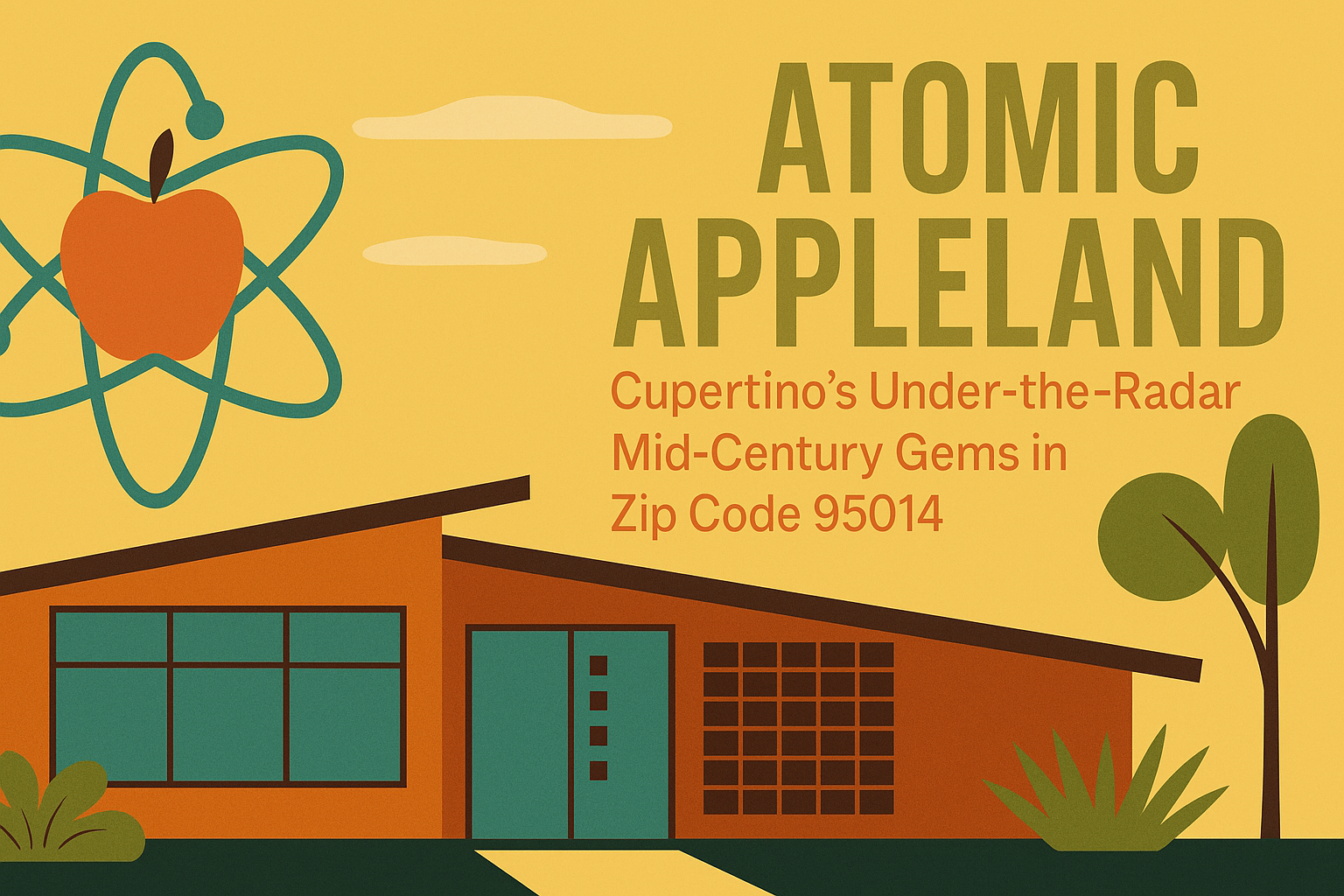
A Mid-Century Oasis in the Heart of Appleland
In a city world-famous for cutting-edge technology and the sleek Apple Park campus, a quiet enclave of mid-century modern homes stands as a delightful contrast. Tucked into the Rancho Rinconada area on Cupertino’s eastern fringe, these homes are authentic Eichler houses – modest mid-century gems that many drive past without realizing their significance. Built in the late 1950s and early 1960s, these atomic age tract homes were once affordable housing for young families. Today, they sit within the boundaries of some of Silicon Valley’s top-performing schools, making them both architecturally interesting and immensely desirable for families zillow.com. This unlikely pairing of space-age design and top-notch education has turned Cupertino’s Eichler neighborhood into a fascinating under-the-radar treasure for design-savvy homebuyers.
Eichler Homes in Rancho Rinconada: Hidden Mid-Century Gems
Cupertino’s Eichler pocket is centered in the Rancho Rinconada subdivision – a neighborhood that evolved from cherry orchards to housing during California’s post-war boom. Originally, Rancho Rinconada was filled with small, low-cost ranch houses built in the 1950s for modest incomes. By the early 1960s, however, developer Joseph Eichler’s modernist homes became the dominant style in one section of the tract known as Fairgrove. In total, roughly 200–225 Eichler homes were built here between 1959 and 1961 boyengateam.com. This makes Cupertino’s Eichler tract relatively small compared to Eichler communities in Palo Alto or San Mateo, yet it remains one of the only mid-century modern concentrations in the city.
Location is key: The Fairgrove Eichlers are bounded by Stevens Creek Boulevard, Lawrence Expressway, Bollinger Road, and Miller Avenue – placing them squarely in a prime part of Cupertino. Remarkably, despite their unassuming appearance, these mid-century homes now feed into highly ranked Cupertino schools, such as Sedgwick Elementary, Hyde Middle, and Cupertino High School. Realtors often emphasize the “TOP Cupertino Schools” as a selling point when marketing these homeszillow.com. The neighborhood is also minutes away from Apple’s campus and the vibrant Main Street Cupertino developmentatriare.com, adding to its appeal. In a city where new mega-homes and tech money dominate, this little enclave of one-story 60-year-old houses has become a hot commodity for buyers seeking character, community, and convenience.
Signature Eichler Design: Modernist DNA in Cupertino
What makes an Eichler home special? Joseph Eichler, working with visionary architects, brought Modernist design to suburban tract homes, and the Fairgrove models in Cupertino embody many of those signature features. Post-and-beam construction, allowing for open floor plans and indoor-outdoor flow, is at the core of each house. Rooms have vaulted ceilings with exposed beams and floor-to-ceiling glass in the form of large windows or sliding doors opening to backyards or patiosboyengateam.com. The street-facing facades are often modest and unadorned, sometimes featuring a carport or minimalist garage, while the rear of the home opens up with glass to bring the outdoors in. The roofs are characteristically flat or low-pitched, extending broadly with deep eaves. Inside, living areas wrap around open-air courts or atriums (especially in later models), and materials like wood paneling and tongue-and-groove ceilings add warmth. These elements reflect Eichler’s original design principles: an emphasis on simplicity, openness, and blurring the line between indoors and outdoorsscribd.com.
An extensively renovated Eichler in Cupertino’s Fairgrove tract exemplifies the iconic mid-century modern aesthetic. The low-pitched, asymmetrical roofline, expansive panes of glass, and minimal street facade reflect Eichler’s design principles of simplicity and indoor-outdoor integration. Many Fairgrove homes maintain these hallmark features – from post-and-beam construction to seamless backyard connections – preserving a slice of Atomic Age architecture amid Cupertino’s otherwise contemporary landscape.
Notably, the Eichler homes in Cupertino were built in two phases, which gives the neighborhood a mix of layouts. The first phase (circa 1959–60, primarily east of Hyde Ave) featured smaller 3-bedroom models centered around open courtyards – these did not include the enclosed atriums that Eichler is famous for. The second phase (1961, west of Hyde) introduced some larger plans (up to 4 bedrooms and ~1,850 sq ft) and included true atrium models with a glass-walled indoor courtyard at the heart of the home. This was an evolution in Eichler design, as atriums became a defining feature in many 1960s Eichlers. Compared to the more famous Eichler tracts – for example, Greenmeadow in Palo Alto (a 1954 Eichler subdivision recognized on the National Register of Historic Placesen.wikipedia.org) – Cupertino’s Eichlers were built slightly later and reflect that progression in style. Greenmeadow and its sister Palo Alto neighborhoods were early Eichler “utopias” with community parks and pools; Fairgrove, by contrast, is a smaller pocket development without a built-in community center. Yet the same Modernist DNA runs through them all. A design enthusiast walking the tree-lined streets of Fairgrove will recognize the familiar Eichler look that also graces better-known neighborhoods in Palo Alto, Sunnyvale, or the San Mateo Highlands. In Cupertino’s case, the Eichlers truly feel like hidden mid-century gems – a compact but authentic time capsule of 1960s California Modern tucked within an otherwise typical Silicon Valley suburb.
Hallmarks of Eichler Architecture in Fairgrove
Many of the classic Eichler design features can be seen in Cupertino’s mid-century tract. Key architectural hallmarks include boyengateam.com scribd.com:
Open Floor Plans & Post-and-Beam Construction: Load-bearing posts at the perimeter allow for wide, open living areas and glass walls, creating an airy, continuous space for kitchen, dining, and living rooms under a single roof span.
Floor-to-Ceiling Glass: Huge fixed windows and sliding glass doors (often forming a glass wall ~20–25 feet long) connect the indoors to patios and yards, flooding the interior with natural light.
Flat or Low-Pitched Roofs: Nearly horizontal rooflines with deep eaves give the homes a distinct profile. The ceilings are typically exposed wood decking (tongue-and-groove), and the beams extend past the glass, emphasizing horizontal lines.
Indoor-Outdoor Integration: Many models feature a private courtyard or atrium at the entry, and all are designed so that living areas have views onto either the central atrium or the backyard. Sliding doors often open to a covered patio, making outdoor space an extension of the home.
Minimalist Facades & Natural Materials: Street fronts have a restrained appearance – often a blank facia or modest carport, with the front door tucked behind a fenced courtyard. Exteriors feature simple materials like vertical wood siding, and organic colors that blend with the landscape. Decorative excess is avoided in favor of clean, geometric lines.
These design principles were radical for their time – a departure from the traditional suburban homes of the 1950s – and they remain highly appealing today. The Eichlers of Fairgrove proudly display this mid-century modern ethos, which is a big reason why architecture buffs hold them in such esteem. In a city dominated by contemporary remodels and new construction, stepping into “Atomic Appleland” (as one might affectionately call this neighborhood) feels like a step back to the optimistic Jet Age California, with all its glass, light, and indoor-outdoor harmony.
Modern Living in a Mid-Century Home: Renovation and Reinterpretation
Living in a 60-year-old Eichler home can be a dream come true for fans of modernist design – but it also comes with quirks and challenges. Many of these Cupertino Eichlers were built around 1960 and originally sold for about $20,000 each; they were solidly built but minimal by today’s standards. Over the decades, homeowners have found creative ways to update and reinterpret these mid-century homes for modern living while respecting their architectural heritage. The result is a neighborhood full of homes that honor the past yet embrace the present.
One common approach is to undertake a “down-to-the-studs” renovation that upgrades the infrastructure (plumbing, electrical, insulation) and amenities, all without altering the iconic Eichler aesthetic. A prime example is a recently renovated Eichler on Shadygrove Drive in Fairgrove, which was completely modernized and expanded within its original shell. The project added a fourth bedroom and third bathroom (bumping the home from ~1,700 sq ft to ~2,000 sq ft) to create a more functional floor plan, yet managed to maintain the home’s mid-century vibe and open feelsunset.com. The updated design preserved hallmark elements like the open-beam ceilings and even continued the tongue-and-groove paneling into new areas so that additions feel seamlesssunset.com. Large skylights were installed where an atrium was enclosed, ensuring the interior still gets the bright, airy quality Eichler intendedsunset.com.
Renovating an Eichler often means balancing authenticity with upgrades. Homeowners typically modernize kitchens and bathrooms with upscale finishes (e.g. sleek European cabinetry, quartz countertops, high-end appliances) while keeping the overall layout intact. In the Shadygrove home, the kitchen was transformed into a chef’s dream with a Bosch professional range, pot-filler, and custom cabinetry – all within the original open kitchen footprint. Bathrooms were turned into spa-like retreats featuring floating vanities and clean, modern tile, yet they still fit the mid-century character. Many owners also tackle less glamorous but crucial updates: replacing old single-pane glass with insulated windows, upgrading the foam roof for better efficiency, and installing new heating systems. (Original Eichlers had radiant floor heating which may have failed over time; some homes retain it or upgrade to modern solutions.) It’s not uncommon to see energy-efficient improvements like LED lighting, tankless water heaters, and even solar panels, all integrated in a way that doesn’t detract from the home’s period look6224shadygrove.com.
Crucially, structure and style are preserved even as comforts are added. Architects and builders skilled in MCM (Mid-Century Modern) restorations know to keep the open beams, the open floor plan, and the indoor-outdoor connections intactsunset.com. For instance, rather than subdividing spaces, a renovation might create a master suite by reconfiguring existing rooms or extending the house unobtrusively toward the rear. Whenever possible, materials are chosen to match or evoke the originals – such as Mahogany wall panels, globe pendant lights, or VCT flooring in a retro palette – so that new work blends with the old. The goal, as one Eichler interior designer put it, is to achieve a “modern and warm update” that still feels like a mid-century homesunset.com. This sensitive approach to remodeling has allowed many Cupertino Eichlers to shine in the 21st century: they now boast open, highly functional layouts with contemporary amenities, yet remain instantly recognizable as Eichlers.
Of course, remodeling an Eichler isn’t without its hurdles. Owners quickly discover the uniqueness of mid-century construction. For example, the slab-on-grade foundation means plumbing lines are encased in concrete – adding a new bathroom can require jackhammering the slab to re-route pipessunset.com. The lightweight roof and lack of attic space mean running new electrical wiring often has to be done through walls, since traditional ceiling routes aren’t availablesunset.com. Creativity and expertise are needed to upgrade these homes, but for those who love the Eichler style, the effort is worthwhile. The end result is a home that delivers an experience few modern houses can replicate: the drama of an open atrium or glass-walled great room, the tranquility of an enclosed garden patio, and the chic simplicity of mid-century design – all adapted for today’s living.
Preservation vs. Progress: Keeping Eichler’s Spirit Alive
One of the most compelling storylines in Rancho Rinconada has been the community’s fight to preserve the character of its mid-century homes in the face of Silicon Valley’s relentless redevelopment. As tech wealth transformed Cupertino over the last few decades, many old houses in the city were torn down and replaced with much larger luxury homes. In fact, Rancho Rinconada became something of a battleground over “monster homes” around the turn of the millennium. In the late 1990s, developers began buying up the tiny 700–1,100 sq ft post-war ranch houses in this neighborhood and erecting two-story mansions that dwarfed the remaining originalssfgate.com. The contrast of towering stucco boxes with faux Mediterranean columns looming over single-story mid-century homes was so jarring that long-time residents staged a “community revolt,” demanding actionsfgate.com. At that time, Rancho Rinconada was still an unincorporated county pocket, but the outcry led to the area’s annexation by the City of Cupertino in 1999sfgate.com. Once under city jurisdiction, planners moved quickly to rein in out-of-scale development: new replacement homes would have to be smaller and more in harmony with the neighborhood going forwardsfgate.com.
For the Eichler enclave of Fairgrove, this shift was critical. Homeowners in this tract organized to ensure their beloved Eichlers wouldn’t all be bulldozed for McMansions. They petitioned the city to conduct an architectural survey, which concluded that Fairgrove’s Eichler homes were uniquely valuable to Cupertino’s heritage and “must be preserved.” In 2001, responding to resident advocacy, the City of Cupertino took the noteworthy step of adopting Eichler Design Guidelines specifically for the Fairgrove neighborhood. Cupertino was one of the first cities in the nation to enact such guidelines for a mid-century modern tract, setting an example that inspired other cities to followatriare.com. These Fairgrove Eichler Guidelines (also referred to as the Eichler Design Handbook) lay out design principles to guide any additions, remodels, or new construction so that the Eichler aesthetic is maintainedscribd.com. For instance, the guidelines emphasize preserving the low-profile rooflines, using compatible materials and colors, and avoiding design features that clash with mid-century modern stylescribd.com. They also address the sensitive issue of second-story additions: since Eichlers were intended as single-story homes, any second floor must be set back and subtle, matching the Eichler roof pitch and form to remain “harmonious” with the neighborhoodscribd.com. In essence, Cupertino created a protective bubble around its Atomic Age district, allowing change but insisting on respectful, context-sensitive change.
The city’s General Plan even underscores this commitment. Policy statements explicitly call for preserving the unique character of the Eichler homes in Fairgrovecupertino.gov. Zoning for the area was adjusted to R1-6e (Single-Family Residential – Eichler), signaling that this is an Eichler preservation district with special rulescupertino.legistar.com. Practically speaking, this means an owner who wants to tear down an Eichler and build new will face strict design scrutiny – the new build must “meet the Eichler design guidelines” and fit the established scale and stylecupertino.legistar.com. It’s a gentle form of historic preservation that stops short of outright forbidding redevelopment, but strongly encourages renovation over replacement. The result, two decades on, is that Fairgrove still looks and feels much as it did in the 1960s: the vast majority of original Eichlers are intact (many upgraded or expanded, as noted), and new construction is rare. In contrast, the surrounding Rancho Rinconada streets that were not part of the Eichler tract have seen far more teardowns and big rebuilds – a quick drive will reveal numerous 3,000+ sq ft modern houses occupying lots where a 900 sq ft cottage once stood sfgate.com. But within the Eichler “district”, there’s a palpable pride in keeping the mid-century modern heritage alive.
The tension between preservation and progress is an ongoing story. Some homeowners naturally want to maximize their property’s square footage or modernize the facade beyond Eichler’s original look, while others are passionate about historic preservation and maintaining architectural integrity. So far, Cupertino’s balanced approach – voluntary guidelines backed by city policy – has favored the preservationists without creating too many onerous restrictions. Community efforts, like neighborhood associations and informal Eichler owners’ networks, also play a role in educating new buyers about the uniqueness of these homes. There’s an encouraging trend of tech industry professionals, young families, and design enthusiasts deliberately choosing these Eichler homes because of their character, not in spite of it. These buyers often plan careful restorations, which further helps tip the balance away from indiscriminate tear-downs. As mid-century design enjoys a renaissance in popular culture, owning an Eichler in Cupertino has even become something of a status symbol in its own right – a statement that one values architecture and history as much as square footage.
Real Estate Dynamics: Value, Trends, and Outlook
From a real estate perspective, Cupertino’s Eichler homes have gone from bargain buys to big-ticket assets. What began as $20k starter homes for mid-century engineers now trade in the multi-millions, thanks to a combination of location and rarity. Being in Cupertino, the land itself is extremely valuable – add on the appeal of top-rated schools and the cachet of Eichler design, and you have a potent mix for strong demand. Although these houses are smaller and older than the typical luxury new builds in the city, they are often described as “more affordable homes in Cupertino” (relatively speaking) due to their size. In recent years, an unrenovated 3-bedroom Eichler in decent condition might list in the mid-$2 million range, and competition among buyers can be fierce. Some homes attract Eichler aficionados who will pay a premium to secure an intact example of MCM architecture, while others draw young families eager to get into Cupertino schools without paying for a brand-new mansion.
For instance, a 3-bed, 2-bath Eichler of about 1,250 sq ft on Newsom Avenue (original 1950s condition but upgraded with basics) sold in the late 2010s for around $1.3–1.5M; today, Zillow estimates its value at roughly $2.6–3.1Mzillow.com. Meanwhile, fully remodeled Eichlers command top dollar: the showpiece 4-bedroom Eichler on Shadygrove mentioned earlier (expanded to ~1,564 sq ft and loaded with high-end upgrades) sold in early 2025 for $3.6 million. That sale not only reflects the premium for a turn-key renovated Eichler, but also underscores how desirable this neighborhood has become. The median listing price in the broader Rancho Rinconada area hovers around $3.1–3.3M as of 2025realtor.com, with Eichler homes often at the center of bidding wars due to their comparative scarcity. Ironically, what were once viewed as cheap, “cookie-cutter” tract houses are now prized real estate collectibles in the Silicon Valley market.
Buyer profiles in this niche are interesting. Many are local Silicon Valley professionals (often in tech or design fields) who appreciate the mix of practicality and style. They’re drawn to the efficient use of space – Eichlers live larger than their square footage thanks to the open layouts – and to the notion of owning a piece of California’s design history. There’s also a segment of buyers specifically looking for project homes to restore; these folks value the architecture so much that they’d rather restore an Eichler than buy a bigger contemporary house. On the flip side, some buyers initially come for the schools and location and only later discover the quirks of Eichler ownership (like all-glass walls and the joy of an atrium). In many cases, even those unfamiliar with Eichlers become converts, enchanted by the abundant light and unique lifestyle these homes offer.
Investment potential remains strong, but it comes with caveats. Land values in Cupertino will likely keep rising, so the underlying value of these lots is secure. However, the preservation guidelines mean owners can’t simply double or triple the house size to flip for profit; any additions must stay within neighborhood character. This tends to moderate speculative teardown activity – a good thing for long-term Eichler preservation, but it also means those who buy in Fairgrove are often planning to stay and enjoy the home rather than make a quick profit. That said, well-renovated Eichlers have shown excellent appreciation. They tap into a niche market of buyers willing to pay for design pedigree. As mid-century modern style continues to be celebrated (in magazines, TV shows, and by groups like the Eichler Network), the cachet of owning an Eichler in Cupertino may only increase. There is also the intangible value of the community: Fairgrove’s residents share a pride in their neighborhood’s character, which can enhance the sense of community and even influence property values positively (neighborhoods with strong identities often hold value well).
On the horizon, zoning and city planning will continue to play a role. Cupertino’s commitment to preserving these mid-century gems is likely to remain, especially with language in the General Plan supporting itcupertino.gov. We might see further measures such as single-story overlay zoning (as some other cities have done) to ensure no looming two-story homes appear in the tract. There’s also the possibility of official historic designation in the future, as appreciation for mid-century architecture grows – though currently the approach has been to use design guidelines instead of strict historic status. Cupertino’s Eichler tract could conceivably follow the path of Palo Alto’s Greenmeadow (which became an officially historic neighborhood)en.wikipedia.org, but whether the community pursues that is an open question.
For now, Rancho Rinconada’s Fairgrove Eichler neighborhood stands as a delightful anomaly: an “Atomic Ranch” time-capsule neighborhood thriving in the middle of high-tech, high-density Silicon Valley. These under-the-radar mid-century homes have proven their staying power – culturally, architecturally, and financially. They remind us that good design is enduring, and that even in the land of iPhones and startups, there’s a place (and a passionate market) for the classic California Modern home. Whether lovingly preserved or sensitively updated for the 21st century, Cupertino’s Eichler gems continue to radiate the optimistic modernism of the 1950s, all while offering families a chance to live in a piece of architectural history without sacrificing the practical benefits of life in Cupertino. In the grand story of Silicon Valley real estate, these homes are truly the atomic-age treasures of Appleland – modest in size, but with an outsized impact on the hearts of those who discover them.
Eric and Janelle Boyenga of the Boyenga Team at Compass are widely recognized as leading Eichler Real Estate Experts in Silicon Valley. With decades of experience representing buyers and sellers of architectural and mid-century modern homes, they offer in-depth neighborhood knowledge, innovative marketing strategies, and a true passion for preserving design integrity. Whether you're restoring a classic Eichler in Rancho Rinconada or seeking the perfect modernist home near Apple HQ, the Boyenga Team delivers expert guidance and Next-Gen service rooted in architectural appreciation.
Sources:
Cupertino’s Fairgrove Eichler neighborhood overview
Architectural features of Eichler homes boyengateam.comt
City of Cupertino preservation policy and Eichler design guidelines
SFGate report on Rancho Rinconada redevelopment and annexationsfgate.comsfgate.com
Example of modern Eichler renovation (Sunset Magazine, 2023)sunset.comsunset.com
Recent Eichler real estate data and sale in Cupertino
Historic Eichler tracts (Palo Alto’s Greenmeadow) for comparisonen.wikipedia.org