
The Eichler Kitchen: From St. Charles Steel to Smart Appliances
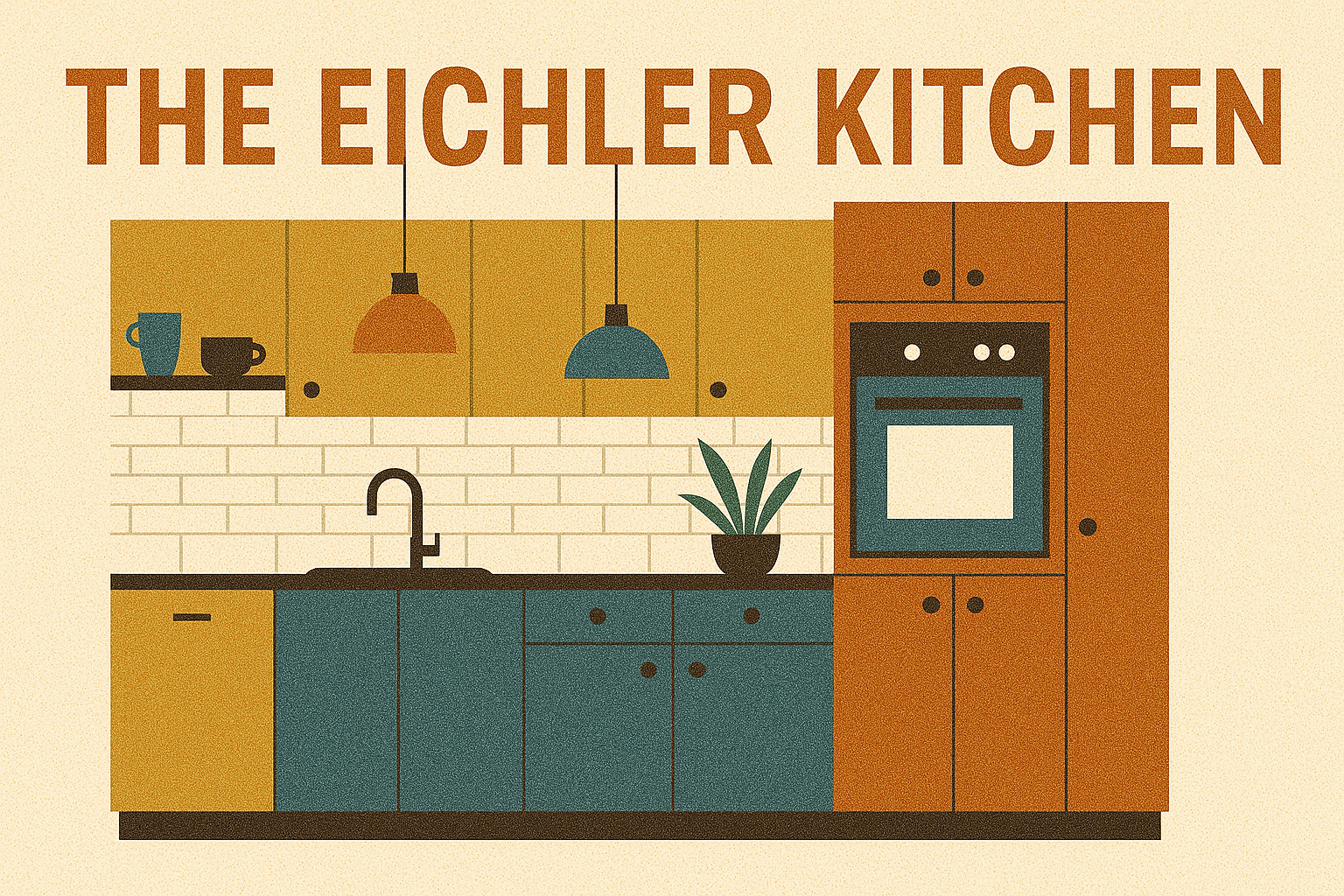
Eichler homes are icons of mid-century modern design, and nowhere is their blend of form and function more evident than in the kitchen. From the gleaming St. Charles steel cabinets and efficient galley layouts of the 1950s, to the tiled countertops and oak cupboards of 1980s remodels, and finally to today’s smart-appliance-equipped restorations, Eichler kitchens have undergone a fascinating evolution. This comprehensive journey will explore how these kitchens transformed through the decades – highlighting original design features (like pass-throughs and built-ins), major renovation waves, and modern reinterpretations that honor Joseph Eichler’s vision. Along the way, we’ll visit real Eichler neighborhoods across Northern and Southern California, peek into design archives and renovation case studies, and discuss how thoughtful kitchen updates can preserve and enhance both the mid-century feel and the value of these architectural gems.
Mid-Century Origins: Eichler Kitchen Design in the 1950s–60s
In the 1950s and 1960s, original Eichler kitchens set a new standard for modern living. Joseph Eichler, working with progressive architects like A. Quincy Jones, Frederick Emmons, Anshen & Allen, and Claude Oakland, crafted homes around open-plan layouts and indoor-outdoor harmony – and the kitchen was no exception. Key elements of these mid-century Eichler kitchens included:
Premium steel cabinetry: Eichler often outfitted kitchens with St. Charles metal cabinets – considered the “cream of the crop” of steel kitchen cabinets at the timeretrorenovation.com. These cabinets had sleek flat doors (sometimes with sliding panels) and came in bold enamel colors or subtle speckled finishes (such as the brown Zolatone paint found in some models).
Galley or U-shaped layouts: Many Eichler kitchens were compact galley-style or modest U-shapes that maximized efficiency. A proper work triangle (fridge, stove, sink placement) was integral to the design. Homeowners of intact Eichlers often praise that “[a] galley kitchen with a proper work triangle is a joy forever. Jones & Emmons knew what they were doing,” as one owner of a 1955 Eichler with its original layout remarked atomic-ranch.com.
Pass-throughs and openness: Despite their defined workspace, Eichler kitchens never felt isolated. Architectural features like pass-throughs or partial walls were used to maintain connection with adjacent living areas. For example, some models included a three-quarter-height wall between the kitchen and dining room – high enough to hide kitchen clutter, but low enough (or topped with glass) to let light and conversation flow through atomic-ranch.com. These pass-through designs allowed the cook to serve guests or family easily, reinforcing the open-plan ethos. (In fact, Eichler owners often caution against removing such half-walls in misguided “open concept” overhauls, since they were purpose-built to create flow and separation simultaneously atomic-ranch.com.)
Built-in appliances and futuristic features: Eichler kitchens embraced modern gadgetry. Wall-mounted Thermador ovens and matching cooktops were common high-end fixtures, integrated neatly into the cabinetry for a built-in look. Original marketing brochures touted features like slide-out range hoods, built-in blenders, and efficient storage. Many kitchens even had a small drop-leaf breakfast bar or pivoting table attached to the cabinetry – an ultra-modern convenience for the era atomic-ranch.com. Formica countertops (often in light colors or subtle patterns) and easy-clean linoleum or vinyl tile flooring completed the space, emphasizing practicality with style.
Eichler neighborhoods from Northern California (such as the Greenmeadow tract in Palo Alto, the San Mateo Highlands, or Lucas Valley in Marin County) to Southern California (the Fairhaven/Fairhills tracts in Orange, and Balboa Highlands in Granada Hills) featured these forward-thinking kitchens. A well-preserved example is a 1955 Eichler in Sacramento: its kitchen still sports the original white and black cabinetry with wood trim, plus the original Thermador oven and cooktop – all in a compact galley that remains entirely untouched atomic-ranch.com. The stove-side counter retains its 1950s Formica, and even the sectional sliding cabinet doors are intact. Stepping into that kitchen is like entering a time capsule of mid-century modern design. It’s easy to imagine the first owners marveling at their “Kitchen of Tomorrow” – a space that felt efficient, open, and integrated with the rest of the house in a way traditional homes of the time did not.
The 1970s–80s Remuddling Era: When Eichler Kitchens Lost Their Way
As decades passed, tastes changed. By the late 1970s and into the 1980s, some Eichler owners began remodeling their homes in then-trendy styles that unfortunately clashed with the original mid-century aesthetic. In what Eichler aficionados often dub the “remuddling” era, many classic Eichler kitchens were stripped of their modernist character in favor of faux-traditional makeovers. Common changes included: replacing sleek flat-panel cabinets with ornate oak cabinetry, swapping out simple countertops for busy tile or granite, adding fussy details like crown moldings or decorative trim, and even enclosing or reconfiguring the layout. The result often turned an airy Eichler kitchen into something indistinguishable from any suburban home of the 1980s – much to the chagrin of today’s purists.
Eichler experts have strong opinions about these changes. One Eichler Network writer quipped that a kitchen remodel is the time to “remove the ugliness of Victorian crown molding, Bavarian woodcarvings, 1980s oak cabinets, and four-inch tile countertops” that earlier owners had added in erroreichlernetwork.com. Such elements, while popular in their day, did not belong in the clean lines of an Eichler. The open soffits and globe pendant lights of the original design were frequently replaced by dropped fluorescent light boxes and decorative fixtures unsuited to the post-and-beam ceilings. Some remodelers even walled off the kitchen entirely or added upper cabinets that blocked sight-lines, undermining Eichler’s signature indoor-outdoor feel.
Perhaps the biggest issue with these 1980s-era remodels is that they didn’t age well – aesthetically or functionally. By the 2000s, new buyers of Eichler homes often saw past these dated upgrades and longed to restore the mid-century charm. One profile of an Eichler family noted that the 1980s kitchen remodel “has got to go,” as the new owners vowed to undo it and start fresh eichlernetwork.com. In many cases, those oak cabinets and pink-beige tiles were ripped out just a couple of decades after they’d been installed, essentially becoming expensive mistakes in hindsight.
From a real estate perspective, these off-style remodels can even hurt an Eichler’s value. Loni Nagwani, a San Jose realtor specializing in Eichler homes, explains that she gives far more value to kitchens that remain in the original Eichler spirit than to those redone in 1980s mainstream style. “When appraising an Eichler, I will give more value to those kept in the original design than to a 1980s remodel or an oak kitchen remodel,” Nagwani points out eichlernetwork.com. In other words, a 60-year-old kitchen with its vintage cabinets and layout intact might be seen as more of an asset (at least to the right buyer) than a newer but stylistically inconsistent renovation. Eichler fans covet authenticity; they’d rather have an old St. Charles metal cabinet (even if it’s a bit worn) than a shiny oak replace-in that breaks the architectural harmony.
1990s–2000s Revival: Rediscovering and Restoring the Eichler Look
By the 1990s and early 2000s, a mid-century modern revival was in full swing. A new generation of homeowners and design enthusiasts began to recognize the timeless appeal of Eichler homes eichlerhomesforsale.com. Instead of gutting these houses or “updating” them with generic styles, people increasingly aimed to restore or re-create the original Eichler vibe – especially in the kitchens and living areas that define these homes.
Several factors fueled this revival. Publications like Atomic Ranch magazine (launched in the mid-2000s) celebrated mid-century homes and showed inspiring renovations. The Eichler Network and local enthusiast groups organized home tours that highlighted well-preserved Eichlers, spreading appreciation for original details. As appreciation grew, so did practical support: vintage parts and replicas became easier to source. One could find replacement globe lights, period-style cabinet pulls, and even original St. Charles steel cabinets salvaged from other remodels. (In fact, one ingenious couple in California famously sourced two entire sets of vintage St. Charles cabinets and combined them to outfit their 1953 kitchen – talk about dedication!)
During this revival era, many 1980s-style kitchens were ripped out and redone in a mid-century modern spirit. Some Eichler owners were lucky to uncover preserved elements hidden by previous remodels – for example, unpainted Philippine mahogany wall paneling behind drywall, or intact tongue-and-groove ceilings above a dropped ceiling. Others embarked on “mid-mod” reinterpretations: installing brand-new cabinets and finishes that looked like they belonged in the 1950s or 60s, even if they were modern in construction. Flat-front cabinet doors returned to favor (often in walnut veneer or bright retro colors), and vintage-inspired materials made a comeback. It wasn’t uncommon to see new kitchens with boomerang-pattern laminate or Heath Ceramics tile backsplashes, sleek Danish modern hardware, and period-appropriate color palettes.
A great example comes from an Eichler in San Jose (circa 1959) that underwent a dramatic “back to MCM” transformation. The home’s kitchen had been given a dark, builder-basic 1990s treatment by a prior owner – think black granite counters and standard oak-front cabinets. In just 18 days, the new owners and their designer swapped out that dated look for a custom mid-century-inspired design that feels bright and authentic to the home’s roots msdevlinsmith.files.wordpress.com. They even took the extra step of incorporating original Eichler kitchen pieces: the homeowners salvaged some original cabinet panels from a neighbor’s Eichler that was being remodeled and used those as a template for their new cabinetry. On the dining-room side of their island, they installed sliding cabinet doors made of mahogany that match the home’s original wood wall paneling, and on the kitchen side they used white laminate on plywood – mirroring how Eichler’s own cabinets were built in the 1950smsdevlinsmith.files.wordpress.com. The new backsplash features a playful random-pattern tile in turquoise, yellow, and gray, giving a nod to mid-century geometrics. The result is a kitchen that feels like 1959 (at a glance you might think the cabinets were lovingly preserved originals) but functions like 2025. The homeowners summed up their design approach: “[We] wanted to build a modern version of what an original Eichler kitchen could be,” blending old and new seamlessly.
Throughout Eichler enclaves in Palo Alto, Sunnyvale, and Mountain View, you can find similar stories of mid-mod revival from the 2000s. In Southern California as well, Eichler tracts in Orange and Granada Hills saw new residents undoing past “improvements” to bring back open sight-lines, restore authentic materials, and otherwise recapture the homes’ mid-century magic. This era also saw creative compromises: if original steel cabinets were long gone, an owner might install IKEA cabinet boxes but dress them up with custom Semihandmade walnut slab doors or colorful panels to emulate a 1960s look. Reproduction or salvaged Thermador ovens (or their modern equivalents) found their way into many remodels. In essence, the goal was to make the kitchen look like it belonged in an Eichler again – even if that meant actually installing brand-new components.
By the end of the 2000s, the best Eichler kitchen remodels were those that you couldn’t immediately tell were remodels at all; they might fool you into thinking you’d walked into a perfectly kept Eichler time capsule, albeit one with a very fresh coat of paint.
Modern Eichler Kitchen Renovations: Smart Tech with Mid-Century Style
Fast forward to the 2010s and 2020s, and Eichler kitchens are evolving once more – this time marrying 21st-century technology with mid-century aesthetics. Homeowners today want the convenience of a contemporary kitchen (high-end appliances, smart home integration, durable finishes) but still crave the soul of a mid-century modern space. The good news is that these goals are not mutually exclusive. With careful planning, modern Eichler kitchens can enhance functionality while preserving that classic look that fans adore.
A thoughtfully remodeled Eichler kitchen in San Jose keeps the mid-century spirit alive. Clean white cabinets (IKEA boxes with custom flat fronts) echo the original Eichler simplicity, while new quartz countertops, a large island, and smart stainless-steel appliances bring the space into the 21st century. Note the iconic post-and-beam ceiling with exposed decking above – an Eichler hallmark retained in this update.
Designers who specialize in Eichler renovations (like Klopf Architecture in the Bay Area, or homeowners-turned-designers such as Urbanism Designs) often emphasize a few guiding principles for these projects. Firstly, maintaining an open layout is key – or opening it back up if a past remodel closed it off. That can mean removing a full wall added in the ’70s or simply foregoing overhead cabinets that would block views. Many modern renovations opt for an island or peninsula in the kitchen to provide storage and seating while keeping sight-lines open to the dining and living areas. For instance, in one recent San Jose Eichler remodel, an L-shaped 1980s kitchen was reconfigured into an island layout, instantly improving circulation and creating a more social space for a young family dwell.com.
Secondly, new cabinetry choices are made to complement the Eichler aesthetic. Flat, slab-style cabinet doors remain the go-to style (no raised panels or ornate molding here!). Popular finishes include warm wood veneers (walnut and teak to match original Eichler paneling) and smooth painted or laminate surfaces in neutral or era-inspired hues. Some homeowners even seek out period-correct details like sliding cabinet doors (a hallmark of some original Eichlers) or use two-tone color schemes reminiscent of the 1960s. In one Palo Alto Eichler, the remodel included custom walnut cabinets and a bookmatched walnut veneer pantry wall that pay homage to the home’s mid-century rootshomeworlddesign.com archello.com. Another Eichler renovation in Orange County paired crisp white cabinet fronts with a celadon-green tile backsplash for a subtle retro twist, then added replica vintage pendant lights to complete the look.
Of course, modern appliances are integrated as well – but the trick is doing so invisibly or in harmony with the design. Stainless steel appliances are common and can blend in given Eichler’s original use of stainless trim (for example, vintage Thermador ovens had stainless faces). Many Eichler renovators choose panel-ready refrigerators that can be concealed behind wood panels matching the cabinets, so the huge fridge doesn’t dominate the visual field. Induction cooktops or sleek gas cooktops set into the island maintain a low profile compared to old bulky ranges. Even ovens and microwaves are often tucked into wall cabinets at a comfortable height, similar to how the originals were. The latest smart appliances (touchscreen fridges, Wi-Fi enabled ovens, etc.) can coexist with a mid-century look as long as their exteriors are streamlined. It’s not unusual to see a state-of-the-art refrigerator that you can talk to, right next to a set of cabinetry that looks straight out of 1962.
One innovative example is a Fairglen Eichler in San Jose owned by Loni Nagwani. She and her husband decided to update judiciously rather than rip everything outatomic-ranch.comatomic-ranch.com. They retained their original 1958 kitchen cabinets with the rare brown Zolatone finish, but refreshed the space with a stainless-steel countertop and backsplash, a new GE Profile fridge and Fisher & Paykel drawer dishwashers, and even raised the existing island on steel legs to a more ergonomic heightatomic-ranch.comatomic-ranch.com. The vintage Thermador cooktop and wall oven were left in place as functional conversation pieces. The outcome was a perfect blend of old and new: “Our kitchen is an example of what an original Eichler kitchen can be with very little cost—$5,000 to $10,000 in upgrades,” Nagwani says, noting that “it looks modern because it was designed modern”atomic-ranch.com. By keeping the core design intact and simply enhancing it, she ended up with a kitchen that feels both authentically mid-century and contemporarily stylish. And as she points out, a slick European import kitchen “wouldn’t go with the rest of the house”atomic-ranch.com – a sentiment many Eichler owners understand well.
Finally, materials and finishes in modern Eichler kitchen projects are chosen to echo mid-century sensibilities while meeting today’s standards. Countertops might be durable white quartz or honed granite in a subtle pattern that resembles vintage laminates. Backsplashes offer a chance for creative expression: some go with classic subway tile or Heath Ceramics mosaics, while others use bold geometric tile patterns to inject a bit of retro fun (as seen in the Sunnyvale Eichler with a hexagonal motif backsplash that “makes the space”msdevlinsmith.files.wordpress.com). Flooring often stays true to Eichler’s practical roots – many homeowners restore the concrete slab and add hydronic heating with a polished finish, or lay down large-format porcelain tiles throughout for a cohesive indoor-outdoor look. A few brave souls reintroduce linoleum or VCT tiles in vintage-inspired colorways (for example, checkerboard patterns or colorful abstract designs) to really nail the period feel underfoot.
In essence, the best modern Eichler kitchen renovations are labors of love that respect the original DNA of the home. They tend to edit and update, rather than reinvent from scratch. By doing so, they achieve something remarkable: a kitchen where a 1960s Eichler homeowner and a 2025 tech-savvy family would both feel equally at home.
Preserving Character and Value: Eichler Kitchens and Resale Considerations
For Eichler homeowners (and prospective buyers), the kitchen is often a make-or-break element. Not only is it the heart of the home, but it’s also a big piece of what makes an Eichler, well, an Eichler. Renovating this space raises important questions about character and resale value. Go too contemporary or disjointed, and you risk alienating the very audience that loves these homes. Stay too authentic (with aging appliances or outdated features), and you might turn off general buyers who don’t appreciate quirks. The goal is to strike the right balance – preserving mid-century charm while providing modern comfort.
From a market standpoint, Eichler specialists consistently report that remodeling in line with the home’s original style pays off. If you plan to sell, it’s wise to keep the design modernist. As realtor Loni Nagwani advises clients, “stay with modern and stay away from [traditional styles]” when updating an Eichler kitchen (and indeed the whole house). Homes that retain Eichler elements or thoughtfully modernize them tend to attract stronger interest and higher offers from the growing community of mid-century enthusiasts. Conversely, an Eichler that has a Tuscan-style kitchen or a farmhouse sink and shiplap (trends that might be lovely elsewhere) can linger on the market or require price adjustments, because buyers see the cost and effort needed to correct the mismatch.
It’s interesting to note that much of an Eichler’s resale value is cosmetic – meaning, the appearance and style cohesion matter a lot. Structural updates like new plumbing or a roof are important, of course, but an ultra-chic Eichler kitchen makeover can sometimes boost a home’s appeal more immediately than behind-the-walls improvements. As Nagwani noted, Eichler buyers often make judgments based on whether the home looks authentic and move-in ready in the mid-century sense eichlernetwork.com. This is why a modestly updated original kitchen (with, say, a fresh coat of paint on the slab cabinets and new period-style countertops) can outperform an expensive full remodel done in the wrong style. The former whispers “authentic Eichler,” whereas the latter might shout “remodel opportunity.”
For those who love Eichlers, the highest value kitchen is either pristinely original or beautifully updated in spirit. Pristinely original could mean 60-year-old cabinets, yes – but if they’re in good shape, that patina is part of the charm and value. (There’s a market for original St. Charles steel cabinets; some restorers will even pay to acquire them from homes that are remodeling.) On the other hand, an Eichler kitchen outfitted with custom walnut cabinets, retro-looking tile, and high-end modern appliances hidden behind panel fronts can add value, because it saves the buyer the trouble of doing a sympathetic remodel themselves. In California’s competitive real estate scene, turnkey condition is a plus – and for an Eichler, “turnkey” increasingly means updated without erasing the mid-century character.
To maximize both enjoyment and value, Eichler owners today often follow a few best practices in their kitchen projects:
Work with the Eichler layout, not against it: If the original kitchen was a galley or had an open pass-through, honor that in your new design. Removing a useful partial wall or relocating the kitchen to a completely different part of the house could disrupt the home’s flow (and might even require costly structural changes). It turns out the original architects often got it right atomic-ranch.com.
Use quality, minimalist materials: Flat-panel cabinets (whether you refurbish vintage ones or install new) and simple countertop profiles (no ornate edges) look “correct” for the home. Durable modern materials like quartz, stainless steel, and porcelain can all work – just choose finishes in keeping with mid-century simplicity. For example, many Eichler remodels use quartz counters in white or subtle gray as a nod to the clean Formica of old, but with better performance.
Integrate appliances thoughtfully: Go for a unified look where possible – stainless with stainless, or panel-covered fronts – so the eye isn’t drawn to any one giant appliance. Modern smart appliances (from fridges with touchscreens to Alexa-controlled ovens) are fine luxuries to include; just ensure the exterior design of these units is sleek. In some cases, retro-styled appliances (like those with a minimalist, vintage look) can be used if one wants a pop of nostalgia.
Preserve some original details: Even in a full gut renovation, keeping or reintroducing one or two original details can make a huge difference. This might be an open beam ceiling (don’t cover it up!), restoring the mahogany wall panels in an eating nook, or reinstalling a vintage Nelson bubble lamp or spindle clock on the wall as a focal point. Such touches reinforce the Eichler character. One remodel in Palo Alto saved a section of original cabinet with sliding doors and incorporated it as a pantry in the new kitchen – a small but meaningful link to the past.
Consult Eichler-specific resources: Because Eichlers are unique, many owners turn to resources like Eichler Network forums or specialized contractors when planning a kitchen update. This can help avoid pitfalls and discover creative solutions (for instance, how to run new electrical wiring without damaging the exposed ceiling, or where to source custom windows to fit the original kitchen window slot). An Eichler-savvy approach in the kitchen can extend to details like using period-appropriate trim, baseboards, and even considering Vastu or Feng Shui principles popular in some Eichler communities eichlerhomesforsale.com, to appeal to a wide range of prospective buyers.
In the end, the Eichler kitchen remains a centerpiece – both literally in the home’s open layout, and figuratively in the minds of Eichler fans and buyers. From the mid-century purist restoring a 1960 Palo Alto Eichler with an eye toward historical accuracy, to the tech executive in San Mateo who wants an Instagram-worthy MCM kitchen with all the modern perks, the guiding philosophy can be the same: honor the house. As one Eichler owner wisely realized, bigger, shinier, newer isn’t always better if it doesn’t suit the homeatomic-ranch.com. Eichler kitchens were born from a forward-thinking spirit – in their heyday they were the epitome of modern living – and by thoughtfully blending old and new, we can ensure they continue to inspire and delight for decades to come.
Case Studies: Eichler Kitchen Transformations Across California
To wrap up, let’s highlight a few real-world Eichler kitchen case studies that illustrate the evolution and possibilities discussed:
“Time Capsule” 1955 Eichler (Sacramento) – Owners Zann Gates and Jeff Roush purchased an intact Eichler in an unlikely location (yes, even Sacramento has an Eichler tract!). The kitchen retains its original St. Charles cabinets in white with black edges, original appliances, and even a three-quarter height divider wall. They chose to keep it all. Their only upgrades were behind the scenes (electrical, insulation) and cosmetic refreshes. The payoff is a jaw-dropping original kitchen that anchors their open floor plan. As Zann says, “the galley kitchen with a proper work triangle is a joy… [the architects] knew what they were doing”atomic-ranch.com. This home proves that a carefully preserved Eichler kitchen can be a major asset, even boosting the home’s historical cachet and value.
The “Remuddled-to-Radical” Revival (Sunnyvale) – A young couple in Sunnyvale, Pamela Lin and Erwin Tam, bought an Eichler that had endured a clunky 1990s remodel. They took matters into their own hands (literally – Pamela became a designer through this process) and reimagined the kitchen completely. Walls that separated it from the dining room were removed, restoring the open flowinstagram.com. They installed new flat-panel cabinets in a mix of crisp white and natural wood, punctuated by pops of color in the backsplash and floor tiles. Contemporary Beko appliances were chosen for their sleek look and energy efficiency. Impressively, they incorporated Eichler-esque details like sliding upper cabinet panels and kept the original indoor planter box feature by the kitchen. The transformation was so successful it was featured in Dwell and 7x7 magazines, and it essentially kickstarted Pamela’s design career. It demonstrates how an Eichler kitchen can be reborn for modern living without sacrificing its soul – the space is now light, bright, and functional, yet if you squint you’d think it’s straight from 1960.
Nagwani’s Smart Restoration (San Jose Fairglen Eichler) – Loni Nagwani’s case, which we touched on earlier, is worth revisiting as a model of restraint and impact. She had all the pieces of an original Eichler kitchen (cabinets, layout, vintage appliances) and resisted the urge to rip them out. Instead, she updated selectively: new stainless steel surfaces here, a couple of smart drawer dishwashers there, and improved task lighting throughout. She kept the quirky pivoting breakfast table and the unique brown cabinet finish that Eichler had originally installedatomic-ranch.com. The result looks like an immaculately kept Eichler kitchen, but functions like a new one. Her home’s value in the resale market actually climbed after the renovation, as it struck the perfect chord with Eichler enthusiasts. And on a personal note, she enjoys a kitchen that “was designed modern” from the startatomic-ranch.com – proving that sometimes the best design move is knowing what not to change.
Orange County Mid-Mod Makeover (Fairhaven, Orange) – In Southern California’s Fairhaven tract, one Eichler homeowner undertook a kitchen remodel that demonstrates balance. The original kitchen had been partly gutted by previous owners, so fully restoring it wasn’t an option. Instead, they opted for all-new cabinetry inspired by Donald Wexler’s steel homes (flat steel-gray laminate cabinets) combined with a vibrant backsplash of orange and yellow tiles – a cheerful nod to the 1960s palette of the Eichler development. They opened a wall to create a pass-through bar counter to the living room, reintroducing that social connectivity Eichler kitchens are known for. High-tech touches included a smart oven with a retro-style knob interface and an induction cooktop that stays cool (a plus in warm Orange County). Realtors later noted that this kitchen became the “wow factor” that helped sell the house, proving that new and old can blend to boost market appeal.
Each of these case studies, from NorCal to SoCal, underscores a common theme: Eichler kitchens thrive when they respect their roots. Whether through careful preservation or imaginative reinterpretation, the most successful projects understand that an Eichler house is a cohesive design – the kitchen, living room, atrium, and exterior all relate. Change one piece drastically out of character, and the harmony is off. But update with a keen eye to Eichler’s mid-century principles, and you’ll likely end up with a kitchen that’s not only a joy to live with, but also a strong selling point that can enhance your home’s value in the eyes of the right buyer.
Conclusion
From the St. Charles steel cabinets and bold formica of the 1950s, through the detours of 1980s “improvements,” to the thoughtful restorations and smart-tech integrations of today, the journey of the Eichler kitchen is a microcosm of mid-century modern homes themselves. Styles and preferences may change, but good design endures. Joseph Eichler’s belief in “modern living for the masses” meant these kitchens were cutting-edge in their time – open, efficient, and unpretentious – and with the current wave of appreciation and restoration, they have become cutting-edge once again.
For Eichler fans, real estate watchers, and architecture buffs, the kitchen is often the first stop on any Eichler home tour – it’s where the mid-century modern ideals meet daily life most directly. There is something undeniably satisfying about standing in an Eichler kitchen that looks like 1962 but operates with 2025 ease, or conversely, one that has never changed since the day it was built and still functions beautifully for a contemporary family. These spaces tell stories. They speak to how families in post-war California embraced modern design (sometimes before the rest of America caught on), and how subsequent generations rediscovered and rejuvenated that design.
In the end, the Eichler kitchen teaches an important lesson in design: innovate, but respect what works. The best renovations find the innovation in what Eichler and his architects already created – and amplify it. Steel cabinets might give way to walnut veneer, and wall ovens to smart ranges, but the spirit of an Eichler kitchen – informal, integrated, and inventive – can continue from the age of martini shakers and fondue pots right into the era of smart fridges and instant pots. As we’ve seen, bridging these eras is not only possible, but deeply rewarding, yielding kitchens that honor a legacy while living comfortably in the present. And that is exactly the kind of evolution Joseph Eichler would appreciate: design that stands the test of time by adapting just enough, but never losing its soul.
Sources: The insights and examples in this article draw from a range of Eichler home resources, including homeowner stories in Atomic Ranch atomic-ranch.com, expert commentary from Eichler Network and mid-century design archiveseichlernetwork.com retrorenovation.com, real estate perspectives, and documented renovations featured in publications like Dwell and Houzz. These sources highlight the enduring appeal of Eichler’s mid-century vision and how it continues to influence kitchen design choices today.
Sources