
Inside the Original Specs: What Materials Made an Eichler an Eichler
Silicon Valley’s mid-century Eichler homes – found in Palo Alto, Sunnyvale, San Jose, Mountain View and beyond – are beloved for their distinct modernist style. But what truly makes an Eichler home iconic? It comes down to the original materials and design elements that Joseph Eichler’s team used to create that indoor-outdoor California modernism. In this blog, we’ll dive inside the original specs of Eichler homes, highlighting the materials that defined their mid-century character: from warm Philippine mahogany walls and globe pendant lights to radiant-heated floors and open-beam ceilings. We’ll also provide tips for homeowners aiming for an authentic Eichler restoration – where to source period-accurate materials, how to preserve those vintage features, and examples of local Eichlers that have lovingly retained their original finishes. Finally, we’ll spotlight the Boyenga Team as Silicon Valley’s trusted Eichler experts who guide restoration-minded buyers and sellers. Let’s explore what materials made an Eichler truly an Eichler, and how to keep that spirit alive today.
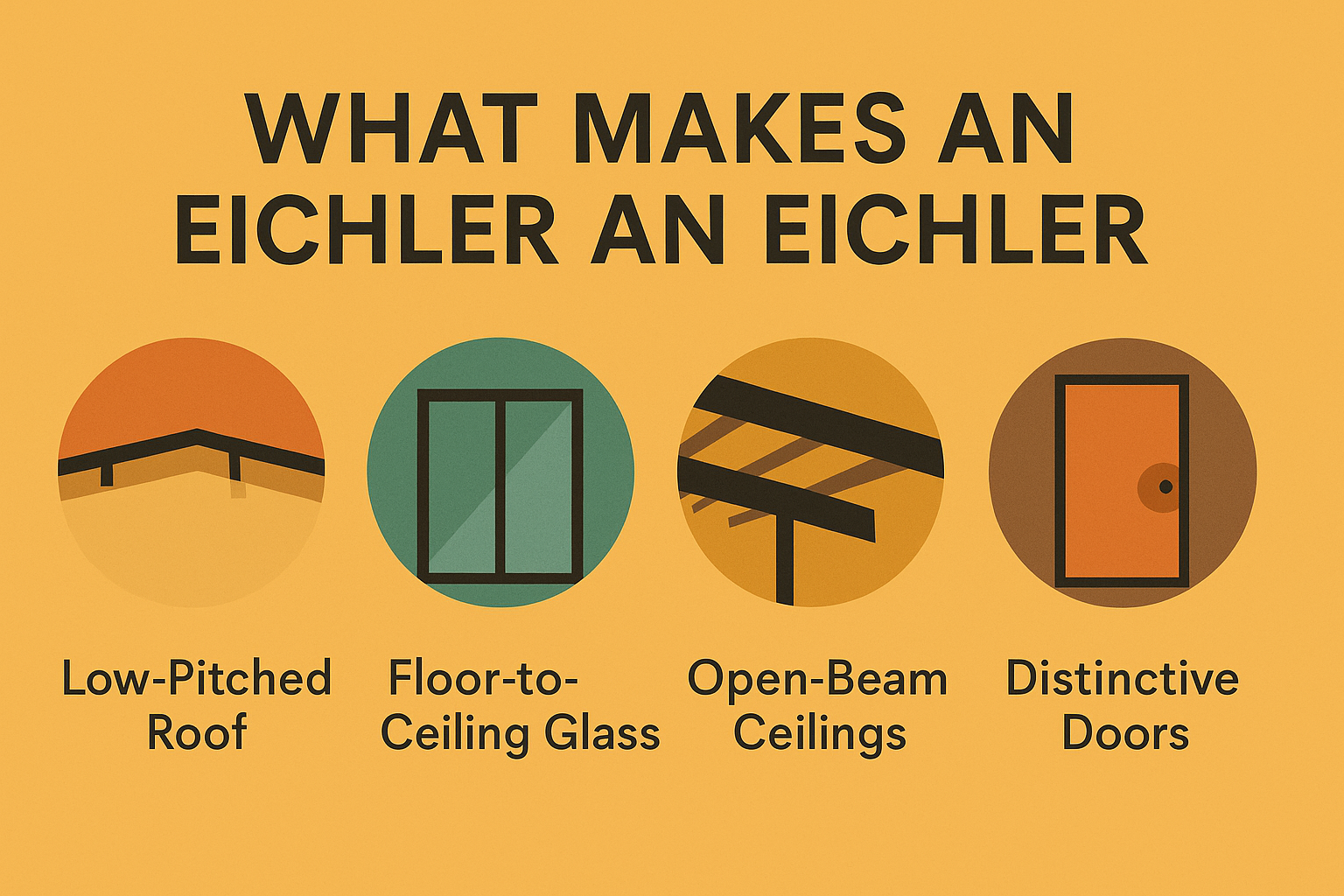
An artistic illustration of an iconic mid-century Eichler exterior, showcasing hallmark features: a low-sloped post-and-beam roof, expansive floor-to-ceiling glass, vertical wood siding, and a brightly colored front door. These design elements, paired with the right materials, define the Eichler look.
Philippine Mahogany Paneling: Eichler’s Warm Interior Walls
Walk into a classic Eichler and one of the first things you’ll notice is the rich wood paneling lining the interior walls. Early Eichler homes (especially 1950s models) were built with 1/4-inch or 3/8-inch Philippine mahogany plywood panels (also known as lauan mahogany) covering most interior walls eichlerhomesforsale.com. This honey-colored wood, with its warm reddish-brown hue and visible grain, gave Eichler interiors a cozy yet modern feel. Joseph Eichler chose mahogany for its organic warmth and simplicity, not because it was cheap eichlerhomesforsale.com. In fact, intact original mahogany panels are now considered a prized feature – they practically scream “I’m an Eichler!” in a way plain drywall never could eichlerhomesforsale.com.
Originally, these mahogany panels were finished with a clear coat or light stain, allowing the natural wood tone to shine. By the early 1960s, some later Eichlers began to include more drywall, but many Silicon Valley Eichlers (like those in Palo Alto’s Greenmeadow tract) still retained all-wood interiors. Preservation-minded owners today cherish this defining material. Maintaining the panels is key to keeping that mid-century glow: regular dusting and gentle cleaning (no heavy water or paint) will preserve the wood’s character. Experts strongly advise against painting over original paneling – doing so would hide a core element of Eichler design eichlerhomesforsale.com. As Eichler realtors often note, the wood walls are “a key mid-century element” that add value and authenticity eichlerhomesforsale.com.
For those restoring an Eichler, fading or damaged panels can be refinished or replaced in-kind. Over decades, mahogany can dry out or fade from sunlight. A light sanding with fine grit and a fresh coat of finish (matching the original clear or a warm-toned stain) can revive the color eichlerhomesforsale.com. If a panel is beyond repair – say it delaminated from moisture – replacement panels are available. The good news is you can still find mahogany veneer plywood that closely matches the original lauan. Specialty lumber yards and some big-box stores carry 4x8 panels of lauan underlayment or mahogany veneer. One Eichler homeowner reports new mahogany plywood sheets run about $80 each in today’s market eichlerhomesforsale.com, making it feasible to re-panel entire rooms. Just be sure to match the original panel style – Eichler interiors were typically flush panels, though a few models had V-groove patterns, so get the same groove spacing if present eichlerhomesforsale.com. When installing, it’s best to stain and finish the new panel before putting it up so it blends in. With a bit of effort, you can replace missing panels and restore your Eichler’s mid-century soul, rather than opting for drywall.
Homeowners truly dedicated to authenticity have even sourced vintage panels. For example, one Eichler owner in Walnut Creek salvaged several original mahogany panels from a neighbor’s remodel (the neighbor didn’t need them) and installed these rescued panels in their own home’s bedrooms atomic-ranch.com. This kind of resourcefulness shows how passionate Eichler enthusiasts can be about keeping that warm wood look. The bottom line: Philippine mahogany paneling isn’t just an interior finish – it’s part of the Eichler identity. Preserving or restoring it (with fresh veneer or careful refinishing) will instantly transport your home back to the 1950s and maintain that Eichler charm for future generations eichlerhomesforsale.com.
Globe Pendant Lights: The Signature “Ball” Illumination
Another hallmark of Eichler homes is the classic globe pendant light. If you stroll through an Eichler hallway or peer into an atrium at night, you’ll likely see the soft glow of a spherical pendant lamp hanging from the ceiling. In the mid-century era, Eichlers originally used simple white ball-shaped pendants as the primary light fixtures throughout the house eichlerhomesforsale.com. These stem-mounted glass or acrylic globes would be found in entries, living rooms, dining areas, kitchens, and bedrooms – virtually everywhere an overhead light was needed eichlerhomesforsale.com. The effect was a bright yet diffuse light that complemented Eichler’s open, airy design. In fact, using unfussy globe lights contributed to the “bright, airy ambiance” Eichler homes are known foreichlerhomesforsale.com. The fixtures are minimal and unadorned, fitting perfectly with the clean lines of Eichler architecture.
Mid-century modern designers loved the globe pendant for its universality – it’s a simple geometric shape that never goes out of style. Eichler homes made these lights ubiquitous in California modern tract homes. Original Eichler globes were typically opal white and came in a range of sizes (often around 12 inches in diameter, though some areas like entryways might use larger ones). They usually hang from a down-rod (stem) or occasionally a chain, centered in spaces or in repeating rows down a hallway. By providing ample light without the visual bulk of a fussy fixture, they kept the focus on the home’s architecture – the beamed ceilings and paneled walls – rather than on ornate lighting.
Today, finding authentic Eichler-style globe lights is relatively easy, which is great news for restorers. Many modern lighting companies produce replicas of the classic globe pendant. For instance, retailers offer milky white glass globes with various stem finishes (some even in period-appropriate brass or brushed bronze). You can also source true vintage pieces. Eichler owners who remodel sometimes sell their original globe fixtures on second-hand markets. Online marketplaces like eBay and Craigslist are treasure troves for these lights – often, homeowners list old globe pendants removed during renovations, making it possible to snag genuine vintage fixtures at a good price. This can be an affordable route to keep your lighting period-correct, and negotiation is usually possible with individual sellers. If you prefer new, several specialty suppliers (such as Love It Lighting and others) manufacture reproduction globe pendants in various sizes (from petite 6-inch balls to giant 36-inch ones) and even offer different canopy finishes to match your decor. With a bit of searching, you can outfit an entire Eichler with matching globes just like the originals.
In Eichler restorations, globe lights are one of the easiest features to bring back – a simple swap of any modern fixture for a round pendant can instantly recapture the mid-century vibe. And if you want to get creative, designers note that globes look fantastic in clusters or staggered at different heights eichlerhomesforsale.com, just as some Eichler models did in larger rooms or atriums. Whether you choose vintage or quality reproductions, maintaining those iconic globe pendants will keep your Eichler feeling authentic every time you flip the switch.
Vinyl Tile Flooring (VCT): Mid-Century Floors Underfoot
At first glance, many Eichler homes appear to have a simple concrete floor – but originally, they almost always had a finished flooring material on top of the slab. In the 1950s and ‘60s, two types of flooring were commonly installed in Eichlers: asphalt or vinyl tiles and occasionally cork tiles. The most prevalent were the small square tiles made of vinyl-asbestos composite (VAT), which today are replaced with modern vinyl composition tile (VCT) for safety destinationeichler.com. In fact, original Eichler flooring was often 9-by-9-inch vinyl tiles containing asbestos houzz.com. These tiles came in solid colors (white, gray, speckled, etc.) and were laid in a grid throughout the home. They gave a smooth, monolithic appearance – as one Eichler architect noted, the lack of grout lines (unlike ceramic tile) made the floor feel like one continuous surfacehouzz.com, which complemented the open-plan design. The downside was, of course, the asbestos content in the original tiles, which means many have been removed or covered over during subsequent decades.
Despite the environmental/health concerns of the old materials, the look and feel of those floors can be replicated today. Many Eichler enthusiasts opt to reinstall vinyl composition tile (VCT) in their homes as a nod to the original design. Modern VCT (as sold by companies like Armstrong) is essentially the successor to mid-century vinyl tile, minus the asbestos. It’s affordable, extremely durable, and comes in both retro and contemporary color options. A big plus: VCT is budget-friendly – often under $1 per square foot destinationeichler.com – making it an attractive choice to recapture Eichler style without breaking the bank. Several owners in Silicon Valley Eichler neighborhoods have chosen white or light-gray VCT to mimic the classic look. For example, one Palo Alto Eichler “time capsule” home sold recently still had its original 9x9 tiles intact (tests confirmed asbestos, so the new owners planned to overlay with new VCT that looks identical) houzz.com. In another case, Eichler renovators in Walnut Creek specifically replaced dated carpet and ceramic tiles with VCT because “it was a flooring material original to many Eichler homes,” as homeowner Karen Nepacena explained atomic-ranch.com. The result is a period-authentic floor that also stands up well to kids, pets, and daily life.
Some Eichlers did feature cork flooring as well, usually in bedrooms or occasional living areas. Cork tiles were considered a modern choice in the 1950s and Eichler offered them in some models for a softer, warmer feel underfoot. If you’re lucky enough to have original cork that’s in good shape, it can often be refinished (cork can be sanded and resealed). If not, new cork tiles or planks can be installed to match the mid-century aesthetic. Cork gives a nice contrast to the harder VCT in other areas and was indeed used in Eichlers from time to time destinationeichler.com.
When restoring Eichler floors, keep a few tips in mind. First, check for old tiles under any later carpet or flooring – many Eichlers hid their original VAT under 1970s shag carpeting or 1980s laminates. If those old tiles are present, have them tested for asbestos and removed or encapsulated by professionals. Then, if you want that original look, consider installing new VCT in a similar color/pattern. Popular choices include classic white, light neutral tones, or even vintage speckled patterns (Armstrong’s line has some that echo mid-century styles). Once VCT is installed, it does require waxing or sealing to keep it protected and shiny destinationeichler.com – something to budget into maintenance every few years. But the payoff is huge: the space instantly reads “true Eichler” when you see those continuous square tiles wall-to-wall. It’s a subtle detail that real Eichler aficionados notice. Coupled with the radiant heating (lurking just beneath, which we’ll cover next), the vinyl tile floor is both functional and an integral part of Eichler’s original design palette.
Tongue-and-Groove Wood Ceilings: Natural Redwood Above
Look up in an Eichler home, and you’ll likely see wood above you rather than drywall. Eichler’s houses are famous for their tongue-and-groove (T&G) wood plank ceilings, which are actually the underside of the roof itself. In Silicon Valley Eichlers – whether in Mountain View’s Monta Loma neighborhood or San Jose’s Fairglen tract – these ceilings were typically made of 2-inch thick planks of either redwood or Douglas fir, fitted together in parallel rows eichlerhomesforsale.com. The boards span between the exposed beams and follow the roofline, creating a continuous wooden surface overhead. This was both an aesthetic and structural choice. Structurally, the T&G planks doubled as the roof decking, meaning no separate ceiling joists or drywall were needed – the wood was the support and the finish in one eichlerhomesforsale.com. Aesthetically, it introduced a beautiful linear wood grain pattern that draws the eye across the length of the rooms, emphasizing Eichler’s long, low profiles.
Originally, many Eichler ceilings were left with a natural finish or a light stain. Some owners opted to bleach or whitewash the wood in later years, and others have painted the ceilings (white is a common choice to brighten the rooms). Purists, however, often prefer the natural wood look which adds warmth and contrasts with the glass and steel elements of the house. An authentic Eichler ceiling will show the tongue-and-groove seams, occasional knots, and the repetition of beams. Notably, there is no attic in an Eichler – what you see (roof planks, beams) is what you get. In fact, if you look at an Eichler’s eaves from outside, you usually see the same T&G ceiling boards continuing outward under the roof overhang, blurring the line between inside and outeichlerhomesforsale.com. This continuity is a key giveaway of genuine Eichler construction (many “Eichler-inspired” homes have flat ceilings and hidden attics, which true Eichlers lack).
To preserve or restore tongue-and-groove ceilings, consider the following tips. If the wood has been painted but you want to reveal the original redwood/fir, it’s a labor-intensive but rewarding process to strip or sandblast the paint off – several Eichler owners have done this to rediscover the natural wood hidden underneath layers of white paint. If the ceilings are already natural but have years of grime or darkening, a professional wood refinish (cleaning and applying a fresh clear coat) can bring back the luster. Be mindful of insulation: originally Eichler ceilings had no insulation (just wood and then roofing above), which can make them less energy efficient. Some restoration-minded homeowners add a layer of foam insulation and a new roof membrane on top of the T&G during re-roofing, to improve efficiency without touching the interior look. This maintains the exposed wood inside while meeting modern codes. Also, check for any roof leaks – since the wood is the ceiling, a leak can stain or damage the planks. Regular roof maintenance (Eichlers often have tar-and-gravel or foam roofs) will protect those ceilings.
In short, the open beam and T&G ceiling is one of the crown jewels of Eichler design. It creates that iconic mid-century “hut” feeling – a shallow-pitch roof plane hovering above the open living space, with rhythmic beams and natural wood texture. Keeping these ceilings exposed and in good condition is crucial. If you ever see an Eichler with a drop ceiling or added drywall below the beams, you’re likely looking at a misguided remodel – removing those additions to expose the original wood should be a top priority in an authentic restoration. Eichler’s innovative use of tongue-and-groove decking truly set his homes apart, and retaining this feature lets your Eichler proudly display its architectural pedigree eichlerhomesforsale.com.
Radiant Heating in the Slab: Warmth from the Ground Up
Perhaps one of the most innovative (and initially subtle) original features of Eichler homes is the hydronic radiant heating system embedded in the concrete slab floor. While not as visually obvious as glass walls or wood ceilings, Eichler’s choice to heat his homes through the floor had a huge impact on design and comfort. Starting with the very first Sunnyvale Eichlers built around 1950, Joseph Eichler embraced in-floor radiant heating as a modern luxury for homeowners eichlerhomesforsale.com. Instead of radiators or forced-air ducts (which would require wall space and soffits), Eichlers were built on a flat concrete slab that contained a network of thin pipes. Hot water would circulate through these pipes, turning the entire floor into a gentle radiator that warmed the house evenly from the ground up eichlerhomesforsale.com.
The advantages were clear: quiet, even heat with no visible equipment in the living space. There were no floor registers or baseboard heaters to disrupt the clean lines of the interior. This allowed Eichler’s open floor plans and floor-to-ceiling glass walls to flourish without compromise – you could have a wall of glass or mahogany paneling without needing to hang a radiator or vent on it eichlerhomesforsale.com. On a cool Bay Area morning, an Eichler’s slab would radiate warmth, making those modestly insulated homes feel comfortable. Many original owners have fond memories of walking barefoot on a warm floor in winter (and indeed, warm floors are a delightful feature appreciated even today).
However, the radiant systems have proven to be one of the more challenging aspects of Eichler preservation. The original pipes were typically made of steel or copper and, after 50-70 years, they can corrode or develop leaks eichlerhomesforsale.com. A leak in an Eichler’s radiant heat often means jackhammering a portion of the slab to fix the pipe – a messy and costly repair. Some Eichlers have had sections of their radiant system fail over time. In Silicon Valley, it’s not uncommon to find older Eichlers where the radiant heat is no longer operational and the owners have added wall heaters or mini-split heat pumps as a workaround. That said, many Eichler owners covet an intact radiant system. If you have one that still works, it’s a huge plus (some even consider it a selling point for Eichler purists). Regular maintenance can extend its life – experts recommend having an Eichler-experienced HVAC professional pressure-test the system every few years and flush it to prevent corrosion eichlerhomesforsale.com.
For those restoring an Eichler, you have a few options regarding radiant heat. If it’s still there and functional, by all means nurture it: maintain it, maybe update the original boiler to a modern efficient one, and enjoy the comfort as long as possible. If the original radiant is failing, you can consider retrofitting a new radiant system. One approach is to install a modern PEX radiant tubing system over the existing slab (embedded in a thin new layer of concrete or gypcrete) and then add new flooring on top – essentially leaving the old pipes in place and creating a new radiant floor above them. This preserves the concept of warm floors without tearing out the entire slab. In fact, a Palo Alto Eichler on Louis Road was recently restored and the owners chose to abandon the old corroded pipes and lay a new radiant heat system over the slab, then finished it with new tiles – achieving a working radiant floor again without losing the mid-century feelpaloaltoonline.com eichlernetwork.com. Alternatively, if radiant is not in the cards, unobtrusive solutions like high-efficiency wall heaters or ceiling cassettes can provide heat with minimal visual impact.
The key preservation tip for radiant floors is to avoid damage to the slab. Be very cautious about any drilling or nailing into your Eichler’s floors – there could be radiant pipes just below the surface. Many a homeowner or contractor has accidentally punctured a pipe while installing carpet tack strips or closet walls. Use adhesive solutions or shallow fasteners if you must attach something to the floor, and consult old plans or use thermal imaging to locate pipes if possible. By respecting the radiant system and addressing it properly during renovations, you can maintain this innovative Eichler feature or thoughtfully upgrade it for the future. It’s all part of what makes an Eichler an Eichler: even the heating method was forward-thinking!
A classic Eichler living room in San Jose showcasing multiple original materials: notice the white-painted tongue-and-groove ceiling with exposed beams, the Philippine mahogany paneled wall on the right, and the floor-to-ceiling glass opening the space to the yard. A globe pendant light hangs subtly near the center, and the floor is finished in era-appropriate tiles. Maintaining these elements – wood ceilings, paneling, globe lights, and open layouts – is key to preserving the Eichler aestheticeichlerhomesforsale.com.
Doors, Hardware, and Siding: Eichler’s Distinctive Details
Beyond the main structural components, Eichler homes have a host of smaller original details that contribute to their iconic look. Let’s talk about front doors, interior doors, hardware, and exterior siding – all areas where Eichler’s choices differed from a typical home of the era.
Iconic Front Doors and Hardware
Eichler front doors are often instantly recognizable. Many were simple flush panel doors, but typically painted in bold, welcoming colors (bright orange, turquoise, yellow, etc. were popular choices to add a pop of personality to the otherwise subdued exteriors). The door hardware is where things get really interesting. Eichler homes famously featured a large circular escutcheon plate behind the door knob on the exterior side. This roughly 6-inch diameter escutcheon is a decorative backplate that gives the door a mid-century flourish. Original Eichler escutcheons were usually chrome or brass and paired with a simple cylindrical knob or lever. Together, they created a stylish entry statement far different from the colonial-style brass knockers or ornate handles on other tract homes of the time.
Today, finding authentic Eichler door hardware is possible thanks to dedicated enthusiasts. In fact, there’s one Eichler homeowner in Southern California who fabricates reproduction Eichler entry door knob and escutcheon kits and sells them to fellow Eichler owners eichlernetwork.com. These kits are designed to look just like the originals, allowing restoration of that “classic Eichler” look on a new or existing door. (This is a godsend if your home’s original hardware was swapped out in the past for a generic Home Depot doorknob – you can bring it back to period style.) Additionally, some modern hardware companies have started offering mid-century inspired door sets that echo Eichler designs. But for the purist, sourcing that true Eichler escutcheon and knob set is the ultimate win. The Eichler Network and local Eichler clubs often have leads on where to get these. And don’t forget to check online forums or even eBay for vintage pieces; original escutcheons occasionally pop up for sale from old homes.
Interior doors in Eichlers also have their own character. Most Eichlers came with flush lauan mahogany interior doors (bedroom and closet doors) to complement the paneling. These doors are plain, flat slab doors with mahogany veneer – very sleek and modern for their time. They often had simple cylindrical knobs or even sliding pocket doors in some areas. If you have these original doors, treat them well! They contribute to the continuity of the wood throughout the house. Replacements can be found (you can still buy flush hollow-core doors and apply a mahogany veneer if needed). Ensure you match the stain of your walls for a cohesive look. For sliding closet doors, Eichler homes sometimes used wood sliding panels or simple track doors that also had mahogany veneer or even grasscloth wallpaper on them in the 60s. Preserving these, if you have them, maintains the mid-century vibe in bedrooms.
Exterior Siding and Paneling
Eichler exteriors are distinct not just because of their shape, but also because of the wood siding used as cladding. The typical Eichler exterior is a vertical grooved siding – often resembling today’s T1-11 plywood siding, but with specific groove spacing and pattern unique to Eichler. In many models, 4x8 plywood panels with evenly spaced vertical grooves cover the exterior walls, creating a simple, modern facadeeichlerhomesforsale.com. Others featured actual board-and-batten siding: vertical wood boards with joints covered by battens, or a combination of plywood panels with trim that gives a board-and-batten look eichlerhomesforsale.com. The exact pattern of the grooves could vary by development – a common one is grooves spaced 8 inches on center, which was used in a lot of 1960s Eichlers. Some early Eichlers in Palo Alto even had a slightly different pattern or combed redwood siding (which has a textured surface). But generally, if you see an Eichler, you’ll notice the facade isn’t made of horizontal lap siding or shingles – it’s these planar panels of wood with vertical lines, giving a streamlined, modern look eichlerhomesforsale.com.
The siding was usually painted (often in earth tone colors like taupe, gray, or muted green, with the front door as a contrasting accent color). In some cases, where redwood was used, owners stain or seal it to show the wood. Maintenance of Eichler siding is crucial because those panels are integral to the structure’s weather envelope. Over time, they can suffer rot at the bottom edges or where they meet planter boxes or damp areaseichlerhomesforsale.com. A key preservation tip: keep soil and plants away from directly touching the siding, and ensure sprinkler heads aren’t soaking themeichlerhomesforsale.com. Regular painting (every 7-10 years) will protect the woodeichlerhomesforsale.com. If you notice any small soft spots, you can sometimes patch with epoxy to avoid replacing an entire panel eichlerhomesforsale.com.
If a section of siding is too far gone and needs replacement, matching the original pattern is important. Fortunately, there are suppliers (like Eichler Siding in Northern California) that stock the common Eichler siding patterns eichlerhomesforsale.com. You can often find the correct plywood panels with the exact groove spacing. For example, if your Eichler has 8-inch OC grooves, you can order new panels with that same pattern, now usually made in a durable plywood or even cement-fiber panel for longevity. Architect Robert Nebolon, who has worked on many Eichler remodels, actually suggests upgrading from the original 3/8” thick panels to 5/8” when replacing, for a bit more strength and durability (while still looking the same) eichlerhomesforsale.com. When installing new siding, best practice is to prime and seal all edges of the wood before installation (including the back side and especially cut edges)eichlerhomesforsale.com. This helps prevent future rot by sealing against moisture. After replacement, paint the new panels to blend in with the rest of the house. Done properly, a patch or two of new siding can be invisible, maintaining the home’s authentic facade.
Original exterior accent details also include things like the exposed beams that extend through the siding (often painted in a trim color), the thin fascia boards along the roofline, and the pattern of block or plank fencing used in Eichler elevations. While siding is a major component, remember to preserve those beams and fascias – they are usually redwood as well and part of the look (many Eichlers have their beams painted dark brown or black now for contrast).
In summary, keeping an Eichler authentic means paying attention to these details: a front door with its period hardware and color pop, flush wood interior doors and original knobs, and exterior siding that matches Eichler’s distinct patterns. Each of these elements contributes to the cohesive mid-century modern design. Replacing any of them with generic contemporary styles (for example, a six-panel front door, or vinyl lap siding) would erode the Eichler character. Instead, by sourcing the right materials and restoration pieces, you ensure that every facet of your Eichler – from the siding on the outside to the lights and walls inside – stays true to its roots.
Restoring an Eichler: Tips and Resources for Authenticity
Owning an Eichler in Silicon Valley is not just owning a home – it’s stewarding a piece of architectural history. Whether you have a Palo Alto Eichler that needs a gentle refresh or a San Jose one that a previous owner “remuddled,” there are many resources to help you bring back its original glory. Here are some tips for homeowners interested in authentic Eichler restoration:
Do Your Research (and Find Inspiration): Start by learning what your home looked like originally. Browse Eichler books, Eichler Network articles, or even old house-plan catalogs. Join online forums or Facebook groups for Eichler owners – locals often share restoration stories, supplier recommendations, and even spare parts. Home tours (like the San Mateo Highlands Eichler Home Tour or neighborhood open houses) are great for seeing well-preserved Eichlers up close and getting ideas.
Source Period-Accurate Materials: Luckily, many mid-century materials are still obtainable once you know where to look. For interior mahogany paneling, check specialty lumber yards for lauan or mahogany plywood. In the Bay Area, outfits like Eichler Siding (despite the name) sometimes carry interior panel products or can direct you to sources eichlerhomesforsale.com. Big-box stores may have “luan underlayment” panels that are very similar to original Eichler walls – just ensure the thickness and grain look right. For exterior siding, as mentioned, you can order matching grooved plywood panels from Eichler specialist supplierseichlerhomesforsale.com. Measure your groove spacing (e.g. 8” on center, etc.) to get an exact match, and don’t hesitate to opt for the slightly thicker modern versions for durability eichlerhomesforsale.com.
Restore or Reproduce, Don’t Replace (when possible): Original elements like globe lights, door hardware, and cabinets are worth saving. Rather than ripping things out, see if they can be refurbished. Original globe light fixtures can be rewired or cleaned up; if they’re missing, look for vintage replacements online. For globe pendant lights, as noted, eBay and Craigslist can yield authentic finds. If you prefer new, companies offer replicas in various sizes – you can even mix in a few vintage globes with new ones to maintain consistency. When it comes to door hardware, if your Eichler still has its original escutcheon and knob, consider having it re-chromed or polished by a hardware restoration service. If not, seek out the reproduction kits from Eichler aficionados eichlernetwork.com or check salvage yards that specialize in mid-century fixtures. Cabinetry in Eichlers (especially in the kitchen) was often modular with sliding doors – some owners have restored these or built new cabinets in the style of the originals (flat slab doors with mahogany veneer or period laminate colors). Preservation architects can help design new elements that blend seamlessly with the old.
Work with Eichler-Savvy Professionals: Not all contractors “get” Eichlers. It’s often worth seeking out architects, contractors, or handypeople who have experience with these homes. They’ll know, for example, how to run new electrical without damaging the ceiling beams, or how to insulate the roof without ruining the roofline. They will also appreciate the significance of keeping original elements. For instance, a preservation-minded contractor will suggest options to repair your mahogany walls rather than demo them. Eichler specialist contractors can be found via the Eichler Network service directory or referrals from other owners. Even the Boyenga Team and other Eichler-focused realtors can be a resource, connecting you with contractors who understand these homes and can suggest clever solutions a generic contractor might miss eichlerhomesforsale.com.
Preserve for Value: Remember that authentic Eichler features aren’t just aesthetically pleasing – they also add value. Many buyers specifically seek Eichlers that are as intact as possible. Original wood paneling, working radiant heat, unpainted ceilings, and correct siding can significantly boost your home’s appeal on the market. As you restore, keep documentation of the materials you used and the care you took. If you ever decide to sell, the Boyenga Team (or any Eichler-savvy agent) will highlight the preservation work to prospective buyerseichlerhomesforsale.com. Homes that maintain their Eichler integrity often fetch a premium because they’re “turn-key Eichler” – meaning the new owner doesn’t have to undo incompatible updates. Embracing restoration over renovation can thus be financially smart, not just historically right.
Enjoy the Process: Lastly, restoring an Eichler can be a fun journey into mid-century culture. Many owners find joy in hunting down that perfect globe light or learning how to refinish wood walls to a satin glow. You might connect with long-time Eichler residents in your area who have spare materials (someone who replaced all their panels might have extra mahogany sheets to give away or sell). By preserving your Eichler, you also become part of the broader mission to keep mid-century modern architecture alive and appreciated. There’s a strong community aspect – from neighborhood home tours to online groups – that makes the process rewarding.
By following these tips and tapping into the wealth of local knowledge, you can successfully bring back the authentic look and feel of your Eichler. The result will be a home that not only looks like it jumped out of 1955, but also one that honors the Eichler legacy – the bold experiment that brought modern architecture to the masses in our Silicon Valley suburbs.
The Boyenga Team: Trusted Eichler Home Experts in Silicon Valley
When it comes to buying or selling an Eichler (or any mid-century modern gem) in the Bay Area, having a knowledgeable guide is invaluable. Enter Eric & Janelle Boyenga – the Boyenga Team at Compass – widely recognized as Eichler home experts™ in Silicon Valleyeichlerhomesforsale.com. The Boyenga Team has developed an intimate knowledge of Eichler architecture through years of experience, and they’ve built a network of specialists to support Eichler homeowners. From Palo Alto to Willow Glen, they’ve helped countless clients navigate the unique challenges and opportunities that come with these homes.
What sets the Boyenga Team apart is their passion for preservation and authenticity. They understand that an Eichler isn’t just a regular house – it’s an architectural treasure. When working with buyers, the Boyengas often educate them on original Eichler features, pointing out details like mahogany walls, original globes, or intact radiant heating that a newcomer might overlook. They help buyers imagine the possibilities of restoration, offering guidance on what period-correct upgrades are feasible and connecting them with the right resources. As one example, if a buyer is interested in a Mountain View Eichler that has its paneling painted over, the Boyenga Team might discuss how it’s possible to restore or replace it with mahogany veneer, even providing referrals to trusted contractors. This level of insight ensures new Eichler owners know exactly what they’re getting – and how to care for it eichlerhomesforsale.com.
For sellers, Eric and Janelle craft marketing strategies that celebrate original Eichler elements rather than hiding them. They know that Eichler aficionados value things like original siding or vintage lighting. So, the Boyenga Team will highlight a home’s mid-century features in listings and staging. If you’ve maintained your Eichler faithfully, they make sure buyers know it – for instance, noting “all original Philippine mahogany paneling lovingly preserved” or “home retains working in-floor radiant heat” in the marketing materials. They often advise sellers on light touch improvements that can boost appeal without compromising authenticity (such as polishing concrete floors or repainting in Eichler-appropriate color schemes). By doing so, they attract the right buyers and can often command higher offers for these well-kept Eichlerseichlerhomesforsale.com. The Boyenga Team’s track record shows they understand the intrinsic and monetary value of Eichler features – a knowledge that benefits their clients directly.
Additionally, the Boyengas are connected in the Eichler community. They stay up to date on local Eichler news, whether it’s a new supplier offering reproduction panels or an upcoming Eichler Home Tour event. They have a roster of vetted vendors – from inspectors who know how to evaluate an Eichler’s slab and roof, to lenders who understand the insurable quirks of these homes, to contractors who can execute mid-century appropriate repairs eichlerhomesforsale.com. This network means that whether you’re fixing an atrium leak or installing a period-accurate globe light in every room, the Boyenga Team can refer professionals who will do it right. Such support is crucial, as many owners have learned that generic solutions can sometimes hurt an Eichler (improper repairs can lead to things like a shattered slab or a butchered beam). With the Boyenga Team’s guidance, you’re far less likely to fall into those pitfalls.
In essence, the Boyenga Team offers end-to-end expertise for Eichler enthusiasts. From the moment you consider buying one, through the stewardship of ownership, to the day you eventually sell, they provide seasoned guidance to “engineer” your Eichler lifestyle with confidence eichlerhomesforsale.com. They are not just sales agents; they are educators, facilitators, and fellow Eichler lovers. Their own branding as “Your Eichler Home Experts” isn’t just a slogan – it’s backed by years of dedicated experience and a genuine commitment to these homes and the people who cherish them.
If you’re in Silicon Valley and dreaming of an Eichler – or if you already own one and want to ensure it’s appreciated by the next custodian – partnering with the Boyenga Team is a smart move. They’ll help you maximize your Eichler’s value (both in monetary terms and historical integrity) and make the journey enjoyable. Eric and Janelle Boyenga have proven time and again that they have the marketing savvy, valuation expertise, and strategic insight to celebrate what makes Eichlers special. With their help, your mid-century modern home can find the right future owner or, if you’re buying, you can embark on your Eichler adventure with total confidence. In the world of Eichler homes in Silicon Valley, the Boyenga Team truly stands out as trusted experts and advocates for preserving the Eichler legacy.