
The Eichler Premium: Valuation Dynamics of Mid-Century Modern Renovations
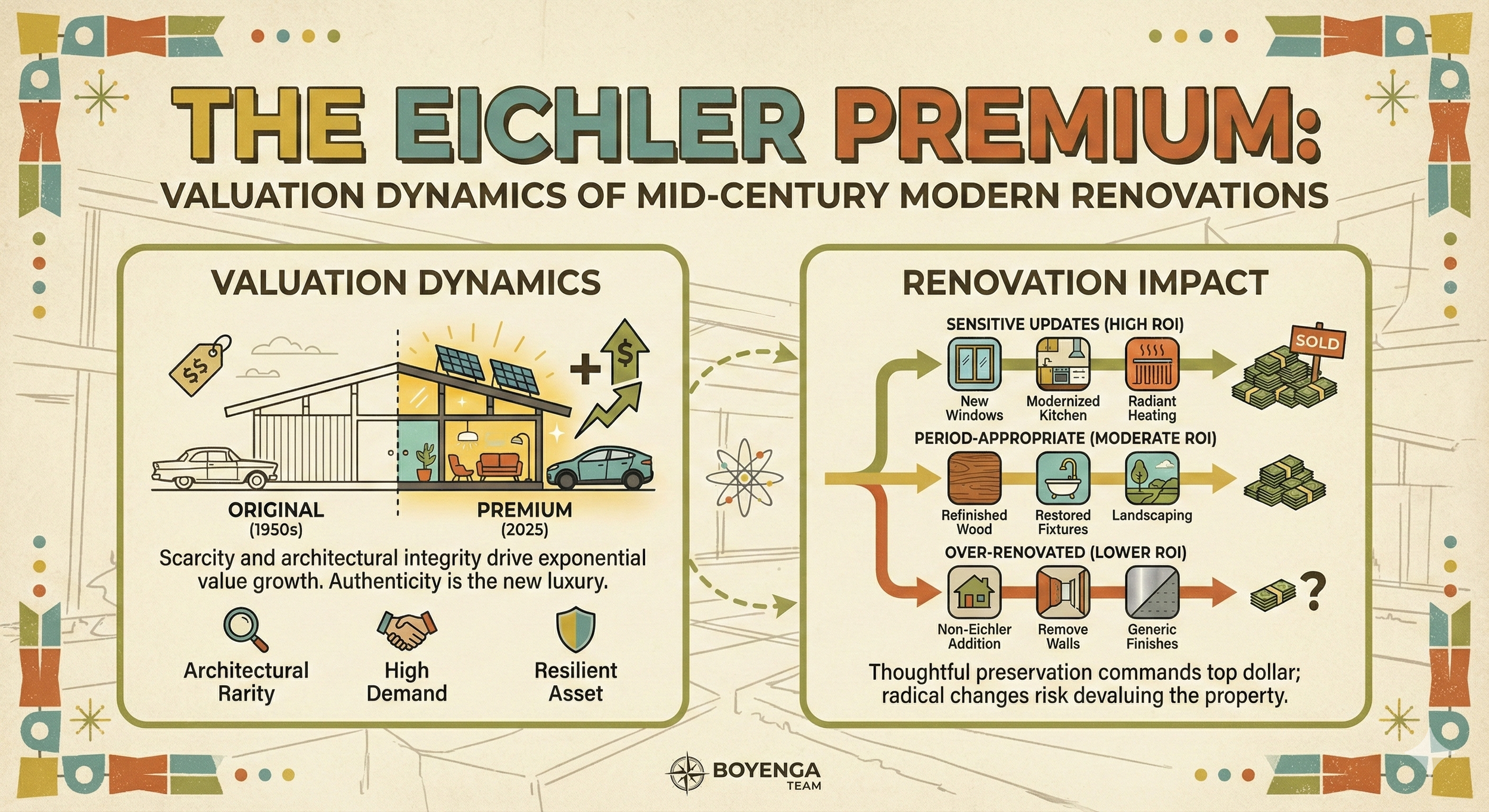
The Economics of Experience
The residential real estate market typically operates on a standardized set of valuation metrics: square footage, bedroom count, lot size, and the recency of cosmetic upgrades. In this conventional model, a newly renovated kitchen with high-end finishes translates almost linearly into increased asset value. However, the market for Joseph Eichler’s mid-century modern (MCM) tract homes—primarily concentrated in Northern and Southern California—functions on a fundamentally different economic frequency. In this distinct asset class, value is not a cumulative sum of expenses but a derivative of "experience."
The core thesis of this report drives at a critical, often counter-intuitive financial reality for investors, homeowners, and real estate professionals: Not all upgrades return value; in the Eichler ecosystem, generic luxury and visible expense often actively destroy equity.
Buyers in this segment are not merely purchasing shelter; they are acquiring a piece of architectural history that embodies a specific lifestyle philosophy—one of openness, minimalism, and a seamless dissolution of the barrier between indoors and outdoors. Consequently, the market punishes renovations that obscure this philosophy, even if those renovations are objectively expensive. High-end finishes like crown molding, raised-panel cabinetry, or heavy granite countertops, which might garner a premium in a traditional suburban ranch, are viewed as "remuddling" in an Eichler. These alterations are frequently categorized by savvy buyers as liabilities requiring costly remediation.
Conversely, investments that restore or enhance the original architectural intent—such as restoring open atriums, preserving mahogany paneling, upgrading glass for thermal efficiency without altering sightlines, and maintaining the invisible comfort of radiant heat—yield the highest return on investment (ROI). The "Eichler Premium" is essentially a payment for the successful preservation or recreation of Joseph Eichler’s original vision: a social contract between the architecture and the inhabitant that prioritizes light, nature, and privacy over ornamentation.
This report provides an exhaustive, granular analysis of the remodeling hierarchy for Eichler homes. It delineates the high-return improvements that leverage the "purist premium," identifies the capital-intensive errors that lead to valuation stagnation, and offers a strategic framework for pre-sale preparation. The analysis confirms that the most lucrative strategy is one of rigorous restraint: buyers pay for the authenticity of the Eichler atmosphere, characterized by post-and-beam clarity and radiant warmth, rather than the visible expense of mismatched modern luxury.
Chapter 1: The Architectural Asset Class
To understand where money moves the needle in an Eichler renovation, one must first deconstruct the asset class itself. Eichler homes are increasingly viewed not just as housing stock, but as "collectors' items," akin to vintage automobiles or mid-century furniture, where provenance, condition of original features, and the integrity of the design language dictate the ceiling price.
1.1 The Democratization of Modernism: A Historical Context
Joseph Eichler was not an architect; he was a developer inspired by living in a Frank Lloyd Wright Usonian home. Between 1949 and 1974, he built over 11,000 homes in California, employing renowned architects like Anshen & Allen, A. Quincy Jones, and Claude Oakland to bring high design to the middle class. These homes were radical departures from the prevailing post-war trends. While typical developers were building insular boxes with small windows to conserve heat and privacy, Eichler was building glass pavilions that turned their back to the street and opened entirely to the rear garden.
This historical context is vital for valuation because the features that define the home—the post-and-beam grid, the floor-to-ceiling glass, the atrium—are not merely stylistic choices; they are the physical manifestations of a philosophical stance on living.
The Post-and-Beam Grid: By moving the structural load to heavy timber beams, Eichler eliminated the need for load-bearing interior walls, allowing for the open floor plan that is now standard in modern design but was revolutionary at the time.
The Glass Envelope: The use of glass walls was intended to "bring the outdoors in," creating a psychological expansion of space. A 1,600-square-foot Eichler often feels larger than a 2,500-square-foot traditional home because the visual boundary is the property line, not the exterior wall.
1.2 The "Remuddling" Era and the Rise of Preservation
For decades, particularly in the 1980s and 1990s, the value of the Eichler aesthetic was misunderstood. Homeowners, prioritizing energy efficiency or traditional comforts, often covered the glass, painted over the redwood ceilings, and installed colonial doors. This period is referred to by preservationists as the era of "remuddling".
Today, the market has corrected. The scarcity of unaltered Eichlers has driven their value up significantly. Data indicates that "Original Eichlers" (those retaining mahogany panels, globe lights, and original layouts) and "Tastefully Upgraded Eichlers" (those modernized within the strict design idiom) command the highest prices, creating a U-shaped value curve.
Original Condition: High Value due to rarity and preservation of the "soul."
The "Remuddled" Middle: Lowest Value. These are homes updated with generic materials (oak cabinets, tile counters, textured drywall). These homes often sit on the market longer because buyers view the "upgrades" as demolition projects they must fund.
Architecturally Aligned Renovation: Highest Value. Homes where systems are modernized (radiant heat, roof, insulation) and finishes are high-end but strictly adherent to MCM principles (flat panel cabinets, terrazzo or concrete floors).
1.3 The "Brand" Value
Eichler is one of the few developer names that functions as a brand in real estate. Listings that emphasize specific architects (e.g., "Double A-frame by A. Quincy Jones") or specific models (e.g., "The Atrium Model") attract a dedicated following. Buyers often set alerts specifically for "Eichler," bypassing other homes in the same zip code. This brand loyalty means that adhering to the brand's visual identity is the surest path to liquidity. Deviating from it by introducing foreign architectural elements (like bay windows or stucco) dilutes the brand equity and, consequently, the resale value.
Chapter 2: The Buyer Profiles
The valuation of an Eichler renovation is ultimately determined by who shows up to bid. The buyer pool for these homes is distinct from the general market. It is bifurcated into two primary archetypes, both of whom reject standard suburban finishes, though their technical priorities differ slightly. Understanding these personas is critical for determining which renovations will yield a return.
2.1 The Mid-Century Purist
This buyer is driven by historical accuracy and views the home as an artifact to be stewarded.
Motivation: They are buying a piece of art. They are often members of the "Eichler Network" or follow mid-century preservation blogs.
Valuation Triggers: For the Purist, original features such as unpainted redwood tongue-and-groove ceilings, luan (Philippine mahogany) wall paneling, and original globe lighting are not "dated"—they are essential assets.
The "Time Capsule" Premium: This demographic is willing to pay a premium for "time capsule" homes because they understand the cost and difficulty of sourcing extinct materials. The original "Zolatone" cabinet finish or the specific "Mistlite" obscure glass used in entryways are details they inspect rigorously.
Renovation Reaction: To this buyer, a "modernized" kitchen with shaker cabinets or granite countertops is a defect. They calculate the cost of ripping out these "upgrades" and restoring flat-panel cabinetry, effectively lowering their offer price by the cost of the demolition and restoration.
2.2 The Modernist Pragmatist
This buyer, often a tech worker in Silicon Valley or a creative professional in Los Angeles, values the spirit of the Eichler—the light, the flow, the indoor-outdoor connection—but demands modern performance and comfort.
Motivation: Lifestyle and aesthetics. They want the "cool" factor of the Eichler but do not want to live in a museum with 1950s technology.
Valuation Triggers: They prioritize energy efficiency (foam roofs, double-pane glass) and system reliability (updated electrical panels, functional heating). They do not necessarily need the original 1950s Thermador cooktop (which might be a fire hazard), but they demand that any replacement maintain the minimalist geometry of the original—opting for induction cooktops and integrated appliances.
Renovation Reaction: They will pay top dollar for a "turn-key" Eichler that has been updated with high-end modern materials (polished concrete, quartz) that mimic the original intent. However, they will walk away from a property that feels "closed in," dark, or stylistically confused.
2.3 The "Trophy Hunter" vs. The "Flipper"
A third, smaller group is the speculative investor or flipper. Historically, flippers have performed poorly with Eichlers because their standard playbook (gray laminate floors, white shaker cabinets, subway tile) is incompatible with the asset class. The market has become sophisticated enough that "flipped" Eichlers often sit on the market while original or properly restored ones sell immediately. The "Trophy Hunter"—often a wealthy executive—will pay a premium for a "Double A-Frame" or a "Gallery" model, provided the renovations are of architectural quality.
2.4 Regional Nuances
Silicon Valley (Palo Alto, Sunnyvale, Mountain View): High-income tech workers drive this market. Demand is for "turn-key" perfection. They value the look of the Eichler but demand modern performance (AC, insulation, smart home tech). Renovation strategy here involves high-end modern finishes like walnut cabinets and Miele appliances. "Purist" features are valued, but function is non-negotiable due to the $2M–$4M price point.
Marin County (Lucas Valley, Terra Linda): A stronghold of the "Purist." Preservation is key here. Painting unpainted beams white might hurt value more here than in Sunnyvale. Buyers are looking for the "Eichler soul" and organic landscaping that blends with the hills.
Southern California (Orange, Granada Hills): High style is paramount. "Palm Springs Modern" influences are acceptable here (e.g., breeze blocks, brighter door colors, terrazzo floors). Pool restoration is critical due to the warmer climate.
Chapter 3: The Atrium Paradox (The Heart)
The atrium is arguably the most defining feature of the Eichler design language and the most volatile variable in valuation. Originally designed as an open-air transition zone—a private outdoor room contained within the footprint of the house—it is the primary lung of the home.
3.1 The Physics of Value: Light and Air
In typical real estate appraisal, enclosed square footage is king. A 2,000-square-foot house is theoretically worth more than a 1,800-square-foot house. However, in the Eichler market, enclosing the atrium to "gain" square footage often results in a net loss of value.
The open atrium performs three critical architectural functions that buyers pay for:
Light Penetration: It allows sunlight to reach the deep center of the floor plan. Without it, the living room and kitchen often become cave-like.
Visual Axis: It creates the signature "see-through" transparency where one can look from the front door, through the atrium, through the living room, to the backyard. This layering of space is what makes the home feel expansive.
Thermal Regulation: It acts as a cooling tower in summer, allowing hot air to escape and cross-ventilation to occur when sliders are open.
When a seller encloses the atrium to create a "foyer" or "den," they destroy these three functions. The ventilation loop is broken, and the "wow factor" of the entry is muted. Market analysis suggests that buyers often bid 10–15% over list price for well-preserved atrium models, whereas enclosed atriums can sit as stigmatized assets.
3.2 The Enclosure Liability
Enclosed atriums frequently suffer from technical failures that scare off savvy buyers:
The Greenhouse Effect: Without sophisticated (and expensive) venting, glass-roofed atriums become heat traps in summer and condensation chambers in winter. This creates a space that is uncomfortable for much of the year.
Radiant Disconnect: The original radiant heating system was never installed in the atrium slab. Consequently, an enclosed atrium is often a cold zone in winter, forcing the heating system to overwork or requiring the installation of unsightly auxiliary heating units.
Leak Risks: Retractable roofs or makeshift skylights are notorious leak points. A buyer seeing a retractable roof often sees a future maintenance headache rather than a luxury feature.
3.3 Restoration as a Value-Add
Paradoxically, removing a roof from an enclosed atrium can be a high-ROI activity. Restoring the space to an open-air garden re-establishes the architectural integrity of the home. Sellers are advised to remove plastic corrugated roofing or heavy timber structures that block the sky.
If weather protection is absolutely desired, high-end, sheer architectural sunshades that do not obscure the feeling of openness are the only acceptable compromise. These provide shade without creating the "greenhouse" issues of a solid or glass roof.
Table 1: Atrium Configuration vs. Buyer Perception
Atrium StateBuyer PerceptionImpact on ValueOpen-Air (Original)Authentic, Luxurious, "True Eichler"High PositiveRetractable RoofFunctional compromise, potential maintenance riskNeutral / Slight PositiveFixed Glass EnclosureGreenhouse effect, distinct "remuddle" riskNeutral / NegativeSolid Roof ConversionDark, destroys floor plan flow, "Cave-like"High Negative
Chapter 4: The Kitchen Trap
The kitchen is the most dangerous room for an Eichler renovation. In standard real estate, the kitchen is the place to "splurge." In an Eichler, it is the place to "edit." The most common error is overbuilding—installing a kitchen that is too large, too ornate, or too visually heavy for the delicate post-and-beam shell.
4.1 The "Overbuilt" Phenomenon
Eichler kitchens were originally compact galleys or small L-shapes, often separated from the living area by partial walls or pass-throughs. They were designed to be functional workspaces, not the "theater kitchens" of modern McMansions. Renovations that attempt to force a massive chef’s kitchen with double islands, pot fillers, and commercial-grade range hoods often require removing critical structural posts or cluttering the visual field. If a kitchen renovation blocks the sightline from the entrance to the backyard, it has failed the valuation test.
4.2 The Cabinetry Litmus Test: Shaker vs. Flat Panel
Nothing signals a "bad flip" faster to an Eichler buyer than Shaker-style cabinetry.
The Shaker Error: Shaker cabinets, with their recessed panels and rails, are rooted in traditional, colonial, or farmhouse aesthetics. They introduce vertical shadow lines and decorative complexity that clash with the horizontal, minimalist ethos of the Eichler. Installing Shaker cabinets is widely cited by designers and realtors as a mistake that detracts from authenticity and signals a lack of understanding of the architecture.
The Flat-Panel Imperative: The only architecturally appropriate choice is flat-panel (slab) cabinetry. This honors the original "Zolatone" or mahogany sliding doors of the 1950s. Modern iterations using walnut veneers, matte laminates, or glossy acrylics are highly desirable. They allow the kitchen cabinetry to read as a "wood wall" rather than a collection of boxes.
Hardware: Minimalist or integrated hardware (touch-latch or edge pulls) is preferred over ornate knobs that interrupt the visual plane.
4.3 Appliance Integration and Materiality
Buyers pay for the disappearance of the kitchen. In an open plan, the kitchen is part of the living room, and appliances should not dominate the visual landscape.
Integrated Appliances: "Panel-ready" refrigerators and dishwashers that blend into the cabinetry wall are superior to stainless steel. They maintain the "furniture-like" appearance of the kitchen walls, preventing the appliance from becoming a visual focal point. While more expensive, this integration creates a seamless look that buyers value highly.
Countertops:
Granite: Often considered too busy and visually "heavy." The speckled patterns of granite conflict with the clean lines of the architecture and are increasingly seen as dated.
Quartz: A top choice for durability and uniformity. Solid colors (like Caesarstone "Blizzard") are preferred over faux-marble veining, which can look artificial in a home that celebrates honest materials.
Concrete: Highly valued for its industrial, organic aesthetic which mirrors the slab foundation. It provides texture without pattern, fitting perfectly with the Eichler ethos.
Porcelain/Sintered Stone: Rising in popularity for its ability to mimic monolithic stone without the thickness or weight of concrete.
Insight: The goal of a high-ROI Eichler kitchen is to recede. It should feel like a continuation of the living space's architecture, utilizing the same wood tones and flooring, rather than a separate, tiled utility zone.
Chapter 5: Systems Engineering & Invisible Equity
While cosmetic details grab attention, the "invisible" systems of an Eichler drive the confidence of the purchase offer. Because these homes are built on slab on grade with flat roofs, system failures are catastrophic and expensive. Buyers discount heavily for "unknowns" in these areas.
5.1 The Radiant Heat Dilemma
The original copper or steel pipes embedded in the concrete slab are the heart of the Eichler.
The "Leaking Slab" Fear: A non-functional radiant system is a major red flag. It implies the need for jackhammering the floor or abandoning the system entirely. Buyers will often deduct $30,000–$50,000 from an offer if the heating status is ambiguous.
Repair vs. Abandon:
High ROI: A documented, working original system (or one repaired with epoxy lining) is a major selling point. It creates "thermal comfort" that forced air cannot match and eliminates the need for unsightly ducts.
Medium ROI: Abandoning the slab pipes and installing modern hydronic baseboards (sleek, European-style wall radiators). This preserves the boiler infrastructure but loses the "warm floor" luxury.
Modern Alternative: Ductless Mini-Splits. These are acceptable and efficient, offering the bonus of Air Conditioning (which Eichlers lack). However, the wall units can be visually intrusive. Concealed "slim-duct" or "Unico" systems are preferred as they can be hidden in closets or modified roofs.
Negative ROI: Installing visible ductwork on the roof (the "octopus" look) or dropping ceilings to hide ducts. This destroys the architectural profile and lowers ceiling heights.
5.2 The Foam Roof Revolution
Eichler’s original tar-and-gravel roofs provided almost zero insulation. The house would bake in summer and freeze in winter.
Sprayed Polyurethane Foam (SPF): This is the gold standard for Eichler re-roofing. It adds 1–3 inches of insulation directly to the exterior, sealing the envelope and dramatically improving comfort. It creates a seamless, monolithic barrier that prevents leaks.
Valuation Impact: A relatively new foam roof is a tangible value-add because it addresses the number one complaint about Eichler living: temperature fluctuation. It also eliminates the risk of leaks associated with the flat roof design. A 20-year foam roof is an "asset" listed in marketing; a patch-worked tar roof is a "liability" that buyers will price in for immediate replacement.
5.3 Electrical Infrastructure
200-Amp Panels: Original 60 or 100-amp panels are insufficient for modern living (EV chargers, induction cooktops, AC). An upgrade to 200 amps is an expected baseline for a home in the $2M+ range. While it doesn't have a 1:1 ROI in terms of profit (costing ~$3,000-$6,000), the lack of it is a negotiation lever for buyers to demand credits. It is a "hygiene factor"—its absence hurts, but its presence is expected.
Chapter 6: The Glass Envelope
The glass walls are the defining interface of an Eichler. Original single-pane glass is a safety hazard (non-tempered) and a thermal liability. However, simply replacing it with "modern windows" can be disastrous for value if the proportions are wrong.
6.1 Safety and Performance
The Hazard: Many original Eichlers still have standard plate glass. In an earthquake or impact, this glass shards dangerously. Modern code requires tempered glass in these locations.
Thermal Performance: Single-pane glass has an R-value of roughly 1. It is a massive source of heat loss. Replacing it with double-pane low-E glass significantly improves the livability of the home.
6.2 The Frame Factor: Specifications for Value
The Mistake: Installing vinyl replacement windows with thick, white frames (2-3 inches wide). This creates a "picture frame" effect that visually shrinks the window, breaks the connection to the outdoors, and looks cheap against the redwood siding. This is considered a "negative upgrade".
The Solution: Anodized aluminum or fiberglass frames with narrow sightlines (under 1 inch). Dark bronze, black, or clear aluminum finishes are preferred as they recede visually, letting the eye pass through to the garden. The goal is for the frame to disappear.
Safety Film: For sellers on a budget, applying 4-mil safety film to original plate glass can bring it up to "hazardous location" code requirements without the massive cost of replacement. This is a valid strategy for "preservationist" buyers who want the original glass, provided the glass is not foggy or scratched.
6.3 The Division of Lites
Eichlers use large, uninterrupted sheets of glass.
The Mistake: Using windows with "divided lites" (grids) or muntins. This is a traditional farmhouse aesthetic that destroys the modern transparency.
The Solution: Expansive, clear, uninterrupted glass units. If safety markers are needed, subtle etching is preferred over physical grids.
Chapter 7: Surfaces & Structure
The materials chosen for the large horizontal planes (floors and ceilings) determine the "feel" of the home. In an Eichler, these planes are unbroken and vast, making material choice disproportionately important.
7.1 The Flooring Matrix
The cardinal rule of Eichler flooring is continuity. The same flooring material should run from the front door to the back glass, and ideally (in texture/color) onto the patio to blur the indoor-outdoor line. Breaking the flooring materials between the kitchen, hallway, and living room chops up the visual space and makes the home feel smaller.
Table 2: Flooring ROI Hierarchy
MaterialEichler SuitabilityROI PotentialNotesPolished/Sealed ConcreteExcellentVery High
Authentic, industrial, extremely durable, efficient for radiant heat.
TerrazzoExcellentHigh
Luxurious, period-correct, indestructible, but high install cost.
CorkVery GoodHigh
The original material. Warm, quiet, authentic. Needs UV protection to prevent fading.
Large Format Tile (Porcelain)GoodMedium/High
Practical, durable. Must be neutral (gray/slate) to mimic concrete.
Engineered HardwoodModerateMedium
Popular with general buyers, but acts as an insulator (bad for radiant efficiency) and can be damaged by moisture.
CarpetingPoorNegative
Traps heat (blocks radiant), dates the home, breaks visual flow.
Faux-Wood Laminate/VinylPoor/FairLow
Can look cheap. "Luxe Vinyl" is better, but purists prefer honest materials.
7.2 The Beam Debate: To Paint or Not to Paint?
The exposed beams are the "bones" of the house.
Rot Maintenance: Before aesthetics, structural integrity is paramount. Beam rot at the atrium or eaves is common. "Capping" beams with metal is a cheap fix that can hide (and accelerate) rot. Proper restoration (cutting out rot, using epoxy consolidants, or full replacement with Douglas Fir) is expensive ($700+ per beam) but necessary for a clean inspection report.
The Aesthetic Verdict:
Natural/Stained: The "Holy Grail" for purists. Stripping painted beams back to redwood is labor-intensive but creates a high-value "warm" aesthetic that distinguishes the home from generic flips.
Painted (White/Grey): Acceptable and common. It brightens the home and feels modern, but loses the "woodsy" texture.
The Negative: Painting over original unpainted wood is considered a destruction of value by purists. Once painted, it is very costly to restore.
7.3 Mahogany Paneling: The "White Blight"
Original luan paneling is a finite resource. Painting over it (the "White Blight") makes the room feel like a standard drywall box.
Strategy: Cleaning and restoring original paneling yields the highest ROI. If paneling is too damaged, replacing it with new wood veneer is better than drywall.
Accent Walls: If a room is too dark, some owners paint some walls but leave key accent walls natural. This preserves the character while increasing light.
Chapter 8: The "Negative ROI" Danger Zones
To preserve equity, homeowners must avoid specific "upgrades" that the market consistently penalizes. These are the renovations that cost money to install and money to remove.
8.1 The Second Story Addition
Adding a second story to an Eichler is widely considered the ultimate sin against the architecture.
Aesthetic Destruction: It ruins the low-slung, horizontal profile that defines the style.
Privacy Issues: Eichler neighborhoods are designed for privacy at the ground level. A second story peers into neighbors' atriums and backyards, often leading to neighborhood disputes and planning commission rejections.
Valuation: While it adds square footage, it narrows the buyer pool significantly. Purists will not buy it. The result is a home that may sell for a higher absolute price due to size, but a significantly lower price per square foot, often resulting in a negative ROI on the construction costs.
8.2 The Garage Conversion
Converting the garage into living space is often done poorly, leaving the house with no storage (a critical Eichler weakness).
The Curb Appeal Hit: If the conversion looks like a garage from the street (driveway leading to a blank wall), it creates a confused façade.
Storage Deficit: Eichlers have no attics and rarely have basements. The garage is the only storage space. Eliminating it makes the house functionally difficult for families.
8.3 The "Colonial" Conversion
Adding baseboards, crown molding, or paneled doors is a fundamental misunderstanding of the architecture.
No Baseboards: Eichlers are designed without trim ("gallery" style). The walls float. Adding baseboards outlines the room, making the walls look shorter and the design cluttered. It is a visual interruption that buyers have to pay to remove.
Paneled Doors: Replacing flat-panel doors with 6-panel colonial doors dates the home to a generic 1990s renovation.
8.4 Removing the "Mistlite" Glass
The obscure "Mistlite" glass used near entryways provides privacy while admitting light. It is an iconic texture of the Eichler brand. Replacing it with generic clear glass reduces privacy, while replacing it with drywall makes the entry dark. Preserving or sourcing replica Mistlite glass is a small detail that signals a high-quality restoration.
Chapter 9: The Landscape of Value
Since the walls of an Eichler are glass, the garden is visually part of the living room. The landscaping must be treated as interior design.
9.1 The "Outdoor Room" Philosophy
The Aesthetic: "Geometric Simplicity." Overgrown English gardens, messy lawns, or chaotic flower beds clutter the view from inside. The landscape should be architectural.
Hardscape: Concrete pads or rectangular pavers that align with the home’s grid are essential. If the sliding door is 6 feet wide, the patio pads should ideally be 6 feet wide, creating visual runways from inside to outside.
Materials: Exposed aggregate (pebbly concrete) was a common original finish. Reproducing this, or using a "top-cast" finish that reveals the sand texture, is more valuable than stamped concrete (which looks fake) or pavers (which look busy).
9.2 High-ROI Planting
Plant Palette: Structural, sculptural plants are preferred. Agave, Bamboo (contained), Horsetail, and Japanese Maples provide the right texture.
The Atrium: This is the jewel box. A single sculptural tree (like a Japanese Maple) and minimalist ground cover (gravel, moss, or baby tears) create a Zen-like focus. Overplanting the atrium makes the house feel claustrophobic.
Lighting: Nighttime lighting is critical. Because the glass is reflective at night, dark gardens turn windows into black mirrors. U-lighting trees in the atrium and backyard creates depth and drama visible from inside, effectively expanding the living space at night.
9.3 Drought Tolerance
A mix of hardscape, gravel, and drought-tolerant planting is now the expectation in California Eichler neighborhoods. It signals "low maintenance" and "eco-friendly," both high priorities for the demographic. Traditional lawns requiring heavy water are increasingly seen as a liability.
Chapter 10: Pre-Sale Strategy & Staging
The final mile of value creation lies in how the home is presented. Staging an Eichler is not optional; it is a critical component of the value proposition.
10.1 The 1% Rule
Experts advise spending ~1% of the list price on prep and staging. In an Eichler, this staging investment often yields higher returns than physical renovations because it helps buyers visualize the "lifestyle" in a way that empty rooms cannot. Empty Eichlers can feel cold and industrial; staged Eichlers feel like boutique hotels.
10.2 Specialized Staging
Furniture Selection: Generic "Pottery Barn" staging flatlines the emotional appeal. Eichlers require MCM-specific furniture (Eames, Nelson, Saarinen replicas).
Scale: Low-profile furniture is essential. High-backed sofas block the view of the glass walls and make the ceilings feel lower. Low-slung mid-century furniture emphasizes the height of the tongue-and-groove ceiling and keeps the sightlines clear.
10.3 Marketing the "Vibe"
Twilight Photography: Because of the extensive glass and atrium lighting, Eichlers look spectacular at dusk. Twilight photos are non-negotiable for the listing.
Narrative: The listing description should use the lexicon of the architecture: "Post-and-beam," "Atrium model," "Radiant heat," "Indoor-outdoor flow." This signals to the algorithm and the buyer that this is a specific asset class.
Chapter 11: Market Analysis & ROI Matrix
The following matrix synthesizes the renovation landscape, categorizing projects by their cost relative to their impact on buyer perception and final sale price.
Table 3: The Eichler Renovation ROI Matrix
Renovation CategoryProjectCost EstimatePerception / Value ImpactROI VerdictPreservationRestoring Atrium to Open AirLow/Med ($5k-$15k)Extreme Positive. Returns the "soul" to the home.HighestCosmeticRefinishing Mahogany PanelsLow ($3k-$8k)High Positive. Creates "time capsule" value.Very HighSystemsFoam Roof InstallationMed ($15k-$25k)High Positive. Solves insulation/leak fears.HighStructuralTempered Double-Pane GlassHigh ($30k-$60k)High Positive. Safety + Comfort + Aesthetics.HighSurfacePolished Concrete FloorsMed ($8-$15/sqft)Positive. Authentic, durable, modern.HighKitchenFlat-Panel CabinetryMed ($25k-$50k)Positive. Aligns with architecture.GoodSystemsRadiant Heat RepairMed ($5k-$20k)Positive. Preserves original luxury.GoodKitchenIntegrated AppliancesHigh ($5k premium)Positive. "Furniture look" fits open plan.GoodSystemsMini-Split AC (Ductless)Med ($10k-$20k)Positive. Adds missing cooling.GoodKitchenShaker Style CabinetsMed ($25k-$50k)Negative. Clashes with architecture. "Remuddle."NegativeSurfaceCrown Molding / BaseboardsLow ($2k-$5k)Negative. Breaks clean lines. Cost to remove.NegativeStructuralEnclosing the AtriumHigh ($20k+)Negative. Destroys light/ventilation/flow.Very NegativeStructuralSecond Story AdditionVery High ($200k+)Negative. Ruins profile, privacy, and purist appeal.Very NegativeSurfacePainting Beams White (if natural)Low ($5k)Mixed. Modernizes but destroys "purist" value.Risk
Conclusion: The Philosophy of Restraint
The data is clear: Buyers pay for the Eichler Experience, not the sum of renovation receipts. The "Eichler Experience" is defined by light, lines, and continuity. It is a fragile ecosystem that is easily disrupted by heavy-handed "improvements."
For a homeowner preparing to sell or an investor looking to flip, the strategy should be subtractive rather than additive. Instead of adding a $100,000 chef's kitchen with Shaker cabinets and crown molding, the better investment is often $20,000 spent on restoring the mahogany panels, polishing the concrete floors, and staging the home with period-correct furniture.
The Golden Rule of Eichler Value: If a renovation draws attention to itself (e.g., a flashy backsplash, an ornate fireplace mantel, a complex tile pattern), it is likely destroying value. If a renovation disappears (e.g., seamless glass, matching flooring, integrated appliances, invisible heating), it is building equity. The most valuable Eichler is the one that feels as though it has simply "always been that way," effortless and open, just as Joseph Eichler intended. The premium is paid for the preservation of a dream, not the accumulation of features.
🏛️ Eichler Fundamentals & Architectural Identity
Eichler Homes: Silicon Valley Remodel for Modern Living | NanaWall
https://nanawall.comThinking of Selling Your Eichler Home? 15 Things You Need to Know
https://eichlerhomesforsale.com5 Rules of True Eichler Style (and What Breaks Them)
https://eichlerhomesforsale.comThe Eichler Kitchen: From St. Charles Steel to Smart Appliances
https://eichlerhomesforsale.comEichler Homes in Silicon Valley: Architectural Features and Price Impacts
https://eichlerhomesforsale.comThe Eichler Pricing Paradox
https://eichlerforsale.com
🧱 Remodeling, Additions & Preservation Strategy
The Pros And Cons Of Renovating An Eichler Home
https://gmjconstruction.usTop Mistakes To Avoid When Remodeling An Eichler Home
https://gmjconstruction.usSilicon Valley Eichler Home Additions & Remodels
https://eichlerhomesforsale.comRemodeling Eichler Homes for the 21st Century: Green Upgrades …
https://eichlerhomesforsale.com6 Remodeling Mistakes That Hurt Resale
https://onlinehsa.com12 Remodeling Projects That Offer the Best Value at Resale
https://nar.realtor
🍽️ Kitchens, Cabinets & Appliances
Eichler Kitchen Remodel Ideas: Modern Upgrades with Mid-Century ...
https://eichlerhomesforsale.comShaker vs Flat Panel Cabinets | Style Comparison Chicago
https://akcabinetcraft.comShaker Style Cabinets vs Flat Panel: Complete Comparison 2025
https://castacabinetry.comShaker Style Cabinets vs. Flat Panel Cabinets: In-Depth Review
https://badgercabinets.comPaneled vs. Stainless Steel Appliances - Drury Design
https://drurydesigns.comBuilt-In & Integrated Appliance Differences
https://mountainhighappliance.com
🧊 Countertops & Surface Materials
What Is the Best Kitchen Countertop Material? (2025 Guide)
https://fixr.comConcrete Countertops vs. Quartz, Granite & More
https://concretenetwork.com
🔥 Heating, Cooling & Energy Systems
Radiant Revival: Should You Keep or Replace Your Eichler's Original Heating System?
https://eichlerhomesforsale.comRadiant Heating in Eichler Homes: A Silicon Valley Guide
https://eichlerhomesforsale.com
🏠 Roofs, Insulation & Structural Systems
what is the possible cost to replace roof | Eichler Network
https://eichlernetwork.comInsulation Without Destruction: How to Retrofit an Eichler Roof
https://eichlerhomesforsale.comWhat Is the Cost to Upgrade an Electrical Panel? - This Old House
https://thisoldhouse.comDoes upgrading the electrical panel increase home value? (Reddit)
https://reddit.com
🪵 Flooring & Interior Materials
Flooring Material Matrix for Eichler Homes
https://eichlerhomesforsale.comEichler Cork Flooring
https://eichlernetwork.comRadiant heating system over Cork Flooring
https://corkfloorsales.comNew in Eichler Flooring
https://eichlernetwork.com
🌿 Atriums, Light & Landscape
Four-Season Atrium Living in Eichler and Mid-Century Modern Homes
https://eichlerhomesforsale.comLost in the Dark No More - Page 2 | Eichler Network
https://eichlernetwork.comThe Eichler Landscape Blueprint: Planting Plans That Fit the Architecture
https://eichlerhomesforsale.com
🪚 Beams, Ceilings & Wood Restoration
Eichler Tongue-and-Groove Ceilings: Preservation Tips
https://eichlerhomesforsale.comBeam Restoration and Repair
https://mcmsac.comThose Dirty, Rotten Beams - Page 3 | Eichler Network
https://eichlernetwork.comThose Dirty, Rotten Beams - Page 2 | Eichler Network
https://eichlernetwork.comstaining ceiling | Eichler Network
https://eichlernetwork.com
🏛️ Historic & Regulatory Context
Historic Resources Board | City of Palo Alto
https://cityofpaloalto.orgMin - PC - 1992.08.10 | Burlingame Records
https://burweblink.burlingame.org
🧠 Market Perception, Forums & Buyer Psychology
[Bay Area, CA] Eichler homes or Veteran homes?? (Reddit)
https://reddit.comSunnyvale Eichler homes : r/BayAreaRealEstate (Reddit)
https://reddit.comPreparing Your Eichler for Sale in Today's Strong Market
https://eichlernetwork.comStaging vs No Staging for San Rafael Home Sales (Jeff Marples)
https://jeffmarples.com
🏷️ Selling, Staging & Marketing Eichlers
Comprehensive Guide to Selling Eichler Homes: Prep, Staging, Marketing & Legal
https://eichlerhomesforsale.comThe Ultimate Eichler Buyer’s Checklist: 25 Things to Inspect Before You Fall in Love
https://eichlerhomesforsale.com