
The Eichler Zeitgeist: How California Modernism Became a National Obsession
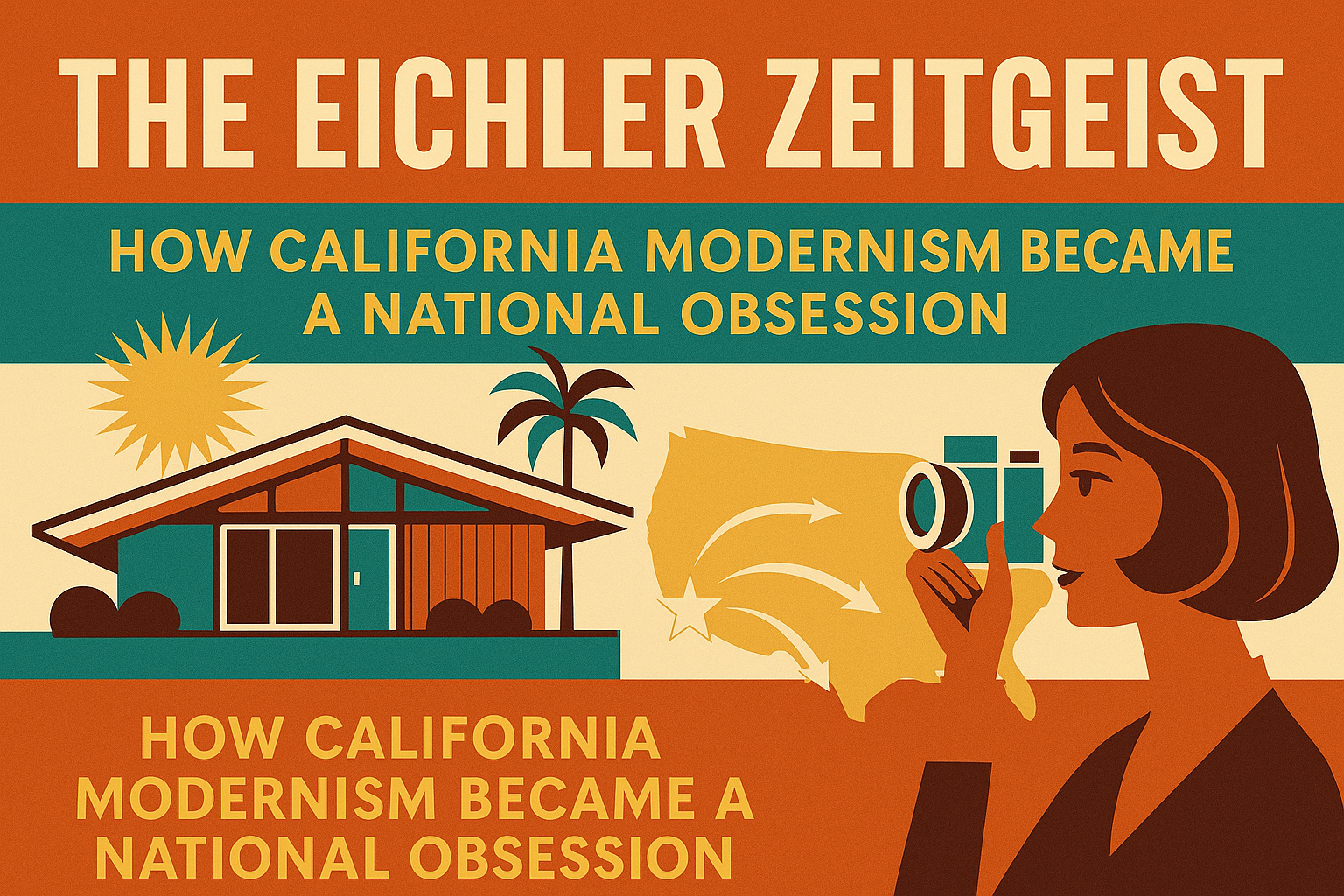
The Eichler Zeitgeist: How California Modernism Became a National Obsession
An iconic mid-century Eichler home in San Jose, California, showcasing the low-pitched roof, exposed beams, and atrium entry that blur the line between indoors and outdoors. The clean facade and simple geometric forms exemplify California Modernism’s emphasis on functional beauty and harmony with nature.
In recent years, mid-century modern Eichler homes have surged back into the spotlight – not just in California, but across the nation. These once-modest postwar tract homes have become design icons, inspiring everything from contemporary architecture and interior design to minimalist fashion and wellness lifestyles. Scroll through Instagram or Pinterest and you’ll find thousands of posts celebrating the Eichler aesthetic: open-plan layouts bathed in sunlight, indoor gardens framed by glass walls, and sleek, post-and-beam lines that feel both retro and timeless. What is it about these California Modern houses, built 60-70 years ago, that so perfectly captures today’s Zeitgeist?
This comprehensive look at “The Eichler Zeitgeist” explores how the architectural vision of Joseph Eichler – a mid-century developer with a utopian streak – became a cultural phenomenon. We’ll delve into Eichler’s architectural, philosophical, and aesthetic influence, situating it within the broader legacy of California Modernism. We’ll also see how the mid-century movement is alive in 21st-century trends: in our homes (hello, indoor-outdoor living and open kitchens), in our wardrobes (clean lines and quality materials), in wellness and branding (calm, uncluttered environments), and in the curated lifestyles of Millennials and Gen Z on social media. Finally, we’ll introduce the Boyenga Team at Compass – Silicon Valley’s go-to Eichler real estate experts – who help keep this mid-century flame burning bright.
California Modernism and the Eichler Vision
To understand the Eichler craze, we first need to travel back to post-World War II California. The late 1940s through 1960s saw an explosion of innovative home design on the West Coast – a movement now dubbed California Modernismboyengateam.com. Visionary architects like Frank Lloyd Wright and Ludwig Mies van der Rohe had pioneered open, horizontal house designs with glass walls, and California developers took noteen.wikipedia.org. Joseph Eichler was one of the boldest: between 1950 and 1974, his company built over 11,000 modern homes in Californiacultofmac.com, making high-design architecture accessible to middle-class families. “In a nutshell, the significance of Eichler houses is that they were homes for middle-class people designed by good architects,” notes architect Paul Adamsoncultofmac.com. In an era when most builders were churning out simple ranches or Cape Cods, Eichler hired cutting-edge architects (like Anshen & Allen, Jones & Emmons, and Claude Oakland) to design entire neighborhoods of modern homesen.wikipedia.org. The result was a new suburban paradigm: egalitarian yet stylish communities defined by openness, simplicity, and integration with nature.
Eichler’s philosophy went beyond style – it was socially progressive. He believed in building inclusive communities and famously refused to discriminate against buyers by race or religion (a stance virtually unheard of among developers in the 1950s)en.wikipedia.org. In fact, Eichler resigned from the National Association of Home Builders in protest when it wouldn’t support a non-discrimination policyen.wikipedia.org. This spirit of openness and fairness was literally built into Eichler neighborhoods, which often featured community parks and centers to encourage gatheringen.wikipedia.org. Today’s generation, with its emphasis on diversity and community, can appreciate Eichler’s ahead-of-his-time values. An Eichler home was meant to be a “modern house for everyone,” embodying the optimistic, forward-looking ethos of mid-century California – an ethos of innovation, openness, and living in harmony with others and the environment.
Key Eichler Design Principles: Modernist Ideas Ahead of Their Time
What makes an Eichler home instantly recognizable? Several signature design elements set Eichlers apart from conventional homes – and these same features are exactly what design-savvy folks today find so appealing. Eichler homes are textbook examples of Modernist architecture or “California Modern” styleen.wikipedia.org. Here are the key Eichler design principles and why they mattered then (and now):
Open Floor Plans: Eichler layouts did away with the warren of small rooms typical in older homes, opting instead for free-flowing living, dining, and kitchen areas. This open concept was revolutionary in the 1950s – a stark contrast to compartmentalized Colonial Revival houses of prior decadeshousebeautiful.com. For families then, it felt futuristic and informal; for families now, it’s become the gold standard. An open plan encourages togetherness and flexibility, whether you’re supervising kids from the kitchen or hosting friends. It’s no surprise open-concept living is one of the most sought-after features in home design today, a direct inheritance from mid-century modern innovators.
Post-and-Beam Construction: Instead of relying on interior walls for support, Eichler homes use a post-and-beam structural system, meaning vertical posts and horizontal beams carry the load. This method (inspired by Mies van der Rohe’s and Frank Lloyd Wright’s ideas) allowed Eichler architects to create those wide-open interiors and expansive glass wallsen.wikipedia.org. Exposed ceiling beams and tongue-and-groove wood ceilings were left visible as part of the decor, celebrating the honesty of materials. The aesthetic of exposed structure and natural wood not only looked warm and modern, but it also aligns with today’s love for “honest,” minimalist design – where the structure itself becomes decoration. Modern builders still emulate post-and-beam style to achieve that airy, undivided space and mid-century vibe.
Indoor-Outdoor Flow: Perhaps the most beloved Eichler principle is “bringing the outside in.” Eichler homes were designed to erase the barrier between indoors and outdoorsboyengateam.com. They famously feature floor-to-ceiling glass walls and sliding glass doors opening onto patios, courtyards, or central atriums. Many Eichlers have a private atrium – an open-air courtyard at the heart of the house – so that nature literally sits at the center of the home. Huge glass panels and skylights flood the interior with natural light and offer views of gardens and sky in every directionen.wikipedia.org. Back in the ’50s and ’60s, this was a revelation: modest homes with the kind of indoor-outdoor living previously seen only in luxury estates. Today, that seamless connection to nature is touted as a feature that supports wellbeing and biophilic design. Who doesn’t love a home that opens wide to a backyard oasis or lets you dine under the stars in your own atrium? Eichler’s indoor-outdoor flow prefigured our modern desire for homes that extend living space outside and make us feel connected to the environment.
Walls of Glass: Hand-in-hand with indoor-outdoor living comes the extensive use of glass. Eichler homes boldly incorporate entire walls of glass in living areas and often around the atrium, using large fixed panes and sliding doors. These transparent walls were striking for mid-century tract homes – such “glass houses” had been mostly experimental or high-end until thencultofmac.com. Eichler brought them to the suburbs, giving ordinary families floor-to-ceiling views and sunlight. The effect is both glamorous and calming: rooms feel larger and more harmonious with the landscape. Modern homeowners and architects have renewed this love affair with glass, not just for the dramatic look, but also for the wellness benefits of natural light. Sunlit interiors can boost mood and regulate circadian rhythms, and broad windows help bring in the outdoorsy feel that so many crave in today’s stressful world.
Atriums and Courtyards: Eichler’s introduction of the enclosed atrium — essentially a private open-air room — might be one of his most influential innovations. The atrium is a signature of many Eichler models, acting as a transitional space between the street and the home’s true front door, or nestled between living spacesen.wikipedia.org. It’s like having a little slice of nature inside your home’s footprint. You walk through a gate into an atrium garden, and only then do you reach the actual front door – a dramatic entry sequence that still feels fresh today. These atriums were often filled with plants, pebble groundcover, maybe a specimen tree or water feature, creating a mini sanctuary. Mid-century owners enjoyed them as a safe play area for kids or a conversation patio sheltered from wind. Fast forward to now: homeowners are turning Eichler atriums into Zen gardens, yoga spaces, or outdoor dining rooms, capitalizing on the sense of tranquility they provide. The popularity of courtyards and indoor planters in today’s design (even in condos and urban homes) owes much to the Eichler atrium concept – it’s about bringing light, air, and greenery to the center of our lives.
Distinctive Rooflines: From the street, Eichler homes announce themselves with clean, geometric rooflines. Many are flat or nearly flat; others sport a low-slung A-frame peak over the entry, often with a glass gable filled in, as seen in the Foster Residence Eichler in Granada Hillsen.wikipedia.org. Deep overhanging eaves create shade and emphasize horizontal lines. Eichler exteriors were purposefully spartan: vertical wood siding (often unpainted redwood or in natural tones), simple façades with minimal ornament, and almost no street-facing windows for privacyen.wikipedia.org. The drama was saved for the inside and back of the house, while the front remained elegantly modest. This understated, minimalist curb appeal feels very contemporary now – it’s common to see new homes emulating Eichler-like facades: blocky forms, muted palettes, and clever use of roof geometry. The low-pitched roofs weren’t just stylish; they were practical for the California climate, allowing space for clerestory windows and providing shade. Today’s push for sustainable design notes that those deep eaves and roof angles helped with passive cooling and solar management, proving that Eichler’s aesthetic had functional merits that green builders still appreciate.
Radiant Floor Heating: Under the concrete slab floors of Eichler homes ran a network of hot water pipes, an innovative in-floor radiant heating system. This quiet, invisible heating eliminated the need for bulky radiators or forced-air ducts and delivered gentle, even warmth (famously, Eichler kids could walk barefoot on toasty floors in winter)cultofmac.com. Joseph Eichler took pride in offering such “luxury” features in a middle-class home. Radiant heat is cozy and actually energy-efficient, since it heats people and objects in a room directly, rather than blowing hot air. Many Eichler owners still love it (when it’s working, as older pipes sometimes fail). In the 21st century, radiant floor heating has made a comeback in high-end construction and eco-friendly homes for its efficiency and comfort. It’s another example of Eichler being ahead of his time in prioritizing occupant comfort with modern technology. As Steve Jobs – who grew up in an Eichler-inspired home – fondly recalled, “They had awesome little features, like radiant heating in the floors… we had nice toasty floors when we were kids.”cultofmac.com
Mid-Century Materials & Built-Ins: Eichler interiors embraced a then-modern material palette that remains much loved by today’s mid-century enthusiasts. Exposed wood paneling (often lauan Philippine mahogany) warmed the wallsen.wikipedia.org, and globe pendant lights and futuristic cone fireplaces provided stylish focal points. Eichler kitchens were compact and efficient, often with sliding partition walls or pass-throughs – concepts we see mirrored in today’s modular and tiny-home designs. They also featured built-in furniture like cabinets, closets, and room dividers that optimized space – a principle visible now in the custom built-ins of many contemporary minimalist homes. The overall minimalism of Eichler interiors – simple materials, lack of fussy trim, everything in service of easy living – resonates strongly with our modern desire to declutter and focus on quality over quantity. It’s the antithesis of the McMansion era. Instead of grand foyers or superfluous formal rooms, Eichler homes were compact, purposeful, and human-scaled, something many homeowners are returning to as they seek simplicity and authenticity in design.
Each of these design elements – radical in Eichler’s time – has proved enduring. In fact, they form the backbone of what many consider good home design today. An Eichler home feels remarkably “modern” to walk into, even now. As Atomic Ranch magazine put it, “With large open spaces, walls of glass, indoor-outdoor living and in-floor radiant heating, Eichler emphasized the designs of the future and…people today are still chasing that mid-century dream.” These houses truly were “the designs of the future” packaged in 1950s form, and that future has arrived.
From Mid-Century Marvel to Millennial Dream Home: Eichler’s Influence Today
The Eichler influence on today’s trends is everywhere – even if people don’t always realize it. The mid-century modern movement at large has strongly shaped contemporary tastes in architecture and interior decor, and Eichler’s philosophy in particular anticipated many values we now hold dear. Let’s unpack how Eichler homes and California Modernism have become touchstones in modern living, from our houses to our hashtags:
● Mainstream Home Design: Tour almost any newly built suburban development or watch a home renovation show, and you’ll spot mid-century elements pioneered by Eichler and his contemporaries. Open-concept layouts are a given (no new homeowner today wants a boxed-in kitchen). Indoor-outdoor flow is aggressively marketed – giant sliding or folding glass doors leading to patios are now a luxury must-have, often called “California rooms” in new construction. Even in colder climates, architects find ways to connect homes to nature, using courtyards, decks, and plenty of glass, echoing Eichler’s ethos of transparency and opennessen.wikipedia.org. The popularity of single-story ranch-style homes is also a mid-century legacy – postwar builders like Eichler shifted Americans toward horizontal livinghousebeautiful.com, and now one-story living is appreciated for accessibility and ease. We can thank mid-century Modernists for the fact that “light-filled”, “open-plan”, and “indoor-outdoor” are real estate buzzwords in 2025.
● Interior Design and Furniture: The mid-century modern interior aesthetic has basically become timeless at this point – think tapered-legged furniture, Eames lounge chairs, Nelson bubble lamps, etc. Eichler homes provided the perfect canvas for these modern furnishings back in the day, and they still do for retro-minded owners. What’s interesting is how this aesthetic has infiltrated big-box retail and mainstream decor. Walk into a West Elm or IKEA and you’ll find entire lines of mid-century inspired furniture and decor (clean lines, simple forms, wood and metal combos) because Millennials and Gen Z adore the look. There’s a sense of curated simplicity to mid-century style that aligns with the minimalist movement. As a result, even people living in a contemporary condo might style it with a walnut credenza and geometric rug straight out of 1960. It’s all part of the Eichler zeitgeist – the idea that good design should be functional, unfussy, and visually light. This has made mid-century design a staple in staging homes for sale and in the branding of many modern furniture companies (for instance, Joybird and Article built their brand on affordable mid-century-style pieces for the hip consumer).
● Wellness and Biophilic Design: Eichler’s design principles resonate strongly with today’s emphasis on wellness in the home. Modern wellness design preaches access to nature, sunlight, fresh air, and calming spaces – exactly what Eichler homes were crafted to deliver. As one Eichler-focused wellness article notes, these homes “encapsulate an ethos of simplicity, harmony with nature, and functional beauty,” aligning seamlessly with contemporary mindfulness idealseichlerhomesforsale.com. Features like big windows and skylights that fill interiors with natural light are now known to boost mood and reduce reliance on artificial lightingeichlerhomesforsale.com. The indoor-outdoor fluidity of atriums and patios encourages residents to step outside, garden, or practice yoga under the open skyeichlerhomesforsale.com. In fact, some homeowners are literally converting Eichler atriums or spare rooms into meditation areas and yoga studios, leveraging the open floor plans and tranquil vibe for healthy livingeichlerhomesforsale.com. The minimalist aesthetics of Eichlers – uncluttered rooms, built-in storage hiding mess – create a serene backdrop that today’s wellness experts say is ideal for reducing stresseichlerhomesforsale.com. There’s even a growing field called wellness architecture that echoes what Eichler intuitively knew: a house that brings in sunlight, nature, and openness can nurture its occupants’ mental and physical health. Joseph Eichler might not have used the term “biophilia,” but his houses certainly embody it. It’s no wonder that in a time when self-care is front and center, living in an Eichler or a home like it is seen as a way to enhance one’s quality of life.
● Sustainability and “Right-Sizing”: Mid-century homes have also become symbols of a more sustainable, simpler lifestyle compared to the oversized houses of the late 20th century. Eichler homes average around 1,500–2,000 sq. ft., which by today’s standards is modest for a single-family home in affluent areas. Yet they feel spacious due to the open layout and light. This aligns with the movement against McMansions – many younger buyers actually prefer a smaller footprint if it’s well-designed and energy-efficient. The thick slab floors of Eichlers provide thermal mass, the wide eaves reduce solar gain, and the courtyard layouts facilitate cross-breezes, all of which are passive design strategies sustainability gurus applaud. Modern homeowners are also retrofitting Eichlers with green upgrades – from installing solar panels on those flat roofs to updating original single-pane glass to high-efficiency glazing – proving that these 60-year-old structures can adapt to meet 21st-century green standards. There’s a poetic sustainability in preserving and loving an old Eichler instead of tearing it down to build new; it’s the ultimate form of recycling. Plus, materials like the original redwood siding (used extensively by Eichler) were of such quality that many homes still maintain them – a nod to mid-century material longevity versus fast-fashion construction today. In summary, Eichler homes check many boxes for eco-conscious living: smaller size, indoor-outdoor connection (which fosters appreciation of nature), and the capacity for modern energy-efficient retrofits. Embracing an Eichler is, in a way, a vote for sustainable simplicity over excess.
● Minimalist Fashion and Lifestyle Branding: The influence of mid-century modernism extends even into how we dress and market lifestyles. The era that gave us Eichlers also gave us a fashion ethos of clean lines and functional elegance – think of the classic 60s silhouettes and simple patterns. Today’s minimalist fashion trends mirror those principles. As a 2024 fashion review noted, mid-century modern style was known for “tailored silhouettes, minimalistic patterns, and a muted color palette,” and these elements are being “integrated into contemporary fashion” for a look of elegant simplicitynewsbytesapp.comnewsbytesapp.com. In other words, the same “less is more” approach that Eichler applied to architecture is evident in the popularity of capsule wardrobes, neutral-toned clothing lines, and timeless cuts. Brands like COS, Everlane, or even the resurgence of 1960s-inspired mod pieces on runways demonstrate that mid-century aesthetics are perennially chic. The cross-pollination between home and fashion is real – a consumer drawn to the calm, modern vibes of an Eichler likely also appreciates the uncluttered look in apparel and branding.
Speaking of branding, many wellness and lifestyle brands today consciously adopt a mid-century or minimalist aura to signal sophistication and calm. Browse the marketing for a high-end yoga studio, an organic skincare line, or a boutique hotel and you’ll frequently see backdrops of modernist architecture or sparsely furnished rooms with sun streaming in. The message: our product will give you the sleek, serene life pictured here. California Modernism has become shorthand for cool, healthy, and tasteful. For example, some spa and wellness retreats are actually set in mid-century modern buildings or copy the style to enhance relaxation. Lifestyle marketing often borrows the visual language of Eichler homes – neutral colors, indoor plants against white walls, sunlight on hardwood floors – to invoke feelings of balance and authenticity. Even tech giant Apple, known for its minimalist product design, has an indirect link to Eichler: Apple’s co-founder Steve Jobs admired Eichler’s philosophy of democratizing good designcultofmac.com, and Steve Wozniak credits growing up in an Eichler home for his love of simple, user-friendly designcultofmac.com. That ethos certainly carried into the clean lines of Apple’s gadgets and stores. In a cultural sense, Eichler helped seed the idea that modern design = improved lifestyle, a concept that marketers run with in countless industries today.
● Social Media and the Mid-Century Revival: The rise of the internet and social media has supercharged interest in mid-century modern design – what was once a niche interest of architects and baby boomers has become an all-out Millennial and Gen Z obsession. Online communities swap renovation tips and gush over Eichler floor plans. Pinterest boards abound with “mid-century modern inspiration”, and the hashtag #midcenturymodern yields over a million photos on Instagram ranging from meticulously restored 1950s living rooms to new furniture inspired by Eames and Noguchi. Eichler homes, with their photogenic atriums and dramatic walls of glass, are Instagram gold. Homeowners proudly showcase their Eichler remodels, and dedicated accounts attract followers by posting dreamy images of iconic mid-century houses (often accompanied by that nostalgic “Mad Men” flair). In fact, the TV show Mad Men is often cited as a catalyst for young people’s renewed fascination with mid-century style – when it aired in the late 2000s, it reintroduced the world of 1960s fashion, furniture, and architecture to an audience that had never experienced it, sparking a craze for all things mid-century modernhousebeautiful.com.
The impact on real estate has been palpable. In California, original Eichler homes in neighborhoods like Palo Alto, Orange County, or Marin County became hot properties, coveted by a new generation of buyers who see them as cooler and more soulful than generic suburban houses. Design-conscious buyers from tech and creative fields have flocked to mid-century homes, often outbidding developers who might otherwise tear them down. This demand has in turn driven up prices and spawned specialized realtors (like the Boyenga Team) who focus on these homes. Elsewhere in the country, where Eichlers aren’t available, enthusiasts build new homes in the mid-century modern stylehousebeautiful.com. Architects like John Klopf (who frequently renovates Eichlers) confirm there’s nationwide interest – from East Coast suburbs to the Midwest – in erecting new houses that capture the Eichler spirit, with open layouts and retro-modern exteriorshousebeautiful.com. It’s now common to hear of a 2020s build described as a “modern ranch” or “Eichler-inspired design”, proving that the mid-century DNA is a template still going strong.
Perhaps the most vivid illustration of this national obsession is Palm Springs Modernism Week, an annual festival in Southern California that celebrates mid-century architecture and culture. What began as a modest home tour has ballooned into an 11-day extravaganza attracting design fans from around the world. In 2024, Modernism Week drew over 130,000 attendees to tours, lectures, and parties celebrating vintage modern homesukenreport.com – yes, over a hundred thousand people paying homage to houses of the 1950s and ’60s! The event has effectively turned mid-century modern fandom into a mainstream hobby, with participants from all 50 states and far-flung countries flying inukenreport.com. They wander through iconic homes (many very Eichler-esque in style), buy vintage furnishings at the bazaars, and sip cocktails by kidney-shaped pools, reenacting a romanticized mid-century lifestyle. As Sunset magazine put it, “Modernist houses allow us to be more aware of who we are in the moment. It’s a feeling I had while visiting Richard Neutra’s Kaufmann House…the quintessence of midcentury living: indoor-outdoor life, a sleek yet inviting house, beautiful people at ease by a pristine pool.”sunset.comsunset.com Modernism Week and similar events underscore how mid-century modernism has transformed into a cultural event – part nostalgia, part aspirational living. The Eichler zeitgeist isn’t confined to architecture buffs; it’s become a pop-culture phenomenon embraced by young and old alike, from TikTokers doing home tours of their grandparents’ retro pad to influencers styling mid-century rooms on YouTube.
At the core of this obsession is a yearning for what Eichler homes represent: a lifestyle that is stylish but unpretentious, connected to nature, and focused on ease and wellbeing. In an age of digital overload, the idea of a simple, open, light-filled space is incredibly alluring. Eichler’s legacy proves that good design is truly timeless – and it’s finding fresh life as new generations adapt mid-century principles to contemporary living.
The Boyenga Team: Silicon Valley’s Trusted Eichler Home Experts
As the passion for Eichler homes grows, so does the need for experts who truly understand these unique properties. In Silicon Valley – home to many coveted Eichler neighborhoods – Eric & Janelle Boyenga (known as the Boyenga Team at Compass) have emerged as the go-to Eichler real estate specialists. With over 450 five-star reviews on Zillow and a reputation as the #1 Eichler Real Estate Team in Silicon Valleyboyengateam.com, the Boyenga Team has made mid-century modern more than a niche – it’s the core of their business and passion.
Eric and Janelle Boyenga have decades of experience helping clients buy and sell Eichler homes and other mid-century properties. More importantly, they have a deep personal appreciation for the design and history of these homes. They’re not just realtors; they’re self-described “property nerds” and design aficionados who can speak fluently about post-and-beam construction, original Eichler floor plans, and the best ways to update an atrium without losing its character. This design fluency means they can advise sellers on how to highlight classic features like exposed beams or globe lighting, and guide buyers on restoration-friendly contractors or sourcing period-appropriate materials. Their goal is to ensure that each transaction honors the Eichler legacy while also achieving the client’s real estate goals.
The Boyenga Team’s comprehensive approach – from aggressive Eichler-specific marketing to an extensive network of mid-century contractors and inspectors – has earned them the trust of the Eichler community. They understand that Eichler homes require a specialized touch; for instance, recognizing the significance of preserving original mahogany walls or the nuances of maintaining radiant heating systems. Clients often comment on Eric and Janelle’s genuine enthusiasm when touring an Eichler – they can instantly envision the potential of that light-filled great room or the landscaping possibilities for that atrium. This passion is infectious and reassuring for fellow Eichler lovers. Whether it’s a young tech couple seeking their first iconic mid-century home, or long-time owners ready to pass their beloved Eichler to the next caretaker, the Boyengas provide expert guidance rooted in experience and integrity.
Importantly, the Boyenga Team represents both buyers and sellers of Eichlers with equal commitment. Buyers benefit from their insider knowledge of off-market listings and Eichler neighborhoods (from Palo Alto’s Greenmeadow to Sunnyvale’s Fairbrae), often giving them a leg up in competitive situations. Sellers appreciate the tailored marketing – professional staging that respects mid-century style, beautiful photography that captures that indoor-outdoor magic, and access to a rolodex of design-conscious buyers who are willing to pay a premium for an Eichler in great hands. The Boyengas have a proven track record of not only obtaining top dollar for Eichler listings, but also matching these homes with owners who value their uniqueness. This matchmaking is crucial; Eichlers are more than buildings, they’re a lifestyle, and the Boyenga Team excels at conveying that story to the market.
In short, Eric and Janelle Boyenga have built a mid-century real estate legacy of their own – one that complements Joseph Eichler’s vision by cultivating a community of appreciation around these homes. They demonstrate that with the right experts, buying or selling an Eichler can be a rewarding experience that celebrates design and history. If the Eichler zeitgeist has sparked your imagination and you’re dreaming of glass walls and open-beam ceilings, the Boyenga Team is there as trusted Eichler home experts to guide you every step of the way. Their dedication ensures that Eichler’s mid-century masterpieces continue to thrive in the Silicon Valley real estate market, connecting appreciative new owners with the spirit of California Modernism.
Conclusion: The national obsession with Eichler homes and California Modernism shows no signs of slowing down. And why should it? In an era fixated on wellness, sustainability, and authenticity, these mid-century marvels offer an antidote to the hectic modern world – a chance to live simply, beautifully, and in harmony with our surroundings. From open-plan living and indoor gardens to the very idea that good design can enrich everyday life, the Eichler ethos is as relevant as ever. As we’ve seen, it permeates our homes, our culture, and even our aspirations for how life should feel. The Eichler zeitgeist reminds us that the environments we create matter deeply. It’s a testament to Joseph Eichler’s legacy that a tract home in 1955 could hold the blueprint for a 21st-century lifestyle centered on openness, ease, and connection.
Whether you’re scrolling through a dreamy Instagram feed, sipping coffee in a lovingly restored atrium, or working with experts like the Boyenga Team to make an Eichler your own – you’re participating in a cultural phenomenon that celebrates the past while living in the present. And that blend of nostalgia and now is exactly what makes Eichler homes so compelling. They invite us to step inside and experience the California Modern dream, wherever we may be. In doing so, we become part of a story, a Zeitgeist, that continues to unite generations in a shared love for modern design, timeless values, and the simple joy of a home that breathes with light and lifesunset.com. The Eichler zeitgeist is here to stay, inspiring a national (and even global) community to build a future that looks – and feels – a lot like that optimistic mid-century dream of California living.
Sources