
The Eichlers of Sunnyvale: Why This City Has More Than Any Other
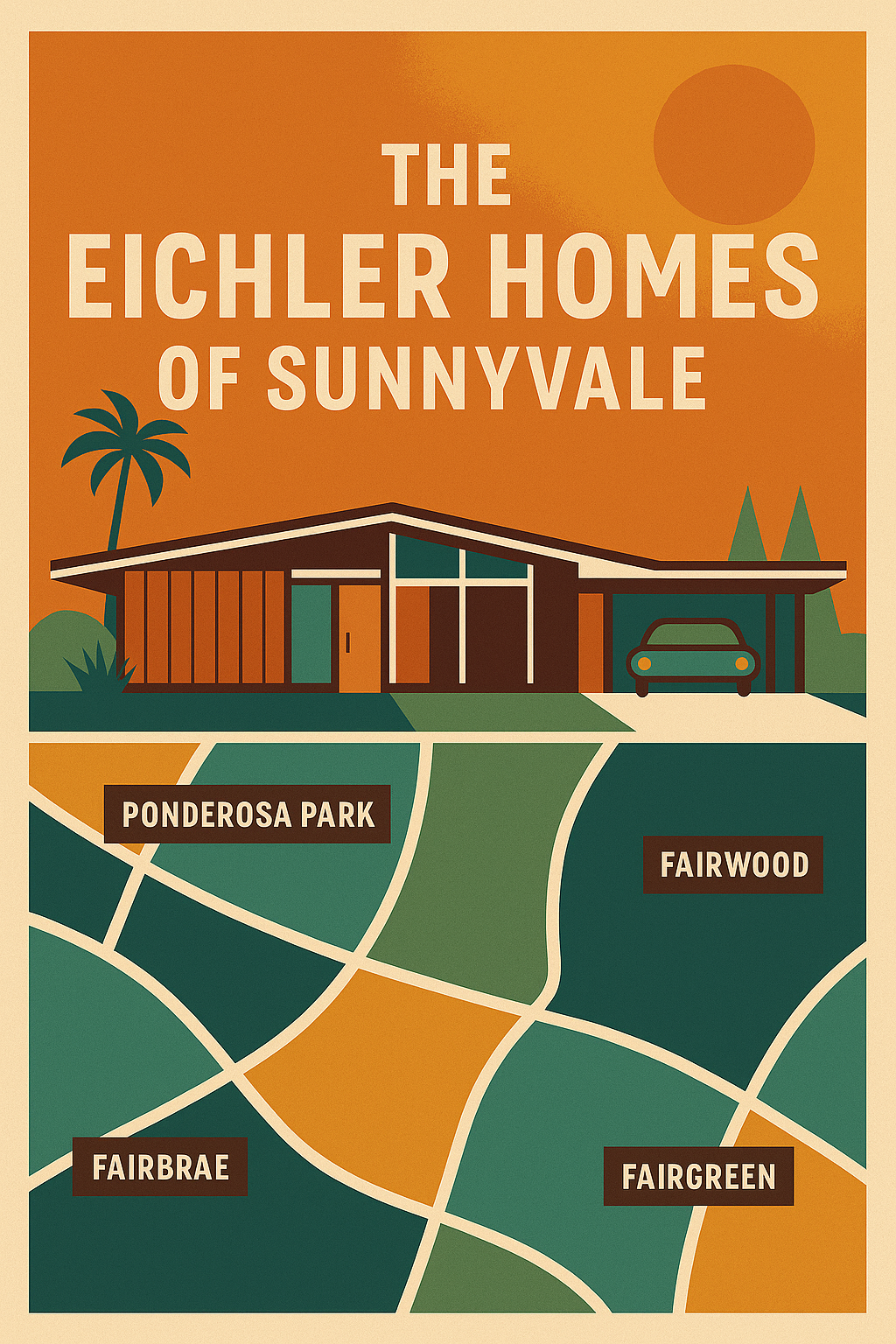
A classic Eichler home in Sunnyvale, California, showcasing open-beam construction and floor-to-ceiling glass that blurs indoor and outdoor living.
Sunnyvale, California is a unique mid-century modern treasure trove. This unassuming Silicon Valley city is home to an extraordinary concentration of Eichler homes – the iconic modernist houses developed by Joseph Eichler in the 1950s and 60s. In fact, Sunnyvale boasts around 1,100 Eichler homes, spread across numerous neighborhoods heritageparkmuseum.org. These flat-roofed, glass-walled homes are more than just stylish houses; they represent a postwar vision of California living that Sunnyvale embraced like no other city. In this post, we’ll explore why Sunnyvale became Eichler’s playground, how the city’s geography, economy, and explosive postwar growth set the stage, and dive deep into the architectural legacy of specific Sunnyvale Eichler tracts – Fairbrae, Rancho Verde, Cherry Chase, and Ponderosa Park. We’ll also examine what makes each tract special (from atriums to rooflines), what amenities and community features they offer, and how today’s buyers and preservationists view these neighborhoods.
Sunnyvale’s Eichler Legacy: Postwar Boom Meets Modern Design
Sunnyvale’s Eichler story begins in the late 1940s, when the Bay Area was booming with returning WWII veterans and new industries. A massive housing shortage was underway, and federal programs like the G.I. Bill and the Housing Act of 1949 spurred a suburban building boom heritageparkmuseum.org. Once a quiet agricultural town of orchards (“the Apricot Capital of the World”), Sunnyvale suddenly needed thousands of new homes for its surging population (which jumped from about 10,000 in 1950 to over 52,000 by 1960 myheartmountain.weebly.com). The city – not master-planned like some suburbs, but rapidly growing around defense plants and electronics factories – welcomed innovative, easy-to-build housing to meet this demand heritageparkmuseum.org.
Enter Joseph Eichler, a visionary developer with a radical idea: bring modern architecture to the mass market. Eichler wasn’t an architect himself, but he hired brilliant architects (like Robert Anshen, A. Quincy Jones & Frederick Emmons, and Claude Oakland) to design modernist tract homes that ordinary families could afford. Sunnyvale was the proving ground for Eichler’s vision. In 1949, Eichler formed a building company (tellingly named the Sunnyvale Building Company) and built his very first modern tract homes in Sunnyvale heritageparkmuseum.org. Those early developments – Sunnyvale Manor (at East Maude and N. Bayview) and Sunnymount Gardens (36 houses) – were the humble start of what would become an Eichler empire heritageparkmuseum.org en.wikipedia.org.
Over the next two decades, Eichler’s company constructed 16 tracts throughout Sunnyvale, ranging from small enclaves of a few dozen houses to large neighborhoods of a few hundred heritageparkmuseum.org. Sunnyvale thus contains examples of Eichler homes from every era of his work – from the very first 1949 models (modest 2-bedroom houses with simple modern styling) to one of his last developments in 1968 (the Rancho Sans Souci tract with ~84 homes eichlerhomesforsale.com, built just before Eichler Homes ceased operations). It’s no wonder Eichler enthusiasts call Sunnyvale a living museum of Eichler architecture. The city is adorned with over 1,000 Eichler homes today eichlerhomesforsale.com – one of the largest concentrations of Eichlers anywhere – each a “beacon of the mid-century modern ethos” eichlerhomesforsale.com that helped define Sunnyvale’s transition from orchards to high-tech.
Why Sunnyvale? Several factors made this city Eichler’s ideal canvas. Geographically, Sunnyvale offered expansive flat land (former fruit orchards) perfect for tract development, and a mild Mediterranean climate that suited Eichler’s indoor-outdoor designs (plenty of California sun to stream through those glass walls) sfgate.com. Economically, Sunnyvale in the 1950s was booming – defense contractors like Lockheed had set up shop, and the seeds of Silicon Valley were sprouting – attracting a wave of educated middle-class professionals looking for housing. Eichler’s homes, with their comparatively affordable prices and avant-garde style, appealed to these young families and tech pioneers who wanted something forward-looking in the suburbs. And critically, Sunnyvale’s city leaders and planners were receptive to new ideas. By embracing Eichler’s modern subdivisions, Sunnyvale could rapidly provide housing and stand out as a progressive suburb. The cultural climate also played a role: Eichler insisted on fair housing, selling to people of all races and religions at a time when many builders practiced discrimination. In 1958, he famously quit the National Association of Home Builders over their refusal to support his non-discrimination policy heritageparkmuseum.org. This progressive ethos may have resonated in Sunnyvale, a community open to growth and change.
The architecture of Eichler homes was utterly unlike the conventional houses of the time, and this bold design is a big part of why they flourished in Sunnyvale. Eichler homes are mid-century modern icons characterized by: post-and-beam construction, open floor plans (where kitchen, dining, and living spaces flow together), floor-to-ceiling glass walls and sliding doors, and central open-air atriums in many models heritageparkmuseum.org. The idea was to “bring the outside in” – blurring the line between indoors and outdoors with courtyards, skylights, and huge panes of glass looking out onto private yards heritageparkmuseum.org. These homes were typically single-story with either flat or low-pitched A-frame roofs, and featured Philippine mahogany paneling inside for warmth heritageparkmuseum.org. Notably, most Eichlers turned a blank face or nearly windowless facade to the street, placing their glass and openness on the rear and atrium – a radical departure from typical suburban houses that broadcast big windows and fancy fronts to the street heritageparkmuseum.org. Eichler’s houses also had innovative technology for the time, like in-floor radiant heating (no clunky radiators – warmth came up through the concrete slab) heritageparkmuseum.org. All these elements combined to create a light-filled, airy, and modern living experience that was very attractive to postwar homebuyers seeking something new. Early on, some folks were skeptical – these homes looked so different – but in Sunnyvale they quickly caught on. Eichler’s “California Modern” style fit perfectly with Sunnyvale’s optimistic, future-oriented growth.
By the 1960s, Sunnyvale was not just another suburb – it was Eichlerville. These neighborhoods helped define the city’s character. They were so impactful that in 2009 the City of Sunnyvale formally adopted “Eichler Design Guidelines” to help preserve the character of its Eichler tracts eichlernetwork.com. (Think about that – a city issuing design guidelines for 50-year-old tract homes – it speaks to how treasured they are.) Today, walking through Sunnyvale’s Eichler enclaves is like stepping back in time to the Mad Men era: you’ll see the same low-slung profiles, rock gardens, and globe pendant lights glowing on front porches just as they did half a century ago. Yet these neighborhoods are alive and well, filled with families who cherish the mix of retro charm and modern Silicon Valley convenience.
Let’s zoom in on four of Sunnyvale’s most notable Eichler areas – Fairbrae, Rancho Verde, Cherry Chase, and Ponderosa Park. Each has its own story, architectural highlights, and present-day vibe.
Fairbrae: The Heart of Sunnyvale’s Eichler Community
Fairbrae is a crown jewel of Sunnyvale’s Eichler legacy – a broad neighborhood in the city’s west end that epitomizes Eichler’s vision of harmonious modern living. Developed between 1958 and 1961, the core Fairbrae tract contains approximately 110 Eichler homes eichlerhomesforsale.com, and if you include its adjacent Eichler additions (Fairbrae Extension and others), the area consists of over 200 Eichler houses in total eichlerhomesforsale.com. Bounded roughly by Wolfe Road, Remington Drive, Hollenbeck Avenue, and Fremont Avenue, Fairbrae spans several curving residential streets (Torrington, Sheraton, Quince, Pomegranate, and more) that are almost entirely Eichler-built. Strolling these streets, you’ll notice one Eichler after another, creating a time-capsule neighborhood of mid-century modern design.
Design and Architecture: Fairbrae showcases many of Eichler’s finest architectural elements. The homes were designed by a “who’s who” of Eichler architects – Anshen + Allen, Jones & Emmons, and Claude Oakland each had a hand in various Fairbrae models eichlerhomesforsale.com. As a result, there’s a rich mix of designs: some homes have atriums at their center, others a wide A-frame roof, others a flat roof profile – but all share the Eichler DNA of post-and-beam structure and open layouts. Hallmark features in Fairbrae include floor-to-ceiling glass panels opening to backyards, exposed ceiling beams, and Philippine mahogany interior walls eichlerhomesforsale.com. Many Fairbrae homes are atrium models, meaning you enter through a gated open-air courtyard that leads to the front door – a dramatic indoor-outdoor transition flooded with light. The indoor spaces wrap around the atrium, thanks to walls of glass, so almost every room gets a view of a private garden or patio. This integration with nature was intentional and remains breathtaking today. Fairbrae Eichlers also feature the classic Eichler simplified facade – you’ll see modest fronts with grooved siding and maybe a pop of color on the front door (turquoise and orange are popular choices), while the backside is all glass. Rooflines in Fairbrae are mostly low-gabled or flat; from the street you often just see a carport and a blank front wall, but peek over the fence and you’ll see the butterfly roofs and deep eaves that give these homes their mid-century flair.
Community Amenities: One of the things that makes Fairbrae stand out is its built-in sense of community. Eichler developments often included shared amenities to bring neighbors together, and Fairbrae is a prime example. The tract features the Fairbrae Swim & Racquet Club, a private community pool and tennis facility that was established for Eichler owners and remains a social hub heritageparkmuseum.org. Tucked within the neighborhood (on Sheraton Drive), this club includes a large swimming pool, tennis courts, and a clubhouse – it’s where generations of local kids have learned to swim and families gather for summer BBQs. The fact that Eichler included a swim club shows how forward-thinking these developments were; it wasn’t just houses, it was a lifestyle. Beyond that, Fairbrae’s streets were designed with limited through-traffic (lots of cul-de-sacs and gentle curves), fostering a quiet, safe atmosphere perfect for walking and play. Nearby, within a few minutes’ drive, are Serra Park and Las Palmas Park if you’re seeking larger green spaces, but many Fairbrae residents find their own backyards and the swim club to be the recreational heart of the community.
Current Market & Appeal: Today, Fairbrae is one of the most sought-after Eichler neighborhoods in the Bay Area eichlerhomesforsale.com. Home buyers – from tech professionals to young families to mid-century enthusiasts – are drawn to Fairbrae for its blend of historic charm and modern convenience. The neighborhood has a close-knit, sociable vibe, with an active neighborhood association and friendly neighbors who often stop to chat on evening walks. Top-rated schools (the area feeds into excellent Sunnyvale and Cupertino schools) and proximity to major job centers make it practical as well as charming eichlerhomesforsale.com. Preservation is strong here: many homes retain their original Eichler character (terrazzo entryways, globe pendant lights, etc.), and remodels tend to be Eichler-sensitive (thanks in part to Sunnyvale’s Eichler design guidelines). Driving through, you won’t see teardowns or McMansions – you’ll see mostly intact low-profile Eichlers, some beautifully updated with modern kitchens but still true to the mid-century aesthetic. For Eichler “purists”, Fairbrae is a favorite locale because so many homes have their original layout and feel. Real estate-wise, properties in Fairbrae often command premium prices and can ignite bidding wars, given their rarity and iconic status. As one local agent noted, Fairbrae offers a near-perfect package: historical significance, architectural integrity, a family-friendly environment, and a superb location close to parks, schools, and Silicon Valley’s tech corridor eichlerhomesforsale.com. It’s a neighborhood that “echoes mid-century modern charm” while remaining utterly livable in the 21st century eichlerhomesforsale.com.
Rancho Verde: A Mid-Century Gem with Neighborly Spirit
On Sunnyvale’s western side, not far from Fairbrae, lies Rancho Verde – a smaller Eichler tract that packs a lot of character and history into its cozy confines. Developed in 1961-1962, Rancho Verde (and its tiny offshoot, Rancho Verde Addition) was actually the final phase of Eichler’s Fairbrae developments (in fact, it’s sometimes called “Fairbrae Unit No. 5” by old-timers) boyengateam.com. This enclave is bordered by South Mary Avenue, Ticonderoga Drive, and Pome Avenue, with a strip of commercial shops to the south that conveniently serves the neighborhood boyengateam.com. In total, Rancho Verde includes roughly 68 Eichler homes in the main tract (built 1961) plus an additional 21 homes in the 1962 addition eichlerhomesforsale.com – so about 89 Eichler homes all together, making it a tight-knit pocket community. Every house on streets like Ticonderoga, Plymouth, Yorktown, Lexington, and portions of Quail and Sherwood Drives is an Eichler, giving Rancho Verde a distinct identity.
Design and Architecture: Rancho Verde’s homes were designed by Claude Oakland and Jones & Emmons, two of Eichler’s most trusted architectural teams eichlerhomesforsale.com. By the early 1960s, Eichler’s architects had honed a wide array of models, and Rancho Verde reflects that architectural diversity eichlerhomesforsale.com. Here you’ll find classic 4-bedroom atrium models alongside slightly larger models with expanded family rooms – Eichler was catering to growing suburban families by this time. The tract features low-pitched gable roofs as well as some nearly flat roof designs, giving the streetscape a bit of variation. Many Rancho Verde homes have a pronounced A-frame entry projecting over the atrium or front door, creating an attractive modern pediment. Inside, expect all the Eichler hallmarks: open beam ceilings, lofty living rooms with floor-to-ceiling glass looking out to the yard, and central atriums in a good number of the models. Because these homes were built at the tail end of Eichler’s big Silicon Valley run, some include slight mid-60s tweaks – for instance, you might see updated kitchens (for the era) with breakfast bars, or more built-in cabinetry as original features. One charming bit of Rancho Verde lore: when the first owners moved in around 1962, every home had a cherry tree planted in the yard as part of the landscaping boyengateam.com. This was a nod to the area’s recent past as cherry orchards (and perhaps a clever tie-in to the adjacent Cherry Chase neighborhood). Those original cherry trees have matured or been replaced over time, but the idea of flowering trees on each lot adds to Rancho Verde’s curb appeal in springtime.
Neighborhood and Amenities: Rancho Verde might be small, but it has a very strong sense of community. Many original owners stayed for decades, fostering an old-fashioned neighborly atmosphere. One famous example is Chuck and Patty Ward, who moved into Rancho Verde in 1962 when the Eichlers were brand new – they have been community anchors, helping preserve the tract’s character over the years boyengateam.com. Thanks to long-time residents like the Wards (and newer enthusiasts who have moved in), Rancho Verde remains one of the best-preserved Eichler neighborhoods in Sunnyvale. Neighbors here have a history of socializing – you’ll often see folks chatting on evening walks or kids playing in the cul-de-sacs. The streets even used to hold an annual summer block party, a tradition that some residents still continue. While Rancho Verde doesn’t have a private community center, it benefits from having a small strip shopping center right next door (along Hollenbeck and Mary) – residents can walk to stores, cafés, and services easily boyengateam.com. This walkability is a perk that many suburban tracts lack. Parks are also close: De Anza Park and Mango Park (with a public swimming pool and tennis courts) are just a short drive or bike ride away, giving Rancho Verde families ample recreation options. The neighborhood’s tree-lined streets and low traffic (since it’s somewhat enclosed by its borders) make it great for pedestrians. In terms of schools, Rancho Verde is zoned similarly to Fairbrae and Cherry Chase areas, often to Cherry Chase Elementary or Cumberland Elementary (both highly regarded), Sunnyvale Middle, and Homestead High – another draw for families.
Market Appeal and Preservation: For today’s homebuyers, Rancho Verde offers a slightly more intimate Eichler experience compared to larger tracts. People love it for its charming scale and neighborly feel – it’s the kind of place where you know your neighbors and feel a part of a little community. Architecturally, the homes are prized for being pure Eichlers with minimal outside intrusions; the tract was fortunate to avoid having any two-story “pop-ups” in its midst. In recent years, Eichler owners in Sunnyvale (including those in Rancho Verde) have been actively fighting to prevent oversized rebuilds that would disrupt the character of their neighborhoods. In fact, several Rancho Verde owners joined city-wide petitions to bar “McMansions” from being built among single-story Eichlers. Their goal is to protect the unique mid-century vibe – and it appears to be working, as Sunnyvale’s design review process strongly discourages incompatible remodels in Eichler areas. As a result, Rancho Verde’s Eichlers are very well-preserved. Many still feature the original globe lighting fixtures, grooved ceilings, and Philippine mahogany walls. When homes do change hands, buyers often modernize things like kitchens or bathrooms, but there’s an emphasis on sensitive updates (for example, using period-appropriate materials or hiring architects who specialize in Eichler remodels). The neighborhood’s real estate value has climbed steeply along with the broader market – an Eichler in Rancho Verde is highly desirable for those specifically seeking mid-century modern style with a community feel. Compared to larger tracts, Rancho Verde can feel like a hidden gem – and indeed, when one of these homes hits the market, Eichler aficionados jump at the chance. Diverse, sociable, and rich in character, Rancho Verde remains a mid-century modern haven. It truly reflects Eichler’s goal of creating not just houses, but thriving communities where “The American Way” of modern living could flourish.
Cherry Chase: Eichler Charm in a Top-School Neighborhood
Cherry Chase isn’t a single Eichler tract but rather a beloved Sunnyvale neighborhood that includes several Eichler pockets woven into a larger fabric of mid-century homes. Centered around Cherry Chase Elementary School (near Hollenbeck Avenue and Fremont Avenue), this area in northwest Sunnyvale gained a reputation for its “Cherry Chase Charmers” – the mid-century ranch and Eichler homes that dominate the streets . In the 1950s and 60s, as Sunnyvale expanded, multiple builders (including Eichler) developed subdivisions here. Eichler’s contributions include tracts such as Fairorchard (built 1958, about 31 homes) and Rancho San Souci / Parmer Place (late 1960s, around 62 homes) on the south side, and Fairwood (1961–62, roughly 44 homes) on the north side eichlerhomesforsale.com. Collectively, the Cherry Chase neighborhood encompasses hundreds of Eichler homes sprinkled among other ranch-style houses, making it one of the largest mid-century concentrations in Santa Clara County. In fact, roughly 2,500 homes in Cherry Chase were built in the ’50s and ’60s, and Eichler’s distinctive modern designs make up a good share of them.
Design and Characteristics: The Eichler homes in Cherry Chase display all the classic design elements that made Eichler famous. A typical Cherry Chase Eichler, for example, might be a 4-bedroom, 2-bath atrium model built in 1961 – featuring a central open-air atrium surrounded by floor-to-ceiling glass panels, an open beam tongue-and-groove ceiling, and an L-shaped great room with glass walls facing the backyard. The front facade is modest, often a low-sloping roof with a carport or garage tucked to one side and a plain door (sometimes hidden behind a screen wall). But open the gate, and you step into a tranquil atrium courtyard – perhaps with a bubbling fountain or potted Japanese maple – that acts as the heart of the home. From the atrium, sliding glass doors connect into the living room and hallway, exemplifying Eichler’s indoor-outdoor flow. Many Eichlers in this area also boast globe pendant lights hanging in the atrium or dining areas, original lauan mahogany paneling in the bedrooms, and built-in cabinetry characteristic of Eichler interiors. Roof profiles vary a bit: some are the trademark nearly-flat roofs with perimeter fascias, while others have gentle peaks. A keen eye will notice subtle differences between early Eichlers (late ’50s) and later ones (late ’60s). For instance, the Fairorchard (1958) Eichlers were among the first to introduce atriums and tend to be smaller in square footage (3-bedroom models, for example), whereas the Rancho San Souci (1968) Eichlers are larger and reflect Eichler’s later style with features like two-car garages and more expansive layouts eichlerhomesforsale.com. But regardless of these differences, all share the Eichler soul: post-and-beam construction, open-plan interiors, and that unmistakable mid-century modern aesthetic.
One distinctive aspect of Cherry Chase Eichler areas is mature landscaping – after 60+ years, the neighborhood’s trees (including many fruit trees that predate the houses) and gardens are lush and established. It’s common to see Eichlers framed by towering camphor trees or shaded by old apricot and plum trees from the orchard days. Springtime brings blooming cherry blossoms (true to the area’s name) along streets like Homestead Road and Heatherstone Way.
Community and Amenities: Cherry Chase is highly sought-after by families, primarily because of the top-rated schools embedded in the neighborhood. Cherry Chase Elementary itself is a California Distinguished School, and many Eichler homes are just a short walk or bike ride for the kids. (Local joke: children here learn to ride bikes on Eichler carport driveways!) The area feeds into Sunnyvale Middle School and the acclaimed Homestead High School, which consistently rank among the best – a huge draw for buyers. But beyond schools, the community vibe is a major asset. The neighborhood has an active Cherry Chase Neighborhood Association that organizes block parties, holiday events, and neighborhood watch programs. The result is a tight-knit, welcoming community where original homeowners (some houses are still in the hands of families who bought in the 60s) mingle with younger newcomers at summer BBQs or while chatting on evening strolls.
For recreation, De Anza Park sits in the heart of Cherry Chase, offering 9+ acres of grassy fields, picnic areas, a playground, and even a skatepark. On a given weekend, you might see pickup basketball games at De Anza or families flying kites. Another nearby facility is Mango Park (just east of Cherry Chase), which has a city swimming pool and tennis courts – great for those who want the amenities of a swim club without leaving the area. Because Cherry Chase is an older part of Sunnyvale, it also enjoys convenient access to shops and services: along El Camino Real to the south are grocery stores, restaurants, and cafes. And tech workers appreciate that the neighborhood has quick routes to the freeways (Highway 85 and 280) for commuting.
Market and Preservation: Homes in Cherry Chase, Eichlers in particular, are highly coveted. Buyers value not only the architectural style but also the practical benefits – large lot sizes (for Silicon Valley, having a 7,000+ sq ft lot is common here), single-story living, and the aforementioned schools. It’s the kind of neighborhood where an Eichler listing might advertise “Coveted Cherry Chase Eichler” and emphasize original mid-century details. Over the years, many of these Eichlers have been lovingly preserved or carefully updated. It’s not unusual to find a Cherry Chase Eichler that still has its original mahogany walls, 1960s globe light fixtures, and even original cabinetry – owners here know the value of these vintage touches and often restore rather than replace. Where updates have been made (kitchens, bathrooms, etc.), they tend to honor the home’s mid-century roots eichlerhomesforsale.com. Preservation-minded buyers often seek out Cherry Chase because the neighborhood has resisted tear-downs and maintains a consistent 1950s-60s character. Unlike some areas where new giant houses dwarf older homes, Cherry Chase’s streets have a cohesive look – Eichlers and low-slung ranches that belong together. This is partly due to resident advocacy and Sunnyvale’s Eichler guidelines, which help “honor their mid-century roots” in any renovation eichlerhomesforsale.com.
From a preservationist standpoint, Cherry Chase is seen as a success story: it’s a vibrant living neighborhood that nonetheless feels historic. The city’s guidelines, along with neighbor support, have thus far kept out-of-scale development at bay. In fact, Cherry Chase was one of the neighborhoods actively involved when Sunnyvale Eichler owners petitioned the city to prevent two-story rebuilds – their efforts underscore how valued these Eichler homes are to the community’s identity. Today, when you drive through Cherry Chase, you’ll likely see evidence of pride in ownership: neat drought-tolerant front landscaping that complements the mid-century homes, maybe an Eichler Network bumper sticker on a resident’s car, or a restoration contractor’s sign out front (indicating another Eichler getting a respectful makeover). The market appeal is tremendous: not only do Eichler aficionados target this area, but so do general buyers who simply want a great neighborhood. The combination of design, community, and schools often results in multiple offers on Eichler listings, with prices well into seven figures. Yet, for those who live here, it’s not about speculation – it’s about being part of a historic, tight-knit neighborhood that continues to age gracefully. Cherry Chase’s Eichlers are truly where “mid-century modern meets modern family living.”
Ponderosa Park: Mid-Century Modern Style Beyond Eichler
Sunnyvale’s Eichler legacy doesn’t end with the homes Joseph Eichler built himself. The Ponderosa Park neighborhood, on the eastern side of Sunnyvale, illustrates how Eichler’s California Modern style inspired other developers to create their own mid-century modern havens. Ponderosa Park (located roughly around E. Remington Drive, Lawrence Expressway, and a namesake city park on Silverlake Drive) was developed in the mid-to-late 1950s and early 1960s by builders like Elmer Gavello and Stern & Price, rather than Eichler’s company. However, many of the houses here are so similar in look and spirit to Eichlers that they are often affectionately called “Eichler clones.” In fact, many Gavello-built homes appear in the Ponderosa Park area of Sunnyvale boyengateam.com, and at a glance you’d swear they were Eichlers. This neighborhood is a fascinating part of Sunnyvale’s architectural tapestry, showing the ripple effect of Eichler’s influence.
Design and Architecture: The mid-century modern homes of Ponderosa Park share key features with Eichler homes: single-story slab-on-grade construction, exposed beam or open-web joist ceilings, large panes of glass, and integration with outdoor spaces. Developer Elmer Gavello, who built a tract called Gavello Glen in 1956 on the east side of Sunnyvale, carried many of those designs into Ponderosa Park in the following years boyengateam.com. Gavello even collaborated with Eichler’s early architects Anshen & Allen to design some of his homes boyengateam.com. The result? Houses that embody Eichler’s style – so much so that the Anshen & Allen designs in Sunnyvale’s Gavello developments won a prestigious Merit Award for architecture in the 1950s boyengateam.com. A typical Gavello home in Ponderosa Park might have a low-gabled roof with open eaves, an L-shaped layout wrapping around a patio, and walls of glass facing a backyard pool. Many include courtyards or atrium-like entrances (though often uncovered), and clerestory windows along the street-facing side – details straight out of Eichler’s playbook. Interiors feature open beam ceilings (often painted white), brick or concrete block fireplaces, and open floor plans. Some Gavello models even have flattened butterfly roofs and other dramatic mid-century rooflines that Eichler used. It’s clear that Gavello and others were tapping into the strong demand for modern design that Eichler had proven was viable.
One notable difference: Gavello’s homes in Gavello Glen (just north of Ponderosa) were built on oversized lots – often around 10,000 sq ft (≈0.25 acre), significantly larger than typical Eichler lots boyengateam.com. This gave those homes a more estate-like feel (and indeed, Gavello marketed them as a bit upscale). In Ponderosa Park, while lot sizes vary, there are pockets with similarly generous lots and custom-feel homes. Another difference is that some Ponderosa Park MCM homes include more traditional features (for example, a slightly higher-pitched roof or a bit of ornamentation) that Eichler homes avoid – a reminder that not all were exact clones. However, the majority clearly draw from the same mid-century modern vocabulary. So much so that Sunnyvale’s preservation and heritage discussions often include Ponderosa Park alongside true Eichler tracts, as part of the city’s mid-century modern heritage.
Neighborhood Amenities: Ponderosa Park the neighborhood is anchored by Ponderosa Park the public park, a lovely 9-acre park with a nostalgic Western theme (a nod to Sunnyvale’s ranch past). The park features playgrounds, a picnic area, horseshoe pits, basketball and tennis courts, a sand volleyball court, and even a bocce ball court sunnyvale.ca.gov. It’s a recreational hub that brings the community together – weekends see families playing and neighbors walking dogs under the old trees. The presence of this park greatly enhances the quality of life for local residents (including those in the mid-century modern homes around it). Additionally, the neighborhood is conveniently near the Ponderosa Shopping Center on El Camino Real, so groceries, cafes, and other services are within a short drive or bike ride. The Lawrence Station Caltrain isn’t far either, which is great for commuters. The area’s street layout mixes curving residential lanes with straight thoroughfares, but traffic inside the tract remains light, making it fairly quiet and kid-friendly. Schools serving Ponderosa Park include Ponderosa Elementary and Peterson Middle, and while these may not have the name recognition of Cherry Chase’s schools, they are solid community schools that local families appreciate.
Market and Preservation: The mid-century homes of Ponderosa Park have long been a bit of a hidden secret for MCM lovers. They sometimes trade at slightly lower prices than true Eichlers in Fairbrae or Cherry Chase (likely due to not having the “Eichler” brand name), which means savvy buyers can get Eichler-style architecture with a bit more bang for the buck. In recent years, however, awareness of Gavello homes and other Sunnyvale MCM properties has grown, and their values have climbed accordingly. Preservationists view Ponderosa Park’s mid-century enclave as an integral part of Sunnyvale’s architectural heritage. In the 1990s, residents of Gavello’s tract (just adjacent to Ponderosa Park) sought to designate it as an official Sunnyvale Heritage Housing District to protect its character boyengateam.com. While that specific designation never materialized, the effort underscored the community’s desire to recognize and preserve these modern homes. Today, Ponderosa Park homes are often included in Eichler-oriented home tours and events, highlighting their authentic design. Many owners have kept or restored period features – it’s not unusual to find a Ponderosa Park home with original accordion room dividers, vintage light fixtures, and carefully maintained 50s cabinetry. Others have been remodeled, but there’s a growing trend to do mid-century–appropriate renovations. And with Sunnyvale’s Eichler design guidelines (which, while focused on Eichler tracts, have influenced attitudes citywide), even non-Eichler mid-century homes benefit from a culture of preservation and context-sensitive remodeling.
For buyers, Ponderosa Park offers a chance to live in a “modernist” neighborhood setting without the price premium of some Eichler tracts – though that gap is closing. The large lots in some sections (especially Gavello Glen nearby) are a big draw, providing space for expansions, landscaping, or outdoor living that smaller Eichler lots can’t. We’re seeing young families, in particular, drawn to these homes: they get the open-plan, floor-to-ceiling glass vibe that’s great for raising kids (easy to watch them in the yard through the glass!) combined with a friendly community and park next door. The area’s identity as a mid-century enclave is only becoming stronger as people realize what a gem it is. In essence, Ponderosa Park’s Eichler-influenced homes extend the legacy of Eichler in Sunnyvale – proving that imitation (or inspiration) is the sincerest form of flattery. They contribute to Sunnyvale’s reputation as a mid-century modern hotspot, and their preservation ensures that even neighborhoods beyond the official Eichler tracts share in that architectural continuity.
Living Legacy and Expert Guidance
Sunnyvale’s Eichler neighborhoods – from Fairbrae’s extensive tract to Rancho Verde’s cozy loop, from the tree-lined Cherry Chase streets to the Eichler-inspired Ponderosa Park enclave – together form a remarkable legacy of mid-century modern living. These areas are not frozen in time, but evolving communities that balance historic preservation with modern lifestyles. Preservationists laud Sunnyvale for its efforts (like the 2009 Eichler guidelines) to maintain the architectural integrity of these tracts eichlernetwork.com. Homeowners have organized, petitioned, and even battled at City Hall to ensure that towering McMansions don’t invade their low-profile neighborhoods. And by and large, they’ve succeeded – Sunnyvale’s Eichler districts remain instantly recognizable and highly intact. Buyers today flock to these neighborhoods not only for the aesthetic and “cool factor” of living in an Eichler, but also for the intangible lifestyle benefits: the sense of community, the connection to California history, and the joy of living in a home that truly “brings the outside in” and encourages family time in open gathering spaces.
If you’re contemplating joining one of these Sunnyvale Eichler communities – or perhaps selling a cherished Eichler – it pays to have experts on your side who understand just how special these homes are. That’s where the Boyenga Team at Compass comes in.
Silicon Valley’s Eichler Experts – The Boyenga Team
Eric and Janelle Boyenga, founders of the Boyenga Team, are renowned as “Property Nerds” and Silicon Valley Eichler experts. As top-producing realtors with deep roots in the region, they have made it a mission to understand every nuance of Eichler homes and mid-century modern real estate. The Boyenga Team doesn’t just see an Eichler as a house; they appreciate it as a piece of architectural art and a cultural artifact. This passion translates into unparalleled service for Eichler sellers and buyers. Selling an Eichler? Eric and Janelle know how to market its unique appeal – from highlighting original features like mahogany walls and atriums, to advising on period-appropriate staging that resonates with mid-century enthusiasts. They tap into an extensive network of Eichler-loving buyers and use specialized marketing (high-quality photography that captures the indoor-outdoor flow, compelling descriptions that tell the home’s story) to ensure your Eichler stands out. It’s not uncommon for the Boyenga Team to set record prices by positioning an Eichler as the coveted collectible it truly is.
Buying an Eichler? The Boyenga Team will guide you through the entire journey, helping you navigate both the allure and the complexity of these homes. Eichlers, while beautiful, come with unique considerations – flat roofs and radiant heating systems, for example, require knowledgeable inspection. Eric and Janelle have a roster of trusted inspectors and contractors who understand Eichlers inside and out, ensuring that you know exactly what you’re getting (and how to maintain it). They also understand the competitive dynamics of Eichler sales in Sunnyvale; many Eichlers receive multiple offers from dedicated fans. With the Boyenga Team’s guidance, you can craft a winning offer strategy that balances your budget with creative terms to appeal to the seller. Perhaps most importantly, the Boyengas educate their Eichler-buying clients – sharing insights on the specific tract’s history, any architectural variants of that model, and even connecting you with local Eichler homeowner groups or resources like Eichler Network for ongoing support. By the time you get the keys, you’ll feel not just like you bought a house, but like you’ve joined a community and embraced a lifestyle.
The Boyenga Team’s expertise in Eichler and mid-century homes has been honed over years of dedicated work. They’ve represented countless Eichler transactions across Sunnyvale, Palo Alto, Mountain View, and beyond, giving them broad perspective on value trends and buyer demographics. They are often consulted for their knowledge – whether it’s advising a seller on which improvements yield the best return (for example, polishing up an atrium vs. installing AC) or counseling a buyer on how to tackle a preservation-friendly remodel. Their client testimonials frequently mention how smooth and enlightening the process was – “like having a historian, architect, and agent all in one.” Beyond the transaction, Eric and Janelle remain a resource for their clients, happy to recommend a specialist to fix that Eichler boiler or a source for retro light fixtures. It’s this full-service, deeply informed approach that has earned them the moniker “Eichler home specialists”eichlerhomesforsale.com and a sterling reputation in the community.
In a market as niche and cherished as Eichler homes, working with a knowledgeable team is key. The Boyenga Team at Compass has proven time and again that they not only understand these properties, but truly love them – and that passion fuels results. Whether you’re entrusting them to sell your treasured Eichler to the right steward, or leaning on them to find you the Eichler of your dreams in Sunnyvale’s competitive market, you can rest assured you’re in expert hands. They will help you “discover the smarter way to buy or sell a home” boyengateam.com, with your needs and Eichler’s legacy equally respected.
Sunnyvale’s Eichler neighborhoods are a testament to a visionary builder and a city that embraced modern living. With the Boyenga Team’s help, you too can become part of this remarkable story – living in (or passing on) an Eichler, and preserving the mid-century magic that makes Sunnyvale so special.
SEO Title: Sunnyvale Eichler Homes – Inside the City’s Largest Mid-Century Modern Neighborhoods
SEO Excerpt: Discover why Sunnyvale, CA is an Eichler home haven. Explore the history and architecture of Sunnyvale’s mid-century modern Eichler neighborhoods – Fairbrae, Rancho Verde, Cherry Chase, and Ponderosa Park – and learn how postwar growth made this city the epicenter of Joseph Eichler’s vision. Insights on each tract’s design, community vibe, and today’s market appeal.
SEO Keywords: Sunnyvale Eichler homes, Eichler Sunnyvale, mid-century modern Sunnyvale, Joseph Eichler Sunnyvale, Eichler Fairbrae, Fairbrae Eichler tract, Rancho Verde Eichler, Cherry Chase Eichler, Ponderosa Park mid-century, Eichler architecture, atrium Eichler, Eichler rooflines, Sunnyvale mid-century neighborhoods, Eichler historical Sunnyvale, Eichler real estate Silicon Valley, Sunnyvale modernist homes, Eichler design guidelines Sunnyvale, Eichler preservation, Eichler homes for sale Sunnyvale, Boyenga Team Eichler experts, Silicon Valley Eichler specialist
Meta Description: Sunnyvale, California boasts one of the largest collections of Eichler homes anywhere. Dive into the fascinating story of how postwar Sunnyvale became Joseph Eichler’s favorite canvas, with 1,100+ mid-century modern houses across neighborhoods like Fairbrae, Rancho Verde, Cherry Chase, and Ponderosa Park. Learn about each tract’s history, architecture (atriums, post-and-beam construction, iconic rooflines), community amenities (like Fairbrae’s swim club), and why these Eichler neighborhoods are so prized today by homebuyers and preservationists. If you’re dreaming of an Eichler lifestyle or planning to sell one, get expert tips from the Boyenga Team – Silicon Valley’s Eichler specialists – on navigating the unique appeal and complexities of these architectural gems. eichlerhomesforsale.com heritageparkmuseum.org
Sources