
Anshen + Allen: Architects Behind the First Eichler Homes
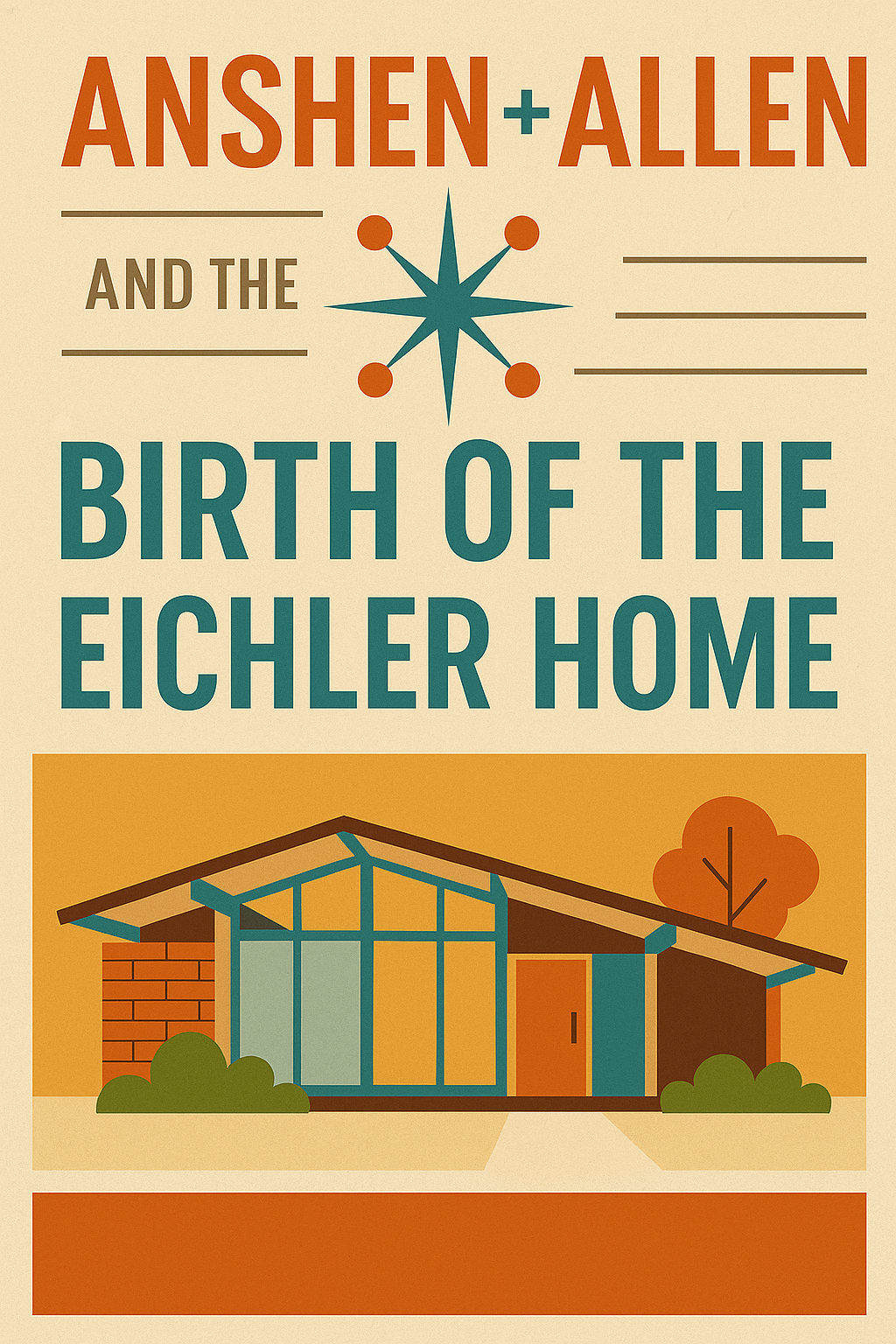
Early Lives of Robert Anshen and Steve Allen
Samuel Robert “Bob” Anshen (1910–1964) and William Stephen “Steve” Allen Jr. (1912–1992) met as architecture students at the University of Pennsylvania in the 1930sen.wikipedia.org. After graduating, the two moved to San Francisco and in 1940 founded their firm, Anshen & Allenen.wikipedia.org. Early in their career they designed a lavish Tudor-style mansion in Woodside, CA, completed in 1941en.wikipedia.org. But their trajectory soon shifted toward modern design, especially after World War II when they began experimenting with gas station prototypes and other modern structuresen.wikipedia.org.
Anshen in particular was drawn to Frank Lloyd Wright’s ideas; he was an avowed Wright admirer (a “Wright disciple of sorts” in the words of one sourceen.wikipedia.org) who embraced Wright’s Usonian principles of open plans, honest materials, and integration with nature. This modernist outlook set the stage for a life-changing collaboration when a like-minded developer named Joseph Eichler came knocking in the late 1940s.
Partnering with Joseph Eichler: Modern Homes for the Middle Class
Joseph Eichler was a visionary housing developer who believed modern architecture could be accessible to average Americans. In the mid-1940s, Eichler had lived in a Frank Lloyd Wright-designed Usonian house (the Bazett House in Hillsborough, CA) and was deeply inspired by Wright’s design ideasen.wikipedia.orgen.wikipedia.org. Determined to bring similar design quality to the booming postwar housing market, Eichler insisted on using real architects to design even his tract homes – a radical idea at the timeeichlerhomesforsale.com.
In 1949, Eichler was introduced to Bob Anshen, who at the time was a young modernist architect in the Bay Arearostarchitects.com. Eichler initially hired Anshen to design his own personal residence, and during their early meetings Anshen famously challenged Eichler: “Why are you selling homes that aren’t modern?”rostarchitects.com. This frank question struck a chord. Eichler, who was passionate about modern design, realized that his initial foray into building more conventional homes could be reimagined. He soon commissioned Anshen & Allen to design a prototype for a new kind of tract house – one that would bring modern architecture to the masses.
Eichler’s decision to hire Anshen & Allen in 1949 for his first housing developments was virtually unheard of in the tract-home industry (most developers at the time offered generic plans without architects)eichlerhomesforsale.com. But Eichler and Anshen were ideal partners who saw eye-to-eye on design philosophy. As one account notes, “Eichler’s vision of affordable, stylish homes for the postwar middle class resonated with the architects’ modernist leanings”eichlerhomesforsale.com. Thus began a collaboration that would help define the California Modern style of residential architecture and put Joseph Eichler on the map as a pioneer of modern suburban developmentmidcenturyhome.com.
Establishing the Eichler Aesthetic and Philosophy
When Anshen & Allen set to work on Eichler’s houses, they established the aesthetic and philosophy that all “Eichler Homes” would become known for. In contrast to the traditional, compartmentalized homes of the 1940s, Anshen & Allen’s designs emphasized open floor plans, seamless indoor-outdoor living, and the use of modest, honest materials. They took cues from Wright’s organic architecture – for example, extending interior materials like wood paneling to the exterior of the house for continuity, and installing radiant heated floors in concrete slabs, an idea Wright had pioneeredeichlerhomesforsale.com. The resulting style was a “less is more” approach: clean lines, functionality, and integration with nature over superficial ornamentationeichlerhomesforsale.com.
Key aspects of the Eichler aesthetic introduced by Anshen & Allen included:
Open-Plan Layouts: Living rooms, dining areas, and kitchens were often combined or connected without walls, erasing the stuffy formal separation of rooms typical in older homeseichlerhomesforsale.com. This made the interior feel larger and facilitated family interaction. Hallways were minimized or eliminated to “break the box” of conventional floorplans, making even compact homes feel more expansiveeichlerhomesforsale.com.
Indoor-Outdoor Harmony: Floor-to-ceiling glass walls and sliding glass doors opened onto patios and backyards, literally “bringing the outside in”eichlerhomesforsale.com. Instead of picture windows facing the street, the main windows faced private outdoor spaces, like interior courtyards or rear gardens. This design shunned the public street in favor of the family’s own private outdoor oasiseichlerhomesforsale.com. Large panes of glass, paired with post-and-beam construction, allowed for broad openings and vistas of the outdoors.
Post-and-Beam Construction: Anshen & Allen utilized a wooden post-and-beam structural system with an exposed beam ceiling. This approach did away with the need for attic space or load-bearing interior walls, enabling those open layouts and abundant glass. It also permitted distinctive vaulted ceilings with exposed beams and clerestory windows (small high windows) to capture additional lighteichlerhomesforsale.com. A construction photo from the period shows the simplicity of this system, essentially a kit of parts that could be erected quickly, allowing flexibility in floorplansrostarchitects.com.
Minimalist Facades: The street-facing exterior of the Eichler homes designed by Anshen & Allen were purposefully unadorned and almost austere. They often featured plain vertical wood siding, a simple low-sloped or flat roof, and a carport at the front. There was little to no ornamentation – no shutters, no columned porches, none of the period-revival details other developers were selling. In fact, many Eichler fronts presented a blank face to the street (aside from the carport), because the emphasis was on the private side of the house and the indoor-outdoor courtyard in backeichlerhomesforsale.com. As journalist Dave Weinstein noted, Eichler homes “shunned the street” in favor of interior life and gardenseichlerhomesforsale.com. This was a bold rejection of curb appeal conventions, yet it created an air of mystery and modernity that attracted buyers seeking something new.
“Honest” Materials and Features: In line with modernist ideals, the homes highlighted natural and affordable materials rather than hiding them. For instance, Anshen & Allen clad interior walls in Philippine mahogany plywood paneling, celebrating the wood’s grain and warmthrostarchitects.com. Concrete slab floors were used (both as a cost-saving measure and a modernist choice) and were outfitted with radiant heating, a luxurious comfort feature in 1950s tract homesrostarchitects.com. Eichler and Anshen got the idea for radiant floor heating directly from Frank Lloyd Wright’s Usonian houses, and it became a signature element of Eichler homes. Likewise, the use of carports instead of full garages in many models was inspired by Wright (who felt a carport was more efficient); Eichler homes often have open carports that frame the front facade.
All of these innovations combined into a unique philosophy: housing could be modern, beautiful, and functional for the average family. Anshen & Allen proved that “a house for Mr. Everyman need not be a tract house cliché”eichlerhomesforsale.com – as Bob Anshen himself put it in 1953 – a pointed statement that their work was creating something far beyond the typical cookie-cutter suburb. Indeed, Eichler models designed by Anshen & Allen won acclaim in the industry, with House & Home magazine in 1955 spotlighting their excellenceeichlerhomesforsale.com. The clean, flexible, indoor-outdoor living concept they established would form the DNA of all Eichler homes to come.
Open-beam ceilings, extensive glass, and a seamless flow to outdoor spaces characterize Eichler homes. Anshen & Allen’s early designs for Eichler pioneered these now-classic mid-century modern features, creating bright, informal living areas that brought contemporary style to middle-class suburbs.
Signature Eichler Models of the Early 1950s
Anshen & Allen’s work for Eichler in the early 1950s produced a number of signature home designs and floorplans that set the template for future Eichlers. The very first prototype house they designed for Eichler was known as the AA-1 model (for Anshen & Allen). Built as a test case around 1949 and put on the market in 1950, this plan was a simple T-shaped layout of about 1,044 square feetrostarchitects.com. It featured three small bedrooms and one bathroom grouped on one side of the house, with a combined living/dining area on the other side, and a compact kitchen near the center. A carport projected forward (forming the base of the “T”), and a rear patio extended the living space outdoorsrostarchitects.com. Priced around $9,500 (including appliances and that new radiant heating system), this modest modern home “sold out in two weeks” when Eichler debuted it in Sunnyvale in 1950rostarchitects.com. Homebuyers were attracted to its novel openness and style. It was essentially the first architect-designed tract home Eichler built, and its success proved that there was a market for modern architecture in postwar suburbseichlerhomesforsale.com.
Buoyed by this success, Eichler had Anshen & Allen refine the design for subsequent developments. They added improvements like a second bathroom and a true master bedroom (a “primary suite”) – features uncommon in starter homes of that erarostarchitects.com. One early Eichler model in Palo Alto, for example, was a 3-bedroom, 2-bath layout that gave parents their own bathroom, a selling point that set Eichler homes apart from other tract houses at the timerostarchitects.com. These practical enhancements showed Eichler’s willingness to offer a bit of luxury and convenience in his homes, even as he targeted middle-class buyers.
Another influential design by Anshen & Allen was their “Plan 37” Eichler model (circa 1951). Plan 37 introduced a front courtyard and covered walkway (or loggia) at the entrance, essentially creating a partially enclosed outdoor vestibule in lieu of a traditional foyereichlerhomesforsale.com. This feature was a direct precursor to what would later become the iconic Eichler atrium. In Plan 37, one entered through a gated front court, under a covered outdoor extension of the roof, before reaching the front door – blurring the line between indoors and out from the very first step. Architectural historians note that “as early as 1951, [Anshen & Allen] designed an Eichler model with a front court and covered loggia (Plan 37) that presaged the full atrium concept”eichlerhomesforsale.com. Bob Anshen was enthusiastic about the idea of a central courtyard and is credited with “specifically adding the atrium to Eichler’s building plans,” recognizing that it could become a “classic Eichler feature”eichlerhomesforsale.com. At first this appeared simply as an entry patio or semi-enclosed atrium, but it broke new ground by carving out a private outdoor room at the heart of the home – something virtually unheard of in mass housing at the timeeichlerhomesforsale.com. A few years later, in the later 1950s, the atrium would evolve into a fully open-air, glass-walled centerpiece of many Eichler designs (especially under architects Jones & Emmons), but it was Anshen & Allen who planted the seed of the idea.
Other hallmarks of early-’50s Eichler plans included their typically compact size and efficient use of space. Many were around 1,100–1,500 sq ft and kept costs down by using modular components – for example, standard panel sizes, sliding doors, and built-in cabinetry that could be prefabricatedeichlerhomesforsale.com. Yet thanks to the open plans, abundant light, and indoor-outdoor orientation, these homes felt larger and more inviting than their square footage implied. Indeed, Anshen & Allen proved that good design could add tremendous value: as Bob Anshen asserted, a thoughtfully designed home for the everyman “need not be a tract house cliché”eichlerhomesforsale.com. Their Eichler models from this era won several awards and set a high bar for quality, influencing countless builders to come.
(One notable experimental project during this period was a small Eichler demonstration house made of steel, known as the X-100, built in 1956. While the X-100 was actually designed by Jones & Emmons, it was part of Eichler’s push for innovation that Anshen & Allen kicked off. It showed the same principles – open plan, indoor garden atrium, etc. – taken to an experimental level.)
Notable Eichler Communities Designed by Anshen & Allen
Between 1950 and the late 1950s, Anshen & Allen served as Eichler’s primary architects, designing dozens of tract developments around Northern Californiaeichlerhomesforsale.com. Some of the most famous Eichler neighborhoods from this era were either designed entirely by Anshen & Allen or had many homes based on their designs. These include:
Sunnyvale Manor (Sunnyvale, 1950): Eichler’s very first subdivision of modern tract homes was in Sunnyvale. Sometimes referred to as “University Gardens” or Sunnyvale Manor, the initial tract (and its extension, Sunnyvale Manor II) comprised the first Eichler homes ever designed by an architecteichlerhomesforsale.com. Here, Anshen & Allen rolled out the 3-bed/1-bath prototypes that proved Eichler’s concept. The success in Sunnyvale led Eichler to quickly expand to new areas.
Green Gables (Palo Alto, 1950–51): A pioneering mid-century modern tract in Palo Alto’s north end, Green Gables was designed by Anshen & Allen as an enclave of 63 modest homesboyengateam.com. These houses averaged just 1,100 sq ft, each with three bedrooms and one bathroom (in two basic floor plan variations), and offered either a carport or a small garageboyengateam.com. Despite their simplicity, the Green Gables homes beautifully embodied the Eichler ethos – glass walls facing private back gardens, open beam ceilings, and a fluid indoor-outdoor layout. Decades later, Green Gables gained recognition for its significance: it became one of the first modern suburban tracts in the country to be listed on the National Register of Historic Placesboyengateam.com. As historian Dave Weinstein noted, Green Gables “illustrates how California, with its booming economy, was transformed after the war, and how Eichler became ‘a leader in modern design’ by employing architects to create innovative and aesthetically pleasing neighborhoods that influenced builders nationwide.”boyengateam.com Today, Green Gables remains a beloved, intact Eichler neighborhood, its residents proud stewards of the Eichler legacy.
Fairmeadow and Greenmeadow (Palo Alto, early 1950s): After Green Gables, Eichler continued building in Palo Alto with tracts like Fairmeadow (1951–54) and Greenmeadow (1954–55). Greenmeadow was a particularly ambitious project in South Palo Alto featuring around 220 homes, many designed by Anshen & Allen, and including a community park and swimming pool for residents. It represented Eichler’s move into a slightly more upscale market for young middle-class families needing a bit more spacealmanacnews.comsfgate.com. The houses in Greenmeadow were still single-story post-and-beam Eichlers, but often a bit larger and with refined layouts (some were designed in collaboration with Jones & Emmons, who joined Eichler’s team by 1953). Greenmeadow was recognized alongside Green Gables on the National Register in 2005 for its architectural significance as an exemplary Eichler tracten.wikipedia.orgeichlerforsale.com. These two Palo Alto neighborhoods are essentially outdoor museums of Anshen & Allen’s Eichler work – remarkably well-preserved time capsules of 1950s modern living.
Fairglen (San Jose, 1960–62): Fairglen is a tract in San Jose’s Willow Glen area that showcases Eichler homes from the early 1960s. It includes roughly 200 homes, designed by Anshen & Allen and Jones & Emmons in tandemfairgleneichlers.org. By this time, Anshen & Allen’s influence had firmly taken root, and Fairglen’s Eichlers display the hallmark features: open plans, extensive glass, post-and-beam construction, and integration with nature in their sitingfairgleneichlers.org. Many Fairglen models also incorporated the atrium as it had become a standard feature by the 60s. The tract’s layout of gently curving streets and cul-de-sacs was intended to foster a close-knit community, another Eichler goalfairgleneichlers.org. Fairglen recently was added to the National Register (2019) for its architectural and historic valuefairgleneichlers.org. It stands as a testament to how well Anshen & Allen’s design principles endured into the 1960s and how Eichler neighborhoods have aged gracefully.
Other notable Eichler developments credited to Anshen & Allen include El Centro Gardens in San Carlos (1950), Atherwood in Redwood City (early 50s), parts of Rancho San Miguel in Walnut Creek (mid-50s), and several smaller clusters in Menlo Park, Atherton, and Oaklandeichlerhomesforsale.comeichlerhomesforsale.com. In each, the influence of Anshen & Allen’s original Eichler concepts is evident. Even when other architects joined Eichler’s roster, many early tracts were based on Anshen & Allen’s prototype plans or were co-designed with them during transition years.
Influence of Frank Lloyd Wright on Anshen & Allen’s Designs
It’s impossible to discuss Anshen & Allen’s work for Eichler without highlighting the profound influence of Frank Lloyd Wright. Both Robert Anshen and Steve Allen were admirers of Wright; they had studied his work and, while not direct apprentices, they followed his principles closelyeichlernetwork.com. Wright’s philosophy of creating affordable, well-designed homes (exemplified in his Usonian house series of the 1930s and 40s) directly inspired Eichler’s entire program, and Anshen & Allen were the perfect translators of that vision.
Several Wrightian themes can be seen in the Eichler homes that Anshen & Allen produced:
Usonian Floor Plans: Wright’s Usonian houses often featured L-shaped or T-shaped plans with combined living/dining areas, similar to the layouts Anshen & Allen employed in the early Eichlersrostarchitects.comrostarchitects.com. The idea of an open living space anchored by a fireplace and open to a garden is pure Wright. Anshen & Allen effectively brought that concept into a mass-market context.
Integration with Nature: Like Wright, they strove to make the house complement its environment – low-pitched roofs echoing the horizontal landscape, large glass openings to merge with the garden, and materials like wood and stone used in an unadorned, natural state. The interior mahogany paneling extending outdoors is one nod to Wright’s notion of continuity between inside and outsideeichlerhomesforsale.com.
Carports and Slab Floors: Eichler’s use of carports (instead of enclosed garages) and concrete slab foundations with radiant heat mirrors features Wright used in Usonian homes (Wright invented the carport in 1936 and was an early adopter of slab-on-grade radiant heating). Anshen & Allen eagerly adopted these modern features for Eichler as they were both cost-efficient and architecturally forward-thinkingeichlerhomesforsale.com.
“Breaking the Box”: Wright often spoke about breaking the box of traditional room divisions. Anshen & Allen’s elimination of hallways and creation of flowing spaces is very much in that spiriteichlerhomesforsale.com. They were essentially applying Wright’s custom-home ideas to a reproducible suburban house.
Given that Joseph Eichler himself was directly inspired by living in a Wright house, it’s fitting that his chosen architects were steeped in Wright’s approach. Anshen & Allen did more than just copy Wright’s style, however – they adapted and simplified the Usonian concept to fit economical construction methods. In doing so, they achieved something Wright never did: building modern homes at a large scale. As one architecture writer put it, Anshen, “a devotee of Frank Lloyd Wright, infused Wright’s Usonian principles into Eichler’s first models”eichlerhomesforsale.com, thereby democratizing high design. This fusion of Wright’s ideas with Eichler’s egalitarian goals is a big reason Eichler homes are often called “Wrightian” and remain admired today.
Laying the Foundation for Jones & Emmons and Claude Oakland
Anshen & Allen’s partnership with Eichler set the foundation upon which later architects would build. By the mid-1950s, Eichler’s homebuilding enterprise was rapidly expanding, and the volume of new developments required more hands on deck. In 1951, Eichler brought on the Los Angeles–based architects A. Quincy Jones and Frederick Emmons, who would become prolific Eichler designers in their own righteichlerhomesforsale.comeichlerhomesforsale.com. Rather than replace Anshen & Allen, Jones & Emmons initially worked in parallel with them through the 1950seichlerhomesforsale.com. There was a spirit of collaboration and healthy competition: Anshen and Jones developed a close relationship, often trading ideas and refining each other’s designs for Eichler’s subdivisionsrostarchitects.com. For example, Jones & Emmons would later fully realize the atrium concept – by 1958, they were integrating open-air atriums in many new Eichler modelsrostarchitects.com – but this was building directly on the courtyard concept Anshen & Allen had introduced years before. Likewise, bold roof designs like A-frame peaks and folded plate roofs emerged later, yet the fundamental post-and-beam vocabulary remained the same.
One of Anshen & Allen’s senior associates during the 1950s was Claude Oakland, a talented architect who worked on many Eichler projects under Bob Anshen’s wingeichlerhomesforsale.com. Notably, Oakland co-designed a unique group of Eichler duplexes in Redwood City in 1956 with Anshen & Allen, an experimental project that showed Eichler’s modern designs could be adapted to higher density housingeichlerhomesforsale.com. (From the street, those duplexes were “nearly indistinguishable from Eichler single-family homes”eichlerhomesforsale.com – a testament to how strong the Eichler design language was.) This experience proved valuable for Oakland. By 1960, Joseph Eichler decided to consolidate his design team, ending his contract with Anshen & Allen and giving Claude Oakland his own independent commissioneichlerhomesforsale.com. Part of the reason was Bob Anshen’s untimely death in 1964, which was preceded by some creative friction as Eichler’s needs evolvedeichlerhomesforsale.com. Oakland established his own firm and became Eichler’s lead architect through the 1960s, carrying the torch that Anshen & Allen had lit.
In retrospect, Anshen & Allen laid the groundwork that made Eichler’s later innovations possible. They proved that subdivision homes could be modern and exciting, opening the door for Jones & Emmons to introduce even more daring ideas (like the all-glass atrium houses and two-story Eichlers in the 1960s). They also mentored Claude Oakland, who would design more Eichler homes than anyone else (over 5,000) and ensure continuity of the Eichler aesthetic into the mid-‘60sen.wikipedia.org. Every future Eichler architect worked within the paradigm that Anshen & Allen created. As Eichler historians note, Eichler’s early developments under Anshen & Allen “went far beyond mass-produced housing typically built in the suburbs after the war”, illustrating “the enduring value that good design can bring to any housing project.”eichlerhomesforsale.com Their influence is evident in every gabled roofline, every atrium, every floor-to-ceiling window that came after.
Legacy of Anshen & Allen’s Eichler Designs
The houses that Bob Anshen and Steve Allen designed for Joseph Eichler in the 1950s have transcended their origins as tract homes to become celebrated icons of Mid-Century Modern architecture. Over 11,000 Eichler homes were built between 1949 and 1966en.wikipedia.org, and while Anshen & Allen weren’t responsible for all of them, their imprint is on them all. The essential form and philosophy they established is what makes an “Eichler” an Eichler.
Today, Eichler homes are highly sought after by preservationists, architecture enthusiasts, and homebuyers alike. Many Eichler neighborhoods remain wonderfully well-preserved. In addition to the National Register districts of Green Gables and Greenmeadow in Palo Alto, other Eichler tracts like Fairglen in San Jose and Rancho San Miguel in Walnut Creek have also earned historic recognition and passionate local support for preservationfairgleneichlers.org. Owners of Eichler houses often carefully restore original elements – from Philippine mahogany walls to globe pendant lights – or undertake sensitive renovations that honor the homes’ mid-century character. The Eichler Network, a magazine and community devoted to Eichler homeowners, shares resources on restoration, and numerous books and tours have celebrated the Eichler legacy. What was once simply a tract home is now considered an architectural gem – a turnaround that speaks to the timelessness of Anshen & Allen’s designs.
Crucially, these homes remain livable and relevant. The concepts of open-plan living, indoor-outdoor connection, and minimalist design are arguably even more appealing in the 21st century than when they were introduced. In the heart of Silicon Valley, for instance, Eichler neighborhoods have become hot properties precisely because their design fosters a casual, airy California lifestyle that many contemporary homes struggle to replicate. As historian Paul Adamson observed, Eichler’s early homes “went far beyond mass-produced housing... after the war,” showing “the enduring value that good design can bring to any housing project.”eichlerhomesforsale.com In short, Anshen & Allen’s Eichlers have aged gracefully – they still feel “modern” in a way that many of their 1950s ranch-house contemporaries do not.
Given this legacy, it’s no surprise that there’s a robust market for Eichler homes today, and with it a need for specialized expertise. The Boyenga Team at Compass, based in the Bay Area, has emerged as trusted Eichler home experts who help buyers and sellers navigate these architecturally significant homes. With deep knowledge of Eichlers’ design and construction, the Boyenga Team provides the kind of market insight and design fluency that Eichler owners appreciate – from understanding the unique value of an unaltered Mahogany-paneled wall, to advising on appropriate window replacements that maintain the mid-century look. Working with experts like these ensures that when Eichler homes change hands, their new owners understand the heritage and potential of the property. The Boyenga Team, even branding themselves as “Your Eichler Home Experts,” have helped keep the Eichler spirit alive by matching these homes with appreciative new stewards and even assisting in their restoration and modernization in line with Eichler’s original philosophy.
In conclusion, Anshen & Allen’s partnership with Joseph Eichler not only produced beautiful homes for mid-century families, but also sparked a new paradigm in American suburban architecture. Their work proved that modern design could be humanistic, accessible, and commercially successful. The ripple effects – through architects like Jones & Emmons and Claude Oakland, through thousands of delighted homeowners, and through present-day experts and preservationists – continue to be felt. Eichler homes remain “modern living” touchstones nearly 70 years later, a lasting tribute to the vision that Joseph Eichler and the team of Anshen & Allen set in motion. The enduring popularity and reverence for these homes affirm the idea that good design is not a luxury reserved for a few, but something that can enrich the daily life of many – a credo that Bob Anshen, Steve Allen, and Joe Eichler would wholeheartedly agree with.
Sources: Historical data and quotes sourced from Eichler Network and Eichler-focused publications, including Eichler-specific real estate resources and expert commentaryboyengateam.comeichlerhomesforsale.comeichlerhomesforsale.comrostarchitects.com, as well as writings by mid-century architecture historiansen.wikipedia.orgeichlerhomesforsale.com. The contributions of Anshen & Allen and their impact on Eichler Homes are documented in numerous articles and the National Register listings for Eichler neighborhoodsboyengateam.comen.wikipedia.org, underscoring the significance of this architectural collaboration.
Sources