
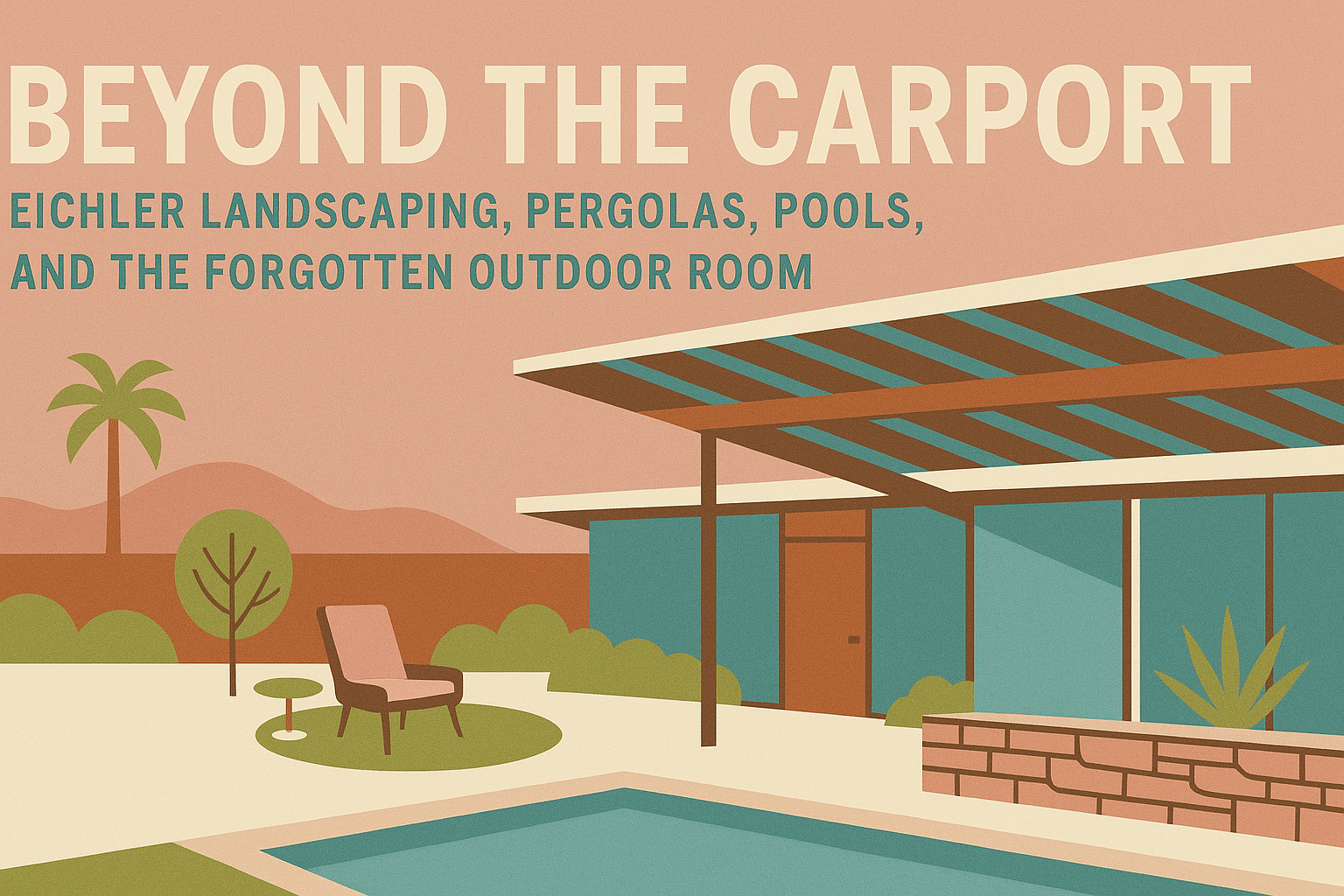
Beyond the Carport: Eichler Landscaping, Pergolas, Pools, and the Forgotten Outdoor Room
Introduction: Mid-Century Dreams Move Outdoors
Joseph Eichler’s modernist homes are famed for their clean lines, glass walls, and iconic carports – but equally important is what lies beyond the carport. From atrium courtyards to backyard patios, Eichler envisioned the outdoors as an extension of the home, a “forgotten outdoor room” waiting to be rediscovered. In the 1950s and ’60s, Eichler’s Silicon Valley developments (in Palo Alto, Sunnyvale, Mountain View, San Jose and beyond) championed indoor-outdoor living as a way of life. Advertisements promised buyers “usable living space, inside and out” eichlerhomesforsale.com, and model homes displayed seamless transitions between glass-walled interiors and private gardens. This blog journey delves into Eichler’s landscaping and hardscaping philosophy – from original planting plans, privacy screens and pergolas, to pools, breezeways and that revolutionary atrium. We’ll explore how architects and landscape designers shaped Eichler backyards, how mid-century California climate influenced plant choices, and how Eichler owners then and now have treated their outdoor domains. In short, we venture beyond the carport to celebrate the patios, courtyards and pools that made the Eichler lifestyle shine.
The Outdoor Room: Eichler’s Indoor-Outdoor Vision
Eichler homes were pioneers of “indoor-outdoor harmony,” blurring the line between house and garden. Eichler’s architects (like Anshen & Allen, Jones & Emmons, and Claude Oakland) oriented major living spaces toward the yard, often leaving street facades nearly blank eichlerhomesforsale.com. Floor-to-ceiling windows and sliding glass doors in every room invited the sunlight and green vistas of California inside kqed.orgkqed.org. Eichler advertisements in the 1960s famously showed families enjoying “rooms and patios as one living space”, with open-plan interiors flowing into landscaped courtyards eichlerhomesforsale.com. One Sacramento tract even branded its model the “Eichler Atrium”, boasting that owners could live “Al Fresco All Year” eichlerhomesforsale.com. The message was clear: in an Eichler, your yard was not just a yard – it was an extra room for living, playing, and entertaining. In fact, Sunset Magazine frequently featured Eichler homes as exemplars of “modern living” in the West paloaltoonline.com, inspiring a generation to treat patios and gardens as functional extensions of the home. As one Eichler designer put it, the signature atrium “created a private outdoor room that not only brought light and nature into the center of the home, but also improved the entry sequence – a visitor passes through a garden before even reaching the front door”eichlerhomesforsale.com. This concept of the outdoor room – whether an open-air atrium, a covered breezeway, or a backyard terrace – is at the heart of Eichler’s design legacy.
Atriums and Courtyards: Bringing Light, Air and Privacy
Perhaps the most emblematic of Eichler’s “outdoor rooms” is the atrium. Enclosed on four sides by the house but open to the sky, an atrium serves as a casual patio or formal garden at the very center of the homecac.edu.ge. Early Eichlers in the 1950s experimented with U-shaped or L-shaped layouts that wrapped around fenced front patios, effectively creating a courtyard at the entry eichlerhomesforsale.com. By 1958, architect A. Quincy Jones introduced a fully enclosed atrium in Eichler models – a bold move that initially made Eichler nervous about a house that “looked like a blank wall to the street” eichlerhomesforsale.com. Homebuyers, however, loved it. The atrium became “the focal point of family life”, a dramatic open-air foyer and “heart of the home” in many Eichler tracts eichlerhomesforsale.com. In Silicon Valley neighborhoods like Palo Alto’s Greenmeadow and Los Arboles, or San Jose’s Fairglen, atrium models proliferated, giving each homeowner a private slice of outdoors that was central to daily livingeichlerhomesforsale.com
Stepping into an Eichler atrium is like entering an outdoor living room. Planter boxes with lush shrubs often line the perimeter, while the middle is typically paved for seating cac.edu.ge. Many owners furnish these spaces with lounge chairs or even dining sets, treating them as an extra social hub “under the sky”eichlerhomesforsale.com. Interiors open directly onto the atrium through floor-to-ceiling glass, so that even when you’re indoors you enjoy views of plants and open air eichlerhomesforsale.comeichlerhomesforsale.com. The benefits are both practical and aesthetic. The atrium floods the home with natural light and ventilation – warm sun in winter and a cooling breeze in summer eveningseichlerhomesforsale.com. In fact, as one California owner observed, “the atrium is built for the valley, as it gets us that indoor-outdoor feel without scorching us with the heat” eichlerhomesforsale.com. Because Eichler street fronts tend to be windowless or guarded by screens, the atrium also ensures total privacy – your living room faces trees and sky, not the neighbors’ windows eichlerhomesforsale.com. Eichler’s atrium thus achieves a trifecta of mid-century design goals: air, light, and privacy in one elegant move. No wonder it’s often called the signature Eichler feature – a literal open-air room at the center of modern family life.
A lush atrium in a remodeled Sunnyvale Eichler, with a crape myrtle tree (dating to the home’s original 1962 construction) as a focal point. The atrium acts as an open-air living room, exemplifying Eichler’s indoor-outdoor philosophy dwell.com.
Landscaping the Eichler Way: Modernist Gardens for California
While the architecture grabbed headlines, Eichler’s developments also came with a distinctive landscape ethos. Original landscaping in mid-century Eichler tracts was often minimal and modern. Developers typically provided a simple front lawn accented by a few shrubs or young trees historicdenver.org. This sparse approach put emphasis on the house’s lines – “the landscaping should never obscure the house”, advise mid-century design guides historicdenver.org. Instead of ornate flowerbeds, Eichler yards embraced geometric simplicity: low planters, rock or brick edging, and open sightlines. Notably, many Eichler homes show a subtle Asian influence in their gardens, reflecting the mid-century fascination with Japanese design. Contemporary observers note that “cloud-pruned” (bonsai-like) shrubs, dwarf pines, Nandina (heavenly bamboo), and junipers were popular plant choices that “seem to look right with Eichlers”pieceofeden.blogspot.com. This East-West fusion made sense – Japanese gardens prized simplicity and structure over gaudy blooms, echoing Eichler’s own minimalist aesthetic.
Crucially, Eichler landscaping was tailored to California’s climate and lifestyle. The mild Mediterranean climate allowed outdoor living year-round, so features like broad eaves and trellises were incorporated to mediate sun and shade. Many Eichler models included pergolas or lattice trellises over patios and atriums, extending the roofline in slatted patterns to let in dapples of light while cutting glare. Drought tolerance was not the buzzword it is today, but even in the ’50s designers favored hardy plants that could thrive in the dry summer months. Original plant lists often featured tough evergreen shrubs and groundcovers (juniper, ivy, oleander, etc.), as well as deciduous trees placed to maximize summer shade and winter sun. A signature material was redwood: fences, screens, and even decks were commonly built of California redwood, which resists rot and blends with the natural surroundings. Famed Bay Area landscape architect Thomas Church – a contemporary influence on the Eichler era – pioneered the concept that outdoor living areas (like redwood decks, paved terraces, and sand patios) were as important as the plants themselves eichlernetwork.com. He “invented the idea that landscape gardening was not necessarily about just plants,” focusing on creating usable outdoor spaces archive.org. Eichler’s outdoor spaces followed this philosophy, using materials like redwood, concrete, brick, and aggregate to shape garden rooms for people. Large sections of Eichler yards might be paved or decked to form play courts, outdoor dining areas, or simply to “create usable spots for living outside” eichlernetwork.com – a marked contrast to traditional lawns.
Defining Features: Privacy Screens, Pergolas, and Planter Walls
Look closely at an Eichler exterior and you’ll notice several unique hardscape features devised to integrate house and landscape. One is the privacy screen – often a slatted wood or translucent glass screen near the entry or around the carport. These screens are strategically placed to shield the interior from public view while still allowing light and airflow. For example, some models used Mistlite obscure glass panels on the street-facing side of the atrium, creating a glowing wall that lets in daylight but blocks prying eyessocalmodern.com. Others used vertical redwood slats as fencing or freestanding panels to achieve a similar effect. These partitions turn the front yard or side yard into a semi-private courtyard, so that by the time you reach the front door you’ve already passed through a filtered outdoor space. It’s an approach that feels both open and sheltered – a hallmark of Eichler’s design. In mid-century marketing, Eichler’s team played up this idea, inviting homeowners to enjoy “private garden patios [as] a visual part of each major room” and an “open-to-the-sky inner courtyard” flooding the home with light – quotes from a 1959 Eichler brochure that emphasized privacy and openness in one breath eichlerhomesforsale.com.
Another signature element is the use of planter walls and built-in planters. Many Eichler models include low concrete or brick planter boxes along the entry walkway or inside the atrium. These planters blur the line of indoors and outdoors – sometimes they even straddle that line, with half a planter inside the glass and half outside. An indoor planter in the living room might align with an outdoor planter in the patio, creating one continuous ribbon of greenery through a glass wall. Similarly, Eichler patios often had perimeter planter walls that defined outdoor “rooms.” For instance, a low planter might separate a dining terrace from a play lawn, or outline a breezeway connecting the carport to the backyard. The breezeway itself – essentially a covered outdoor hallway – is another feature in some Eichlers (especially early models without atriums). These open-air corridors, shaded by the roof extension, provide a transitional space where you might find a built-in bench or planter. Functionally, breezeways funnel cooling breezes (hence the name) while giving homeowners a chance to experience the outdoors in motion – walking from front to back door under the sky. In Eichler’s Fairglen tract in San Jose, for example, one can spot homes where the carport roof extends to cover an entry breezeway lined with a wooden screen and planters, creating an outdoor foyer before you even reach the true front door. All of these features – screens, planters, pergolas, breezeways – serve to articulate space in the garden as thoughtfully as inside the house. They carve the outdoors into functional zones: an open atrium for gathering, a shaded patio for dining, a secluded corner behind a screen for private relaxation, etc. Modernism’s love of geometry is evident in these elements, turning the yard into a series of interlocking rectangles and courts that complement the architecture.
Pools, Patios, and Mid-Century Leisure in the Backyard
By the 1960s, the backyard pool had become an aspirational symbol of California living – and Eichler neighborhoods were no exception. Many Eichler developments offered community pools or encouraged private pool installation as families sought their own suburban oasis. In Palo Alto’s Greenmeadow – an Eichler tract begun in 1954 – Eichler included a community center with a large pool and park for residentseichlerhomesforsale.com. This not only provided a recreation hub but also reinforced the idea of communal outdoor space enhancing the neighborhood. Private pools popped up in Eichler backyards as well, especially as tract houses moved into the more affluent 1960s. The typical Eichler pool was often kidney-shaped, a popular mid-century design that echoed the freeform, organic aesthetic of the era (and perhaps the influence of Thomas Church’s famous kidney-bean shaped pool design in the Donnell Garden). These pools were usually set in a concrete patio area directly accessible from the living room or family room. An Eichler house with its sliding glass doors could literally open the living area straight onto the pool deck – the ultimate indoor-outdoor entertainment setup for summer BBQs and pool parties. Period photos and accounts celebrate how “every room has access to the outside” in Eichlers kqed.org, often with the backyard swimming pool as the sparkling focal point just steps away. Breezeways and covered patios adjacent to pools offered shaded seating for watching the kids swim or enjoying a drink after a dip. In design terms, pools became a key hardscape feature – essentially a reflecting pond you could swim in – adding visual coolness to the hot California afternoons and literally embodying the postwar leisure lifestyle.
Beyond pools, the patio itself was an essential piece of the Eichler yard. Typically finished in concrete (sometimes with a pebble aggregate for texture), the patio anchored the outdoor room concept. It was often placed right outside the main living spaces, furnished with patio chairs, a Sunbrella umbrella, or even built-in barbecue pits in some models. One Eichler listing from Southern California describes a “large and private backyard with sparkling pool, lawn, dining/patio area, and lush tropical landscaping” socalmodern.coms – painting a picture of how these elements combined to create a personal resort. The cultural significance of these backyard spaces in mid-century design cannot be overstated. In an era defined by optimism and newfound prosperity, having a modern house with glass walls onto a backyard patio (and maybe a pool) symbolized “the Good Life” for middle-class families. It was California’s answer to the American Dream: not a white picket fence and rocking chair on the porch, but a breezeblock screen and an Eames lounge chair by the pool. Magazines like Sunset ran features on “patio living” and “garden pools”, often using Eichler or Eichler-like homes as the backdrop for how contemporary families could live outdoors.
And what about the more everyday touches? Eichler backyards also commonly included concrete stepping pads or aggregate walkways, linking different zones (say, from the atrium to the garden, or from the back door to the side gate) with clean lines. Outdoor lighting was modest – globe lights or simple downlights under the eaves to softly illuminate patios without spoiling the night. Many Eichlers had low wooden fences (often of redwood) enclosing the back and side yards to ensure privacy and a uniform look. These fences were usually horizontal boards or board-and-batten, complementing the house siding. They defined the boundary of the outdoor room like walls, but at a human scale. Planter walls we mentioned also doubled as seating in some cases – a kid could perch on the edge of a concrete planter during a family gathering, effectively making it a bench. In sum, Eichler’s outdoor spaces were crafted with the same care as the interiors, balancing utility and beauty. They provided not just a backdrop of greenery, but an active setting for the mid-century lifestyle – whether that meant a quiet afternoon reading under the patio trellis, a neighborhood pool party, or simply hanging laundry to dry in the sun (yes, even chores were considered in the design, with side yards often including screened service areas). Eichler had truly reimagined the backyard as a vital living area, not just a leftover lot behind the house.
Case Studies: Eichler Neighborhoods in Silicon Valley
Silicon Valley is dotted with Eichler enclaves, each with its own story of architecture and landscape. Let’s look at a few notable examples that highlight Eichler’s outdoor design principles:
Greenmeadow (Palo Alto) – Developed in the early 1950s, Greenmeadow remains a showcase of Eichler’s community-centric planning. Its wide streets and consistent rows of modern homes are complemented by mature trees and a neighborhood park. Eichler deliberately included a community center with a swimming pool and playground here, so families could gather outdoors and kids could safely play and swim eichlerhomesforsale.com. The presence of a shared pool was relatively novel for a tract development, underscoring the importance of leisure and outdoor recreation. Greenmeadow’s individual homes each have their own private yards as well, but pride was taken in the collective landscape – maintained front lawns, street trees, and low fences creating an open, park-like feel. Today Greenmeadow is a historic district, and many residents strive to preserve the original mid-century landscaping vibe (with updated drought-tolerant plants now). Walking through, you’ll see original Eichler planter boxes and brick retaining walls still in place, as well as sympathetic new plantings that respect the low, linear aesthetic of the homes.
Fairmeadow (Palo Alto) – Nicknamed “The Circles” for its unique concentric circular street plan, Fairmeadow exemplifies how site design influenced the outdoor spaces eichlerhomesforsale.com. Built in the late 1950s, Fairmeadow’s looping streets slow down traffic and create interior cul-de-sac islands, effectively turning front yards into communal greens where children can wander safely. This layout fostered “communal interaction through design” eichlerhomesforsale.com – neighbors see each other out front, talk over low fences, and share the visual continuity of the circular landscape. Fairmeadow Eichler homes themselves boast expansive atriums and large windows opening to back patios eichlerhomesforsale.com. The circular lot shape meant some backyards fan out wide, providing ample room for gardens or pools. Oral histories note that many Fairmeadow families planted fruit trees in back (taking advantage of Palo Alto’s mild climate – oranges, plums, apricots) and kept the front minimal per Eichler’s intent. The result was an enclave where modern architecture met suburban garden suburb. Even today, Fairmeadow’s quiet, curving streets with their original model homes feel like a mid-century time capsule: low-slung roofs, globe porch lights, and kids playing in the “circle” under watch of parents lounging in front patios.
Fairglen (San Jose) – Built in the early 1960s in San Jose’s Willow Glen area, the Fairglen additions tract features 218 Eichler homes and a proud sense of identity. Fairglen’s lots are a bit larger on average than some earlier Palo Alto tracts, which allowed many homeowners to install backyard pools and expanded patios over time. A look at Fairglen today finds a mix of preserved vintage yards and updated landscapes. Some homes still flaunt their original “private garden patios” visible through the living room glass, complete with mid-century brick planters and aggregate concrete slabs. In fact, a 1959 Eichler brochure for the Fairglen models touted how “private garden patios are a visual part of each major room” and “open-to-the-sky courtyards flood your home with light and beauty” – a direct appeal to buyers who wanted that indoor-outdoor wow factor. Fairglen’s street layout is more conventional grid, but the neighborhood stands out for its consistent redwood fences and carport screens that maintain privacy between neighbors while preserving a low profile. The community today has an active Eichler homeowners’ network; they’ve even hosted home tours highlighting both restored interiors and gardens. Fairglen yards show the range of what Eichler owners do: some have embraced tropical themes with palms and hibiscus around a remodeled pool, others have Japanese-inspired zen gardens with raked gravel, and some stick close to the 1960s look with neatly trimmed shrubs and a lawn. It’s a living laboratory of Eichler landscape evolution within one tract. What unites them is an appreciation that the backyard is as important as the front façade – drive through Fairglen and you’ll notice most houses reveal little to the street (aside from maybe a small atrium peek or a tasteful entry planting), yet behind those fences lie vibrant outdoor living spaces.
Other Silicon Valley Eichlers – Throughout Sunnyvale, Mountain View, and Cupertino, smaller clusters of Eichlers dot the map, each reflecting similar principles. Sunnyvale’s Fairbrae Eichler neighborhood, for instance, not only had Eichler homes but also lent its name to the Fairbrae Swim & Racquet Club – another case of a developer including a pool/club for residents. Mountain View’s Monta Loma neighborhood mixes Eichlers with other mid-century homes; there, many Eichler owners have worked with landscape designers to modernize their yards while complementing the retro architecture. Common improvements include replacing thirsty lawns with decomposed granite or gravel, accented by sculptural succulents and grasses that maintain a mid-century vibe but with far less water. As these homes age, original redwood trees planted in the 50s tower higher and sometimes pose challenges (beautiful shade, but roots invading patios). In response, some owners plant new drought-tolerant trees like crape myrtles (which, as noted in one Sunnyvale remodel, can survive from the original build and still grace an atrium decades later) dwell.com. Across these neighborhoods, one sees a dialogue between preservation and adaptation – an effort to keep Eichler’s “Western living” spirit alive even as plant palettes and lifestyles change.
Evolving Trends: Preservation vs. Reimagining Eichler Landscapes
Seventy years on, Eichler’s outdoor spaces continue to evolve. Modern Eichler homeowners fall roughly into two camps: those who preserve and restore the mid-century look, and those who reimagine the landscape in contemporary terms (ideally without losing the Eichler spirit). On the preservation side, enthusiasts strive to replicate original elements – refurbishing redwood pergolas, reconstructing planter boxes, and even replanting vintage species. It’s not uncommon for an owner to scour period resources to find, say, the right cultivar of juniper or to rebuild a breezeblock screen in the exact 1960 pattern. Communities like Greenmeadow and Green Gables in Palo Alto, which are on the National Register, encourage era-appropriate landscaping to match the historic architecture. The City of Palo Alto has even published Eichler Design Guidelines emphasizing how “landscape tenets for Eichler properties” should maintain open front yards, low planting, and integration with the house design (reinforcing that outdoor “rooms” remain visually connected to the street and the home). Preservation-minded owners often favor “modern landscapes with simple and textured plantings” or subtle Asian-influenced gardens, noting that many overgrown 1950s bushes need replacement after 60+ years historicdenver.org. The key is to ensure new landscaping “enhances the connection between inside and outside” and doesn’t overwhelm the architecture historicdenver.org. In practical terms, that might mean keeping plant heights low under window level, using linear rows or grids of plants to mirror the module of the post-and-beam structure, and choosing foliage colors that complement Eichler’s palette of natural wood, white, and earth-toned brick.
On the other hand, many Eichler dwellers are innovating within their outdoor spaces to suit 21st-century tastes. Sustainable gardening is a big driver: expansive lawns have given way to water-wise gardens with drip irrigation and native plants. One Eichler listing proudly noted “drought tolerant plants and landscaping at front yard, recently installed” as a selling feature socalmodern.com. In California’s climate-challenged future, this trend is here to stay. Yards are being designed to require less maintenance and less water, yet still evoke a modern vibe. Landscape designers experienced with Eichlers, like Beth Mullins of San Francisco, relish the challenge of balancing old and new. Mullins, who redesigned a San Mateo Eichler garden, said “Eichler renovations run the gamut, some ‘honoring the Eichler intent’ more than others… It is a nice challenge to update but still stay true to the origins of the house.” gardenista.com. For that project, she created a “low-water, low-maintenance landscape that would do justice to the master developer of California style”gardenista.com – in other words, an eco-friendly garden that still felt Eichler-esque. The result blended Mid-century Modern geometry (gridded concrete pads, structured plant beds) with contemporary touches like a vegetable patch and a fire pit. This mix and match approach is increasingly popular: owners add features like outdoor kitchens, sleek modern decks, or artistic landscaping that weren’t in the original plans, but they attempt to do it in a way that complements the Eichler architecture rather than fights it. For example, a new ipe wood deck might echo the module of the house and extend in a straight line from the living room, as if it was always meant to be there. Or drought-tolerant grasses might be planted in a row along the famous Eichler glass walls, providing a soft privacy screen that sways in the breeze much like original shrubs did.
One area of intense debate in Eichler circles is the atrium cover. Some modern owners opt to cover the open atrium with a retractable glass roof or a fixed skylight, effectively turning it into a solarium. This yields more interior space and weather protection – but purists argue it destroys the very soul of the Eichler design. Ask an Eichler enthusiast about covering an atrium and you’ll start a heated debate, as one observer wryly notedyoutube.com. Indeed, the Eichler Network reports many dozens of atrium cover installations in recent years, often custom-built to be as discreet as possible eichlernetwork.com. Owners with covers claim they “can hardly tell it is there” when opened eichlernetwork.com, while opponents lament the loss of open sky. This conflict encapsulates the broader theme of how far one should go in updating an Eichler’s outdoor room for modern convenience. There’s no single answer – it boils down to personal lifestyle and values. Some people crave the authentic open-air atrium with the risk of leaves blowing in, others prioritize an extra 200 sq ft of all-weather living area. What’s encouraging is that even those who modify these spaces often do so thoughtfully, trying to honor Eichler’s intent in spirit. For instance, an owner might add a hot tub in the atrium (decidedly not 1950s original), but they keep surrounding it with plants and ensure the tub’s profile is low so it still feels like a garden court.
In recent years, mid-century revivalism has inspired even those without strict preservation goals to at least borrow from Eichler-era style. Breeze blocks are in vogue again – a few Eichler remodels have added breeze-block privacy walls to patios where none existed, purely because it looks cool and retro (and it does provide function). Homeowners are painting their block walls in fun pastel colors as a nod to the period. Original Eichler “globe” lights for exteriors are being reproduced, so people restoring an Eichler can once again hang a white globe lamp at the entry or atrium and instantly evoke 1962. The furniture and decor of outdoor spaces is also part of this evolution: it’s not unusual to see a pair of vintage Russell Woodard wire chairs or a retro butterfly chair sitting out on an Eichler patio now – pieces that may or may not have been there originally but certainly fit the time and spirit.
Ultimately, today’s Eichler owners often strive for what Mullins described: “update but still stay true”. The best modern Eichler landscapes tend to follow a few principles: respect the horizontal lines, keep the palette of materials simple (concrete, wood, gravel, greenery), emphasize year-round usability (shade in summer, sun in winter, outdoor heaters or covers as needed), and maintain that critical visual connection from inside to out. As long as the view from the living room still showcases a bit of nature and sky – as Eichler intended – the outdoor room is doing its job.
Conclusion: The Legacy of Eichler’s Backyard Modernism
Joseph Eichler’s Silicon Valley homes did more than house families – they invited a new way of living that centered on the interaction between indoors and outdoors. In an Eichler, the backyard wasn’t an afterthought; it was integral to the architecture’s function and joy. The patios, atriums, pergolas, and pools formed a stage for the California modern lifestyle – casual, healthful, community-oriented, and in tune with the climate. Eichler once marketed that his designs offered “more usable living space, inside and out” and that ethos has proven prescient eichlerhomesforsale.com. Today, as we grapple with making our homes more liveable and sustainable, the Eichler model of blurring indoor and outdoor space feels as relevant as ever. Contemporary architects designing new homes in Silicon Valley and beyond still cite Eichler’s atrium concept and open plans as inspiration. Terms like “outdoor living room” and “bringing the outside in” – now clichés of real estate listings – were trail-blazed by Eichler and his team in the mid-20th century.
The cultural significance of Eichler’s outdoor rooms also lives on in the collective imagination. Think of how many movies, TV shows, and ads have used a mid-century modern home with a sparkling pool or a cool patio to signify chic, easy living. (The Eichler look was even chosen for the Parr family’s house in Pixar’s The Incredibles, to capture that quintessential California cool kqed.org.) Eichler’s landscapes contributed to defining the American suburban ideal for a time – one where kids would cannonball into pools and parents would sip cocktails on the patio amid twinkling tiki torches. It was optimistic, it was fun, and it was markedly different from the generation before (who often fenced off yards or treated them as utilitarian space for victory gardens or clotheslines).
“Beyond the carport” lies an entire philosophy of living that Eichler helped mainstream: one that says a home extends to the boundaries of your lot, not just your walls. Your garden is not just decoration but an active part of your daily experience – a place to relax, entertain, play, and make memories. Eichler understood this, and he worked with talented architects and even landscape consultants to ensure the outside matched the inside in importance. Progressive landscape architects like Doug Baylis and Maggie Baylis collaborated on projects like the 1955 Eichler X-100 steel house, creating innovative gardens that were as modern as the home itselfasla-ncc.org. That tradition continues with homeowners and designers today who treasure these homes.
In the end, the story of Eichler landscaping in Silicon Valley is one of continuity and change. The materials and plant species might evolve, but the core idea of indoor-outdoor living endures. Every time a family opens a wall of sliding glass and steps onto their Eichler patio – whether to enjoy a quiet morning coffee among the ferns or to host friends for a weekend barbecue – they are participating in Joseph Eichler’s grand experiment of modern living. They are proving that the forgotten outdoor room was never really forgotten, just waiting for us to appreciate it anew. So here’s to the atriums filled with sunlight, the breezeways and pergolas casting artistic shadows, the pools gleaming in the afternoon sun, and the humble planter boxes bursting with life – the timeless accompaniments to Eichler’s architectural symphony, still playing a vibrant tune of California modernism in the great outdoors.
Mid-century modern curb appeal in an Eichler home. A low-slung roof and broad carport are paired with complementary landscaping – note the breeze-block atrium wall and bright door for privacy and pop, the palms and agaves evoking a California vibe, and the open lawn and gravel that keep the facade clean and uncluttered. This simple, geometric approach to the front yard allows Eichler’s architecture to take center stage socalmodern.com.
Sources: Architectural and historical details have been drawn from Eichler’s own marketing brochures and expert analyses. Eichler’s ads in the 1960s celebrated “major rooms open toward the backyard” and “rooms and patios as one living space” eichlerhomesforsale.com. Palo Alto’s Eichler design guidelines and historical essays reinforce the concept of outdoor “rooms” tailored to climate and community eichlerhomesforsale.com. Contemporary reflections and renovations (KQED, Eichler Network, Atomic Ranch, Dwell) provide insight into the lasting impact and adaptation of Eichler’s landscaping ideals in today’s contextkqed.orggardenista.com. The legacy of Eichler’s outdoor room – from Greenmeadow’s pool to Fairmeadow’s circles – continues to thrive in Silicon Valley, marrying mid-century modern design with California outdoor living.
Sources